IN hrM practIcES? a cluStEr aNalySIS
of thE hIgh-pErforMaNcE paradIgM
acroSS 31 couNtrIES
pedro ferreira
[email protected] faculty of business and Economics, Lusiada University, famalicão, portugal
abstract: Is there a European convergence in hrM practices? a cluster
analysis of the high-performance paradigm across 31 countries
the High-Performance paradigm can be seen as a set of new forms of work organization combined with flexible hr practices that enhance organizational performance through employee involvement and empowerment. with roots in the american hr tradition, there is an ongoing debate on its universal applicability between what has been called the universalist and the contigent perspectives.
based on this debate, the main goal of this paper is to test if there is a general approach to the high-performance paradigm, common to all European countries or if it is possible to find different profiles of high-performance practices within Europe.
The results show that there is not a single bundle that reflects one “system” of work and Hr practices. cluster analysis revealed three clusters and the distribution of countries by clusters shows a distinct geographical pattern: south-west Europe, south-Eastern Europe and northern Europe, the latter being more close to the high-performance paradigm.
Key-words: high-performance work practices; employee involvement;
europe; cluster analysis; principal components analysis
Introduction
The increasing global competition and the demand for innovative approaches to management, capable of coping with economic challenges, has turned researchers and practitioners to the resources that can add real value to companies and national economies. Within this framework, Human resources Management (hrM) has been viewed in the last decades as a serious competitive advantage capable of create differentiation while contributing to organizational overall performance. In the recent years, a growing body of research goes even further and argues the strategic value of human capital to organizations’ performance and success.
according to this idea, human resources are a vital asset for organizations’ competitiveness. This assumption is well stressed by the strategic human
resources management perspective. although this is not a new idea, an approach has recently emerged while keeping the same concerns. With roots in the american tradition of hrM, this perspective argues that employee involvement is critical for organizational performance. according to this argument the high-Performance paradigm (Godard, 2004) has been developed as “systems of managerial practices that increase the empowerment of employees and enhance the skills and incentives that enable and motivate them to take advantage of this greater empowerment” (Boxall and Macky, 2007, p. 262).
despite the growing body of literature on the subject, several discussions remain. The large majority of studies are confined to one or few companies or employees of one country (Kuvaas and Dysvik, 2010; ollo-Lopez, Bayo-Moriones and Larraza-Kintana, 2010; Wei and Lau, 2010), companies or employees of an activity sector (tsai, 2006; Harley, allen and sargent, 2007; tapia, correa and Guthrie, 2009; samGnanakkan, 2010), or at best large samples of one country or a few countries (Zatzick and iverson, 2006; Yalabik, chen, Lawler and Kim, 2008; Haines, Jalette and Larose, 2010; richardson, Danford, Pulignano, and stewart, 2010). the comparative perspective, especially with large samples of several countries, is not very common with the exception of few studies (ignjatovic and svetlik, 2003; nikandrou, apospori and Papalexandris, 2005; apospori, nikandrou, Brewster and Paplexandris, 2008; stavrou, Brewster and charalambous, 2010).
taking into account these gaps in the literature, specially the lack of studies based on larger contexts, the main goal of this paper is to test if there is a general approach to the high-performance paradigm, common to all European countries or, on the contrary, if it is possible to find different profiles of high-performance practices within Europe.
The structure of the paper is as follows: first, the main theoretical assumptions are presented, followed by the methodological guidelines, namely the description of the database, variables and statistical procedures. Then we move to the analysis, focusing on the results of the cluster analysis, followed by the conclusions.
the high-performance paradigm
the High-Performance paradigm can be seen as a set of new forms of work organization combined with flexible hr practices that enhance organizational performance through employee involvement and empowerment. It has been gaining popularity over the last two decades, which, according to the researchers, is an outcome of an anti-Taylorist wave and the growing desire of western companies to match the competitions from upcoming countries like china and Japan, who already showed remarkable cost-control in their production processes (Boxall and Macky, 2007, 2009; cappelli and neumark, 2001).
The diversity of approaches and the emphasis on different aspects gave rise to different expression to designate the high-performance paradigm, such as holistic work models (Lindbeck and snower, 2000), high performance work systems (applebaum and Batt, 1994; tomer, 2001), high involvement management (Lawler, 1986) or high-commitment employment practices (Walton, 1985). nevertheless, its central aim remains the same, i.e., to increase empowerment of the employees, enhance their skills, arranging appropriate incentives, inventing ways to keep them motivated and eventually create a powerful, dedicated workforce that would keep on matching with organizational, market and social requirements (applebaum, Bailey, Berg and Kalleberg, 2000; Boxall and Macky, 2007, Gollan, 2005; Lawler, 2005).
one of the first systematization of high-performance work systems was made by Lawler (1986). His main concern was the need for high-involvement as means to generate positive results for companies and employees. The theoretical landmark of his thinking was the participative approaches to management, namely quality circles, employee survey feedback, job enrichment, work teams, and gain sharing. although his main focus was on involvement of employees as a mean to promote better working conditions, but also enhanced performance, in doing so he also ends up proposing a set of Hr and work practices that pervade other areas of management. Moreover, when he proposes a high-involvement management, he also calls the attention to the performance benefits that they can bring to the organization.
Lawler (1986) proposes a theoretical framework for the implementation of high-involvement management based on four principles: information, power, knowledge and rewards. He underlies that most of the practices associated with participative management are not new, and indeed have some positive influence on those principles. nevertheless, the result of a more complete and congruent implementation of a participative management approach leads to jointly maximizes the involvement of employees and organizational effectiveness. Individual practices must fit together and should affect everyone in the same way. Thus, Lawler already underlines the importance of internal fit and complementarities between practices as a mean to create congruence and maximize positive externalities.
several years later, Pfeffer (1998) presented his view of this innovative management approach in the well known and widely cited book “the human equation. Building profits by putting people first”. Drawing on various studies, related literature and personal observation, pfeffer points out seven dimensions that, in his opinion, characterize innovative management practices: employment security; selective hiring of new personnel; self-managed teams and decentralization of decision making; comparatively high compensation contingent on organizational performance; extensive training; reduced status distinctions and barriers; extensive sharing of information (financial and performance).
More recently appelbaum et al (2000), pointed three drivers of action, like involvement, training, and incentives. involvement, the first important component of hpws, stems from the idea of providing the employees an increased opportunity to participate in decisions (Barnes, 2001). this becomes possible by sharing information among the members of the organisation. The second component is training which aims to develop the knowledge and skill base of the employees on the subjects that are related to their production processes. The third component of hpws is rewards or Incentives. hpws points at the importance of aligning the goals of the employees with the goal of the organisation by utilizing the reward system. The combination of the above three drivers in a free flowing manner creates an egalitarian work environment that eliminates the status and power differences, and instead becomes a key driver to enhance collaboration and teamwork.
high-performance hr and work organization practices
as several authors have mentioned, there is no consensus on what practices constitute HPWs (Harley, 2002; Kalmi and Kauhanen, 2008; Boxall and Macky, 2009). as Wood’s (1999) review indicates there is an array of definitions and assertions which creates some confusion when approaching the high-Performance paradigm. Despite this apparent lack of consensus, there seems to be some agreement on the purpose of the practices elected. The idea that there is a need to involve employees in order to achieve higher levels of performance doesn’t seem to be in dispute. also, the idea that this involvement should be grounded on a well established skills and information base is also generally accepted. finally, there is a general consensus on the need to implement reward practices in order to correctly direct workers behaviour and compensate their achievements.
the ability of workers to influence their own work and the way the organization works, which Lawler (1986) defined as “power”, is an important principle. High-involvement work practices typically include greater decision-making autonomy on the job, as well as off-line quality circles or other types of problem-solving groups (Boxall and Macky, 2007), often realized through formal teams (Handel and Gittleman, 2004). Decentralized decision making is, according to this perspective, at the heart of every high-performance system, involving the ability to take decisions and participate in decision making in diversified contexts such as teamwork, quality circles, individual and group problem solving and job rotation.
some work practices can foster employee participation and empowerment, such as teamwork or self-managed teams. in the context of teamwork, employees can decide over several aspects concerning the team, solve problems on their own, and also make decisions on aspects that affect team members. teamwork
has thus been widely identified as a crucial high-performance practice (e.g. pil and MacDuffie, 1996; ichniwoski, shaw and Prennushi, 1997; ramsay, scholarios and Harley, 2000; Guthrie, spell and nyamori, 2002; Paul and anantharaman, 2003; Guerrero and Barraud-Didier, 2004; Zacharatos, Barling and iverson, 2005; iverson and Zatzick, 2007; Wood and de Menezes, 2008).
Job tasks in high-involvement workplaces involve greater variety than traditional taylorist arrangements (Handel and Gittleman, 2004). Besides the autonomy and delegation inherent to self-managed teams, job rotation schemes are also a part of this variety. some researchers refer explicitly the expression job rotation (osterman, 2006), meaning “a work system in which employees rotate among different jobs” (Handel and Gittleman, 2004, p. 75); others however include job rotation as an indicator of functional flexibility (ichniwoski, shaw and Prennushi, 1997; Forth and Millward, 2004) or refer to job rotation as “job descriptions that are flexible and not fixed to one specific task” (Bacon and Blyton, 2001: 9). others yet associate job rotation with cross-training practices (which will be dealt later on) and name it cross-utilization (guthrie, spell and nyamori, 2002; Guthrie, Flood, Liu, and Maccurtain, 2009; Liu, Guthrie, Flood and Maccurtain, 2009).
Information is a crucial input to a high-performance system. accoding to Lawler (1986) information enables workers to participate and to decide. Information is the natural complement of empowerment. without information, the power given to employees to participate and make their own decisions could be seriously compromised, because the absence of information impoverishes decisions (Lawler, 1986). on the other hand, information fosters coordination and cooperation, which reinforces the importance of information dissemination to all levels of the hierarchy, which can only be achieved through effective communication.
Information sharing practices are very common in the hpws literature (e.g. Huselid, 1995; Pil and MacDuffie, 1996; ichniwoski, shaw and Prennushi, 1997; Harley, 2002; Zacharatos, Barling and iverson, 2005; Kintana, alonso and olaverri, 2006; Guthrie et al, 2009; tapia, correa and Guthrie, 2009), and can be presented in many forms. general practices of information sharing are widely mentioned such as information disclosure practices (Forth and Millward, 2004; Wood and de Menezes, 2008), general information concerning the organization, information related to compensation, employees’ means of expression, employee marketing, employee attachment (Guerrero and Barraud-Didier, 2004), and relevant operating, financial and strategic performance information (guthrie et al., 2009). consultation is another important form of information sharing; at the same time, it allows employees to participate in the daily life of the organization. ramsay, scholarios and Harley (2000) use consultation as an indicator of high-performance practices, including whether employees were consulted or negotiated with on change, and whether targets (related to budget, cost, profit or productivity) were set in consultation with employees or their representatives.
development appraisal practices are considered a very important moment to provide employees with feedback regarding their job performance, constituting an important form of communication and information sharing. several researchers mention this kind of practices in different ways: performance evaluation (Zheng, Morrison and o’neill, 2006), performance and development appraisal (ramsay, scholarios and Harley, 2000; Macky and Boxall, 2007; Whitener, 2007), formal appraisals (Huselid, 1995; Wu and chaturvedi, 2009), and formal performance feedback (Guthrie et al., 2009).
although the practices seen so far are designed to enhance participation they can also be very demanding for workers. Participation in teamwork, problem solving or job rotation demands knowledge of the tasks to be performed but also of the organization as a whole. Job enrichment and enlargement presupposes that workers have the ability to perform several jobs and tasks, sometimes with diversified content. If information can be considered as the basis of a good decision process, knowledge and skills can be understood as the basis for doing the work well done. according to the literature, organizations can promote the knowledge and skills necessary for any job essentially by two means: recruitment and selection processes and training.
The reference to recruitment and selection processes is not always very specific. several authors make reference to recruiting and selection practices without specifying what those practices are. Training practices are a widely referred indicator of hpws in the literature. following a similar pattern as recruitment and selection practices, skills acquisition is often referred to in general terms as training (Huselid, 1995; Delaney and Huselid, 1996; ichniwoski, shaw and Prennushi, 1997; Fey, Bjorkman and Pavlovskaya, 2000; Paul and anantharaman, 2003; Kintana, alonso and olaverri, 2006; scotti, Harmon and Behson, 2007; camps and Luna-arocas, 2009; tapia, correa and Guthrie, 2009) or skills development (Becker and Huselid, 1998; Guerrero and Barraud-Didier, 2004; tsai, 2006; Zheng, Morrison and o’neill, 2006; Harley, 2002; Yalabik, chen, Lawler and Kim, 2008). also, the amount of training provided to workers is, according to Guthrie, spell & nyamori (2002), an important indicator of the presence and importance given to training practices.
reward practices represent an important support to other practices, because they work at the motivation level, allowing the organizations to influence employees’ behaviour direction and intensity. on the other hand, when organizations implement practices to enhance involvement and participation through power and skills, they may also be creating the expectation of more rewards, especially when employees feel their performance contributed to a more effective organization.
The most referred reward practices in the literature are targeted to the extrinsic level and directly related to performance. This is the case of performance-related pay (Huselid, 1995; Fey, Bjorkman and Pavlovskaya, 2000; ramsay, scholarios and Harley, 2000; Zheng, Morrison and o’neill, 2006; Harley, allen
and sargent, 2007; Macky and Boxall, 2007; scotti, Harmon and Behson, 2007; Wu and chaturvedi, 2009). other type of reward widely referred is employee share ownership (ramsay, scholarios and Harley, 2000; Guthrie, spell and nyamori, 2002; Paul and anantharaman, 2003; Guerrero and Barraud-Didier, 2004), which reveals the intention to involve employees with the organization. finally, another common reward practice in the literature is profit sharing (huselid, 1995; ramsay, scholarios and Harley, 2000; Guthrie, spell and nyamori, 2002; Handel and Gittleman, 2004; Guerrero and Barraud-Didier, 2004). this is also a performance-related reward practice like performance-related pay, but it works at the group/organization level; in other words, it emphasizes the importance of the organization’s performance as a whole.
the contextualist approach to the high-performance paradigm
considering that an important part of the strategy planning is based on the environment of the company, the debate around the universal vs. contingency approach is also applicable to HrM and work organization. in fact, the changes in the environment are an important piece of the strategic thinking and planning. More stable or more dynamic environments produce different effects inside the company. This calls for a contingency approach to management in general and to hrM in particular, meaning that every decision and action should be planned taking into account the characteristics of the surrounding environment.
In the case of high-performance this is reflected in two interpretations. on the one hand, the universal approach reflects the opinion that the high-performance practices should be the same regardless of the characteristics of the company or the environment. on the other hand, the contingency approach argues that the practices should be adapted to the specificities of the company and the environmental demands. as a consequence, the contingency perspective denies the “one best way” or “best practice” approach.
some earlier research (Huselid, 1995) argue that high-performance practices should be part of system and that system should be made of the same practices in order to produce the desired effect. on the other hand, and more recently, others (Brewster, 2004, 2007) advocate the idea that high-performance practices should be implemented taking into account several contingencies posed by internal and external companies’ environment.
while the universalist or “best practice” approach has its roots in the american research tradition (Brewster, 1999), the contextualist or contingent perspective is more common in Europe. The underlying methodological approaches of these competing conceptual perspectives are also different: the universalist perspective looks for Hr practices that are universally applicable and advancements in research and understanding of HrM is deductive; the contextualist approach focus on understanding of differences between and within
the various hrM clusters in various contexts. In this perspective, the mode of inquiry is inductive, mainly exploratory and descriptive (Brewster, Mayrhofer and Morley 2000), searching for an overall understanding of what is contextually unique, focusing this understanding on what is different between and within HrM in various contexts (Brewster, 2007).
another consequence of the universalist/contingency debate is that high-performance practices should be implemented in a combined and integrated fashion. This combination should promote a systemic effect and the combined effects of the practices should surpass their results when implemented in isolation.
according to Boxall (2003), the work systems and employment models seen as supportive of high-performance imply a mix of key practices: more rigorous selection and better training systems to increase ability levels, more comprehensive incentives (such as employee bonuses and internal career ladders) to enhance motivation and participative structures (such as self-managing teams and quality circles) that improve opportunity to contribute (appelbaum et al, 2000). at the same time, there is significant debate about the particular mix of high-performance practices, one of the key arguments running through the literature is that the relevant practices work much better when “bundled” together (ichniowski et al, 1996; MacDuffie, 1995).
This debate goes further on the extent to which management practices work together. For example, Huselid (1995), Huselid and Becker (1996) and more recently Boxall and Macky (2007) argue that management practices can be combined in one single factor. others (arthur, 1992; Kalleberg and Moody, 1994; MacDuffie, 1995; ichniowski et al., 1997; Pil and MacDuffie, 1996; Becker and Huselid, 1998; Delaney and Huselid, 1996; Becker, Huselid, Pickus and spratt, 1997) have also explored the notion of a single effective bundle of HPWs practices. however, there is a difference between those who argue for a contingent perspective, in which those bundles vary according to several contingent factors, such as sector or business strategy, and a universalist perspective, one-style-fits-all view (ramsay et al, 2000). Meanwhile, others (e.g. Wood and de Menezes, 1998) see high-commitment management as a matter of degree, arguing against this package view.
It appears that there is research to support the argument of the high-performance system (in which there is only on bundle), but also the argument of several bundles made of different practices. In fact, this discussion is the extension of the universalist vs. contingent arguments. The universalist approach is more close to the idea of high-performance as a system and, thus, with only one bundle. on the opposite, contingent approach arguing on favour of the need to adjust practices to internal and external fit seems to argue for several bundles of practices.
Methods
the study will be supported in a large sample taken from the 2005 european Working conditions survey (eWcs), promoted by the european Foundation for the improvement of Living and Working conditions (eurofound), involving employees from 31 european countries (27 eu-members, two candidate countries, switzerland and norway), with more than 24.000 participants. the use of such a large sample from 31 european countries is not common, since previous and recent studies used data from no more than 18 (nikandrou, apospori and Papalexandris, 2005) or 21 countries (apospori, Kikandrou, Brewster and Papalexandris, 2008).
once the population of the eWcs is active population aged 15 years and over, the data obtained captures the working conditions of european workers as they are perceived and reported by them. Thus, it should be noted that the information provided compiles workers’ point of view, although several questions are directed to factual information, so that the gap between “reality” and “perceived reality” should be minor; in other cases, the respondents are asked to subjectively evaluate their situation which makes the problem of “reality vs. perception” irrelevant. although arguable, this does not need to be considered as a weakness, because in many cases, is the perception effect that drives behaviours, not reality itself. in fact, Meyer and allen (1997) observed that employees’ perceptions of ‘reality’ are likely to influence their performance more than other formal contingencies. thus, if a worker perceives he/she is unfairly paid, he/she may show dissatisfaction by asking for a raise, try to move to another job or show his/her dissatisfaction through behaviour in any other way.
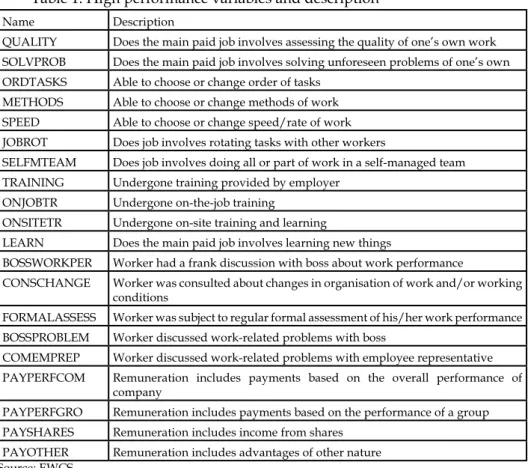
the eWcs 2005 database aggregates information from various subjects relating to working conditions. For the purpose of this analysis, the selected variables refer to work organization and Hr practices based on the studies reviewed in the previous chapter. as it was discussed before, there is no consensus on the specific practices to be included in hpws, although there are a set of practices that are commonly accepted as reflecting the hpws philosophy characterized by early studies (Lawler, 1986; Pfeffer, 1998; appelbaum et al, 2000). among them are self-managed teams, training practices, communication practices and some kind of rewards system. the approach for this analysis was an inclusive one, which is to include all the practices related to hpws covered by the database in order to include the most possible different realities. This is a common path followed by early studies that used large survey databases (ramsay, scholarios and Harley, 2000; Harley, 2002).
table 1: High performance variables and description
name description
qUaLITy Does the main paid job involves assessing the quality of one’s own work soLvprob does the main paid job involves solving unforeseen problems of one’s own ordTasks able to choose or change order of tasks
METhods able to choose or change methods of work spEEd able to choose or change speed/rate of work JobroT Does job involves rotating tasks with other workers
sELfMTEaM Does job involves doing all or part of work in a self-managed team TraInIng Undergone training provided by employer
onJobTr Undergone on-the-job training
onsITETr Undergone on-site training and learning
LEarn does the main paid job involves learning new things
bossworkpEr Worker had a frank discussion with boss about work performance
conschangE Worker was consulted about changes in organisation of work and/or working conditions
forMaLassEss Worker was subject to regular formal assessment of his/her work performance bossprobLEM Worker discussed work-related problems with boss
coMEMprEp Worker discussed work-related problems with employee representative paypErfcoM remuneration includes payments based on the overall performance of
company
paypErfgro remuneration includes payments based on the performance of a group paysharEs remuneration includes income from shares
payoThEr remuneration includes advantages of other nature source: Ewcs
all the variables of work practices used in the analysis are binary (yes/no) and were recoded in order to present the same scale direction. The answers that pointed to the presence of the practice asked in the question were coded as two; the answers that indicated the absence of the practice were coded as one. The only exception is the variable that captures the presence of self-managed teams. according to the literature, the type of teamwork that best expresses the concept of HPWs is self-managed teams (Bacon and Blyton, 2001; Handel and Gittleman, 2004; Kintana, alonso and olaverri, 2006; osterman, 2006; Kalmi and Kauhanen, 2008), because it allows team members to decide over several issues that concern to the team work and its members, which gives them more autonomy. the database doesn’t present any variable that by itself captures this concept. Thus, and following the procedure of Kalmi and Kauhanen (2008), it was necessary to compute a new variable from the questions that asked respondents if their job involved doing all or part of their work in a team and whether or not the team members decided for themselves the division of tasks. if the respondents answered “yes” to both questions, the new variable computed a positive answer
(“yes”=2) to the variable that captures the participation in self-managed teams. all other combinations were computed as negative answers (“no”=1).
In terms of statistical procedures, we used a combination of data reduction techniques. the first reason is the large number of variables used in the description of HPWs, which makes any analysis a challenging task. on the other hand, although past research uses several strategies to measure the hpws latent variable, the most common strategy is dimension reduction to find possible “bundles” of practices (arthur, 1992; Kalleberg and Moody, 1994; Huselid, 1995; MacDuffie, 1995; Delaney and Huselid, 1996; Huselid and Becker, 1996; Pil and MacDuffie, 1996; Becker et al., 1997; ichniowski et al, 1997; Becker & Huselid, 1998). in order to reduce the number of variables to a few, we used Principal components analysis (Pca). However, since we are working with qualitative variables, we used a combination of linear and non-linear Pca, known as Principal components analysis for categorical Data (catPca). after obtaining the transformation of the variables through the optimal quantification procedure, we performed a linear pca.
cluster analysis will be used to explore the assumption of regional similarities in approaching the high-performance paradigm. according to the characteristics of the cluster technique and the methodological framework adopted by recent studies on the subject, the procedure adopted in this study will be based on the combination of hierarchical and non-hierarchical methods. based on the comparison of the hierarchical and non-hierarchical methods, the former is well adjusted to exploratory cluster analysis, that is, when there is no previous number of clusters to be formed. although it could be said that previous literature could inform the number of clusters, the fact is that these studies were based on different data and a different number of countries. since cluster analysis is highly sensible to new information – namely new variables and new cases (or countries in this case) – it is not advisable to use previous research as the basis to define the number of clusters to be extracted. The second step will use non-hierarchical clustering method, based on the number clusters defined by the exploratory cluster analysis. This is a procedure recommended by the literature (Hair, anderson, tatham and Black, 1999) when it comes to choose between the hierarchical and non-hierarchical clustering methods. The analysis uses ward’s method of clustering cases and the Euclidean distance as a measure of dissimilarity.
the data analysis uses sPss (statistics Package for social sciences), version 17, namely the classifying methods (hierarchical cluster and k-means cluster) and the catPca module, version 1.1, developed by the Data theory scaling system group (dTss) from the faculty of social and behavioral sciences of the Leiden university, netherlands (Meulman and Heiser, 2007).
analysis and discussion
The goal of this paper is to test if there is a general approach to the high-performance paradigm, common to all European countries or, on the contrary, if it is possible to find different profiles of high-performance practices within Europe. Before look at the cluster analysis, the analysis starts by reducing the variables, using principal components analysis. after the caTpca, which allowed the variables transformation, the linear pca was performed. The components were extracted and rotated using varimax rotation method. The bartlett test of sphericity does not accept the null hypothesis that the correlation matrix is an identity matrix and the test of Kaiser-Meyer-olkin (KMo) with a value of 0.812, points to the presence of common factors. Thus, these results indicate that the sample is adequate for the principal component analysis.
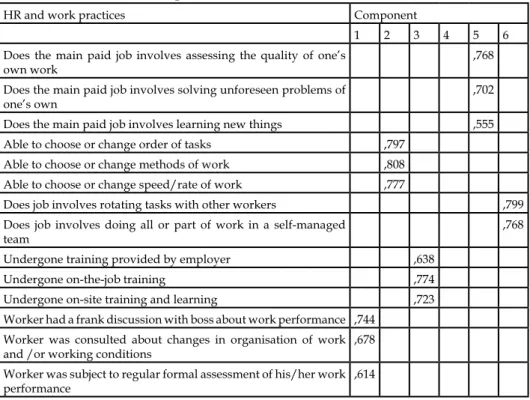
according to the rotated component matrix (table 2), all variables load in six components and the component loadings are above 0,460. the variables loaded in the first component describe the workers practices of communication with the boss, reflecting vertical communication practices; but this component also includes practices of communication between the worker and the employee representative. Thus, this component can be named as “communication”.
The second component loads the variables “able to choose or change order of tasks”, “able to choose or change methods of work” and “able to choose or change speed/rate of work”. these variables reflect presence or absence of control over one’s tasks and job. Following Bauer (2004), Harley, allen and sargent (2007) and ollo-Lopez, Bayo-Moriones and Larraza-Kintana (2010) this component can be named as “individual autonomy”.
The third component loads variables “Undergone training provided by employer”, “Undergone on-the-job training” and “Undergone on-site training and learning”. these variables reflect the training workers have been involved in; thus, this component groups “training” developed by employers.
The fourth component groups the following variables: “remuneration includes payments based on the overall performance of company”, “remuneration includes payments based on the performance of a group”, “remuneration includes income from shares” and “remuneration includes advantages of other nature”. these variables are all related to the presence or absence of rewarding practices; thus, this component groups what can be called “rewards and incentives”.
The fifth component groups variables such as “does the main paid job involves assessing the quality of one’s own work”, “Does the main paid job involves solving unforeseen problems of one’s own” and “does the main paid job involves learning new things”. apparently these variables seem to have little in common: the first is about quality control, the second is about problem solving and the third is about learning new things. however, what underpins them all is the possibility that employees perform tasks beyond their basic function. this was also the idea that Wood and de Menezes (2008) used to define what they
called work enrichment; thus, following this idea this component can be called “job enrichment”.
finally, the sixth component groups two variables reflecting the presence or absence of job rotation (“Does job involves rotating tasks with other workers”) and managed teams (“Does job involves doing all or part of work in a managed team”). one possible explanation for this can be on the nature of self-managed teams. teamwork allows a high degree of autonomy in decision making, distribution of tasks, and in the management of day-to-day teams’ constraints, but also the selection of their leader and decision on the internal division of responsibilities. taking into account that job rotation refers to the possibility of doing several tasks not specific to one job description (Handel and Gittleman, 2004; ichniwoski, shaw and Prennushi, 1997; Forth and Millward, 2004; Bacon and Blyton, 2001), job rotation may be considered an inherent practice of “self-managed teams”.
The results show that there is not a single bundle that reflects one “system” of work and Hr practices. this may question several previous assumptions. for example, the “system” approach in which the practices function as whole, supporting each other in a systemic manner (where the output is greater than the sum of the parts) is not supported by the present results.
table 2: rotated component Matrix
Hr and work practices component
1 2 3 4 5 6
Does the main paid job involves assessing the quality of one’s
own work ,768
does the main paid job involves solving unforeseen problems of
one’s own ,702
does the main paid job involves learning new things ,555 able to choose or change order of tasks ,797
able to choose or change methods of work ,808 able to choose or change speed/rate of work ,777
Does job involves rotating tasks with other workers ,799 Does job involves doing all or part of work in a self-managed
team ,768
Undergone training provided by employer ,638
Undergone on-the-job training ,774
Undergone on-site training and learning ,723 Worker had a frank discussion with boss about work performance ,744
Worker was consulted about changes in organisation of work
and /or working conditions ,678
Worker was subject to regular formal assessment of his/her work
Worker discussed work-related problems with boss ,742 Worker discussed work-related problems with employee
representative ,491
remuneration includes payments based on the overall
performance of company ,745
remuneration includes payments based on the performance of
a group ,699
remuneration includes income from shares ,586 remuneration includes advantages of other nature ,469
principal components analysis allowed reducing the data to just a few significant components, which correspond to bundles of practices. The next step was to perform the cluster analysis which was based on the means of the bundles for each country. the goal was to look for similarities among european countries, sustaining a European approach to the high-performance paradigm. The premise of this analysis, and according previous literature (apospori, nikandroua, Brewster and Papalexandris, 2008; Brewster, 2004; clark and Pugh, 2000; ignjatovíc and svetlik, 2003; Mayrhofe and Brewster, 2005; nikandrou, apospori and Papalexandris, 2005), is that countries have similarities between them, allowing grouping them, taking into account the level of development of different bundles of human resource practices and work organization practices.
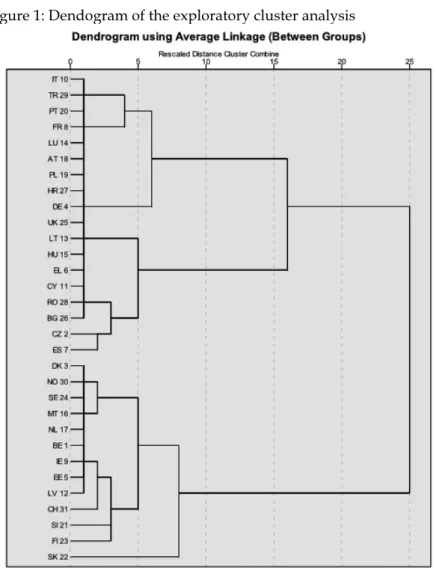
Figure 1: Dendogram of the exploratory cluster analysis
according to the exploratory cluster analysis, the dendogram (Figure 1) makes clear that, although the two clusters solution was possible, the first cluster would have to be divided in two clusters. In further analysis, these two sub-bundles would have to be analytically separated in order to look for differences between them. Thus, the decision is to go for the three clusters solution, which allows the separation from the start.
The next step was to perform the confirmatory cluster analysis, this time using the non-hierarchical clustering method, which calls for the definition of the number of clusters. the k-means cluster analysis was performed with the extraction of three clusters. European countries grouped in the following way (Figure 2):
cluster 1: Germany, spain, France, italy, Luxembourg, austria, Poland, Portugal, croatia and turkey.
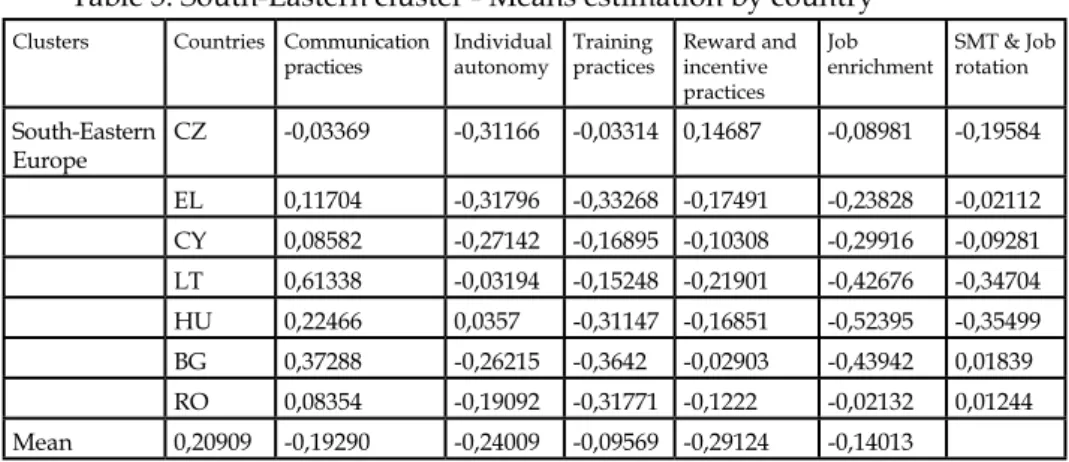
cluster 2: czech republic, Greece, cyprus, Lithuania, Hungary, Bulgaria and romania.
cluster 3: Belgium, Denmark, estonia, ireland, Latvia, Malta, netherlands, slovenia, slovakia, Finland, sweden, united Kingdom, norway and switzerland.
Figure 2: Geographic distribution of High-Performance clusters
The distribution of countries by clusters shows a distinct geographical pattern. cluster 1 (Germany, spain, France, italy, Luxembourg, austria, Poland, Portugal, croatia and turkey) groups countries from the south-western europe, with the exception of turkey. cluster 2 groups countries mostly from the eastern Europe (czech republic, greece, cyprus, Lithuania, hungary, bulgaria and romania), with a predominance of southern-eastern countries. finally, cluster 3 (Belgium, Denmark, estonia, ireland, Latvia, Malta, netherlands, slovenia, slovakia, Finland, sweden, united Kingdom, norway and switzerland) is made of northern countries, with three exceptions: slovenia, slovakia and switzerland. Thus, with only little damage to exact geographical reality, the clusters are named as follows:
(1) cluster 1: south-Western cluster (2) cluster 2: south-eastern cluster (3) cluster 3: northern cluster
The one-way anova shows that the differences between groups are all significant, with the exception of rewards & Incentives. In fact, as was already noted, the level of rewards and incentives practices across all Europe is extremely low, which might help explain this lack of significance.
Figures 3, 4 and 5 present the mean scores organized by geographic clusters. northern Europe is the European region where high-performance is more developed and widespread. In fact, the so called nordic countries (norway, Finland, sweden and Denmark) are included in the northern cluster and score above the average in at least five out of six bundles; moreover, sweden score above the mean (zero score) in all bundles. nonetheless, scores of two countries – slovakia and united Kingdom – are not coincident with the rest of the cluster; although some bundles in these countries score negative, they are close to the mean. in short, all the 14 countries of this cluster score above the mean in almost all bundles – with the nordic countries standing out with more solid scores – this is the region that shows a more developed implementation of high-performance practices.
table 3: northern cluster - Means estimation by country
clusters countries communication
practices Individual autonomy Training practices reward and incentive practices Job enrichment sMT & Job rotation northern Europe bE -0,05144 0,19527 0,27592 0,12479 0,05508 -0,09396 dk 0,05647 0,40671 0,01405 -0,01065 0,37484 0,45392 EE 0,23681 0,07481 0,10306 0,09042 0,16404 -0,02204 IE 0,05794 0,0694 0,138 0,18625 -0,09247 0,03159 Lv 0,23314 0,10005 0,07792 -0,08551 -0,09635 0,11328 MT 0,07054 0,47209 -0,10218 -0,16222 0,14462 0,1363 nL 0,26403 0,14401 -0,18296 0,10075 0,27224 0,20799 sI -0,03051 -0,0435 0,12124 0,3433 0,01648 0,44608 sk -0,09514 -0,119 0,31337 0,65872 -0,4672 -0,04505 fI 0,50351 0,15973 0,58202 0,04921 -0,07541 0,22314 sE 0,17314 0,31271 0,39326 0,10473 0,24377 0,25992 Uk -0,0221 -0,11306 0,34543 -0,17529 -0,03648 0,03396 no 0,14195 0,17996 0,15374 -0,06662 0,39249 0,33383 ch 0,18558 0,18416 0,31948 -0,08591 0,38278 -0,11262 Mean 0,12313 0,14452 0,18231 0,07656 0,09131 0,14045
note: numbers in bold show values above the European mean
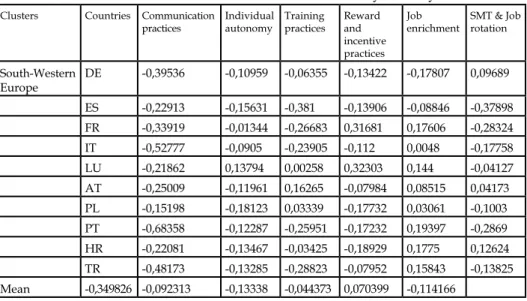
on the opposite, south-western and south-Eastern clusters present the lowest level of implementation of high-performance practices. on the one hand, south-western countries generally score below the mean in all bundles, especially in “communication practices” and “individual autonomy”, but also, although to a lesser extent, in “reward and incentives”, “training practices”
and “sMT & job rotation”. In fact, only “job enrichment” bundle seems to have some implementation in southern-western cluster. on the other hand, the south-Eastern cluster, although scoring below average on almost all bundles, “communication practices” seem to be well implemented, since all countries in this cluster score positive in this bundle, although the overall mean of the cluster is not very high (a little above 0,2 in a range between -1 and 1). in addition, it should be mentioned that “training practices” and “job enrichment” present scores below the mean in all south-Eastern countries.
table 4: south-Western cluster - Means estimation by country
clusters countries communication
practices Individual autonomy Training practices reward and incentive practices
Job
enrichment sMT & Job rotation
south-western Europe dE -0,39536 -0,10959 -0,06355 -0,13422 -0,17807 0,09689 Es -0,22913 -0,15631 -0,381 -0,13906 -0,08846 -0,37898 fr -0,33919 -0,01344 -0,26683 0,31681 0,17606 -0,28324 IT -0,52777 -0,0905 -0,23905 -0,112 0,0048 -0,17758 LU -0,21862 0,13794 0,00258 0,32303 0,144 -0,04127 aT -0,25009 -0,11961 0,16265 -0,07984 0,08515 0,04173 pL -0,15198 -0,18123 0,03339 -0,17732 0,03061 -0,1003 pT -0,68358 -0,12287 -0,25951 -0,17232 0,19397 -0,2869 hr -0,22081 -0,13467 -0,03425 -0,18929 0,1775 0,12624 Tr -0,48173 -0,13285 -0,28823 -0,07952 0,15843 -0,13825 Mean -0,349826 -0,092313 -0,13338 -0,044373 0,070399 -0,114166
note: numbers in bold show values above the European mean
In short, northern Europe cluster present a widespread implementation of nearly all bundles, with the exception of “rewards and incentives” (with a negative score) and sMT & job rotation (with a slightly positive score), and thus is the cluster that is best represents the hpwp model. south-Eastern Europe cluster is mainly characterized by a relatively widespread implementation of “communication practices”, with all other bundles presenting negative scores. finally, the south-western Europe is on the opposite side of northern cluster, since it is characterized be a very low degree of implementation of all hpwp bundles, only with job enrichment slightly above the mean.
Table 5: south-Eastern cluster - Means estimation by country
clusters countries communication
practices Individual autonomy Training practices reward and incentive practices
Job
enrichment sMT & Job rotation
south-Eastern Europe cz -0,03369 -0,31166 -0,03314 0,14687 -0,08981 -0,19584 EL 0,11704 -0,31796 -0,33268 -0,17491 -0,23828 -0,02112 cy 0,08582 -0,27142 -0,16895 -0,10308 -0,29916 -0,09281 LT 0,61338 -0,03194 -0,15248 -0,21901 -0,42676 -0,34704 hU 0,22466 0,0357 -0,31147 -0,16851 -0,52395 -0,35499 bg 0,37288 -0,26215 -0,3642 -0,02903 -0,43942 0,01839 ro 0,08354 -0,19092 -0,31771 -0,1222 -0,02132 0,01244 Mean 0,20909 -0,19290 -0,24009 -0,09569 -0,29124 -0,14013
note: numbers in bold show values above the European mean
briefly, the main conclusion is that there is a great cleavage between northern (especially nordic) and southern (especially Mediterranean) European countries regarding workers’ involvement in HPWP. Moreover, central european countries display a two-fold pattern. while some countries are close to the nordic pattern, others are clearly near the southern countries. finally, Eastern European countries are clearly close to the pattern presented by southern countries.
The analysis reveals that Europe is divided in three main regions – northern, south-western and south-Eastern – but also that the region that more closely is to the high-performance paradigm is the northern, specially the nordic countries, while the southern countries (either south-western or south-eastern) are far from the ideal type defined by the high-performance paradigm, although south-western show some relevance of “job enrichment”, while south-Eastern countries give some importance to “communication practices”.
conclusion
The main goal of this study was to examine the implementation of the high-performance paradigm in Europe. In addition, based on the contextualist perspective, another goal was to understand similarities and differences among European countries, looking for regional patterns regarding the implementation level of High-Performance Work Practices.
The general involvement of European employees is not uniform across European countries. In fact, there is a great cleavage between northern (especially nordic) and southern (especially Mediterranean) European countries regarding workers’ involvement in HiWP. Moreover, central european countries display a two-fold pattern. while some countries are close to the nordic pattern, others are clearly near the southern countries. finally, Eastern European countries are clearly
close to the pattern presented by southern countries. despite this scenario, the correlation among some bundles may imply that some bundles are implemented in a strategic manner, corroborating the strategic approach to hrM.
The cluster analysis revealed three different clusters of European countries corresponding to three different geographic regions: northern Europe, south-western Europe and south-Eastern Europe. The analysis of high-involvement bundles shows that only one region – northern Europe – is close to the ideal model of a hIws. on the contrary, the southern regions are far from that model, although western region show some relevance of “job enrichment”, while south-Eastern region gives some importance to “communication practices”.
the examination of a european model of High-Performance work organization based on a large survey, involving employees from thirty-one European countries is one of the main contributions of this study. Examining clusters of countries with such a large coverage is also an important contribution. finally, the statistical approach is an important contribution. in fact, data reduction techniques, when used to measure high-performance bundles of practices, are essentially based on pca. This study, taking an exploratory perspective, proposed an alternative approach, combining linear principal components analysis (pca) with non-linear principal components analysis (caTpca). In terms of cluster analysis, the combined use of hierarchical method and non-hierarchical is also an important contribution, because it is not very common in hrM literature.
despite the contributions of this research, some limitations should be mentioned. the study is based on data from a large survey of european employees in 31 countries, which was not collected to this specific end, conditioning the variables used to describe high-involvement work. in fact, this limitation is frequently pointed out to studies that use large databases collected for other purposes. however, it should be noted that, the solutions are not many when it comes to conduct comparative cross-national studies. also, this study uses data from employees, which may give only a partial perspective of reality. Information collected at the company level should be used as complementary to employees’ perspective.
references
appelbaum, e., and Batt, r. (1994), The new American workplace: transforming work
systems in the United States, Ithaca: ILr press
applebaum, e., Bailey, t., Berg, P., and Kalleberg, a. (2000), Manufacturing Advantage:
Why high-performance work systems pay off, Ithaca: ILr press
apospori, e.; nikandroua, i.; Brewster, c. and Papalexandris, n. (2008), ‘HrM and organizational performance in northern and southern Europe’, The International
Journal of Human Resource Management, 19: 7, 1187-1207
arthur. J.B. (1992), ‘the link between business strategy and industrial relations systems in american steel minimills’, Industrial and Labor Relations Review, 45, 488-506
Bacon, n. and Blyton, P. (2001), ‘High involvement Work systems and Job insecurity in the International Iron and steel Industry’, Canadian Journal of Administrative
Sciences, 18: 1, 5-16
Barnes, W.F. (2001), ‘the challenge of implementing and sustaining high performance work system in the united states: an evolutionary analysis of i/n tek and Kote’. unpublished phd dissertation, University of notre dame.
Bauer, t.K. (2004), ‘High Performance Workplace Practices and Job satisfaction: evidence from europe, institute for the study of Labor’, Discussion Paper n.º 1265, bonn
Becker, G. & Huselid, M.a. (1998), ‘High performance work systems and work performance: a synthesis of research and managerial implications’. In Research in
Personnel and Human Resources Management (ed.), g. Eerris, stamford. conn.: JaI
Press, 53-101
Becker, G., Huselid. M. a., Pickus. P. s. and spratt, M.F. (1997), ‘Hr as a source of shareholder value’, Human Resource Management Journal, 31, 1-6.
Boxall, P. (2003), ‘Hr strategy and competitive advantage in the service sector’,
Human Resource Management Journal, 13: 3, 5-20.
Boxall, P., and Macky, K. (2007), ‘High-performance work systems and organisational performance: bridging theory and practice’, Asia Pacific Journal of Human Resources, 45:3, 261-270.
Boxall, P., and Macky, K. (2009), ‘research and theory on high-performance work systems: progressing the high involvement stream’, Human Resource Management
Journal, 19: 1, 3-23.
Brewster, c. (2004), ‘european perspectives on human resource management’,
Human Resource Management Review, 14, 365-382
Brewster. c. (2007), ‘comparative HrM: european views and perspectives’, The
International Journal of Human Resource Management, 18: 5, 769-787
camps, J. and Luna-arocas, r. (2009) ‘High involvement work practices and firm performance’, International Journal of Human Resource Management, 20: 5, 1056-1077 cappelli, P., and neumark, D. (2001), ‘Do ‘high-performance’ work practices improve
establishment level outcomes?’, Industrial and Labor Relations Review, 54, 737–76. clark, t. and Pugh, D. (2000) ‘similarities and differences in european conceptions of
human resource management’, International Studies of Management & Organization, 29: 4, 84-100
Delaney, J.t., and Huselid, M.a. (1996), ‘the impact of human resource management practices on perceptions of organisational performance’, Academy of Management
Journal, 39: 4, 949-969.
Fey, c.F., Bjorkman, i. and Pavlovskaya, a. (2000), ‘the effect of human resource management practices on firm performance in russia’, International Journal of
Human Resources Management, 11: 1, 1-18
Forth, J. & Millward, n. (2004), ‘High-involvement Management and Pay in Britain’,
Industrial Relations, 43: 1, 98-119
Journal of Industrial Relations, 42: 2, 349–378.
Gollan, P. (2005), ‘High involvement management and human resource sustainability: The challenges and opportunities’. Asia Pacific Journal of Human Resources, 43: 1, 18– 33.
Guerrero, s. and Barraud-Didier, V. (2004), ‘High-involvement practices and performance of french firms’, The International Journal of Human Resource
Management, 15:8, 1408-1423.
Guthrie, J.P., spell, c.s., and nyamori, r.o. (2002), ‘correlates and consequences of high involvement work practices: the role of competitive strategy’, International
Journal of Human Resource Management, 13: 1, 183–197.
Guthrie, J.P., Flood, P.c., Liu, W. and Maccurtain, s. (2009), ‘High performance work systems in Ireland: human resource and organizational outcomes’, The International
Journal of Human Resource Management, 20: 1, 112-125.
Haines, V.Y., Jalette, P. and Larose, K. (2010), ‘the influence of Human resource Management practices on Employee voluntary Turnover rates In The canadian non governmental sector’, Industrial and Labor Relations Review, 63: 2, 228-246. Hair, J.F., anderson, r., tatham, r., Black, W. (1999) Analisis Multivariante, 5th Ed.,
Madrid: prentice hall.
Handel, M.J. and Gittleman, M. (2004), ‘is there a Wage Payoff to innovative Work practices?’, Industrial Relations, 43: 1, pp. 67-97.
Harley, B. (2002), ‘employee responses to High-Performance Work system Practices: an analysis of the awIr95 data’, The Journal of Industrial Relations, 44: 3, 418-434. Harley, B., allen, B.c. and sargent, L.D. (2007), ‘High performance work systems
and employee experience of Work in the service sector: the case of aged care’,
British Journal of Industrial Relations, 45: 3, 607-633.
Huselid, M. (1995), ‘the impact of human resource management practices on turnover, productivity, and corporate financial performance’, Academy of
Management Journal, 38: 3, 635-672.
Huselid, M.a . and Becker, B.e. (1996), ‘Methodological issues in cross-sectional and panel estimates of the Hr-firm performance link’, Industrial Relations, 35, 400-422. ichniowski, c., shaw, K., Prennushi, G. (1997), ‘the effects of human resources
management practices on productivity: a study of steel finishing lines’, The
American Economic Review, 87: 3, 291-313.
ignjatovíc, M. and svetlik, i. (2003), ‘european HrM clusters’, Estonian Business
Review, 17, 25-39.
iverson, r.D., and Zatzick, c.D. (2007), ‘High-commitment Work Practices and Downsizing Harshness in australian Workplaces’, Industrial Relations, 46: 3, 456-480. Kalleberg, a. L, and Moody. J. W. (1994), ‘Human resource management and
organizational performance’, American Behavioral Scientist, 37, 948-62.
Kalmi, P. and Kauhanen, a. (2008), ‘Workplace innovations and employee outcomes: Evidence from finland’, Industrial Relations, 47: 3, 430-459.
Kintana, M.L., alonso, a.u. and olaverri, c.G. (2006), ‘High-performance work systems and firms’ operational performance: the moderating role of technology’,
The International Journal of Human Resource Management, 17: 1, 70-85.
Kuvaas, B. and Dysvik, a. (2010), ‘Does best practice HrM only work for intrinsically motivated employees?’, The International Journal of Human Resource Management, 21: 13, 2339-2357.
Lawler, e. (1986), High-Involvement Management, new Jersey: Jossey-bass
Lawler, e. (2005), ‘creating high performance organisations’, Asia Pacific Journal of
Human Resources, 43: 1, 10–17.
Lindbeck, a. and snower, D. J. (2000), ‘Multi-task learning and the reorganization of work: from tayloristic to holistic organization’, Journal of Labour Economics, 18: 3, 353-376
Liu, W., Guthrie, J.P., Flood, P.c., Maccurtain, s. (2009), ‘unions and the adoption of High Performance Work systems: Does employment security Play a role?’,
Industrial and Labor Relations Review,63: 1, 109-127.
MacDuffie, J.P. (1995), ‘Human resource bundles and manufacturing performance: organisational logic and flexible production systems in the world auto industry’,
Industrial and Labour Relations Review, 48: 2, 197-221.
Macky, K., and Boxall, P. (2007), ‘the relationship between ‘high performance work practices’ and employee attitudes: an investigation of additive and interaction effects’, International Journal of Human Resource Management, 18: 4, 537–567.
Mayrhofer, W. and Brewster, c. (2005), ‘european Human resource Management: researching developments over Time’, Management Revue, 16: 1, 36-62.
Meulman, J.J. and Heiser, W. (2007), PASW® Categories 17.0, chicago: spss Inc. Meyer, J.P. and allen, n.J. (1997) Commitment in the workplace: Theory, research, and
application, thousand oaks, ca: sage Publications.
nikandrou, i., apospori, e. and Papalexandris, n. (2005), ‘changes in HrM in europe: a longitudinal comparative study among 18 european countries’, Journal
of European Industrial Training, 29: 7, 541-560.
ollo-Lopez, a., Bayo-Moriones, a. and Larraza-Kintana, M. (2010), ‘the relationship between new Work Practices and employee effort’, Journal of Industrial Relations, 52: 2, 219-235.
osterman, P. (2006), ‘the Wage effects of High Performance Work organization in Manufacturing’, Industrial and Labor Relations Review, 59: 2, 187-204.
Paul, a.K. and anantharaman, r.n. (2003), ‘impact of people management practices on organizational performance: analysis of causal model’, International Journal of
Human Resources Management, 14: 7, 1246-1266.
Pfeffer, J. (1998), The Human Equation: Building Profits by Putting People First, boston: harvard business school press.
ramsay, H, scholarios, D., and Harley, B. (2000), ‘employees and High-Performance Work systems: testing inside the Black Box’, British Journal of Industrial Relations, 38: 4, 501-531.
richardson, M., Danford, a., Pulignano, V. and stewart, P. (2010), ‘employee participation and involvement: experiences of aerospace and automobile workers in the Uk and Italy’, European Journal of Industrial Relations, 16: 1, 21-37.
samGnanakkan, s. (2010), ‘Mediating role of organizational commitment on Hr practices and Turnover Intention among IcT professionals’, Journal of Management
Research, 10: 1, 39-61.
scotti, D.J., Harmon, J. and Behson, s.J. (2007), ‘Links among High-Performance Work environment, service Quality, and customer satisfaction: an extension to the healthcare sector’, Journal of Healthcare Management, 52: 2, 109-124.
stavrou, e.t., Brewster, c. and charalambous, c. (2010), ‘Human resource management and firm performance in Europe through the lens of business systems: best fit, best practice or both?’, The International Journal of Human Resource
Management, 21: 7, 933-962
tapia, i., correa, J.a., and Guthrie, J.P. (2009), ‘High performance work systems and export performance’, The International Journal of Human Resource Management, 20: 3, 633-653.
tomer, J.F. (2001), ‘understanding high-performance work systems: the joint contribution of economics and human resource management’, Journal of
Socio-Economics, 30, 63-73.
tsai, c. (2006), ‘High performance work systems and organizational performance: an empirical study of Taiwan’s semiconductor design firms’, The International Journal
of Human Resource Management, 17: 9, 1512-1530.
Walton, r.a. (1985), ‘From control to commitment in the workplace’, Harvard Business
Review, 63: 2, 77-84.
Whitener, e.M. (2007), ‘Do “high commitment” human resource practices affect employee commitment? a cross-level analysis using hierarchical linear modelling’,
Journal of Management, 27, 515-535.
Wood, s. (1999), ‘Getting the measure of the transformed high-performance organisation’, British Journal of Industrial Relations, 37: 3, 391-417.
Wood, s., and de Menezes, L.M. (2008), ‘comparing perspectives on high involvement management and organizational performance across the british economy’, The
International Journal of Human Resource Management, 19: 4, 639-682.
Wu, P. and chaturvedi, s. (2009), ‘the role of Procedural Justice and Power Distance in the relationship Between High Performance Work systems and employee attitudes: a Multilevel perspective’, Journal of Management, 35: 5, 1228-1247. Yalabik, Z., chen, s-r., Lawler, J. and Kim, K. (2008), ‘High-Performance Work
system and organizational Turnover in East and southeast asian countries’,
Industrial Relations, 47: 1, 145-152
Zacharatos, a., Barling, J. and iverson, r.D. (2005), ‘High-Performance Work systems and occupational safety’, Journal of Applied Psychology, 90: 1, 77–93.
Zatzick, c.D. and iverson, r.D. (2006), ‘High involvement management and workforce reduction: competitive advantage or disadvantage?’, Academy of
Management Journal, 49: 5, 999-1015.
Zheng, c., Morrison M. and o’neill, G. (2006), ‘an empirical study of high performance hrM practices in chinese sMEs’, The International Journal of Human