UNIVERSIDADE DE LISBOA FACULDADE DE CIÊNCIAS DEPARTAMENTO DE INFORMÁTICA
SECURITY ANALYSIS
OF NETWORK NEIGHBORS
Sérgio Miguel Geraldes de Oliveira Serrano
MESTRADO EM SEGURANÇA INFORMÁTICA
UNIVERSIDADE DE LISBOA FACULDADE DE CIÊNCIAS DEPARTAMENTO DE INFORMÁTICA
SECURITY ANALYSIS
OF NETWORK NEIGHBORS
Sérgio Miguel Geraldes de Oliveira Serrano
Orientador
Nicolas Christin
Co-Orientador
Marcelo Pasin
MESTRADO EM SEGURANÇA INFORMÁTICA
Resumo
O presente trabalho aborda um problema comum a muitos dos actuais fornecedores de serviços Internet (ISPs): mitigação eficiente de tráfego malicioso na sua rede. Este tráfego indesejado im-põe um desperdício de recursos de rede o que leva a uma consequente degradação da qualidade de serviço. Cria também um ambiente inseguro para os clientes, minando o potencial oferecido pela Internet e abrindo caminho para actividades criminosas graves. Algumas das principais condi-cionantes na criação de sistemas capazes de resolver estes problemas são: a enorme quantidade de tráfego a ser analisado, o facto da Internet ser inerentemente anónima e a falta de incentivo para os operadores de redes de trânsito em bloquear este tipo de tráfego.
No âmbito de um ISP de média escala, este trabalho concentra-se em três áreas principais: ori-gens de tráfego malicioso, classificação de segurança de redes vizinhas ao ISP e políticas de intervenção.
Foram colectados dados de rede considerando, determinados tipos de tráfego malicioso: varri-mento de endereços e inundação de fluxos de ligações; assim como informação de acessibilidades rede: mensagens de actualização de BGP disponibilizadas pelo RIPE Routing Information Service. Analisámos o tráfego malicioso em busca de padrões de rede, o que nos permitiu compreender que é maioritariamente originário de um subconjunto muito pequeno de ASes na Internet. No âm-bito de um ISP e de acordo com um conjunto de métricas de segurança, definimos uma expressão de correlação para quantificar os riscos de segurança associados a conexões com redes vizinhas, a qual denominámos Risk Score. Finalmente, propusemos técnicas para concretização das tarefas de rede necessárias à redução de tráfego malicioso de forma eficiente, se possível em cooperação com redes vizinhas / ASes.
Não temos conhecimento de qualquer publicação existente que correlacione as características de tráfego malicioso de varrimento de endereços e inundação de fluxos de ligações, com informação de acessibilidades de rede no âmbito de um ISP, de forma a classificar a segurança das vizi-nhanças de rede, com o propósito de decidir filtrar o tráfego de prefixos específicos de um AS ou bloquear todo o tráfego proveniente de um AS.
Acreditamos que os resultados apresentados neste trabalho podem ser aplicados imediatamente em cenários reais, permitindo criar ambientes de rede mais seguros e escaláveis, desta forma melhorando as condições de rede necessárias ao desenvolvimento de novos serviços.
Palavras-chave: tráfego malicioso, vizinhança de rede, BGP, regras de especificação de fluxos,
Abstract
This thesis addresses a common issue to many of current Internet Service Providers (ISPs): effi-cient mitigation of malicious traffic flowing through their network. This unwanted traffic imposes a waste of network resources, leading to a degradation of quality of service. It also creates an unsafe environment for users, therefore mining the Internet potential and opening way for severe criminal activity. Some of the main constraints of creating systems that may tackle these problems are the enormous amount of traffic to be analyzed, the fact that the Internet is inherently untraceable and the lack of incentive for transit networks to block this type of traffic.
Under the scope of a mid scale ISP, this thesis focuses on three main areas: the origins of malicious traffic, security classification of ISP neighbors and intervention policies.
We collected network data from particular types of malicious traffic: address scans and flow floods; and network reachability information: BGP update messages from RIPE Routing Information Ser-vice (RIS). We analyzed the malicious traffic looking for network patterns, which allowed us to understand that most of it originates from a very small subset of Internet ASes. We defined a correlation expression to quantify the security risks of neighbor connections within an ISP scope according to a set of security metrics that we named Risk Score. We finally proposed techniques to implement the network tasks required to mitigate malicious traffic efficiently, if possible in coop-eration with other neighbors/ASes.
We are not aware of any work been done that correlates the malicious traffic characteristics of address scans and flow flood attacks, with network reachability information of an ISP network, to classify the security of neighbor connections in order to decide to filter traffic from specific prefixes of an AS, or to block all traffic from an AS.
It is our belief, the findings presented in this thesis can be immediately applied to real world sce-narios, enabling more secure and scalable network environments, therefore opening way for better deployment environments of new services.
Keywords: malicious traffic, network neighbors, peering, BGP, flow specification rules, network
Acknowledgments
This thesis was only possible with the contributions of many different persons and entities. Their time, opinions, questions and doubts had a crucial impact on this work and helped making it possi-ble.
A special thank you for my advisor Nicolas Christin whose opinions were fundamental for driving this work through with a pragmatic view, it was a true pleasure to work with an advisor that tried to be always present and supportive. To my co-advisor Marcelo Pasin, who gave me very interesting and simple ideas for solving complex problems.
I would like to thank André Cardoso, Pedro Gonçalves and Pedro Mitra for their constant insightful observations and for their effort to provide me all the necessary technical conditions to develop the work presented in this thesis.
Finally I would like to mention the spirit of companionship and discussion from all my MSIT-IS colleagues with whom I shared this intense experience that I will cherish for the rest of my life.
Contents
1 Introduction 1
1.1 Challenges of Internet Service Providers . . . 1
1.2 Contribution . . . 2
1.3 Document organization . . . 3
2 Background 5 2.1 The Internet . . . 5
2.2 Malicious Traffic . . . 9
2.3 Malicious Traffic Mitigation . . . 10
3 Related Work 13 4 Data Analysis 17 4.1 Malicious Traffic Identification . . . 17
4.1.1 Traffic Anonymization . . . 18
4.1.2 Flow floods . . . 18
4.1.3 Address scans . . . 19
4.1.4 Analysis . . . 19
4.2 Network Reachability Information . . . 27
4.2.1 BGP update messages . . . 27
4.2.2 Routing Information Service from RIPE . . . 27
4.2.3 Analysis . . . 28 4.3 Software Tools . . . 31 4.3.1 PyBGPdump . . . 31 4.3.2 Whois service . . . 32 4.3.3 ipaddr-py . . . 32 4.3.4 Crypto-PAn . . . 33
5 Risk Score 35 5.1 Concept . . . 35 5.2 Metrics . . . 36 5.3 Custom Parameters . . . 37 5.4 Malicious AS in Path . . . 38 5.5 Correlating Metrics . . . 40 5.6 Comparing Risks . . . 41 5.7 Simulation . . . 42 6 Intervention Policies 47 6.1 Network Mitigation Techniques . . . 47
6.1.1 Depeering . . . 47
6.1.2 Prefix Filtering . . . 48
6.1.3 Route Injection and Flow Spec . . . 48
6.2 Making a Choice . . . 49 6.3 Deployment . . . 53 7 Conclusions 59 7.1 Future Work . . . 59 7.2 Conclusions . . . 60 Bibliography 63
List of Figures
2.1 ICANN structure. . . 6
2.2 Internet private peering topology example. . . 8
4.1 Address scans cumulative source addresses. . . 20
4.2 Flow floods cumulative source addresses. . . 20
4.3 Address scans ranking source addresses. . . 21
4.4 Flow floods ranking source addresses. . . 21
4.5 Prefixes versus AS address scans. . . 22
4.6 Prefixes versus AS flow floods. . . 22
4.7 Time series for top 5 address scan origins. . . 24
4.8 Time series for top 5 flow flood origins. . . 25
4.9 AS versus Total address scan events. . . 26
4.10 AS versus Total flow flood events. . . 26
4.11 BGP update messages dynamics. . . 29
4.12 AS 3243 public reachability paths. . . 30
5.1 AS topology example. . . 38
5.2 Karma impact on Risk Score. . . 43
5.3 Weight impact on Risk Score. . . 44
5.4 Risk score simulation. . . 45
6.1 Risk Score Intervention Policy Selection. . . 51
6.2 Risk Score Intervention Policy Selection - Block All Traffic. . . 52
6.3 Risk Score Intervention Policy Selection - Block Specific Traffic. . . 53
List of Tables
4.1 Reserved IP addresses. . . 23
4.2 RIS probes. . . 28
5.1 RIS reachability map for ASes A, M1, M2, M3. . . 39
5.2 Adjacency table example. . . 39
5.3 Neighbor AS table example. . . 40
5.4 Malicious traffic metrics (real data). . . 42
5.5 Karma impact on Risk Score. . . 43
5.6 Weight impact on Risk Score. . . 44
6.1 Policy Class Threshold Values. . . 50
6.2 Malicious ASes main prefixes malicious traffic distribution. . . 55
6.3 Risk Score Threshold (TRS) Calculation. . . 55
Chapter 1
Introduction
In this chapter we describe the main network security challenges faced by Internet Service Providers (ISPs) and explain the contributions provided by this thesis to help solving them.
1.1 Challenges of Internet Service Providers
When dealing with ISP networks several additional issues arise, not only due to the number of hosts, amount of traffic, technology diversity, but mainly due to the lack of control over the sources of malicious traffic. Although this problem is similar to the ones dealt in typical local area networks, one big difference exists, the Internet is managed by a myriad of entities, each with their own agenda and not all overlap. Finally, the fact that ISPs are typically only considered traffic carriers raises a whole new set of challenges, since although the ISP has the responsibility of protecting its network, some of the possible defense mechanisms may be considered too intrusive, with privacy concerns for the end customers (e.g., blocking certain types of traffic, virus detection). A thin line therefore exists between traffic engineering and network operator abuses.
One of the main obstacles to have efficient solutions for dealing with malicious traffic is the lack of incentives for ISPs to mitigate it. First, ISPs of entities that generate malicious traffic do not have any incentive to mitigate this traffic. The malicious users are often paying customers and the incentive is on the opposite direction, i.e., for the ISP to provide the best service, which in those cases means providing Internet connectivity. Second, in case ISPs choose to assume a responsible role on this issue, they need to increase their operational costs for deployment of mitigation mechanisms, i.e., new equipment and new specialized personnel. Also, such mechanisms are not perfect, they add complexity to network architectures and anecdotal evidences of negative impact on well-behaved customers are common.
As mentioned one big obstacle to the mitigation of malicious traffic within an ISP network is its lack of control above the rest of the Internet. Although we can gain a lot from the inherent openness of the Internet, we must be conscious of the problems that derive from that fact. Considering the Internet as an open system means that malicious traffic mitigation in the Internet must be a joint
effort of all parties to be effective. All networks must be called to this effort, or at least the most relevant in current Internet infrastructure, e.g., Tier-1 ASes. This brings many other problems to the table, e.g., business relationships, Internet neutrality, secrecy of traffic policies.
Since we cannot control actions from all providers, one possibility may be to create proper incen-tives for malicious traffic mitigation best practices.
1.2 Contribution
In this thesis we create a mechanism that enables security classification of network neighbors, allowing the design of security systems that deal with malicious network neighbors and in particular peering relationships.
This thesis provides an analysis of particular types of malicious traffic in a medium size ISP network, providing useful input for the task of designing new tools that deal with malicious traffic within an Internet network. Due to the extremely wide range of issues that building such tools present, this information is extremely useful for focusing on particular ones, to understand the scalability of a specific approach, and to understand if it may even be a viable solution on current Internet. Simplification in integrating with existing platforms allows capitalization of previous investments, an important factor for new technologies since one of the main problems that currently exist is the in-creasing operational cost of maintaining a network. Integration is therefore crucial for a sustainable solution.
Based on the observations obtained from the malicious data analysis, we defined Risk Score, a classification mechanism that allows correlation of different metrics to characterize malicious traffic. A specific set of metrics was selected, however the Risk Score was defined with enough flexibility to easily integrate new types of metrics. Having a Risk Score allows a network operator to better interpret its network neighbors, namely its peering relationships, and quantify their security characteristics. Several different possibilities to integrate it with network mechanisms that enable malicious traffic mitigation are also presented.
If we desire the Internet to be a fertile environment for innovation, e-governance and socio-economic changes, we need to deliver the best conditions for doing so. This means security is a fundamen-tal requirement. For this to happen we need proper incentives, and for those we may contribute with technological tools that help us provide them. This work is an effort in that direction, enabling network operators to be better prepared to deal with an environment not completely "friendly". Cre-ating new ways of interaction between different network operators. With the work being presented with this thesis we provide a flexible way to quantify how an ISP relates to other neighbor networks. A continuous perspective of the network neighbors behavior is fundamental and this is the rationale that drives this work.
1.3 Document organization
The rest of this thesis is structured in order to give a contextualization of network environment, current state of the art malicious traffic studies, to support the classification methodology of network neighbors and applicability of proper network mechanisms to address ISP network security issues. Chapter 2 provides the necessary background related to the Internet infrastructure, malicious traffic and proposed traffic control mechanisms. Chapter 3 dives into existing work done within this area of expertise. Chapter 4 presents the analysis done on malicious traffic, BGP reachability information and a description of the tools used in the process. Chapter 4 describes the concept of Risk Score, its metrics, usage and simulation results to understand its applicability. On chapter 6 we propose a set of intervention policies, which have as main input the previously defined Risk Score. Finally on Chapter 7 we present the thoughts derived from the work done and new venues that this thesis opens for the research community.
Chapter 2
Background
Following in this chapter we provide the necessary background to better understand the concepts studied in this thesis, namely the Internet infrastructure, behaviors of malicious traffic and existing network mitigation techniques.
2.1 The Internet
The Internet was born from a United States military and private research program with the purpose of creating highly robust distributed computer networks that could interconnect different technolo-gies in a seamless way. From than to current Internet a lot changed at extremely high speed but not always in the most sustainable way. The particular environment under which the Internet was born is often seen as one of the main reasons for many of its security weaknesses. Nevertheless its flexibility and inherent capability to integrate different technologies is an extremely strong argument for considering the Internet as a success case albeit all its problems.
Current Internet is composed of different interconnected networks administered by distinct entities, some private, some military, some governmental, each one with its particular agenda. The Inter-net is therefore a global Inter-network of Inter-networks that allows communication between many different entities, with different intentions and some of which are malicious.
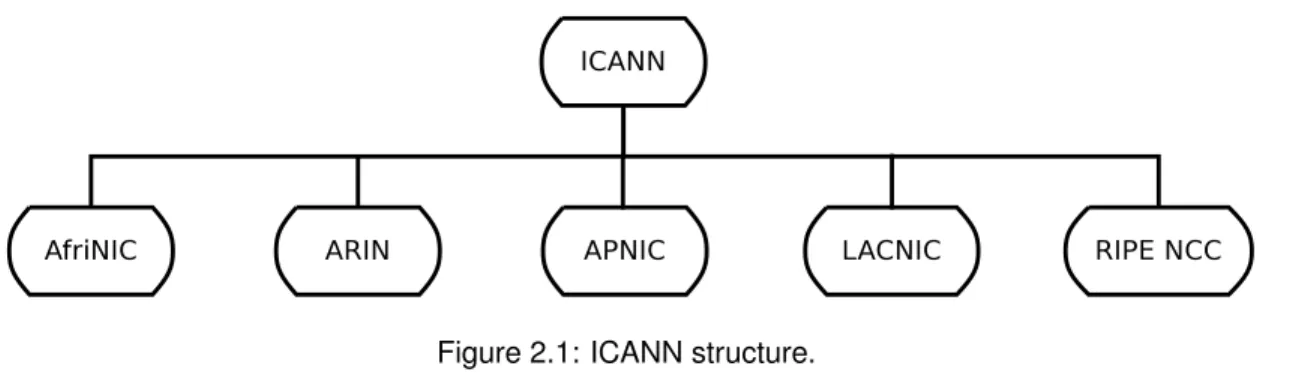
The Internet has two important entities for its infrastructure: ICANN and IETF. The former is respon-sible for the management of Internet Protocol address space, top-level domain names, Internet protocol identifiers; the latter is responsible for the Internet technology layer decisions. Regard-ing ICANN it is also responsible for managRegard-ing another important organization, IANA, which deals with the technical aspects of ICANN operations, being one the most relevant for this thesis, the management of the IP address space.
Figure 2.1: ICANN structure.
Depending on the region of the world, IANA delegates the allocation/registration of IP address space and autonomous system numbers (ASNs) to one of five RIRs (Regional Internet Registries):
• AfriNIC - African Network Information Centre for Africa;
• ARIN - American Registry for Internet Numbers for North America; • APNIC - Asia-Pacific Network Information Centre for Asia/Pacific;
• LACNIC - Latin America and Caribbean Network Information Centre for Latin America and some Caribbean Islands;
• RIPE NCC - Réseaux IP Européens Network Coordination Centre for Europe, the Middle East, and Central Asia.
Considering the scope of this thesis, following are some of the most important aspects of the Internet structure:
Networks and Prefixes In the IP address space the term network usually refers to an IP classful
network, i.e., class A, B or C network as specified in RFC 791 [37]. In this context, prefixes are classless hierarchical blocks of IP addresses as defined in RFC 4632 [27], i.e., CIDR blocks that may include subnets of networks or groups of one or more networks.
Autonomous System (AS) According to RFC 1930 [28] an AS is "(...) a connected group of one or more IP prefixes run by one or more network operators which has a SINGLE and CLEARLY DEFINED routing policy". An AS is the routing policy entity used in EGP protocols, for example BGP
[41], which is the Internet de facto protocol for inter-AS routing. Regarding the routing policy, an AS can have different interior gateway protocols (IGP) and related metrics to make routing decisions, however when interacting with other ASes it should have a consistent routing policy, namely the reachability information of prefixes should be coherent. Usually ASes are classified according to the relationships with their network neighbors. They are considered to be one of the following types: • Stub: only a connection exists to an upstream AS. If the AS routing policy is equal to the one of the upstream AS, one AS would be enough, in fact since it is considered an unjustifiable waste of resources, this situation is considered to be a bad practice [28]. Albeit a stub, the AS may have peering connections with other ASes;
• Multi-homed: the AS has multiple connections to upstream ASes. This is a common prac-tice if an entity wishes to have different upstream service providers, e.g., to have network redundancy;
• Transit: the AS provides connectivity to other networks. The most common case of this type is an Internet Service Provider (ISP).
These definitions are not standardized, for which reason we can find different classifications in research works [22], they are simply the most common.
Autonomous System Number (ASN) This is currently a 4 byte globally unique number [49]
used to identify the AS and to exchange exterior gateway information with other ASes. For BGP messages the ASN can be found in Open Messages, used to negotiate BGP session terms be-tween BGP peers, and in three attributes of a BGP update message: AS_PATH, AGGREGATOR, COMMUNITIES. Till recent times, ASNs only had 2 bytes, however due to resource exhaustion it became necessary to have an update to the standard in order to enable a bigger allocation space. This change is very recent and some concerns still exist in network operators regarding its deploy-ment [33], however since January 1 2009, 4 bytes ASNs were allocated by default for new requests and since January 1 2010 only 4 bytes ASNs are allocated for new requests.
Border Gateway Protocol (BGP) BGP is an inter-domain routing protocol [41] that enables
ex-change of network reachability information between ASes and is responsible for enabling the inter-connection of all ASes in the Internet. BGP standardizes mechanisms to announce and withdrawal prefix routes, enabling forwarding policies solely based on the destination addresses of IP packets. To allow finer grained routing decisions specific attributes may be used, namely:
• MULTI_EXIT_DISC (MED): an optional non-transitive attribute for discriminating among mul-tiple entry or exit points towards a neighbor AS;
• LOCAL_PREF: a well-known attribute that has its value calculated per route and is only sent to internal peers. Due to the importance of this protocol many other mechanisms were added and formally defined in the form of RFCs.
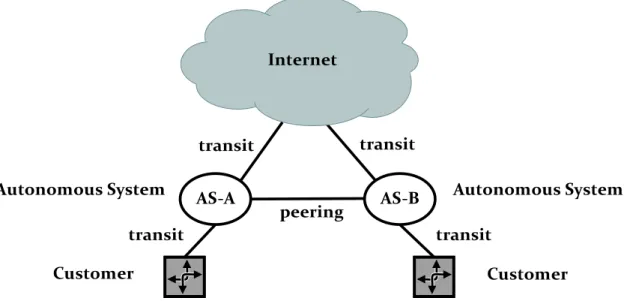
Figure 2.2: Internet private peering topology example.
Other relevant BGP attributes that will be addressed in this thesis are:
• AS_PATH: a well known attribute composed by all the autonomous systems through which a BGP update message has passed by. From this attribute we know the ASes that a packet will traverse when sent towards a certain destination;
• COMMUNITIES [17]: an optional non-transitive attribute to enable definition of a common goal for a set of prefixes, e.g., control how to distribute routing information among a BGP speaker neighbors.
Peering Based on an agreement between network operators (i.e., ASes) named peers, for the
exchange of data traffic at an interconnection point. This strategy allows direct exchange of data without the need to go through the Internet cloud. Peering is done when found beneficial for the involved parties, therefore peering agreements often imply definition of contracts with specific SLAs agreed between parties, where peering relationship terms are defined, e.g., allowed network activ-ities. Two main types of peering exist:
• Private: when done between only two networks that create a direct interconnection point. Often this type of peering is not publicly disclosed, which makes the understanding of Internet data flows more complex to understand [18]. Depending on the type of contract agreed it might imply a fee, or be simply free, it is a business decision dependant on the mutual benefits for both networks;
• Public: when done at an interconnection point where more than two network entities exist e.g. Amsterdam Internet Exchange (AMS-IX), Seattle Internet Exchange (SIX). In most cases this type of peering is economically more viable for networks to connect since many network entities are reachable from a single interconnection point.
Depeering When peering ceases to be considered beneficial for the parties involved the peering
infrastructure is dismantled, which means traffic between both networks will start traversing the Internet cloud. This means reachability between both networks should still be possible, however without taking advantage of a direct connection, e.g., lower round trip times, higher dedicated band-width. The technical implication for a depeering action is the tier down of the BGP session between both ASes.
Security Current Internet has many security limitations, some with higher severity than others.
At the top of the most serious are the ones related to BGP, which have at prefix hijacking the most frightening attack towards network operators and that apparently is still very common nowadays [33] despite all the research efforts that have been done to mitigate this problem [11, 39, 29]. From the background knowledge described in this sub-chapter it becomes easier to understand that the Internet is a set of unregulated interconnected networks that behave as open systems, i.e., the actions performed within a network at one side of the world, may affect networks on the opposite side of the world. The traffic flows through a myriad of ASes in the Internet, often without any security mechanisms in place.
2.2 Malicious Traffic
The Internet provides a fertile ground for malicious activities to occur. Analyzing the Symantec Global Internet Security Threat Report for 2009 [25] we can observe that malicious agents in the In-ternet have been highly active, and although threat trends change, e.g., decrease in data breaches, increase in botnets activity; it is not clear for what reason exactly, if due to intended actions or simply due to cyber criminals moving to more profitable areas. Overall still much has to be done to create a safer environment.
Malicious traffic can present itself through different attack vectors, different types of threats and different agendas from the part of the malicious agents. According to a senior responsible for security technology and response at Symantec: "The scale of these attacks and the fact that they
originate from across the world makes this a truly international problem requiring the cooperation of both the private sector and world governments.". As more enterprises move to the Internet their
communications infrastructure, malicious activity also increases since it becomes a more profitable business for cyber criminals.
According to the Arbor report [33] the most relevant attack vectors in 2009 were flood based attacks, e.g. UDP, ICMP, which indicates special attention must be given to address this particular type of attack vector.
Distributed Denial of Service (DDoS) attacks bandwidth growth slowed down, however it is still growing, for example in 2009 the largest DDoS attack had a peak of 49 Gigabits per second. Besides bandwidth denials of service, an increase in other types of resource exhaustion attacks were detected, e.g. CPU exhaustion, targeted at services facing the Internet, e.g., DNS. According to the Arbor report [33] the biggest threat was in fact DDoS to links, hosts or services.
Although all the evolutions seen for mitigating flood attacks, whether TCP or UDP, it is still an extremely common attack vector used in current Internet, approximately 45% of all registered attack vectors. In fact, this type of attacks is not only toward typical public services, e.g., HTTP, but also towards BGP peering addresses, which if successful, may have a devastating impact in networks connectivity.
Spam is a malicious activity responsible for much effort allocation by the part of corporations and one of its usual side effects is port/host scanning. For this reason, the latter is often used as a correlation factor when understanding this particular malicious traffic behavior.
In current Internet, many network operators already have some form of detecting and mitigating DDoS attacks [36]. Some of the most popular mitigation techniques for malicious traffic include: source/destination based access control lists (ACLs), source/destination based BGP remotely trig-gered blackholing (RTBH) [48], intelligent filtering, rate-limiting and BGP flow specification. Since some of these techniques may have negative impact in legitimate traffic and in the service provided to well-behaved paying customers, less harsh approaches are being used not to completely block traffic from entire networks but placing customers in wall-gardens or in quarantine. These more "sympathetic" solutions are of course done for the internal customers, relationships with external networks are usually addressed differently. This thesis focuses on the latter.
All these observations are obviously considering that malicious traffic is an unwanted type of traffic for a network operator. This is, unfortunately, not always true, placing this area of research in considerably fuzzier grounds. The following question is therefore very relevant:
Why may a network operator want malicious traffic? Some possible answers include:
• The malicious traffic originator is a paying customer. Blocking its traffic leads to an unsatisfied customer;
• The network operator has malicious intentions, e.g. organized crime, and is colluding with the originator of malicious traffic;
• Some network operators base their business models on accounted traffic, this means if a customer exchanges more traffic it also pays more.
2.3 Malicious Traffic Mitigation
Two main areas exist for the development of defense mechanisms in regard to malicious traffic, host-based and network-based. Host-based approaches (e.g., rootkit scanners, patching policies) are confined to hosts and although they have an extremely important role in the deployment of efficient security measures, network-based approaches (e.g., Intrusion Detection System) provide a wider defense barrier. The work done in this thesis focuses on network-based approaches, for which reason the defense mechanisms that will be described within this section belong to that class of defenses.
Source/destination based access control lists (ACLs) A simple solution for malicious traffic
mitigation is to have ACLs deployed in routers found in the path to the target prefix within the target network. These ACLs may be defined to drop/rate-limit traffic destined to the target network (destination based ACLs), or have traffic from a specific origin dropped/rate-limited (source based ACLs). This technique has the advantages of being simple and enabling good filter granularity, e.g., traffic type, source/destination prefix, TCP port, packet size. The main disadvantages are the inherent complexity of managing ACLs, the fact they must be configured router-by-router in their ingress or egress interfaces, and they do not distinguish malicious from legitimate traffic.
Destination based black-holing One technique that uses BGP to mitigate malicious traffic sent
to a particular target is simple black-holing. When an attack is detected within an AS, an iBGP custom update message is created, where the targeted prefix (host or network) has the next hop selected from the private internet networks defined in RFC 1918 [42]. This advertisement is than exchanged within the iBGP domain. This technique considers that most routers in the Internet, in particular edge-routers, have routes configured to send networks from RFC 1918 to the null inter-face. Since the null interface route will generate a host unreachable ICMP message, if the network operator does not want for the attacker to realize the attack is being manipulated, workarounds must be but in place for the ICMP message to not reach the attacker machine(s). This approach has the advantage of avoiding the rest of the network from being affected, however for this to be achieved the network operator is shutting down the part of its network that the attack is targeting, affecting malicious as well as legitimate traffic. This is consequence of another disadvantage of this technique, the low granularity available to characterize the malicious traffic.
Source/destination based BGP remotely triggered black-holing( RTBH) RTBH is a more
ad-vanced technique that tries to overcome the limitations of simple black-holing by defining special BGP communities within the target AS. BGP is therefore used as a signaling protocol, which can be deployed from a unique management point. For each edge-router a special community is de-fined and another for particular groups of edge-routers. When an attack is detected, an iBGP advertisement is propagated in the victim AS for the destination prefix, with the communities as-sociated with the routers through which the attack is passing through and with a no-export policy. A pre-configured policy exists in every router to filter advertisements with their particular commu-nity identification strings. That policy will then state the injection of routes with specific next hops, which can be for example the null interface. With the RTBH mechanism we can choose only the routers through which the malicious traffic is flowing and signal them to manipulate the malicious traffic. This has the advantage that all other routers will continue to provide the correct service for legitimate traffic. Details for this technique can be found in RFC 3882 [48].
Sinkhole tunnels [48] The RTBH technique implicitly states black-holing traffic, however, instead
of simply dropping packets by specifying the next hop as the null interface, it can be configured to maintain the next hop but to forward the packets through a particular path/tunnel, which can have a packet sniffer for malicious traffic analysis, or be manipulated in more intelligent ways, e.g., using traffic engineering techniques for:
• QoS policies deployment; • Rate-limiting;
• ACLs for dropping traffic.
One of the big security issues of this approach is the eBGP messages exchanged with the network peers, which may be crafted with specific communities used for this technique and that may lead the network operator to wrongly act on traffic otherwise considered legitimate.
BGP flow specification To tackle one of the limitations of RTBH techniques, i.e., low granularity,
another technique named BGP flow specification has been proposed, and is now defined under the proposed standard RFC 5575 [32]. Due to its high communication efficiency, this technique still uses BGP as a signaling protocol, however it also enables a much finer granularity level for characterizing traffic, including source/destination ports, protocol type. The same traffic engineering techniques mentioned for sinkhole tunnels, can also be applied for the BGP flow specification.
Chapter 3
Related Work
The problems originated from malicious traffic do not seem to have an end in the near future; nevertheless a lot of effort has been put into this field of research. Several improvements have been made but still no perfect solution exists which leads to a continuous effort among research community to find better mechanisms to deal with this problem. Some believe that the only solution is to start from a clean slate [12], others believe it has been proved through the years that although changes and new mechanisms may be required, an evolutionary approach is the best solution [23]. We believe that the latter approach is not just more pragmatic but can indeed provide the better results for designing efficient countermeasures. The power provided by years of use of the Internet infrastructure is not only valuable for checking the quality of network protocols but also not duplicable in any test bed. For this reason, the work developed in this thesis follows the evolutionary approach.
Some of the biggest security shortcomings of the Internet infrastructure exist at its core, the nature of TCP/IP itself [13], allowing the user to access the data and control planes, namely the routing facilities. From the latter, BGP is one of the most influential protocols, however it is considered too naive to deal with current threats. Several alternative solutions have been tried out [16], however none of which have found its way to total acceptance, several reasons are cited: too cumbersome mechanisms (e.g., S-BGP), lack of incentives or lack of liability. Although this work does not solve these basilar problems, they must be referenced for the reader to understand the challenge they present.
An infinite number of research works has been done focusing on the BGP problems. Nordstrom and Dovrolis [34] raised awareness in the networking community for BGP and interdomain routing vulnerabilities. They believed that since no relevant attacks had been performed till that time, proper care was not being given to such a fundamental component of current Internet. A description of the main attacks existing at the time (objectives and mechanisms) was done, which included loss of connectivity, traffic subversion and data interception. For the attacks described, it was assumed one or more BGP peers had been compromised and were being maliciously controlled, therefore entering in the study field of Byzantine faults. These observations make us aware of, not only the importance that network neighbors represent as means for malicious activity but that may also have as blocks for the construction of defense mechanisms. This thesis does not deal with the
problems of malicious BGP neighbors as malicious entities of the BGP protocol, instead it presents a mechanism that considers network neighbors as important parts of security classification and that may be used for reducing the amount of malicious traffic received by a network.
One of the most feared threats related to BGP is prefix hijacking - currently without a global solution deployed - for which we had in the Pakistan Telecom/Youtube hijack event [10] one of the most well known. For better prepare network operators to deal with this problem, the research community has created some helpful tools. Lad, Massey et al. presented PHAS [29], a tool that enables prefix owners to be notified in case their prefixes’ BGP origin is modified. Qiu et al. have recently devel-oped LOCK [39], a monitoring system that enables locating prefix hijackers and therefore improving the efficiency of mitigation actions. This particular issue, although not directly approached in this thesis, serves as reference, not only to understand the dependability of the Internet infrastructure on BGP, but also to understand how the publicly available reachability information, namely BGP update messages, can be used as input in a security tool.
To better understand the network security problems of the Internet, one of the obvious steps would be to understand how exactly the Internet is laid out, what exactly is the topology of the Internet. Although apparently easy this has been a herculean task and till this moment without an exact answer. It is hard if not impossible to determine which network relationships currently exist in the Internet [35]. Some authors [18] argue it is due to limited reach of monitoring systems based in probe networks, for example RouteViews [8], RIS [9] (commonly used by the research community) and propose use of other data inputs, e.g., looking glass sites or routing policy information available in Internet Routing Registry (IRR) databases. Dimitropoulos et al. [22] observe that information only gathered from BGP tables is far from providing enough information to define complete adjacency tables for ASes in the Internet. Another difficulty is the private character that private peering In-ternet connections usually have, which although difficult to maintain secret for Tier-1 ASes due to their visibility, it is a lot easier for all the other ones. Other interesting data sources for AS con-nectivity information are the Internet Routing Registries (RIRs) that manage databases for ISPs, which can register routes and routing policies. The main problem with these databases is that their updates are not mandatory for network operators, this leads to lack of confidence in their own com-munity regarding their accuracy, unfulfilling the whole purpose of their existence. Although all these challenges exist, to build efficient network defense mechanisms in the Internet, being aware of the network topology provides a great advantage and that was a principle used for creating the Risk Score algorithm we present in this thesis. We propose a pragmatic method to define the network topology for specific networks, in order to use it as an input for the Risk Score.
Knowing the AS topology based on the exchange of public data can therefore be of considerable value. Several tools [30, 51, 38] have been developed for monitoring BGP messages through the Internet, whether for analysis of BGP update messages patterns or associated network behaviors. One particular example is the work done by Chi, Oliveira and Zhang, whom developed Cyclops [21], a tool that provides a graphical interface for AS-level connectivity in the Internet, based on a number of data inputs, e.g., RouteViews, looking glasses. In our thesis we chose to use the RIS platform from RIPE [9] as the data input.
Studies of malicious traffic behaviors and patterns within the Internet environment have been done and some interesting conclusions have been reached. Chen, Ji and Barford [19] present an
inter-esting study on network behavior for malicious sources in which they consider the main problem of the Internet to be the lack of built-in security mechanisms, leading to the need of having several add-on mechanisms deployed. According to this work, malicious sources are mainly constant in terms of:
• Space: regarding the IP address space usage;
• Time: regarding the lifetime of malicious source addresses.
Most of the sources, which are responsible for a reduced number of attacks, also have small life-times, and the source prefixes responsible for the highest number of attacks, belong to the same AS. This may be due to the infection of neighboring machines and to the network effect. Authors observe the rule of 80/20 "about 80% sources locate in the same 20% IP address space over time.", for which reason they believe 20% of the IP address space should be the focus for both attackers and defenders. Another interesting observation is that a considerable amount of traffic originates from unrouted prefixes, i.e., private addresses and IANA unallocated prefixes, also known as "bo-gons". The existence of "bogon" routes is in itself a management problem for network operators and not always dealt in the best manner [24]. Most of these observations are corroborated by our own work in this thesis, providing strong confidence that defense mechanisms based in network behaviors are not only viable but may provide high efficiency values. The authors however do not use the results of their study for building any system, which is one of the contributions from the current work.
Through the years, most of the security research has focused on spam, the main reason for this investment is because spam has been one of the major concerns for service providers [33, 25]. Ramachandran and Feamster [40] studied this particular type of malicious traffic and tried to corre-late it with network behaviors, in particular an interesting correlation between BGP prefix hijacking and spam. From their conclusions we may say that short-lived BGP routes provide a good metric for characterizing an AS as malicious. The authors believe that the network properties of malicious traffic may provide a more robust form of filtering than common content rules (e.g. signatures). The work presents an analysis of blacklists and concludes that the number of false positives is high and they are only effective if several different types of blacklists are used in conjunction. Although many problems in characterizing malicious traffic through network properties exist, it is believed that it may be the one less prone to be manipulated. Besides the advertisement of routes for more specific prefixes by spammers, which is already common knowledge, one interesting discovery is that spammers sometimes advertise large address blocks to workaround network filtering usually done for smaller network blocks e.g. less then a Class C. Authors introduce a new concept named BGP spectrum agility where spammers announce IP address space (usually hijacked) for short periods of time, from which they send spam. From the point of view of the spammer this technique has also the problem of circumventing black lists. For this reason we consider that defense mecha-nisms based on lists have high manageability costs, scalability constraints and efficiency problems, reason why we present alternatives exactly based on network behaviors to deal with malicious traffic.
Some research efforts have tried to have in consideration not only the routers near the target of the malicious traffic but the whole path, namely through different ASes. Ioannidis et al. [31] present
a protocol named Aggregate-based Congestion Control (ACC), intended to detect and limit high bandwidth aggregates in network infrastructures. Authors consider one of the main challenges to be how to distinguish between legitimate and malicious traffic, even because it is not a simple case of applying policies to one particular flow, since in both cases many undifferentiated flows may exist, hence the term aggregate. Authors describe particular mechanisms of the protocol as the calculation of rate-limit values for creating traffic filters, and explain how congestion control messages are communicated upstream to all nodes in the path (i.e. pushback mechanism) to the source of malicious traffic. We follow the rationale of this work and propose intervention policies that consider a joint effort among network neighbors to deal with malicious traffic through the use of known technologies within the network operators context (e.g., BGP).
Other approaches not so ambitious in terms of network relationships, take more pragmatic ap-proaches. Borremans and Valke [15] embrace the inevitability of attacks affecting services and the only solution being the damage minimization through traffic diversion. Depending on the area of the network where malicious traffic is diverted, three different types of traffic diversion classifi-cations are defined: early (at the carrier level), near (at the network neighborhood near the ISP’s upstream providers and peers) and late (as near as possible to the ISP). Their work describes some DDoS defense techniques namely: Rate Limiting, Oversizing, Firewalling (TCP/UDP blocking), Ex-ternal ISP diversion (including BGP community dropping), Stop Announcing, Isolation (ranking of malicious sources and different announcements through different links) and some commercial im-plementations. The authors also take particular attention to relationships between neighbor ISPs and mention that contracts between ISPs may include network specific details, e.g., minimum size of networks to be advertised, re-advertisement of communities. The use of defense mechanisms at a network level is also used in this thesis and, regarding peering agreements, that idea can also be used as an enhancement for the work presented in this thesis. Although Borremans and Valke do not perform a thorough study of this issue, it is an interesting idea to apply.
The work done in this thesis shares the same approaches of part of the works here described, for example the importance of network behaviors of malicious traffic, the use of an evolutionary approach, avoids others, for example the use of pre-computed lists . Nevertheless, we used all the research work here presented to define a strategy on building efficient security defense mecha-nisms, contributing with new security classification mechanisms integrated with viable deployment scenarios.
Chapter 4
Data Analysis
In this chapter we analyze the data corpus of malicious data sent towards a mid scale ISP network. Also, we perform an analysis of network reachability information based on raw BGP data from RIS [9]. Finally we explain the software tools used to perform the analysis.
4.1 Malicious Traffic Identification
This thesis contains an analysis of malicious traffic sent towards a medium scale ISP network in-frastructure for the time window from 2010-04-13 to 2010-07-12. The malicious traffic identification and classification is performed by a closed source detection platform. Two types of malicious traffic were selected: flow floods and address scans; to be described on sections 4.1.2 and 4.1.3. These classifications are not based on static signatures but on traffic behavior. For both types of traffic it is possible to refine what exactly is considered malicious or legitimate. This can be done by defining thresholds for time or for number of events after which it can be considered malicious traffic. For the particular types of malicious events under analysis we have the following definitions: DEFINITION1 Let N and T be configurable system parameters, a flow flood event is defined by a host trying to open N connections towards a single destination host and port within a T seconds time window.
DEFINITION 2 Let N and T be configurable system parameters, an address scan event is defined by a host sending messages towards N ports at a single destination host within a T seconds time window.
For the particular types of malicious traffic under analysis we have the following definitions: DEFINITION3 Let M and T be configurable system parameters, flow flood malicious traffic is defined by M flow flood events detected within a T seconds time window.
DEFINITION 4 Let M and T be configurable system parameters, address scan ma-licious traffic is defined by M address scan events detected within a T seconds time window.
For the mentioned time window a total of 8453 events were detected:
• 3359 flow floods; • 5094 address scans.
4.1.1 Traffic Anonymization
To allow the traffic analysis it was required by the ISP that the malicious traffic information be anonymized. This was achieved with the help of CryptoPAn (see chapter 4.3.4) for the IP addresses and a simple conversion mechanism for the AS numbers. We used the real source IPs of the malicious traffic as input for a whois service (see chapter 4.3.2) from which we received the real AS numbers. At this point we could anonymize the IP addresses by running a tool based on the Crypto-PAn library. Besides the IP addresses we also used the same tool to anonymize the IP prefixes. The Crypto-PAn has as one of its best features the capability to preserve the prefixes after anonymization, which means that two real IP addresses included in a particular prefix will remain in the same prefix after anonymization. This ensures that we can perform coherent analysis based on IP addresses or prefixes.
Regarding the AS numbers we used a much simpler mechanism based in the private AS numbers reserved by IANA [28] - from 64512 to 65535 - creating a translation between the real and private AS numbers, therefore ensuring the anonymity of the real ASes.
Using these mechanisms we ensure that the data analysis will still be valid, while preserving the data anonymity.
4.1.2 Flow floods
As mentioned in several research works [47, 50] flow flood attacks are considerably difficult to detect and to defense mechanisms that do not affect legitimate traffic are almost impossible to develop. The reason for this is related to the extreme difficulty in distinguishing an attack from a perfectly legitimate access to a service, e.g., flash crowd. Due to these reasons they are often used by malicious entities for inflicting distributed denial of service (DDoS) attacks. Another important factor that potentiates this type of attacks is the current availability of botnets on the black market, rented as a commercial service. Botnets not only provide anonymity and big attack power for the attacker but also, and more relevant for the DDoS attacks, diffusion.
Typical use cases include infected hosts initiating many simultaneous connections towards a spe-cific victim. Currently, there are even certain websites that provide the infrastructure for this type of attacks from more radical activists campaigns. The impact of such attack is dependent on the network size of infected machines, higher network sizes enable more powerful attacks.
For this type of malicious traffic the following data was analyzed:
• Number of bytes; • Number of packets; • Source IP address; • Start timestamp.
Commonly TCP SYN flood attacks are relatively small in actual bits per second but they often exhaust other resources through an increase of number of connection requests since the end point (e.g., router) must save the connections state.
4.1.3 Address scans
Address scans are usually used for acquiring information regarding services that are open to the network. This is often a way to determine the type of attack that is more likely to succeed. Although not mandatory, some of the typical originators of such traffic are hosts infected by worms or viruses when trying to propagate to other devices. Although not all attacks are preceded by address scans (many malicious code simply searches for specific vulnerabilities in specific service ports and tries to exploit them), existing address scans usually precede attacks, for which reason they should be considered as an interesting metric for understanding the behavior of malicious traffic. Knowing which ports are open restricts the vulnerabilities that the attacker may try to exploit. For example knowing that port 80 is opened may tell the attacker that an exploit to the HTTP service may be possible.
For this type of malicious traffic the following data was analyzed:
• Number of events; • Number of bytes; • Number of packets; • Source IP address; • Start timestamp.
4.1.4 Analysis
In this chapter we analyze the characteristics of malicious traffic as a whole and a more detailed analysis of the top 5 higher originators of malicious traffic. The analysis will be performed for the two types of malicious traffic previously described in 4.1.2 and 4.1.3. Due to the considerable amount of different traffic sources and since most of it was from a small subset of origins, selecting the top 5 most significant origins reduced the analysis scope allowing a more thorough analysis of the relevant sources.
Cumulative
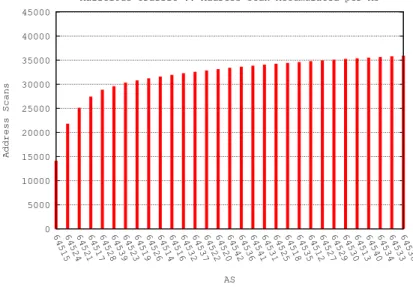
When considering the whole data set from which this analysis was done, we get 474 different AS origins. However, looking at Figures 4.1 and 4.2 we can conclude that only a few are responsible for most of the malicious traffic.
The top 5 ASes for address scans are described by the ordered set {64519, 64524, 64521, 64517, 64528} and for flow floods by the ordered set {64549, 64557, 64542, 64562, Reserved}. We can observe that although address scan events have approximately 50% more events than flow floods, both figures have similar curves. This means although the magnitude of values differs, trends for both types of events are similar.
0 5000 10000 15000 20000 25000 30000 35000 40000 45000 64515645246452164517645286453964523645196452664514645166453264537645226452064542645366454164531645256451864535645126452764529645306451364540645346453364538 Address Scans AS
Malicious Traffic :: Address Scan Accumulated per AS
Figure 4.1: Address scans cumulative source addresses.
0 10000 20000 30000 40000 50000 60000 70000 64549645576454264562Reserved6455264543645556456564545645246451564550645596452264548645616455364563645466453264523645566456664554645446456064551645646454764558 Flow Floods AS
Malicious Traffic :: Flow Floods Accumulated per AS
From the charts we can see that flow flood events reach a ceiling faster than the address scans. Although the behavior is similar, the ASes responsible for contributing to the cumulative value of flow floods become almost irrelevant for other than the first fifteen. This observation is more visible in the ranking charts present in figures 4.3 and 4.4, where the number of flow flood events is approximately zero. 0 2000 4000 6000 8000 10000 12000 14000 64515645246452164517645286453964523645196452664514645166453264537645226452064542645366454164531645256451864535645126452764529645306451364540645346453364538 Address Scans AS
Malicious Traffic :: Address Scan Ranking per AS
Figure 4.3: Address scans ranking source addresses.
0 2000 4000 6000 8000 10000 12000 14000 16000 18000 64549645576454264562Reserved6455264543645556456564545645246451564550645596452264548645616455364563645466453264523645566456664554645446456064551645646454764558 Flow Floods AS
Malicious Traffic :: Flow Floods Ranking per AS
Figure 4.4: Flow floods ranking source addresses.
For address scans however, we can see that this difference is not so abrupt. Although, as men-tioned before, the first ASes are the main originators of malicious events, after the first ten the trend toward value zero is also visible but with a softer slope. From this observation we may also conclude that address scans are more common than flow floods.
Prefix distribution
Although it is interesting and relevant to know the amount of malicious traffic originating from a particular AS it is also relevant to know if sending malicious traffic is a generalized behavior of the AS or simply the action from a particular segment of the network, namely a particular prefix. For this reason, an analysis of the prefixes originating the traffic was also done. From the total number of ASes we chose a subset to understand what exactly was the impact of particular prefixes versus the total malicious traffic originating from the AS. We chose 8 ASes for address scans and 10 ASes for flow floods since, as previously explained, the contribution of the first ranked ASes for flow floods is more relevant than for address scans. The choice of prefixes was done based on their ranking regarding all the detected prefixes, the ones responsible for originating the higher number of events were selected. 0 % 20 % 40 % 60 % 80 % 100 % 64515:133.191.255.0/1364521:65.206.255.0/1664524:67.51.255.0/1664517:65.153.191.0/1864524:85.155.0.0/1964515:249.196.0.0/1464528:253.176.139.0/2464524:67.248.255.0/18 Address Scans AS
Malicious Traffic :: Address Scans Events - Previx vs AS
Figure 4.5: Prefixes versus AS address scans.
0 % 20 % 40 % 60 % 80 % 100 % 64557:165.173.160.0/1964557:81.146.32.0/2164562:93.156.0.0/1464552:5.60.255.0/1664542:33.152.0.0/1464543:74.68.32.0/21Reserved 64549:95.232.0.0/1664555:185.173.255.0/1664550:179.39.72.0/21 Flow Floods AS
Malicious Traffic :: Flow Flood Events - Prefix vs AS
From the charts in figures 4.5 and 4.6 we observe that two main types of situations exist:
1. Malicious traffic from an AS is originating mostly from a single prefix, sometimes completely, e.g., 64562:93.156.0.0/14 (flow floods);
2. Malicious traffic from an AS is originating from more than a single prefix, e.g., 64524:67.248.255.0/18 (address scans).
Considering the first situation, if defense mechanisms are put in place to filter only the malicious prefixes, they will have high efficiency values. For the second situation, it may be possible to apply more interesting defense mechanisms, for example depeering from ASes that provide transit for traffic originating from that particular AS identified as malicious. These defense mechanisms are based on the detection and classification platform, which accuracy is dependent on several factors, namely thresholds definition. Knowing that such platforms are not 100% accurate, we must always be careful when introducing harsh measures into the defense mechanisms and we must have in mind that an evolutionary approach to the detection platform itself is required, with the thresholds being constantly validated and fine-tuned. Another issue to be considered regarding the detection mechanism is the possibility of packet origins being spoofed with addresses from a legitimate AS and that AS being wrongly classified as malicious. The top malicious ASes are not required to have direct links to the ISP, which greatly increases the success potential of such spoofing mechanisms. This scenario could therefore become an attack strategy from a malicious entity with the purpose of forcing a legitimate AS to be considered malicious.
For flow floods in particular, a considerable amount of traffic is originated from reserved IP address ranges, which are enumerated in Table 4.1. It is interesting to notice that most of these detected malicious events is from private IP addresses [42] or, typically, misconfigured machines [20]. This type of traffic can be simply ingress filtered using access control lists (ACLs), however it imposes allocating resources in segments of the network that may be under extreme stress, for which reason having more lines inserted in ACLs is sometimes avoided by network operators.
IP Network Description Number of Events
5.0.0.0/8 IANA RESERVED-5 933
169.254.0.0/16 Link Local RFC3927 IANA Reserved[20] 2173 192.168.0.0/16 Private Address CBLK RFC1918 IANA Reserved[42] 1383
Table 4.1: Reserved IP addresses.
In the case of address scans, five of the first eight prefixes are originating less than 21% of the total number of detected events. As for flow floods, eight of the first ten prefixes are responsible for more than 60% of the total number of detected events, the prefix with less number of events (64557:81.146.32.0/21) has 32%, which is still a large percentage from individual prefixes. From these results we can understand that depending on the type of malicious traffic being analyzed, the most efficient defense mechanisms changes. A simpler and more flexible approach for supporting different types of malicious traffic may be to consider a threshold value to define which defense mechanisms to apply.
Temporal distribution
For the top 5 ASes we obtain the charts presented in Figures 4.7 and 4.8 from which we can directly compare the traffic originated from each of the ASes through the time window analyzed.
0 50 100 150 200 250 300 350 400 2010-04-10 2010-04-24 2010-05-08 2010-05-22 2010-06-05 2010-06-19 2010-07-03 Address Scans Date
Malicious Traffic :: Address Scans - Top 5 ASes
AS64515 AS64524 AS64521 AS64517 AS64528
Figure 4.7: Time series for top 5 address scan origins.
For address scans there are two ASes responsible for most of the traffic, AS 64515 and AS 64524, however the former has the most consistent behavior. If the malicious traffic from these two ASes could be mitigated it would have a high impact in the whole network infrastructure of the ISP. An interesting observation that can be made from the chart is the sawtooth pattern of the time series events. This is true for all five ASes depicted in the chart. One possible reason for this could be the periodic behavior that characterizes many of the propagation mechanisms of worms. From the chart we can also observe an increase in the total number of detected events from the month of June onwards. Although AS 64515 is the most constant and therefore the one contributing with the highest number of events overall, in this time window it had a reduction while the other ASes had an increase in their contribution of address scan events.
0 500 1000 1500 2000 2010-04-10 2010-04-24 2010-05-08 2010-05-22 2010-06-05 2010-06-19 2010-07-03 Flow floods Date
Malicious Traffic :: Flow floods - Top 5 ASes AS64549
AS64557 AS64542 AS64562 Reserved
Figure 4.8: Time series for top 5 flow flood origins.
For flow floods there are also two ASes responsible for most of the traffic, AS 64549 and AS 64557, however, although they have the highest volumes of traffic, that traffic is not constant through all the 4 months of data, most of it is concentrated on the months of June and July. This seemed to be a very active period for malicious activity from these two ASes but a more peaceful one for all the other ASes, considering that the majority almost ceased activity. Similar to address scans, mitigating flow floods from these two ASes would have a high impact in the whole network infrastructure of the ISP. As mentioned for address scans, also with flow floods we can observe a sawtooth pattern, which may be due to the same reasons as the ones described for the address scans case.
AS distribution
Another interesting perspective over the data is given by the way malicious activity is distributed across all ASes, and how each AS contributes to the total malicious traffic universe.
Figure 4.9: AS versus Total address scan events.
Considering the address scans (figure 4.9), most of the malicious traffic (36%) is spread ac cross the AS space, however a significant amount is originating in a small subset of ASes, in particular AS 64515 with 31% and AS 64524 with 17% of all malicious traffic.
The same conclusions can be obtained for flow floods (figure 4.10), in which 27% of the malicious traffic is spread through different ASes but three of them, namely ASes 64557, 64549 and 64562, are contributing with significant volumes of malicious traffic, 26%, 26% and 6% respectively. For both types of malicious traffic it is perfectly viable to focus our mitigation efforts only in a small subset of ASes.
Figure 4.10: AS versus Total flow flood events.
Given the data set provided by the monitoring system, we analyzed how all the malicious traffic is distributed through the AS space in order to better understand how a real ISP is targeted. We could
conclude that although traffic is sent from many different sources, most of the traffic can be con-tained within a small subset, in our case we chose 5 ASes which are responsible for approximately 64% of all address scans and 73% of all flow floods. This conclusion gives hope that protecting the network from a particular AS can have a great impact in the overall security of the network. To consider this information when designing defense mechanisms can be extremely useful not only for estimating their efficiency but also their scalability.
4.2 Network Reachability Information
4.2.1 BGP update messages
Considering that our thesis is under the scope of a particular ISP (i.e., AS), all its neighbors may be defined using the BGP information available from the core routers of the ISP. The network topology issues only arise regarding the topologies of other ASes, since one of the main challenges of defining the Internet AS topology is exactly the lack of complete BGP public information, which can be due to different reasons e.g. business secrecy, traffic aggregation [18].
From the BGP update messages we are only interested in a subset of fields:
• Prefix - IP prefix; • Origin - origin AS;
• Type - announcement, withdraw; • AS Path (see section 2.1 for details).
With the above information we are able to understand what ASes an IP packet will traverse to reach a particular prefix. First we need to understand how the Internet sees the ISP AS, what known paths currently exist, in order to create the ISP AS reachability map. Second we need to understand how we can classify an AS in terms of neighborhood, i.e., which ASes are directly connected. Since the Internet is an extremely vast and dynamic environment we must restrict our scope of analysis. For achieving this purpose we defined the following sets of ASes we considered interesting:
1. AS paths related to the ISP AS prefixes;
2. AS paths that include the top 5 sources of malicious traffic previously determined.
4.2.2 Routing Information Service from RIPE
Different platforms for collecting BGP routing tables and update messages information exist, namely:
• Route Views; • Looking Glasses;
• RIPE Routing Information Service (RIS); • CAIDA.
For this work we chose to use RIS [9]. RIS has a network of 14 active probes, which collect BGP update messages from several locations around the world (see table 4.2). This information enables us to know, approximately, how other ASes in the Internet reach a particular AS.
Probe Location
RRC00 RIPE-NCC Multihop, Amsterdam
RRC01 LINX, London
RRC03 AMS-IX / NL-IX / GN-IX, Amsterdam
RRC04 CIXP, Geneva
RRC05 VIX, Vienna
RRC06 DIX-IE, Tokyo
RRC07 Netnod, Stockholm
RRC10 MIX, Milan
RRC11 NYIIX, New York
RRC12 DE-CIX, Frankfurt
RRC13 MSK-IX, Moscow
RRC14 PAIX, Palo Alto
RRC15 PTTMetro, Sao Paulo RRC16 Terremark - NOTA, Miami
Table 4.2: RIS probes.
We can parse the BGP update messages, searching for announcements of prefixes belonging to the ISP AS, in order to collect all the published AS paths. This defines the first set of interest-ing ASes too look for in BGP update messages. For the second set of ASes we must filter all announcements/withdraws that include the malicious top 5 ASes.
Given these two sets of ASes, we are now able to know all paths from the Internet towards the ISP AS and an adjacency list for all interesting ASes with their neighbors, which may be malicious or benign. This approach to the total universe of existing ASes provides scalability to our approach and therefore to the classification mechanism being presented in this work. The goal of this step is not to create an exact topology of data flows but to have the most probable paths that data may take towards the network operator AS, since it is not possible to determine - in useful time - the exact path that a data flow will take.
4.2.3 Analysis
Besides the reachability perspective given by the RIS service we could have yet another one, the ISP network that could be given by its BGP speaking routers. The former one gives the perspec-tive of Internet-to-ISP and the latter one ISP-to-Internet. To understand how malicious traffic is sent towards the ISP network we should focus on the Internet-to-ISP perspective, i.e., the probes network.
For analyzing the BGP update messages we chose a period of 8 days, from June 1 to June 8 2010. For that period we retrieved the raw update messages available at RIS and parsed them with the goals previously explained (i.e., ISP reachability map, AS adjacency list).
To understand the dynamics of BGP update messages, we present the amount of announcements and withdraws observed for only this period:
0 10 20 30 40 50 60 70 80 2010-06-01 2010-06-02 2010-06-03 2010-06-04 2010-06-05 2010-06-06 2010-06-07 2010-06-08 Updates Date
RIS BGP update messages
Announcements Withdraws
Figure 4.11: BGP update messages dynamics.
As reference for parsing the BGP update messages, we considered the ISP AS with ASN 3243. Filtering reachability information for its prefixes, a total of 49 unique paths were detected, from which information we could create the network topology present in figure 4.12.
Figure 4.12: AS 3243 public reachability paths.
From the above chart we conclude that AS 3243 has only two different access points from the Internet to its network: AS 8657 and AS 1930. This however is not a full characterization of the AS topology since it does not consider its role as a transit AS. From the BGP update messages we could also discover other directly connected ASes, not included in BGP update messages for prefixes from the ISP AS, but for which the ISP provides transit: ASes 8426, 42863, 12527, 28672, 41159, 65001, 9118, 31497, 39088, 28998, 15525, 47784, 29673, 13200, 6773, 25253, 34873 and 6939. As mentioned before we must not forget that we are interested in collecting all the neighbors of ASes:
• in the path to the ISP AS, which can be done by filtering BGP update messages that include the ISP AS in their AS PATH attribute;
• neighbors of the malicious ASes.
After collecting this information we have fulfilled the minimal requirements for creating a topology snapshot of the ISP AS and its neighborhood. Regarding the top 5 ASes responsible for originating