Proceedings of the
5th European Conference on
5th European Conference on
Intellectual Capital
VOLUME ONE
University of the Basque Country,
y
q
y,
Bilbao, Spain
11-12 April 2013
Edited by
Lidia Garcia, Arturo Rodriguez-Castellanos
and Jon Barrutia-Guenaga
University of the Basque Country
Proceedings of
The 5th European Conference on
Intellectual Capital
University of the Basque Country
Bilbao, Spain
11-12 April 2013
Edited by
Lidia Garcia, Arturo Rodriguez-Castellanos
and Jon Barrutia-Guenaga
University of the Basque Country
Bilbao, Spain
Copyright The Authors, 2013. All Rights Reserved.
No reproduction, copy or transmission may be made without written permission from the individual authors.
Papers have been double-blind peer reviewed before final submission to the conference. Initially, paper abstracts were read and selected by the conference panel for submission as possible papers for the conference.
Many thanks to the reviewers who helped ensure the quality of the full papers. These Conference Proceedings have been submitted to Thomson ISI for indexing.
Further copies of this book and previous year’s proceedings can be purchased from http://academic-bookshop.com E-Book ISBN: 978-1-909507-15-9
E-Book ISSN: 2049-0941
Book version ISBN: 978-1-909507-13-5 Book Version ISSN: 2049-0933
The Electronic version of the Proceedings is available to download at ISSUU.com.. You will need to sign up to become an IS-SUU user (no cost involved) and search for the conference name.
Published by Academic Conferences and Publishing International Limited Reading
UK
44-118-972-4148
Contents
Paper Title Author(s) Page
No.
Preface V
Committee Vi
Biographies viii
The Effect of Transformational Leadership on Product and Process Innovation in Higher Education: An Empirical Study in Iraq
Sawasn Al-Husseini, Ibrahim Elbeltagi and Talib Dosa
1
From Taxonomic to Networked Models of Intellectual Capital and its Development
Eckhard Ammann 11
Structural Capital, Innovation Capability, and Com-pany Performance in Technology-Based Colombian Firms
Nekane Aramburu, Josune Sáenz and Carlos Blanco
20
A Structural Model for Organizational Justice in Universities Based on Intellectual Capital
Azizi Balvand, Fattah Nazem, Alireza Chenar
and Omalbanin Sadeghi 30
What Makes an Enterprise Sustainable? Or: is “Green” Really “Green”?
Dina Barbian 38
Creating Virtual Mentoring Programs for Developing Intellectual Capital
Bob Barrett 47
The Impact of Intangibles on Value Creation: Com-parative Analysis of the Gu&Lev Methodology for the United States Software and Hardware Sector
Leonardo Basso, Herbert Kimura, Juliana
Saliba and Erica Braune¹ 54
The Existence and Disclosure of Intangibles versus Corporate Financial Performance in France
Leonardo Fernando Cruz Basso, Evelyn Se-ligmann-Feitosa, Diógenes Bido and Herbert Kimura
63
The Influence of the Process of Measuring IC on Performance
Donley Carrington 74
The Distinctiveness of Knowledge Sharing Processes Within Multinational Companies
Vincenzo Cavaliereand Sara Lombardi 82
The Influence of Relational Capital on Product Innovation Performance at Innovative SMEs
Pedro Figueroa Dorrego, Ricardo Costaand
Carlos Fernández-Jardon Fernández 91
The Role of ISO 14001 in Sustainable Enterprise Excellence
Tijana Durdevic, Cory Searcyand Stanislav
Karapetrovic 99
Measuring the Impact of Services Innovation: What do we Know?
Susanne Durstand Anne-Laure Mention 108
Socio-Ecological Innovation: Strategic Integration of Innovation for Sustainability and Sustainable Innovation
Rick Edgeman and Jacob Eskildsen 114
Sustainable Enterprise Excellence: The Springboard Model and Assessment
Rick Edgeman and Jacob Eskildsen 123
Coupling with Standardisation and Diversity: Intellectual Capital Reporting Guidelines for European Universities
Susana Elena and Karl-Heinz Leitner 132
IC Management in Universities: Where is Teaching?
Susana Elenaand Katja Pook 142
Biographies of Presenting Authors
Ercilia Garcia Alvarez is a Professor at the Business Management Department at the Universitat Rovira i Virgili. Ercilia is the
Principal researcher of the Qualitative Research in Leisure Markets and Organizations (Qualocio) research group and senior researcher of Consumption, Markets and Culture (CMC) research group of the Universitat Autònoma de Barcelona.President of the Spanish Association for the Advancement of Qualitative Research (Espacual).
Prof. Dr. Eckhard Ammann is a professor for computer science at the Reutlingen University, Germany, since 1992. Before
that, he spent 8 years with the IBM Company doing research and development in parallel systems and system structures. His research interests include knowledge management, intellectual capital, business process modeling, distributed systems, and virtual organisations.
Nekane Aramburu is PhD in Economics and Business Administration and member of the Strategy and Information Systems
Department of Deusto Business School (University of Deusto, Spain). She specializes in the fields of Organizational Learning, Change Management, and Business Organization. Her research focus is currently on Organizational Learning, Knowledge Management, and Innovation.
Zeinab Azizi Blavand has eight years of research experience at university, authored international article and her study field of
interest is intellectual capital.
Dr Joseph Azzopardi BA(Hons), MSc(Manc), PhD(Manc) .Joseph is Head of the Department of Management at the University
of Malta. His research interests include all aspects of Human Resource Management and Development with special focus on small enterprise, Action Learning and Action Research, business and community development, organisational learning and knowledge management.
Dr. Dina Barbian is Research Assistant at the Chair for Information Systems, Friedrich Alexander University of
Erlangen-Nuremberg (Germany). Her main research interest lies in Sustainable Development. She holds a Master’s Degree in Industrial Engineering and a Doctoral Degree from the Faculty of Economics, University of Kaiserslautern (Germany). She lectures on "Sustainable Development and Macroeconomics".
Dr. Bob Barrett is a professor for the School of Business at the American Public University in Charles Town, West Virginia,
USA. He lectures both nationally and internationally on the topics of Intellectual Capital, Knowledge Management, Disability in the Workplace, e-Portfolios, and e-Learning.
Leonardo Basso Ph.D: New School for Social Research - New York. Professor of finance: Graduate program in Business
Ad-ministration - Mackenzie Presbyterian University, São Paulo, Brazil.
Dolores Bengoa Ass. Prof. International Business School at Vilnius University, Lithuania is an experienced international coach
and lecturer since 1992 in the field of cross cultural management, communication and intercultural knowledge transfer. She has a doctoral degree from Leeds Metropolitan University (England) as a result of her degree uses innovative and proprietary tools and techniques to improve the transferability of knowledge in cross-border business co-operations.
Carlos Blanco has a PhD in Economics and Business Administration. He has been Associate Professor in the Pontificia
Univer-sidad Javeriana (Bogotá, Colombia), in the fields of Knowledge Management and Innovation. Nowadays he is consultant in these domains, having worked for different organizations: Ministry of National Education of Colombia, TES-America, Univer-sidad Eafit, etc.
!"!#$%&"'()$ is a third year PhD student at the University of Latvia; she worked at the private University, Higher School of
!"!#$%$"&'!"(')*+,!-'.*/0'12&&34&35!6'7*/'89':$!/4'!4'!"'!+!($%,+'!"('!(%,",4&/!&,;$'4&!77'!"('!&'</$4$"&'4=$',4'&=$'>$!(' of the Department of Development Planning and Project Management in Lielvarde Municipality.
Maria Do Rosario Cabrita holds a PhD and is Assistant Professor and researcher at the Universidade Nova de Lisboa,
Portu-gal, and teaches at the Portuguese Banking Management School in Lisbon. She has several years of experience in executive positions in international banks. Her current field of research is focused on intellectual capital, knowledge management and measuring intangibles.
Donley Carrington is a Lecturer in Accounting, at the University of West Indies, Cavehill Campus, Barbados. Donley
Graduat-ed UWI, Iowa State University, USA, Institute of Management Accountants USA and University of Hull, UK. Donley’s PhD the-sis “An exploratory study of Intellectual Capital in the hospitality industry in the Caribbean”. Donley researches Intellectual Capital, Strategic Cost and Management Accounting.
Vincenzo Cavaliere is Associate Professor of Business Organization at Department of Business Administration – University of
Florence. His research interests include entrepreneurship and organization learning in SMEs, knowledge sharing and strategic human resource management. He is member of AIDEA (Accademia Italiana di Economia Aziendale).
*+,!-$%.'"(/, PhD has been working since 2001 on MaterialsEngineering Faculty, STU, mainly dealing with business
ics/business ethics, and social dialogue. *+,!-$ is an author of over 90 scientific publications/publications in field of econom-ics, economic ethics and project management. Member of team of authors working on research projects in field ofproject management/economics.
Ricardo V. Costa is an Auxiliary Professor at ISMAI - Instituto Superior da Maia and a researcher at UNICES. He graduated in
Economics at Universidade do Porto, and received is Phd in Business Management from Universidade de Vigo, in Spain. He got an Executive MBA in Business Strategy from Escuela de Negocios Caixanova, in Vigo, and attended the “Program in Inter-national Management” at Georgetown University in Washington.
Luís Mesquita Diniz, Master`s degree in Economics from the Lusíada University of Lisbon. Attending a PhD in Economics at
the Lusíada University. The thematic research focuses on Intellectual Capital and Training. Author of a paper on UFHRD EUROPE 2012 entitled “The influence of training in labor productivity”.
Catalin Drob, Phd. in Management is working as a lecturer, at the “Vasile Alecsandri” University of Bacau, Engineering
Fac-ulty. His main areas of interest in teaching and research are: investment, management, project management and financial management.
Tijana Durdevic is a grad student of Mechanical Engineering at the University of Alberta in Edmonton, Canada. She holds a
Master of Industrial Engineering (MSc) from the University of Belgrade in Belgrade, Serbia. Currently, her research areas are Management System Standards and Implementation, Integration, and Auditing of Management Systems.
Susanne Durst is Researcher at the Center for Knowledge and Innovation Research (CKIR) at Aalto University School of
Eco-nomics and Assistant Professor at the Chair in International Management, Institute for Entrepreneurship, at the University of Liechtenstein. Her research interests include small business management, SME succession/transfer, IC management, knowl-edge management, innovation and corporate governance.
Rick Edgeman is Professor of Sustainability and Performance in the Interdisciplinary Centre for Organizational Architecture at
Aarhus University. He has previously chaired the Statistical Science Department at the University of Idaho (USA) and was QUEST Professor & Executive Director of the QUEST Honors Program at the University of Maryland. He has authored ap-proximately 175 publications.
Ibrahim Elbeltagi. Is a Senior lecturer in information and knowledge management, School of Management, University of
Ply-mouth. Publications largely related to electronic commerce, adoption of ICT, information systems in developing countries, social networking and knowledge management. I have more than 40 journal and conferences papers published or accepted for publication in many national and international journals and conferences.
Nehal El-Helal received her Bachelor degree in business administration from the faculty of commerce-Mansoura University.
She is currently working as demonstrator in business administration department in the faculty of commerce-Mansoura Uni-versity and is preparing for her masters thesis in customer knowledge management topic.
Dr. Susana Elena Perez is currently a Scientific Fellow at the IPTS (European Commission). Worked as Lecturer at the Pablo de
Olavide University (Spain), member of the PRIME Network of Excellence and participated in various European projects. She holds a PhD in Economics and Management of Innovation. Research interests: universities, management and governance, intellectual capital, and science and technology policy.
Mr Ahmed Elsetouhi is assistant lecturer at Faculty of commerce, Mansoura University, Egypt. In 2009 till now, he is a PhD
student at Business Management – Plymouth University. His research interests focus on intellectual capital, innovation, knowledge management, e-commerce- ICT and SEMs. He has published a paper at Journal of Global Information Manage-ment (3 star), and two conference papers.
Jacob Eskildsen is professor of business performance management at Aarhus University and a member of the
Interdiscipli-nary Centre for Organizational Architecture. Before entering academia Jacob worked as quality manager in a large multina-tional company. He holds an MSc and a PhD from the Aarhus University and is the author of more than 100 publications.
The Influence of Relational Capital on Product Innovation
Performance at Innovative SMEs
Pedro Figueroa Dorrego
1, Ricardo Costa
2and Carlos Fernández!Jardon Fernández
31
Departamento de Organización de Empresas y Marketing, at Facultad de Ciencias Sociales
y de la Comunicación, Universidade de Vigo, Spain
2
UNICES (Unidade de Investigação em Ciências Empresariais e Sustentabilidade), at ISMAI,
Instituto Superior da Maia, Portugal
3
Departamento de Economia Aplicada, at Facultad de Ciencias Economicas y
Empresariales, Universidade de Vigo, Spain
[email protected] [email protected] [email protected]
Abstract: The authors build on the intellectual capital and new product development perspectives to study the influence of
relational capital on product innovation performance. An empirical research was conducted, using a questionnaire administered to Portuguese innovative SMEs. The results suggest that relational capital does have a positive effect on product innovation performance. In particular, “Vertical relationships” stands out as the main relational capital element significantly affecting product innovation at the innovative SMEs level. The existence and proactive management of relationships with customers and suppliers emerge as critical factors to product innovation success. We find our results to be useful for both researchers and practitioners: at the intellectual capital level, we contribute to the ongoing understanding of relational capital’s impact on critical business activities; at the product innovation level, we contribute to the identification of additional critical success factors for new product development. At a time when intellectual capital and product innovation management are both considered to be critical for companies to gain a competitive edge (and even survive) in today’s unstable business environment, this study contributes to acknowledge the relevance of relational capital management on product innovation success at innovative SMEs.
Keywords: intellectual capital, relational capital, product innovation, new product development, innovative SMEs, Portugal
1.
Introduction
Academic research on business competitiveness has for the past decades gradually changed its focus. The development of dynamic capabilities sustained in factors that are tacit, invisible or intangible by nature has arisen as a privileged mean to achieve greater resource efficiency and create competitive barriers. At the same time, innovation has materialised as one of the most crucial factors for structural development. Against this backdrop, the general purpose of this research is to study interaction effects between intangible assets and innovation at the firm level. Specifically, we will analyse the influence of relational capital on product innovation performance at innovative small and medium enterprises (SMEs).
It is nowadays generally accepted that the main components of intellectual capital can be structured into three dimensions: human capital, structural capital and relational capital (Curado et al. 2011).The relational capital concept is based on the consideration that companies are not isolated systems. On the contrary, they are actively and permanently connected to multiple external entities. All valuable relationships of this kind, with customers, suppliers and other relevant stakeholders, represent relational capital (Roos et al. 2001). Bontis (1998) argues that the knowledge of marketing channels and customer relationships is the main theme of relational capital. It represents the potential an organization has due to external intangibles, including the knowledge embedded in customers, suppliers, the government or related industry associations. According to Bueno and Salmador (2000), relational capital represents the firm’s “competitive and social intelligence”. For the purpose of this study, we will thus define relational capital as all valuable relationships, channels and networks that exist between an organization and its stakeholders.
Innovation, in the broadest sense, is in the heart of economic change. The vision of innovation as the main driver of long term development is today widely accepted (Leiponen 2005). At the firm level, innovation is nowadays considered to be inevitable: driven by a variety of forces (including globalization, technological evolution and demography), the economic environment is changing rapidly. To succeed in such a context, or even to remain viable, corporations must respond with innovation (Govindarajan and Trimble 2005). Product
Pedro Figueroa Dorrego, Ricardo Costa and Carlos Fernández!Jardon Fernández
innovation, due to its higher visibility in the relationship between companies and consumers, stands out as an element of particular importance to any business. Companies must develop new products, at least on occasion, to maintain or gain competitive advantages, and their ability to create new products has been linked to performance and even long!term survival (De Jong and Vermeuler 2006, and Linzalone 2008).
Several studies have succeeded in trying to empirically demonstrate that intangible assets in general are positively and significantly associated with the firms’ innovative capabilities (for example Canibaño et al. 2002; Chen et al. 2004; Del Canto and González 1999; European Commission 2006; Linzalone 2008; Santos Rodrigues et al. 2010; Subramanian and Youndt 2005; Wu et al. 2008). Nevertheless, rarely were those researches specifically oriented at assessing the impact of relational capital on product innovation performance. Similarly, several authors from the product innovation field (e.g. Abetti 2000; Bullinger et al. 2004; Cooper et al. 2004, 2004a, 2004b; Kandemir et al. 2006; Montoya!Weiss and Calantone 1994; Shum and Lin 2007) have analysed the critical success factors for new product development (NPD), but they seldom focused on the specific impact of relational capital elements. In order to fill these gaps, the main purpose of this study is to empirically validate if the existence of relational capital elements at innovative SMEs influences its product innovation performance.
2.
Relational capital and product innovation: Theoretical model
Product innovation is by definition an uncertain process, with few repetitive or predictable elements. Consequently, it requires a search for knowledge outside the firm’s existing knowledge base, often in areas unrelated with its current operations. This is why relational capital, or the intensity with which the organization is connected with elements outside its walls, can be a critical source of innovation.
Hargadon and Sutton (1997) studied how the development of network connections across industries can benefit product innovation. Continuous innovation, they argue, is often related to occupying a “structural hole”, that is, the gap in the flow of information between subgroups in a larger network. In fact, knowledge is often shared imperfectly through time, people, organizations and industries. The ideas that come up in a group could solve other groups’ problems, but that can only happen if there are links that can go through the existing frontiers between solutions and problems. When those connections take place, existing ideas can appear new and creative, as they change shape and are combined with other ideas to solve new problems. We thus argue that high levels of relational capital at the firm level (through a clear orientation to develop links with external knowledge sources) strengthen the firm’s ability to absorb and transform new knowledge, and thus its product innovation potential. In fact, some authors (eg. Cohen and Levinthal 1990) state that the ability of a firm to recognise the value of new, external information, assimilate it, and apply it to commercial ends (that is, the firm’s “absorptive capacity”) represents a learning process that is critical to its innovative capabilities.
Empirical support was also found for the notion that developing and nurturing the existence of knowledge flows beyond the borders of the firm and through distinct scientific areas turns R&D efforts more productive (Pike et al. 2005). This kind of initiatives includes cooperation agreements with suppliers, external experts, research centres or universities, as well as contacts with regulatory entities. Nonaka and Takeuchi (1995) argue that the creation of an R&D network based on strong connections with suppliers was determinant for the success of Japanese firms’ innovation efforts in the 80’s.
Other studies (for example, Ahuja 2000) tried to understand the impact of collaboration networks on the firm’s innovative capabilities. It was found that direct and indirect ties with other firms and institutions do have an influence on the firm’s innovation output. In fact, the existence of collaboration networks was found to contribute to the sharing of knowledge, know!how and physical resources, serving as “conductors” through which the news of technological breakthroughs, new solutions to existing problems or failed approaches travel from one firm to another. Bullinger et al. (2004) also argue that the existence of vertical and horizontal networks (with customers and suppliers and with other firms) is a very important factor to the firm’s ability to innovate. Firms “need to build up a company!wide internal innovation network of innovation actors and integrate their innovation process in mutual horizontal and vertical networks” (Bullinger et al. 2004, pp. 3346) in order to share knowledge and benefit from complementary competencies, as a critical way to timely identify new innovation options and directions. Subramanian and Youndt (2005) conclude that external relationships, alliances and collaboration networks are essential to an organization’s innovation versatility, adding that “social capital” is gaining increasing importance and visibility as an organizational resource.
Pedro Figueroa Dorrego, Ricardo Costa and Carlos Fernández!Jardon Fernández
Some studies stress the importance of relational capital as a manifestation of the organization’s market orientation. Bontis (1999) mentions the relevance of an organization!wide generation of “market intelligence” regarding current and future needs of customers, especially through vertical relationships. This pragmatic perspective of relational capital stresses the importance of developing multiple external links as a way to increase the firm’s ability to identify the true needs of the market, and thus increase the potential success of its new products.
We thus find some evidence that relational capital, representing the set of channels, contacts and initiatives that build bridges between the firm and its external environment, can be a critical source of new knowledge that feeds the firm’s innovative capabilities. Therefore, it seems acceptable to assume that the existence and proactive management of relationships with external stakeholders will have a relevant influence on the firm’s product innovation efforts at innovative SMEs. These relationships increase access to new ideas and contribute to a better understanding of the target markets, increasing the odds of success at launching new products. We will thus hypothesise that relational capital is positively associated with product innovation performance at innovative SMEs.
Even if one accepts this hypothesis in a general way, another important question remains: which of the constitutive elements of relational capital are the main drivers of product innovation? Within the notion of collaborative networks lies a wide array of possibilities, namely regarding the decision to establish relationships with very different types of stakeholders. Understanding which are more relevant to product innovation at innovative SMEs is particularly critical, more so if we accept the notion that collaborative networks are harder to establish and manage at the SME level. To help identify the specific relational capital elements that improve product innovation performance is another purpose of this article.
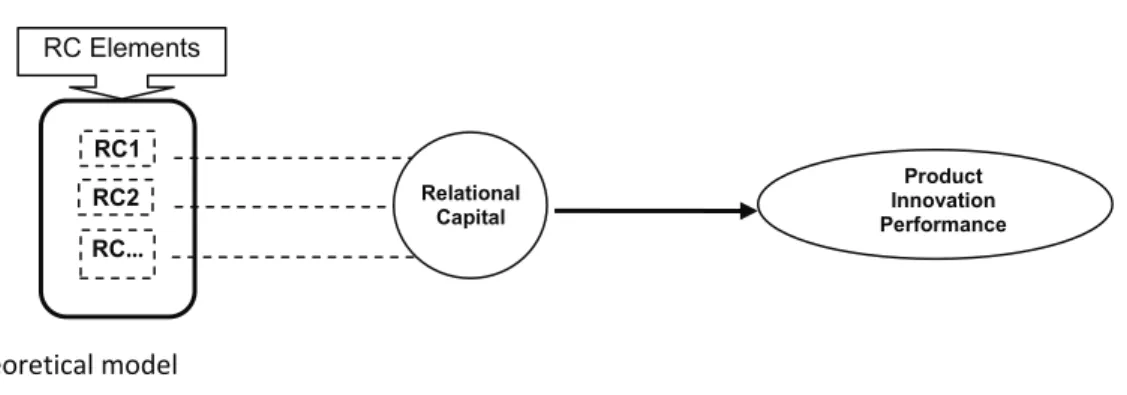
Figure 1 encapsulates the theoretical model we intend to test:
RC1 RC2 RC... Product Innovation Performance Relational Capital RC Elements
Figure 1: Theoretical model
3.
Research methodology
In order to empirically gauge the influence of relational capital on product innovation performance at innovative SMEs, and having presented the theoretical background that inspired this study, we will now focus on the research methodology that guided our field work.
3.1 Variable definition and measurement
Being a volatile and uncertain process, product innovation often requires a search for knowledge outside the firm’s existing knowledge base, frequently in areas not directly related to its current activities. That is why relational capital, or the intensity with which the firm relates with external entities, can be an essential basis to acquire new knowledge. It thus seems adequate to assume that the existence of direct and indirect links with external stakeholders will have a determinant impact on the firm’s innovative capabilities, and particularly on its product innovation performance. Firms with stronger ties to its suppliers and customers also gain an increased sensitivity towards market needs, which turns their product innovation effort into a more oriented and effective process. In order to study the existence of relationships with the exterior, and also to understand to what extent they are proactively managed at the firm level, we chose to consider two relational capital elements: the existence of vertical and horizontal relationships; and the management of relationship processes (incorporating the results of our own research and also studies from Ahuja 2000; Bullinger et al. 2004; IADE 2003; Pike et al. 2005; Subramanian and Youndt 2005, and Youndt et al. 2004):
Pedro Figueroa Dorrego, Ricardo Costa and Carlos Fernández!Jardon Fernández
Vertical and horizontal relationships surveyed the existence of relationships with customers, suppliers, competitors and other institutions with the specific goal of enriching the firm’s product innovation capabilities. We relied on three indicators to measure this element:
There are vertical relationships (with customers and suppliers) with the specific goal of strengthening our product innovation capabilities
There are horizontal relationships (with partners and competitors) with the specific goal of strengthening our product innovation capabilities
There are relationships with other institutions (government agencies, external experts, public and private R&D centres, shareholders, etc.) with the specific goal of strengthening our product innovation capabilities Management of relationship processes relates to the proactive and systematic management of existing
relationship processes and channels with the exterior. We relied on five indicators to measure this element:
The company makes a specific effort to identify and establish relationships with customers or users who are more receptive to innovative products (lead users)
The company actively manages formalized relationship processes with clients The company actively manages formalized relationship processes with suppliers The company actively manages formalized relationship processes with competitors
The company actively manages formalized relationship processes with institutions, shareholders and investors
In what concerns the measurement of product innovation performance, a growing number of studies is relying on the use of the so!called “impact indicators”, which measure the financial and economic significance of product innovation to the company. With that in mind, we relied on three indicators to measure product innovation performance, incorporating the results of our own research and also studies from Cooper (2004), OECD (2005), Shum and Lin (2007) and Souitaris (2002):
Proportion of projects entering development stage that became commercial successes (met or exceeded sales goals) in the past three years;
Percentage of current sales revenue derived from new products introduced in the past three years; Proportion of projects hitting their launch dates on time and on budget.
3.2 Sample definition and data collection
As in most studies concerning intellectual capital and product innovation, this research was conducted at the firm level. The theoretical population was established as “small and medium Portuguese innovative firms”. We chose a network of Portuguese innovative SMEs, COTEC’s “Rede PME Inovação”, as being the best possible sample for our theoretical population. COTEC is a non!profit association supported by the Portuguese Government and the institutions of the National Innovation System, aimed at promoting the competitiveness of companies established in Portugal, through the development and the diffusion of a culture and practice of innovation. COTEC’s membership list includes virtually all of the most prominent companies operating in Portugal. Among its initiatives, COTEC endorses an expanding innovative SMEs network (“Rede PME Inovação”) based in Portugal, which comprises innovative SMEs that, having applied for network membership, fulfil a set of specific criteria and enjoy a minimal score on COTEC’s “innovation scoring”. At the date of the research, this network comprised 100 firms, with a total of around 7729 employees and 782 million Euros of total turnover.
Once the research constructs were operationalised and the target population and its sample were established, a preliminary version of the questionnaire was designed. A 5!point Likert scale was used in relational capital related indicators (comprising a total of eight statements), and a choice of percentage intervals was used in product innovation performance items (three in total). A pilot study with four firms and an expert interview were conducted, and some items were refined through this purification process. The data collection took place from July 2008 to January 2009, via e!mail, involving all 100 companies. The request included a description of the study, stating its usefulness and social value, and a statement of confidentiality. The questionnaire was directed to the CEO of each firm, as suggested by the Oslo Manual (OECD 2005). Follow!up telephone calls
Pedro Figueroa Dorrego, Ricardo Costa and Carlos Fernández!Jardon Fernández
were made to each firm explaining the purpose of the research, and a few questionnaires were taken in person. 72 responses were received, for a response rate of 72 percent. As every response was valid, 72 was our effective sample size.
4.
Data analysis and results
This section is dedicated to the empirical findings of the research. Once all questionnaires were received, we proceeded to the treatment and analysis of the data, using a combination of multivariate statistical techniques.
4.1 Preliminary analysis
A preliminary analysis of the data for processing and purification purposes was conducted, using SPSS software. The existence of abnormal behaviour was studied through the analysis of frequency tables and descriptive statistic measures, as well as through a joint purification by classifying the data into clusters, using k!averages. As a consequence, two cases were considered to be incoherent, and were therefore excluded. A chi!square test proved the geographical representativeness of the sample. Cronbach’s " coefficients of the constructs were then calculated. Cronbach’s " coefficient for “relational capital” was 0.770, and Cronbach’s " coefficient for “product innovation performance” was 0.746. Typically, the minimum threshold of Cronbach’s " coefficient is 0.7 (Hair et al. 1998).
4.2 Regression analysis and results
The next step of the study was to empirically test the relationships between relational capital and product innovation performance. We started by reducing the data, using a principal components factor analysis. In what concerns relational capital, KMO’s measure of sampling adequacy was 0.696, signalling an acceptable quality of correlation between variables. Bartlett’s test resulted in a 0.000 level of significance, dismissing the hypothesis that the correlation matrix is the identity matrix. These results allowed us to proceed with factor analysis for relational capital. Two factors were extracted under the established criteria, as presented in Table 1, obtained through a Varimax rotation with Kaiser normalization that converged in three iterations. These factors account for 59,476 percent of cumulative variance explained. All item loadings are over 0.5, which is commonly considered as a high significance level.
Table 1: Factor analysis results for relational capital
Factor Percentage Item description Loadings
Factor 1: Vertical relationships The companyactively manages formalised relationship processes with clients
,893
The companymakes a specific effort to identify and establish relationships with customers or users who are
more receptive to innovative products (lead users)
,794
There are vertical relationships (with customers and suppliers) with the specific goal of strengthening our
product innovation capabilities
,673
Variance explained Cumulative variance explained
39,575 39,575
The companyactively manages formalised relationship processes with suppliers
,624
Factor 2: Horizontal and institutional relationships
The companyactively manages formalised relationship processes with institutions, shareholders and investors
,807
There are relationships with other institutions with the specific goal of strengthening our product innovation
capabilities
,786
There are horizontal relationships (with partners and competitors) with the specific goal of strengthening our
product innovation capabilities
,706
Variance explained Cumulative variance explained
19,901 59,476
The companyactively manages formalised relationship processes with competitors
,604
According to the characteristics of the items, we labelled these two factors as follows:
Factor 1: “vertical relationships”, representing the existence and proactive management of vertical relationships (with customers and suppliers), aimed at improving the firm’s product innovation capability;
Pedro Figueroa Dorrego, Ricardo Costa and Carlos Fernández!Jardon Fernández
Factor 2: “Horizontal and institutional relationships”, representing the existence and proactive management of horizontal relationships (with partners and competitors, as well as with shareholders, investors and other institutions), aimed at improving the firm’s product innovation capability.
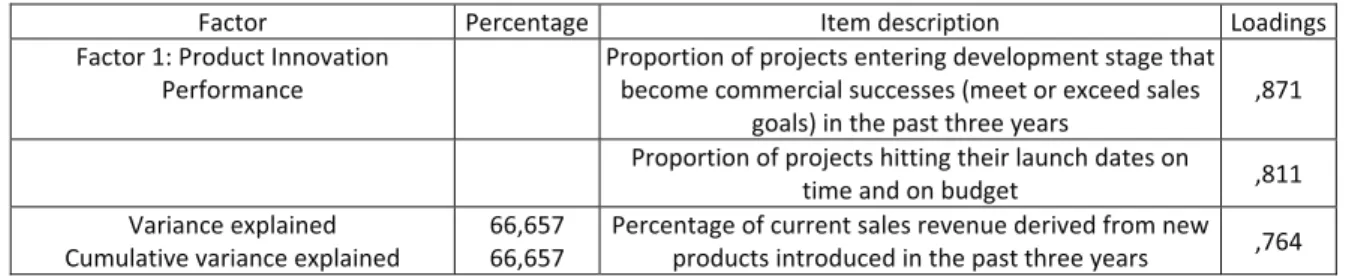
In what concerns product innovation performance, KMO’s measure of sampling adequacy was 0.653, signalling a reasonable quality of correlation between variables. Bartlett’s test resulted in a 0.000 level of significance, dismissing the hypothesis that the correlation matrix is the identity matrix. These results allowed us to proceed with factor analysis for product innovation performance. One single factor was extracted under the established criteria, as presented in Table 2, which accounts for 66,657 percent of cumulative variance explained. Therefore, we aggregated the three items into one single measure for product innovation performance. Again, all item loadings are over 0.5.
Table 2: Factor analysis results for product innovation performance
Factor Percentage Item description Loadings
Factor 1: Product Innovation Performance
Proportion of projects entering development stage that become commercial successes (meet or exceed sales
goals) in the past three years
,871
Proportion of projects hitting their launch dates on
time and on budget ,811 Variance explained
Cumulative variance explained
66,657 66,657
Percentage of current sales revenue derived from new products introduced in the past three years ,764
We proceeded by performing a multiple linear regression on the data resulting from our factor analysis. The results are contained on Figure 2.
! Number on top is the path coefficient ( ), t-value in brackets ! Significance levels: *p<.05; **p<.01; ***p<.001 (2-tailed).
RELATIONAL CAPITAL Vertical relationships 0.252* (2,159) Horizontal and institutional relationships Product Innovation Performance -0.191 (-1.657) R2 = 0.063
Figure 2: Regression analysis
The results confirm that relational capital does have a positive influence on product innovation performance, but strong differences in significance levels show that not all relational capital elements we considered have such a relevant effect. In fact, only the element we called “vertical relationships” reveals a significant impact on product innovation performance.
5.
Discussion, limitations and directions for future research
The objective of this study was to analyse the influence of relational capital on product innovation at innovative SMEs. We conducted a linear regression analysis between constructs to test our assumption, which was validated by the results: relational capital showed a positive and significant impact on product innovation performance. However, only one of the elements that comprise it revealed such an impact. That element was identified as “vertical relationships”, representing the existence and proactive management of vertical relationships (with customers and suppliers) aimed at improving the firm’s product innovation capabilities. Other types of relationships the firm establishes and manages with the exterior, namely with partners and competitors, shareholders, investors and other institutions, did not show a significant effect on product innovation performance at the companies we analysed. Looking at the overall responses to the questionnaire, we verify that horizontal and institutional relationships reveal much lower mean scores than vertical relationships, indicating that it is clearly more common to create and cultivate links with clients and suppliers than with other stakeholders.
These results are consistent with some fragmented research findings published recently in similar contexts (e. g. Bontis 1998; Cabrita and Bontis 2008; Chen et al. 2004), and allow us to generally conclude that the better
Pedro Figueroa Dorrego, Ricardo Costa and Carlos Fernández!Jardon Fernández
the innovative SMEs manage and nurture their relational capital, the more successful those firm’s product innovation efforts will be. The specific relevance of “vertical relationships” that was detected is consistent with the interpretation of relational capital as a manifestation of the firms’ “market orientation”. In fact, an effective way to gather important knowledge regarding current and future market needs is through the establishment of relationships with clients and suppliers. By doing this, firms are able to more easily obtain, absorb and internalise market knowledge and to manage their product development process in a more oriented and effective manner. This idea is reinforced by some authors from the product innovation research stream (for example Cooper et al. 2002 and Kotler 1991), who stress the importance of creating strong ties with clients and suppliers to enhance the firm’s ability to identify market needs and thus increase its product innovation effectiveness. Our research shows that these findings also seem to apply to innovative SMEs. We hope this study contributes to clarify which relational capital elements are the most important to product innovation success, offering some clues on how to address the problem of managing relational capital to increase product innovation performance. Creating and managing relationships with customers and suppliers seem to be key factors to consider.
This research has some limitations that need to be addressed. The first one relates to the characteristics and size of the population being studied, COTEC’s “Rede PME Inovação”. We cannot state without reservations that these firms are representative of all Portuguese innovative SMEs, so the generalization of our results must be cautious. Conducting further research within a larger population would be useful to confirm the generalization of our results to all innovative SMEs.
Another important issue to consider regards the decision to analyse the influence of only one intellectual capital component on product innovation. Some studies (for example, Bontis 1998; Bontis et al. 2000; Cabrita and Bontis 2008; Chen et al. 2004; Santos Rodrigues et al. 2010) have found that intellectual capital components often reveal relevant path dependencies among themselves, when measuring their combined influence on organizational phenomena. Low R2 readings on our model suggest the convenience to rebuild it by incorporating other intellectual capital components (namely structural capital and human capital). In the future we will study the combined impact of all dimensions of intellectual capital on product innovation performance.
References
Abetti, P. (2000) “Critical Success Factors for Radical Technological Innovation: a Five Case Study”, Creativity and Innovation Management, Vol. 9, No. 4, pp 208!221.
Abou!Zeid, E. and Cheng, Q. (2004) “The Effectiveness of Innovation: a Knowledge Management Approach”, International Journal of Innovation Management, Vol. 8, No.3, pp 261!274.
Ahuja, G. (2000) “Collaboration Networks, Structural Holes and Innovation: a Longitudinal Study”, Administrative Science Quarterly, 45 (2000), pp 425!455.
Bontis, N. (1998) “Intellectual Capital: an Exploratory Study that Develops Measures and Models” Management Decision, vol. 36, No. 2, pp 63–76.
Bontis, N. (1999) “Managing Organizational Knowledge by Diagnosing Intellectual Capital: Framing and Advancing the State of the Field”, International Journal of Technology Management, 18/5!6!7!8, pp 433–462.
Bontis, N.; Keow, W. and Richardson, S. (2000) “Intellectual Capital and Business Performance in Malaysian Industries”, Journal of Intellectual Capital, vol. 1, No. 1, pp 85!100.
Bueno, E. and Salmador, Mª. P. (2000) “Perspectivas sobre Dirección del Conocimiento y Capital Intelectual”, Instituto Universitario Euroforum Escorial, Octubre, Madrid.
Bullinger, H.!J.; Auernhammer, K. and Gomeringer, A. (2004): ”Managing innovation networks in the knowledge!driven economy” International Journal of Production Research, vol. 42, No. 17, pp 3337!3353.
Cabrita, M. and Bontis, N. (2008) “Intellectual capital and business performance in the Portuguese Banking Industry”, International Journal of Technology Management, vol. 43, No. 1!3, pp 212!237.
Cañibano L, Sanchez P, García!Ayuso M and Chaminade C (2002) “Directrices para la Gestión y Difusión de Información sobre Intangibles”, MERITUM Project, available at
http://www.uam.es/personal_pdi/economicas/palomas/DIRECTRICES%20MERITUN%20!%20 ESPANOL.pdf Chen, J.; Zhu, Z. and Xie, H. (2004) “Measuring Intellectual Capital: a New Model and Empirical Study”, Journal of
Intellectual Capital, vol. 5, No. 1, pp 195!212.
Cohen, W. and Levinthal, D. (1990) “Absorptive Capacity: A New Perspective on Learning and Innovation”, Administrative Science Quarterly, Special Issue: Technology, Organizations, and Innovation (March, 1990), 35/1, pp 128!152. Cooper, R.; Edgett, S. y Kleinschmidt, E. (2002) “Optimizing the Stage!Gate Process; What Best!practice Companies Do ! I”,
Research Technology Management, September!October 2002, pp 21!27.
Pedro Figueroa Dorrego, Ricardo Costa and Carlos Fernández!Jardon Fernández
Cooper, R.; Edgett, S. and Kleinschmidt, E. (2004) “Benchmarking Best NPD Practices – I”, Research Technology Management, January!February 2004, pp 31!43.
Cooper, R.; Edgett, S. and Kleinschmidt, E. (2004a) “Benchmarking Best NPD Practices – II”, Research Technology Management, May!June 2004, pp 50!59.
Cooper, R.; Edgett, S. and Kleinschmidt, E. (2004b) “Benchmarking Best NPD Practices – III”, Research Technology Management, November !December 2004, pp 43!55.
Curado, C., Henriques, P. and Bontis, N. (2011) “Intellectual CapitalDisclosure Payback”, Management Decision, vol. 49, No. 7.
De Jong, J. and Vermeulen, P. (2006) “Determinants of Product Innovation in Small Firms ! A Comparison Across Industries”, International Small Business Journal, vol. 24/6, pp 587!609.
Del Canto, J., and González, I. (1999) “A Resource!based Analysis of the Factors Determining a Firm’s R&D Activities”, Research Policy, 28 (1999), pp 891!905.
European Commission (2006) RICARDIS: Reporting Intellectual Capital to Augment Research, Development and Innovation in SMEs, Luxembourg.
European Commission (2010) Annual report on EU small and Medium!sized Enterprises 2009, Luxembourg.
Govindarajan, V. and Trimble, C. (2005) “Organizational DNA for Strategic Innovation”, California Management Review, vol. 47, No. 3, Spring, pp 47!76.
Hair, J.; Anderson, R.; Tatham, R. and Black, W. (1998), Multivariate Data Analysis, Fifth Edition, Prentice Hall, New Jersey. Hall, R. and Andriani, P. (2002) “Managing Knowledge for Innovation”, Long Range Planning, 35 (2002), pp 29!48. Hargadon, A. and Sutton, R. I. (1997) “Technology Brokering and Innovation in a Product Development Firm”,
Administrative Science Quarterly, 42/4, pp 716–49.
IADE (2003) “Metodología para Elaboración de Indicadores de Capital Intelectual”, Documentos Intellectus nº 4, Centro de Investigación sobre la Sociedad del Conocimiento ! Universidad Autónoma de Madrid.
INE – Instituto Nacional de Estatística (2010) Estudos sobre Estatísticas Estruturais das Empresas: Micro, Pequenas e Médias Empresas em Portugal, Instituto Nacional de Estatística, IP, Lisboa.
Kandemir, D.; Calantone, R. and Garcia, R. (2006) “An Exploration of Organizational Factors in New Product Development Success”, Journal of Business and Industrial Marketing, 21/5, pp 300!310.
Kotler, P. and Armstrong, G. (1991) Principles of Marketing, Prentice!Hall, Englewood Cliffs, NJ.
Leiponen, A. (2005) “Skills and Innovation”, International Journal of Industrial Organization, 23/2005, pp 303!323. Linzalone R., (2008) “Leveraging Knowledge Assets to Improve New Product Development Performances", Measuring
Business Excellence, vol. 12, No. 2, pp 38!50.
Montoya!Weiss, M., and Calantone, R. (1994) “Determinants of New Product Performance”, Journal of Product Innovation Management, 1994/11, pp 397!417.
Nonaka, I. and Takeuchi, H., (1995) The Knowledge!Creating Company, Oxford University Press, Oxford.
OECD ! Organisation for Economic Co!Operation and Development (2005) “Guidelines for Collecting and Interpreting Innovation Data”, Oslo Manual (3rd. Edition), OECD, Paris.
Pike, S.; Roos, G. and Marr, B. (2005) “Strategic Management of Intangible Assets and Value Drivers in R&D Organizations”, R&D Management, 35/2, pp 111!124.
Roos, G.; Bainbridge, A. y Jacobsen, K. (2001) “Intellectual Capital Analysis as a Strategic Tool”, Strategy & Leadership, vol. 29, No. 4, pp 21!26.
Santos Rodrigues, H.; Figueroa Dorrego, P. and Fernández!Jardón, C. M. (2010) "The Influence of Human Capital on the Innovativeness of Firms", International Business & Economics Research Journal (IBER), vol. 9, No. 9.
Shum, P. and Lin, G. (2007) “A world class new product development best practices model”, International Journal of Production Research, vol. 45, No. 77, pp 1609!1629.
Souitaris, V. (2002) “Firm!specific Competences Determining Technological Innovations: a Survey in Greece”, R&D Management, vol. 32, No. 1, pp 61!77.
Stewart, T. A., (1997) Intellectual Capital: The New Wealth of Organizations, Doubleday/Currency, New York, NY. Subramaniam, M. and Youndt, M. (2005) “The Influence of Intellectual Capital on the Types of Innovative Capabilities”,
Academy of Management Journal, vol. 48, No. 3, pp 450!463.
Thornhill, S. (2006) “Knowledge, Innovation and Firm Performance in High ! and Low – Technology Regimes”, Journal of Business Venturing, 21 (2006), pp 687!703.
Vaona, A. and Pianta, M. (2008) “Firm Size and Innovation in European Manufacturing”, Small Business Economics, vol. 30, No. 3, pp 283–299.
Youndt, M. A.; Subramaniam, M. and Snell, S. A. (2004) “Intellectual Capital Profiles: an Examination of Investments and Returns” Journal of Management Studies, 41/2, pp 335–61.
Wu, W.; Chang, M. and Chen, C. (2008) “Promoting Innovation through the Accumulation of Intellectual Capital, Social Capital, and Entrepreneurial Orientation”, R&D Management, vol. 38, No. 3, pp 265!277, June 2008.