UNIVERSIDADE DE LISBOA
FACULDADE DE CIÊNCIAS
MULTI
-
SKILL RESOURCE
-
CONSTRAINED PROJECT
SCHEDULING PROBLEMS
:
MODELS AND ALGORITHMS
Doutoramento em Estatística e Investigação Operacional
Especialidade de Otimização
Bernardo Pedro Esteves Ferreira de Almeida
Tese orientada por:
Prof. Doutor Francisco Alexandre Saldanha da Gama Nunes da Conceição
Prof. Doutora Isabel Cristina Silva Correia
UNIVERSIDADE DE LISBOA
FACULDADE DE CIÊNCIAS
MULTI
-
SKILL RESOURCE
-
CONSTRAINED PROJECT SCHEDULING
PROBLEMS
:
MODELS AND ALGORITHMS
Doutoramento em Estatística e Investigação Operacional
Especialidade de Otimização
Bernardo Pedro Esteves Ferreira de Almeida
Tese orientada por:
Prof. Doutor Francisco Alexandre Saldanha da Gama Nunes da Conceição
Prof. Doutora Isabel Cristina Silva Correia
Júri: Presidente:
● Doutor Luís Eduardo Neves Gouveia, Professor Catedrático Faculdade de Ciências da Universidade de Lisboa
Vogais:
● Doutor Jorge Manuel Pinho de Sousa, Professor Catedrático Faculdade de Engenharia da Universidade do Porto
● Doutor António José Galrão Ramos, Professor Adjunto
Instituto Superior de Engenharia do Porto, do Instituto Politécnico do Porto ● Doutor Luís Eduardo Neves Gouveia, Professor Catedrático
Faculdade de Ciências da Universidade de Lisboa
● Doutora Maria Eugénia Vasconcelos Captivo, Professora Catedrática Faculdade de Ciências da Universidade de Lisboa
● Doutor Francisco Alexandre Saldanha da Gama Nunes da Conceição, Professor Auxiliar Faculdade de Ciências da Universidade de Lisboa
Abstract
I
n this dissertation, project scheduling problems with multi-skill resources are investigated. These problems are commonly found in companies making use of human resources or multi-purpose machin-ery equipment. The general problem consists of a single project comprising a set of activities. There are precedence relations between the activities. Each activity requires one or several skills for being pro-cessed and for each of these skills, more than one resource may be needed. The resources have a unitary capacity per time unit and may master more than one skill. The resources can contribute with at most one skill to at most one activity that requires it, in each time unit. It is usually assumed that the resources are homogeneous, i.e., the proficiency at which each skill is performed is the same across all resources that master that skill. Preemption is not allowed, which implies that once an activity starts being processed it cannot be interrupted. When a resource is assigned to perform a skill for an activity, it remains in that status for the whole processing time of the activity. The objective of the problem is to schedule all the activities, satisfying all constraints such that the makespan of the project is minimized.After introducing a framework to the realm of project scheduling problems with multi-skill resources and highlighting the main objectives and contributes of this thesis, a state-of-the-art review on the topic is presented.
The particular problem investigated in this document is then described in detail and its specific fea-tures are discussed. To that end, a continuous-time mathematical formulation from the literature is re-visited, an example of the problem is presented and some aspects related to the computation of feasible solutions are discussed. This last topic is of major relevance when dealing with problems that combine personnel staffing with project scheduling.
In order to properly assess the quality of solutions obtained by the methodological developments pro-posed in this thesis, it became necessary to develop an instance generator to build a set of instances larger than those existing in the literature. After formally proposing such generator, we detail the characteristics of the two sets of instances considered for the computational experiments to be performed.
In the next sections of the document, the solution methodologies developed within the scope of this thesis are presented and thoroughly discussed.
A wide range of mathematical formulations is studied, two of which are first proposed in this docu-ment. From the assessment of their ability both to compute feasible and possibly optimal solutions and to derive good lower bounds (stemming from their linear programming relaxations) to the problem, it will become clear that the so-called discrete-time formulations yield the strongest lower bounds whereas a continuous-time formulation from the literature proved to be the most suitable for solving instances of the problem to optimality. This trend is observed for both sets of instances considered. Two constructive
Abstract
lower bound mechanisms proposed for the resource-constrained project scheduling problem are extended to account for the existence of multi-skill resources and multi-skill requirements of the activities. The results reveal that such methods improve the lower bounds achieved by the studied mathematical formu-lations for some instances.
Real-world project scheduling problems usually involve a large number of activities, resources and skills. Hence, the use of exact methods such as the standard techniques for tackling the aforementioned mathematical models, is often impractical. When faced with this kind of situations, a project manager may consider preferable to have a good feasible solution, not necessarily an optimal one, within an admissible time, by means of an approximate method.
A close look into the problem being investigated in this thesis reveals that it has some features that are not present in some well-studied particular cases of it, namely the notion of skill—multi-skill resources and skill requirements of the activities. Hence, with the objective of developing approximate solution methodologies that better exploit the specific characteristics of the problem at hand, two new concepts are introduced: activity grouping and resource weight. The well-known parallel and serial scheduling schemes, proposed originally for the class of resource-constrained project scheduling problems, are ex-tended to our problem setting and the two above-mentioned concepts are incorporated into these two new frameworks. Such frameworks use well-known activity priority rules for defining the order by which the activities are selected to be scheduled and resource weight rules to determine a set of resources that meets the requirements of all the activities to be scheduled at each time with the least total cost (weight). Thereafter, two heuristic procedures making use of those schedule generation schemes are proposed, namely a multi-pass heuristic built upon the parallel scheduling scheme and a biased random-key ge-netic algorithm. The idea of computing a feasible solution using the so-called backward planning is also considered in both methods.
The multi-pass heuristic retrieves the solution with the minimum makespan after performing a spe-cific number of passes, each associated with a unique combination of the considered activity priority rules, the developed resource weight rules and the two precedence networks: forward and backward.
The biased random-key genetic algorithm is a metaheuristic whose developed chromosome structure encodes information related to: (i) the priority values of the activities; (ii) the weights of the resources; (iii) how a chromosome is decoded, i.e., the scheduling scheme and precedence network scheme to be used for computing the associated makespan. By embedding all this information into the chromosomes, it becomes possible to take advantage of the evolutionary framework of the biased random-key genetic algorithm, which tends to allow the evolution of such data (change in their values) over time, towards better makespan valued solutions. Three variants of the biased random-key genetic algorithm are consid-ered with regard to the type of scheduling generation scheme to be used for decoding its chromosomes: (i) all chromosomes are decoded with the parallel scheduling scheme; (ii) all chromosomes are decoded with the serial scheduling scheme; (iii) the scheduling scheme to be used for decoding each chromosome depends on the value of the associated parameter which is embedded in the chromosome.
The computational results revealed that the proposed multi-pass heuristic is an efficient algorithm for computing feasible solutions of acceptable quality within a small computational time whereas the biased random-key genetic algorithm is a robust algorithm and a more competitive approximate approach for computing feasible solutions of higher quality, especially for harder instances such as those of medium and large dimensions.
We conclude this thesis with an overview of the work done and with some directions for further research in terms of methodological developments and of some potentially interesting extensions of the addressed problem.
Resumo
N
esta dissertação investigam-se problemas de sequenciamento de projetos com recursos limitados e polivalentes (multi-skill), i.e., recursos capazes de desempenhar diversas funções, estando cada uma delas associada à realização de uma competência (skill) específica. Estes problemas são habitualmente encontrados em empresas que trabalhem com recursos humanos ou máquinas cuja utilização possa sa-tisfazer várias finalidades distintas. Tipicamente, um problema deste tipo consiste num projeto que é composto por um conjunto de atividades, com determinadas durações e entre as quais existem relações de precedência. Cada atividade necessita de uma ou mais competências para ser processada e para cada uma dessas competências poderá ser preciso recorrer à alocação de mais do que um recurso. Os recursos têm uma capacidade unitária em cada unidade de tempo e detêm, normalmente, mais do que uma competência. Assume-se ainda que os recursos são homogéneos, i.e., a eficiência com que cada competência é realizada é a mesma para todos os recursos que a saibam desempenhar. Não é permitida a suspensão da execução das atividades, o que implica que uma vez que uma atividade comece a ser executada, não possa ser interrompida. Quando um recurso é afeto à realização de uma determinada competência para uma atividade, ele permanece a executar essa mesma competência durante todo o tempo de processamento da atividade. O problema tem como objetivo o sequenciamento de todas as atividades, satisfazendo todas as restrições, de forma a que o projeto termine o mais cedo possível.Após realizar uma breve introdução destinada ao enquadramento da área de investigação de proble-mas de sequenciamento de projetos com recursos limitados e polivalentes e, depois de se destacarem os principais objetivos e contributos desta tese, apresenta-se uma revisão da literatura da especialidade.
O problema particular alvo de estudo nesta tese é detalhadamente descrito sendo apresentados os aspetos específicos que o caracterizam. Revisita-se uma formulação matemática de tempo contínuo (continuous-time formulation), apresenta-se um exemplo do problema e discutem-se alguns aspetos rela-cionados com a determinação de soluções admissíveis para o mesmo. Este último tópico é de uma grande relevância quando se lida com problemas que combinam a alocação de recursos polivalentes com o sequenciamento de atividades de um projeto.
De forma a avaliar devidamente a qualidade das soluções obtidas pelos métodos propostos nesta tese, tornou-se necessário o desenvolvimento de um gerador de instâncias para construir um conjunto de instâncias de dimensões maiores do que as que existiam na literatura.
Após apresentar formalmente esse gerador de instâncias, descrevem-se em detalhe as características dos dois conjuntos de instâncias considerados nas experiências computacionais a serem realizadas.
Nas secções seguintes do documento apresentam-se e descrevem-se pormenorizadamente as meto-dologias desenvolvidas no âmbito desta tese.
Resumo
Várias formulações matemáticas são estudadas, duas das quais são propostas pela primeira vez nesta dissertação. Através da avaliação da capacidade das formulações estudadas em determinar tanto soluções admissíveis e, possivelmente ótimas, como bons limites inferiores (decorrentes das suas relaxações li-neares) para o problema, tornar-se-á claro que as formulações matemáticas de tempo discreto (discrete-time formulations) são as que permitem obter os limites inferiores de melhor qualidade enquanto que uma formulação matemática de tempo contínuo mostrou ser a mais adequada para resolver instâncias do problema. Esta tendência é observada para ambos os conjuntos de instâncias considerados. Dois métodos construtivos para obtenção de limites inferiores propostos para o problema de sequenciamento de projetos com recursos limitados são generalizados para considerarem a presença de competências tanto nos recursos como nos requisitos das atividades. Os resultados computacionais mostram que estes métodos melhoram os limites inferiores obtidos pelas formulações matemáticas estudadas em algumas instâncias.
Os problemas reais de sequenciamento de projetos envolvem geralmente um grande número de ativi-dades e de competências. Por isso, a utilização de métodos exatos, como as técnicas comuns para lidar com os modelos matemáticos referidos anteriormente, é frequentemente inviável. Quando confrontado com este tipo de situações, um gestor de projetos pode considerar preferível a obtenção de uma boa solução admissível, não necessariamente uma solução ótima, num tempo aceitável, mediante a utiliza-ção de um método aproximado.
Uma reflexão profunda sobre o problema analisado nesta tese revela que este possui algumas caracte-rísticas que não estão presentes em alguns casos particulares do mesmo muito estudados, nomeadamente a noção de competência—recursos polivalentes e requisitos das atividades expressos sob a forma de número de recursos necessário para processar cada competência requerida à sua execução.
Assim, com o objetivo de desenvolver métodos aproximados para calcular soluções admissíveis para o problema que explorem melhor as suas características específicas, introduzem-se dois novos conceitos: agrupamento de atividades e atribuição de pesos aos recursos. Os amplamente conhecidos esquemas de geração de sequenciamentos em paralelo (parallel scheduling scheme) e em série (serial scheduling scheme), propostos inicialmente para o problema de sequenciamento de projetos com recursos limitados, são generalizados para o problema em análise, e os dois conceitos referidos anteriormente são incorpo-rados nestes dois novos procedimentos. Estes algoritmos utilizam as conhecidas regras de prioridade para definir a ordem pela qual as atividades são escolhidas para serem sequenciadas bem como regras de atribuição de pesos para determinar um conjunto de recursos que satisfaça os requisitos de todas as atividades a serem sequenciadas num dado momento com o custo (peso) total mínimo. Seguidamente, duas heurísticas que utilizam os referidos esquemas de geração de sequenciamentos são propostas: uma heurística multi-pass que utiliza o referido esquema de geração de sequenciamentos em paralelo e um algoritmo genético de chaves aleatórias viciadas. O cálculo de uma solução admissível utilizando o conceito de sequenciar o projeto do fim para o começo (backward planning) também é considerado em ambos os métodos.
A heurística multi-pass devolve a solução associada à menor duração do projeto depois de realizar um número específico de execuções (passes), cada uma delas associada a uma combinação única de regras de atribuição de prioridade para as atividades, de regras de atribuição de pesos para os recursos, e de redes de precedência (sequenciamento das atividades do começo para o fim do projeto e do fim para o começo).
O algoritmo genético de chaves aleatórias viciadas é uma metaheurística cuja estrutura cromossómica desenvolvida codifica informação relativa a: (i) valores de prioridade das atividades; (ii) os pesos dos re-cursos; (iii) a forma como um cromossoma é descodificado, nomeadamente o algoritmo de geração de um sequenciamento para o projeto e a rede de precedência a serem utilizados para calcular o tempo associado de conclusão do projeto. Ao incorporar toda esta informação nos cromossomas, é possível tirar partido da estrutura evolutiva do algoritmo genético de chaves aleatórias viciadas que permite a evolução desses
da-Resumo
dos (alteração nos seus valores) no decorrer da sua execução, em direção a soluções associadas a menores durações do projeto. Consideram-se três variantes do algoritmo genético de chaves aleatórias viciadas de acordo com o tipo de geração de sequenciamento para o projeto a ser utilizado para descodificar os seus cromossomas: (i) todos os cromossomas são descodificados utilizando o parallel scheduling scheme; (ii) todos os cromossomas são descodificados utilizando o serial scheduling scheme; (iii) o esquema de geração de um sequenciamento para o projeto depende do valor do parâmetro associado.
A heurística multi-pass desenvolvida demonstrou ser um método eficiente para a obtenção de soluções admissíveis de qualidade aceitável dentro de um tempo computacional reduzido enquanto que o algo-ritmo genético de chaves aleatórias viciadas demonstrou ser um algoalgo-ritmo robusto e uma abordagem aproximada mais competitiva no que diz respeito à determinação de soluções admissíveis de melhor qualidade, em particular para as instâncias mais difíceis como aquelas de média e grande dimensão.
Esta tese termina com um resumo do trabalho desenvolvido e com algumas direções onde pode ser prosseguida a investigação nesta área tanto ao nível de desenvolvimento de metodologias como de algu-mas generalizações potencialmente interessantes do problema estudado.
Palavras-chave: Sequenciamento de projetos; recursos polivalentes; modelos de otimização; heurís-ticas; limites inferiores.
Acknowledgments
T
his dissertation results from a major endeavor undertaken throughout my Ph.D. journey which would had never been possible without the support and encouragement that I received from numerous people to whom I would like to express my sincere acknowledgments.Foremost, I would like to express my deepest gratitude to my Ph.D. supervisors Professor Francisco Saldanha da Gama of the Faculty of Sciences at the University of Lisbon and Professor Isabel Correia of Faculty of Sciences and Technology at NOVA University whose expertise and immense knowledge along with the continuous feedback provided kept me motivated and steered in the right direction towards the achievement of the outlined objectives.
I would like to express my sincere appreciation for the endless support that my family has provided me throughout my entire life and in particular during the course of my Ph.D. studies.
I am deeply grateful to my grandparents. Thank you for always being a source of inspiration to overcome all the challenges I have faced throughout my life and to contribute to my personal growth by sharing your passions, experiences and discoveries.
I would like to express my heartfelt indebtedness to my parents and my girlfriend for their wise and invaluable advice and for being always extraordinarily supportive and understanding. Without his encouragement and unconditional support, this dissertation would never have seen the light of day.
Finally, I would like to thank all of my friends for the vigorous support provided throughout this Ph.D. journey.
“You can’t be perfect, but if you don’t try, you won’t be good enough” —PAUL HALMOS
Contents
List of Figures xiii
List of Tables xv
List of Algorithms xvii
1 Introduction 1
2 Literature Review 5
2.1 Homogeneous Resources . . . 5
2.2 Non-homogeneous Resources . . . 10
2.2.1 Static efficiency levels . . . 10
2.2.2 Dynamic efficiency levels . . . 13
2.3 Conclusions . . . 14
3 The studied problem 17 3.1 Problem description . . . 17
3.2 Notation and a mathematical model . . . 21
3.3 Additional concepts and properties . . . 24
3.3.1 Compatibility issues . . . 24
3.3.2 Resource weights . . . 25
3.3.3 Activity priorities . . . 25
3.4 Instances for the MSRCPSP . . . 26
3.4.1 Relevant features . . . 26
3.4.2 Existing Instances . . . 27
3.4.3 An instance generator . . . 27
3.4.4 A new set of instances . . . 34
3.5 Conclusions . . . 36
4 Mathematical models and lower bounds 37 4.1 Enhancements for a continuous-time model . . . 38
4.1.1 Reduction tests . . . 39
4.1.2 Other inequalities . . . 40
4.2 Discrete-time models . . . 42
Contents
4.2.2 New models . . . 44
Model PDT . . . 44
Model PN . . . 46
4.2.3 Valid inequalities for the discrete-time models . . . 46
4.3 Lower bounds . . . 47 4.4 Conclusions . . . 50 5 Heuristic Algorithms 51 5.1 A multi-pass heuristic . . . 52 5.1.1 Priority rules . . . 53 5.1.2 Resource weights . . . 53
5.1.3 Parallel Scheduling Scheme — PSS . . . 54
5.1.4 Precedence network schemes . . . 57
5.1.5 The heuristic . . . 57
5.2 A Biased Random-key Genetic Algorithm — BRKGA . . . 58
5.2.1 Preliminaries . . . 59
5.2.2 Extension to the MSRCPSP . . . 60
5.3 Computational experiments and results . . . 64
5.3.1 Multi-pass heuristic . . . 64
5.3.2 Biased Random-key Genetic Algorithm — BRKGA . . . 74
5.3.3 Mathematical models and lower bounds . . . 86
5.4 Conclusions . . . 98
6 Conclusions and directions for future work 101
Bibliography 105
List of Figures
3.1 Example of the problem: precedence network. . . 19
3.2 Example of the problem: the critical path. . . 19
3.3 Example of the problem: an optimal schedule. . . 20
3.4 A generic GWt. . . 25
3.5 Precedence network after the initialization step. . . 29
3.6 Precedence network generation: four types of redundancy identified in Kolisch (1995). . 31
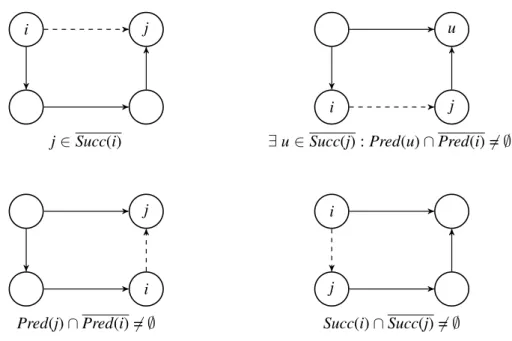
3.7 Graph for checking if an activity can be processed by the existing resources. . . 34
5.1 A generic eGWt. . . 55
5.2 A generic chromosome for the BRKGA. . . 63
List of Tables
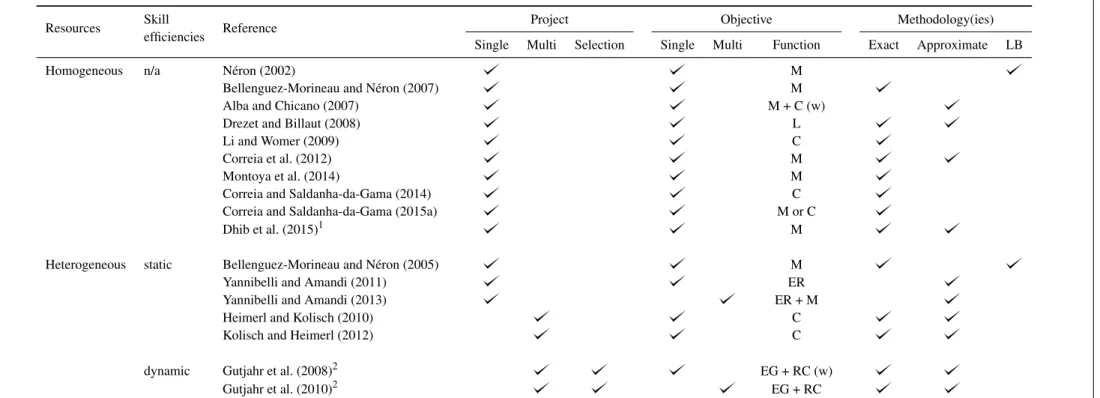
2.1 Literature review: characteristics of the problems and proposed methodologies. . . 15
2.2 Literature review: characteristics of the resources and of the activities. . . 16
3.1 Example of the problem: activities. . . 19
3.2 Example of the problem: resources. . . 19
3.6 Modified resource strength, skill factor and number of resources for instances in Set 1. . 27
3.10 Modified resource strength, skill factor and number of resources for instances in Set 2. . 35
3.11 Instance generator: an example of the input data. . . 35
3.12 An instance of the problem: partial precedence network. . . 35
3.13 An instance of the problem: resources. . . 36
3.14 An instance of the problem: activities. . . 36
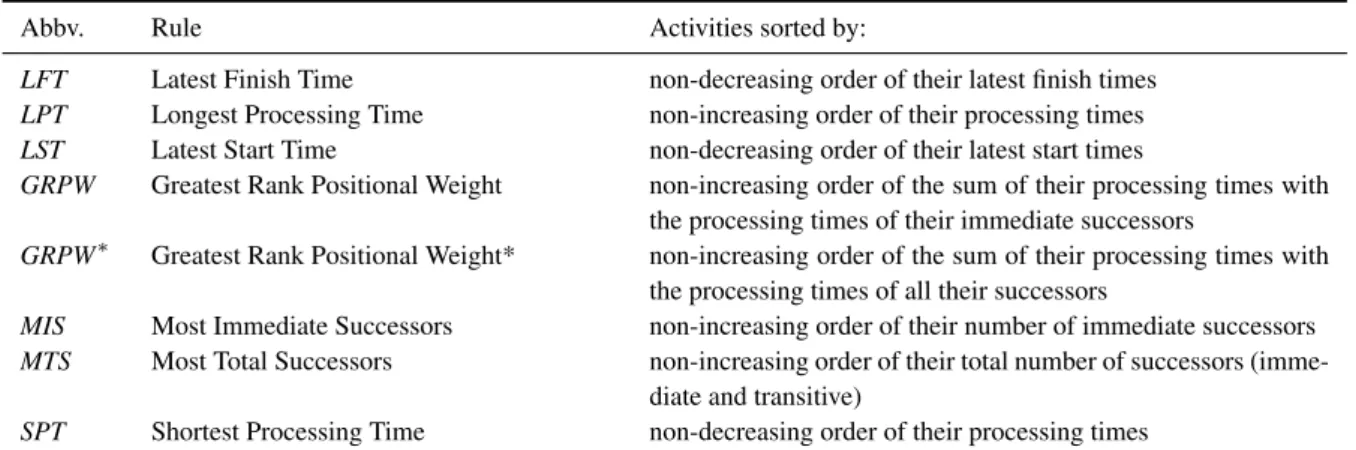
5.1 Activity priority rules. . . 53
5.2 Decoder parameters. . . 63
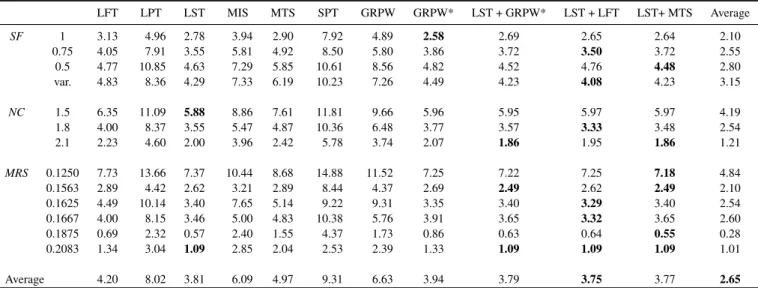
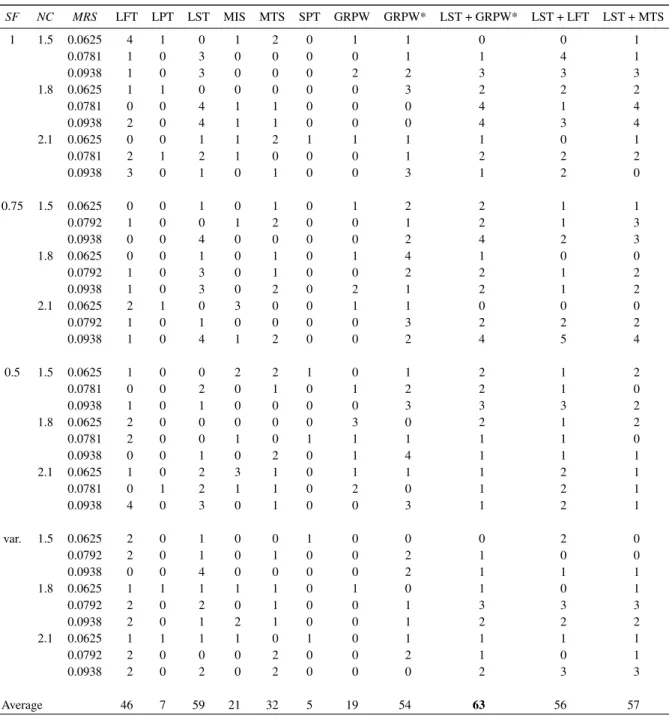
5.3 Multi-pass heuristic — Set 1: average gaps for the activity priority rules studied. . . 65
5.4 Multi-pass heuristic — Set 1: average gaps for each resource weight rule. . . 68
5.5 Multi-pass heuristic — Set 1: average gaps for each activity priority rule, summary. . . . 69
5.6 Multi-pass heuristic — Set 1: average gaps for each resource weight rule, summary. . . . 69
5.7 Multi-pass heuristic — Set 2: performance analysis of the activity priority rules. . . 71
5.8 Multi-pass heuristic — Set 2: multi-pass heuristic and CPLEX results. . . 72
5.9 Multi-pass heuristic — Set 2: performance analysis of the activity priority rules, summary. 73 5.10 Multi-pass heuristic — Set 2: multi-pass heuristic and CPLEX results, summary. . . 74
5.11 BRKGA — Preliminary tests for determining the values for the parameters of the BRKGA. 75 5.12 BRKGA — Results of the preliminary tests. . . 76
5.13 BRKGA — Set 1: comparative analysis. . . 79
5.14 BRKGA — Set 1: comparative analysis, summary. . . 80
5.15 BRKGA — Set 2: comparative analysis. . . 84
5.16 BRKGA — Set 2: comparative analysis, summary. . . 85
5.17 Mathematical formulations — Set 1: overall results. . . 87
5.18 Model PCT — Set 1: results per each value of SF, NC and MRS. . . 88
5.19 Model PNDDT — Set 1: results per each value of SF, NC and MRS. . . 89
5.20 Mathematical formulations — Set 2: overall results. . . 90
5.21 Model PCT — Set 2: results per each value of SF, NC and MRS. . . 90
List of Tables
5.23 Lower bounds — Set 1: SbCB and SbCSLB gaps. . . 92 5.24 Lower bounds — Set 2: SbCB and SbCSLB gaps. . . 94 5.25 Set 1 — Gaps of the developed heuristics computed using the best known lower bound. . 95 5.26 Set 2 — Gaps of the developed heuristics computed using the best known lower bound. . 96 5.27 Set 1 — Gaps of the developed heuristics computed using the best known lower bound,
summary. . . 97 5.28 Set 2 — Gaps of the developed heuristics computed using the best known lower bound,
List of Algorithms
3.1 A procedure for generating a precedence network. . . 29
3.2 A procedure for generating the information concerning the activities. . . 32
4.1 Reduction test proposed by Correia et al. (2012). . . 39
5.1 Resource assignment . . . 56
5.2 A Parallel Scheduling Scheme (PSS) for the MSRCPSP . . . 57
5.3 A multi-pass PSS heuristic . . . 58
5.4 Biased Random-Key Generic Algorithm (BRKGA) . . . 60
5.5 A Serial Scheduling Scheme (SSS) for the MSRCPSP . . . 62
7.1 Generating a precedence network — Step 1 . . . 111
7.2 Generating a precedence network — Step 2 . . . 112
7.3 Generating a precedence network — Step 3 . . . 112
7.4 Generating a precedence network — Step 3: removing arcs from the network . . . 113
7.5 Generation of the activities — Step 2 . . . 113
Terminology
A set of pairs of activities having no precedence relations.
AOA activity-on-arc network.
AON activity-on-node network.
BRKGA biased random-key genetic algorithm.
DDT disaggregated discrete-time precedence constraints, originally
proposed by Christofides et al. (1987) for the RCPSP.
E set of pairs of activities having an immediate precedence
re-lation.
EFj earliest finish time of activity j.
ESj earliest start time of activity j.
GWt = (VWt, EWt) network for determining whether a set of activities can be
pro-cessed simultaneously by the resources available at time t. e
GWt = (VWt, EWt) network obtained from GWt = (VWt, EWt) by replacing the weight of each arc (v0, k), k ∈ ZWt by the corresponding
re-source weight, wk.
GA genetic algorithm.
GRPW greatest rank positional weight priority rule: activities are
sorted in a non-increasing order of the sum of their processing times with the processing times of their immediate successors.
GRPW∗ greatest rank positional weight* priority rule: activities are
sorted in a non-increasing order of the sum of their processing times with the processing times of all their successors.
K total number of resources.
L total number of skills.
L = {1, . . . , l, . . . , L} set of skills.
Lj⊆ L set of skills required by activity j ∈ V \ {0, n + 1}.
Lk ⊆ L set of skills mastered by resource k ∈ R.
LWt =S
j∈WtLj set of skills required to process all the activities in Wt.
LFj latest finish time of activity j.
LFT latest finish time priority rule: activities are sorted in a
non-decreasing order of their latest finish times.
LP linear programming.
LPT longest processing time priority rule: activities are sorted in a
Terminology
LSj latest start time of activity j.
LST latest start time priority rule: activities are sorted in a
non-decreasing order of their latest start times.
makespan completion time of the project.
MCNFP(eGWt) min-cost flow problem on eGWt.
MILP mixed-integer linear program.
MIS most immediate successors priority rule: activities are sorted
in a non-increasing order of their number of immediate suc-cessors.
MRS modified resource strength.
MSRCPSP multi-skill resource-constrained project scheduling problem.
MTS most total successors priority rule: activities are sorted in a
non-increasing order of their total number of successors (im-mediate and transitive).
n total number of non-dummy activities to be scheduled.
NC network complexity.
pj processing time of activity j ∈ V.
PCT continuous-time formulation for the MSRCPSP proposed by
Correia et al. (2012).
PDT discrete-time formulation for the MSRCPSP proposed in this
thesis.
PDDT formulation obtained from PDT by replacing the precedence
constraints with the DDT ones.
PM discrete-time formulation proposed by Montoya et al. (2014).
PMDDT formulation obtained from PM by replacing the precedence
constraints with the DDT ones.
PN discrete-time formulation for the MSRCPSP proposed in this
thesis.
PNDDT formulation obtained from PN by replacing the precedence
constraints with the DDT ones.
Pred(j) set of immediate predecessors of activity j, j ∈ V \ {0}.
Pred(j) set of all predecessors of activity j (including those obtained
by transitivity), j ∈ V \ {0}.
PSS parallel scheduling scheme.
pvj priority value of activity j ∈ V \ {0, n + 1}.
R = {1, . . . , k, . . . , K} set of resources.
Rj= {k ∈ R : Lj∩ Lk6= ∅} set of resources mastering at least one skill required to process
activity j ∈ V.
Rl= {k ∈ R : l ∈ Lk} set of resources mastering skill l ∈ L.
rjl number of resources mastering skill l ∈ Ljrequired to process
activity j ∈ V. rWtl=P
j∈Wtrjl number of resources required to fulfill the requirements of
each skill l ∈ LWt.
RCPSP resource-constrained project scheduling problem.
RKGA random-key genetic algorithm.
SbCB skill-based capacity bound.
SbCSLB skill-based critical sequence lower bound.
Terminology
SPT shortest processing time priority rule: activities are sorted in
a non-decreasing order of their processing times.
SSS serial scheduling scheme.
Succ(j) set of immediate successors of activity j, j ∈ V \ {n + 1}.
Succ(j) set of all successors of activity j (including those obtained by transitivity), j ∈ V \ {n + 1}.
UB upper bound on the makespan of the project.
UV set of unscheduled activities at some time instant during the
execution of an algorithm.
V = {0, . . . , i, . . . , j, . . . , n + 1} set of activities to be executed. Activities 0 and n + 1 are dummy; they only represent the beginning and the end of the whole project, respectively.
Vl= {j ∈ V : l ∈ Lj} set of activities requiring skill l ∈ L.
Vk= {j ∈ V : Lj∩ Lk6= ∅} set of activities requiring skills mastered by resource k ∈ R.
wk weight of resource k ∈ R.
Wt subset of UV consisting of activities whose predecessors have
all been finished at time t. This set also contains the activities that have no predecessors.
XWtl⊆ ZWt set of resources in the optimal solution of MCNFP(eGWt) that meet the skill requirements l ∈ LWt.
ZWt set of resources that are available at time t and that master at
least one skill required by at least one activity in Wt.
dxe the smallest integer greater than or equal to x.
bxc the largest integer less than or equal to x.
CHAPTER
1
Introduction
P
roject scheduling is one of the most important tasks in project management. It can be defined as the process of sequencing the activities of a project without violating any of the imposed constraints (e.g., precedence relations, resource capacity, skill requirements, budget) such that a predefined performance measure is optimized. The makespan (i.e., the completion time of the project) and total cost are among the most studied performance measures.The first project scheduling problem studied considered a project comprising a set of activities linked by precedence relations. Each activity, alternatively referred to as task with exactly the same meaning, is associated with a specific processing time. The precedence relations between each pair of activities can be depicted in an activity-on-arc (AOA) network. The goal is to find an optimal schedule by se-quencing the activities while satisfying the precedence constraints such that the makespan of the project is minimized. The optimal solution to this problem consists in finding the longest path between the ini-tial and the terminal nodes in the above-mentioned precedence network, which is something that can be achieved in polynomial time. This problem was tackled by Kelley Jr. and Walker (1959) and Malcolm et al. (1959), who developed the well-known Critical Path Method (CPM) and Program Evaluation and Review Technique (PERT), respectively. The main difference between such approaches relies on how the processing times of the activities are determined. More specifically, the CPM assumes that the activities have a deterministic processing time while the PERT uses a probability distribution for computing the processing times of the activities. By assuming resource availability to be unconstrained, a huge draw-back associated with the difficulty in properly handling and allocating resources to concurrent activities was reported by Kelley Jr. and Walker (1959) in a practical application of the procedure developed therein.
When resources and their scarceness are taken into account, we dive into a major field of research which has been receiving an increasing attention from both researchers and practitioners that is the class of resource-constrained project scheduling problems (RCPSP). In these problems, resources are limited. Each resource has a specific capacity and is associated with meeting a specific need (e.g., bricks, people, money). Each activity requires specific units of each resource type for being processed. The goal is to find a schedule for the project such that all resource and precedence constraints are satisfied and a predefined performance measure is optimized. Besides the makespan minimization, other objectives have been considered, the more common being related to the presence of resources and to the cost that they represent to the project. This combinatorial optimization problem was proved to be N P-hard in the
1. Introduction
strong sense by Bła˙zewicz et al. (1983). The problem has been widely studied in the literature along with many variants of it due to their potential for application in many real-world settings.
Scheduling problems in general have always been tied to the development of new and more powerful computers which has made possible to take the research in this area one step further. The advances in both Computer Science and technology provided the opportunity for developing and studying numerous extensions of the RCPSP, with a particular emphasis to the multi-mode generalizations.
The multi-mode resource-constrained project scheduling problems assume that each activity may be processed in one of multiple ways, the so-called “modes”. Each mode of executing a given activity is defined by specific resource requirements and possibly by a specific processing time. The objective is to assign a mode and a start time to each activity, ensuring that the resource requirements and the precedence constraints are satisfied and such that a predefined performance measure is optimized. The most frequently considered performance measures are the same ones described above for the RCPSP.
The class of RCPSP has attracted the attention of numerous researchers who have presented new vari-ants of the basic problem and developed exact and heuristic procedures to address them. For overviews on resource-constrained project scheduling problems, the reader should refer to Herroelen et al. (1998), Brucker et al. (1999), Hartmann and Briskorn (2010), and W˛eglarz et al. (2011) as well as to the refer-ences therein.
More recently, and with the objective of better capturing the characteristics of realistic scheduling problems, a new class of problems emerged—the multi-skill resource-constrained project scheduling problems (MSRCPSP). These problems extend the well-known RCPSP and hence fall into the class of N P-hard combinatorial optimization problems. In a MSRCPSP, the resources besides being available in limited amounts are also associated with the ability of performing a range of functions, each of which associated with mastering a specific skill. These multi-competent resources are referred to in the liter-ature as multi-skill or flexible resources. In this context, the activities may need several skills for their execution, and for each one of those skills, several resource units may be required. These problems are drawing an increasing attention of researchers and practitioners due to their numerous applications in the real-world (e.g., software developments, civil engineering projects) particularly when human resources are involved. In this situation, when the capacity of the resources is unitary, the resulting problem can be formulated as a unit-capacity multi-skill resource-constrained project scheduling problem.
This is the type of problems studied in this thesis. This Ph.D. dissertation falls within the scope of Operations Research and emerges from the need of developing effective solution methodologies for tackling a particular unit-capacity multi-skill resource-constrained project scheduling problem, namely instances of the problem of large dimensions. More particularly, the contributions of this work are as follows (listed in order of appearance):
• a literature review. Due to the importance of discussing the particular problems investigated so far as well as of highlighting the limitations of the solution methodologies adopted, the literature considered to be the most relevant is reviewed;
• an instance generator. The development of an instance generator is of major relevance particularly in situations where no benchmark instances are available. A set of instances of large dimensions was built using such generator. By combining these new instances with a set of smaller instances from the literature it was possible to assess more properly the performance of the methodologies proposed in this thesis, than if only the smaller instances were considered;
• two optimization models. It is of particular interest to develop alternative mathematical formula-tions for the problem being studied even though it belongs to the class of N P-hard combinatorial optimization problems. In fact, mathematical formulations can still be used both to solve small instances of the problem and to yield lower bounds stemming from their respective linear program-ming relaxations. Lower bounds are especially useful to evaluate the performance of approximate
1. Introduction
methods;
• two methods for computing lower bounds. These methods, which require a negligible computa-tional effort, are specifically useful when, for example, the linear programming relaxations of some mathematical models cannot be solved to optimality within an admissible computational time; • two schedule generation schemes. These schemes extend well-known methods proposed for the
RCPSP to our problem setting. They can be considered the backbone for developing approximate solution methodologies to the problem and hence their development is of major relevance; • a multi-pass heuristic. When a schedule generation scheme is available, it is possible to perform
several executions (multiple passes) of it. Each execution (pass) is associated with both a dis-tinct set of rules (e.g., activity priority rules) among those considered and the schedule generation scheme to be used. By performing multiple passes, instead of a single one, several and possibly distinct makespan values are achieved. The multi-pass heuristic retrieves the best solution which corresponds to the smallest of those makespan values;
• a metaheuristic, namely a biased random-key genetic algorithm. Schedule generation schemes may also be embedded into more sophisticated frameworks. The main reasons for developing this particular genetic algorithm instead of any other metaheuristic are mainly associated with both the high-quality results it provided for resource-constrained project scheduling problems and the fact that the chromosomes resulting from crossover operations always encode a feasible solution to the problem, which is associated with the use of random-keys. This second aspect has a positive impact in the running time of the algorithm since it does not require any additional computational time to recover feasibility. Besides the aforementioned specific features, this metaheuristic also benefits from the general characteristics of genetic algorithms which contribute to an evolution towards better solutions, such as: (i) the ability to escape from local optima; (ii) the ability to handle multiple solutions (under the form of chromosomes) simultaneously; (iii) the ability to adapt problem-related values over time rather than using predefined rules for computing them. The remainder of this thesis is organized as follows. Chapter 2 presents a literature review of the field of research of multi-skill resource-constrained project scheduling problems. In Chapter 3, the specific problem being studied is thoroughly described and the developed instance generator is presented in detail. Chapter 4 is devoted to the development of mathematical formulations and lower bounds. In Chapter 5, the proposed approximate methods are presented and comprehensively discussed. The computational results of the proposed methodologies are also presented in this chapter. Finally, Section 6 presents some concluding remarks and suggests some directions for further research.
CHAPTER
2
Literature Review
I
n this chapter, we present a literature review on the relevant research done in the realm of project scheduling problems with multi-skill resources. While reviewing such work, it became clear that the references could be partitioned into two categories according to the efficiency levels at which the skills can be performed by the resources. Such classification allowed the definition of two types of resources: homogeneous and non-homogeneous. In Section 2.1, we present the studies that consider that each skill is performed with the same efficiency by all the resources that master it—homogeneous resources. In Section 2.2, we review the references that assume that the efficiency level at which each skill is performed may not be the same for all resources that master it—non-homogeneous resources. Furthermore, these efficiency levels may be constant or vary over time. We conclude this chapter by presenting an overview of the analyzed research.2.1
Homogeneous Resources
In this section, we present the studies that consider that all resources mastering a given skill perform it at the same efficiency level. The problems investigated in those studies may be partitioned into two classes: (i) the problems that consider that each activity requires only one resource to meet the demand of each skill needed for its execution—unitary skill requirements; (ii) the problems that do not impose such limit on the skill requirements of the activities—general skill requirements.
We begin by introducing the reviewed research that consider that the skill requirements of the activ-ities are unitary. Then, we present the studies whose analyzed problems do not impose such restriction.
Unitary skill requirements
Li and Womer (2009) investigate a problem in which the activities are linked by generalized precedence relations including minimal and maximal time lags and due dates. The minimal (maximal) time lag is defined for a pair of activities as the least (most) amount of time that has to elapse between their start times. Time lags are used to depict situations where the start time of one activity is constrained to a specific state of completion of some other activity, hence generalizing the classical precedence relations (e.g., start-to-start, finish-to-start).
In this problem, the activities require only one resource unit to fulfill the demand of each one of the skills needed for their execution. The resources have a predefined maximum workload capacity.
2.1. Homogeneous Resources
The objective is to minimize the total cost associated with the resources without violating a predefined deadline for the project. The authors develop a hybrid Benders decomposition approach and a cut-generating scheme, which links the master problem associated with the resource assignment, i.e., the problem of meeting the skill requirements of the activities, and the subproblem, which deals with the activity scheduling, i.e., the problem of finding whether a specific resource assignment corresponds to a feasible schedule that satisfies the stipulated precedence constraints. The resource assignment problem is formulated as a mixed-integer linear programming formulation (MILP) and solved by branch-and-bound and branch-and-cut whereas constraint programming is applied to check the feasibility of the scheduling problem. When performing the computational experiments, the authors assume that every resource re-ceives the same salary. Hence, the objective of the problem reduces to minimizing the number of distinct resources selected to perform the project. The computational results reveal that the proposed approach appears to be competitive to tackle the specific problem studied. Nonetheless, the characteristics of the instances considered are not fully described.
Dhib et al. (2015) study a project scheduling problem with multi-skill resources where some activities may be preempted, i.e., the execution of some activities may be interrupted. Resources are unavailable within some time-windows and the activities require only one resource for executing each skill needed for their execution. The processing time of each activity is not directly stipulated. Instead, there is a fixed duration associated with the execution of each one of the skills needed to process such activity. Moreover, despite the start time of an activity being the same for all its required skills, in an event of preemption, these skills may be restarted at different time instants. The resources assigned to each pair (activity, skill) cannot be changed even in the event of a preemption of the skill they were assigned to perform. As usual, it is only after all skills have been processed for a given activity, that its immediate successors become eligible to be scheduled. In this problem, each pair (activity, skill) can be seen as a separate task, if we assume that, for each activity, all its associated tasks have the same start time. The authors formulate the problem as a discrete-time MILP optimization model and suggest a parallel scheduling scheme for computing feasible solutions. A parallel scheduling scheme is a time-incrementing schedule generation scheme. A general parallel scheduling scheme can be briefly summarized as follows. Initially, the activi-ties are ranked according to some criteria and a time counter is set to zero. Then, at each time instant that corresponds to the conclusion of some activity(ies), a set of activities whose predecessors have already finished at that time is built—decision set. The highest ranked activity (according to the defined criteria) from that set is iteratively scheduled and the necessary resources are assigned to it. When all activities in that set have been scheduled or no more activities belonging to that set can be scheduled due to the lack of resources available at that time, the time counter is incremented to the minimum finish time of all activities already scheduled. At that time, a new decision set is then built and a new iteration starts. This process is repeated until all the activities in the project have been scheduled. The authors noted that the MILP model is only suitable for dealing with small instances of the problem. Regarding the proposed approximate method, it is important to notice that, by scheduling and fulfilling the requirements of the activities one at a time, a less efficient resource allocation may be obtained. Despite referring to solving a min-cost flow for resource allocation, the authors present neither a cost function nor rules for cost at-tribution. The computational experience performed is rather superficial.
General skill requirements
Néron (2002) studies a makespan minimization project scheduling problem with multi-skill resources. In this problem, the activities may require more than one resource to meet the demand of each skill needed for their execution. In that work, two methods for deriving lower bounds are proposed: one is based on linear programming and the other one on energetic reasoning. The former is an adaptation of a linear programming approach presented by Carlier and Néron (2003) (whose work was submitted for publication in 2001) for the resource-constrained project scheduling problem and the latter has been
2.1. Homogeneous Resources
previously applied by Baptiste et al. (1999) for the cumulative version of such problem. The cumulative resource-constrained project scheduling problem assumes that: (i) the capacity of each resource can be greater than one; (ii) each resource may process more than one activity at a time as long as its per period capacity is not surpassed. The energetic reasoning aims at finding, for each time interval, whether the available resources are enough to meet the requirements of all the activities being processed in such interval or not. Both methods for finding lower bounds are classified as destructive since the value of the lower bound supplied as input to the referred methods is incremented until no infeasibility on the constructed schedule is detected. No computational experience on the proposed lower bounds is presented.
Bellenguez-Morineau and Néron (2007) tackle a project scheduling problem with multi-skill re-sources. The resources may be unavailable within certain time periods, which are known beforehand. The objective is to minimize the makespan of the project. For solving this problem, the authors propose a branch-and-bound method with a depth first branching strategy and three different branching schemes: (i) activity with maximum slack; (ii) adaptation of the graph of compatibility lower bound proposed by Bellenguez-Morineau and Néron (2005) to the particular case where each is skill is performed with the same efficiency by all resources that master it; (iii) energetic reasoning lower bound proposed in Néron (2002). At each node of the branch-and-bound, an activity is selected and its slack is updated. Each node has two child nodes, one of which corresponds to a decrease of the latest finish time of the associated activity (in a number of time units that corresponds to the smallest integer greater than or equal to half of its slack) and the other to an increase of the earliest start time of that activity (in a number of time units that corresponds to the largest integer less than or equal to half of its slack). A leaf node is reached when all the activities have a zero slack. To assure the feasibility of that node, a fixed-job problem has to be solved. This auxiliary problem helps checking whether the skill requirements of the activities can be met at the designated start times. The authors present a superficial computational experience and conclude that the proposed branching strategies have roughly the same performance. The characteristics of the instances used are not extensively detailed. The authors do not present any indicators to measure the degree of difficulty of the referred instances or any evidence that ensures that they are feasible instances of the problem. In this situation, it becomes impossible to categorize the instances according to some sort of parameter(s) and consequently to properly assess the quality of the proposed solution methodology. The only information provided is the total number of instances considered and the ranges of their number of activities, resources and skills.
Correia et al. (2012) propose a MILP mathematical formulation for solving a project scheduling problem with multi-skill resources. The authors derive several valid inequalities and reduction tests with the objective of enhancing the model by fixing some variables at their optimal values beforehand, hence reducing the search space. Since an upper bound on the completion time of the project was required for some of the valid inequalities above, the authors propose a simple heuristic inspired on the well-known parallel scheduling scheme. The approximate method proposed by Correia et al. (2012) is a two-phase heuristic. The first phase comprehends the construction of a feasible solution and the second phase consists in applying a local search procedure to that solution, in an attempt to improve its quality. The constructive phase is slightly different from the generic parallel scheduling scheme described previously. The proposed constructive procedure schedules blocks of at most three activities at a time. All activities in a block start at the same time and the completion time of a block is equal to the maximum finish time across all activities in that block. A block is built by iteratively selecting and scheduling the unscheduled activity with the most total successors and which has all its predecessors already scheduled and finished. The resources are then assigned to that activity by finding a feasible flow in a specific network, without accounting for the skill requirements of other activities that may still be scheduled at that same time. When either the current block consists of three activities or it is not possible to schedule more activities at that time, the time is incremented to the completion time of that block. After building a feasible
2.1. Homogeneous Resources
solution to the problem, the local search phase of the heuristic starts. The neighborhood of the proposed local search procedure consists of all solutions that differ from the initial one by swapping exactly two activities belonging to adjacent blocks. From those solutions, the algorithm selects the one associated with the least makespan. Due to the absence of judiciously generated instances in the literature, the authors develop a methodology to build instances for the MSRCPSP, which was inspired in the instance generation for the RCPSP. The authors built instances with different characteristics, that caused different degrees of difficulty to the solver. The computational results show that the proposed methodology is competitive for solving instances of small and medium dimensions.
Montoya et al. (2014) develop a branch-and-price algorithm for tackling a multi-skill resource-constrained project scheduling problem. The objective is to minimize the makespan of the project. A discrete-time formulation is presented along with a column generation procedure, and combined into a branch-and-price. The discrete-time formulation and the branch-and-price algorithm are solved using an off-the-shelf solver. The computational results suggest that the branch-and-price procedure may be more competitive than the discrete-time formulation regarding the number of optimal solutions achieved. Nonetheless, it is important to note that, due to the lack of information regarding the instances consid-ered, similarly to Bellenguez-Morineau and Néron (2007), we cannot conclude about the suitability of the proposed branch-and-price method to tackle some properly generated and well-described instances such as the ones built by Correia et al. (2012).
Correia and Saldanha-da-Gama (2015b) noted several inconsistencies in the formulation of Montoya et al. (2014) and present a corrected version of such discrete-time mathematical model.
Correia and Saldanha-da-Gama (2014) study the project scheduling problem with multi-skill re-sources investigated by Correia et al. (2012) but consider a different objective function. The objective is to minimize the fixed and variables costs associated with the resources while assuring that the project finishes before a stipulated deadline. More precisely, the fixed costs are associated with the selection of a resource to participate in the project (perform a skill for at least one activity) and the variable costs depend on the makespan value of the derived schedule. Both costs are dependent on the number of skills mastered by each resource (i.e., resources mastering a wider range of skills are costlier). The authors develop a mixed-integer optimization model with a non-linear objective function, which was later lin-earized through the introduction of a set of continuous variables and additional constraints. With the objective of improving the mixed-integer linear programming formulation, several sets of valid inequal-ities already considered by Correia et al. (2012) were included in the developed mathematical model. In the computational experience, the authors assess the impact of fixed and variable costs separately and together on a comprehensive set of instances built upon those generated by Correia et al. (2012). The numerical results reveal that the proposed approach is efficient for tackling the referred instances.
Correia and Saldanha-da-Gama (2015a) develop a general modeling framework for a project schedul-ing problem with multi-skill resources. More precisely, the authors address modelschedul-ing issues related to the development of a MILP modeling framework that depicts the characteristics of the problems studied by Li and Womer (2009) and by Correia et al. (2012), simultaneously. It is shown that several variables can be fixed in a preprocessing phase and that the valid inequalities proposed by Correia et al. (2012) are suitable to be included in the developed framework.
Alba and Chicano (2007) and Drezet and Billaut (2008) also consider homogeneous resources but with some additional assumptions that allow to distinguish the problems studied by these authors from the references presented previously. In the first work, a project scheduling problem faced by software de-velopment companies is studied. The objective is to minimize a weighted average of cost and makespan of the project. Two weights are considered (one for the makespan and other for the cost) for modeling the relative importance of the two objectives. The authors provide a general verbal description of the characteristics of the problem. Each multi-skill resource has a monthly salary and a maximum degree of dedication to the project, i.e., the fraction of its working day where it may contribute to the project. Each
2.1. Homogeneous Resources
activity needs a set of skills and its requirements are expressed under the form of man-hours per month. Unlike the majority of the research on project scheduling problems with multi-skill resources, Alba and Chicano (2007) consider that the processing times of activities are not known beforehand and also that their requirements for being processed are not skill-specific. In fact, the processing times of the activities depend on the number and dedication level of the assigned resources. It is understood that an activity may be processed by only one resource. Moreover, there does not appear to be an upper limit on the number of resources that can be assigned to each activity. The only constraint is that each skill required by an activity must be mastered by at least one of the resources assigned to it. Hence, as long as there are resources that master each one of the required skills, it seems possible to additionally assign resources whose mastered skills are not required by such activity. These resources contribute to decreasing the processing time of that activity. Since no skill-specific requirements are defined, we may conclude that the authors assume that the resources may contribute with all the skills they master simultaneously to the activities they are assigned to perform. From the example given by the authors, it also seems possible to assign the same resource to concurrent activities. No mathematical formulation for the problem is presented. A genetic algorithm is proposed to tackle the described problem. Despite stating that the resources are available to work overtime and that a highly working resource may increase a specific error rate, the authors appear to have neglected these factors when the proposed algorithm was developed. From the presented computational results, it is not possible to conclude that the proposed metaheuristic is an adequate method for tackling this problem. This is due to its inability to provide feasible solu-tions consistently and to the fact that neither a gap nor other performance measure is presented, which is usually considered mandatory for a proper evaluation of an approximate method. Additionally, the computational time consumed by the proposed solution methodology is not reported. The instances were generated by the authors using an algorithm that is not fully clear and which appears to allow the addi-tion of precedence relaaddi-tions (between pairs of activities) without checking if their inclusion introduces redundancy in the network.
In Drezet and Billaut (2008), a particular project scheduling problem faced by software companies is studied. The requirements of the activities are not expressed as a number of resources per each skill required. Instead, the authors determine, beforehand, the resources that are eligible to perform each ac-tivity (possibly accounting for the skills mastered and needed, respectively). Two types of requirements for executing each activity are defined. Both of them are time-dependent, meaning that the requirements of an activity may not be constant throughout its execution. More specifically, the processing time of each activity can be partitioned into unitary time intervals. Each one of these time intervals is associated with a specific demand of resource units, which is bounded by a minimum and maximum value. Ad-ditionally, there are also skill requirements in each time interval, but in a different setting. Similarly to Alba and Chicano (2007), the skill requirements of each activity appear not to be skill-specific and hence are similar to the aforementioned demand of resource units. These skill requirements are also bounded by a minimum (maximum) value, which seem to result from aggregating the minimum (maximum) skill requirements across all skills needed to process such activity, in each time interval. The latter means that the pairs (resource, skill) are not determined for each pair (activity, time interval). The number of assigned resources in each time period does not have any impact in the processing time of the activity, which is a fixed and predefined value. The resources that can be assigned to meet each of the described requirements have to be among the ones defined beforehand as capable of performing such activity. A resource can be assigned to perform an activity for its whole processing time or only for a subset of the time periods when it will be in progress. In the latter case, the two following conditions must hold: (i) the activity cannot be preempted, which means that the resource requirements and skill requirements have to remain satisfied (i.e., if withdrawing a resource results in a violation of any of the lower limits for the requirements defined above, another resource will have to replace the removed one); (ii) there is a maximum number of resource assignments/withdrawals during the execution of the activities that
2.2. Non-homogeneous Resources
has to be respected. There is a minimal and a maximal length for the working day of each resource as well as a maximum number of activity changes throughout each working day. The objective of the problem is to minimize the maximum lateness. For each activity, its lateness denotes the deviation, in time units, between the due date of such activity and its actual finish time. The authors present a mathe-matical formulation for the problem and develop a greedy heuristic and a tabu search to compute feasible solutions to it. From the mathematical formulation, we may conclude that the skill requirements of a given activity in each time interval are met considering all the resources busy within such time interval and which were defined as candidate to perform this activity (regardless if they are actually performing this activity or other concurrent activities). The heuristic is based on a serial scheduling scheme and the tabu search considers swap moves between resources and activities and right or left-shifts of one activ-ity by one or several time periods. The serial scheduling scheme is an activactiv-ity-incrementing schedule generation scheme whose procedure can be briefly summarized as follows. Initially, the activities are ranked according to some criteria. Then, according to the defined criteria, the best precedence feasible activity is scheduled at the earliest (feasible) time possible and the necessary resources are assigned to it. The method repeats until all activities in the project are scheduled. Both approximate methods al-low the violation of some constraints namely the ones related to the length of the working day of each resource, its maximum number of assignments/withdrawals and the ones associated with meeting the skill requirements of the activities. The authors claim to have considered two criteria in the objective function. In this objective function, the total number of violated constraints has to be minimized before the maximal lateness. However, it is not clear how such is assured. The computational study is not fully explained and the numerical experiments are very limited. The authors claim to have fixed the values for some parameters of the tabu search according to the results provided by preliminary tests whose details are not presented (e.g., the ranges of values considered for each parameter). The characteristics of the instances considered for the computational experiments performed are not clearly described. The results reveal that the number of violated constraints decreases after employing the tabu search. No gap measure is computed. Furthermore, the derived solutions are associated with the violation of constraints, which implies that they not consist of feasible solutions to the studied problem.
2.2
Non-homogeneous Resources
In this section, we review the references that consider that the efficiency level at which a given skill is performed may vary across the resources mastering that skill. This non-uniform efficiency/exper-tise/proficiency of performing a given skill is also referred to in the literature as hierarchical levels of skills (see, for instance, Bellenguez-Morineau and Néron, 2005). We designate hereafter this type of resources as non-homogeneous or alternatively, heterogeneous. Moreover, we would like to point out that these efficiency levels may be constant or may vary over time (corresponding to their improvement or deterioration).
We begin by presenting in Section 2.2.1, the research that considers that the efficiency at which a resource performs a given skill remains unchanged throughout the planning horizon—static levels of efficiency. Later, in Section 2.2.2, we review the papers that allow the possibility of these efficiencies varying over time—dynamic levels of efficiency.
2.2.1 Static efficiency levels
Bellenguez-Morineau and Néron (2005) study a project scheduling problem with multi-skill resources where each skill may be performed at different efficiency levels and the resources may be unavailable in predefined time-periods. A resource can perform each one of the skills it masters at every efficiency level equal or smaller than its top efficiency level for that skill. The objective is to minimize the makespan. The
2.2. Non-homogeneous Resources
authors develop two lower bounds. One of the proposed lower bounds is based on finding a maximum-weight independent set in a compatibility graph. We note that the maximum-maximum-weight independent set problem is N P-hard and hence this approach may be improper to deal with instances of reasonable dimensions. This specific graph is built by linking all pairs of activities that can be in progress simulta-neously (i.e., their processing time-windows overlap and there are enough resources to process them at the same time). The authors claim to have tried solving the maximum-weight independent set problem by an approximate method and by a MILP formulation using an off-the-shelf solver. The other lower bound extends the energetic reasoning lower bound proposed by Néron (2002) to account for the multi-levels of efficiency at which a skill can be performed. No computational results are presented.
Yannibelli and Amandi (2011) investigate a multi-skill project scheduling problem where each ac-tivity requires skills that may be performed at different efficiency levels. The objective function of the problem regards the assignment of the set of most efficient resources to the activities underlying a soft-ware project. No mathematical formulation for the problem is presented. The authors propose a genetic algorithm that coordinates a serial scheduling scheme for tackling this problem. The number of genes in each chromosome is considered to be two times the number of activities in the project. The chromo-some structure of the genetic algorithm comprehends information defining a precedence feasible order by which activities are selected to be scheduled and the list of the specific resources that should be as-signed to each one of them. Hence, the information specific to each activity spans across two genes. The proposed serial scheduling scheme is not extensively detailed. It is important to note that the absence of a deadline on the completion of the project may allow the building of schedules where activities are processed one after the other, each of which having always the set of most apt resources assign to it. Such solutions appear to be optimal solutions to the problem according to the designated objective. In the computational experiments, it assumed that the resources only master one skill. The characteristics of the instances are not extensively detailed.
Yannibelli and Amandi (2013) extend the previous work by considering a multi-objective problem that seeks to minimize the makespan of the project besides assigning the most effective set of human resources to the activities. The authors propose a metaheuristic consisting of a multi-objective simu-lated annealing algorithm embedded into a multi-objective evolutionary algorithm. In each iteration of the evolutionary algorithm, the multi-objective simulating annealing is applied to each solution with the objective of preventing the premature convergence of the evolutionary algorithm. The chromosome structure of the evolutionary algorithm is the same one used in the reference presented above (Yannibelli and Amandi, 2011). The authors state that a serial scheduling generation scheme has been employed to decode the chromosomes. No detailed explanation of the developed methodologies, namely the em-ployed serial scheduling scheme is given. The authors assume, similarly to what was considered by Yannibelli and Amandi (2011), that the resources only master one skill in the computational experiments performed. Moreover, the characteristics of the instances are not properly explained. The authors claim to know the optimal solution of the objectives when addressed individually. Nonetheless, no source for those values of reference is provided.
Multi-skill resources have also been considered in multi-project environments (i.e., when several concurrent projects have to be scheduled) but with additional assumptions. We present next, some of the research done in this direction.
Heimerl and Kolisch (2010) study a cost minimization project scheduling problem with multi-skill resources faced by a company. The authors do not consider a project selection phase, which implies that all the available projects have to be scheduled. For each project, the sequence by which the activi-ties are processed and consequently its makespan is known beforehand. Nonetheless, it is necessary to determine both the start time of each project (which have to be within a predefined time-window) and the resources that should be assigned to meet its skill requirements in each time slot where it will be in execution. There are two kinds of resources: internal and external, which have specific costs. The