Carvalhais, L., Limpo, T., Richardson, U., & Castro, S.L. (2020). Effects of the Portuguese Graphogame on reading, spelling, and phonological awareness in second graders struggling to read. Journal of Writing Research, 12(1), 9-34. https://doi.org/10.17239/jowr-2020.12.01.02 Contact: Lénia Carvalhais, Universidade Portucalense, Rua Dr. António Bernardino Almeida, 541-619, P 4200-072, Oporto | Portugal - [email protected]
Copyright: Earli | This article is published under Creative Commons Attribution-Noncommercial-No Derivative Works 3.0 Unported license.
Effects of the Portuguese GraphoGame
on Reading, Spelling, and Phonological
Awareness in Second Graders
Struggling to Read
Lénia Carvalhais°, Teresa Limpo*, Ulla Richardson
+& São Luís Castro*
° Portucalense University | Portugal * University of Porto | Portugal
+ University of Jyväskyla | Finland
Abstract: The interest in computer-assisted interventions to promote literacy has increased over the years. In this study, we developed the Portuguese version of the GraphoGame Fluent and tested its effects on reading, spelling, and phonological awareness. Second graders struggling to read were randomly assigned to two groups: GraphoGame Fluent group (n = 15), which received a computer-assisted remedial reading intervention, or GraphoGame Math group (n = 15), which received a computer-assisted numeracy intervention. An additional, non-playing group, composed by second graders without reading difficulties, was formed (business-as-usual group, n = 15). Results showed clear benefits of GraphoGame on spelling and phonological awareness. After the intervention and one month later, the GraphoGame Fluent group displayed spelling and phonological awareness skills similar to the business-as-usual group, and above the GraphoGame Math group. Overall, these findings indicate that Portuguese struggling readers benefit from computer-assisted interventions that combine letter-sound correspondences with more complex orthographic patterns.
Keywords: computer-assisted intervention; reading; spelling; phonological awareness; Portuguese GraphoGame
1. Introduction
Over the last decades, there has been an increasing research focus on the development of computer-assisted interventions to promote literacy in children at risk of reading difficulties (Lyytinen, Erskine, Kujala, Ojanen, & Richardson, 2009; McCandliss, 2010; Saine, Lerkkanen, Ahonen, Tolvanen, & Lyytinen, 2011; Solheim, Frijters, Lundetrae, & Uppstad, 2018). Although most published studies were based on learning to read in English (Kyle, Kujala, Richardson, Lyytinen, & Goswami, 2013; Lyytinen et al., 2009), which is classified as an opaque orthography (Seymour, Aro, & Erskine, 2003), recent studies have focused on transparent orthographies, such as Finnish (Richardson & Lyytinen, 2014). However, little is still known about the effectiveness of computer-assisted literacy interventions in intermediate depth orthographies. This is the case of Portuguese, in which the correspondences between phonemes and graphemes are not always univocal (Seymour et al., 2003). In this study, we tested if Portuguese struggling readers benefit from a computer-based intervention in early phases of reading/writing development (Grade 2, age 7-8). Here, struggling readers refer to children struggling with the process of acquiring automaticity in word reading.
1.1 Development and Promotion of Reading and Spelling
An important model of reading development is Ehri’s stage model (Ehri & McCormick, 1998; Saine et al., 2011). This five-stage model emphasizes the importance of letter-sound relationships in learning to read. During the pre-alphabetic stage children distingue visual cues as logos associated with words, shapes, and letter names. In the partial-alphabetic stage children use phonetic cues regarding the link between letters and sounds to start recognizing words (e.g., initial letters). In the full-alphabetic stage, children can fully apply the alphabetic principle to decode familiar and unfamiliar words. With reading practice, children move to the consolidated alphabetic stage, where they start joining multi-letter units into words. Finally, in the automatic stage, children are able to read words with fluency and accuracy. According to this model, children progress across theses stages through explicit and systematic reading instruction focused on letter-sound correspondences (Saine et al., 2011). This kind of teaching, providing training in phonological awareness with highly structured reading instruction (Hatcher, Hulme, & Ellis, 1994; Hatcher et al., 2006), helps children to realize that spoken words can be broken into smaller units of sounds and to learn the multitude of spelling-sound correspondences (Gillon, 2004).
An identical stage-like progression has been proposed for spelling (Ehri, 1992; for a review see Babayiğit, 2009). In the earliest stage, children realize that writing is different from drawings. Their first writing attempts are characterized by scribbles or letter-like shapes. With increased exposure to print and the beginning of reading
instruction, children realize that speech is represented by alphabet letters. At this stage, children make use of partial alphabetic knowledge to spell words in writing. The progressive increase of alphabetic knowledge leads to full alphabetic spelling, in which children spell words by applying the alphabetic principle. However, given the complexity of orthographic systems, exclusive reliance on this strategy may lead to errors, mainly when spelling complex words (e.g., homophones). Progressively, children acquire more sophisticated knowledge of the spelling system, including knowledge of orthographic patterns and morphological relationships among words.
Supporting the key role of the alphabetic principle in reading and spelling development, several studies showed the effectiveness of interventions targeting letter-sound correspondences to promote both reading (Fletcher, Lyon, Fuchs, & Barnes, 2007; Snowling & Hulme, 2011) and spelling (Graham, Harris, & Fink Chorzempa, 2002). However, the mainstream approach to reading and spelling instruction still fails to support at-risk children (Hatcher, Hulme, & Snowling, 2004). The use of technology through computer games seems a promising means to support children that struggle in the initial steps of learning to read and write.
1.2 Computer-Assisted Tools: GraphoGame
1There are several advantages in using computer-based teaching tools. For example, they reduce the demands of traditional instruction (Knight et al., 2020; Nicolson, Fawcett, & Nicolson, 2000), allow children to receive responsive and immediate feedback (Lyytinen, Aro, Holopainen, Leiwo, Lyytinen, & Tolvanen, 2006), promote individualized learning by adapting tasks to children’s learning progress, and increase children’s motivation to be engaged in the learning task (Richardson & Lyytinen, 2014; Vandermeulen, Leijten, & Van Waes, 2020). Computer-assisted reading interventions seem particularly effective for those at-risk for reading difficulties (Blok, Oostdam, Otter, & Overmaat, 2002; Nicolson et al., 2000). However, for the success of those tools, it is crucial to catch children’s attention, adapt the task to their learning in a playful environment, and motivate them to complete the tasks. A reading program that was developed based on these premises was the GraphoGame (Lyytinen, Ronimus, Alanko, Poikkeus, & Taanila, 2007).
The GraphoGame program was created to enrich regular remedial intervention with individualized repetition of carefully selected items (Lyytinen et al., 2007). Across several motivating games, this tool trains the partial-, full-, and consolidated-alphabetic stages proposed in Ehri’s model (Ehri & McCormick, 1998). This is achieved by exposing children to phoneme-grapheme correspondences along with specific knowledge about letters, which together improve reading fluency and accuracy (Lyytinen et al., 2007). Notably, this study also found transfer effects of GraphoGame to writing, in particular, to children’s spelling skills. The game is
organized according to a hierarchy of streams, levels, and items with increasing difficulty. Children’s progress along these depend upon their learning.
A typical task within GraphoGame involves two steps (Lyytinen et al., 2009). First, players listen to a spoken item, which can be presented as many times as needed. Second, players must select the written item that matches the spoken item, presented among several distractors. The written items can be letters, syllables, onset-rimes, words or pseudowords. Players are then immediately provided with visual (color) and auditory (sound) feedback, indicating a correct or incorrect answer. A correct answer allows children to move forwards in the game. After an incorrect answer, the target item appears again (with or without distractors), giving children the opportunity to learn. The rationale behind this procedure is that task difficulty increases or decreases depending on the players providing correct or incorrect answers, respectively (Richardson & Lyytinen, 2014; Ronimus, Kujala, Tolvanen, & Lyytinen, 2014). The progression throughout the game is therefore automatically computed in accordance with the responses provided by children so that a success probability of 80% is kept constant ( Kujala, Richardson, & Lyytinen, 2010; Lyytinen et al., 2009). Another important feature of the GraphoGame is the reward system used, which aims to keep children motivated to play. At the root of this system is a personal avatar, selected by the players from the very beginning, and the stamps he/she receives after each level, which are pasted in the player’s personal page.
For each player, the GraphoGame web platform presents information about games’ exposure time and performance (i.e., lower and higher marginal know-how expressed in percentage of correct answers). The platform also saves several other performance indicators organized into a table. For an item, the table displays the number of times the item was presented, accuracy percentage of the first and last seven trials (representing players’ level of success at the beginning and end of each session), mean accuracy percentage of all trials, and the lowest and highest success level. Users can have access to more fine-grained results graphically presented through the Daisygraphs, which illustrate discrimination between letters (Lyytinen et al., 2009). Based on these graphs, it is possible to determine how well a player distinguishes a target item from a specific distractor.
1.3 Effectiveness of the GraphoGame
GraphoGame is now a worldwide computer game adapted to several different languages (around 30 versions; more information from https://info.grapholearn.com/ partners/) and used in the four continents: Europe (e.g., Austrian, Swiss-German, Greek, Dutch, Norwegian versions), Africa (e.g., Nyanja, Kiswahili, or Afrikaans); America (e.g., Chilean Spanish, Brazilian Portuguese, Canadian); and Asia (British English as a second language, Indonesian, Pinyin, and Mandarin). It was initially developed for preventive purposes.
Specifically, it was designed for Finnish children showing early signs of reading difficulties at the end of kindergarten.
The first evidence on the effectiveness of GraphoGame came from pilot studies. Initial results were very promising, by indicating that non-reading children were able to acquire basic reading skills after 4 hours of gaming (Lyytinen et al., 2007). In the first pilot study described by Lyytinen and collaborators (2007), twelve kindergarteners were divided into two groups, who played the GraphoGame or a math-focused game (active control). Performance in a blending task – in which children were asked to say a full word form presented by the computer in segments (viz., syllables and/or phonemes) – revealed the first efficacy results of the Finish GraphoGame. Saine and colleagues (2011) conducted a longitudinal intervention study using the GraphoGame method with Finnish speakers, who were followed from Grade 1 to 3. Based on the assessment of the pre-reading skills of 166 seven-year-old students, 50 children were identified as struggling readers and assigned to one of two intervention groups receiving remedial reading support via traditional methods or GraphoGame. Results showed that GraphoGame greatly improved children’s reading and spelling skills and that it was highly beneficial compared to traditional support. Because Finnish has a transparent orthography, the relationship between phonemes and graphemes (or vice-versa) is univocal. Thus, the design method developed to train contents in Finnish language using the GraphoGame is very straightforward. The game starts introducing the simplest correspondences (e.g., a, s, t) and moves to correspondences that are phonetically less distinguishable (e.g., m, n, l). Only later are larger units, such as syllables and rimes, targeted in the games, followed by whole words (Richardson & Lyytinen, 2014).
Other versions of the GraphoGame were created for less transparent orthographies, such as English, and the efficacy of its different versions have been shown (Richardson & Lyytinen, 2014). For example, Kyle and collaborators (2013) developed the English GraphoGame Rime and the English GraphoGame Phoneme, which were administered to poor readers in Grade 2. Although both forms were designed to automatize grapheme-phoneme conversion skills, one game targeted phoneme-level units, whereas the other focused on orthographic rime units. Different groups of children played each game for 12 weeks, during five sessions per week (total of 11 hours of training). Results showed that, regardless of targeting phonemes or rimes, GraphoGame resulted in gains in reading, spelling, and phonological awareness compared with an untreated control group. In addition to the Phoneme and Rime versions, there is also a GraphoGame Fluent version designed to promote fast and effortless reading. The GraphoGame Fluent also aims to impact on the teaching practices of literacy in children with specific reading difficulties who need extra help for learning. One study that tested the GraphoGame Fluent with poor readers of Finish found clear gains in reading speed regarding all trained syllables, and transfer effects to the word level for certain types
of syllables (Heikkilä, Aro, Närhi, Westerholm, & Ahonen, 2013). The Finnish GraphoGame Fluent version was adapted to English, German, and Polish. The current study aimed to adapt it to Portuguese (see the Method section for more detail on the features of the adapted version). Portuguese is an orthography of intermediate depth with some orthographic complexities (Seymour, Aro, & Erskine, 2003), which are acquired throughout primary school (Mesquita, Carvalhais, Limpo, & Castro, 2020). At the end of Grade 1, children seem to have already acquired basic decoding skills (Fernandes, Ventura, Querido, & Morais, 2008). They were able to correctly read and spell an average of 6 out of 8 simple words and about half of their errors were due to partial or complete parsing of words phonemic structure. Thus, the GraphoGame Fluent version seemed particularly suitable for second graders with basic decoding skills but struggling with the process of acquiring automaticity in word reading. Indeed, the Fluent version was designed to overcome the limitations of other versions focused on individual letter-sound correspondences, and therefore more appropriate for second graders and/or children with difficulties in acquiring the alphabet principle.
1.4 Present Study
As noted above, GraphoGame has been largely implemented either in transparent orthographies, such as Finnish (Saine et al., 2011), or opaque orthographies, such as English (Kyle et al., 2013). Little is still known about the advantages of GraphoGame to promote reading and spelling skills in struggling readers in orthographies of intermediate depth, such as Portuguese, as well as across different educational systems and instructional contexts. This was the main goal of the present study, in which we developed and tested the Portuguese version of GraphoGame Fluent (Richardson, 2011).
After adapting the original Finish version to Portuguese, GraphoGame was implemented with second graders displaying low results in standardized reading measures. Struggling readers playing GraphoGame Fluent over a 6-week period were compared with struggling readers playing GraphoGame Math (Richardson & Lyytinen, 2014), and their peers without reading difficulties. Students’ reading, writing, and phonological awareness skills were assessed before and after training as well as one month later. Based on the previously surveyed research, we anticipated that GraphoGame Fluent would improve children’s reading, spelling, and phonological awareness skills. These gains were expected to be induced by the systematic and explicit training targeting not only phoneme-grapheme correspondences but also larger units, such as syllables, rimes, and whole words; along with training on the specific rules of the Portuguese orthography.
2.
Method
2.1 Screening Procedure
A total of 104 second graders from two schools in a middle-class urban area in Portugal were invited to participate in the study via school authorities and parents. Except for two students who failed to return parental consent and one student who transferred to a school in another country, all other children were assessed to determine their reading and cognitive abilities (M = 7.6 years, SD = 0.3, range 7.1-9.1; 58 boys). Students’ reading skills were assessed with the Reading Age Test (Teste de Idade de Leitura, hereafter TIL; Sucena & Castro, 2010; see description below under Measures). Their cognitive abilities were assessed with the Progressive Raven Coloured Matrices (PRCM; Simões, 2002). The whole sample achieved an average score of 30.98 (SD = 16.40) in the TIL, and 26.34 (SD = 4.18) in the PRCM. The following criteria were set to identify poor readers: (a) a score within the 1st quartile (0–25% accuracy) in the TIL test, (b) a score above the 1st quartile in the Portuguese norms of the PRCM test; and (c) teacher’s classification of the child as a poor reader. Thirty children fulfilled the three criteria.
2.2 Participants and Design
The 30 children that met inclusion criteria were pseudo-randomly divided into two groups matched on sex, reading skills, and cognitive ability: GraphoGame Fluent condition and GraphoGame Math condition. An additional business-as-usual (BAU) group was formed by randomly selecting 15 students included in the screening procedure who exhibited typical reading development and without cognitive difficulties (mainstream students). Before starting the intervention, one-way Analyses of Variance (ANOVAs) revealed no group differences (Fs < 2.62, ns) in terms of age, intellectual ability, and vocabulary (assessed with the Peabody Vocabulary Test, Portuguese version from Vicente, Sousa, & Silva, 2011). Descriptive statistics by group are displayed in Table 1.
2.3 Educational Setting
Reading and spelling are important contents of the Portuguese curriculum in primary school (Buescu, Morais, Rocha, & Magalhães, 2015). In Grade 1, teachers focus more on developing children’s decoding skills, whereas from Grade 2 onward they start targeting reading comprehension skills more explicitly. Children are expected to read texts of different genres and to improve their vocabulary. Reading comprehension is promoted by teaching children how to reformulate texts and how to identify and analyze text elements (e.g., sequence of events, main theme, characters’ intentions and emotions). Typically, teaching spelling involves explicit instruction of orthographic rules and rote memorization, trained through dictations
and error-finding activities. Of interest in the present study is the lack of use of technology through computer games to promote reading and spelling skills.
Table 1. Students’ Characterization by Condition
GraphoGame Fluent GraphoGame Math BAU
N 15 (7 boys) 15 (6 boys) 15 (7 boys)
Age (years)
M 7.54 7.51 7.49
SD 0.25 0.24 0.24
min 7.20 7.20 7.10
max 7.90 7.90 7.80
Raven Coloured Matrices (raw score)
M 26.27 24.00 27.20 SD 4.74 3.89 3.00 min 18.00 17.00 20.00 max 35.00 31.00 32.00 Vocabulary (Peabody) M 130.33 133.07 134.67 SD 20.02 18.89 19.88 min 91.00 102.00 106.00 max 175.00 184.00 170.00
Note. BAU = business as usual.
2.4 Interventions
General procedure
The intervention groups played the computer games for approximately 15 min daily for four/five sessions a week over a 6-week period. Each child completed a maximum of 28 sessions for a total of 7 hours of gaming. The school provided a quiet room with six PC computers with Windows XP and an internet connection, where five to six children at a time could play the games. Children played the games individually on separate laptops with headphones after the regular school schedule. This minimized disruption of the rest of the class and ensured that the children in the training programs were exposed to the same contents as their classmates. One of the authors (LC) was present to set up the laptops at the beginning of each
session, welcome the children and make sure that the training sessions unfolded smoothly; she also provided general encouragement and motivation.
GraphoGame Fluent Portuguese Version
The development of the Portuguese GraphoGame took into account the properties of Portuguese orthography, mainly those critical to the transition from purely alphabetic to skilled reading. The game provides practice in simple letter-sound correspondences as well as in complex word and sentence reading, including an intermediate level of syllable processing (overall, 966 stimulus items). Syllables are of the Consonant-Vowel type (96%), as these syllabic structures are the most common in Portuguese (Gomes & Castro, 2003). Words are uninflected nouns selected from Portulex (Teixeira & Castro, 2007) and Escolex (Soares et al., 2014), which are lexical databases providing word frequency counts based on schoolbooks from Grades 1-6. Only high-frequency words were used to maximize the probability that they would be familiar to children (knowing their meanings and phonological forms, the child would be better able to focus on the speech-to-print associations). Overall, the stimuli included in the game vary across three dimensions: lexicality (words and pseudowords), length (different extensions of words, rimes, and syllables), and orthographic complexities (different letter-sound correspondences).
Based on the orthographic complexities of the Portuguese spelling system, the game was organized into seven levels with increasing difficulty. The first level focused on vowels and a set of consonants with one-to-one correspondences (viz., <b>, <p>, <d>, <t>, <f>, <v>, <m>, <n>, and <l>). After hearing the sounds, players have to select the corresponding letter from a set of distractors, which are randomly selected or chosen on the basis of visual similarity (Simpson, Mousikou, Montoya, & Defior, 2013). An example is depicted in Figure 1: The player hears the sound [i] and has to click on the corresponding ball with the letter <i>.
In the second level, the complex graphemes <lh> and <nh> are introduced through rime units. The third level introduces contextual regularities of nasal vowel spellings (e.g., to represent a nasal vowel followed by a consonant, <m> is used before <p> and <b>, and <n> is used in the remaining cases). The fourth level targets word-initial clusters. This is an important issue in Portuguese because as CV is the typical syllable structure, CCV and CVC structures are prone to error (e.g., confusions between <pi/pri/pir>). In line with prior research (Struiksma, van der Leij, & Stoel, 2009), these types of word-initial clusters were trained first in syllables and then words. An example is depicted in Figure 2: The player hears the syllable [pri] and has to click on the corresponding ball with the consonantal cluster <pri>.
Figure 1. Example of the Portuguese GraphoGame Fluent (phoneme level): The player hears
the sound [i] and has to click on the corresponding ball with the letter <i>, presented among a random and a visually similar distractor (respectively, <a> and <t>). The loudspeaker, once clicked, allows the player to hear the sound again, and the bar at the bottom represents the player’s progress in that game. Both the loudspeaker and the bar are present in all games.
Figure 2.Example of the Portuguese GraphoGame Fluent (syllable level): The player hears the syllable [pri] and has to click on the corresponding ball with the consonantal cluster <pri>, presented among a random <bu> distractor and easily-confused distractors (<pi>, <pir>, and <pro>).
In the fifth level, players train regularities associated with fixed position rules. Specifically, the letter <r> at the beginning of any word is always read as a trill [R], but between vowels and as part of a CVr it is read as a flap [r], and the trill between vowels must be spelled <rr> (as in, respectively, rato [ ́Ratu], mouse; caro [ ́karu], expensive; parte [part], part; carro [ ́kaRu], car). The sixth level focuses on regularities associated with <g> which are more complex and not determined by absolute position: the letter <g> corresponds to the velar stop [g] if followed by <a, o, u>, but it corresponds to the voiced fricative if followed by <i> or <e> (as in, respectively, gato [ ́gatu], cat; golo [ ́golu], goal; gume [ ́gum], edge and guizo [‘gizu], rattle; giro [ ́ʒiru], nice; gelo [ ́ʒelu], ice). Finally, the seventh level focuses on the one-to-many correspondences of the letter <s> (as in, saco [ ́saku], bag; caso [ ́kazu], case) and the associated complex grapheme <ss> (as in, osso [ ́osu], bone).
Besides letters, syllables, and words, the GraphoGame Fluent Portuguese version also includes pseudowords and sentences. Pseudoword-based games aim to train grapheme-phoneme correspondences in shorter and longer sequences (n = 44). These are organized in levels of increasing length, from 2- to 6-letter items. Sentence-based games aim to tap reading beyond the word level (n = 270). Here, the game involves reading for meaning: The child has to read the sentence and judge whether it is true or false. The sentences were adapted from the original version. They were first translated to Portuguese and then backtranslated to English, in order to achieve a final set of sentences culturally adapted to Portuguese children.
Before starting to play at a given level, there is an initial test to assess the child’s current knowledge and determine the baseline from which to select the stimuli. This procedure guarantees that performance is successful at the predetermined level. After training at that level, a final test is done. In this test, half of the items are the ones that were trained, and the other half includes new items to test whether the learning generalized.
GraphoGame Math
In order to determine if potential effects of training with the GraphoGame Fluent Portuguese were specifically due to practice in reading rather than general motivational factors, we formed an active control group composed of poor readers. These students received training in mathematics implemented through the GraphoGame Math (Richardson & Lyytinen, 2014), which we adapted to Portuguese. With the exception of instructions, which were translated and recorded in Portuguese, all math exercises were the same as used in the original Finnish version. The instructions were short and could be easily understood by second graders. The exercises consisted in the identification of quantities, counting, and addition. In an exercise for identifying quantities, children are presented with a set of images with different numbers of birds; then, they are asked to select the image with more birds
or to arrange the images in ascending/descending order. In a counting exercise, children are explained that, in number sequences, they can go forwards (e.g., 1, 2, 3), or backwards (e.g., 3, 2, 1); then, they are requested to indicate the number that comes after/before a set of numbers presented at a time. In an exercise to practice addition, children see two pictures, one with two trees and another with one tree; then, they are asked to choose the picture representing the total number of trees.
2.5 Procedure and Measures
To examine the effectiveness of GraphoGame, before and after the interventions as well as one month later, students did a set of tests examining their reading, spelling, and phonological skills.
Reading
Two tests were used to assess reading abilities: TIL (Sucena & Castro, 2010) and the Portuguese Dyslexia Differential Diagnosis Maastricht (3DM; Blomert & Vaessen, 2009; Reis et al., 2020). TIL was used to assess reading comprehension. This is a short 5-min test composed of 36 sentences where the final word is missing. The child is asked to select the appropriate word from a set of five alternatives. The final score is the number sentences correctly completed. From the 3DM battery, we used three subtests: high-frequency word reading, low-frequency word reading and pseudoword reading. These are computer tasks where the child is asked to read aloud as accurately and quickly as possible lists of words or pseudowords presented on the computer screen (30 s for each list). In the three subtests, the final score is the number of words correctly read. This score combines both response accuracy and speed.
Spelling
Spelling was assessed with the Portuguese 3DM writing-to-dictation subtest (Reis et al., 2020). The experimenter reads aloud the word that the child is asked to write down. The task contains 96 words divided into four levels of orthographic complexity, from simple one-to-one correspondences to inconsistent words. The final score is the number of words correctly spelled.
Phonological awareness
The ability to segment speech into sound units was examined with two subtests from the battery Reading Assessment in European Portuguese (ALEPE; Sucena & Castro, 2011). We used the implicit awareness of rimes task, in which students are asked to detect if a pair of words share the same rime (e.g., responding Yes to marca
- pardo; 20 items), and the explicit awareness of syllables task, where children are asked to say what is the common unit in a pair of words (e.g., responding bur to the
pair burgo-burla; 12 items). In both tests, the final score is the number of correct responses.
3.
Results
In a set of preliminary analyses, firstly, we tested if our data met the normality assumption of parametric procedures. The inspection of the skewness and kurtosis of all pretest and posttest scores revealed no severe distributional problems, as the absolute values of these indexes did not exceed 3.0 and 10.0, respectively (Kline, 2005; other stringent criteria have however been proposed, e.g., West, Finch, & Curran, 1995).
Secondly, we tested if there were differences between groups for all dependent measures at pretest. As expected, one-way ANOVAs showed that struggling readers in the GraphoGame Fluent and Math conditions did not differ in any dependent variable (all ps > .83) and that these students performed more poorly than those in the BAU condition in all variables (all ps < .04).
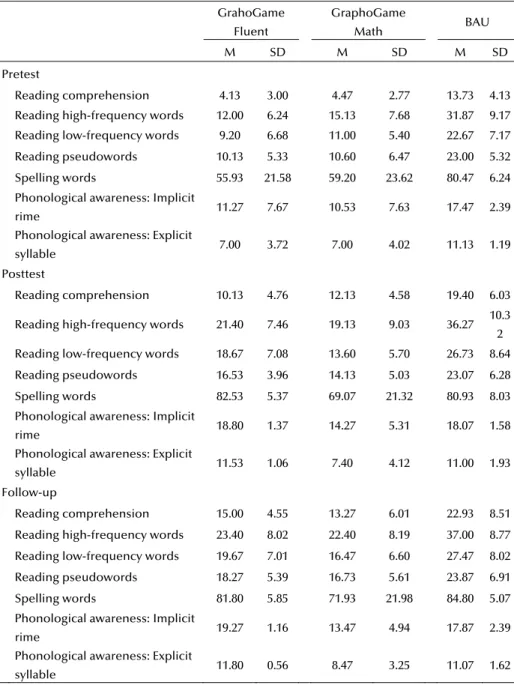
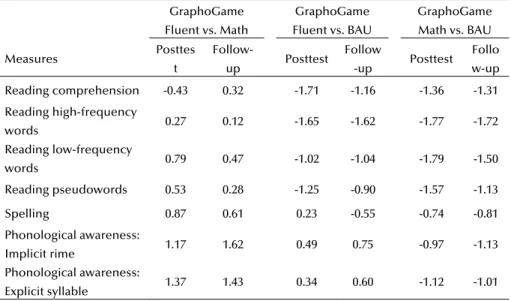
To examine the effectiveness of the Graphogame Fluent Portuguese version, we conducted 3 x 3 (Condition [GraphoGame Fluent, GraphoGame Math, BAU] x Testing Time [pretest, posttest, follow-up]) ANOVAs with repeated measures on the last factor. Table 2 provides means and standard deviations for all dependent variables. As can be seen in Table 3, ANOVA results revealed significant main effects of group and time as well as significant Group x Testing Time interactions for all dependent variables. In what follows, only the results of the interactions are presented. Condition x Testing Time interactions were examined by means of tests of simple main effects. First, we report results regarding differences between conditions within each testing time. Then, we present results regarding differences between testing times within each condition. Significant simple effects were followed-up through pairwise comparisons. Table 4 reports Cohen’s d for all pairwise comparisons between conditions at posttest and follow-up (Cohen, 1988).
3.1 Reading Comprehension
Tests of simple main effects for the interaction revealed differences between conditions at pretest, F(2, 42) = 39.60, p < .001, ηp2 = 0.65, posttest, F(2, 42) = 13.36, p
< .001, ηp2 = 0.39, and follow-up, F(2, 42) = 9.26, p < .001, ηp2 = 0.31. For the three
measurement occasions, follow-up analyses revealed that students in the GraphoGame Fluent and GraphoGame Math conditions performed poorer that students in the BAU condition (all ps < .002). Tests of simple main effects also revealed differences between testing sessions for the GraphoGame Fluent, F(2, 41) = 38.46, p < .001, ηp2 = 0.65, GraphoGame Math, F(2, 41) = 31.73, p < .001, ηp2 = 0.61,
and BAU conditions, F(2, 41) = 27.60, p < .001, ηp2 = 0.57. Whereas the reading
comprehension skills of students GraphoGame Fluent and BAU conditions increased from pretest to posttest, and from posttest to follow-up (all ps < .001),
Table 2. Means and Standard Deviations for All Measures in each Condition by Testing Time GrahoGame Fluent GraphoGame Math BAU M SD M SD M SD Pretest Reading comprehension 4.13 3.00 4.47 2.77 13.73 4.13 Reading high-frequency words 12.00 6.24 15.13 7.68 31.87 9.17 Reading low-frequency words 9.20 6.68 11.00 5.40 22.67 7.17 Reading pseudowords 10.13 5.33 10.60 6.47 23.00 5.32 Spelling words 55.93 21.58 59.20 23.62 80.47 6.24
Phonological awareness: Implicit
rime 11.27 7.67 10.53 7.63 17.47 2.39
Phonological awareness: Explicit
syllable 7.00 3.72 7.00 4.02 11.13 1.19
Posttest
Reading comprehension 10.13 4.76 12.13 4.58 19.40 6.03 Reading high-frequency words 21.40 7.46 19.13 9.03 36.27 10.3
2 Reading low-frequency words 18.67 7.08 13.60 5.70 26.73 8.64 Reading pseudowords 16.53 3.96 14.13 5.03 23.07 6.28 Spelling words 82.53 5.37 69.07 21.32 80.93 8.03
Phonological awareness: Implicit
rime 18.80 1.37 14.27 5.31 18.07 1.58
Phonological awareness: Explicit
syllable 11.53 1.06 7.40 4.12 11.00 1.93
Follow-up
Reading comprehension 15.00 4.55 13.27 6.01 22.93 8.51 Reading high-frequency words 23.40 8.02 22.40 8.19 37.00 8.77 Reading low-frequency words 19.67 7.01 16.47 6.60 27.47 8.02 Reading pseudowords 18.27 5.39 16.73 5.61 23.87 6.91 Spelling words 81.80 5.85 71.93 21.98 84.80 5.07
Phonological awareness: Implicit
rime 19.27 1.16 13.47 4.94 17.87 2.39
Phonological awareness: Explicit
syllable 11.80 0.56 8.47 3.25 11.07 1.62 Note. BAU = business as usual.
Table 3. Results of the 3 (Condition) x 3 (Testing Time) Repeated Measures ANOVAs. ME of Condition ME of Testing Time Condition x Testing Time Interaction Measures F(2, 42) ηp2 F(2, 41) ηp2 F(4, 84) ηp2 Reading comprehension 18.08*** 0.46 92.94*** 0.82 2.48* 0.11 Reading high-frequency words 20.07*** 0.49 86.59*** 0.81 5.48*** 0.21 Reading low-frequency words 13.83*** 0.40 84.83*** 0.81 7.11*** 0.25 Reading pseudowords 14.71*** 0.41 33.24*** 0.62 5.73*** 0.21 Spelling words 4.22* 0.17 37.80*** 0.65 8.31*** 0.28 Phonological awareness: Implicit rime 7.72** 0.27 12.74*** 0.38 3.39* 0.14 Phonological awareness: Explicit syllable 9.28*** 0.31 10.78*** 0.35 5.57** 0.21 Note. ME = main effect.
* p < .05. ** p < .01. *** p < .001.
Table 4. Effect Sizes (Cohen’s d ) Computed for all Pairwise Comparisons between Conditions at Posttest and Follow-Up
GraphoGame Fluent vs. Math GraphoGame Fluent vs. BAU GraphoGame Math vs. BAU Measures Posttes t Follow-up Posttest Follow -up Posttest Follo w-up Reading comprehension -0.43 0.32 -1.71 -1.16 -1.36 -1.31 Reading high-frequency words 0.27 0.12 -1.65 -1.62 -1.77 -1.72 Reading low-frequency words 0.79 0.47 -1.02 -1.04 -1.79 -1.50 Reading pseudowords 0.53 0.28 -1.25 -0.90 -1.57 -1.13 Spelling 0.87 0.61 0.23 -0.55 -0.74 -0.81 Phonological awareness: Implicit rime 1.17 1.62 0.49 0.75 -0.97 -1.13 Phonological awareness: Explicit syllable 1.37 1.43 0.34 0.60 -1.12 -1.01
those of the students in the GraphoGame Math increased from pretest to posttest (p < .001), and then remained stable.
3.2 High Frequency Words Reading
Analyses decomposing the Condition x Testing Time interaction showed differences between conditions at pretest, F(2, 42) = 28.19, p < .001, ηp2 = 0.57,
posttest, F(2, 42) = 15.99, p < .001, ηp2 = 0.43, and follow-up, F(2, 42) = 14.37, p < .001,
ηp2 = 0.41. Again, results showed that students in the GraphoGame Fluent and
GraphoGame Math conditions achieved lower performance than students in the BAU condition at all testing times (all ps < .001). Testing time effects within conditions were also significant for the three groups: GraphoGame Fluent, F(2, 41) = 64.55, p < .001, ηp2 = 0.76; GraphoGame Math F(2, 41) = 20.97, p < .001, ηp2 = 0.51;
and BAU, F(2, 41) = 13.58, p < .001, ηp2 = 0.40. Follow-up analyses revealed that, in the
GraphoGame Fluent and BAU conditions, the number of high-frequency words correctly read increased from pretest to posttest (both ps < .001) and levelled off from posttest to follow-up. For the GraphoGame Math condition, performance in the high-frequency words reading increased progressively throughout the three measurement occasions (ps < .004).
3.3 Low Frequency Words Reading
Tests of simple main effects for the interaction showed differences between conditions at pretest, F(2, 42) = 19.22, p < .001, ηp2 = 0.48, posttest, F(2, 42) = 12.55, p
< .001, ηp2 = 0.37, and follow-up, F(2, 42) = 9.18, p < .001, ηp2 = 0.30. At pretest, results
showed that students in the GraphoGame Fluent and GraphoGame Math conditions correctly read less words than BAU students (both ps < .001).Even though the effect was not statistically significant (p = .06), the difference between the two GraphoGame conditions at posttest resulted in a large effect size (d = 0.79), with students in the Fluent condition performing better than those in the Math condition. This effect decreased at follow-up (d = 0.47). At both posttest and follow-up, the performance of students in both GraphoGame conditions was inferior than that of BAU students (ps < .005). Tests of simple main effects also revealed differences between testing sessions for the GraphoGame Fluent, F(2, 41) = 74.62, p < .001, ηp2 = 0.78, GraphoGame Math, F(2, 41) = 14.14, p < .001, ηp2 = 0.41, and BAU
conditions, F(2, 41) = 14.70, p < .001, ηp2 = 0.42. Likewise results on high-frequency
words, the number of low-frequency words correctly read increased from pretest to posttest (both ps < .001) and then remained stable for GraphoGame Fluent and BAU conditions, but performance increased gradually from pretest to follow-up for the GraphoGame Math condition (both ps < .01).
3.4 Pseudowords Reading
Simple effect analyses to examine the interaction between condition and testing time revealed significant differences between conditions at pretest, F(2, 42) = 24.32, p < .001, ηp2 = 0.54, posttest, F(2, 42) = 11.96, p < .001, ηp2 = 0.36, and follow-up, F(2,
42) = 5.86, p = .01, ηp2 = 0.22. Results were identical to those obtained for the other
word reading measures. Specifically, students in the GraphoGame Fluent and GraphoGame Math condition performed poorer than BAU students in the three measurement occasions (all ps < .02). Concerning time effects for each condition, although there was no significant progress among BAU students (F < 1), those in the GraphoGame Fluent, F(2, 41) = 16.37, p < .001, ηp2 = 0.41, and GraphoGame Math
conditions, F(2, 41) = 30.50, p < .001, ηp2 = 0.78, were observed to increase their
performance from pretest to posttest and from posttest to follow-up (ps < .04).
3.5 Spelling
Tests of simple main effects for the interaction revealed differences between conditions at pretest, F(2, 42) = 7.52, p = .002, ηp2 = 0.26, posttest, F(2, 42) = 4.47, p =
.02, ηp2 = 0.18, and follow-up, F(2, 42) = 3.76, p = .03, ηp2 = 0.15. At pretest, students in
the GraphoGame conditions revealed poorer spelling skills than their peers in the BAU condition (both ps < .004). However, at both posttest and follow-up students in the GraphoGame Fluent condition performed similarly to BAU students and surpassed those in the GraphoGame Math condition (ps < .05), who continued to show poorer spelling skills than BAU students (ps < .02). Additionally, results showed differences in spelling performance throughout time, in the GraphoGame Fluent, F(2, 41) = 41.66, p < .001, ηp2 = 0.67, GraphoGame Math, F(2, 41) = 12.32, p <
.001, ηp2 = 0.38, and BAU conditions, F(2, 41) = 10.03, p < .001, ηp2 = 0.33. Specifically,
results showed that spelling skills increased from pretest to posttest in the GraphoGame Fluent condition (p < .001); increased from pretest to posttest and from posttest to follow-up in the GraphoGame Math condition (ps < .002); and increased from posttest to follow-up in the BAU condition (p < .001).
3.6 Phonological Awareness: Implicit Rime
Analyses decomposing the Condition x Testing Time interaction showed differences between conditions at pretest, F(2, 42) = 5.32, p = .01, ηp2 = 0.20, posttest,
F(2, 42) = 8.18, p = .001, ηp2 = 0.28, and follow-up, F(2, 42) = 13.10, p < .001, ηp2 = 0.38.
Again, at pretest, students in the GraphoGame conditions performed worse than those in the BAU condition (all ps < .01). However, at both posttest and follow-up, students in the GraphoGame Fluent condition achieved a performance level virtually equal to that of students in the BAU condition, which was above that of students in the GraphoGame Math condition (all ps < .003). Tests of simple main effects also revealed differences between testing sessions for the GraphoGame Fluent, F(2, 41) = 14.98, p < .001, ηp2 = 0.42, and GraphoGame Math conditions F(2,
41) = 4.90, p = .01, ηp2 = 0.19, but not for the BAU condition (F < 1). In both
GraphoGame conditions, performance increased from pretest to posttest (ps < .01) and then remained stable.
3.7 Phonological Awareness: Explicit Syllable
Analyses decomposing the Condition x Testing Time interaction showed differences between conditions at pretest, F(2, 42) = 8.16, p = .001, ηp2 = 0.28, posttest,
F(2, 42) = 10.43, p < .001, ηp2 = 0.33, and follow-up, F(2, 42) = 10.22, p < .001, ηp2 = 0.33.
As the results obtained for spelling and implicit rime, students in the GraphoGame conditions achieved a lower performance than students in the BAU condition at pretest (both ps < .001). At posttest and follow-up, students in the GraphoGame Fluent condition performed as good as students in the BAU condition and outperformed those in the GraphoGame Math condition (all ps < .002). Regarding time effects for each condition, although there was no significant progress among BAU students (F < 1), those in the GraphoGame Fluent, F(2, 41) = 20.28, p < .001, ηp2
= 0.50, and GraphoGame Math conditions, F(2, 41) = 3.36, p = .04, ηp2 = 0.14. Whereas
the performance of students in the GraphoGame Fluent condition increased from pretest to posttest (p < .001) and then remained stable, performance of students in the GraphoGame Math condition remained stable from pretest to posttest and increased from posttest to follow-up (p = .03).
4.
Discussion
The present study investigated the effectiveness of a Portuguese version of GraphoGame, which is a technology-enhanced learning environment that aims to improve reading in children who struggle in the initial stages of reading and spelling. These children exhibit difficulties in automatizing letter-sound correspondences and slow phonological decoding mechanisms, which are associated with deficits in word and nonword reading (Ziegler, Perry, Ma-Wyatt, Ladner, & Schulte-Körne, 2003). To store letter-sound correspondences and to achieve rapid automatic retrieval, struggling readers require intensive phonological training (Écalle, Magnan, & Calmus, 2009; Lyytinen et al., 2007). However, in less transparent languages, such as Portuguese, it is important to consider larger units than just phoneme-grapheme correspondences (Richardson & Lyytinen, 2014). Following this premise, we developed the Portuguese version of GraphoGame, which focused on less transparent connections between letters and sounds and included phoneme-grapheme, syllable, rime, and word items. The effectiveness of this program was tested with children showing low reading ability, and effects were examined on reading skills as well as on spelling and phonological awareness skills. Overall, we found no effects of GraphoGame on reading tasks, but clear improvements on spelling and phonological awareness. These results were in line with other reading interventions reporting benefits on letter knowledge and
phoneme awareness, but no effects on other literacy skills, such as reading (e.g., Duff, Hulme, Grainger, Hardwick, Miles, & Snowling, 2014; Regtvoort & van der Leij, 2007). These findings extend current research on GraphoGame effects to an orthography of intermediate depth and to the Portuguese educational system.
4.1 Reading
Contrary to our expectations, there were no major improvements in reading comprehension nor in the reading of high- and low-frequency words and pseudowords. Due to its focus on phoneme-grapheme conversions (Richardson & Lyytinen, 2014) and on more complex orthographic patterns, trained through syllables, rimes, and whole words (Kyle et al., 2013), we were anticipating GraphoGame to promote an automatization of children’s ability to read fluently and accurately. However, this was not observed. Though this can be partially related to the reduced sample size that could have reduced the power of our study, a similar lack of benefits on reading, including in children at risk for reading difficulties, was already reported in prior studies (Duff et al., 2014; Elbro & Petterson, 2004; Regtvoort & van der Leij, 2007). One explanation for this finding can be the reduced training time provided by GraphoGame. Despite being planned to be short, it might be the case that the 7 hours of training were not enough to improve reading comprehension in struggling readers in Grade 2. Previous research suggested that the most effective interventions tapping phonological awareness skills lasted between 5 to 18 hours of practice spread across several weeks (Ehri et al., 2001). Considering that this computer-based tool has been most tested in transparent and opaque orthographies, little is still known about the time of exposure needed to improve reading in an orthography of depth intermediate, such as Portuguese. Struggling Portuguese readers may require more training and practice to reach the reading level of the mainstreamers (Saine et al., 2011; Torgesen, 2005).
Moreover, the emphasis of GraphoGame on training children to sound out the constituent graphemes of words may have affected reading performance, by slowing their reading speed. This effect was already demonstrated in a previous study (Connelly, Johnston, & Thompson, 2001). Word recognition based on phonological decoding has been reported as a slower reading strategy than orthographic processing (Regtvoort & van der Leij, 2007). Additionally, the provided training cannot be restricted to decoding abilities through the training of isolated words. It also needs to include exercises focused on comprehension. Even though the Portuguese GraphoGame included a set of games targeting reading comprehension through sentence-based exercises, results from each player’s playing report revealed that children had a reduced exposure to these games. The majority of playing time was devoted to games aimed to train phonemic awareness and orthographic patterns of consistent and inconsistent words presented in
isolation. The benefits of this type of training were clearly observed in spelling and phonological awareness.
4.2 Spelling
As anticipated, the Portuguese version of the GraphoGame Fluent improved children’s spelling skills, assessed through a word dictation test. Despite the general growth across all groups, likely explained by the regular teaching at school, children playing this game exhibited a larger growth in spelling throughout the intervention. Both after training and one month later, struggling readers playing GraphoGame Fluent displayed a spelling achievement of the same level of their mainstream peers and above that of struggling readers playing the GraphoGame Math. Similar spelling benefits of GraphoGame have been reported in the literature (Kyle et al., 2013; Saine et al., 2011), indicating the effectiveness of this computer-based tool to promote writing-related skills. Struggling readers seem to need intensive and individual support to reach the level of their counterparts without reading difficulties (Saine et al., 2011). The GraphoGame was found to be an effective aid for teachers to support their at-risk students and improve their ability to correctly spell words. This is an important finding because spelling is a foundational writing skill in primary and middle grades (Limpo & Alves, 2013; Limpo, Alves, & Connelly, 2017;O'Rourke, Connelly, Barnett, & Afonso, 2020). For example, Abbott, Berninger, and Fayol (2010) found that students’ ability to spell words was a longitudinal predictor of their ability to compose text consistently from Grade 1 to 7. Future research should go beyond the examination of GraphoGame effects on spelling isolated words and examine its effects on spelling words in authentic writing tasks (e.g., text production) as well as on other writing-related measures (e.g., syntactic skills).
4.3 Phonological Awareness
In line with previous studies, including research with at-risk children (Duff et al., 2014; Regtvoort & van der Leij, 2007), GraphoGame was effective in improving phonological awareness. Our findings revealed that both at posttest and follow-up, students playing GraphoGame Fluent performed as good as mainstreamers, and better than students playing GraphoGame Math. This was observed in both the implicit and explicit phonological awareness tasks. In the implicit task, children were asked to identify whether a pair of words shared or not the same rime. In the explicit task, children were asked to say what was common syllable in pairs of words. GraphoGame improved struggling readers’ ability not only to explicitly identify common syllables across words but also to implicitly recognize if two words share the same rime. Both skills were fully trained in the GraphoGame Fluent. Across several games, children had to identify the listened word among several distractors representing minimal pairs (i.e., words sharing almost sounds with the
target item). The benefits of GraphoGame on phonological awareness is an important finding, as this skill is crucial for beginning reading and spelling (Lyon, Shaywitz, & Shaywitz, 2003; Saine et al., 2011; Snowling, Gallagher, & Frith, 2003).
5.
Limitations
In addition to the limitations already identified, current findings should be viewed in light of three additional limitations, which may also be useful to guide future research. First, the practical constraints imposed by the inclusion criteria (i.e., struggling readers) and the randomized design of this study resulted in a small sample size (15 children per group), which might have weakened the statistical power of the study. Future studies providing further validity on the Portuguese version of the GraphoGame Fluent should aim for larger samples to examine the replicability of current findings.
Second, despite the advantages of including the GraphoGame Math condition – which allowed for a more robust test of the GraphoGame Fluent effectiveness by controlling for motivational effects associated with the computer game – we were not able to collect any measures on math-related skills. This precluded us from examining the successful implementation of this intervention. It would be important to conduct further experimental research on the effectiveness of GraphoGame Fluent that include control conditions implementing technology-based interventions as in here, along with treatment-specific measures testing their effects and confirming their benefits.
Third, we did not include a BAU group of struggling readers. The BAU group in this study was composed of children with typical reading development, which allowed us to examine the extent to which GraphoGame improved the skills of struggling readers to the level of their typically developing peers. However, for a more robust examination of GraphoGame effects, future studies should include a BAU group including children with similar reading difficulties as the experimental group.
Finally, we did not collect measures regarding the regular reading instruction that students were receiving in the classroom. As discussed in the literature, the regular reading instruction that intervention students receive can weaken intervention benefits (Duff et al., 2014). In the Portuguese educational system, Grade 2 is critical in what concerns the teaching of reading, with a particular focus on contextual and orthographic inconsistencies. The involvement of both struggling readers and mainstreamers in the research project could have also led teachers to give special attention to the development of their reading abilities.
6.
Future Developments
This study constitutes a first step in examining the effectiveness of a Portuguese version of the GraphoGame Fluent. This is a technology-enhanced tool specifically tuned to support Portuguese students’ learning to read in the first years of schooling. As revealed by our findings, the Portuguese version of GraphoGame helped struggling beginning readers to master some of the complexities of the Portuguese language. Despite being a promising tool to assist literacy acquisition in Portuguese, new studies are needed to strengthen the validity of this tool. It would be important to conduct further randomized controlled trials with larger samples and implemented at the national level, including private and public schools and students from different socioeconomic status. Larger studies would also allow an examination of the relationship between children’s performance either at baseline or during GraphoGame training and training effects on reading and writing measures.
Based on the current findings, which showed limited effects of GraphoGame on reading comprehension skills, it would be particularly interesting to develop computer-based intervention programs targeting reading-related skills beyond letter-sound correspondences. For example, such a game could aim to develop vocabulary and narrative skills in oral language. This development would be important for two reasons. First, given the strong relationship between oral and written language (Muter, Hulme, Snowling, & Stevenson, 2004), it could be an effective means to promote decoding and comprehension skills as well as spelling and text production abilities. Second, it could be used with children in preschool to promote oral language and pre-literacy skills. By adopting a preventing perspective, this computerized intervention could be beneficial for preschoolers, either with typical development or with an elevated risk for emerging literacy problems.
Another avenue for future research would be to create add-on training components specifically aimed to engage parents in the game. Research has already shown the key role that parents may play in children’s learning (Snow, Burns, & Griffin, 1998). For example, children using a computer-based literacy tool implemented by their parents at home for 14 weeks improved phonemic awareness and letter-sound correspondences (Regtvoort & van der Leij, 2007). Currently, there is a reduced knowledge about the effectiveness of computer-based training with parents as tutors.
Overall, by targeting other skills and ages, and by considering children’s educational environment, the proposed developments for GraphoGame may constitute a secure foundation for developing literacy.
Note
1. The name GraphoGame is used in this article because this was the name of the tool when this study was implemented. However, the rights to use the name GraphoGame were recently acquired by a private company, thus the current name of the game is GraphoLearn.
Acknowledgements
The research was supported by the Portuguese Foundation for Science and Technology (Grant SFRH/BPD/ 65831/2009, attributed to the first author).
References
Abbott, R. D., Berninger, V. W., & Fayol, M. (2010). Longitudinal relationships of levels of language in writing and between writing and reading in Grades 1 to 7. Journal of Educational Psychology, 102, 281-298. doi:10.1037/a0019318
Babayiğit, S. (2009). Reading and spelling development in transparent alphabetic orthographies: Points of convergence and divergence. In C. Wood & V. Connelly (Eds.), Contemporary perspectives on reading and spelling (pp. 133-148). London: Routledge. Block, H., Oostdam, R., Otter, M., & Overmaat, M. (2002). Computer-assisted instruction in
support of beginning reading instruction: A review. Review of Educational Research,72, 101-130. doi:10.3102/00346543072001101.
Blomert L., & Vaessen A. (2009). 3DM Differential diagnostics for dyslexia: Cognitive analysis of reading and spelling. Amsterdam: Boom Test Publishers.
Buescu, H., Morais, J., Rocha, M. R., & Magalhães, V. M. (2015). Programa e metas curriculares de Português do ensino básico [Portuguese curriculum and goals of basic education]. Lisboa: Direção-Geral da Educação
Cohen, J. (1988). Statistical power analysis for the behavioral sciences (2nd ed.). Hillsdale, NJ: Lawrance Earlbaum Associates.
Connelly, V., Johnston, R. & Thompson, G.B. (2001). The effect of phonics instruction on the reading comprehension of beginning readers. Reading and Writing: An Interdisciplinary Journal, 14, 423-457. doi:10.1023/A:1011114724881
Duff, F., Hulme, C., Grainger, K., Hardwick, S., Miles, J., & Snowling, M. (2014). Reading and language intervention for children at risk of dyslexia: A randomized controlled trial. Journal of Child Psychology and Psychiatry, 55(11),1234-1243. doi:10.1111/jcpp.12257 Écalle, J., Magnan, A., & Calmus, C. (2009). Lasting effects on literacy skills with a
computer-assisted learning using syllabic units in low-progress readers. Computers & Education, 52, 554-561. doi:10.1016/j.compedu.2008.10.010
Ehri, L. C. (1992). Reconceptualising the development of sight word reading and its relationship to recoding. In P.B. Gough, L.C. Ehri & R. Treiman (Eds.), Reading acquisition (Vol. 5, pp.107-143). London: Erlbaum.
Ehri, L. C., & McCormick, S. (1998). Phases of word learning: Implications for instruction with delayed and disabled readers. Reading and Writing Quarterly, 14(2), 135-163. doi:10.1080/ 1057356980140202
Ehri, L. C., Nunes, S. R., Willows, D. M., Schuster, B.V., Yaghoub-Zadeh, Z., & Shanahan, T. (2001). Phonemic awareness instruction helps children learn to read: Evidence from National Reading panel’s meta-analysis. Reading Research Quarterly, 36, 250-287. doi: 10.1598/RRQ.36.3.2
Elbro, C., & Petterson, D. K. (2004). Long-term effects of phoneme awareness and letter sound training: An intervention study with children at risk for dyslexia. Journal of Educational Psychology, 96(4), 660-670. doi:10.1037/0022-0663.96.4.660
Fernandes, S., Ventura, P., Querido, L., & Morais, J. (2008). Reading and spelling acquisition in European Portuguese: A preliminary study. Reading and Writing: An Interdisciplinary Journal, 21, 805-821. doi: 10.1007/s11145-007-9093-7
Fletcher, J., Lyon, G., Fuchs, L., & Barnes, M. (2007). Learning disabilities- from identification to intervention. New York: Guilford.
Gillon, G. (2004). Phonological awareness: From research to practice. New York, NY: The Guilford Press.
Gomes, I., & Castro, S. (2003). Porlex, a lexical database in European Portuguese. Psychologica, 32, 91-108. Retrieved from https://repositorio-aberto.up.pt/bitstream/10216/6931/2/ 83626.pdf
Graham, S., Harris, K. R., & Fink Chorzempa, B. (2002). Contribution of spelling instruction, writing, and reading of poor spellers. Journal of Educational Psychology, 94, 669-686. doi: 10.1037//0022-0663.94.4.669
Hatcher, P., Hulme, C., & Ellis, A. (1994). Ameliorating early reading failure by integrating the teaching of reading and phonological skills: The phonological link-age hypothesis. Child Development, 65, 41-57. doi:10.1111/j.1467-8624.1994.tb00733.x
Hatcher, P., Hulme, C., & Snowling, M. (2004). Explicit phoneme training combined with phonic reading instruction helps young children at-risk of reading failure. Journal of Child Psychology and Psychiatry, 45, 338-358. doi: 10.1111/j.1469-7610.2004.00225.x
Hatcher, P., Hulme, C., Miles, J., Carroll, J., Hatcher, J., Gibbs, S., et al. (2006). Efficacy of small group reading intervention for beginning readers with reading-delay: A randomized controlled trial. Journal of Child Psychology and Psychiatry, 47, 820-827. doi:10.1111/j.1469-7610.2005.01559.x
Heikkilä, R., Aro, M., Närhi, V., Westerholm, J., & Ahonen, T. (2013). Does training in syllable recognition improve reading speed? A computer-based trial with poor readers from second and third grade. Scientific Studies of Reading, 17(6), 398–414. doi: 10.1080/10888438. 2012.753452
Kline, R. B. (2005). Principles and practice of structural equation modeling (2nd ed.). New York: The Guilford Press.
Knight, S., Shibani, A., Abel, S., Gibson, Ryan, P., Sutton, N., Wight, R., Lucas, S., Sándor, Á., Kitto, K., Liu, M., Vijay Mogarkar, R., & Buckingham-Shum, S.J. (2020). AcaWriter: A learning analytics tool for formative feedback on academic writing. Journal of Writing Research 12(1), 141-186. https://doi.org/10.17239/jowr-2020.12.01.06
Kujala, J., Richardson, U., & Lyytinen, H. (2010). Estimation and visualization of confusability matrices from adaptive measurement data. Journal of Mathematical Psychology, 54(1), 196-207. doi:10.1016/j.jmp.2008.05.007
Kyle, F., Kujala, J., Richardson, U., Lyytinen, H., & Goswami, U. (2013). Assessing effectiveness of two theoretically motivated computer-assisted reading interventions in United Kingdom: GG Rime and GG Phoneme. Reading Research Quarterly, 48(1), 61-76. doi:10.1002/rrq.038
Limpo, T., & Alves, R. A. (2013). Modeling writing development: Contribution of transcription and self-regulation to Portuguese students’ text generation quality. Journal of Educational Psychology, 105, 401-413. doi:10.1037/a0031391
Limpo, T., Alves, R. A., & Connelly, V. (2017). Examining the transcription-writing link: Effects of handwriting fluency and spelling accuracy on writing performance via planning and translating in middle grades. Learning and Individual Differences, 53, 26-36. doi:10.1016/j.lindif.2016.11.004
Lyon, G., Shaywitz, S., & Shaywitz, B. (2003). Defining dyslexia, comorbidity, teachers’ knowledge of language and reading: A definition of dyslexia. Annals of Dyslexia, 53, 1-14. doi:10.1007/s11881-003-0001-9
Lyytinen, H., Aro, M., Holopainen, L., Leiwo, M., Lyytinen, P., & Tolvanen, A. (2006). Children’s language development and reading acquisition in a highly transparent orthography. In R. M. Joshi, & P. G. Aaron (Eds.), Handbook of orthography and literacy (pp.47-62). Mahwah, NJ: Lawrence Erlbaum.
Lyytinen, H., Ronimus, M., Alanko, A., Poikkeus, A-M., & Taanila, M. (2007). Early identification of dyslexia and the use of computer game-based practice to support reading acquisition. Nordic Psychology, 59(2), 109-126. doi: 10.1027/1901-2276.59.2.109
Lyytinen, H., Erskine, J., Kujala, J., Ojanen, E., & Richardson, U. (2009). In search of a science-based application: A learning tool for reading acquisition. Scandinavian Journal of Psychology,50, 668-675. doi:10.1111/j.1467-9450.2009.00791.x
McCandliss, B. (2010). Educational neuroscience: The early years. PNAS, 107, 8049-8050. doi: 10.1073/pnas.1003431107
Mesquita, A., Carvalhais, L., Limpo, T., & Castro, S. L. (2020). Portuguese spelling in primary grades: Complexity, length and lexicality effects. Reading and Writing: An Interdisciplinary Journal. doi:10.1007/s11145-019-10012-5
Muter, V., Hulme, C., Snowling, M., & Stevenson, J. (2004). Phonemes, rimes, vocabulary, and grammatical skills as foundations of early reading development: Evidence from a longitudinal study. Developmental Psychology, 40, 665-681. doi: 10.1037/0012-1649.40.5.665 Nicolson, R., Fawcett, A., & Nicolson, M. (2000). Evaluation of a computer-based reading
intervention in infant and junior schools. Journal of Research in Reading, 23(2), 194-209. doi:10.1111/1467-9817.00114
O'Rourke, L., Connelly, V., Barnett, A., & Afonso, O. (2020). Spellcheck has a positive impact on spelling accuracy and might improve lexical diversity in essays written by students with dyslexia. Journal of Writing Research 12(1), 35-62. https://doi.org/10.17239/jowr-2020.12.01.03
Regtvoort, A., & van der Leij, A. (2007). Early intervention with children of dyslexic parents: Effects of computer-based reading instruction at home on literacy acquisition. Learning and Individual Differences, 17, 35-53. doi: 10.1016/j.lindif.2007.01.005
Reis, A., Castro, S., Inácio, F., Pacheco, A., Araújo, S., Santos, M., & Faísca, L. (2020). Portuguese version of the 3DM battery for reading and writing assessment. Manuscript in preparation. Richardson, U. (2011). A science-based tool for training fluency in literacy for teachers and learners (Progress Report). Brussels: Education, Audiovisual & Culture Executive Agency. Richardson, U., & Lyytinen, H. (2014). The Graphogame method: The theoretical and
methodological background of the technology-enhanced learning environment for learning to read. Human Technology, 10, 39-60. doi:10.17011/ht/urn.201405281859
Ronimus, M., Kujala, J., Tolvanen, A., & Lyytinen, H. (2014). Children's engagement during digital game-based learning of reading: The effects of time, rewards, and challenge. Computers & Education, 71, 237-246. doi: 10.1016/j.compedu.2013.10.008
Saine, N. L., Lerkkanen, M.-K., Ahonen, T., Tolvanen, A., & Lyytinen, H. (2011). Computer-assisted remedial intervention for school beginners at risk for reading disability. Child Development, 82, 1013-1028. doi:10.1111/j.1467.8624.2011.01580.x
Seymour, P., Aro, M., & Erskine, J. and the COST Action A8 Network (2003). Foundation literacy acquisition in European orthographies. British Journal of Psychology, 94, 143-174. doi:10.1348/000712603321661859
Simões, M. (2002). Investigações no âmbito da aferição nacional do Teste das Matrizes Progressivas Coloridas de Raven [Investigations within the scope of the national measurement of the Raven's Colored Progressive Matrix Test] . Coimbra: Textos Universitários de Ciências Sociais e Humanas.
Simpson, I., Mousikou, P., Montoya, J., & Defior, S. (2013). A letter visual-similarity matrix for Latin-based alphabets. Behavior Research Methods, 45(2), 431-439. doi: 10.3758/s13428-012-0271-4
Soares, A., Medeiros, J., Simões, A., Machado, J., Costa, A., Iriarte, A., Almeida, J., Pinheiro, A., & Comesaña, M. (2014). ESCOLEX: A grade-level lexical database from European Portuguese elementary to middle school textbooks. Behavior Research Methods, 46, 240-253. doi:10.3758/s13428-012-0271-4
Solheim, O., Frijters, J., Lundetrae, K., & Uppstad, P. (2018). Effectiveness of an early reading intervention in a semi-transparent orthography: A group randomised controlled trial. Learning and Instruction, 58, 65-79. doi:10.1016/j.learninstruc.2018.05.004
Snow, C., Burns, M., & Griffin, P. (Eds). (1998). Preventing reading difficulties in young children. Washington DC: National Academy Press.Snowling, M., Gallagher, A., & Frith, U. (2003). Family risk of dyslexia is continuous: Individual differences in the precursors of reading skills. Child Development, 74, 358-373. doi:10.1111/1467-8624.7402003
Snowling, M., & Hulme, C. (2011). Evidence-based interventions for reading and language difficulties: Creating a virtuous circle. British Journal of Educational, 81, 1-23. doi:10.1111/ j.2044-8279.2010.02014.x
Struiksma, C., van der Leij, A., & Stoel, R. (2009). Response to fluency-oriented intervention of Dutch poor readers. Learning and Individual Differences, 19, 541-548. doi:10.1016/j.lindif. 2009.07.005
Sucena, A., & Castro, S. (2011). ALEPE, Bateria de Avaliação da Leitura em Português Europeu. Lisboa: Cegoc.
Sucena, A., & Castro, S. (2010). Aprender a Ler e Avaliar a Leitura – O TIL, Teste de Idade de Leitura. [Learning to Read and Assessment of Reading – TIL Reading Age Test]. Porto: Almedina.
Teixeira, C., & Castro, S. (2007). Portulex: Base de dados lexical de manuais do 1º ao 4º anos de escolaridade. Laboratório de Fala da FPCE Universidade do Porto: Porto.
Torgesen, J. (2005). Recent discoveries from research on remedial interventions for children with dyslexia. In M. Snowling & C. Hulme (Eds.), The science of reading: A handbook (pp. 521-537). Oxford, UK: Blackwell.
Vandermeulen, N., Leijten, M., & Van Waes, L. (2020). Reporting writing process feedback in the classroom: Using keystroke logging data to reflect on writing processes. Journal of Writing Research 12(1), 109-140. https://doi.org/10.17239/jowr-2020.12.01.05
Vicente, S., Sousa, A., & Silva, M. (2011). Adapted version of Peabody Picture Vocabulary Test-4 from Dunn & Dunn (2007) (master’s thesis). Universidade do Porto: Porto.
West, S. G., Finch, J. F., & Curran, P. J. (1995). Structural equation models with nonnormal variables: Problems and remedies. In R. H. Hoyle (Ed.), Structural equation modeling: Concepts, issues, and applications (pp. 56-75). Thousand Oaks, CA, US: Sage Publications. Ziegler, J., Perry, C., Ma-Wyatt, A., Ladner, D., & Schulte-Körne, G. (2003). Developmental dyslexia in different languages: Language-specific or universal? Journal of Experimental Child Psychology, 86, 169-193. doi: 10.1016/S0022-0965(3)00139-5

![Figure 2. Example of the Portuguese GraphoGame Fluent (syllable level): The player hears the syllable [pri] and has to click on the corresponding ball with the consonantal cluster <pri>, presented among a random <bu> distractor and easily-con](https://thumb-eu.123doks.com/thumbv2/123dok_br/15917922.1093485/10.892.191.704.622.945/example-portuguese-graphogame-syllable-corresponding-consonantal-presented-distractor.webp)