ISSN: 2146-4553 www.econjournals.com
Energy Consumption and Foreign Direct Investment: A Panel Data
Analysis for Portugal
Nuno Carlos Leitão
Polytechnic Institute of Santarém, ESGTS Complexo Andaluz, Apt 295-2001-904- Santarém,
and CEFAGE-UE, Évora University, Portugal. Email: [email protected]
ABSTRACT: This research considers the relationship between energy consumption and foreign direct investment (FDI) for the period 1990-2011. As econometric strategy, we use unit root test and panel data. The empirical results illustrate that the income per capita and political globalization present a positive impact on energy consumption. The selected components of globalization (cultural, social and political) show that these variables promote Portuguese foreign direct investment. The econometric models also considered two control variables, trade openness and exchange rate. These proxies are positively correlated with FDI. The variables of income per capita and the squared income per capita validate the environmental Kuznets curve assumptions.
Keywords: Energy Consumption; Foreign Direct Investment; Panel Data; Unit Root Tests JEL Classifications: C23; F10; Q30
1. Introduction
This article analyzes the link between energy consumption and foreign direct investment (FDI). The relationship between FDI and political, cultural and social globalization is also analyzed. Recently Cruz and Taylor (2013) formulated a theoretical model to explain the energy economics. The authors demonstrate the importance of energy and the economic growth. They consider the arguments of spatial economics with monopolistic competition.
The energy consumption model was analyzed, by Elliot et al. (2013), Sbia et al. (2014), and Zaman et al. (2012). The literature shows that there are two positions on the topic of energy consumption and FDI. Thus, there are empirical studies (Sbia et al. 2014; Lee, 2013) that found a negative impact of FDI on the consumption for energy, which concludes that the FDI is not explained by excessive energy practice. However, most econometric models found a positive correlation between FDI and energy consumption, which is explained by excessive use of energy (Omri and Kahouli, 2014; Zaman et al., 2012).
According to the data provided by Prodata and INE (Portuguese National Institute of Statistics), the per capita consumption of energy has increased since 1995 in the Portuguese economy. In 1995, the industry used a power consumption amounting to 1334.7 per capita Kilowatt hour (kWh), amounted to 1674,2 kWh in 2011. The agricultural sector also increased considerably. In 1995, the energy consumption amounted 43,6 kWh per capita reaching 92,9 kWh in 2011.
This paper aims to contribute to the existing literature. This study evaluates the impact of FDI on energy consumption, and the effect of cultural, social and political globalization on Portuguese foreign direct investment. We also consider in this research the environmental Kuznets curve arguments. The study is structured as follows. The next section presents a literature review. The third section presents the explanatory variables and the econometric specification models. The empirical results and their discussion are present in section four. The conclusion and policy recommendations are described in section 5.
2. Literature Review
The theoretical arguments of energy consumption and its association with the FDI, and the determinants of foreign direct investment are presented in this section. There is another category of ecological economics studies called the environmental Kuznets curve (EKC). This research also considers the last issue. Shahbaz et al. (2014), Tan et al. (2014), Leitão and Shahbaz (2013), Shahbaz and Leitão (2013), which are some examples. The empirical studies of EKC usually consider as econometric methodology time series or panel data. The issue of the EKC curve in the open economy was considered by Shahbaz et al. (2014). The authors use time series methodology to analyze Tunisia. This empirical work covers the period 1971-2010. They concluded that growth, the openness trade, carbon dioxide emissions and energy consumption are co-integrated (Shahbaz et al. 2014:355).
The empirical study of Leitão and Shahbaz (2013) analyzed the topic of carbon dioxide emissions, urbanization and globalization. The authors applied a dynamic panel data (GMM-system) for the period 1990-2010. Leitão and Shahbaz (2013:24) consider a sample for 18 countries. The econometric results demonstrate that CO2 decreased in the long run. The variable income per capita and squared income per capita corroborate with EKC hypothesis, i.e., linear income per capita presents a positive sign, and squared income per capita presents a negative impact on CO2 (Leitão and Shahbaz 2013:28). The explanatory variables of globalization and energy consumption have a positive impact on CO2. However, urban population is negatively correlated with CO2. Portuguese carbon dioxide emissions and economic growth were evaluated by Shahbaz and Leitão (2013) using time series (OLS estimator, and ARMA model) for the period 1970-2009. This study demonstrates that economic growth is positively correlated with carbon dioxide emissions. Shahbaz and Leitão (2013) also show that international trade and energy consumption have a positive impact on CO2. Ozturk (2010) shows that there is a vast literature about the issue of energy consumption and economic growth. The relationship between energy consumption and FDI has been evaluated in the literature by several empirical studies (Sbia et al., 2014; Omri Kahouli, 2014; Zaman et al., 2012).
Nayan et al. (2013) use a panel data to evaluate the relationship between energy consumption and growth. They consider two equations: one for energy consumption and the other for economic growth. The econometric results demonstrate that energy consumption and economic growth is positive between them. The impact of foreign direct investment, the energy and the carbon dioxide emissions on growth were considered by Lee (2013). This study considers a panel data for the period 1971-2009. Lee formulated three models, the first equation considers the economic growth as dependent variable; the second equation uses the carbon dioxide emissions as dependent variable, and the third model studies the determinants of clean energy. The fixed effects regression shows that FDI, carbon dioxide emissions and energy have a positive effect on growth.
Sbia et al. (2014) consider the relationship between FDI and energy consumption in UAE for the period 1975-2011. This study uses multivariate time series (ARDL, VEC model, and Granger causality). The authors found a negative association between FDI and energy consumption. Concluding that the FDI contributes to the reduction of energy used. The openness trade also presents a negative association with energy consumption. The energy and FDI applied to the Chinese case was analyzed by Elliot et al. (2013). The authors consider a panel data (Random effects) for the period 2005-2008. They formulated an econometric model based on EKC literature (Elliot et al. 2013: 486-487).The results of this study demonstrate that income per capita and squared income per capita are according to EKC assumptions. Elliot et al. (2013) also found a negative sign between FDI and energy consumption. Using a dynamic panel data (GMM system estimator) for the period 1990-2011, Omri and Kahouli (2014) found a positive impact of FDI, economic growth on energy consumption. The authors consider a sample for 69 countries (high- income countries, middle-income and low-income, Omri and Kahouli 2014: 917). Zaman et al. (2012) found a positive correlation between FDI and energy.
The energy consumption, economic growth and CO2 were investigated by Dritsaki and Dritsaki (2014). The authors consider the relationship between energy consumption, economic growth and CO2 for Greece, Spain, and Portugal using the panel data (OLS, FMOLS, and DOLS) for the period 1960-2009.The econometric results demonstrate that CO2 and economic growth have a positive impact on energy consumption. Withey (2014) reflects about the association between energy use, income and carbon dioxide emission. The author applied Toda Yamamoto methodology for the Canadian case. Granger causality test indicates that income and energy use are bidirectional causality.
The empirical study of Farhani and Rejeb (2012) applied for the MENA region for the period 1973-2008 demonstrates that economic growth is positively correlated with energy consumption for Egypt, Israel, Oman, Tunisia and Turkey (Farhani and Rejeb 2012:78). For the variable CO2, the econometric models using FMOLS show that 15 MENA countries present a positive impact on energy consumption with the exception Egypt, Oman and Sudan. Hanna et al. (2014:137) exhibit that resources are an important factor to explain the attraction of FDI. This qualitative study concluded that the intensity of natural resource and local environment are essential to explain FDI.
Ozturk and Bilgili (2015) consider the relationship between economic growth and biomass consumption for Sub-Sahara African countries. The authors use as econometric strategy a dynamic OLS regression and panel unit root tests. The empirical study demonstrates that biomass consumption; openness trade and population are correlated with economic growth.
Usually the empirical studies of foreign direct investment (FDI) consider the location factors and the macroeconomic environment (e.g. wages, inflation, human capital, market size, openness trade, exchange rate, and geographical distance) to explain the determinants of FDI. These are explained by the classical theories of location and internalization (Hymer, 1960; Kindleberger, 1969; Caves, 1971) models. The paradigm OLI (Ownership, Localization, and Internalization) synthesizes the pioneering theories of FDI (Dunning, 1992).
There are many studies that use a gravity model for explains the determinants of FDI. Cavallari and Addona (2013) utilize a gravity model to explain the determinants of FDI. The authors selected 24 OECD countries for the period 1985-2007. As econometric strategy, the authors used the fixed effects and the Heckman model (Cavallari and Addona, 2013:2607). The econometric results demonstrate that the exchange rate has a positive effect on FDI. When Cavallari and Addona (2013) consider the Heckman model, it is possible to observe that the common language, border, population and GDP per capita have a positive impact on FDI. The relationship between taxes, agglomeration and FDI, was evaluated by Hansson and Olofsdotter (2013).They studied the European Union countries for the period 1986-2006.Using a Heckman estimator, the study found evidence that taxes and agglomerations encourage FDI inflows.The empirical study of Leitão (2012) used overall index of globalization to evaluate the impact of this proxy on FDI.
Recently, Allen (2008:9-12) demonstrated that the human ecology economics permits to explain the economic growth, international trade and FDI. In fact, the determinants of FDI involve understanding the belief, social environment rules and human population of host country. In this context, we can refer that cultural proximity and the economic diplomacy stimulate the international investments. Leitão (2011), Severiano (2011), Júlio et al. (2013) are some example of recent studies of Portuguese FDI. The localization and institutional determinants of FDI were investigated by Leitão (2011). The author considers the inward FDI for the period 1995-2008. The variables of taxes, labor costs, inflation and corruption are negatively correlated with inward FDI. This study demonstrates that the globalization and the economic dimension encourage foreign investors. In this context, Severiano (2011) considers the determinants of Portuguese FDI applied to nine sectors for the period 1980-2009 using OLS estimator. The variables of openness trade and exchange rate present a positive impact on FDI. Júlio et al. (2013) consider the localizations and institutional determinants to evaluate Portuguese FDI. This study demonstrates that geographical distance; the openness trade is the main factors of FDI. -However, the political risk and economic policy are also necessary to explain FDI.
The determinants of FDI in transition countries were analyzed by Derado (2013) with special emphasis on Croatian economy for the period 1996-2004. The author considers OLS estimator and the arguments of the gravity model. Their results show that the market size, openness trade, border and European integration present a positive impact on FDI. The geographical distance is negatively correlated with FDI. The results are according to the literature. The determinants of Iran FDI were studied by Mohammadvandnahidi et al. (2012). The authors consider a time series analysis (ARDL, and a VAR model) for the period 1975-2007. The unit root test was also considered. The results demonstrate that openness trade, exchange rate, and the infrastructures present a positive sign on FDI.
3. Data and Econometric Models
This section presents the variables utilized in this paper. To evaluate the relationship between energy consumption and the determinants of FDI, we decided to formulate four equations. In the first and second equation, we explain the consumption for energy. The dependent variable is energy
consumption for the period 1990-2011. The data was selected in the World Bank web site. The third equation considers the relationship between carbon dioxide emissions and energy consumption. The last model evaluates the determinants of FDI. The dependent variable is Portuguese inflows FDI for the period 1990-2011. The data was selected in OECD dataset (FDI flows by partner country).The explanatory variables are collected by KOF index Globalization from Swiss Federal Institute of Technology Zurich (Dreher 2006; Dreher and Gaston 2008), and the independent variables of exchange rate are from World Bank (World Development Indicators). All variables used in the regressions are in natural logarithms. Considering the empirical research (Sbia et al. 2014; Dritsaki and Dritsaki 2014; Withey 2014; Farhani and Rejeb 2012; Elliot et al. 2013; Mohammadvandnahidi et al. 2012), we formulate four models:
Model [1]: Et Y Y 3CO2 4FDI it
2 2 1
0 (1)
Where Et – Energy consumption; Y- income per capita; Y2- Squared income per capita; CO2 - Carbon dioxide emissions; FDI- Portuguese inward foreign direct investment. The expected signs are:
Model [2]: Et 0 1Y 2FDI 3CO24OT 5PolG it (2)
Where Et – Energy consumption; Y- income per capita; FDI- Portuguese inward foreign direct investment; CO2 - Carbon dioxide emissions; OT- Openness trade; PolG –Political globalization. The expected signs are:
Model [3]: CO Y Y 3Et 4FDI it 2 2 1 0 2 (3)
Where CO2 - Carbon dioxide emissions; Y- income per capita; Y2- Squared income per capita; Et – Energy consumption; FDI- Portuguese inward foreign direct investment.
Model [4]:FDI 0 1CultG 2SocG 3PolG 4OT 5ExcRate it (4)
Where FDI- Portuguese inward foreign direct investment; CultG; SocG, and PolG are Cultural, Social and Political globalization (see Dreher 2006, and Dreher et al. 2008); OT- Openness trade;
ExcRate - Real exchange rate. The expected signs for the foreign direct investment equation are:
Table 1 presents the partners used in this research. Table 1. Portuguese Partners used in this study
4. Results and Discussion
Table 2 presents the correlations between the variables. The variable of FDI is correlated with income per capita, and squared income per capita. There is a positive association between cultural globalization (CultG) and FDI. The exchange rate (ExcRate) presents a positive correlated with FDI, openness trade (OT), and political globalization (PolG). However, the variable exchange rate presents a negative correlation with energy consumption (Et) and carbon dioxide emissions (CO2).
Australia Austria Belgium
Brazil Canada China
Cyprus Czech Republic Denmark
Finland France Germany
Greece Hungary India
Ireland Italy Japan
Luxembourg Malta Netherlands
Poland Romania Russia
Singapore Spain Sweden
Switzerland United Kingdom United States
0
;
0
;
0
;
0
;
0
;
0
2 2 3 4 5 1
0
;
0
;
0
;
0
;
0
;
0
2 3 4 5 5 1
0
;
0
;
0
;
0
;
0
2 3 4 4 1
0
;
0
;
0
;
0
;
0
2 3 4 4 1
Table 2. Correlations between variables
Variables Et Y Y2 CO2 FDI OT CultG SocG PolG ExcRate
Et 1.00 Y 0.62 1.00 Y2 0.61 0.99 1.00 CO2 0.96 0.42 0.41 1.00 FDI 0.25 0.08 0.07 0.26 1.00 OT 0.86 0.66 0.66 0.79 0.19 1.00 CultG 0.63 0.84 0.83 0.50 0.09 0.56 1.00 SocG 0.72 0.95 0.95 0.55 0.11 0.69 0.93 1.00 PolG 0.70 0.59 0.59 0.67 0.14 0.60 0.76 0.70 1.00 ExcRate -0.02 0.20 0.20 -0.09 0.04 0.00 0.15 0.17 0.02 1.00
Table 3 exhibits the results of unit root test (ADF- Chi-square) based on Phillips– Perron test. The variable energy consumption (Et), carbon dioxide emissions (CO2), foreign direct investment (FDI), cultural globalization (CultG), political globalization (PolG), and exchange rate (ExcRate) are stationary.
Table 3. Panel unit root based on Phillips – Perron test
Note: Newey-West lags; (1) lag is included in CO2.
P -value at 1% (***), and 10% (*) statistically significant.
The model [1] for energy consumption is presented in table 4. The econometric results are according to EKC assumptions (Elliot et al. 2013; Leitão and Shahbaz 2013; Shahbaz et al. 2014). The results with fixed effects and GMM-system demonstrate that income per capita and squared income per capita (Y2) present a positive and (negative) impact on energy consumption. As in Elliot et al. (2013:490), squared income per capita (Y2) presents an inverted U. The variables foreign direct investment (FDI) and carbon dioxide emissions (CO2) are positively correlated with energy consumption. These results are according to previous studies (Dritsaki and Dritsaki 2014; Zaman et al. 2012). The GMM –system estimator illustrates that there is no problem of serial correlation (Ar2, test proposed by Arellano and Bond, 1991). The instruments used are corrected in this regression (Sargan test).
Table 5 displays the econometric results for energy consumption equation (model 2) using fixed effects and GMM-system estimator. The explanatory variables used are income per capita (Y), foreign direct investment (FDI), openness trade (OT), carbon dioxide emissions (CO2), and political globalization (PolG). The fixed effects regression shows that all explanatory variables are statistically significant at 1% level. The model presents higher quality of adjustment (Adj. R2=0.97).
Variables Statistic P-value
Et 424.856*** 0.00 CO2 76.125* 0.07 FDI 126.82*** 0.00 CultG 165.63*** 0.00 SocG 281.87*** 0.00 PolG 813.65*** 0.00 ExcRate 98.02*** 0.00
Table 4. Energy Consumption and FDI with FE and GMM-SYS: Model [1]
Variables FE (fixed effects) GMM-System
Et-1 0.44*** Y 3.58*** 3.24*** Y2 -4.19*** -0.31*** CO2 0.71*** 0.40*** FDI 0.05*** 0.04*** C -4.82*** -5.27*** Observations 448 407 Ad. R2 0.72 Ar (2) 0.62 Sargan 1.00
Note: P-value at 1% (***) statistically significant. The estimative are corrected with White test. The coefficients are presented in logarithmic form.
Table 5. Energy Consumption and FDI with FE and GMM-SYS: Model [2]
Variables FE (fixed effects) GMM-System
Et-1 -0.12*** Y 0.08*** 0.05*** FDI 9.37*** 0.142*** OT 0.05*** 8.35*** CO2 0.85*** 1.12*** PolG 6.50*** 0.08*** C 0.01 12.89*** Observations 448 384 Ad. R2 0.97 Ar (2) 0.34 Sargan 1.00
Note: P-value at 1% (***) statistically significant. The estimative are corrected with White test. The coefficients are presented in logarithmic form.
The variable of income per capita has a positive impact on energy consumption. Sbia et al. (2014) found a positive correlation between economic growth (Y) and energy consumption. Portuguese foreign direct investment (FDI) is positively correlated with energy consumption. This result is according to the empirical studies of Omri and Kahouli (2014), Zaman et al. (2012). Carbon dioxide emissions (CO2) present a positive effect on energy consumption. The recent empirical studies of Dritsaki and Dritsaki (2014), Farhani and Rejeb (2012) found a positive sign for CO2.The climate changes are explained by the use of energy. In this equation, we considered political globalization (PolG) as a control variable. According to the result, we can conclude that PolG encourages the energy consumption. With GMM-system estimator, we observe that the results are according to the expect signs. However, in the long run the lagged variable of energy consumption presents a negative sign, and the variable is statistically significant at 1% level. This result demonstrates that in the long run the energy consumption decrease. The result is in line with the development work by the movements and environmentalists parties. There is no problem of serial correlation (Ar2, test proposed by Arellano and Bond, 1991). The instruments used are corrected in this regression (Sargan test).
Table 6 presents the estimative of carbon dioxide emissions and foreign direct investment using fixed effects (FE) and GMM-System estimator. Considering the environmental Kuznets curve assumptions, we can observe with GMM- system estimator that the lagged variable of carbon dioxide
emissions presents a negative sign, and the variable is statistically significant at 1% level. This result is in the line of Leitão and Shahbaz (2013), showing that in the long run CO2 emissions decreased. The variables income per capita(Y) and squared income per capita (Y2) are statistically significant at 1% level. The previous studies of Leitão and Shahbaz (2013), Shahbaz and Leitão (2013), Shahbaz et al. (2014) also found a positive sign and negative sign for income per capita and squared income per capita. The energy of consumption (Et) presents a positive impact on carbon dioxide emissions. The variable is statistically significant at 1% level.
Table 6. Carbon Dioxide Emissions and FDI with FE and GMM-SYS: Model [3]
Variables FE (fixed effects) GMM-System
CO2t-1 -0.15*** Y 1.47** 1.92*** Y2 -0.18** -0.22*** Et 0.93*** 1.15*** FDI -0.02*** -0.04*** C -5.33*** 1.23 Observations 448 407 Ad. R2 0.87 Ar (2) 0.50 Sargan 1.00
Note: P-value at 1% (***); and 5% (**) statistically significant. The estimative are corrected with White test. The coefficients are presented in logarithmic form.
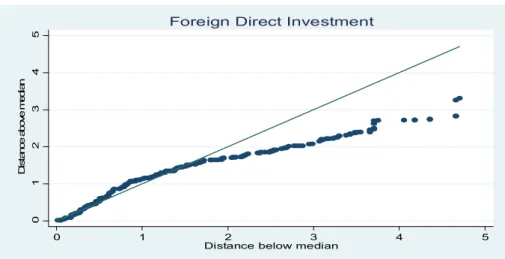
Following the empirical literature (Sbia et al. 2014; Elliot et al. 2013) we introduce in the regression the variable of foreign direct investment (FDI). Our results are in the line of Sbia et al. (2014), Elliot et al. (2013). There is a negative effect between FDI and carbon dioxide emissions. The distribution of foreign direct investment can be observed in figure 1.
Figure 1. Plot of FDI (Foreign Direct Investment)
Source: Author calculation using Stata.
Table
7
presents the estimative of Portuguese FDI using fixed effects (FE) and GMM-System estimator. Following, Faustino and Leitão (2007) we decide to apply a dynamic panel data (GMM-System). The dynamic panel data solves the serial correlation and the endogeneity. The results with FE demonstrate that all independent variables are statistically significant. The variables of globalization (social and political components) show that these encourage the FDI.The social and political globalization has a positive effect on foreign direct investment, demonstrating that economic diplomacy and communications are determinants of FDI. However, cultural globalization is negatively correlated with FDI. Indeed, the sign obtained is contradictory that we expected. This sign could be explained by different type of development between countries
0 1 2 3 4 5 D is ta n c e a b o v e m e d ia n 0 1 2 3 4 5
Distance below median
selected in the regression. The openness trade and real exchange rate show that there is a positive effect of these variables and FDI. The study of Mohammadvandnahidi et al. (2012) also found the same results. The estimates with GMM-system demonstrate that there is no problem of serial correlation (Ar2, test proposed by Arellano and Bond, 1991). The instruments used are corrected (Sargan test). In the long run analyzed by lagged FDI, we can observe that variable presents a positive impact on Portuguese economy. This result is in line with the empirical work of Leitão (2012).When we compare the coefficients obtained with FE and GMM-SYS, we can conclude that the trend of political globalization is different. With GMM-SYS the coefficient of political globalization (PolG) presents a negative effect on Portuguese FDI.
Table 7. Portuguese FDI with FE and GMM-SYS: Model [4]
Variables FE (fixed effects) GMM-System
FDIt-1 0.32*** CultG -1.58** -14.56*** SocG 7.35*** 47.21*** PolG 6.73*** -10.40** OT 0.02*** 0.28*** ExcRate 2.46* -4.41 C -26.78*** -32.01* Observations 395 315 Ad. R2 0.23 Ar (2) 0.42 Sargan 1.00
Note: P-value at 1% (***); 5% (**), and 10% (*) statistically significant. The estimative are corrected with White test. The coefficients are presented in logarithmic form.
5. Conclusions and Recommendations
This paper measured the relationship between energy consumption and foreign direct investment. This research also investigated the impact of human ecology (cultural, social, and political globalization) on FDI for the period 1990-2011.The literature review demonstrates that energy consumption and foreign direct investment are complementary. The association between energy and FDI usually utilize the assumptions of EKC. In the first equation, we consider these hypotheses; the income per capita is positively correlated with energy consumption. The squared income per capita presents a negative impact on energy consumption (Elliot et al. 2013). Our results are in line with empirical studies (Dritsaki and Dritsaki 2014, Withey, 2014). In the long run, the energy consumption decreased, we observed this effect with GMM-System estimator for the model [2]. In fact, the decreases of climate changes depend on the behavior of society. The international conferences and summits on sustainability are fundamental for sustainable development. In this context, Cassella (2008:230-264) demonstrates that it will be necessary the change in behavior. The chapter presented by the author describes several scenarios for explaining the period 2005-2060.
A positive impact between FDI and the energy consumption was established. We can conclude that energy consumption is necessary to attract foreign direct investment. The studies of Omri and Kahouli (2014), Zaman et al. (2012) also found a positive association between these variables. To analyze the determinants of FDI we introduced as explanatory variables the openness trade, and the exchange rate. Using a panel data (fixed effects and GMM-System) the results show that the political and social globalization encourage FDI. Indeed, the participation of Portuguese economy in political agreements is an important determinant of inflows of FDI. The study also concludes that the openness trade is essential to attract foreign investors. This research allows inference in terms of economic and
energy policy for the Portuguese economy. The economic diplomacy is a key factor in attracting foreign direct investment. It is interesting to observe that the consumption of energy promotes economic growth. However, in the long term we observe that the energy consumption is not directly correlated with economic growth, this condition validates the hypothesis of the EKC model. This result demonstrates that the Portuguese economy has followed the path of developed countries. This analysis presents some limitations. In future work, we need to consider in this regression other Portuguese speaking countries. In fact, Angola and Mozambique are significant investors in Portugal. The study needs to consider some arguments of the gravity model such as country borders, common language, and Euro Zone countries for the determinants of FDI.
References
Allen, E.R, (2008), A Human Ecology Approach to Economics, in Human Ecology Economics A New Framework for Global Sustainability, Edited by Roy E. Allen, Routledge.
Arellano, M., Bond, S, (1991), Some Test of Specification for Panel Data: Monte Carlo Evidence and an Application to Employment Equations, Review of Economic Studies 58(2), 277- 297. Cruz, M. J., Taylor S.M. (2013), A Spatial Approach to Energy Economics, NBER Working Paper
18908, 1-60.
Cassella, A., (2008), Re-Adjusting What we know What we Imagine, in Human Ecology Economics A New Framework for Global Sustainability, Edited by Roy E. Allen, Routledge, 230-264. Caves, R. (1971). The Industrial Economics of Foreign Investment, Economics, 18, 1-27.
Cavallari, L, Addona, S, (2013), Nominal and real volatility as determinants of FDI, Applied Economics, 45(18), 2603-2610.
Caves, R, (1971), The Industrial Economics of Foreign Investment, Economics, 18, 1- 27.
Derado, D, (2013), Determinants of FDI in Transition countries and the estimation of the potential level of Croatian FDI, Financial Theory and Practice 37 (3),227-258.
Dritsaki, C., Dritsaki, M, (2014), Causal Relationship between Energy Consumption, Economic Growth and CO2 Emissions: A Dynamic Panel Data Approach, International Journal of Energy Economics and Policy 4(2): 125-136.
Dreher, A, (2006), Does globalization affects growth? Evidence from new index of Globalization, Applied Economics, 38, 1091-1110.
Dreher, A., Gaston, N, (2008), Has globalization increased inequality?, Review of International Economics, 16, 516-536.
Dunning, J. (1992), Trade, Localization and Economic Activity and the Multinational Enterprise: A Search for an Eclectic Approach, in Dunning, J. (ed.) The United Nations library on transnational corporations – the theory of transnational corporation, 1, New York: Routledge, 183-218.
Elliot, R.J.R, Sun, P., Chen S. (2013), Energy intensity and foreign direct investment: A Chinese city- level study, Energy Economics 40, 484-494.
Faustino, H., Leitão, N.C. (2007), Intra-Industry Trade: A Static and Dynamic Panel Data, International Advances in Economic Research 13(3), 313-333.
Farhani, S., Rejeb, J.B. (2012), Energy Consumption, Economic Growth and CO2 Emissions: Evidence from Panel Data for MENA Region, International Journal of Energy Economics and Policy, 2(2), 71-81.
Hanna, F.G., Hammoud, M.S., Converso, J.A.R. (2014), Foreign Direct Investment in Post- Conflict Countries: The Case of Iraq´s Oil and Electricity Sectors, International Journal of
Energy Economics and Policy, 4(2), 137- 148.
Hansson, M.A., Olofsdotter, K. (2013), FDI, taxes and agglomeration economies in EU15, Applied Economics 45(18), 2653-2664.
Hymer, S. (1960), The International Operations of National Firms: A Study of Direct Foreign Investment, MIT Press, Cambridge, MA.
Júlio P., Alves, P.R., Tavares, J. (2013), Foreign Direct Investment and Institutional Reform: Evidence and an Application to Portugal, Portugal Economic Journal, 12(3), 215-250.
Kindleberger, C.P. (1969), American Business abroad Six Lectures on Direct Investment, New Heaven: Yale University Press.
Lee, J.W., (2013), The Contribution of Foreign Direct Investment to Clean Energy Use, Carbon Emissions and Economic Growth. Energy Policy 55, 483-489.
Leitão, N.C. (2011), Foreign Direct Investment: Localization and Institutional Determinants, Management Research and Practice 3(2), 1-6.
Leitão, N.C., (2012), Foreign Direct Investment and Globalization, Actual Problems of Economics 4, (130), 398-405.
Leitão, N.C., Shahbaz M. (2013), Carbon Dioxide Emissions, Urbanization and Globalization: A Dynamic Panel Data, Economic Research Guardian 3(1), 22-32.
Mohammadvandnahidi, M.R., Jaberikhosroshahi, N, Norouzi, D. (2012), The Determinants of Foreign Direct Investment in Iran: Bounds Testing Approach, Economic Research - Ekonomska Istrazivanja 25(3), 560-579.
Nayan, S., Kadir, N. Ahmad, M. Abdullah, M.S. (2013), Revisiting Energy Consumption and GDP: Evidence from Dynamic Panel Data Analysis, Procedia Economics and Finance 7, 42-47. Omri, A., Kahouli, B. (2014), Causal Relationships between Energy Consumption, Foreign Direct
Investment and Economic growth: Fresh Evidence from Dynamic Simultaneous-Equations Models, Energy Policy 67, 913-922.
Ozturk, I. (2010), A Literature Survey on Energy-Growth Nexus. Energy Policy, 38(1), 340-349. Ozturk, I., Bilgili, F. (2015), Economic Growth and Biomass Consumption Nexus: Dynamic Panel
Data Analysis for Sub- Sahara African Countries. Applied Energy, 37,110-116.
Pordata, INE, and DGEG/MEE (2014), Consumo de Energia Elétrica per capita, última atualização 2014-10-01. http://www.pordata.pt/
Severiano, F.A.A. (2011), The Determinants of FDI in Portugal: A Sectoral Approach, Master Science in Economics Dissertation, Católica University of Lisbon, 1-71.
Sbia, R., Shahbaz, M., Hamdi, H. (2014), A Contribution of Foreign Direct Investment, Clean Energy, Trade Openness, Carbon Emissions and Economic Growth to Energy Demand in UAE, Economic Modeling 36, 191-197.
Shahbaz, M., Khraief N., Uddin, G. S., Ozturk, I. (2014), Environmental Kuznets Curve in an Open Economy: A Bounds Testing and Causality Analysis for Tunisia, Renewable and Sustainable Energy Reviews 34, 325-336.
Shahbaz, M., Leitão, N.C. (2013), Portuguese Carbon Dioxide Emissions and Economic Growth: A Time Series Analysis, Bulletin of Energy Economics 1(1), 1-7.
Tan, F., Lean, H. H., Khan H. (2014), Growth and Environmental Quality in Singapore: Is there any Trade-off? Ecological Indicators, 47, 149-155.
Withey. P., (2014), Energy use income, and carbon dioxide emissions: Direct and multi- horizon Causality in Canada, International Journal of Energy Economics and Policy, 4(2), 178-188. Zaman, K., Khan, M.M., Ahmad, M., Rustem, R. (2012), Determinants of Electricity Consumption


![Table 4. Energy Consumption and FDI with FE and GMM-SYS: Model [1]](https://thumb-eu.123doks.com/thumbv2/123dok_br/15883607.1089568/6.892.105.731.110.439/table-energy-consumption-fdi-fe-gmm-sys-model.webp)