Empirical Articles
Assessing Burnout in Portuguese Health Care Workers who Care for the
Dying: Validity and Reliability of a Burnout Scale Using Exploratory Factor
Analysis
Carol Gouveia Melo
*
a, David Oliver
ab[a] Centre for Professional Practice, University of Kent, Chatham, United Kingdom. [b] Wisdom Hospice, Rochester, United Kingdom.
Abstract
Aims: The aim of this study was to develop an effective instrument to measure levels of burnout in Health Care Workers (HCWs) who care
for dying patients and confirm the validity and reliability of the scale. The Burnout scale for workers who care for dying patients was created in 2005, by Gouveia Melo, using items from the Maslach Burnout Inventory (Human Services Survey) (Maslach, Jackson, & Leiter, 1997), the Burnout Test (Service Fields) (Jerabek, 2001) and items specifically designed for burnout in end-of-life care. Method: The scale was validated with 280 HCWs working in oncology hospitals and in community home care in different parts of the country. The psychometric methods used were exploratory factor analysis using principal components analysis (PCA), Cronbach’s α coefficients, and intra-class correlation coefficients.
Results: The initial 40 items were submitted to analysis for suitability of the data and 38 items were chosen for PCA. Results showed 3 main
components with 36 items explaining a total of 34.29% of the variance. These factors were emotional exhaustion (15 items), professional fulfillment (14 items) and depersonalization (7 items). Cronbach’s α coefficients were .86 for emotional exhaustion, .83 for professional fulfillment and .63 for depersonalization. Pearson bivariate correlations were performed on the 150 participants, with an interval of 4 months for test-retest purposes with intra-class correlations from .55 to .59 in each domain. Convergent and divergent validation showed significant correlations.
Conclusions: The validity and reliability of this scale was established, enabling it to be used within the Portuguese population.
Keywords: burnout, scale, validation, palliative care, oncology
Psychology, Community & Health, 2012, Vol. 1(3), 257–272, doi:10.5964/pch.v1i3.21 Received: 2012-06-24. Accepted: 2012-09-07. Published: 2012-11-30.
*Corresponding author at: Rua Gil Vicente 12, Bloco C R/C, 2775-198 Parede, Portugal, email: [email protected] This is an open access article distributed under the terms of the Creative Commons Attribution License
(http://creativecommons.org/licenses/by/3.0), which permits unrestricted use, distribution, and reproduction in any medium, provided the original work is properly cited.
Introduction
Health care workers who care for dying patients are in daily contact with physical degradation, suffering and inevitable death. This is a source of stress that is often more present in this field of medical action than in other medical care areas. Research has shown that health care workers (HCWs) who care for terminal patients can also suffer from death anxiety and that this may lead to burnout affecting the quality of patient and family care (Bernard & Creux, 2003;Connelly, 2009;Keidel, 2002;Lowry, 1997). The underlying causes may be the HCWs’ own fear of death, feelings of inadequacy, insufficient understanding of the needs of dying patients, and difficulties in communicating (Keidel, 2002;Lowry, 1997).
In this study, the term Health Care Worker (HCW) will be used to refer to all trained health professionals who care for patients in their area of expertise. In this particular case, they are nurses, nursing aides, doctors, psychologists,
social workers, physiotherapists, nutritionists, occupational therapists, hospital chaplains and unit secretaries who have direct contact with patients and their families.
Death anxiety has been defined as “a negative emotional reaction provoked by the anticipation of a state in which the self does not exist” (Tomer & Eliason, 1996, p. 345). It has also been suggested that the fear expressed by the dying may be the same type of fear that people experience “in everyday life rather than in acute situations where there are immediate threats to life...[It] has multiple components including: anticipating [oneself’s] dead, fear of the process of dying and fear about the death of significant others” (Payne, Dean, & Kalus 1998, p. 701). Other similar existential fears may include: fear of pain and suffering, fear of being alone and of not having close and fulfilled relationships, fear of living with uncertainty, fear of the unknown, fear of not living a meaningful life, fear of physical degradation, fear of losing one’s dignity and being judged by others, and fear of what comes after death (Hennezel & Leloup, 1997). Lack of awareness of the existence of these existential fears in their own lives may lead HCWs to experience feelings of death anxiety when caring for terminal patients, which can interfere with the HCW-patient relationship (Lowry, 1997;Meier, Back, & Morrison, 2001), and eventually lead to burnout.
Burnout has been defined as “a syndrome of emotional exhaustion, depersonalization and reduced personal accomplishment that can occur among individuals who work with other people in some capacity” (Maslach, Jackson, & Leiter, 1997, p. 192). HCWs’ burnout and death anxiety can affect patients, institutions, and HCWs themselves in many ways. It can lead to poor quality of care, increased absenteeism and job turnover, and personal dysfunction - physical exhaustion, insomnia, increased use of alcohol and drugs, and marital and family problems (Maslach, Jackson, & Leiter, 1997). Emotional exhaustion was referred to by the same authors as “The depletion or draining of emotional resources” and depersonalization as “the development of negative, callous and cynical attitudes towards the recipients of one’s services”. This is different from the psychiatric meaning where depersonalization is used to denote a person’s extreme alienation from the self and the world. In Maslach and Jackson’s definition, it refers to a “callous or even dehumanized perception of others, rather than to an impersonal view of the self” (Maslach, Jackson, & Leiter, 1997, p. 192). In this study, the term ‘personal accomplishment’ used by Maslach was referred to as ‘professional fulfillment’ and can be defined as a sense of well-being in relation to one’s working performance, one’s relationships with colleagues and patients and within the working environment. When assessing burnout in this specific population, there is a need to take death anxiety into account as one of the causes towards burnout. This is particularly important, because studies using the Maslach Burnout Inventory (MBI) have shown that burnout is generally not high in these health care workers. However qualitative studies have shown that health care workers who care for the dying may have different sources of stress than other HCWs (Gouveia e Melo & Oliver, 2011;Pereira, 2011;Soares, 2010) and thus, there is a need for an instrument that will provide a more accurate evaluation of burnout in this population.
Methods
Participants
The participants were 280 health care workers in Portugal, aged 21 to 67 years, comprising 177 (63.2%) nurses, 62 (22.1%) nursing aides, 13 (4.6%) psychologists, 11 (3.9%) doctors, eight (2.9%) social workers, three (1.1%) physiotherapists, two (0.7%) secretaries, one (0.4%) occupational therapist, two (0.7%) chaplains and one (0.4%) nutritionist. Overall, 247 (88.2%) were female and 33 (11.8%) male. A total of 124 (44.3%) worked in palliative care units and 156 (55.7%) worked with dying patients but not within a palliative care unit. Most of the participants
worked in oncology hospitals, both in the centre and north of Portugal and others worked in community home care.
Procedure
The scale was designed as an anonymous self-administered scale using a Likert-type scale from 1 to 6. To examine the validity of the scale, construct, convergent and divergent validation analyses were performed on the data from the 280 participants. The reliability of the scale was assessed through analysis of the internal consistency of each factor, also on the data from the 280 participants. The test-retest reliability of items was performed with an interval of 4 months on 150 of the 280 participants. In between the two tests, these 150 participants had participated in an intervention to reduce burnout and death anxiety and improve the quality of their helping relationship. The statistical package SPSS 19 was used for all analyses.
Development of the Scale — The scale was devised by the corresponding author to measure emotional
exhaustion, depersonalization, and professional fulfillment specifically in HCWs who care for the dying, as opposed to HCWs in general. It was comprised of items from different origins to assess emotional exhaustion (EE), depersonalization (D) and professional fulfillment (PF):
A - The Maslach Burnout Inventory (Maslach, Jackson, & Leiter, 1997)
Authorization was received from the Maslach Burnout Inventory’s (MBI) authors to translate questions from the MBI into Portuguese and to integrate them into the scale. The MBI’s items integrated in the present study are shown inTable 1.
B - Psychtests Aim Inc. (Jerabek, 2001)
Authorization was received from the authors of PsychTest Aim Inc. to use some of their items, translate them into Portuguese and to integrate them into the scale. Those items are displayed inTable 2.
C - Questions Developed by the Researcher Specifically for Burnout Related to Working With Dying Patients
A total of 14 items were devised, based on a survey performed with 20 nurses who worked with dying patients, to understand what their difficulties were.Table 3presents this information.
Self-reported answers to each item were evaluated using a Likert-type scale, ranging from 1 (disagree completely) to 6 (agree completely).
Distribution of the Scale — A pilot test was performed among 10 participants who were debriefed to ensure that
all questions were understood as intended. With the ethical consent of the clinical director of each hospital department, the scale was then distributed to 280 Portuguese HCWs who cared for terminally ill patients and who agreed to participate in the research project. The study aims at understanding whether an intervention, comprising both an educational component, as well as a personal introspection component regarding death anxiety, could reduce burnout and improve the quality of helping relationship skills with patients and their families.
The scale was filled in by HCWs who had not yet received the intervention. They were each given a cover letter explaining the research project and an identification sheet with demographic data (age, sex, place of work - in or
Table 1
Questions Integrated from the MBI Emotional exhaustion
1. I feel emotionally drained by my work.
2. I have no strength left at the end of a day’s work.
3. I feel tired when I get up in the morning and have to face another day of work 4. I feel frustrated by my work
5. I feel that I work too hard in my profession
6. Working directly with people causes me a lot of stress 7. I feel worn out
8. Working every day with people is a real burden for me
Depersonalization
9. I feel that I treat many people impersonally, as if they were objects 10. I have become more insensitive to people since I have this job 11. I am afraid this job will make me become emotionally hard 12. I do not pay real attention to what happens to other people 13. I feel that other people censor me because of their own problems
Professional fulfillment (referred to by Maslach as ‘Personal Accomplishment’)
14. I resolve other people’s problems efficiently
15. I can easily understand what other people are experiencing 16. I have a positive influence on the people I coordinate at work 17. I feel energetic
18. It is easy for me to create a relaxed atmosphere with other people 19. I feel fulfilled when I work in close collaboration with others 20. I have accomplished many useful things in this work 21. At work, I deal with emotional problems very calmly
Table 2
Questions Integrated From Psychtest Aim Inc.
Depersonalization
1. I would be incapable of coping with my work if I considered my patients as unique individuals 2. I don’t really care what happens to my patients
3. I cannot afford to answer to the individual needs of my patients.
Professional fulfillment
4. I feel that what I do makes a difference
5. I feel that other people have realistic expectations regarding my working performance
Table 3
Questions Devised by the Researcher
Emotional exhaustion
1. Dealing psychologically with terminally ill patients makes me feel insecure and anxious 2. I feel helpless when faced with the patient’s fragility
3. I am emotionally disturbed by the death of so many patients 4. The relationship with the patient’s family wears me out
5. I am frustrated because I cannot find the time to have a quality relationship with the patient 6. I feel stressed due to lack of debate and support within the team, with regard to our difficulties 7. I ask myself many times if I could have “done more” and this makes me feel anxious
Depersonalization
8. I give more importance to the technical part of my work than to the human part
9. I give a lot of importance to treating the illness, but do not have patience for the psychological and spiritual caring of the patient
Professional fulfillment
10. I feel fulfilled at work because I manage to find time to just “be” with the patient or their family 11. I have moments of sharing with the patients, with no need to hide my feelings
12. My work allows me to value life more
13. I manage to find time in my work to talk to patients and to help them find meaning in their lives 14. I often contribute towards giving my patients quality of life, comfort and dignity at the end of their life
out of a palliative care unit - level of education, and profession). Anonymity was assured. The scales were collected for construct, convergent and divergent validation and tests of internal consistency.
Four months later, the scale was distributed again to the 150 participants who had completed the intervention and test-retest reliability analyses were performed.
Sensitivity — Each item was examined in terms of median, skewness, and kurtosis. Items with a Sk > 3 and Ku
> 8 were eliminated from the scale before performing factor analysis. These are shown inTable 4.
Validation — Construct validity of the 40 items was examined using exploratory factor analysis (principal
components analysis - PCA) with Varimax rotation. Prior to performing the PCA, the suitability of the data for factor analysis was assessed. Inspection of the correlation matrix revealed the presence of many coefficients of .3 and above. The Keiser-Meyer-Oklin value was .84, exceeding the recommended value of .6 (Kaiser, 1970,
1974) and Bartlett’s Test of Sphericity (Bartlett, 1954) reached statistical significance, supporting the factorability of the correlation matrix.
Convergent and divergent validation was performed using Pearson correlations with factors from another questionnaire measuring death anxiety and the quality of HCWs’ helping relationship with their patients (Gouveia e Melo, & Oliver, 2011).
Reliability — Once the validity of the domains of the scale had been established, the internal consistency of each
factor was tested using Cronbach’s α coefficients and test-retest reliability was determined by calculating intra-class correlation coefficients with a 4-month interval (Pearson bivariate correlations).
Calculation of the Cut-Off Point — The cut-off point should be calculated taking into account the sample of
population as follows (seeTable 5):
• The sum of each factor (total scores/nr. of participants), is divided by the number of validated items; • The final score of the two negative factors, is summed and divided by 2;
Table 4
Medians (Mdn), Skewness (sk) and Kurtosis (ku), Minimum and Maximum Values, to Evaluate Sensitivity of the 40 Items
Max Min Ku Sk Mdn Item Item ID
Emotional exhaustion (ee)
6 1 3.00
I feel emotionally drained by my work
ee01 .08 -.95
6 1 3.00
I feel worn out.
ee15 .03 -1.02
6 1 3.00
I feel tired when I get up in the morning and have to face another day of work.
ee06 .33 -1.07
6 1 3.00
I have no strength left at the end of a day's work.
ee20 .27 -1.03
6 1 4.00
I feel that I work too hard in my profession.
ee23 -.32 -.76
6 1 4.00
I am frustrated because I cannot find the time to have a quality relationship with the patient
ee13 -.54 -.66
6 1 3.00
Dealing psychologically with terminally ill patients makes me feel insecure and anxious
ee21 .25 -1.03
6 1 4.00
I feel stressed due to the lack of debate and support within the team, with regard to our difficulties.
ee35 -.21 -1.02
6 1 4.00
I feel helpless when faced with the patient's fragility.
ee10 -.13 -.95
6 1 3.00
The relationship with the patient's family wears me out.
ee28 .34 -.68
6 1 4.00
I ask myself many times if I could have "done more" and this makes me feel anxious
ee38 -.19 -.85
6 1 1.00
I feel frustrated by my work
ee08 1.50 1.60
6 1 4.00
I am emotionally disturbed by the death of so many patients.
ee25 -.15 -1.06
6 1 2.00
Working directly with people causes me a lot of stress.
ee31 .93 .31
6 1 2.00
I cannot afford to answer to the individual needs of my patients.
d27 .76 -.45
Professional fulfillment (pf)
6 1 4.00
I have a positive influence on the people I coordinate at work.
pf32 -.41 .08
6 1 4.00
It is easy for me to create a relaxed atmosphere with other people.
pf14 -.24 -.21
6 1 4.00
I resolve other people's problems efficiently
pf03 -.55 .28
6 1 5.00
I often contribute towards giving my patients quality of life, comfort and dignity at the end of their life.
pf40 -.59 .03
6 1 5.00
I feel that what I do makes a difference
pf22 -.85 .83
6 1 4.00
At work, I deal with emotional problems very calmly.
pf26 -.33 -.19
6 1 4.00
I feel that other people have realistic expectations regarding my working performance.
pf29 -.78 .61
6 1 5.00
I have accomplished many useful things in this work.
pf19 -1.85 4.50
6 1 4.00
I can easily understand what other people are experiencing
pf05 -.53 .05
6 1 5.00
I have moments of sharing with the patients, with no need to hid my feelings.
pf33 -.61 -.10
6 1 5.00
I feel fulfilled when I work in close collaboration with others.
pf17 -1.71 3.65 6 1 4.00 I feel energetic pf36 -.36 -.22 6 1 4.00
I manage to find time in my work to talk to patients and to help them find meaning in their lives.
pf39 -.46 -.22
6 1 4.00
I feel fulfilled at work because I manage to find time to just "be" with the patient and their family pf09 -.48 -.48 Depersonalization (d) 6 1 1.00
I don't really care what happens to my patientsa
d24 3.38 13.22
6 1 1.00
I have become more insensitive to people since I have this job
d07 1.33 .82
6 1 2.00
I give more importance to the technical part of my work than to the human part.
d30 1.54 3.19
6 1 2.00
I am afraid this job will make me become emotionally hard
d12 .70 -.76
6 1 2.00
I do not pay real attention to what happens to other people.
d16 1.19 1.20
6 1 1.00
I give a lot of importance to treating the illness, but do not have patience for the psychological and spiritual caring of the patient
d34 2.14 4.82
6 1 1.00
I feel that I treat many people impersonally, as if they were objects
d02 2.00 5.12
6 1 1.00
Working everyday with people is a real burden for mea
ee18 2.57 8.21
6 1 2.00
I would be incapable of coping with my work if I considered my patients as unique individuals
d04 .90 -.32
Note. ee = emotional exhaustion; d = depersonalization; pf = professional fulfillment.
Table 5
Calculation of Cut-Off Point
Negative Positive Mean Total score Factors Mean Total score Factor 3.20 48.03
Nf1: Emotional exhaustion (15 items) 4.35
60.91 Professional fulfillment (14 items)
2.02 14.13 Nf2: Depersonalization (7 items) 5.22 Total negative (Nf1+Nf2) 4.35 Total positive 2.61 4.35 Mean 3.48
Cut-off point = mean of positive and negative factors: (4.35+2.61)/2
Results
Of the 300 scales that were delivered to HCWs who cared for dying patients, 280 were returned (response rate, 93.33%). Of the 280 initial responses, 150 HCWs agreed to take the retest, all of which were returned. Of the 280 scales, 208 were delivered personally and checked immediately for missing data and these were filled in by the participant at the time. The remaining 72 were checked for missing data at a later date; ten were found having missing values and were filled in using the mean score of the item.
Sensitivity
Table 4shows that most items fell within the acceptable range of -3.0 to +3.0 for skewness, and -8.0 to + 8.0 for kurtosis. Items 18 and 24 were eliminated from the scale before proceeding to the factor analysis. For a Likert scale of 1 to 6, an acceptable median would be within the range of 3 to 4. This is the case for items relating to emotional exhaustion. However, results were skewed for items relating to professional fulfillment and depersonalization. This is to be expected with this sample. Whereas it is feasible for HCWs to suffer from emotional exhaustion, for example due to excessive contact with death and suffering, and work overload, it is not expected that they would show attitudes of depersonalization with patients who are fragile, vulnerable and dying. Likewise, due to the close and caring relationship with patients, this work is professionally rewarding and brings meaning into the lives of these HCWs. For this reason, these items were maintained for factor analysis.
Construct Validation
Principal components analysis revealed the presence of 11 components with eigenvalues exceeding 1, explaining 60.3% of the variance. An inspection of the scree plot revealed a clear break after the 3rd component. Using Catell’s Scree test (Cattell, 1966), the researchers decided to retain the three components for further investigation. Varimax rotation was performed extracting three factors and suppressing absolute values under 0.3 (seeTable 6). The three-component solution explained a total of 34.29% of the variance. The rotation sums of squared loading showed Component 1 contributing 14.99%, Component 2 contributing 11.00% and Component 3 contributing 8.3%. Analysis of the questions of each component show that they correspond to:
• Factor 1: Emotional exhaustion; • Factor 2: Professional fulfillment; • Factor 3: Depersonalization.
Two items with coefficients below .3 were eliminated from the scale:
• “I feel that other people censor me because of their own problems”.
Table 6
Principal Component Analysis of Burnout Scale: Full Description of the 3 Factors and Coefficients of Each Item, the Alpha C Value and Variance of Each Factor
BURNOUT (N = 280) Communality Factor Loading Item Item Id F1: Emotional exhaustion (α C = 0.86; M = 3.20; SD = .83081; V = 14.99%) .694 0.767
I feel emotionally drained by my work ee 01
.738 0.751
I feel worn out ee 15
.662 0.709
I feel tired when I get up in the morning and have to face another day of work ee 06
.620 0.605
I have no strength left at the end of a day's work ee 20
.669 0.558
Dealing psychologically with terminally ill patients makes me feel insecure and anxious ee 21
.595 0.552
I feel that I work too hard in my profession ee 23
.704 0.540
I am frustrated because I cannot find the time to have a quality relationship with the patient ee 13
.548 0.506
I feel stressed due to the lack of debate and support within the team, with regard to our difficulties ee 35
.623 0.499
The relationship with the patient's family wears me out ee 28
.581 0.496
I feel helpless when faced with the patient's fragility ee 10
.599 0.490
I ask myself many times if I could have "done more" and this makes me feel anxious ee 38
.644 0.489
I am emotionally disturbed by the death of so many patients ee 25
.556 0.468
I feel frustrated by my work ee 08
.541 0.460
Working directly with people causes me a lot of stress ee 31
.515 0.307
I cannot afford to answer to the individual needs of my patients d 27
F2: Professional fulfillment (α C = 0.83; M = 4.35; SD = .61583; V = 11.00%)
.561 0.729
I have a positive influence on the people I coordinate at work. pf 32
.553 0.645
It is easy for me to create a relaxed atmosphere with other people pf 14
.558 0.610
I resolve other people's problems efficiently pf 03
.616 0.578
I often contribute towards giving my patients quality of life, comfort and dignity at the end of their life
pf 40
.615 0.578
At work, I deal with emotional problems very calmly pf 26
.622 0.549
I feel that what I do makes a difference pf 22
.620 0.516
I feel that other people have realistic expectations regarding my working performance pf 29
.585 0.508
I can easily understand what other people are experiencing pf 05
.618 0.470
I have accomplished many useful things in this work pf 19
.632 0.423
I have moments of sharing with the patients, with no need to hid my feelings pf 33 .623 0.414 I feel energetic pf 36 .574 0.399
I feel fulfilled when I work in close collaboration with others pf 17
.692 0.378
I manage to find time in my work to talk to patients and to help them find meaning in their lives pf 39
.604 0.304
I feel fulfilled at work because I manage to find time to just "be" with the patient and their family pf 09
F3: Depersonalization (α C = 0.63; M = 2.02; SD = .69603; V = 8.31%)
.722 0.618
I have become more insensitive to people since I have this job d 07
.678 0.568
I am afraid this job will make me become emotionally hard d 12
.709 0.471
I feel that I treat many people impersonally, as if they were objects d 02
.611 0.454
I give more importance to the technical part of my work than to the human part d 30
.585 0.417
I would be incapable of coping with my work if I considered my patients as unique individuals d 04
.633 0.406
I do not pay real attention to what happens to other people d 16
.488 0.358
I give a lot of importance to treating the illness, but do not have patience for the psychological and spiritual caring of the patient
d 34
Convergent and Divergent Validation
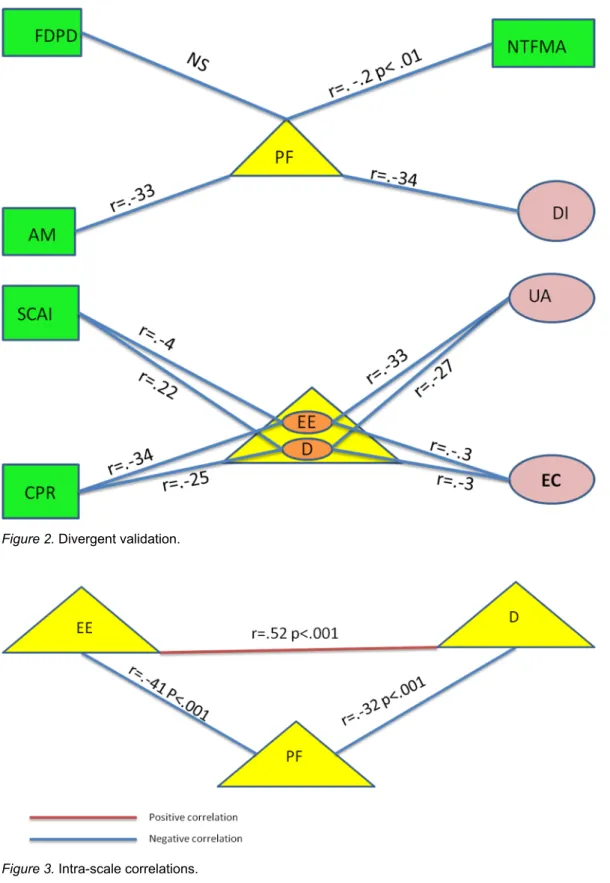
The relationships between burnout, death anxiety and quality of helping relationships were investigated using Pearson’s product-moment correlation coefficient. Preliminary analyses using Q-Q Plots were performed to ensure no violation of the assumptions of normality, linearity and homoscedasticity had occurred. The results are presented in the following diagrams. Correlations with an r value > .500 can be considered to be strong, r from .30 to .49 medium, and r from .10 to .29, weak.Figures 1,2and3display the correlations.
Figure 1. Convergent validation.
Reliability
Cronbach’s alpha coefficients were .86 for factor 1, .83 for factor 2, and .63 for factor 3. In order to establish test-retest reliability, Pearson bivariate correlations were performed on the 3 factors, with an interval of 4 months. Intra-class correlation was from .55 to .59 in each domain (Figure 4). We can therefore conclude that all three factors are reliable both internally and over time.
Figure 2. Divergent validation.
Figure 3. Intra-scale correlations.
Calculation of Cut-Off Point
Justification for Adding Extra Questions to the Scale, Specific for HCWs who Care for the Dying — As
Figure 4. Test-retest correlations to test reliability of scale.
care for dying patients when using the MBI. However, qualitative data from these same studies shows that this is not the case. In order to verify these findings, we calculated the mean of the general items (MBI + Jerabek) and the items written specifically for this population. Results show that the general questions do in fact show a level of emotional exhaustion well below the cut-off point, as presented inTable 7.
Table 7
Means of Burnout Without Questions Specific for HCWs who Care for the Dying
SD T1 M
Factors derived from factor analysis using PCA Name of Questionnaire .88449 2.70 Emotional exhaustion Normal burnout .61707 4.40 Professional fulfillment .67055 1.47 Depersonalization
However the questions designed specifically for this population show levels just above the cut-off point for emotional exhaustion. There is a slight difference in depersonalisation and no difference in professional fulfillment (seeTable 8).
In order to better understand who suffers from emotional exhaustion, we divided the sample in HCWs who work in palliative care (pc) units and those who work with dying patients without palliative care.Table 9show the results regarding the two groups.
Table 8
Means of Burnout Specific for HCWs who Care for the Dying – General
SD T1 M
Factors derived from factor analysis using PCA Name of Questionnaire
.87348 3.50
Emotional exhaustion Burnout specific for HCW who care for the dying
.81918 4.40 Professional fulfillment .80848 1.69 Depersonalization Table 9
Means of Burnout Specific for HCWs who Care for the Dying – In and out of PC
Mean out of PC Mean in PC
Burnout – Specific for HCWs who care for the dying
3.8 3.3 Emotional exhaustion 1.7 1.7 Depersonalization 4.4 4.4 Professional fulfillment
This shows that HCWs who work in palliative care units are below the cut-off point, and those caring for dying patients without being integrated within a team of palliative care are above. Results continue to show no difference in scores of depersonalization and professional fulfillment.
This leads to the question of what actually causes emotional exhaustion in HCWs who care for terminal patients.
Table 10shows a list of the items with the highest scores. The number in brackets shows the order from highest score (1) to lowest score (5).
Table 10
Comparison of Items Related to Emotional Exhaustion, in and out of PC
HCWs out of PC HCWs in PC
All HCWs Question related to emotional exhaustion
4.34 (1) 3.49 (3)
3.86 (1) 1. I ask myself many times if I could have “done more” and this makes me feel anxious
3.92 (4) 3.74 (1)
3.82 (2) 2. I feel that I work too hard in my profession
3.62 (5) 3.69 (2)
3.66 (3) 3. I feel helpless when faced with the patient’s fragility
4.09 (2) 3.13 (5)
3.54 (4) 4. I am emotionally disturbed by the death of so many patients
3.98 (3) 3.19 (4)
3.53 (5) 5. I feel stressed due to the lack of debate and support within the team, with regard
to our difficulties
What causes the most exhaustion in HCWs in PC is work overload, followed by feelings of helplessness. However, in HCWs out of PC, what causes most emotional exhaustion is feeling they could have “done more”, followed by too many deaths. Moreover, on the whole HCWs out of PC had higher scores in emotional exhaustion than HCWs in PC.
After the intervention, HCWs out of pc units made much more progress than those working in pc (Table 11).
In an attempt to understand whether the scale had items that were not contributing towards the measurement of burnout, the mean of each item was calculated for scores at T1 and T2, for the general sample and for HCWs working in and out of palliative care. Results showed the following items which systematically scored below 2.5 (Table 12).
Table 11
T-test of Results of Items Related to Emotional Exhaustion in and out of Palliative Care at t1 and t2
HCWs out of PC HCWs in PC
Question related to emotional exhaustion T1/T2
p < 0.001 ns
1. I ask myself many times if I could have “done more” and this makes me feel anxious
ns ns
2. I feel that I work too hard in my profession
p < 0.008 0.032
3. I feel helpless when faced with the patient’s fragility
p < 0.001 ns
4. I am emotionally disturbed by the death of so many patients
p < 0.019 ns
5. I feel stressed due to the lack of debate and support within the team, with regard to our difficulties Note. ns = not significant.
Table 12 Scores Below 2.5 T2 M HCWs out pc T1M HCWs out pc T2 M HCWs in pc T1 M HCWs in pc T2 M general sample T1 M General sample Item 2.25 2.26 2.41 2.35 2.34 2.31
1. I cannot afford to answer to the individual needs of my patients 2.01 2.29 2.07 2.06 2.05 2.16
2. Working directly with people causes me a lot of stress 1.86 2.03 1.40 1.50 1.60 1.73
3. I feel frustrated by my work
A comparison was performed on emotional exhaustion with all 15 items and emotional exhaustion without these 3 items (Table 13).
Table 13
Comparison of Emotional Exhaustion With and Without Last 3 Items of Factor Analysis
out pc in pc General T1 3.31 2.90 3.10 Emotional exhaustion (15 items)
3.59 3.19
3.36 Emotional exhaustion (12 items)
These results show that without the three items, HCWs who care for dying patients out of PC units are above the cut-off point for emotional exhaustion.
Discussion
This study validated a scale to evaluate self-reported burnout in health care workers who care for terminal patients. It has good internal consistency, test-retest reliability, construct as well as convergent and divergent validity. It adds the following to already existing instruments: (1) it is a scale that is adapted to HCWs who care for terminal patients, because these HCWs suffer from specific sources of stressors leading to burnout that HCWs in other areas do not; (2) quantitative research using the MBI reports low levels of burnout in these HCWs, which is inconsistent with results from qualitative research (therefore, this scale provides a more reliable form of measuring burnout than those presently existing); (3) the scale is concise and easy to administer.
For this reason, this scale can help identify some of the difficulties that these HCWs experience and consequently improve the quality of their emotional support and education.
In Portugal, specific emotional support for professionals working in end-of-life care is not provided within the health care system and therefore, HCWs either need to seek help in their own free time, or, when they do seek help during working hours, they feel rushed because of the extra stress put on their colleagues. Reducing burnout through emotional support and education on how to cope with stress will ultimately improve the care of the patients and improve the efficiency and effectiveness of the hospitals.
This study explored the correlations of factors of the burnout scale, with other questionnaires that evaluated self-reported quality of helping relationship attitudes, death anxiety and existential well-being. Emotional exhaustion and depersonalization were positively correlated to existential fears, such as fear of physical degradation, dependence on others and loss of control and self-criticism for not giving sufficient time towards family and meaningful activities. They were also correlated to the negative factors of self-reported quality of helping relationship (avoidance mechanisms, distance and impatience towards patients). Likewise, professional fulfillment, (the positive factor in the burnout scale) was positively correlated to existential well-being (close family relationships and self-confidence in relation to adversity and illness) and to positive attitudes in a helping relationship (empathy, congruence and unconditional acceptance of patient). Similar findings occurred with negative correlations (see
Figure 2). Intra scale correlations were also performed on the three factors. There was a strong correlation between emotional exhaustion and depersonalization and a negative correlation of medium strength between professional fulfillment and emotional exhaustion and between professional fulfillment and depersonalization.
With the exception of the item “I feel I work too hard in my profession”, the items that scored the highest were items designed specifically to measure stress in HCWs who care for the dying. This was the case for HCWs working in and out of PC. Items that scored the lowest were: “I cannot afford to answer to the individual needs of my patients”, “Working directly with people causes me a lot of stress”, “I feel frustrated by my work”. These were also the items that showed the lowest coefficients in the factor analysis. A further analysis of the means of this factor without these three items (seeTable 13) shows higher levels of burnout. It also shows that for HCWs out of PC units, levels are in fact above the cut-off point. These results are more in alignment with results from qualitative research. One needs to question therefore whether the scale would not be more effective in measuring emotional exhaustion without these items.
This scale was designed for all HCWs who care for dying patients, but 85.3% of the participants were nurses and nursing aides. It is recommended that further psychometric studies are performed with a larger and more homogenous population to improve the generalizability of the scale.
Another limitation of the study was the test-retest correlations to assess reliability over time. It could be argued that the intervention that occurred between the two tests could bias the results. However, one would expect the intervention to affect the results by weakening the correlations, rather than strengthening them, and this was not the case. This is an issue that should be re-evaluated with a larger sample.
In summary, this scale has been designed and validated in Portugal to measure burnout in health care workers who care for the dying. Quantitative studies performed with this population using other burnout scales have shown low levels of burnout; however these findings are not in agreement with qualitative studies that show specific risk
factors for burnout in end-of-life care. This instrument will provide a simpler and more accurate form of measuring burnout, which will also bring forth the need for interventions to help HCWs cope with death and dying.
References
Bartlett, M. (1954). A note on the multiplying factors for various chi square approximations. Journal of the Royal Statistical
Society. Series B. Methodological, 16, 296-298.
Bernard, M., & Creux, F. (2003). Suffering – A problem that also affects nurses. European Journal of Palliative Care, 10(2), 77-81.
Cattell, R. B. (1966). The Scree Test for the number of factors. Multivariate Behavioral Research, 1, 245-276. doi:10.1207/s15327906mbr0102_10
Connelly, J. E. (2009). The avoidance of human suffering. Perspectives in Biology and Medicine, 52(3), 381-391. doi:10.1353/pbm.0.0095
Gouveia e Melo, C., & Oliver, D. (2011, Winter). Can addressing death anxiety reduce health care workers' burnout and improve patient care? Journal of Palliative Care, 27(4), 287-295.
Hennezel, M. D., & Leloup, J. (1997). L'art de mourir: Traditions religieuses et spiritualité humaniste face à la mort. Paris: Robert Laffond.
Jerabek, I. (2001). Burn-out test (service fields). Retrieved fromhttp://testyourself.psychtests.com/testid/2079
Kaiser, H. F. (1970). A second generation little jiffy. Psychometrika, 35, 401-415. doi:10.1007/BF02291817
Kaiser, H. F. (1974). An index of factorial simplicity. Psychometrika, 39, 31-36. doi:10.1007/BF02291575
Keidel, G. C. (2002). Burnout and compassion fatigue among hospice caregivers. The American Journal of Hospice & Palliative
Care, 19(3), 200-205. doi:10.1177/104990910201900312
Lowry, F. (1997). Does doctors' own fear of dying hinder palliative care? Canadian Medical Association Journal, 157(3), 301-302.
Maslach, C., Jackson, S., & Leiter, M. (1997). Maslach burnout inventory (3rd ed.). In C. A. Zalaquett (Ed.), Evaluating stress
– A book of resources (p. 192). London: The Scarecrow Press Inc.
Meier, D. E., Back, A. L., & Morrison, R. S. (2001). The inner life of physicians and care of the seriously ill. Journal of the
American Medical Association, 286(23), 3007-3014. doi:10.1001/jama.286.23.3007
Payne, S. A., Dean, S. J., & Kalus, C. (1998). A comparative study of death anxiety in hospice and emergency nurses. Journal
of Advanced Nursing, 28(4), 700-706. doi:10.1046/j.1365-2648.1998.00632.x
Pereira, S. M. (2011). Burnout em Cuidados Paliativos: Uma perspectiva bioética (Unpublished doctoral dissertation). Universidade Católica Portuguesa, Porto.
Soares, J. (2010). Exaustão Emocional dos cuidadores de doentes oncológicos-Eficácia de uma intervenção de grupo (Doctoral dissertation). Porto: Universidade do Porto, Faculdade de Psicologia e ciências de educação.
Tomer, A., & Eliason, G. (1996). Toward a comprehensive model of death anxiety. Death Studies, 20, 343-365. doi:10.1080/07481189608252787