Analysis of the
SHP2
enhancer for the use of tissue specific activation
tagging in
Arabidopsis thaliana
Antonio Chalfun-Junior*, Jurriaan J. Mes, Marco Busscher and Gerco C. Angenent
Business Unit Bioscience, Plant Research International, Wageningen, The Netherlands.
Abstract
Activation tagging is a powerful tool to identify new mutants and to obtain information about possible biological func-tions of the overexpressed genes. The quadruple cauliflower mosaic virus (CaMV) 35Senhancer fragment is a strong enhancer, which is most commonly used for this purpose. However, the constitutive nature of this enhancer may generate lethal mutations or aberrations in different plant organs by the same overexpressed gene. A tis-sue-specific activation tagging approach may overcome these drawbacks and may also lead more efficiently to the desired phenotype. For this reason theSHATTERPROOF2(SHP2) promoter fragment was analysed for enhancer activity. TheSHP2gene is involved in dehiscence zone development and expressed during silique development. The aim of the experiments described here was to identify a dehiscence zone specific enhancer that could be used for tissue-specific activation tagging. The chosenSHP2enhancer fragment was found to be expressed predomi-nantly in the dehiscence zone and showed enhancer activity as well as ectopic expression activity. This activity was not influenced by its orientation towards the promoter and it was still functional at the largest tested distance of 2.0 kb. Based on these results, theSHP2enhancer fragment can potentially be used in a tissue-specific activation tagging approach to identify newArabidopsismutants with an altered dehiscence zone formation.
Key words: Arabidopsis, development, pod shattering, transcription factors, mutants.
Received: May 2, 2005; Accepted: October 24, 2005.
Introduction
Activation tagging has become an upcoming tool to generate mutant plants. It is an alternative approach for gene function analysis, because loss-of-function mutations has its limitation in cases of functional gene redundancy (ArabidopsisGenome Initiative, 2000). Activation tagging was proposed as a novel gene isolation method in which a gene is either ectopically or constitutively overexpressed compared to normal expression levels (Walden et al., 1994). Waldenet al.(1994) designed a T-DNA based acti-vation tagging approach to identify and isolate novel genes from tobacco, and since then it has been largely applied us-ing either T-DNA insertion strategies (Borevitz et al., 2000; Ito and Meyerowitz, 2000; Leeet al., 2000; van der Graaffet al., 2000; Weigelet al., 2000; Huanget al., 2001) or transposon based approaches (Wilson et al., 1996; Marsch-Martinezet al., 2002). This technology has been applied successfully to many plant species like Arabidopsis, rice, tomato, petunia and tobacco (Weigelet
al., 2000; Jeonget al., 2002; Zubkoet al., 2002; Ahadet al., 2003; Mathewset al., 2003).
Activation tagging is based on strong transcriptional enhancer sequences that can activate gene expression in the vicinity of the site where the enhancer was inserted into the genome. The most commonly used enhancer is a quadruple combination of the cauliflower mosaic virus (CaMV)35S enhancer (Odellet al., 1985; Hayashiet al., 1992). These 4x35S enhancer elements have been reported to strongly enhance endogenous gene expression rather than ectopi-cally or constitutively overexpress genes (Neffet al., 1999; van der Graaffet al., 2000). It has been demonstrated that it can stimulate gene expression of neighboring genes inde-pendently of its orientation, up to a distance of 3.6 kb (Weigelet al., 2000) or even up to 5.0 kb (Chalfun-Junioret al., 2005).
It is tempting to use this technique in a random-like approach to isolate new mutants and analyse in more de-tail the overexpressed genes. In some cases, the mutant displays a phenotype that can either be directly associated with the gene function of the activated gene (Zubkoet al., 2002) or may provide an indication of the pathway in which the gene is involved (Kardailskyet al., 1999; Zhao et al., 2001; Yuen et al., 2003). The activation tagging method has also been used as a novel approach to isolate
www.sbg.org.br
Send correspondence to Antonio Chalfun-Junior. Universidade Fe-deral de Lavras, Laboratório Central de Biologia Molecular, 37200-000 Lavras, MG, Brazil. E-mail: [email protected]. *Present address: Universidade Federal de Lavras, Laboratório Central de Biologia Molecular, Lavras, MG, Brazil.
suppressor mutants of known mutant phenotypes (Neffet al., 1999; van der Graaff et al., 2003). However, when searching for specific mutants with a more specific pheno-type, the 4x35Senhancer is not very attractive to use, as it will induce aberrations in plant tissues other than the spe-cific one that was intended to be modified. In that case, tis-sue-specific enhancement could directly lead to the mutants of interest. To test this hypothesis we have char-acterized a tissue-specific enhancer that may be applica-ble to efficiently generate activation mutants with an altered pod shattering phenotype.
Precocious pod shattering is a phenomenon in which fruits lose their seeds before harvesting time, generating high losses of agronomic crops,e.g., rapeseed. Engineering for shatter resistant plants allow the plants to grow until the fruits are fully ripened, resulting in an optimal product quality and increased crop yield. The closely relatedMADS box transcription factorsSHATTERPROOF1 (SHP1) and SHATTERPROOF2 (SHP2) control seed dispersal in Arabidopsis by regulating the development of the dehiscence zone (Ferrandizet al., 2000; Liljegren et al., 2000; Ferrandiz, 2002). Inshp1shp2double mutant plants, the dehiscence zone is completely absent and the fruits fail to open.
Here, we describe the identification of a SHP2 enhancer taken from its natural promoter, which contains all necessary characteristics required for a tissue-specific activation approach.
Material and Methods
Plant material and transformation
Constructs were introduced intoArabidopsis thaliana ecotype Col-0 using Agrobacterium tumenfaciens strain GV3101 and the floral dip method (Clough and Bent, 1998). For selection of transformants, seeds were surface sterilized by vapor phase sterilization (http://plantpath. wisc.edu/~afb/vapster.html), and selected on medium con-taining kanamycin. Plants were grown in soil, under normal greenhouse conditions (22 °C, 14/10 h light/dark).
Constructs
The SHP2 enhancer fragment
Primers were designed at -1275 bp and -55 bp from the transcription initiation site of theSHP2gene (forward primerSHP2F 5’-GTCGACAAGCTTAAGTTCTTTCTT GAAATG-3’, reverse primer SHP2R 5’-GTCGACAA GCTTCACTTAACTGCTGCTTCAAC-3’). Both primers were extended with sequences for digestion sites to facili-tate subcloning (HindIII andSalI sites underlined). DNA of Arabidopsis thalianaecotype Col-0 was used as template for PCR amplification. Using these primers a band of the expected 1220 bp was obtained, cloned (in pGEMT-Easy®, Promega) and sequenced to confirm its identity.
SHP2 enhancer fused to minimal -47-35S::GUS
The minimal -47-35S promoter GUS vector, GUSXX-47 (Pasquali et al., 1994) was obtained from J. Memelink, (Leiden University, Leiden, The Netherlands). TheSHP2F primer was extended with aHindIII site and the reverse primer with aSalI site, the fragment amplified and ligated in theHindIII-SalI site upstream of the-47-35S pro-moter, which was fused to the GUS reporter gene. The whole fragment was subcloned in pBINPLUS (van Engelenet al., 1995) usingHindIII-KpnI, resulting in vec-tor pGD751.
SHP2 fragment fused to the pFBP1::GUS
BothSHP2primers were extended with bothHindIII andSalI sites to facilitate the cloning of the vectors de-scribed next. Several constructs were generated to test the enhancer activity of theSHP2fragment. For that reason the SHP2fragment (as aHindIII-HindIII fragment) was ligated upstream of theFBP1promoter present in vector pFBP12E (Angenentet al., 1993). This resulted in a sense fusion of the SHP2 enhancer to the ‘short’ 220 bp pFBP1::GUS (pGD418).
TheSalI-SalI fragment was introduced in theSalI di-gested pFBP12E vector, resulting in a sense fusion of the SHP2enhancer to the ‘long’ 1040 bpFBP1promoter fused to the GUS reporter gene (pGD393). For the other con-structs, the SalI-SalI fragment of the cloned PCR SHP2 enhancer fragment was first subcloned in pBluescript SK+ vector (Promega) in both orientations (pARC012 and pARC013). The ‘long’ pFBP1::GUS fragment was also subcloned as an EcoRI-EcoRI from pFBP12E into pBluescript SK+vector in both orientations (pARC014 and pARC015). AClaI-XhoI fragment containing the sense or antisenseSHP2enhancer was then inserted adjacent to the pFBP1::GUS fragment in both vectors pARC014 and pARC015. This resulted in an antisense fusion of theSHP2 enhancer upstream of the ‘long’ pFBP1::GUS fragment and in vectors where theSHP2enhancer was downstream of this fragment in either sense or antisense orientation. The total inserts of these vectors were subcloned in the binary vector pBINPLUS® by usingXbaI andKpnI. All vectors were checked in detail by restriction sites and fragment length analysis.
GUS activity
Histochemical localization of GUS activity was per-formed as described by Jeffersonet al.(1987).
Results
Tissue specificity of theSHP2enhancer
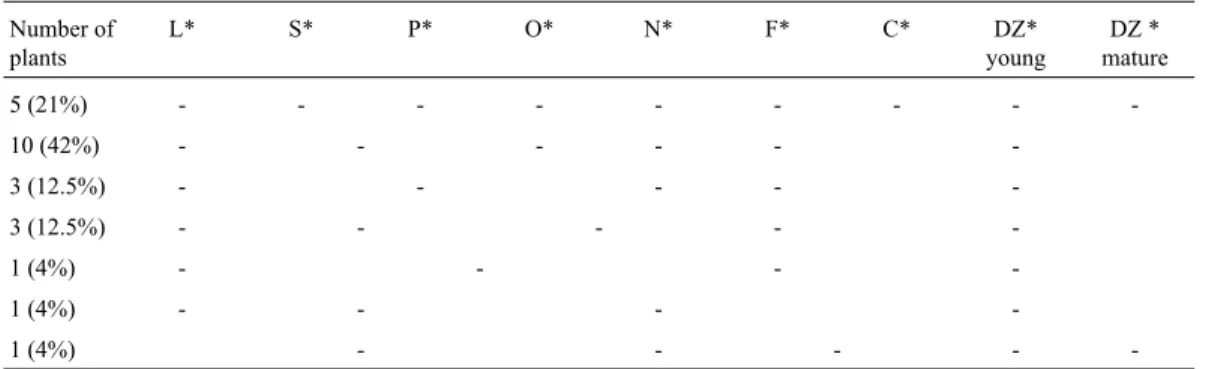
contains thecis-acting elements and all its tissue specific regulating sequences, a 1220 bp upstream sequence was tested for its promoter/enhancer activity. This 1220 bp frag-ment was chosen from -1275 bp to -55 bp upstream of the transcription initiation site, which was also 8 bp upstream of a putative TATA box. This 1220 bpSHP2promoter frag-ment contains a CarG-box like sequence (Savidgeet al., 1995), which is the putativeAGAMOUSbinding site and which is very likely to be important for its regulation. This promoter fragment (from now on referred to as theSHP2 enhancer) was fused to a minimal-47-35Spromoter, which was fused to theGUSreporter gene (GUSXX-47) (Pasquali et al., 1994). This construct will allow the analysis of its transcriptional enhancer activity and tissue specificity. This binary vector (Figure 1A) and a control construct, which carries only the empty vector (GUSXX-47), were intro-duced intoArabidopsisplants ecotype Col-0. In Table 1, the GUS expression patterns of 24 analyzed T1 plants are summarized. No GUS expression was observed in plants containing only the empty vector. In most of the GUS posi-tive plants, GUS staining was observed in the dehiscence zone (Figure 1B). This expression in the dehiscence zone was seen at earlier stages during flower development (Fig-ure 1C). Besides GUS expression in the dehiscence zone, some plants also displayed GUS expression in other tissues, for instance in pollen grains (Figure 1D), ovules (Figure 1E), funiculus (Figure 1F), nectaries (Figure 1G) and the vascular junction at the receptacle (Figure 1H). Similar to the results obtained here,SHP1andSHP2genes were pre-viously described to be expressed in tissues like septum, ovules and funiculus (Maet al., 1991), in addition to the dehiscence zone (Savidge et al., 1995; Liljegren et al.,
1998; Liljegrenet al., 2000). In some plants, no GUS stain-ing was observed. Although no molecular analyses were performed on them, it is very likely that these plants were not transgenic or were not expressing theGUSgene prop-erly (Table 1). Based on these results, it can be concluded that the 1220 bpSHP2enhancer still contains the dehis-cence specific regulatory sequences of theSHP2promoter.
Activity of theSHP2enhancer
Enhancers are defined ascis-acting DNA sequences that can increase the transcription level of genes by the binding of specific transcription factors. Full promoter ac-tivity also requires the DNA region containing the TATA box directly upstream of the transcription start site (Lewin, 2000). Enhancers usually can function in either orientation and separated from a minimal promoter domain. To obtain an enhancer for efficient tissue-specific activation tagging, these features are essential. To test all these features of the SHP2 enhancer, several constructs were generated (Figure 2).
Because enhancers are not able to act alone (Lewin, 2000), a minimal or natural promoter is necessary. There-fore, theFLORAL BINDING PROTEIN1(FBP1) promoter was chosen because this petunia promoter regulates expres-sion in whorl 2 and 3 of the flower (petals and stamens re-spectively) (Angenent et al., 1993). In petunia, two different lengths of theFBP1promoter fragment were ana-lysed, a 220 bp ‘short’ promoter and a 1040 bp ‘long’FBP1 promoter. Both promoter fragments showed the same spec-ificity and levels of expression in petunia (Angenentet al., 1993). Analysis of both promoter fragments inArabidopsis showed the same results as for petunia (unpublished
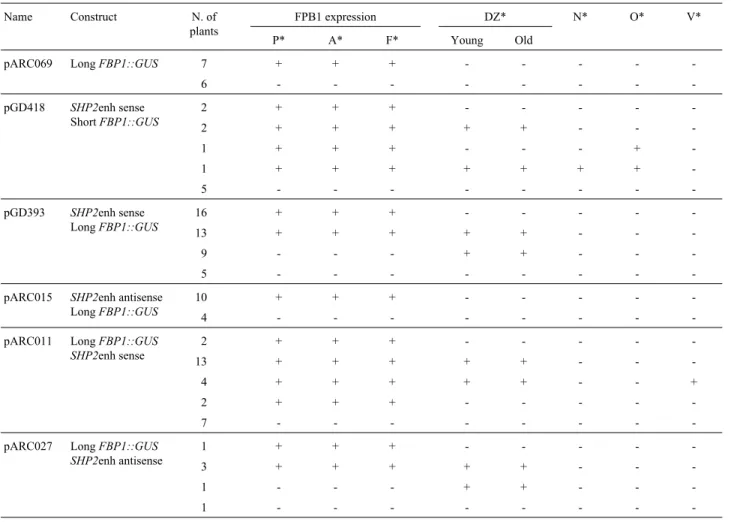
sults). Therefore, as control, a binary vector harbouring the ‘long’FBP1promoter sequence fused toGUSwas intro-duced into Arabidopsis plants. Several transgenic plants were obtained with different levels of GUS expression in petals (often very weak) and filaments (stronger) (Table 2 and Figure 3A, B). This result indicates that this promoter acts as expected, with the same specificity as in petunia (Angenentet al., 1993), and can be used to test theSHP2 enhancer. Figure 2 summarises the vectors that were used to test theSHP2enhancer activity based on its ectopic ex-pression in combination with theFBP1 promoter. In the first two tester constructs, theSHP2enhancer was fused in sense orientation, with both the ‘short’ and the ‘long’ ver-sions of the FBP1 promoter resulting in pGD418 and pGD393 respectively (Figure 2). These constructs were used to test whether the SHP2 enhancer fragment could ectopically activate GUS expression in combination with theFBP1promoter and, moreover, whether the enhancer still keeps its tissue-specific activity when combined with a natural promoter. By using the ‘short’ and ‘long’ version of theFBP1promoter, the influence of the distance towards
the promoter was analysed. The other three constructs should identify whether theSHP2enhancer acts independ-ently of its orientation and position related to the coding se-quence. The results of the GUS staining of the transgenic Arabidopsisplants expressing these constructs are summa-rised in Table 2.
In general, all constructs that contained the SHP2 enhancer fused in either way to thepFBP1::GUS, showed theFBP1-driven expression in whorls 2 and 3 (Figure 3C) and, also ectopic GUS expression in the dehiscence zone (Figure 3D). In whorls 2 and 3, the GUS expression driven by the FBP1 promoter was similar to or in some lines slightly enhanced compared to the expression observed in plants that contained the control construct with only the ‘long’ pFBP1::GUS construct (pARC069). The SHP2 enhancer region drove ectopic expression to the dehiscence zone, however it did not seem to promote up-regulation of theFBP1promoter activity. As expected, this ectopic ex-pression driven by theSHP2enhancer was mostly seen in the dehiscence zone tissue. However in some plants, GUS staining in pollen grains was observed as well (data not shown).
The distance of theSHP2enhancer relative to the pro-moter sequence did not seem to influence the frequency of plants showing ectopic expression in the dehiscence zone. When theSHP2enhancer was situated downstream of the GUS gene (pARC011 and pARC027) (Figure 2), the enhancer was still able to ectopically activate the expres-sion with the same frequency as observed for the upstream sense position of theSHP2enhancer (Table 2).
The only construct that did not result in ectopic ex-pression in dehiscence zone tissue was construct pARC015 (Table 2), which contains theSHP2enhancer positioned upstream, in an anti-sense orientation, linked to the ‘long’ pFBP1::GUS fragment. Out of fourteen T1 plants ana-lysed, 10 showed expression in whorls 2 and 3 only.
Discussion
Tissue specific activation tagging is a novel approach to generate mutants for a specific trait of interest. Require-ments for such a strategy are that: i) the used enhancer
frag-Table 1- GUS expression ofSHP2enhancer-GUSplants (pARC751).
Number of plants
L* S* P* O* N* F* C* DZ*
young
DZ * mature
5 (21%) - - -
-10 (42%) - - -
-3 (12.5%) - - - -
-3 (12.5%) - - - -
-1 (4%) - - -
-1 (4%) - - -
-1 (4%) - - - -
-* L (Leaf); S (Sepals); P (Pollen); O (Ovules); N (Nectary); F (Funiculus); C (Carpels); DZ (dehiscence zone).
Figure 2- Schematic representation of the constructs in which theSHP2
enhancer was fused to thepFBP1::GUSpromoter-gene construct in differ-ent oridiffer-entations. pARC069: thepFBP1::GUSconstruct used as control. pGD418:SHP2in sense orientation upstream of the short version of the
ment shows tissue specificity, avoiding unwanted side effects in other tissues ii) the activity of the enhancer should still be functional at least at several kbs from the natural promoter or gene, increasing the efficiency that genes will be activated, and iii) the insertion in the genome should be carried out by a system that minimizes the chances of com-plex insertion integrations (Nacryet al., 1998), which can cause silencing of the introduced enhancer (Chalfun-Junior et al., 2003).
Here we show that the 1220 bpSHP2promoter frag-ment taken from the upstream sequence of theSHP2gene contains most of thecis-regulatory sequences. It has been previously reported that theSHP2gene is expressed in the dehiscence zone of theArabidopsissilique, in addition to other tissues like septum, ovules and funiculus (Maet al., 1991; Savidgeet al., 1995; Liljegrenet al., 1998; Liljegren et al., 2000). TheSHP2enhancer sequence chosen in our study is mainly expressed in the dehiscence zone, although GUS expression was also observed in ovules, funiculi and nectaries. The expression occasionally observed in a few pollen grains, nectaries and the vascular junction at the re-ceptacle were not described previously. We did not test GUS expression driven by the complete endogenousSHP2
promoter in this same setup, which makes a comparison between publishedin situhybridisation data and our data obtained with the enhancer studies more difficult. In con-clusion, we demonstrated that it is possible to confer spe-cific and ectopic expression of a particular gene by using an upstream enhancer sequence combined with minimal pro-moter elements.
The second prerequisite for an efficient activation tagging approach is that the enhancer activity should reach as far as possible from the minimal promoter elements (e.g., the TATA box). Based on the results obtained with the con-structs in which theSHP2enhancer was fused to theFBP1 promoter (in combination with theGUSreporter gene), we detected ectopic expression driven by theSHP2enhancer in most of the combinations. In some of the plants, the GUS staining in the dehiscence zone was very strong and compa-rable with -47-35S::GUStransgenics. This was even the case when the enhancer was inserted downstream of the GUSgene, which resulted in GUS expression levels com-parable with those for the upstream sense positions.
It still remains unclear why the construct pARC015 revealed no ectopic activation. This improper function may be specific for theFBP1promoter and it is unlikely that this
Table 2- GUS expression observed in tissues of transgenicArabidopsisplants containing different constructs (see Figure 2).
Name Construct N. of plants
FPB1 expression DZ* N* O* V* P* A* F* Young Old
pARC069 LongFBP1::GUS 7 + + + - - - -
-6 - - -
-pGD418 SHP2enh sense ShortFBP1::GUS
2 + + + - - - -
-2 + + + + + - -
-1 + + + - - - +
-1 + + + + + + +
-5 - - -
-pGD393 SHP2enh sense LongFBP1::GUS
16 + + + - - - -
-13 + + + + + - -
-9 - - - + + - -
-5 - - -
-pARC015 SHP2enh antisense LongFBP1::GUS
10 + + + - - - -
-4 - - -
-pARC011 LongFBP1::GUS SHP2enh sense
2 + + + - - - -
-13 + + + + + - -
-4 + + + + + - - +
2 + + + - - - -
-7 - - -
-pARC027 LongFBP1::GUS SHP2enh antisense
1 + + + - - - -
-3 + + + + + - -
-1 - - - + + - -
-1 - - -
is a general feature for an enhancer inserted in antisense ori-entation upstream of a native promoter. Our results demon-strate that the enhancer activity acts over a distance of at least 2.0 kb, making it interesting to explore it in a tis-sue-specific activation tagging strategy. When an even stronger activity would be required, it may be possible to create a tagging construct with a repeatedSHP2enhancer, similar to experiments performed with the35S enhancer (Weigelet al., 2000; Marsch-Martinezet al., 2002). And this brings us to the third requirement for an efficient tag-ging strategy,i.e. avoidance of silencing, which could be induced by the insertion of repeated DNA sequences (Chalfun-Junioret al., 2003).
Based on the findings described by Marsch-Martinez et al.(2002) and our own observations on the methylation of T-DNA based activation tagging using the quadruple 35Senhancer (Chalfun-Junioret al., 2003), we propose a transposon-based tagging strategy as being the most prom-ising. Hopefully this strategy, in which the describedSHP2 enhancer could be used as tissue-specific enhancer, will lead to a better understanding of pod dehiscence and to
novel approaches to control the shattering behaviour of crops.
Acknowledgments
The authors thank John Franken for helping with sec-tioning and taking pictures, Stefan de Folter for helping in the beginning of the experiments, and Marsja Meijer. Ma-arten Koornneef and Mark Aarts for helpful discussions. This work has been partially supported by CAPES-Brazil (BEX 1519/98-0).
References
Ahad A, Wolf J and Nick P (2003) Activation-tagged tobacco mu-tants that are tolerant to antimicrotubular herbicides are cross-resistant to chilling stress. Transgenic Res 12:615-630.
Angenent GC, Franken J, Busscher M, Colombo L and van Tunen AJ (1993) Petal and stamen formation in petunia is regulated by the homeotic geneFBP1. Plant J 4:101-112.
ArabidopsisGenome Initiative (2000) Analysis of the genome se-quence of the flowering plantArabidopsis thaliana. Nature 408:796-815.
Figure 3- GUS expression pattern inArabidopsisplants containing theSHP2enhancer inserted in thepFBP1::GUSconstruct (pGD418). (A-B)
Borevitz JO, Xia YJ, Blount J, Dixon RA and Lamb C (2000) Ac-tivation tagging identifies a conserved MYB regulator of phenylpropanoid biosynthesis. Plant Cell 12:2383-2393. Chalfun-Junior A, Mes JJ, Mlynarova L, Aarts MGM and
Angenent GC (2003) Low frequency of T-DNA based acti-vation tagging inArabidopsisis correlated with methylation ofCaMV 35Senhancer sequences. FEBS Lett 555:459-463. Chalfun-Junior A, Franken J, Mes JJ, Marsch-Martinez N, Pereira
A and Angenent GC (2005) ASYMMETRIC LEAVES2-LIKE1 gene, a member of the AS2/LOB family, controls proximal-distal patterning inArabidopsispetals. Plant Mol Bio 57:559-575.
Clough SJ and Bent AF (1998) Floral dip: A simplified method for Agrobacterium-mediated transformation of Arabidopsis thaliana. Plant J 16:735-743.
Ferrandiz C (2002) Regulation of fruit dehiscence inArabidopsis. J Exp Bot 53:2031-2038.
Ferrandiz C, Liljegren SJ and Yanofsky MF (2000) Negative reg-ulation of theSHATTERPROOFgenes byFRUITFULL dur-ingArabidopsisfruit development. Science 289:436-438. Hayashi H, Czaja I, Lubenow H, Schell J and Walden R (1992)
Activation of a plant gene by T-DNA tagging - auxin inde-pendent growthin vitro. Science 258:1350-1353.
Huang S, Cerny RE, Bhat DS and Brown SM (2001) Cloning of an Arabidopsispatatin-like gene, STURDY, by activation T-DNA tagging. Plant Physiol 125:573-584.
Ito T and Meyerowitz EM (2000) Overexpression of a gene en-coding a cytochrome p450, CYP78A9, induces large and seedless fruit inArabidopsis. Plant Cell 12:1541-1550. Jefferson RA, Kavanagh TA and Bevan MW (1987) GUS fusions:
Beta-glucuronidase as a sensitive and versatile gene fusion marker in higher plants. EMBO J 6:3901-3907.
Jeong DH, An S, Kang HG, Moon S, Han JJ, Park S, Lee HS, An K and An G (2002) T-DNA insertional mutagenesis for acti-vation tagging in rice. Plant Physiol 130:1636-1644. Kardailsky I, Shukla VK, Ahn JH, Dagenais N, Christensen SK,
Nguyen JT, Chory J, Harrison MJ and Weigel D (1999) Ac-tivation tagging of the floral inducerFT. Science 286:1962-1965.
Lee H, Suh SS, Park E, Cho E, Ahn JH, Kim SG, Lee JS, Kwon YM and Lee I (2000) TheAGAMOUS-LIKE 20MADS do-main protein integrates floral inductive pathways in Arabidopsis. Genes Dev 14:2366-2376.
Lewin B (2000) Genes XVII. Oxford University Press, Oxford, 990 pp.
Liljegren SJ, Ferrándiz C, Alvarez-Buylla ER, Pelaz S and Yanofsky MF (1998) Arabidopsis MADS-box genes in-volved in fruit dehiscence. Flow Newsl 25:9-19.
Liljegren SJ, Ditta GS, Eshed Y, Savidge B, Bowman JL and Yanofsky MF (2000)SHATTERPROOFMADS-box genes control seed dispersal inArabidopsis. Nature 404:766-770. Ma H, Yanofsky MF and Meyerowitz EM (1991)AGL1-AGL6, an
Arabidopsisgene family with similarity to floral homeotic and transcription factor genes. Genes Dev 5:484-495. Marsch-Martinez N, Greco R, van Arkel G, Herrera-Estrella L
and Pereira A (2002) Activation tagging using the En-I maize transposon system in Arabidopsis. Plant Physiol 129:1544-1556.
Mathews H, Clendennen SK, Caldwell CG, Liu XL, Connors K, Matheis N, Schuster DK, Menasco DJ, Wagoner W,
Lightner J and Wagner DR (2003) Activation tagging in to-mato identifies a transcriptional regulator of anthocyanin biosynthesis, modification, and transport. Plant Cell 15:1689-1703.
Nacry P, Camilleri C, Courtial B, Caboche M and Bouchez D (1998) Major chromosomal rearrangements induced by T-DNA transformation inArabidopsis. Genetics 149:641-650. Neff MM, Nguyen SM, Malancharuvil EJ, Fujioka S, Noguchi T, Seto H, Tsubuki M, Honda T, Takatsuto S, Yoshida S and Chory J (1999)BAS1: A gene regulating brassinosteroid lev-els and light responsiveness inArabidopsis. Proc Natl Acad Sci USA 96:15316-15323.
Odell JT, Nagy F and Chua NH (1985) Identification of DNA se-quences required for activity of the cauliflower mosaic virus 35Spromoter. Nature 313:810-812.
Pasquali G, Ouwerkerk PB and Memelink J (1994) Versatile transformation vectors to assay the promoter activity of DNA elements in plants. Gene 149:373-374.
Savidge B, Rounsley SD and Yanofsky MF (1995) Temporal rela-tionship between the transcription of two Arabidopsis MADS box genes and the floral organ identity genes. Plant Cell 7:721-733.
van der Graaff E, Dulk-Ras A, Hooykaas P and Keller B (2000) Activation tagging of theLEAFY PETIOLEgene affects leaf petiole development inArabidopsis thaliana. Development 127:4971-4980.
van der Graaff E, Nussbaumer C and Keller B (2003) The Arabidopsis thaliana rlpmutations revert the ectopic leaf blade formation conferred by activation tagging of theLEP gene. Mol Genet Genomic 270:243-252.
van Engelen FA, Molthoff JW, Conner AJ, Nap JP, Pereira A and Stiekema WJ (1995) pBINPLUS: An improved plant trans-formation vector based on pBIN19. Transgenic Res 4:288-290.
Walden R, Fritze K, Hayashi H, Miklashevichs E, Harling H and Schell J (1994) Activation tagging: A means of isolating genes implicated as playing a role in plant growth and devel-opment. Plant Mol Biol 26:1521-1528.
Weigel D, Ahn JH, Blazquez MA, Borevitz JO, Christensen SK, Fankhauser C, Ferrandiz C, Kardailsky I, Malancharuvil EJ, Neff MM, Nguyen JT, Sato S, Wang ZY, Xia YJ, Dixon RA, Harrison MJ, Lamb CJ, Yanofsky MF and Chory J (2000) Activation tagging inArabidopsis. Plant Physiol 122:1003-1013.
Wilson K, Long D, Swinburne J and Coupland G (1996) A disso-ciation insertion causes a semidominant mutation that in-creases expression ofTINY, anArabidopsisgene related to APETALA2. Plant Cell 8:659-671.
Yuen CYL, Pearlman RS, Silo-suh L, Hilson P, Carroll KL and Masson PH (2003)WVD2andWDL1modulate helical or-gan growth and anisotropic cell expansion inArabidopsis. Plant Physiol 131:493-506.
Zhao Y, Christensen SK, Fankhauser C, Cashman JR, Cohen JD, Weigel D and Chory J (2001) A role for flavin monooxy-genase-like enzymes in auxin biosynthesis. Science 291:306-309.
Zubko E, Adams CJ, Machaekova I, Malbeck J, Scollan C and Meyer P (2002) Activation tagging identifies a gene from Petunia hybrida responsible for the production of active cytokinins in plants. Plant J 29:797-808.