RESUMO.- [Parasitos gastrintestinais de suínos criados sob diferentes sistemas de manejo no Estado do Rio de Janeiro.] De 2012 a 2013 foram pesquisados parasitos gas-trintestinais de suínos de granjas localizadas em diferentes
municípios do estado do Rio de Janeiro. Amostras fecais de 790 suínos foram coletadas da ampola retal, sendo 88 de propriedades familiares e 702 de granjas com produção in-dustrial. As amostras foram submetidas às técnicas de Faust et al., Sheather, Ritchie, Lutz e exame direto. A prevalência estimada foi de 93,1% nas granjas familiares e 59,1% nas granjas industriais. Balantidium coli, coccídios e Entamoeba sp. foram os parasitos que apresentaram as maiores frequ-ências, sendo as categorias machos e fêmeas reprodutoras e leitões de terminação as mais infectadas (p<0,05). Trofozo-ítas de B. coli foram mais evidenciados nas amostras fecais de consistências semi-sólida, seguida pelas fezes com consis-tências sólida e diarreica. Ovos de estrongilídeos e Trichuris suis foram detectados exclusivamente em criações familiares. Ovos de Ascaris suum e de Strongyloides ransomi apresenta-ram baixa frequência. O alto grau de parasitismo, principal-mente de protozoários, indica a necessidade de reavaliação do manejo dos suínos em ambos os tipos de produção. TERMOS DE INDEXAÇÃO: Parasitos gastrintestinais, prevalência, granjas de suínos, Balantidium coli, Rio de Janeiro.
Gastrointestinal parasites of swine raised in different management
systems in the State of Rio de Janeiro, Brazil
1Alynne S. Barbosa2*, Otilio M.P. Bastos3, Laís V. Dib2, Mayara P. de Siqueira3,
Matheus L. Cardozo3, Luiz Claudio Ferreira4, William T. Chaves2, Ana Beatriz M.
Fonseca5, Claudia M.A. Uchôa3 and Maria Regina R. Amendoeira2
ABSTRACT.- Barbosa A.S., Bastos O.M.P., Dib L.V., Siqueira M.P., Cardozo M.L., Ferreira L.C., Chaves W.T., Fonseca A.B.M., Uchôa C.M.A. & Amendoeira M.R.R. 2015. Gastrointestinal parasites of swine raised in different management systems in the State of Rio de Janeiro, Brazil. Pesquisa Veterinária Brasileira 35(12):941-946. Laboratório de Toxoplas-mose, Instituto de Oswaldo Cruz (FioCruz), Prédio 108, sala 32/34, Avenida Brasil 4365, Manguinhos, RJ 21045-900, Brazil. E-mail: [email protected]
From 2012 to 2013 were surveyed gastrointestinal parasites from pig farms located in different municpaliyies in the state of Rio de Janeiro. Fecal samples from 790 pigs were col-lected from the rectum on 88 family farms and 702 farms with industrial production. The samples were subjected to Faust et al., Sheather, Ritchie, Lutz and direct examination faecal techniques. The estimated parasite prevalence was 93.1% in family farms and 59.1% in industrial farms. Balantidium coli, coccidia and Entamoeba sp. were the parasites with the highest frequencies, and the male and female reproductive categories and fatteners pigs the most infected (p<0.05). Trophozoites of B. coli were most evident in stool samples from semi-solid followed by solid and diarrheal consistencies. Strongyles eggs and Trichuris suis have been detected exclusively in family farms. Ascaris suum eggs and Strongyloides ranso-mi showed low frequency. The high degree of parasitism, especially protozoa, indicates the need to reassess the management of pigs in both types of production.
INDEX TERMS: Gastrointestinal parasites, prevalence, pig farms, Balantidium coli, Rio de Janeiro.
1 Received on January 14, 2015.
Accepted for publication on August 26, 2015.
2 Laboratório de Toxoplasmose, Instituto de Oswaldo Cruz (Fiocruz), Pré-
dio 108, sala 32/34, Avenida Brasil 4365, Manguinhos, Rio de Janeiro, RJ 21045-900, Brazil. E-mails: [email protected], williantavora@hotmail.
com, [email protected]; *Corresponding author: alynne.barbosa@
ioc.fiocruz.br, [email protected]
3 Laboratório de Parasitologia, Departamento de Microbiologia e
Para-sitologia, Instituto de Biomédico, Universidade Federal Fluminense (UFF), Rua Professor Hernani de Mello 101, sala 212C, São Domingos, Niterói, RJ 24210-130, Brazil. E-mails: [email protected], mayaraperlingeiro@ yahoo.com.br, [email protected], claudiauchô[email protected]
4 Divisão de Parasitologia, Instituto de Pesquisa de Evandro Chagas
(IPEC), Instituto Oswaldo Cruz (Fiocruz), Avenida Brasil 4365, Mangui-nhos, Rio de Janeiro, RJ 21045-900. E-mail: [email protected]
5 Laboratório de Estatística,Departamento deEstatística, UFF, RuaMário
INTRODUCTION
Investment and research in pig farming have positioned Brazil in third and fourth place, respectively, in the ranking of world production and exports, and contributed to incre-ased domestic supply on the world stage (Ministry of Agri-culture 2013, Abipecs 2013). In this context, the states of Brazil in the Southeast (Minas Gerais, São Paulo and Rio de Janeiro) currently hold about 17% of the national herd and 21% of the industrial farms (Embrapa 2011). According to estimated data from IBGE (2012), the State of Rio de Janei-ro has 155,328 heads of pigs.
In national herds, parasite incidence can determine common health problems at all stages of production, and is therefore a limiting factor in pig breeding establishments (Carregaro 2002). The main negative effects on animals
are reflected in economic losses for producers, such as:
reduced feed conversion, reduced fertility, low number of piglets born and weaned, low weight piglets at birth and at weaning, as well as losses relating to viscera of high conde-mnation rate in slaughterhouses (Bordin 1987, Nansen & Roepstorff 1999, Roepstorff et al. 1998). In addition, pigs are considered the main reservoir of Balantidium coli and Entamoeba polecki, which can infect humans, especially farm laborers (Solaymani-Mohammadi & Petri Jr 2006).
Studies in different countries have reported a high prevalence of gastrointestinal parasites in pigs produ-ced mainly in intensive systems, industrial farms, with fewer parasitic frequency reports in animals produced in family systems. In France, Beloeil et al. (2003) detected nematodes, such as Trichuris suis and strongyles in five intensive production pig farms. In 3636 fecal samples from pigs reared on farms with an intensive production system in Guangdong Province, China, Weng et al. (2005) detected 47.5% of positivity for B. coli as well as, T. suis (5.7%), Ascaris suum (5.2%), strongyles (2.5%) and cocci-dia (24.9%). Also in China, the city of Chongqing, Lai et al. (2011) estimated the prevalence of intestinal parasites in pig breeding establishments with intensive and extensive system and is evidenced frequencies for A. suum (12.18%), T. suis (10.13%), Oesophagostomum spp. (10.13%), Eime-ria spp. (16.53%), Cystoisospora suis (5.02%), Cryptospori-dium spp. (6.60%) and cysts of B. coli (22.7%). Uysal et al. (2009) detected with zoonotic potential parasites such as Giardia lamblia (3.7%), Cryptosporidium spp. (8.8%) and B. coli (1.6%) in pig feces of different age groups in Istan-bul, Turkey. Roepstorff et al. (1998) studied about 14.396
fecal samples from pigs confined in industrial farms in di -fferent Nordic countries, showing a high percentage of A. suum (25 - 35%).
In Brazil, Nishi et al. (2000) examined pig feces in an in-tensive system, with 114 samples collected from farms lo-cated in Minas Gerais and 423 in São Paulo. The estimated prevalence of parasitic infections was 38.6% and 39.7%, respectively. Aguiar (2009) made a parasitological survey of 130 pigs of family farms from the Federal District. B. coli has been the most frequently diagnosed (77.6%) parasite, followed by coccidia (71.1%), strongyles (45.3%), Stron-gyloides ransomi (36.9%), A. suum (27.6%), T. suis (14.3%) and Metastrongylus spp. (3.7%). D’Alencar et al. (2006)
stu-died 1.126 fecal samples from pig farms with an intensive system located in Camaragibe, Pernambuco, and obtained 0.27% to 1.6% for the incidence of helminthes and proto-zoa, respectively.
However, in the state of Rio de Janeiro the information on the prevalence of parasitic infections in pigs produced in different raising systems is limited. In this context, the ob-jective of this work was to evaluate the estimated prevalen-ce of gastrointestinal parasites of pigs in family and indus-trial farms in different cities in the state of Rio de Janeiro, correlating the positivity of parasites with the different ca-tegories of pigs in intensive systems and also the frequency of trophozoite B. coli, according to fecal consistency.
MATERIALS AND METHODS
The state of Rio de Janeiro is located in the eastern portion of sou-theastern Brazil, occupying an area of 43,780.172 km2, with 92
cities, having tropical climate with average annual temperatures of 22 to 24°C (IBGE 2012). Family farms from within the metro-politan and coastal lowlands region were invited to participate in the study since most family farmers (traditional) state concentra-te on these areas. The industrial pig farms selecconcentra-ted for this study are the main producers of pig in Rio de Janeiro, especially the ones located near the city of Petrópolis, which today is considered the largest producer in the state.
Nine pig farms were studied in different cities of Rio de Janei-ro. From the metropolitan area: Itaboraí and Maricá; in the moun -tainous: Petrópolis; in a coastal lowland: Rio Bonito, Saquarema, Silva Jardim and Casimiro de Abreu and Northwest Rio: Itaperuna. All pig farms were georeferenced with GPS Garmin model Etrex and their locations in the state of Rio de Janeiro are plotted in Fi-gure 1.
From September 2012 to September 2013 we collected 790 fecal samples, as follows: 88 from family farms in the cities of Rio Bonito (21), Araruama (7), Saquarema (12), Maricá (8), Itaboraí (12), Casimiro de Abreu (23) and Silva Jardim (5) and 702 of in-dustrial pig farms of Petrópolis (479) and Itaperuna (223). This study was approved by the Ethics Committee on Animal (CEUA/ Fiocruz) license number LW57/12, protocol number 79/11-2. On family farms studied, the animals did not have definite bre -eds and remained in collective pens. Most of the farms used the semi-intensive farming system, except for the Araruama city farm that practiced extensive production. In industrial farms was used
intensive system, and the pigs come from specific lineages, in Pe -trópolis animals belonged to TOPIG lineage Brasil® and Itaperuna
the Agroceres® lineage.
In industrial pig farms, the pigs were categorized into: bree-ding sows (adult females): lactating, pregnant and dry sows (in reproductive rest period); female gilts (not adults who have ne -ver been inseminated), breeding males (adults), weaners piglets (weaned, 17 weeks old) and fattener pigs (18-22 weeks old). The samples were collected individually directly from the rectum with long palpation sleeves and were identified, stored in a termic con -tainer and immediately sent to the Parasitology Laboratory of the Biomedical Institute of the Federal Fluminense University for pro-cessing.
For sampling purposes, in family farms, it was decided to col-lect as much as possible of animals, since the number of pigs in each property was small. The collection was excluded the preg-nant females and newborn piglets. In industrial farms was used the confidence of at least 80% range with 5% accuracy, with the exception of fatteners and weaners sectors in the Petrópolis pig farm where convenience sample was adopted, being collected at least 100 stool samples from each category because these sectors had more than 1,000 animals in each.
Fecal samples were categorized according to consistency as: solid, semi-solid and diarrheal being a part of this material im-mediately processed by direct examination. Another part of the sample was homogenized and the filtrate was aliquotted into cen -trifuge tubes with volume 15 ml conical bottom for carrying out centrifugal sedimentation techniques Ritchie (1948) modified by Young et al. (1979), centrifugal flotation Faust et al. (1938); Cen -trifugal flotation Sheather (1923) modified by Huber et al. (2003). Part of the filtered material was left to sediment in conical bottom glasses over 24 h to perform the Lutz’s spontaneous sedimenta-tion technique (1919).
The reading of slides obtained in each technique and photo-graphic documentation was performed in Olympus BX 41 optical microscope, initially at 100x augmentation, and then at 400x for confirmation if necessary. The microscope was coupled to a Sa -msung SDC415 digital camera with the Honestech PVR capture
software. An Olympus CH30 optical microscope on a 400x aug-mentation with an ocular micrometer was used for morphometry of evolutionary forms of the identified parasites.
A fecal sample was considered positive when at least one evo-lutionary form of parasites was found (trophozoites, eggs, cysts or oocysts). The estimation of prevalence was performed dividing the number of positive samples by the total number of samples collected and these data were presented in percentages (%). The X2 test was used with SPSS statistical software version 11.7
(SPSS®, Chicago, IL) with a degree of confidence of 5% to analyze
the parasite positivity of the production systems, in the categories of pigs of the industrial pig farms and also the frequency of tro-phozoites of Balantidium coli, in accordance to the consistency of fecal samples.
RESULTS
Of the total positive pig samples for one or more gastroin-testinal parasites, 93.1% came from the family farms and
59.1% of industrial farm, there was a significant differen -ce (P<0.05) in the total amount of infected animals com-pared the two production systems (Table 1). Positivity for the most common parasites in family and industrial farms was respectively: Balantidium coli (71.6%, 46.4%), coccidia (71.6%, 19.2%) and Entamoeba sp. (44.3%, 18.6%). The family system these protozoa had a higher estimated pre-valence than in the industrialized system, with statistically
significant difference between the types of production (P
<0.05).
Cysts of Giardia lamblia were observed only in one sam-ple of a family farm. In familiar properties the helminthes most diagnosed were eggs of strongyles (46.6%) and Tri-churis suis (9%) which were not detected in samples from industrial farms (P<0.05). Ascaris suum eggs were eviden-ced both in family (4.5%) and in industry farms (0.1%) and embryonated eggs Strongyloides ransomi detected only in
samples of industrial farms (0.6%), with no significant di
-Table 1. Gastrointestinal parasites found in swine raised in family-owned and industrial properties located in different cities of the state of Rio de Janeiro
TS Pig farms Pig Entama A. suumb B. colia Cocca G. lamb *Strona T. suisa S. ranb Total
Samples positivea
Family A 21 6(28.6%) 0 9(56.2%) 14(93.7%) 0 1(6.2%) 1(6.2%) 0 16(76.1%)
B 7 2(28.6%) 0 6(85.7%) 7(100%) 0 6(85.7%) 0 0 7(100%)
C 12 5(41.7%) 0 6(50%) 12(100%) 0 11(91.6%) 5(41.6%) 0 12(100%)
D 8 0 0 7(87.5%) 8(100%) 0 5(62.5%) 0 0 8(100%)
E 12 10(83.3%) 0 11(91.7%) 11(91.7%) 0 10(83.3%) 1(8.3%) 0 12(100%) F 23 15(68.2%) 0 19(86.4%) 6(27.2%) 1(4.3%) 4(18.1%) 0 0 22 (95.6%) G 5 1(20%) 4(80%) 5(100%) 5(100%) 0 4(80%) 1(20%) 0 5(100%) Subtotal 88 39(44.3%) 4(4.5%) 63(71.6%) 63(71.6%) 1(1.1%) 41(46.6%) 8(9%) 0 82(93.1%) Industrial H 479 109(22.8%) 1(0.20%) 257(53.7%) 115(24%) 0 0 0 2(0.4%) 328(68.5%)
I 223 22 (9.9%) 0 69(30.9%) 20(9%) 0 0 0 2(0.9%) 87(39%)
Subtotal 702 131(18.6%) 1(0.1%) 326(46.4%) 135(19.2%) 0 0 0 4 (0.6%) 415(59.1%) Total 790 170(21.5%) 5(0.6%) 389(49.2%) 198(25.1%) 1(0.1%) 41(5.2%) 8(1) 4(0.5%) 497(62.9%) The percentages were calculated dividing the number of samples positive for parasites by the subtotal (total number or samples collected in each type of system). The percentages were calculated dividing the number of samples positive for parasites by the subtotal (total number or samples collected in each type of system). TS = type of system, Entam = Entamoeba sp., A. suum = Ascaris suum, B. coli = Balantidium coli, Cocc = Coccidea,
G. lam = Giardia lamblia, Estron = Egg of Strongyle, T. suis = Trichuris suis, S. ran = Strongyloides ransmoni, A = Rio Bonito, B = Araruama, C = Sa-quarema, D = Maricá, E = Itaboraí, F = Casimiro de Abreu, G = Silva Jardim, H = Petrópolis, I = Itaperuna. * Stron = Strongyles (Eggs of Superfamily Strongyloidea and Trichostrongyloidea were considered). a Statistical difference (P<0.05) between the two types of systems (family-owned and
fference between production system (P>0.05) (Table 1). Monoparasite infections were found in 34.7% (274/790) and multiple parasite in 28.2% (223/790), and the associa-tions of B. coli and Entamoeba sp. 83/223 (37.2%) the most frequent, followed by B. coli and coccidia 62/223 (27.8%) (Data not shown in table).
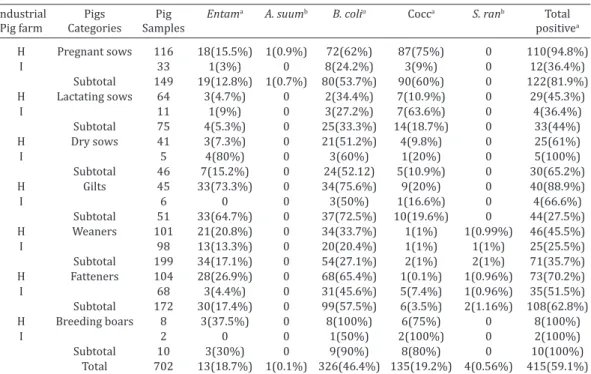
On farms with an industrial-type system, categories of pigs that had higher infection rates were: breeding males, followed by pregnant females (highest value found at the farm H), dry sows, fattener piglets, lactating sows, weaners
piglets and gilt (Table 2). There was a statistically signifi -cant difference (P <0.05) for categories of animals, both in
total frequency parasites, as specific in the B. coli, Entamoe-ba sp. and coccidia, which were the most frequent parasites (Table 2).
From the 790 fecal samples of swine collected, 67.6% presented solid consistency, 25.6% semi-solid consistency and 6.8% diarrhea consistency. Trophozoites of B. coli were found by direct examination of the three categories of fecal
consistencies, given that this evolutionary form was most evident in stool samples from semi-solid followed by solid
and diarrheal consistences, and there was a significant di -fference (P<0.05) in the rate of diagnosis of trophozoites between the three categories of fecal consistency (Table 3).
DISCUSSION
The state of Rio de Janeiro has different pig production systems, among which stand out producers, industry type and family, also known as a traditional system. In this study it became clear the difference in positivity for gas-trointestinal parasites among pigs raised under different management. The total parasitic frequency of family pro-duction was higher than the industrial. High rates of gas-trointestinal parasites (96.1%) on family farms were also observed by Aguiar (2009) in the Federal District, Brazil. Lower frequencies farms with an intensive system of Rio de Janeiro were evidenced by Nishi et al. (2000) in Minas Gerais (38.6%) and São Paulo (39.7%). The high parasite positivity in traditional family systems was also reported by Lai et al. (2011) in pigs of Chongqing, in China, without
significant difference relating to the intensive system.
Evolutionary forms of Balantidium coli, not sporulated oocysts of coccidia and uninucleate cyst of Entamoeba sp. were the most detected in both production systems, with a
significant difference among them being the most evident
parasitism association between these protozoa (B. coli and Entamoeba sp., B. coli and coccidia). Results that differ from the farms of Rio de Janeiro found by Lai et al. (2011) showed that B. coli in traditional and industrial farming respective-Table 2. Gastrointestinal parasites found in categories of swine raised in industrial farms located
in different cities of the State of Rio de Janeiro
Industrial Pigs Pig Entama A. suumb B. colia Cocca S. ranb Total
Pig farm Categories Samples positivea
H Pregnant sows 116 18(15.5%) 1(0.9%) 72(62%) 87(75%) 0 110(94.8%)
I 33 1(3%) 0 8(24.2%) 3(9%) 0 12(36.4%)
Subtotal 149 19(12.8%) 1(0.7%) 80(53.7%) 90(60%) 0 122(81.9%) H Lactating sows 64 3(4.7%) 0 2(34.4%) 7(10.9%) 0 29(45.3%)
I 11 1(9%) 0 3(27.2%) 7(63.6%) 0 4(36.4%)
Subtotal 75 4(5.3%) 0 25(33.3%) 14(18.7%) 0 33(44%) H Dry sows 41 3(7.3%) 0 21(51.2%) 4(9.8%) 0 25(61%)
I 5 4(80%) 0 3(60%) 1(20%) 0 5(100%)
Subtotal 46 7(15.2%) 0 24(52.12) 5(10.9%) 0 30(65.2%) H Gilts 45 33(73.3%) 0 34(75.6%) 9(20%) 0 40(88.9%)
I 6 0 0 3(50%) 1(16.6%) 0 4(66.6%)
Subtotal 51 33(64.7%) 0 37(72.5%) 10(19.6%) 0 44(27.5%) H Weaners 101 21(20.8%) 0 34(33.7%) 1(1%) 1(0.99%) 46(45.5%)
I 98 13(13.3%) 0 20(20.4%) 1(1%) 1(1%) 25(25.5%)
Subtotal 199 34(17.1%) 0 54(27.1%) 2(1%) 2(1%) 71(35.7%) H Fatteners 104 28(26.9%) 0 68(65.4%) 1(0.1%) 1(0.96%) 73(70.2%) I 68 3(4.4%) 0 31(45.6%) 5(7.4%) 1(0.96%) 35(51.5%) Subtotal 172 30(17.4%) 0 99(57.5%) 6(3.5%) 2(1.16%) 108(62.8%)
H Breeding boars 8 3(37.5%) 0 8(100%) 6(75%) 0 8(100%)
I 2 0 0 1(50%) 2(100%) 0 2(100%)
Subtotal 10 3(30%) 0 9(90%) 8(80%) 0 10(100%)
Total 702 13(18.7%) 1(0.1%) 326(46.4%) 135(19.2%) 4(0.56%) 415(59.1%) The percentages were calculated dividing the number of samples positive for parasites by the subtotal. Entam = En-tamoeba sp., A. suum = Ascaris suum; B. coli = Balantidium coli; Cocc = Coccidia; S. ransomi = Strongyloides ransomi, H = Petrópolis, I = Itaperuna. a Statistical difference (P<0.05) between the two types of systems (family-owned and
industrial farms). b There was no statistical difference (P>0.05) between the two types of systems (family-owned and
industrial farms).
Table 3. Rate of trophozoites of Balantidium coli found in fecal samples with solid, semi-solid and diarrheic consistencies in pig farms of different cities in the State of
Rio de Janeiro
Consistency of feces Total
Solid* Semi-solid* Diarrheic*
ly, 22.1% and 23.4%, with smaller frequency, without
signi-ficant difference between the types of production. Indices
slightly larger B. coli (47.2%) and coccidia (24.9%) were shown by Weng et al. (2005) in industrial intensive system farms in Guangdong Province, China.
Uninucleate cysts Entamoeba sp., in fecal samples of pigs, has been scarcely reported. Ismail et al. (2010) stu-died pig rural areas of Chungcheongnam-do, Korea showed a lower frequency of Entamoeba sp. (3.7%) than those de-tected in the farms of Rio de Janeiro. Despite the distinction between Entamoeba polecki and E. suis being relevant,
sin-ce only the first species are considered zoonotic and patho -genic for pigs, this study could not identify them because the size of the cysts present in compatible size ranges in both species (Stensvold et al. 2010). Cysts of Giardia lam-blia were detected only in one sample in the family farm in this study, disagreeing with evidence by Uysal et al. (2009), that reported Giardia lamblia in 9 pigs (3.7%) from diffe-rent farms in Turkey. According Armson et al. (2009) there is still little information about the importance of giardiasis for the health of these animals.
Among the helminths, were only detected nematodes, and most evident in family farms were strongyles. It was considered in this group both eggs Strongyloidea superfa-mily and Trichostrongyloidea superfasuperfa-mily, as the same are identical, necessitating the stool culture and morphological study of the larvae to differentiate them. They were also detected Trichuris suis eggs and Ascaris suum, the latter being evidenced in both production systems no significant
difference. Such helminths are important in pig farming because they cause a reduction in body weight gain, and
specifically A. suum, for determining condemnation of the liver in slaughterhouse (Bordin, 1987).
The frequency of nematodes in industrial farms was 0.6%, which was observed from one sample with eggs of A. suum and four samples with Strongyloides ransomi eggs. Similar results were found by D’Alencar et al. (2006) in Per-nambuco, Brazil, which found a low frequency (0.3%) of nematodes in 1126 pigs tested, including A. suum (0.1%).
Nishi et al. (2000) also observed low frequency, finding
3.5% of A. suum in Minas Gerais and 1.6% in São Paulo. Si-milarly, S. ransomi low frequency (0.4%, 11.8%) was also evidenced by Roepstorff et al. (1998) studied 14,396 pigs of the Nordic countries.
S. ransomi is a little reported in studies of nematode parasites of pigs, possibly because of the need for measu-rement of eggs to distinguish them from superfamilies Tri-chostrongyloidea and Strongyloidea. Another factor that may interfere with the meeting of this parasite, resulting in a false negative, it would be bad thermal conditioning of the samples carrying the eggs hatch, a fact reported by Nansen and Roepstorff (1999).
The significant difference between frequencies: high in
protozoa and low in nematodes, observed mainly in indus-trial farms can be attributed to routine anthelmintic, which is performed mainly in pregnant sows and fattener pigs. Typically, this antiparasitic therapy primarily operates in helminthes, with less effective for protozoa. Beloeil et al. (2003) noted that the low positivity for helminthes might
be related to the parasite control practice that is routinely used in industrial production systems. According to Nishi
et al. (2000) finding nematodes in livestock-intensive sys -tem, even if in low numbers, may be associated with conta-mination and the high resistance of some helminth eggs in the environment.
The higher parasite positivity in the family system than industrial pig farm was expected because industrial farming are generally companies that sell pigs for slau-ghterhouses which supply the consumer market, posses-sing more rigorous sanitary management, with cleaning facilities, room quarantine (remote installations where are the new animals that will be inserted in the farm) and anti--parasite control treatment routines. Already on family far-ms, producers invested in little or no health management,
have little infrastructure (semi-confined or unconfined
pigs) and animals are generally intended for producer con-sumption, or for small business transactions.
In this study, the highest parasitic frequencies by cate-gories of pigs on industrial farms concentrated in animals of reproductive age as breeding boars, pregnant sows and dry sows and also in fattener piglets. Protozoa B. coli, cocci-dia and Entamoeba sp. were the mostly detected with more
significant difference between the categories. These results
agree with Weng et al. (2005) that also showed higher po-sitivity in China in the categories of reproductive females and males.
The highest frequency of parasites in breeding animals can be explained by the fact that boars, females pregnant and dry sows, correspond to categories of pigs with greater
longevity on the farm, living on average five to six years.
The lifetime of animals in the pig farm may have favored their reinfection in contaminated environments. According to Weng et al. (2005) breeding categories when parasitized become reservoirs of infection to other age groups. Alrea-dy, the high rate of parasites in the fattening sector, both in Petrópolis farms (H) as of Itaperuna (I), may be related to
confinement in collective pens and the constant presence of a water layer on the floor, a fact underscored by Nishi et
al. (2000) associated this feature, when used inappropria-tely, for a source of parasite transmission.
Trophozoites of B. coli were diagnosed by direct exa-mination solid consistency of stools, semi-solid and
diar-rheal, with a statistically significant frequency difference.
balan-tidiasis has been mainly reported in countries of tropical and subtropical climates, like those of Rio de Janeiro.
Epidemiological comparisons at national and regional level were hampered due to lack of parasitism studies in pigs, suggesting the need for more research on this topic. In the pig farms located in different cities in the state of Rio de Janeiro showed up high frequency of gastrointestinal parasites mainly of protozoa, with lower percentages in the farms with industrial system. This result demonstrates the need to adopt individual sanitary control, taking into account the type of production, management used by the producer to the age of the animals, property location and physical structure of the farm, as well as the socioeconomic and cultural conditions owner.
Declaration.- The authors state that there is no conflict of interest in this study.
Acknowledgements.- The authors would like to thank for project sup-port: FAPERJ (Research Support Foundation of the State of Rio de
Janei-ro), IOC (Oswaldo Cruz Institute), PROPPI-UFF (Dean’s Office for Research
Studies and Innovation of Federal Fluminense University) and
PROAES--UFF (Dean’s Office for Student Affairs of Federal Fluminense University).
A contribuição dos autores para a publicação do artigo
Alynne S. Barbosa: Executora e responsável por todas as etapas do
estudo (doutoranda);
Laís V. Dib: Executora da coleta de amostras e
processa-mento do material biológico;
Mayara P. de Siqueira: Executora da coleta de amostras e
processa-mento do material biológico;
Matheus Cardozo: Executor da coleta de amostras e
processamen-to do material biológico;
William Chaves: Executor da coleta de amostras e
processamen-to do material biológico;
Luiz Claudio Ferreira: Supervisor e executor do trabalho de campo;
Ana B. Fonseca: Responsável pela análise estatística dos
resul-tados;
Otilio M.P. Bastos: Professor orientador; Claudia Uchôa: Professor orientador;
Maria R.R. Amendoeira: Coordenadora geral do projeto e professora orientadora.
REFERENCES
ABIPECS 2013. Relatório Anual 2012/2013. Associação Brasileira da In-dústria Produtora e Exportadora de Carne Suína, São Paulo.Available in <http://www.abipecs.org.br/uploads/relatorios/relatoriosassocia-dos/ABIPECS_relatorio_2012_pt.pdf Accessed on March 5, 2013. Aguiar P.C. 2009. Aspectos epidemiológicos das parasitoses
gastrintesti-nais de suínos naturalizados de criações familiares do Distrito Federal. Dissertação de Mestrado em Saúde Animal, Universidade Federal de Brasília, Brasília, DF. 100p.
Armson A., Yang R., Thompson J., Johnson J., Reidb S. & Ryanb U.M. 2009. Giardia genotypes in pigs in Western-Australia: prevalence and associa-tion with diarrhea. Exp. Parasitol. 121:381-383.
Beloeil P.A., Chauvin C., Fablet C., Jolly J.P., Eveno E., Madec F. & Reperant J.M. 2003. Helminth control practices and infections in growing pigs in France. Livest. Prod. Sci. 81:99-104.
Bordin E.L. 1987. Relações entre infecções por parasitas internos de suí-nos e o custo de alimentação: uma revisão. Hora Vet. 7:21-27. Carregaro F.B. 2002. Parasitos gastrintestinais em suínos raça/tipo
na-turalizados do Distrito Federal. Monografia, Universidade de Brasília,
Brasília, DF. 31p.
D’Alencar A.S., Faustino M.A.G., Sousa D.P., Lima M.M. & Alves L.C. 2006. Infecção por helmintos e coccídios em criação de suínos de sistema
confinado localizada no município de Camaragibe, PE. Ciênc. Vet. Tróp.
9:19-86.
Embrapa 2011. Distribuição espacial da produção de suínos no Brasil. Embrapa Suínos e Aves, Concórdia, SC. Accessed on September 7, 2013. Available in <http://www.cnpsa.embrapa.br/cias/index.php?option-=com_content&view=article&id=59>
Faust E.C., D’Antoni J.S., Odon V., Miller M.J., Perez C., Sawitz W., Thomen L.F., Tobie J.E. & Walker J.H. 1938. A critical study of clinical laboratory technics for the diagnosis of protozoan cysts and helminth eggs in feces. I. Preliminary communication. Am. J. Trop. Med. 18:169-183.
Huber F., Bomfim T.C. & Gomes R.S. 2003. Comparação da eficiência da téc -nica de sedimentação pelo formaldeído-eter e da téc-nica de
centrifugo--flutuação modificada na detecção de cistos de Giardia sp. e oocistos de
Cryptosporidium sp. em amostras fecais de bezerros.Revta Bras. Parasi-tol. Vet. 12:135-137.
IBGE 2012. Instituto Brasileiro de Geografia e Estatísticas Accessed on
September 3, 2013. Available in <http://www.ibge.gov.br/estadosat/
perfil.php?sigla=rj>
Ismail H.A.H.A., Jeon H., Yu Y., Do C. & Lee Y. 2010. Intestinal parasite in-fections in pigs and beef cattle in rural areas of Chungcheongnam-do, Korea. Korean J. Parasitol. 48:347-349.
Lai M., Zhou R.Q., Huang H.C. & Hu S.J. 2011. Prevalence and risk factors associated with intestinal parasites in pigs in Chongqing, China. Res. Vet. Sci. 91:121-124.
Lutz A.O. 1919. Schistosomum mansoni and Schistomatose according to observations made in Brazil. Mem. Inst. Oswaldo Cruz. 11:121-155. Ministério da Agricultura 2013. Produção. Accessed on: September 5,
2013. Available in <http://www. agricultura.gov.br/animal/merca-do-interno/producao>
Nansen P. & Roepstorff A. 1999. Parasitic helminths of the pig: factors
influencing transmission and infection levels. Int. J. Parasitol. 29:877-891.
Nishi A.M., Gennari S.M., Lisboa M.N.T.S., Silvestrim A., Caproni Jr L. &
Umehara O. 2000. Parasitas intestinais em suínos confinados nos Esta -dos de São Paulo e Minas Gerais. Arqs Inst. Biológico, São Paulo, 67:199-203.
Ritchie L.S. 1948. An ether sedimentation technique for routine stool ex-aminations. Bull. U.S. Army Med. Dep. 8:326.
Roepstorff A., Nilsson O., Oksanenc A.B., Richter S.H., Örtenberg E., Chris-tensson D., Martinsson K.B., Bartlett P.C., Nansen P., Eriksen L., Helle O., Nikander S. & Larsen K. 1998. Intestinal parasites in swine in the Nor-die countries: prevalence and geographical distribution. Vet. Parasitol. 76:305-319.
Sheather A.T. 1923. The detection of intestinal protozoa and monge
para-sites by a flotation technique. J. Comp. Pathol. 36:266-275.
Schuster F.L. & Ramirez-Avila L. 2008. Current World status of Balanti-dium coli. Clin. Microbiol. Rev. 21:626-638.
Solaymani-Mohammadi S. & Petri Jr W.A. 2004. Intestinal protozoa in wild boars (Sus scrofa) in western Iran. J. Wildl. Dis. 40:801-803.
Stensvold C.R., Lebba M. & Clark C.G. 2010. Genetic characterisation of uninucleated cyst-producing Entamoeba spp. from ruminants. Int. J. Pa-rasitol. 40:775-778.
Uysal H.K., Boral O., Metiner K. & Ilgaz A. 2009. Investigation of intestinal parasites in pigs feces that are also human pathogens. Turkey Parasitol. 33:218-22.
Weng Y B., Hu Y.J., Li Y., Li B.S., Lin R.Q., Xie D.H., Gasser R.B. & Zhu X.Q. 2005. Survey of intestinal parasites in pigs from intensive farms in Guangdong Province, People’s Republic of China. Vet. Parasitol. 127:333-336. Young K.H., Bullock S.L., Melvin D.M. & Spruill C.L. 1979. Ethyl acetate as a