Pesq. agropec. bras., Brasília, v.51, n.4, p.330-339, abr. 2016 DOI: 10.1590/S0100-204X2016000400005
Corn root morphoanatomy at different development stages
and yield under water stress
Thiago Corrêa de Souza(1), Paulo César Magalhães(2), Evaristo Mauro de Castro(3), Vinícius Politi Duarte(1) and Alyne Oliveira Lavinsky(2)
(1)Universidade Federal de Alfenas, Instituto de Ciências da Natureza, Rua Gabriel Monteiro da Silva, no 700, Centro, CEP 37130‑000 Alfenas, MG, Brazil. E‑mail: thiago.souza@unifal‑mg.edu.br, [email protected] (2)Embrapa Milho e Sorgo, Rodovia MG‑424, Km 45, CEP 35701‑970 Sete Lagoas, MG, Brazil. E‑mail: [email protected], [email protected] (3)Universidade Federal de Lavras, Departamento de Biologia, Setor de Fisiologia Vegetal, Caixa Postal 3037, CEP 37200‑000 Lavras, MG, Brazil. E‑mail: [email protected]
Abstract – The objective of this work was to characterize the morphoanatomy of roots and the yield traits of two corn hybrids contrasting for drought tolerance (DKB 390, tolerant; and BRS 1030, sensitive), at different stages of development. Water deficit was imposed for ten days, in a greenhouse, at three growth stages: V5, VT, and R3. These treatments were combined to generate cumulative stress during the plant cycle, as: V5VT, V5R3, VTR3, and V5VTR3. The following were analyzed: root anatomy; proportion of aerenchyma in the cortex; metaxylem number and diameter; phloem thickness; as well as morphological characteristics, such as root length, volume, and surface area, specific root length, length of fine roots, grain yield, and ear length and diameter. Development stage affected the responses to stress: DKB 390 showed the best performance for root morphoanatomy and yield traits, under drought stress, at the reproductive stages, mainly R3, and in the treatments with cumulative stress, especially V5VTR3; whereas BRS 1030 presented higher means for the studied parameters, mainly at the V5 and VT stages, but did not show a higher grain yield under water stress. The greater tolerance of the DKB 390 hybrid to water deficit is probably linked with a memory of pre‑exposure to water stress at different growth stages.
Index terms: Zea mays, aerenchyma, drought, endoderm, specific root length, WinRhizo.
Morfoanatomia radicular em diferentes estádios de desenvolvimento
e produtividade do milho sob estresse hídrico
Resumo – O objetivo deste trabalho foi caracterizar a morfoanatomia radicular e os atributos de rendimento de dois híbridos de milho contrastantes quanto à seca (DKB 390, tolerante; e BRS 1030, sensível), em diferentes estádios de desenvolvimento. A deficiência hídrica foi imposta por dez dias, em casa de vegetação, em três estádios de desenvolvimento: V5, VT e R3. Esses tratamentos foram combinados para gerar estresses acumulativos durante o ciclo da planta, como: V5VT, V5R3, VTR3 e V5VTR3. Foram analisados: anatomia radicular; proporção de aerênquima no cortex; número e diâmetro de metaxilema; espessura do floema; bem como características morfológicas, como comprimento, volume e área de superfície radicular, comprimento específico das raízes, comprimento de raízes finas, rendimento de grãos, e comprimento e diâmetro da espiga. O estádio de desenvolvimento influenciou as respostas ao estresse: DKB 390 apresentou o melhor desempenho quanto à morfoanatomia radicular e aos atributos de rendimento, quando submetido a estresse hídrico, nos estádios reprodutivos, sobretudo em R3, e nos tratamentos acumulativos de estresse, principalmente no V5VTR3; enquanto BRS 1030 apresentou as maiores médias para os parâmetros estudados, principalmente nos estádios V5 e VT, mas não apresentou maior rendimento de grãos sob estresse hídrico. A maior tolerância do híbrido DKB 390 ao estresse hídrico provavelmente relaciona‑se à memória de exposição prévia ao estresse hídrico em diferentes estádios de desenvolvimento.
Termos para indexação: Zea mays, aerênquima, seca, endoderme, comprimento específico radicular, WinRhizo.
Introduction
Corn (Zea mays L.) is a highly demanding plant in
terms of water (Gong et al., 2015). Therefore, there
Drought occurrence is more critical during some stages of the phenological cycle. At germination, for example, it reduces the number of plants per
area (Magalhães & Durães, 2008), whereas, in the
vegetative stage, it reduces leaf area and, consequently, the photosynthetic rate and the accumulation of carbohydrates (Yan et al., 2016). At very early stages,
such as V5, drought may reduce yield potential, since, at this time, floral differentiation occurs (Magalhães & Durães, 2008). At the flowering period (VT), in which
grain yield potential is determined, drought reduces the number of grains, leading to pollen desiccation, and,
therefore, to an increase in the anthesis‑silking interval
and in early leaf senescence (Araus et al., 2012).
Finally, during the grain filling period (R3), water deficit reduces the supply of assimilates at the source, leading to losses in grain weight (Khodarahmpour &
Hamidi, 2011).
Although it is well known that drought may occur at different stages of development and may also be accumulative, this information has been ignored until now in most researches. Therefore, major advances in understanding how corn plants respond to damages caused by drought have been based on evaluations performed on a single phenological stage
(Khodarahmpour & Hamidi, 2011; Ge et al., 2012; Lavinsky et al., 2015), and little is known about
corn responses to the cumulative effect of drought throughout its cycle, i.e., in more than one development stage.
Morphoanatomical changes in the canopy and root
system are involved in mechanisms for efficient water absorption and conservation, and the identification
of such mechanisms is crucial for the selection of genotypes tolerant to drought (Zhu et al., 2010; Ge et al., 2012). In corn, it has been shown that greater root length (Ali et al., 2016) and fewer lateral roots
(Zhan et al., 2015) lead to an increase in drought
tolerance. The size of the root cortex and the amount of aerenchyma are characteristics that are heritable and desirable in corn breeding for drought tolerance
(Burton et al., 2015). In fact, Souza et al. (2013)
observed that corn hybrids tolerant to drought have a greater proportion of aerenchyma in the root cortex. It should be noted that recent studies have focused on the characterization of morphoanatomical roots in genetic material of corn under drought conditions (Lavinsky
et al., 2015). However, there is still a lack of details
on these features, since the collection of material for analysis is hampered by the underground location of this organ of water capture (Kumar et al., 2012). No known work to date, therefore, has evaluated morphoanatomical features together with drought stress at different growth stages and cumulatively in corn hybrids contrasting for drought stress.
It has been suggested that the greater tolerance of some corn materials to drought stress is linked with the
memory of pre‑exposure to water deficit. It is possible
that this memory of accumulated drought events induces morphological and anatomical adjustments at root level in order to explore water in deeper soil
layers, which would allow significant improvements in
grain yield attributes under drought conditions.
The objective of this work was to characterize the morphoanatomy of roots and yield traits of two corn hybrids contrasting for drought tolerance (DKB 390, tolerant; and BRS 1030, sensitive), at different stages of development.
Materials and Methods
Two hybrids contrasting for drought tolerance were
used: DKB 390, which is tolerant; and BRS 1030, which
is sensitive (Souza et al., 2013, 2014). The study was
carried out in a greenhouse, at Embrapa Milho e Sorgo,
in the municipality of Sete Lagoas, in the state of Minas
Gerais, Brazil (19º28'S, 44º15'W, at a 732‑m altitude).
The average maximum and minimum temperatures recorded during the evaluation period were 30 and 22ºC, respectively, and the relative humidity ranged
from 55 to 77%. Two plants were used per 20‑L pot containing the soil type Latossolo Vermelho distrófico (Oxisol). Fertilization was done at planting, according
to the recommendation of soil chemical analysis, with
an N‑P2O5‑K2O (5‑20‑20) formulation + Zn, with doses of 1.15 g kg‑1 soil. The plants were regularly irrigated
in order to maintain the optimum soil moisture until stress imposition.
The water content in the soil was monitored daily, in
the morning and in the afternoon, at 9:00 a.m. and 3:00
p.m., respectively, using a watermark moisture sensor
(tensiometer), model 200SS‑5 (Irrometer Company
Inc., Riverside, CA, USA), installed in the center of
the pots at a 20‑cm depth. Two treatments were used:
irrigated and stressed, according to Souza et al. (2014).
Pesq. agropec. bras., Brasília, v.51, n.4, p.330‑339, abr. 2016 DOI: 10.1590/S0100‑204X2016000400005
out every day until soil moisture was close to field capacity, of ‑18 kPa (Souza et al., 2013), whereas,
in the second treatment, water stress was performed
daily by applying at least 50% of the total water
available, i.e., until the soil water tension reached at
least ‑138 kPa; this value was established according to
the soil water retention curve. Stress was maintained for ten days. In order to achieve this, water stress was
imposed at three critical stages of development: V5, VT, and R3. Cumulative stresses were also imposed by combining these growth stages: V5VT, V5R3, VTR3, and V5VTR3, resulting in two and three times
the stress during the life cycle of corn. Therefore, eight
treatments were applied: seven under stress and one
irrigated.
For the evaluation of root morphology, two roots of
each pot were collected from all treatments at the end of the R3 stage. After washing, the plants were separated into roots and shoots, at the root collar. To analyze
the morphology of the root system, the WinRhizo Pro 2007a image analysis system (Regent Instruments Inc., Sainte‑Foy, Quebec, Canada) was used, coupled to a professional scanner Epson Expression 10000 XL (Epson America, Inc., Long Beach, CA, USA) equipped with an additional light unit (TPU). The
images were obtained according to Souza et al. (2012).
The evaluated traits were: root length (cm), which was also analyzed by diameter classes (0 to 4.5 mm) using
the same software; root surface area (cm2); and root
volume (cm3). Roots were then stored in paper bags and maintained in a forced air circulation oven, at 72°C, until constant mass. Specific length (cm g‑1) was also
assessed. In the analysis of root morphology, the index
of relative value of tolerance (RVT) was obtained to
express the tolerance of each hybrid, representing the values of each trait under stress divided by the values under the irrigated treatment (Souza et al., 2013).
For the analysis of root anatomy, one root (with all
parts) was collected from two plants per treatment per
replicate. For each treatment under water deficit, roots
from the corresponding treatment under irrigation
(control) were also collected. The cross‑sections were
done according to Souza et al. (2009) and photographed
in an optical light microscope, model Olympus BX60 (Olympus Corporation of the Americas, Center Valley, PA, USA), coupled to a digital camera. The following parameters were analyzed in the root: cortex thickness;
proportion of aerenchyma in the cortex; width of the
suberized cell layer, present in the hypodermis region (exodermis); endoderm thickness; diameter; number of cells of the metaxylem; and phloem thickness. The proportion of area occupied by the aerenchyma in the cortex was calculated by dividing the total area of the aerenchyma by the total area of the cortex. All these measurements were made by the UTHSCSA ImageTool analysis software (University of Texas, San
Antonio, TX, USA), according to Souza et al. (2009).
The number of ears, ear length, and grain yield were determined at harvest. The experimental design was a randomized complete block in a factorial arrangement
with eight treatments, two hybrids, and five replicates. For anatomical characteristics, only eight treatments
were shown, since there was no statistical difference
between the two hybrids. Means±standard‑error were calculated for each parameter. For statistical analyses,
the analysis of variance (Anova) was carried out and
means were compared by the Scott‑Knott test, at 5%
probability, using the Sisvar software, version 4.3
(Universidade Federal de Lavras, Lavras, MG, Brazil).
Results and Discussion
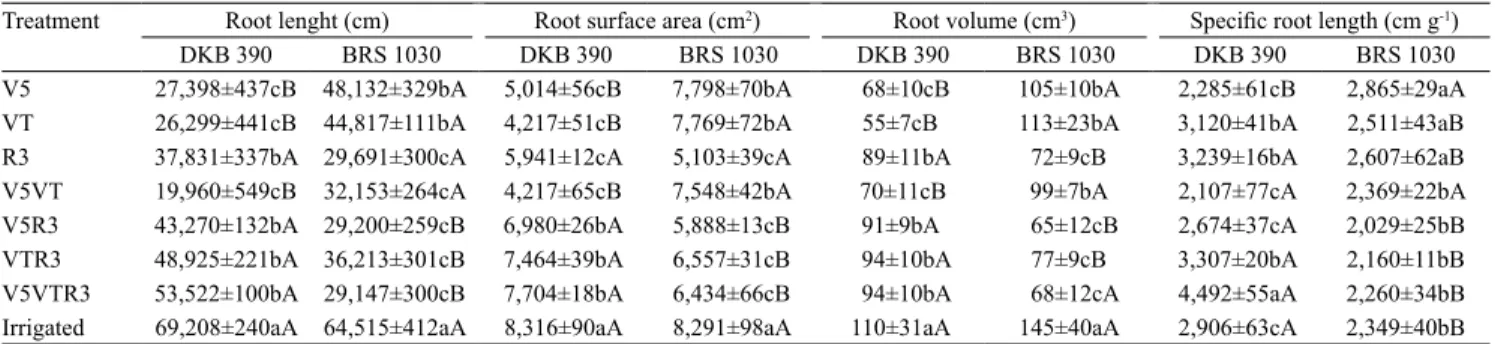
The highest means for root length, surface area, and volume were observed in the irrigated treatment, with
no significant differences between hybrids (Table 1).
Comparing hybrids, total root length was greater
when water stress was imposed at the V5, VT, and V5VT stages for BRS 1030, but at V5R3, VTR3, and V5VTR3 for DKB 390. No differences, however, were
observed among hybrids under water stress at the R3 stage. Comparing treatments, DKB 390 showed the lowest values for root length when water stress was
imposed at the vegetative and flowering stages, i.e., V5, VT, and V5VT, and the highest values at V5R3, VTR3, and V5VTR3. The BRS 1030 hybrid exceeded DKB 390 only when stress was imposed at V5 and VT; in the other treatments, the values for the sensitive
hybrid were lower. Root surface area and length were similar for both hybrids. DKB 390 showed higher root surface area under cumulative stress and in the treatments that overcame R3; however, the opposite occurred in BRS 1030, which presented lower surface area at these stages.
Regarding root volume, higher means were obtained
VT (Table 1). The lowest and highest root volumes for
the tolerant and susceptible hybrids, respectively, were
observed at the V5, VT, and V5VT stages.
In most cases, DKB 390 showed the best morphological characteristics of roots under stress at the reproductive stages (R3) and in the cumulative treatments, whereas BRS 1030 presented better performance with stress imposition at the vegetative
and flowering stages (V5, VT, and V5VT). Despite
cumulative drought imposition in three periods
(V5VTR3), DKB 390 presented greater root length
and root surface area than BRS 1030; these parameters are important morphological markers of drought tolerance. In alignment with the present study, Ali et al. (2016) found that tolerant genotypes have greater
root length in the flowering stage. Li et al. (2011),
while evaluating corn under drought stress, observed that there was an increase in root length, volume, and
superficial area. As water deficit increases, the upper soil layers are generally the first to dry. Therefore,
when all the soil layers are moistened, the plants
develop a predominantly superficial root system, and, when the water ends in the superficial layers of the soil,
the loss of roots and proliferation of deeper roots occur (Li et al., 2011). The growth and deepening of the root system to maintain water absorption can be considered a way to protect against drought. In some crops, such as
rice (Anantha et al., 2016), sorghum (Magalhães et al.,
2016) and corn (Grieder et al., 2014), a more developed and deeper root system contributes substantially to improve performance under water stress. However,
according to Imada et al. (2008), root surface area is
more related to the absorption of nutrients.
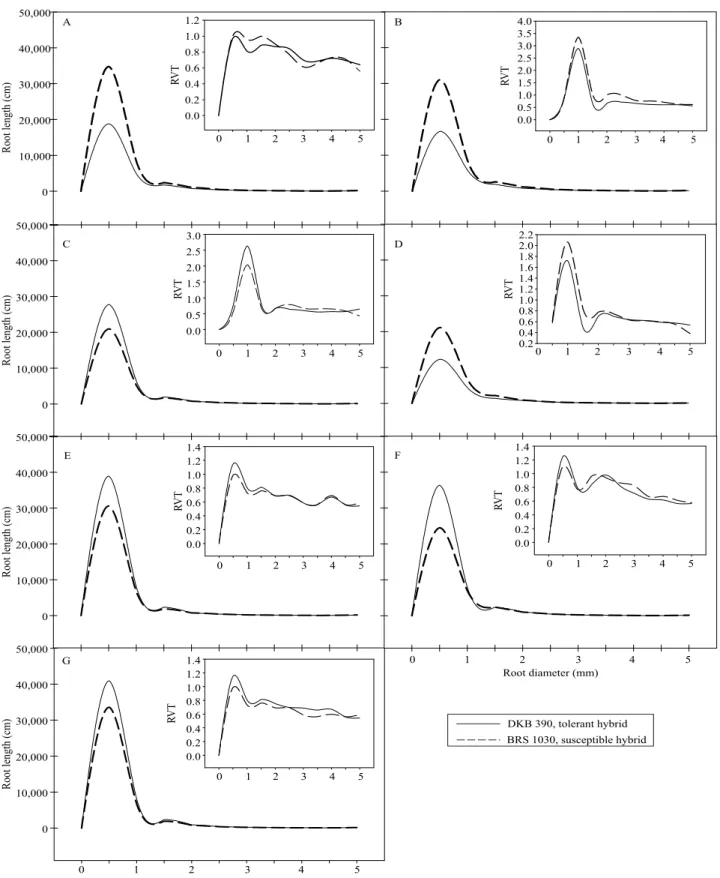
The analysis of the distribution of root length per diameter classes showed a similar behavior to that of the morphological attributes already described. In all treatments in which drought imposition surpassed R3
(V5R3, VTR3, V5VTR3, and R3), a greater length of fine roots, that is, roots with a diameter smaller than
1 mm, was observed for the tolerant hybrid DKB 390
(Figure 1); BRS 1030 presented better performance at V5, VT, and V5VT. This behavior was also detected
when the irrigated treatment was analyzed through
the stress index. Lavinsky et al. (2015) studied the
DKB 390 hybrid under drought imposed only at the
flowering stage and reported no changes in the length of fine roots. However, Hund et al. (2009) concluded
that the tolerant genotype, CML44, presents greater
length of fine roots at the V5 growth stage.
Specific root length was higher for DKB 390 in all treatments, except in V5VT, in which no differences were found, and in V5, in which BRS 1030 presented greater values (Table 1). For DKB 390, the highest value was observed at V5VTR3 and the lowest ones at V5, V5VT, V5R3, and in the irrigated treatment. For
BRS 1030, the highest length was found when stress
imposition occurred at the V5, VT, and R3 stages.
Chimungu et al. (2014), while evaluating tolerant corn
genotypes in a greenhouse, reported higher specific
root length at early stages (seedlings).
The greater length of fine roots (root distribution
by diameter classes) found for DKB 390 in various treatments represents greater chances of water absorption, since these roots are responsible for this
function according to Eissenstat (1992). Thick roots
are more related to the setting of the plant in the soil,
Table 1. Morphological characteristics of roots of two corn (Zea mays) hybrids contrasting for drought tolerance (DKB 390, tolerant; and BRS 1030, susceptible) at different stages of development(1).
Treatment Root lenght (cm) Root surface area (cm2) Root volume (cm3) Specific root length (cm g‑1)
DKB 390 BRS 1030 DKB 390 BRS 1030 DKB 390 BRS 1030 DKB 390 BRS 1030
V5 27,398±437cB 48,132±329bA 5,014±56cB 7,798±70bA 68±10cB 105±10bA 2,285±61cB 2,865±29aA
VT 26,299±441cB 44,817±111bA 4,217±51cB 7,769±72bA 55±7cB 113±23bA 3,120±41bA 2,511±43aB
R3 37,831±337bA 29,691±300cA 5,941±12cA 5,103±39cA 89±11bA 72±9cB 3,239±16bA 2,607±62aB
V5VT 19,960±549cB 32,153±264cA 4,217±65cB 7,548±42bA 70±11cB 99±7bA 2,107±77cA 2,369±22bA
V5R3 43,270±132bA 29,200±259cB 6,980±26bA 5,888±13cB 91±9bA 65±12cB 2,674±37cA 2,029±25bB
VTR3 48,925±221bA 36,213±301cB 7,464±39bA 6,557±31cB 94±10bA 77±9cB 3,307±20bA 2,160±11bB
V5VTR3 53,522±100bA 29,147±300cB 7,704±18bA 6,434±66cB 94±10bA 68±12cA 4,492±55aA 2,260±34bB
Irrigated 69,208±240aA 64,515±412aA 8,316±90aA 8,291±98aA 110±31aA 145±40aA 2,906±63cA 2,349±40bB
(1)Means followed by the equal letters, lowercase in the columns and uppercase in the lines for hybrids, do not differ by the Scott‑Knott test, at 5% probability.
Pesq. agropec. bras., Brasília, v.51, n.4, p.330‑339, abr. 2016 DOI: 10.1590/S0100‑204X2016000400005
whereas the production of fine roots with a larger surface
area per mass unit is a mechanism used to enhance the uptake of water and nutrients in dry conditions.
Consequently, there is an increase in the specific length
and surface area of the root system that may lead to a greater tolerance to drought. Theoretically, a higher
specific root length results in higher exploration and
absorption of water and nutrients from the soil per carbon unit invested. Therefore, in an unfavorable
environment, with water deficit, for example, root
growth is very important in order to allow a greater exploration of the soil in search of water, without excessive energy consumption (Ryser, 2006).
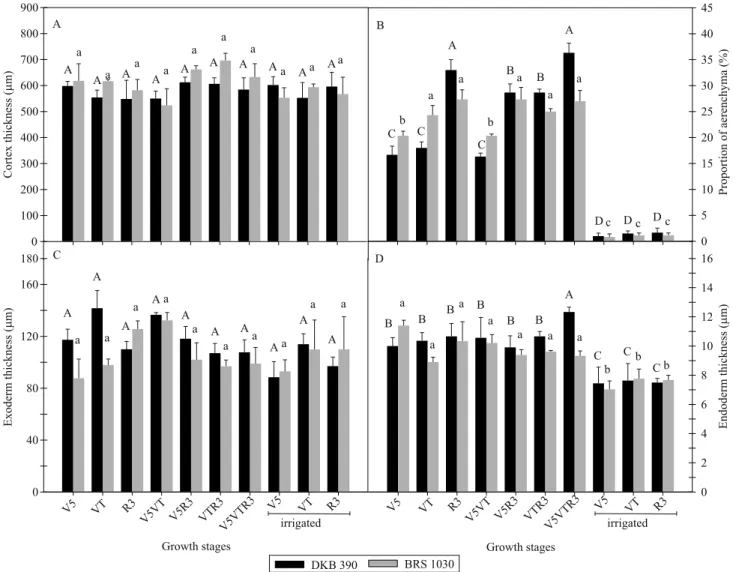
Regarding root anatomy, no differences were observed for cortex thickness among treatments for
DKB 390 and BRS 1030 (Figure 2 A). Water stress
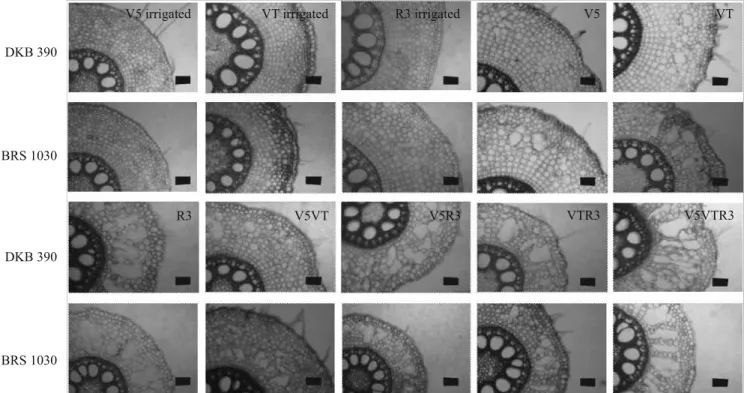
increased the proportion of aerenchyma in the cortex
of the two studied hybrids (Figure 2 B and Figure 3). For DKB 390, the proportion of aerenchyma in the cortex was higher at V5VTR3 and R3, followed by the
other two treatments with water stress imposition at the
reproductive stages, i.e., V5R3 and VTR3 (Figure 3).
In the treatments with stress, BRS 1030 also presented high proportions of aerenchyma – the highest were
found at VT, R3, VTR3, and V5VTR3 (Figure 3). It
should be pointed out that treatments with irrigation resulted in the lowest proportions of aerenchyma for
both DKB 390 and BRS 1030. Exoderm thickness
did not change with the imposition of stress in any
of the hybrids (Figure 2 C); however, differences
Pesq. agropec. bras., Brasília, v.51, n.4, p.330‑339, abr. 2016 DOI: 10.1590/S0100‑204X2016000400005
were observed for the innermost apoplastic barrier
(endoderm) (Figure 2 D). For DKB 390, endoderm thickness was significantly higher at V5VTR3,
followed by all other treatments with drought imposition, whereas, for BRS 1030, differences were found between stressed and irrigated treatments, being lower in the irrigated ones.
These results are important, since endoderm and exoderm are layers of cells in the roots that act as important barriers; a greater thickness after stressed treatments may indicate that the water cannot pass from the xylem vessels to the soil, which would avoid dehydration (Souza et al., 2013).
Even though no differences were found in the
present study, the cortical region of corn roots has been the focus of breeding programs for tolerance to water
deficit. Chimungu et al. (2014) and Jaramillo et al.
(2013) reported that larger cells of the root cortical parenchyma reduce cellular respiration in this region, contributing to the deepening of the root system due to a lower metabolic cost, and that corn plants with lower cortex have higher drought tolerance, due to the smaller number of cell rows. Aerenchyma in corn roots
may have the function of supporting a greater soil and water acquisition, since these structures decrease the metabolic cost of growing roots because of the reduced presence of cells in respiration (Zhu et al., 2010; Souza et al., 2013). Therefore, the greater root system observed in the tolerant hybrid may be attributed to a higher proportion of aerenchyma in the cortex.
In DKB 390, the diameter of metaxylem cells was lower under stress but there were no differences within
each treatment group (Figure 4 A). Conversely, no
difference between treatments was observed for BRS
1030, except at V5VT. The number of metaxylem
vessels and phloem thickness were similar in all
treatments and for both hybrids (Figure 4 B and
C). In addition, the presence of xylem vessels with smaller diameter in the roots of the DKB 390 hybrid, under drought stressed treatments, can support the retention of water in plants. Although no differences were found in the present work, the increase in the number of metaxylem vessels can also promote water conservation. Souza et al. (2013) and Li et al. (2009) reported a greater amount of metaxylems for drought tolerant corn genotypes. These characteristics
may indicate a higher hydraulic conductivity, which increases the water transport capacity. This can be explained by the more apparent effect of drought in the xylem vessels of corn, i.e., by the reduction of hydraulic conductance, which occurs either because of the lack of available water or because of the low
activity/expression of aquaporin (proteins responsible
for the transport of water into the roots). Without water in the xylem (tracheid and vessel elements), air bubbles
can be formed (embolism) or flow can be interrupted
(cavitation) due to stretching (breaking) of the water column (Li et al., 2009). A study showed that thicker
phloem in corn under stress may favor the influx of
photoassimilates coming from the shoots (Souza et al., 2009).
Regarding yield components, no significant
differences were detected for ear length and diameter
between hybrids, except for ear diameter at V5VT
(Table 2). Comparing hybrids, grain yield was higher
for DKB 390 at V5R3, VTR3, and V5VTR3 (Table 2), but, for BRS 1030, only at the VT stage. Comparing
DKB 390 under drought stress, the highest grain yield was observed in the irrigated treatment, followed
by V5R3, VTR3, and V5VTR3; lower yields were found in all the other treatments. For the BRS 1030
hybrid, the highest grain yield was also obtained in the irrigated treatment, but, among the stressed
treatments, V5 surpassed the others. Ge et al. (2012)
also found that water stress is highly dependent on stages of development and on drought intensity and duration; these authors observed differences in plant morphophysiology and yield. In the present study, the sensitive hybrid, BRS 1030, presented higher means
for the evaluated parameters, mainly at the V5 and VT stages, but without resulting in higher grain yield. The DKB 390 hybrid presented: a higher grain yield, confirming its drought tolerance; a larger root system, including total root length, fine root length, root surface area, and specific root length; and anatomical changes in
the aerenchyma, especially under cumulative stresses, which can be explained by drought memory. Recently, some studies involving drought, cold, and heat stresses,
as well as nutrient deficiency, have indicated that
plants may have an ecological stress memory (Walter et al., 2013). The more stress the plant cumulatively experiences, the greater will be the adaptations to survive the next phase of stress. This acclimatization
after the first stress may involve mechanisms such Figure 4. Anatomical characteristics of root vessels in two
Pesq. agropec. bras., Brasília, v.51, n.4, p.330‑339, abr. 2016 DOI: 10.1590/S0100‑204X2016000400005
as: accumulation of osmoprotectants and soluble sugars; changes in mediators of ABA‑triggered gene
expression; increase in the sequestration mechanisms of reactive oxygen species; and morphological changes, including increased root system, among others (Walter et al., 2013).
Physiological studies with Arrhenatherum elatius
grass showed that the plants acclimated after a first
drought stress became more tolerant to a second cumulative stress (Walter et al., 2011). Taking into account the photoprotective mechanisms that led to increased biomass in the plants subjected to cumulative stress, when compared to those that were not, these authors concluded that there is drought memory.
Conclusions
1. The greater tolerance of the DKB 390 corn (Zea mays) hybrid to water deficit is linked with the
memory of pre‑exposure to water stress at different
development stages.
2. Tolerant corn genotypes present a greater root
system, mainly of fine roots, and greater proportions
of aerenchyma.
Acknowledgments
To Coordenação de Aperfeiçoamento de Pessoal
de Nível Superior (Capes), for the scholarship; and to
Fundação de Amparo à Pesquisa do Estado de Minas Gerais (Fapemig, Process No. APQ‑01433‑10), for financial support.
References
ALI, M.L; LUETCHENS, J.; SINGH, A.; SHAVER, T.M.; KRUGER, G.R.; LORENZ, A.J. Greenhouse screening of maize genotypes for deep root mass and related root traits and their association with grain yield under water‑deficit conditions in the field. Euphytica, v.207, p.79‑94, 2016. DOI: 10.1007/s10681‑015‑
1533‑x.
ANANTHA, M.S.; PATEL, D.; QUINTANA, M.; SWAIN, P.; DWIVEDI, J.L.; TORRES, R.O.; VERULKAR, S.B.; VARIAR, M.; MANDAL, N.P.; KUMAR, A.; HENRY, A. Trait combinations that improve rice yield under drought: Sahbhagi Dhan and new drought‑tolerant varieties in South Asia. Crop Science, v.56,
p.408‑442, 2016. DOI: 10.2135/cropsci2015.06.0344.
ARAUS, J.L.; SERRET, M.D.; EDMEADES, G.O. Phenotyping maize for adaptation to drought. Frontiers in Physiology, v.3, p.305, 2012. DOI: 10.3389/fphys.2012.00305.
BURTON, A.L.; JOHNSON, J.; FOERSTER, J.; HANLON, M.T.; KAEPPLER, S.M.; LYNCH, J.P.; BROWN, K.M. QTL mapping and phenotypic variation of root anatomical traits in maize (Zea mays L.). Theoretical and Applied Genetics, v.128, p.93‑106,
2015. DOI: 10.1007/s00122‑014‑2414‑8.
CHIMUNGU, J.G.; BROWN, K.M.; LYNCH, J.P. Reduced root cortical cell file number improves drought tolerance in maize.
Plant Physiology, v.166, p.1943‑1955, 2014. DOI: 10.1104/
pp.114.249037.
EISSENSTAT, D.M. Costs and benefits of constructing roots of small diameter. Journal of Plant Nutrition, v.15, p.763‑782,
1992. DOI: 10.1080/01904169209364361.
GE, T.; SUI, F.; BAI, L.; TONG, C.; SUN, N. Effects of water stress on growth, biomass partitioning, and water‑use efficiency in summer maize (Zea mays L.) throughout the growth cycle. Acta Physiologiae Plantarum, v.34, p.1043‑1053, 2012. DOI: 10.1007/
s11738‑011‑0901‑y.
GONG, F.; WU, X,; ZHANG, H.; CHEN, Y.; WANG, W. Making better maize plants for sustainable grain production in a changing
Table 2. Yield traits of two corn (Zea mays) hybrids contrasting for drought tolerance (DKB 390, tolerant; and BRS 1030, susceptible) at different stages of development(1).
Treatment Ear length (cm) Ear diameter (mm) Grain yield (g per plant)
DKB 390 BRS 1030 DKB 390 BRS 1030 DKB 390 BRS 1030
V5 9.6±0.7aA 9.9±1.7aA 40±1.0aA 37±6.0aA 80±4cA 99±6bA
VT 7.6±0.6aA 10.8±2.0aA 30±7.5aA 33±5.6aA 53±5cB 79±5cA
R3 9.9±0.7aA 8.5±0.7aA 46±1.2aA 38±2.0aA 79±2cA 74±1cA
V5VT 10.0±0.8aA 10.6±1.0aA 46±1.6aA 30±5.0aB 65±2cA 52±7cA
V5R3 12.8±0.8aA 9.0±1.2aA 46±1.0aA 36±1.5aA 114±6bA 66±3cB
VTR3 10.0±0.7aA 9.0±0.7aA 42±2.2aA 33±1.7aA 113±9bA 62±6cB
V5VTR3 10.1±1.7aA 9.3±0.5aA 37±3.0aA 35±1.7aA 111±9bA 68±2cB
Irrigated 13.7±0.2aA 12.9±0.5aA 50±1.0aA 45±1.2aA 147±4aA 149±2aA
(1)Means followed by equal letters, lowercase in the columns for treatments and uppercase in the lines for hybrids, do not differ by the Scott‑Knott test, at 5%
climate. Frontiers in Plant Science, v.6, p.1‑6, 2015. DOI:
10.3389/fpls.2015.00835.
GRIEDER, C.; TRACHSEL, S.; HUND, A. Early vertical distribution of roots and its association with drought tolerance in tropical maize. Plant and Soil, v.377, p.295‑308, 2014. DOI:
10.1007/s11104‑013‑1997‑1.
HUND, A.; RUTA, N.; LIEDGENS, M. Rooting depth and water use efficiency of tropical maize inbred lines, differing in drought tolerance. Plant and Soil, v.318, p.311‑325, 2009. DOI: 10.1007/
s11104‑008‑9843‑6.
IMADA, S.; YAMANAKA, N.; TAMAI, S. Water table depth effects Populus alba fine root growth and whole plant
biomass. Functional Ecology, v.22, p.1018‑1026, 2008. DOI:
10.1111/j.1365‑2435.2008.01454.x.
JARAMILLO, R.E.; NORD, E.A.; CHIMUNGU, J.G.; BROWN, K.M.; LYNCH, J.P. Root cortical burden influences drought tolerance in maize. Annals of Botany, v.112, p.429‑437, 2013.
DOI: 10.1093/aob/mct069.
KHODARAHMPOUR, Z.; HAMIDI, J. Evaluation of drought tolerance in different growth stages of maize (Zea mays L.) inbred lines using tolerance indices. African Journal of Biotechnology, v.10, p.13482‑13490, 2011. DOI: 10.5897/ajb11.2193.
KUMAR, B.; ABDEL‑GHANI, A.H.; REYES‑MATAMOROS, J.; HOCHHOLDINGER, F.; LÜBBERSTEDT, T. Genotypic variation for root architecture traits in seedlings of maize (Zea mays L.) inbred lines. Plant Breeding, v.131, p.465‑478, 2012.
DOI: 10.1111/j.1439‑0523.2012.01980.x.
LAVINSKY, A.O.; MAGALHÃES, P.C.; ÁVILA, R.G.; DINIZ, M.M.; SOUZA, T.C. de. Partitioning between primary and secondary metabolism of carbon allocated to roots in four maize genotypes under water deficit and its effects on productivity. The Crop Journal, v.3, p.379‑386, 2015. DOI: 10.1016/j.
cj.2015.04.008.
LI, C.; SUN, J.; LI, F.; ZHOU, X.; LI, Z.; QIANG, X.; GUO, D. Response of root morphology and distribution in maize to alternate furrow irrigation. Agricultural Water Management, v.98, p.1789‑
1798, 2011. DOI: 10.1016/j.agwat.2011.07.005.
LI, Y.; SPERRY, J.S.; SHAO, M. Hydraulic conductance and vulnerability to cavitation in corn (Zea mays L.) hybrids of differing drought resistance. Environment and Experimental Botany, v.66, p.341‑346, 2009. DOI: 10.1016/j.envexpbot.2009.02.001. MAGALHÃES, P.C.; DURÃES, F.O.M. Fisiologia da produção. In: CRUZ, J.C.; KARAM, D.; MONTEIRO, M.A.R.; MAGALHÃES, P.C. (Ed.). A cultura do milho. Sete Lagoas: Embrapa Milho e
Sorgo, 2008. p.63‑87.
MAGALHÃES, P.C.; SOUZA, T.C. de; LAVINSKY, A.O.; ALBUQUERQUE, P.E.P. de; OLIVEIRA, L.L. de; CASTRO, E.M.
de. Phenotypic plasticity of root system and shoots of Sorghum
bicolor under different soil water levels during pre‑flowering stage.
Australian Journal of Crop Science, v.10, p.81‑87, 2016.
RYSER, P. The mysterious root length. Plant and Soil, v.286, p.1‑
6, 2006. DOI: 10.1007/s11104‑006‑9096‑1.
SOUZA, T.C. de; CASTRO, E.M. de; MAGALHÃES, P.C.; ALVES, E.T.; PEREIRA, F. J. Early characterization of maize plants in selection cycles under soil flooding. Plant Breeding, v.131, p.493‑501, 2012. DOI: 10.1111/j.1439‑
0523.2012.01973.x.
SOUZA, T.C. de; CASTRO, E.M. de; MAGALHÃES, P.C.; LINO, L. de O.; ALVES, E.T.; ALBUQUERQUE, P.E.P. de. Morphophysiology, morphoanatomy, and grain yield under field conditions for two maize hybrids with contrasting response to drought stress. Acta Physiologiae Plantarum, v.35, p.3201‑3211,
2013. DOI: 10.1007/s11738‑013‑1355‑1.
SOUZA, T.C. de; CASTRO, E.M. de; PEREIRA, F.J. ; PARENTONI, S.N. ; MAGALHÃES, P.C. Morpho‑anatomical characterization of root in recurrent selection cycles for flood tolerance of maize (Zea mays L.). Plant, Soil and Environment, v.55, p.504‑510, 2009.
SOUZA, T.C. de; MAGALHÃES, P.C.; CASTRO, E.M. de; CARNEIRO, N.P.; PADILHA, F.A.; GOMES JÚNIOR, C.C. ABA application to maize hybrids contrasting for drought tolerance: changes in water parameters and in antioxidant enzyme activity.
Plant Growth Regulation, v.73, p.205‑217, 2014. DOI: 10.1007/
s10725‑013‑9881‑9.
WALTER, J.; JENTSCH, A.; BEIERKUHNLEIN, C.; KREYLING, J. Ecological stress memory and cross stress tolerance in plants in the face of climate extremes. Environmental and Experimental Botany, v.94, p.3‑8, 2013. DOI: 10.1016/j.
envexpbot.2012.02.009.
WALTER, J.; NAGY, L.; HEIN, R.; RASCHER, U.; BEIERKUHNLEIN, C.; WILLNER, E.; JENTSCH, A. Do plants remember drought? Hints towards a drought‑memory in grasses.
Environmental and Experimental Botany, v.71, p.34‑40, 2011.
DOI: 10.1016/j.envexpbot.2010.10.020.
YAN, W.; ZHONG, Y.; SHANGGUAN, Z. Evaluation of physiological traits of summer maize under drought stress. Acta Agriculturae Scandinavica, Section B — Soil and Plant Science,
v.66, p.133‑140, 2016.
ZHAN, A.; SCHNEIDER, H.; LYNCH, P.J. Reduced lateral root branching density improves drought tolerance in maize. Plant Physiology, v.168, p.1603‑1615, 2015. DOI: 10.1104/pp.15.00187.
ZHU, J.; BROWN, K.M.; LYNCH, J.P. Root cortical aerenchyma improves the drought tolerance of maize (Zea mays L.). Plant, Cell and Environment, v.33, p.740‑749, 2010.