EXPLORING THE POTENCIAL OF AGROFORESTRY
INTEGRATION IN ARABLE AND DAIRY FARMS IN THE
NETHERLANS AN EX-ANTE ASSESSMENT AT FIELD
AND FARM LEVEL
Prins E1*, Groot J2
(1) Student, Farming Systems Ecology, Wageningen UR, Wageningen, The Netherlands (2) Farming Systems Ecology, Wageningen UR, Wageningen, The Netherlands
*Corresponding author: [email protected]
Abstract
Integration of well-designed agroforestry configurations is considered as a promising avenue to maintain farm productivity, while simultaneously strengthening ecological functioning of agroecosystems. The complexity of farming systems and the lack of knowledge on the performance of these agroecologically sound practices under Dutch economic, climatic and environmental conditions hamper farmers to implement agroforestry. In this study we performed a model-based ex-ante analysis of the impact of agroforestry implementation on the economic and environmental performance of two existing farms in The Netherlands. At the field level, we show that two out of three of the designed agroforestry configurations (AFCs) outperformed the monoculture crops (triticale and pasture), resulting in higher financial margin and organic matter balance. Furthermore, we show that these configurations could be successfully integrated at the farm level, reducing or eliminating the existing trade-off between ecological and economical objectives. Further research is needed to develop process-based estimations of technical coefficients.
Keywords: agroforestry; The Netherlands; arable; dairy; FarmDESIGN; restoration agriculture
Introduction
Farming systems in temperate regions are dominated by crop monocultures and large reliance on external inputs such as artificial fertilizers and concentrate animal feeds, which result in pressure on ecological processes. Integration of well-designed agroforestry configurations is considered as a promising avenue to maintain farm productivity, while simultaneously strengthening ecological functioning of agroecosystems. The complexity of farming systems and the lack of knowledge on the performance of these agroecologically sound practices under Dutch economic, climatic and environmental conditions hamper farmers to implement agroforestry.
In this study we performed a model-based ex-ante analysis of the impact of agroforestry implementation on the economic and environmental performance of two existing farms in The Netherlands.
Materials and methods
We selected an arable and a dairy farm to explore opportunities for integrating agroforestry practices. The arable farm is certified as biodynamic and is situated between the cities of Arnhem and Nijmegen, The Netherlands. On an area of 15.6 ha, the farmer cultivates a small
Model and objectives
The FarmDESIGN model was used to explore opportunities to integrate predefined agroforestry configurations (AFCs) and to evaluate farm performance before and after integration of the AFCs. FarmDESIGN is a multi-objective optimization and design tool for farming systems (Groot et al. 2012). The Pareto-based Differential Evolution algorithm is used to generate sets of solutions that contain alternative farming system configurations. Optimization of farming systems is executed based on the objectives to maximize the organic matter (OM) balance and operating profit.
Designing agroforestry configurations
In consultation with the farmers, three agroforestry configurations (AFCs) were designed. For initial expectations about costs and benefits served as initial starting points. Both farmers formulated the preconditions that the AFCs can be managed as natural systems, with low labour requirements for establishment, fertilization and crop protection, being aware that yield is not being maximized. The AFCs are displayed in Figure 1. The biomass flows from fine root turnover were considered in effective organic matter calculations, but not included as a separate crop product.
Determining AFC parameters
All calculations, sources and considerations for determining AFCs parameters, together with the parameters of the AFCs, can be consulted in the supplementary materials 3-5. Crop experts were consulted to discuss the outcomes of the literature research to determine the final yield per AFC. FarmDESIGN summarizes outcomes throughout a year, while the yields are affected by dynamic processes that are affected by cultivation area per hectare AFC, interaction between components and yield formation per plant. To bypass this time dimension, the yields for different time periods were calculated and averaged. Prices of the crop products were kept equal to prices found at Dutch pick-your-own farms, in the literature and from the estimations by crop experts.
The majority of parameters on composition of food products were derived from the USDA Food Composition Database. Chemical constituents on pruning waste were determined by laboratory analyses of the biomass collected from a local pick-your-own farm.
To determine the costs per AFC, a list of all cultivation activities and investments was composed for each AFC. These lists included costs associated with the purchase of plants, plant support and fencing and the costs and labour associated with cultivation, such as planting, pruning, harvesting, mowing, shredding of pruning waste, and fertilization. Based on literature and estimations by the farmers and crop experts, labour demand of for all cultivation activities was estimated. Effective organic matter (EOM) at the field level was determined by multiplying biomass of shredded pruned materials, fine root turnover and litterfall by their humification coefficients, which were approximated based on literature. It was taken into account that the system increases its organic matter production as the system matures, by estimating organic matter production in different time periods. An average of the organic matter production over the entire rotation was used as a field parameter.
Figure 2 shows the margin and input on the organic matter balance of each crop. Restoration Agriculture is outperforming the other crops on both axis and triticale-walnut outperforms sole triticale. Willow-pasture considerably improves the organic matter balance but has a negative margin.
Figure 2: Performance of crop production activities in terms of contribution to soil organic matter and gross margin for current crops (red) and agroforestry fields (green) for the arable (a) and dairy farm (b). Regular labour (hours/ha) is displayed between parentheses, but is not included in the crop margin calculations on field level. The input on OM balance does not include OM inputs by imported manure and fertilizers.
Results
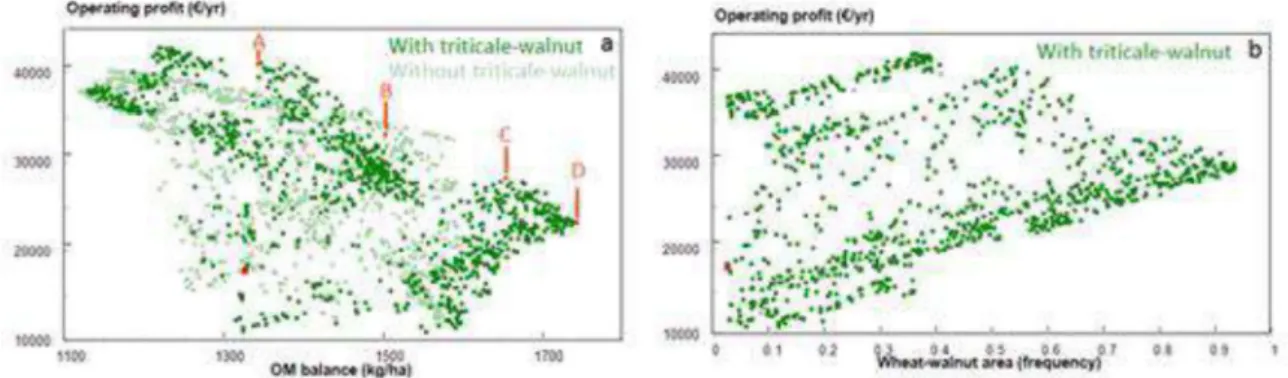
Figure 3: Outcomes of the exploration of the arable farmer with the triticale-walnut configuration along the objectives operating profit, OM balance, area of desired cereals and triticale-walnut area.
Along the trade-off front 4 non-dominated configurations were selected. Option A shows the rotation with three crops with high margins (8.4 of triticale-walnut, 4.7 ha emmer and 1.7 hectare pumpkin). An higher OM balance could be achieved by option B (11.5 ha of triticale-walnut, 2.2 ha pumpkin and 1.2 ha heliaro) and option C (7.8 ha triticale walnut, 4.5 ha heliaro, 2 ha emmer) at the expense of a decrease in operating profit. Option D is the outcome of 10 ha of triticale-walnut and 5 ha of heliaro. Large areas of triticale-walnut were found in the configuration along the entire trade-off frontier, indicating triticale-walnut contributes to both operating profit and OM balance. The shape of the cloud point of Figure 3b shows a positive relation between operating profit and triticale-walnut cultivation. However, along the trade-off frontier an increase of triticale-walnut results in lower operating profits.
Dairy farmer: Exploration with Restoration Agriculture
For the integration of Restoration Agriculture at the dairy farm three explorations are executed, with 0, 5 and 10 ha of Restoration Agriculture as starting points (Figure 4). Without Restoration agricult
and maize import while decreasing purchase of concentrates. To obtain a higher OM balance, more maize silage, concentrates and bedding materials are imported, resulting in a lower financial performance (B and C). The implementation of 5 ha Restoration Agriculture AFC resulted in options to increase operating profit and OM balance (D, E and F in Figure 4). With 10 hectares Restoration Agriculture 7-11 ha of land is rented for pasture and 2.3 hectares for maize (G). Increasing the import of DM again results in a higher OM balance and smaller operating profit (H and I).
Figure 4: Exploration of integrating Restoration Agriculture (RA) at the dairy farm, with 0, 5 and 10 hectares of RA as starting points.
Discussion and conclusion
Our study demonstrates the triticale-walnut AFC and the Restoration Agriculture AFC outperform the current monoculture crops triticale and pasture in economical margin and OM balance. These AFCs were successfully integrated on farm level, with a better farm performance as a result. Without the AFCs, OM balance was increased by purchase of additional feed or bedding material, resulting in a lower operating profit. The AFCs improved OM balance by generating organic matter, diminishing this trade-off. For both farms, integration of Restoration Agriculture offered improved farm configurations with the best results. The willow-pasture AFC could not be integrated without a strong decrease in operating profit, making it unfeasible to produce all woodchips on farm. Further research is necessary in order to make more solid process-based estimations of technical coefficients of AFCs. For effective adoption of these promising systems, we also face challenges in non-productive related fields, such as policy issues and the setting up of new revenue models.
References
Groot JCJ, Oomen GJM, Rossing WAH (2012) Multi-objective optimization and design of farming systems. Agr Syst 110: 63 77.