ON THE UNCANNY IN MATHEMATICS John A. Fossa
UFRN - Brasil
It has been widely remarked that the history of mathematics can be done in at least two ways: diachronically and synchronically. The first tends to be internal, concerning, as it usually does, how certain mathematical theories have evolved over time. The second tends to be external, relating mathematical concepts to more general concepts, usually related to arcane aspects of science or technology, in a given culture in a certain period. All of this, as a rule, is seen as dry as dust and as having precious little to do with life. So, one may be tempted to conclude along with Flaubert1 that "Mathematics dries up the heart". This does not square, however, with the experience of both mathematicians and historians of mathematics, who describe it as an overwhelming intellectual adventure.
We are confronted, then, with two radically different conceptions of mathematics: mathematics as the rational science par excellence and mathematics as the uncanny. Herein, we will not try to unravel the apparent paradox. Rather, we just wish to point out that if we want a credible account of the synchronistic, external history of mathematics in ancient societies – that is, a credible account of the pivotal role that mathematics played in the intellectual life of these societies – we must take account of the uncanny in mathematics. The Experience of the Uncanny
Before giving some examples of how the uncanny arises in mathematics, it will be well to say a few words about the experience itself. The uncanny is something strange and mysterious, but not everything strange and mysterious is uncanny. Indeed, as John Fowles (1977) says in his novel, The Magus, "There is mystery enough at noon." That is to say that mystery is a part of our everyday lives. We constantly come across it, deal with it or, largely, ignore it, without it provoking any special response. The uncanny, however, is of another ilk exactly because it is, as the Germans say, unheimlich, "not homey" or that with which we are "not at home". Thus, the uncanny is not simply something that is strange or mysterious, but it is something that is unfathomable, certainly not invented, but fathomed immediately when we come across it.
The paradox of the unfathomable fathomed is central to the experience of the uncanny. It is felt to be a kind of knowledge that transcends the human experience, giving us a glimpse of the divine that underlies our humanity. Although it may seem strange, especially at first, it
1 Cited by D'Ambrosio {1993).
Especial n 1 – Festschrift Ubiratan D’Ambrosio – (dezembro/2007) Publicação Oficial da Sociedade Brasileira de História da Matemática
also presents itself as somehow so right, so appropriate or so fitting, though often in a rather ironic way. Consequently, the uncanny seems to impart a deeper knowledge of ourselves and of the world we live in. Needless to say, it's a sacred knowledge and, hence, is, especially in ancient cultures, restricted knowledge.
Unexpected Coincidences
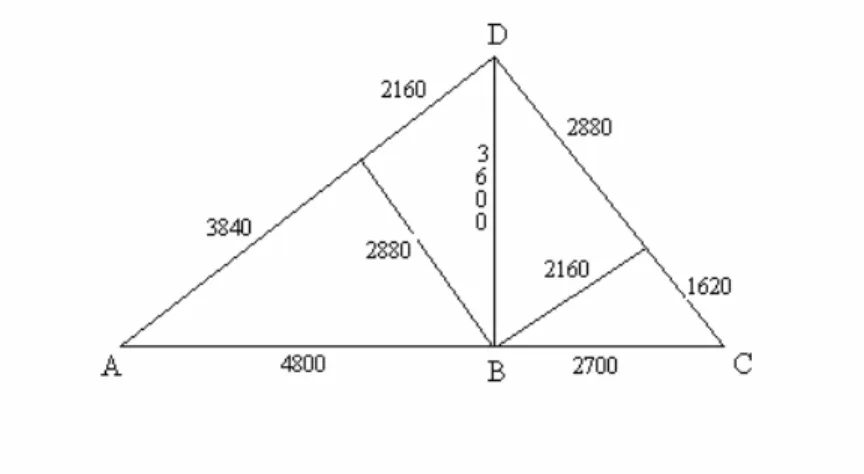
Returning now to the question of how all this comes about, the present author has identified at least three sets of circumstances that seem to have engendered the experience of the uncanny in ancient mathematicians. The first of these may be labeled "Unexpected Coincidences". When two or more apparently unrelated phenomena are shown to have a deep-seated underlying relation, it seems uncanny. Take, for example, the Nuptial Number (see Fossa and Erickson, 1994) and the Number of the Tyrant (see Erickson and Fossa, 1996), both from Plato's Republic. The first is a mathematical method to aid the governors of the Republic in obtaining and maintaining the correct demographics in their community, for, according to Plato, the State should have the appropriate number of people in the ruling class, the warrior class and the productive class. Figure 1 shows his solution to the problem. I omit details here.
Figure 1. The Nuptial Number (in days).
The Number of the Tyrant has to do with the relative happiness of different types of rulers. The Philosopher-King and the Tyrant are at opposite poles in the leader-type hierarchy and the life of the latter, according to Plato, is much less happy than that of the former. In interpreting Plato's doctrine, we found that the mathematical entity that structured the doctrine is a triangular pyramid, itself composed of triangles. What was completely unexpected was that the Nuptial Number is found in the base of the pyramid (see Figure 2). What is even more amazing is that both of these entities are structured by the Divided Line, that is, a line segment divided into two parts, each part of which is divided in the same ratio. When positive whole numbers are used to measure the parts, we obtain n2/nm/nm/m2 with n and m coprime, or a multiple of this (that is, kn2/knm/knm/km2). In either case, the
intermediate term is the geometric mean of the extremes (see Erickson and Fossa, 2006). Now, even if Plato had started with the Divided Line and built up the other two structures from it, it still must have seemed uncanny to him that the world actually was like this. Indeed, it was probably these considerations that led Plato to believe that the microcosm (man) and the mesocosm (the state) mirror the macrocosm (the universe), from which would eventually spring the doctrine of the Great Chain of Being.
Figure 2. Base of the Tyrant's Number. Unexpected Twists
The second way in which ancient mathematicians encountered the uncanny can be called the "Unexpected Twist". This happens when, like in O. Henry's short stories, the resolution is other than what we might normally judge to be the rational outcome, to which we must add the following additional condition: the unexpected resolution is more appropriate and more compelling than the expected outcome. Going back to Figure 2, we observe that there are two copies of the Nuptial Number on the base of the Number of the Tyrant and, instead of resting firmly on their respective bases, they are propped up precariously on a vertex. Even worse, instead of a nice bilateral symmetry, they exhibit a weird rotational symmetry, so that what's up in one is down in the other and vice versa. Yet it seems so right: the world is not a simply symmetric, stable place. It's precarious and symmetric in an ironic sort of way. Also, here we have the mathematical justification for the doctrine of the cyclical nature of time.
Let's look at an example of how these two ways of encountering the uncanny can come together and reinforce each other. Recall that the Material Elements have geometrical forms as regular polyhedra. If we look for their more basic arithmetical forms, recalling that they are in continued proportion and eliminating fractions, we obtain the following results (for more details, see Fossa and Erickson, 2000): Fire 3840, Air 2880, Water 2160 and Earth 1620. This is, indeed, a really unexpected coincidence for these are exactly the four numbers that appear along the top two sides of the Nuptial Number (Figure 1). But there is
also an unexpected twist, since Air and Water are switched in that diagram. The correct order of the Material Elements is Fire (heavenly bodies), Air (the atmosphere), Water (oceans and rivers on the earth) and Earth (at the center of the universe). From a mathematical point of view, this result is not a problem, since a:b::c:d implies a:c::b:d, and, from a physical point of view, it makes sense that the intermediaries can switch places, thereby forming a stronger bond between the extremes.
The switching of the intermediaries, however, is seen to be uncannily appropriate when we look at the qualities of the Material Elements. Triangle ACD (Figure 1) is representative of the ruling class; the psychological (and physical) make-up of people from this class will be a harmonious mixture of all four of the Material Elements. In contrast, the warrior class is represented by triangle ABD, while the productive class is represented by triangle BCD and, consequently, each of them will only partake of two of the four Material Elements. The basic qualities of these Elements are:
If the warrior were composed of Fire and Air, he would have too much Hot and, thus, be unbalanced; similarly, if the artisan were composed of Water and Earth, he would have too much Cold. The switching of the intermediaries, however, insures that the warrior and the artisan have balanced compositions. They do not, to be sure, have the perfect balance of the ruling class, but they do have a secondary kind of balance that insures relative stability. Thus, the mathematics is uncannily appropriate and allows Plato to identify line ADC of Figure 1 with the canopy of the night sky and assign, in order, the signs of the zodiac to each of the four segments of this line, creating thereby the trigons of traditional astrology. Rogue Symbols
The final way that the uncanny is encountered in mathematics is that of the Rogue Symbol. A symbol is something that stands for something else. Naturally, anything can be a symbol for anything because the coupling of the signifier and the signified is accomplished by the creative action of the human mind. Ofttimes, however, the signifier presents itself as intrinsically related to the signified independently the human power that created and sustains it. When this happens, we have an overpowering experience of the uncanny, of being able to see deeper into reality and discern its sacred nature. Two of the most important areas in which this has happened in mathematics are in relation to symbols used as numerals and certain geometrical designs. In the case of numerals, the Rogue Symbol has been a font of number mysticism almost since man has been man. It may even be conjoined with the Unexpected Coincidence as, for example, with magic squares used as talismans.
Conclusion: The Connections
What is common to these three ways of encountering the uncanny in mathematics is a feeling that one has obtained an important insight about what the mathematics means in terms of a deeper understanding of some other aspect of our existence. In consequence, strong links were forged betwixt the mathematics and other investigations, not only science and technology, but philosophy, theology and the arts. Whether the insight turned out to be short-lived and trivial or of lasting cultural importance is, of course, to be judged on a case-by-case basis. What is important to realize, however, is that the experience of the uncanny projected mathematical thought into fundamental roles in the development of a variety of human endeavors and thus made mathematics a pivotal determinant in the evolution of much human culture.
References
D'Ambrosio, Ubiratan. "Mathematics and Literature". In Alvin M. White (Ed.). Essays in Humanistic Mathematics. Washington, DC: MAA, 1993.
Erickson, Glenn W., e John A. Fossa. A Linha Dividida: Uma Abordagem Matemática à Filosofia Platônica. Rio de Janeiro: Relume Dumará, 2006.
______. A Pirâmide Platônica. João Pessoa: Editora da UFPb, 1996.
Fossa, John A., and Glenn W. Erickson. “Sobre a Proporção entre os Elementos Materiais no Timeu”. In John A. Fossa (Org.). Facetas do Diamante: Ensaios sobre Educação Matemática e História da Matemática. Rio Claro: SBHMat,: 2000.
______. “O Número Nupcial no Livro VIII da República”. Cadernos de História e Filosofia da Ciência, 3, 1994.
Fowles, John. The Magus: A Revised Version. Boston: Little, Brown and Co., 1977.
John A. Fossa
Departamento de Matemática
Universidade Federal do Rio Grande do Norte Natal - Brasil