Constraints of learning mathematics:
a systemic historical
review of the literature
IMaria Fatima OliveiraII
Joao Garrott Marques NegreirosII Ana Cristina NevesII
Abstract
In addition to the natural language, human beings hold an intuitive sense of counting. We have the ability to determine the number of objects in a small collection and carry out simple additions and subtractions without direct instruction. By the age of ten, a child understands about 10,000 words and speaks its native language with 95% accuracy. However, by the age of eleven, some children already claim that they do not understand mathematics. Why is that so? One reason is that spoken language and number sense are survival skills but abstract mathematics is not. This article presents a review of literature on the teaching of mathematics. Which web of interactions is established in the teaching-learning process of this subject? How much of what has been said and written about this process is merely a myth? This article aims at contributing in some way to the demystification and improvement of success in mathematics. It is, therefore, essential to understand the structural framework of theoretical research on the various approaches on the term learning and specifically on the difficulties in learning mathematics. This implies reviewing a set of internal (brain function, spoken language and learning style) and external constraints (socio-cultural factors and teaching styles).
Keywords
Mathematics — Learning styles — Socio-cultural factors — Brain function.
I- MSC2000: 97-XX (Mathematics Education); II- University of Saint Joseph, Macau, China. Contacts: [email protected]; [email protected];
Condicionantes da aprendizagem da matemática:
uma
revisão sistêmica da literatura
Maria Fatima OliveiraI
João Garrott Marques NegreirosI Ana Cristina NevesI
Resumo
Para além da linguagem natural, o ser humano nasce com o sentido inato de número. Temos a capacidade de determinar o número de objetos de uma pequena coleção, de contar e de fazer adições e subtrações simples sem necessidade de instrução direta. Por volta dos dez anos, uma criança compreende cerca de 10.000 palavras e fala a sua língua materna com 95% de precisão. Contudo, por volta dos onze anos, algumas crianças já afirmam não conseguir compreender matemática. Por que essa diferença? Uma razão é que a linguagem falada e o sentido de número são capacidades de sobrevivência, mas a matemática abstrata não o é. Ao discutir os condicionantes do ensino dessa área do conhecimento, este artigo consiste em uma revisão bibliográfica acerca dos problemas do ensino da matemática. Que teia de interações se estabelece no processo de ensino-aprendizagem dessa disciplina? Quanto do que se tem dito e escrito a respeito desse processo não passa de preconceito ou mito? Com este artigo, pretende-se contribuir, de algum modo, para a desmistificação e a melhoria no sucesso da disciplina de matemática. Para tanto, é fundamental compreender o enquadramento estruturante da investigação teórica acerca de diferentes abordagens do conceito de aprendizagem e do que poderá estar em causa, especificamente, nas dificuldades da aprendizagem da matemática. Isso significa rever um conjunto de condicionantes internos (funcionamento do cérebro, língua falada e estilo de aprendizagem) e condicionantes externos (fatores socioculturais e estilos de ensino).
Palavras-chave
Matemática — Estilos de aprendizagem — Fatores socioculturais — Funcionamento do cérebro.
Introduction
Mathematics has always been a key field in all education systems. It is an ancient science that has been taught as a mandatory subject of different grades for many centuries and has played a major role as a criterion for social selection. It is considered an absolute language, an infallible standard of knowledge, the key to progress. Other sciences, that have allowed us to understand the mysteries of mankind, of nature, the world and the universe, feed themselves, to a great extent, from Mathematics. Its importance comes from afar and goes further. In the fifth and sixth centuries BC, Pythagoras and his followers believed that mother nature has a mathematical underground and “numbers rule the world”, and Plato, to whom the statement “God geometrizes always” was attributed, is said to have placed a sign on the top of the doors of his school facilities with the well-known sentence “Let no one ignorant of geometry enter”. Napoleon already invoked mathematics to legitimatize power relations by stating that “men are like numbers, their value depends only on their position”. Despite the importance associated with these facts, mathematics has been considered a difficult learning field throughout the years.
It is a fact that mathematics is seen by a high number of students as a difficult subject that deals with extremely abstract, more or less unintelligible objects and theories. However, how much of the students’ opinions is intrinsic to their real experience and not only a result of reduplicated utterances from other voices, as echoes that were heard from their parents, friends, social media, and even teachers? How much of that speech does not bring another underlying speech, a pre-built speech that is engraved in their memory? Education critics consider that only a small number of students are really unable, in terms of development, to deal with mathematics and that, globally, the poor performance in this field is due mainly to an unsuitable teaching approach. One
thing seems certain: students who are weak in mathematics in the early years remain weak in their later years (SOUSA, 2008).
A complete research project of the intercultural learning of mathematics cannot be confined only to cognitive aspects (understanding, reasoning, problem-solving, etc.); thus, an analysis of external factors is imperative in its theorization and empirical research. From times immemorial, the teacher has been considered as the driver of students’ learning, and what they learned depended on what and how the teacher taught, as if teaching and learning were an independent and one-way relationship. Nowadays, the teaching-learning process refers increasingly to a clear assumption that efficiency and effectiveness of teaching are not unrelated to the understanding of how learning is processed in the students.
Which interactions are established in the teaching-learning process of mathematics? Which factors influence positively or negatively this learning process? The complex web of interactions that takes place in the learning process of mathematics is interwoven with a great multitude of wires, aspects to be considered. In general, several constraints might be taken into account, both internal and external to the students. The functioning of the brain (Section 2.1), the spoken language (Section 2.2), and learning style (Section 2.3) can be regarded as the major internal constraints. Socio-cultural factors (Section 3.1) and teaching styles (Section 3.2) are assumed to be external ones. Certainly, the boundaries between and within these two types of limitation are not sharp; on the contrary, they interact, build on each other and fall apart continuously and dialectically.
Internal constraint: brain functioning
questions of the knowledge theory through the genesis of the cognitive subject structures. He distinguishes formal from empirical knowledge and, taking into consideration the origin of these both types of knowledge, Piaget sidesteps the rationalist, empiricist, and traditional views. For the empiricist, the origin of knowledge leans on reality, whilst the subject’s mind represents the passive container of knowledge. For the rationalist, knowledge is innate and its evolution is solely an update of pre-built internal structures. According to Piaget (1970), who introduced the notion of constructivism, knowledge construction implies the interaction between the subject that knows and the known object; it is the subject itself that, driven by the action, builds his own representation of the reality, by interacting with the object of knowledge. For Piaget, the acquisition of knowledge occurs only with the consolidation of mental structures that can be divided into four stages: sensorimotor, preoperational, concrete operational, and formal operational.
Although introduced by Piaget, the concept of constructivism, according to Castañon (2009), was developed in several study areas, from mathematics to logic, from psychology to sociology, from education to psychotherapy and even in the neurosciences. The major contemporary streams of this conduct line are the following:
• Radical Constructivism, presupposing
that knowledge is not more than a constant construction, and based on subjective information of our experience, is defended by theorists such as Ernest von Glasersfeld, Paul Watzlawick and Heinz von Foester.
• Logical Constructivism, better known as
intuitionism – an approach to logic that emerged within the philosophy of mathematics – finds its major theoretical reference in Luitzen Brouwer; in this particular case, constructivism argues that mathematical objects are mental constructions that occur in a pre-linguistic mental structure.
• Social Constructionism (not social
constructivism), which finds its major theoretical reference in Kenneth Gergen, and is
basedonthreepresumptions:Realityisdynamic
and does not hold any essence or immutable laws; knowledge is only a social construction based on linguistic communities; knowledge has social consequences and these are the ones that should determine whether it is valid or not.
•Socio-constructivismorSocialConstructivism
– an approach developed out of the Lev Vygotsky’s work – that explains human development as the social development of the child with the presupposition that knowledge is a social production and it is done through systems and strategies of social mediation-representation. The highest psychological functions are the result of cultural and not biological development.
Piaget’s theory on cognitive development stages influenced many of the learning-teaching conceptions of mathematics, namely the idea that a child that has not yet reached the sensorimotor stage will not have the cognitive structures that allow him/her to, for example, understand the permanency of objects. According to Devlin (2000), referred to by Araújo (2006), this stage notion fell at first when “toddler’s experiments with a couple of months showed that they had grasped, not only the notion of object permanency, as they also understood the basic notions of numbers by expressing object quantities”. Number sense, according to Devlin (2000), consists of the ability to compare the sizes of two groups shown simultaneously and on the skill of recalling the number of objects shown successively. Although number sense is innate to the human being, it does not necessarily mean that all of us will become great mathematicians. Still, we can potentially be much better in arithmetic
andmathematicsthanwemayexpect.Recent
studies about number sense have undermined the theory of Piaget (SOUSA, 2008).
how to teach mathematics in the early school years - that to count and to memorize numbers would not be central, not even necessary for the construction of the number quantity notion. For Piaget (1954), that notion starts developing from logical thinking, between four and seven years of age, and after the notion of number conservation is then acquired
(BUTTERWORTH, 1999 quoted by ARAÚJO,
2006). This idea was defeated by an experiment carried out by Mehler & Bever (1967), in which
both researchers asked children to pick one of different-sized columns of Smarties or M&M
candies. Sometimes, the column made up of four M&Ms was more widely spaced than the
one with six M&Ms; at other times, the column
consisting of six M&Ms was the most widely
spaced one; some other times, both columns had the same length. In all conditions, even the two-year old children always chose the column with more M&Ms (ARAÚJO, 2006).
Crato (2006) refers to the fact that the prestige of Piaget (and, to a less extent, of Kohlberg) allowed generations of teachers to be taught in a way to reduce their expectations towards their students, according to what the “psychological research” supposedly admitted to be possible in each age group or development stage.
The neurologist Castro-Caldas (2006), in his paper “Os processos neurobiológicos subjacentes ao conhecimento da matemática” [The neurobiological processes subjacent to the knowledge of mathematics], considers that memorization and understanding are complementary and not antagonistic; he cogitates that, from the biological point of view, memory training generates more neurons and links among them and, thus, gains future importance by stating that:
[...] learning by heart, for example, all the names of rivers’ streams generates internally an abstract memory that all rivers have streams, which facilitates the learning of streams of new rivers and this notion can be extended to the streets and paths and even
to the knowledge of the body’s arteries and blood vessels. We can conclude that these memorization processes generate complex matrixes for identification per analogy, which is the fastest way of processing information in an adaptive mechanism context. The more perfect and varied the matrixes available, the more effective will be the recognition and the abstract processing of information. (CASTRO-CALDAS,2006, p. 196, own translation)
Yet, he draws attention to the fact that learning implies challenging the practice drills or repetition routine and, as such it is a factor for concern.
Internal constraint: spoken language
Language is an exclusive attribute of human beings, playing a major role in our experience and, subsequently, in our knowledge. Is language a mere expression tool of our thoughts or does it form thinking itself? Do people who speak different languages think in different ways only because they speak different languages? Does the learning of new languages change our way of thinking?
Studies of brain scanning images reveal that Chinese native speakers process arithmetic manipulations in different brain areas when compared with English native speakers, while researchers speculate that the biological code of numbers may differ in these cultures because their spoken languages are written in a different way, which results in dissimilar visual reading experiences (TANG et al, 2006).
On the other hand, Hans and Ginsburg, (2001) claim that language plays an essential role in the learning of mathematics, as it is by its means that ideas are expressed and mathematical concepts are defined, just as connections between different mathematical representations are conveyed. The impact of language as a cognitive tool can vary, with the Chinese language being a great example as a facilitator of learning mathematics.
The system of counting in Western languages causes more difficulties for children who are learning to count than for Asian children. Under western practices, it is more difficult to retain numbers in a short-term memory, which makes the learning to count and the perception of the base-10 numbering system more arduous, therefore creating delay in the calculation process. According to Sousa (2008), when we try to recall a list of numbers by saying them aloud, we are using our verbal memory, a section of the immediate memory that is able to retain information during two seconds. By doing so, the extension of our memory remains limited to the number of words we can pronounce in less than two seconds. It happens that the naming of
Chinese numbers is much shorter than in most Western languages. The majority of Chinese numbers can be recited in less than a quarter of a second, while pronouncing them in English takes about one third of a second. Cantonese speakers have a memory extension for numbers of about ten digits, as opposed to the seven in Western language speakers, which make memorization easier for the former ones. Nevertheless and unlike
Westernlanguages,ChineseandJapaneseholda
syntax number that facilitates its learning and memorization, perfectly reflecting the decimal framework. In Chinese, only eleven words are used to count the first one hundred numbers. In Portuguese (or English), twenty-eight words are needed. Under the Chinese arrangement, the naming of the first ten numbers is completely arbitrary, similar to other languages, but from ten onwards, one says ten one (for ‚eleven‘), ten two (for ‚twelve‘), etc.; from twenty onwards, one says two ten (for ‚twenty‘), two ten two (for ‚twenty-two‘), etc.; from thirty onwards, three ten (for ‚thirty‘), three ten one (for ‚thirty-one‘), three ten two (for ‚thirty-two‘) and so on till one hundred, from which the logical decomposition of numbers takes place (see Table 1).
As a result, Asian children start learning to count in average earlier and better than their Western counterparts (at around the age of four Chinese children are able to count up to forty while Western children, at the same age, can barely count to 15), and they start carrying out simple additions/subtractions earlier (32, three ten two, added to 27, two ten seven, is 59, five ten nine).
Table 1- Comparison of numbers in Portuguese vs. Chinese (Cantonese)
Al-Khowarizmi’s Symbols Reading in Portuguese Chinese Characters Reading in Cantonese
1 Um yat
2 Dois yi
3 Três saam
4 Quatro sei
5 Cinco m
6 Seis lôk
7 Sete tsat
8 Oito baat
9 Nove gau
10 Dez sap
11 Onze sap yat (ten one)
12 Doze sap yi (ten two)
13 Treze sap saam (ten three)
14 Catorze sap sei (ten four)
15 Quinze sap m (ten five)
16 Dezesseis sap lôk (ten six)
17 Dezessete sap tsat (ten seven)
18 Dezoito sap baat (ten eight)
19 Dezenove sap gau (ten nine)
20 Vinte yi sap (two ten)
21 Vinte e um yi sap yat (two ten one)
... ... ... ...
30 Trinta saam sap (three ten)
40 Quarenta sei sap (four ten)
50 Cinquenta m sap (five ten)
60 Sessenta lôk sap (six ten)
70 Setenta tsat sap (seven ten)
80 Oitenta baat sap (eight ten)
90 Noventa gau sap (nine ten)
100 Cem baak
mean ‘figure with six sides’ (six bin shape). Milligan and Milligan (1983) carried out a glossary study about the mathematics teaching books written in English, which shows that 83% of all the terms contain Greek and Latin root words. On the contrary, the majority of mathematical terms in Chinese bears a descriptive nature and is conceptually clear, with a concrete and visual
register(HAN;GINSBURG,2001).
Internal constraint: learning styles
Several theories have been developed to describe the differences observed in the approaches to students’ learning, among which the theory of multiple intelligences by Gardner (1993) and learning styles by Kolb (1981) stand out. Howard Gardner began his research in the 1970s on development and neuropsychology, culminating in the multiple intelligence theory in 1980 and bringing to an end the hitherto widely accepted idea of a single, general intelligence. His theory, according to which there are different human abilities that range from musical intelligence to the one that involves the understanding of oneself, was the subject of his work, Frames of Mind: The Theory of Multiple Intelligences, published in 1983. Gardner asserts the existence of eight effectively demonstrated intelligences: verbal-linguistic, logical-mathematical, visual-spatial, rhythmic-musical, bodily-kinesthetic, naturalistic, intrapersonal, and interpersonal. A ninth one, existential-moral intelligence, still needs deeper insight and revision in order to be added to the already accepted eight. Gardner points out eight criteria to be considered so that any behavior manifested in any individual can be regarded as intelligence:
• Intelligence identiication and its respective
location as a result of brain damage;
•Existenceofidiotsavantswhorevealmajor
limitations at certain intelligence levels and exceptional performance in some others, which allows us to observe them separately;
•Intelligencemanifestationthroughoccasional
stimulus;
•Susceptibilitytointelligencechangethrough
training;
•Intelligencepresenceintheevolutiongenesis
of the humankind;
• Demonstrated intelligence via speciic
examinations that allow intelligence autonomy to be investigated;
•Supportfrompsychometricindings;
•Existenceofaspeciicsymbolicsystemthat
enables intelligence isolation.
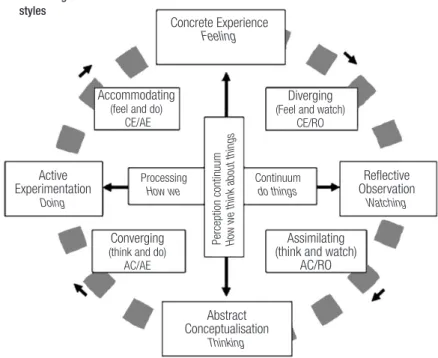
Another model for learning styles was developed by David Kolb in the 1980s. Kolb (1981, 1984) considers that interaction between concrete experience and theoretical conceptualization turns learning into a cyclic process, built up on four steps: concrete experience, reflexive observation, abstract conceptualization, and active experience. These stages are present in the following four learning styles, based on the dichotomies active/reflexive and abstract/concrete:
• Converging (thinking and doing), where
abstract conceptualization and active experience predominate: This is the typical style of those who are more attracted to technical problems and solving tasks rather than interpersonal or social issues, quite often, presenting better skills in the practical application of ideas;
•Diverging(feelingandobserving),featured
by concrete experience and reflexive observations: This is the case of those who are sensitive and prefer to watch rather than to do, with a tendency to obtain information and use creativity to solve problems. By nature, they are creative, emotional and interested in people and group-work. These learners react well to brainstorming, making contributions for a better performance. It is highly connected to people who are strong in arts and human sciences;
• Assimilating (thinking and observing),
observation are dominant, by allowing these learners to be more interested in abstract ideas rather than in people. Understanding and creating models is one of these learners’ strengths. Quite commonly, individuals who work in mathematics tend to have this learning style, just as those whose work involves planning and research;
• Accommodating (feeling and doing), whose
personalities are stronger in concrete and active
experiences: They trust their intuition, to the detriment of logics, i.e. they trust information given by other people rather than trusting their own analysis, preferring a practical and experimental approach, not being afraid of making mistakes in problem-solving tasks. They are risk takers.
The following diagram (see Figure 1) shows the mapping between the learning cycle and the learning styles.
Figure 1- Kolb’s diagram of learning styles. According to this theory, every student, regardless of his/her learning style, can reach the same proficiency level through adequate methodologies and training processes.
Lilienfeld et al (2010) highlighted the problem that one could encounter if one reduces students’ scholastic insuccess to the fact that teachers cannot adjust themselves to the students’ learning style, and if one does not take into account the students’ learning ability and motivation. Under this context, they also refer to a humourous article of a North American satirical newspaper, The Onion, entitled “Parents of nasal-learners
demand odor-based curriculum”, ridiculing the idea that there is a teaching style to unchain the unknown potential of all students with academic performance. They consider that the belief that stimulating teachers to adapt their teaching style to their students’ learning styles can improve the learning process, is no more than an urban legend of educational psychology. The results can be the opposite of what we want to achieve when we focus Kolb’s learning
styles
Concrete Experience
Feeling
Diverging (Feel and watch)
CE/RO Accommodating
(feel and do) CE/AE
Active Experimentation
Doing
Reflective Observation
Watching
Converging (think and do)
AC/AE
Assimilating (think and watch)
AC/RO
Abstract Conceptualisation
Thinking Processing
How we
Continuum do things
Perception continuum How we think a
bout things
teaching on students’ strongest intellectual skills rather than on their weaknesses because learners need to correct and overcome their deficits instead of avoiding them. Moreover, life outside school is not always compatible with our favorite learning styles and good teaching is the one that prepares us for the real world.
External constraint:social-cultural factors
Recognized as one of the greatest
historical personalities of Chinese civilization and culture, Confucius left a great mark in China. His teachings had a significant influence not only in the educational domain, but also in political, economic and cultural fields, and the ethical and moral domain. From the pedagogical perspective, his doctrine is most probably the oldest one that is still in place, with over 2500 years of accumulated experience and in a full-swing process of application, development and adaptation to present times. Many of Confucius’, or to him attributed, sayings are still pertinent and of great relevance.
Associating Confucius with education is, therefore, inevitable, and those links are not limited to traditional Chinese education. His large contribution to education and teaching has given Confucius a very special place in history and culture. Sometimes idolized, sometimes despised, his legacy still influences one fifth of the world population. His pedagogy is still remarkable, while experts wonder how his ideas resist to time. Certainly, the universal validity of his thought and the fact that it addresses the needs and immediate and permanent problems of mankind are a plausible explanation.
Many Western observers point out the incongruence between the positive results that students of Asian countries achieve in mathematics and their obsolete teaching, based on mechanized and routine learning, not leading to the development of higher skills. A teaching system with an authoritarian, teacher-centered pedagogy and a centralized curriculum does
not appropriate for differentiated educational needs and does not promote creativity, on one side, and its biddable, obedient and non-critical students, who learn by means of drills, lacking intrinsic motivation and having examinations
as their inal goal, on the other (GARDNER, 1989; GINSBERG, 1992; OUYANG, 2000).
This is a teaching system where, even today, education is a social ladder, while the admission to universities is very competitive, such as it was till the beginning of the 20th century in China the selection of civil officials, which depended on the competitive imperial exams.
This “paradox of the Chinese student” represents, according to Biggs (1996), an apparent paradox, as there are values, deeply rooted in the Confucian culture and socialization practices, that increase the receptivity of those students to school learning and that are susceptible to deceiving Western observers. Children start very early to develop beliefs about learning based on their culture and those beliefs determine their learning and the outcomes they achieve. For centuries, the Chinese believed in the value of education either for collective benefit or individual development. Thus, the major significance of the education role has both a historical and a current meaning.
Leung (2001) systematized six dichotomies when comparing the teaching of mathematics in Asia and in Western cultures:
the process rather than on the outcome, namely through research activities and problem-solving tasks. Asian scholars believe that their Western homologues go too far in the valorization they assign to the process itself, and they underline the importance of content in the learning process of mathematics.
2) Memorization versus Significant Learning: While Western memorization is linked to mechanized and meaningless learning, Asians face it as legitimate, because it is considered to be an interactive process of a repeated practice, memorization and understanding, so that perceiving memorization as mere mechanized learning is a too simplistic point of view.
3) Hard Study versus Recreational
Pedagogy (or edutainment): Western educators hold the opinion that it is crucial for students to enjoy themselves and have fun while they learn, whereas, from the Asian point of view, learning and study necessarily imply hard work; the pleasure of learning comes essentially from the results achieved. In this sense, (HUANG, 1969) refers to the sentence pinned on a school wall in Beijing: “the roots of knowledge are bitter, but its fruits are sweet”.
4) Intrinsic versus Extrinsic Motivation: For Westerners, intrinsic motivation is overvalued and considered to be the best way of keeping students interested in studying mathematics, whereas the extrinsic incentive, such as preparation for exams, is solely a cause for anxiety, damaging the learning itself. Although Asian educators do not disagree on the relevance of intrinsic motivation, exams have been traditionally considered to be an acceptable motivation source for students’ learning. They also consider that both can be complementary, although the distinction between both types of motivation is not clear.
5) Class versus Individualized Teaching: From the Western perspective, individualized teaching-learning is considered to be the ideal model, and the existence of students’ classes is essentially justified for economic reasons and other resource limitations. In the Eastern
culture, education is understood mainly as a socialization process; therefore, collective, class or group learning is highly valued. This difference leads to different understandings of the teacher’s role. The main role of Western teachers is to meet individual needs of students and, on this basis, individualized syllabi and similar initiatives are the ideal way to teach and learn, preferably in classes that should be as small as possible.
In Eastern cultures, the teacher’s role as a model is essential, so teaching and learning in a group makes sense, and group size does not represent a limitative factor. From this perspective, in China and in Asia in general, it is not class size that determines the quality of the teaching-learning process, but rather the teacher’s qualifications and the way in which he leads that process. Leung (2001) considers that, most of the times, many syllabi for individualized learning merely degenerate into interactions between the student and (namely technological) learning materials, rather than between the student and the teacher, not providing the student with the opportunity to discuss, observe, listen to the teacher, i.e. to learn by having the teacher as a model.
6) Teachers’ Scientific Competence
this scholar image (scholar teacher) has deep roots in the Confucian culture and still has a great impact on the education of those countries. This is confirmed by the Chinese proverb: “a teacher needs to have a bucket of water before he is able to give students a bowl of water”. In the teaching of mathematics, this implies that, in spite of the fact that pedagogy is a major factor in the teaching-learning process, a good command of the program contents is even more important. This being said, the teacher has to be above all a scholar and then a facilitator of the learning process. The dichotomy between program contents and pedagogy suggests, therefore, the existence of different views on the teacher’s role, and although in both cultures the teacher’s scientific competence is considered to play a significant role, in the so-called Asian countries this assumption goes further, to the extent that it is not possible to be a teaching facilitator without being a scholar.
This position is supported by Tung (2000) who considers that without a strong knowledge of advanced mathematics it is difficult for a teacher to teach well, even at the basic level. (MA, 1999) goes further by asserting that without the knowledge of advanced mathematics it is not possible to make use of the appropriate pedagogy, not even
atabasiclevel.Finally(QUEIRÓS,1945),inhis
corrosive meditations on prominent recipes for teaching, holds the opinion that in order to be able to teach there is a tiny, little formality to be observed: knowledge. These particularities that derive from the cultural variables of the learning process, and their inaccurate interpretation, because they are analyzed in different cultural universes, might lead to abusive generalizations and to the constructions of expected outcomes that turn out not to be manifested.
External constraint: teaching styles
Ponte (1992) maintains that mathematical knowledge is based on four main features: formalization according to well-defined logics;
verifiability that allows us to reach consensus on the validity of each result; universality, i.e., its trans-cultural character and the possibility of applying it to the most varied phenomena and situations; and, generativity, which relies on the possibility of discovery, being made up of four building blocks: basic skills (that imply processes of simple memorization and execution), intermediate skills (that involve processes to a certain level of complexity, but do not require a lot of creativity), complex skills (that entail a significant ability to deal with new situations), and knowledge in a broad sense (that include meta-knowledge, i.e. knowledge that affects the previous knowledge itself). The development of mathematic knowledge relies on action (manipulation of objects and of numerical, graphic and algebraic representations), and reflection (thinking over the action, stimulated by the tentative explanation and discussion). (PONTE, 1992) also considers that the conceptual substract plays a determinant role in the thought and in the action and, subsequently, in the teacher’s practice.
meta-knowledge, hardly occurs. These features are believed to occasionally originate an out-of-context teaching, reflecting itself on the non-integration of the student in the society as a critical and participative agent.
In the context of the didactic practices of teachers – those that take place in the classroom – the discursive practices, due to the transversality of language in the human activity, have an important dimension. If the teacher’s practice in classroom mirrors his teaching style, his speech will also reveal his position towards central issues related to mathematics teaching mentioned previously. In the Portuguese version of the Professional Standards for Teaching Mathematics by the National Council of Teachers of Mathematics (NCTM, 1994), it is stated that “the classroom speech mirrors what it means to know mathematics, what makes something become true or reasonable, and what implies to do mathematics; it is, therefore, of major relevance what students learn about mathematics just as much as how they learn it” (own translation).
Ernest (1988), cited by Thompson (1992), based on an empirical study, highlights three elements that can influence the teachers’ practices: (1) The teacher’s beliefs system on mathematics and on its teaching and learning; (2) The social context where its teaching takes place, particularly the obstacles and opportunities that it creates; (3) The teacher’s thinking and reflection level.
What concerns the beliefs about mathematics, Thompsom (1992) argues that it is not a simple cause-effect relation, but rather a dialectic relation, extremely complex and of poorly defined contours. In turn, Ernest (1988) considers the following typologies of beliefs, regarding the way mathematics can be understood:
1) As a tool box (from an utilitarian perspective), in which mathematical knowledge is a set of facts, which are not necessarily related to each other, and serves the development of other sciences and techniques;
2) As a static and unified body of knowledge (from a platonic perspective) which implies that one can only discover but not create new knowledge;
3) As an open field to human creation that expands continuously, leading to new models and procedures (from a perspective of problem resolution).
Chacón (2003), following Thompson (1984), systematizes the teacher’s role within the classroom according to each of those perspectives. In this sense, an instrumentalist teacher will have a teaching method that is rather prescriptive, by emphasizing rules and procedures. A platonic type will highlight the meaning of concepts and logics in the mathematical procedures. Finally, a teacher who is in line with problem resolution will give more importance to the exercises that lead students to become interested in the generative processes of mathematics. The teacher’s role and intervention take on a significant importance, by being, in the first case, a mere instructor and, in the last case, a facilitator or mediator in the construction of students’ mathematical knowledge.
Regardless of the connections that
might be established between learning style and successful learning among students, the lecturer’s role is irrefutable. The significance of the teacher’s role is emphasized in the previous mentioned Professional Standards for the Teaching of Mathematics (NCTM), according to which teachers are the main protagonists of change by which mathematics is taught and learned at schools. In the same document, there is also a reference to the fact that teachers’ – and students’ – beliefs and conceptions build obstacles to major changes in the teaching and learning of mathematics at schools.
Final considerations
vision and subsequent systemic approach of that process are mandatory. None of the above-mentioned constraints is per se an absolute factor of either academic success or failure. What seems to work well in some situations can have disastrous effects in others. It is essential to think and act “out of the box”, without prejudice or pre-conceived ideas. A complex learning architecture presupposes a permanent design of adaptation, a continuing design and
redesign of fashions, methods and styles in an endless search for the teacher’s commitment to the students’ learning. Which teaching design will better serve is an endless search. One thing seems to be certain: the improvement of mathematics teaching implies necessarily the non-overestimation of a single methodological line. On the contrary, it will have to be drawn from a process of diversified methodologies and be based on coherent psychosocial grounds.
References
ARAÚJO, Luísa. Piagetianos e vygotskianos: mitos pedagógicos e práticas promissoras. In: CRATO, Nuno (Coord.). Desastre no
ensino da matemática: como recuperar o tempo perdido. Lisboa: Gradiva, 2006. p. 179-190.
BIGGS, John. Western misconceptions of the Confucian-heritage learning culture. In: WATKINS, David A.; BIGGS, John B. (Eds.). The
Chinese learner: cultural, psychological, and contextual influences. Hong Kong: CERC: ACER, 1996. p. 45-67.
BUTTERWORTH, Brian. What counts: how every brain is hardwired for math. New York: The Free Press, 1999.
CASTAÑON, Gustavo Arja. Construtivismo social: a ciência sem sujeito e sem mundo. Master dissertation, Instituto de Filosofia e Ciências Sociais – Federal University of Rio de Janeiro, Brazil, 2009. Available at: <ppglm.files.wordpress.com/2008/12/ dissertacao-ppglm-gustavo-arja-castanon.pdf>. Retrieved on: 12 April 2012.
CASTRO-CALDAS, Alexandre. Os processos neurobiológicos subjacentes ao conhecimento da matemática. In: CRATO, Nuno (Coord.). Desastre no ensino da matemática: como recuperar o tempo perdido. Lisboa: Gradiva, 2006. p. 196-201.
CRATO, Nuno (Coord.). Desastre no ensino da matemática: como recuperar o tempo perdido. Lisboa: Gradiva, 2006. DEHAENE, Stanislas et al. Arithmetic and the brain. Current Opinion in Neurobiology, v. 14, n. 2, p. 218–224, Apr. 2004. DEVLIN, Keith. The math gene: how mathematical thinking evolved and why numbers are like gossip. New York: Basic Books, 2000.
FREIRE, Paulo. Pedagogia do oprimido. 2. ed. Porto: Afrontamento, 1975.
GARDNER, Howard. Multiple intelligences: the theory in practice. New York: Basic Books, 1993.
GARDNER, Howard. To open minds: Chinese clues to the dilemma of American education. New York: Basic Books, 1989. HANS, Yi; GINSBURG, Herbert. Chinese and English mathematics language: the relationship between linguistic clarity and mathematics performance. Mathematical Thinking and Learning, v. 3, n. 2-3, p. 201-220, 2001.
KOLB, David. Experiential learning: experience as the source of learning and development. New Jersey: Prentice-Hall, 1984. KOLB, David. Learning styles and disciplinary differences. In: CHICKERING, Arthur (Ed.). The modern American college. San Francisco: Jossey-Bass, 1981.
LILIENFELD, Scott O. et al. Os 50 maiores mitos populares da psicologia: derrubando famosos equívocos sobre o comportamento humano. São Paulo: Gente, 2010.
MA, Liping. Knowing and teaching elementary mathematics: teachers’ understanding of fundamental mathematics in China and the United States. New Jersey: Lawrence Erlbaum Associates, 1999.
MEHLER, Jacques; BEVER, Thomas G. Cognitive capacity of very young children. Science, v. 158, n. 3797, p. 141-142, oct. 1967. MILLIGAN, Constance; MILLIGAN, Jerry. A linguistic approach to learning mathematics vocabulary. Mathematics Teacher, v. 76, n. 7, p. 488–497, oct. 1983.
NCTM. Normas profissionais para o ensino da matemática. Lisboa: APM: IIE, 1994. PIAGET, Jean. Genetic epistemology. New York: W.W. Norton & Company, 1970. PIAGET, Jean. The construction of reality in the child. New York: Basic Books, 1954.
PONTE, João Pedro. O desenvolvimento profissional do professor de Matemática. Educação e Matemática, n. 31, p. 9-12, 1992. QUEIROZ, Eça de. Notas contemporâneas. Lisboa: Lello, 1945.
SOUSA, David A. How the brain learns mathematics. Thousand Oaks: Corwin, 2008.
TANG, Y. et al. Arithmetic processing in the brain shaped by cultures. Proceedings of National Academy of Sciences, v. 103, n. 28, p. 10775-10780, 2006. Available at: <www.yiyuan.net/english/PAPERS/PAPERS0607/2006%20PNAS %20Tang%20YY.pdf>. Retrieved on: 2 Oct. 2012.
THOMPSON, Alba G. Teachers’ beliefs and conceptions: a synthesis of the research. In: GROUWS, Douglas (Ed.). Handbook of
research in mathematics teaching and learning. New York: Macmillan: 1992. p. 127-146.
Received on July 27th, 2013
Approved on April 15th, 2014
Maria de Fatima Andrade de Oliveira has been coordinator of the Department of Mathematics at the Portuguese School of Macau - China, recently completed her Master in Education at the University of Saint Joseph, Macau, with the final grade of Sum Cum Lauda.
João Garrott Negreiros Marques has been an Associate Professor of USJ since September 2010 in the field of computing. He holds a doctoral and post-doctoral degree in Geographic Information Technologies and Web development in Portugal and Spain.