CHARACTERISTICS OF GIANT BAMBOO
Wandivaldi Antonio Colla1
, Antonio Ludovico Beraldo2
, José Otávio Brito3 (received: April 13, 2010; accepted: April 28, 2011)
ABSTRACT: Despite countless use possibilities for bamboo, this material has two major disadvantages. One drawback is the low natural durability of most bamboo species due to presence of starch in their parenchyma cells. The other equally important drawback is the tendency bamboo has to present dimensional variations if subjected to environmental change conditions. In an attempt to minimize these inconveniences, strips (laths) of Dendrocalamus giganteus Munro were taken from different portions of the culm and subjected to several temperatures, namely 140 °C, 180 °C, 220 °C, 260 °C and 300 °C under laboratory conditions, at the ESALQ-USP college of agriculture. The thermal treatment process was conducted in noninert and inert atmospheres (with nitrogen), depending on temperature Specimens were then subjected to physicomechanical characterization tests in order to determine optimum thermal treatment conditions in which to preserve to the extent possible the original bamboo properties. Results revealed that there is an optimum temperature range, between 140 ° and 220 °C, whereby thermally treated bamboo does not signifi cantly lose its mechanical properties while at the same time showing greater dimensional stability in the presence of moisture.
Key words: Thermal treatment, Dendrocalamus giganteus.
EFEITOS DO TRATAMENTO TÉRMICO NAS CARACTERÍSTICAS FISICO-MECÂNICAS DO BAMBU GIGANTE
RESUMO: Embora possam ser atribuídas ao bambu inúmeras possibilidades de utilização, duas grandes desvantagens são apresentadas por esse material. A primeira refere-se à baixa durabilidade natural da maioria das espécies, em razão da presença de amido em suas células parenquimáticas. A outra desvantagem, não menos importante, é a tendência apresentada pelo bambu de apresentar variações dimensionais, quando exposto a mudanças ambientais. Na busca da minimização de tais inconvenientes, taliscas (ripas) de Dendrocalamus giganteus Munro foram coletadas de diversas partes do colmo e foram submetidas, em condições de laboratório, na ESALQ-USP, a diversas temperaturas: 140 °C, 180 °C, 220 °C, 260 °C e 300 °C. Dependendo da temperatura, o processo de termorretifi cação foi realizado em ambientes de atmosfera não inerte e inerte (com nitrogênio). A seguir, os corpos-de-prova foram submetidos a ensaios de caracterização físico-mecânica, buscando-se avaliar as condições ideais da termorretifi cação e que, ao mesmo tempo, não implicassem em redução acentuada das características originais do bambu. Os resultados permitiram detectar a existência de uma faixa ótima de temperatura, de 140 ºC a 220 ºC, na qual o bambu termorretifi cado não perde signifi cativamente suas características mecânicas e, ao mesmo tempo, apresenta maior estabilidade dimensional em presença da umidade.
Palavras-chave: Termorretifi cação, Dendrocalamus giganteus.
1Professor M.Sc. in Agricultural Engineering – Universidade Estadual de Campinas – Faculdade de Engenharia Agrícola – Av. Candido Rondon,
501, Barão Geraldo – Cidade Universitária Zeferino Vaz – 13083-875 – Campinas, SP, Brasil – [email protected]
2Agricultural Engineer, Professor Ph.D. in Sciences Du Bois – Departamento de Construções Rurais – Faculdade de Engenharia Agrícola –
Universidade Estadual de Campinas – Av. Candido Rondon, 501, Barão Geraldo – Cidade Universitária Zeferino Vaz – 13083-875 – Campinas, SP, Brasil – [email protected]
3Forest Engineer, Professor Ph.D. in Soils and Plant Nutrition – Departamento de Ciências Florestais – Escola Superior de Agricultura Luiz de
Queiroz – Universidade de São Paulo – Avenida Pádua Dias, 11 – Cx. P. 9 – 13.418-900 – Piracicaba, SP, Brasil – [email protected] 1 INTRODUCTION
Bamboos are woody, herbaceous plants belonging to the grass family, with over 700 classifi ed species being distributed across 50 distinct genera (HIDALGO-LÓPEZ, 2003). It is a perennial plant reasonably easy to cultivate, with a long useful life and capable of promoting great soil regeneration, having accompanied mankind from the beginning of time, providing shelter, food, household utensils, charcoal, paper, fabric, irrigation, musical instruments as well as other artifacts.
bringing benefi ts at the economic level and speeding up the processing phase (APUAMA, 1999).
Treatment possibilities for lignocellulosic material may include use of heat, referred to here as thermal treatment. The action of heat can be relatively intense in wood, on account of the structural changes that occur during combustion (BRITO, 1992).
One of the most important stages in thermal treatments is selecting the temperature range. Pessoa et al. (2006) tested temperatures of 30 °C (room temperature), 120 ºC, 140 °C, 160 °C, 180 °C and 200 °C on wood of Eucalyptus grandis. After undergoing thermal treatments, samples were subjected to decay conditions. A favorable effect was noted of the higher temperature on the mortality of drywood termites.
Due to high sugar, carbohydrate, resin and starch contents in its composition, bamboo is highly vulnerable to insects, bacteria and fungi (PEREIRA; BERALDO, 2007). These damaging organisms include bamboo borer (Dinoderus minutus Fabricius), which causes substantial mass loss, particularly affecting tropical bamboos. The intensity of the damage will depend on starch content, culm age, harvest season and treatment type applied to the bamboo species (HIDALGO-LÓPEZ, 2003).
Structural change to materials, following physical or chemical treatments, is usually assessed by physicomechanical tests. Ultrasound, however, is a relatively quick, nondestructive testing method for verifying internal discontinuities and changes caused to the properties of materials. Velocities of wave propagation are dependent on the direction of propagation and on elastic constants of materials, not always isotropic, as is the case of wood (NOGUEIRA; BALLARIN, 2007). As with other natural materials, bamboo properties vary widely, mainly on account of the specifi c condition of growth. In order to evaluate bamboo properties, it is necessary to apply physicomechanical tests. Nondestructive testing (END), in particular through ultrasound, is a viable alternative to classic mechanical testing because the ultrasonic pulse velocity (VPU) traveling into a specimen potentially detects structural changes caused by the effect of high temperatures (DEL MENEZZI et al., 2007).
2 MATERIAL AND METHODS 2.1 Preparation of strips for thermal treatments
Two bamboo culms of species Dendrocalamus giganteus Munro, at around age 5 years, were collected
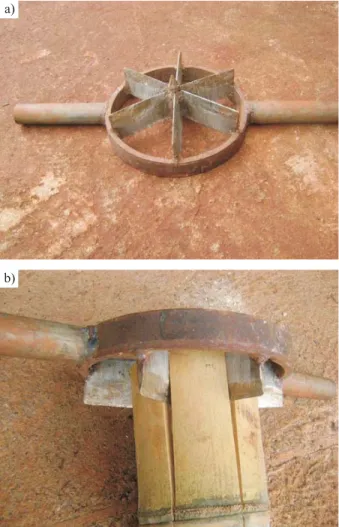
at the Faculdade de Engenharia Agrícola, Campus of the Universidade Estadual de Campinas. Using a device, as illustrated in Figure 1a, the culm was split into 6 (six) sections, referred to here as strips, as is illustrated in Figure 1b. The strips were then machined so as to obtain uniform specimens 30 cm long x 2 cm wide x 1 cm thick. The strips were left to dry in a protected environment until they reached a 10% to 15% moisture content.
Figure 1 – Device for cutting strips.
Figura 1 – Dispositivo para produção de taliscas.
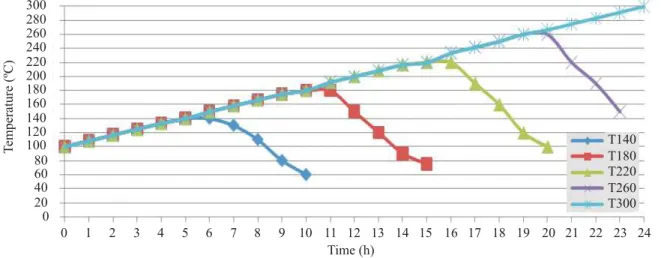
The thermal treatments were performed at the Laboratório Integrado de Química, Celulose e Energia, of the Departamento de Ciências Florestais, Escola Superior de Agricultura Luiz de Queiroz (ESALQ-USP). The strips were heated at 140 ºC, 180 ºC, 220 ºC, 260 ºC and 300 °C. To avoid combustion, N2 was used for the latter three temperatures. The starting temperature was 100 ºC, adopting a heating rate of 0.1388 °C/min, according to Pessoa et al. (2006). The specimens were kept in the oven for 1 hour to reach the desired temperature; then they remained in the oven for the time required to reach an equilibrium temperature. Figure 2 provides the evolution of temperature as a function of heating time.
Mass loss was assessed in the specimens by comparing mass percentages before and after the completion of thermal treatments.
2.2 Tests applied to thermally treated bamboo (BTR)
In evaluating the properties of thermally treated bamboo an optimum temperature range was sought, in an attempt to obtain a more suitable product for each specifi c use, for instance, furniture making. To the extent possible, specimen evaluation followed the guidelines set out in the Brazilian wood standards (ASSOCIAÇÃO BRASILEIRA DE NORMAS TÉCNICAS - ABNT, 1997).
2.2.1 Bulk density
Bulk density (in g.cm-³) was obtained before and after the thermal treatments, by measuring the volume and the mass of specimens.
2.2.2 Swelling and water absorption
Specimens were prepared after determination of breaking strength under static bending testing. Samples 5 cm (long) x 2 cm (wide) x 1 cm (thick) were taken from undamaged portions of specimens, away from the central, damaged parts. Once weight and size measurements were taken, specimens were immersed in water for 24 hours. Mass gain and swelling after 24 hours, in all three anatomical directions (axially, radially and tangentially), were compared with the control sample.
2.2.3 Nondestructive ultrasonic testing (END)
The ultrasonic pulse velocity (VPU) running through specimens was measured before and after the thermal treatment was applied. A Steinkamp-BP7 device with exponential transducers was used, with a resonance frequency of 45 kHz. The ultrasonic pulse velocity was derived by dividing distance (in millimeters) by propagation time (in μs). With the density and VPU of strips, before and after the thermal treatments, the dynamic modulus of elasticity (Ed) was derived by:
ρ = bulk density (kg/m³);
VPU = ultrasonic pulse velocity (m/s). 2.2.4 Static bending
For the modulus of rupture (MOR) in static bending, 10 samples were selected at random from each
Figure 2 – Diagram representing rising temperatures (ºC) as a function of time (h).
Figura 2 – Diagrama representando a elevação de temperatura em (ºC) em função do tempo em (h).
2 9
.( ) .10 ( )
d
Figure 5 – Ultrasonic pulse velocity (VPU), in ms-1.
Figura 5 – Velocidade do pulso ultrassônico (VPU), em ms-1.
Figure 4 – Dynamic modulus of elasticity (Ed), in GPa.
Figura 4 – Módulo de elasticidade dinâmico (Ed), em GPa. thermal treatment. A free span of 150 mm was adopted
using an EMIC testing machine, DL/300 kN model, at a speed of 1 mm/min.
2.2.5 Charpy impact test
To perform this test, specimens 30 cm (long) x 2 cm (wide) x 2 cm (thick) in nominal size were used, with a free span of 24 cm and an energy of 10 kgf.m. The bamboo strips being less than 2 cm in thickness, however, a section was thus required comprising two strips, glued with PVA, under pressure. This test was performed at the Wood Division of the Technological Research Institute (IPT). 2.2.6 Scanning electron microscopy (MEV)
This test was performed at the National Laboratory of Synchrotron Light (LNLS). Each duly prepared sample was analyzed in order to detect any structural changes to bamboo resulting from the thermal treatment.
3 RESULTS AND DISCUSSION 3.1 Mass loss after the thermal treatment
The mass loss in bamboo strips was more intensifi ed for the treatment at 300 °C, around 50% in relation to the original mass, denoting drastic changes in the bamboo structure as a result of temperature (Figure 3). 3.2 Effects of thermal treatment on density, velocity and dynamic modulus
In treatments performed at higher temperatures, the properties of thermally treated bamboo (BTR) dropped dramatically (Table 1). Density decreased as a result of mass loss being more intensifi ed than volume contraction; the dynamic modulus of elasticity Ed (Figure 4) and VPU (Figure 5) increased because the moisture content in the BTR decreased. At 300 °C, however, a marked reduction was noted in such values , indicating the presence of major structural fl aws in the BTR.
Figure 3 – Mass loss (%) in thermally treated bamboo (BTR) as a function of temperature.
Figura 3 – Perda de massa (%) do Bambu Termorretifi cado (BTR) em função da temperatura.
Table 1 – Properties of thermally treated bamboo (BTR) as a function of treatment temperature.
Tabela 1 – Propriedades do Bambu Termorretifi cado (BTR) em função da temperatura de tratamento.
Temperature 30 ºC 140 ºC 180 ºC 220 ºC 260 ºC 300 ºC
Density (g.cm-3) 0.87a* 0.81ab 0.79bc 0.75c 0.67d 0.54e
VPU (m.s-1) 4354d 6041a 6055a 5973b 5774c 2147e
Ed (GPa) 16.56d 29.42a 28.92a 26.95b 22.47c 2.47e
MOR (MPa) 194b 232a 157c 123d 79e 12f
Figure 6 – Modulus of rupture (MOR, in MPa) of thermally treated bamboo (BTR) as a function of temperature, in °C.
Figura 6 – Módulo de ruptura (MOR, em MPa) do Bambu Termorretifi cado (BTR), em função da temperatura, em °C. 3.3 Effect of thermal treatment on the modulus of rupture (MOR)
MOR dropped rapidly with increasing temperatures, proving to be more sensitive to the effect of temperature than VPU or Ed (Figure 6).
3.4 Effect of thermal treatment on swelling
Swelling after 24 hours was found insignifi cant in the axial direction (0.12% to 0.18%), except for the treatment at 300 °C (1.60%), indicating once again, in this case, an important anatomical change occurring in the bamboo. Swelling was greater in the radial direction than in the tangential direction (opposite pattern to normal wood). At 220 °C, a tendency was noted toward stabilization (2%) in both anatomical directions (Figure 7). At higher temperatures, samples were found to become frailer, with a tendency to twist and crack.
Figure 7 – Swelling of thermally treated bamboo (BTR) as a function of anatomical direction.
Figura 7 – Inchamento do Bambu Termorretifi cado (BTR) de acordo com a direção anatômica.
3.5 Impact strength of BTR relative to other woods
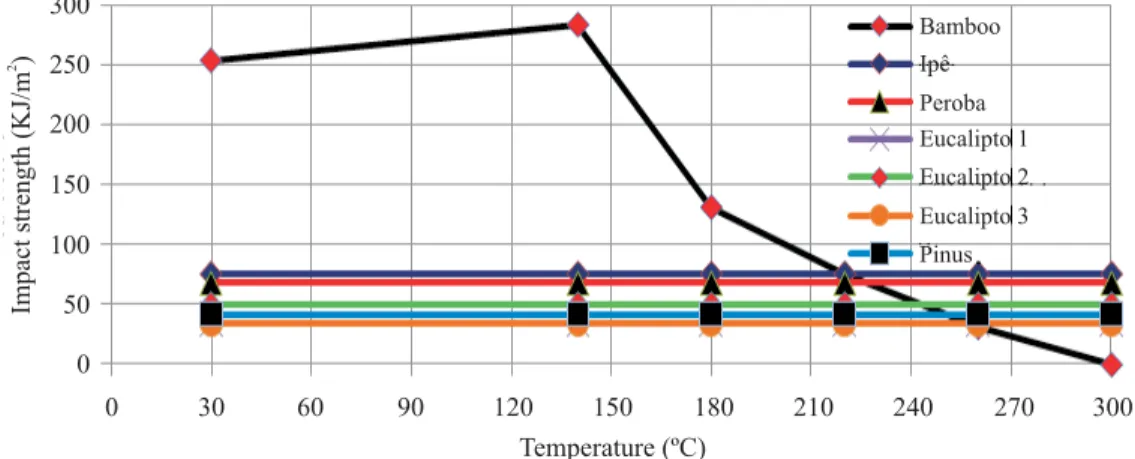
Figure 8 provides Charpy test results for impact strength in bamboo. It should be noted that, for the bamboo treated at 140 °C, the maximum value of the energy scale was adopted (10 kgf.m), since strips being tested simply would not break. For temperatures between 180 °C and 220 °C an abrupt drop in impact strength was noted, yet the value found was well above the value found for woods rated as good quality, again illustrated in Figure 8.
3.6 Effect of thermal treatment on anatomical structure
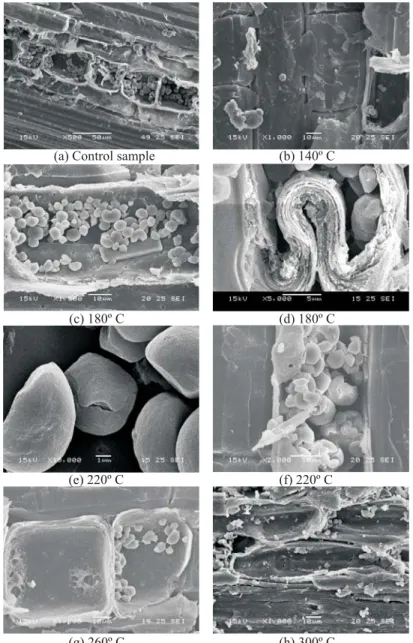
Figures 9a to 9h provide imagery by scanning electron microscopy, for bamboo at room temperature and after thermal treatment. A large quantity of starch is clearly noted, with its typical globular shape and almost fi lling out
Figure 8 – Comparative graph between bamboo and other woods.
Other wood data were provided by the Technological Research Institute (IPT).
Figura 8 – Gráfi co comparativo entre o bambu e diversas madeiras.
Figure 9 – Images obtained by scanning electron microscopy (MEV).
Figura 9 – Imagens obtidas por microscopia eletrônica de varredura (MEV). the parenchyma cells (Figure 9a). Bamboo fi ber bundles
appear on the top and bottom portions of the picture. At 140 °C, starch and cells are still almost unchanged in structure (Figure 9b). Some laceration is yet noted in the parenchyma walls due to cutting being done with an instrument other than a microtome. At 180 °C, structural changes are found to be more drastic (Figure 9c). Parenchyma cells are severely contracted (Figure 9d), noting some fi ssured starch grains (Figure 9e) about to burst. At 220 ºC, starch
4 CONCLUSIONS
Thermally treated bamboo (BTR) was found to have potential for various applications as a function of temperatures being adopted. At 180 °C, the bamboo underwent major changes in structure. Temperatures above 260 °C caused considerable damage to the bamboo structure, suggesting that it may be unsuitable, in particular, for furniture making.
An optimum temperature range was noted to exist, between 140 °C and 220 °C, which could be further refi ned in order optimize the process.
Overall, the thermally treated bamboo was found to have greater dimensional stability than the reference bamboo. Structural changes caused by temperature led to a drastic reduction in the mechanical properties of bamboo. Detected by ultrasound, these changes were more noticeable in impact strength and static bending tests.
5 REFERENCES
APUAMA. Disponível em: <http://www.apuama.org.br/>. Acesso em: 12 set. 2009.
ASSOCIAÇÃO BRASILEIRA DE NORMAS TÉCNICAS.
NBR 7190: projeto de estruturas de madeira. Rio de Janeiro, 1997.
BRITO, J. O. Estudo das infl uências da temperatura, taxa
de aquecimento e densidade da madeira de Eucalyptus maculata e Eucalyptus citriodora sobre os resíduos sólidos
da pirólise. 1992. 81 f. Tese (Livre Docência) - Escola Superior de Agricultura “Luiz de Queiroz”, Piracicaba, 1992.
DEL MENEZZI, C. H. S.; TOMASELLI, I.; SOUZA, M. R. de. Avaliação não-destrutiva de painéis OSB modifi cados termicamente: parte 1, efeito do tratamento térmico sobre a velocidade de propagação de ondas de tensão. Scientia
Forestalis, Piracicaba, n. 76, p. 67-75, dez. 2007.
HIDALGO-LÓPEZ, O. H. Bamboo the gift of the gods. Bogotá: D’Vinni, 2003. 553 p.
LIESE, W. The structure of bamboo in relation to its properties and utilization: bamboo and its use. In: INTERNATIONAL SYMPOSIUM ON INDUSTRIAL USE OF BAMBOO BEIJING, 1992, Beijing. Proceedings... Beijing, 1992.
NOGUEIRA, M.; BALLARIN, A. W.Determinação dos módulos de elasticidade da madeira de Pinus taeda L. com ensaios não-destrutivos. Energia na Agricultura, Botucatu, v. 22, n. 3, p. 86-101, 2007.
PEREIRA, M. A. R.; BERALDO, A. L. Bambu de corpo e
alma. Bauru: Canal, 2007. 240 p.