ISSN 0103-8478
Marcus Vinícius Coutinho CossiI Michelle Vieira de AlmeidaI Mariane Rezende DiasII Paulo Sérgio de Arruda PintoIII Luís Augusto NeroIII*
Inspected and non-inspected chilled chicken carcasses commercialized in Viçosa, MG,
Brazil: microbiological parameters and
Salmonella
spp. occurrence
ABSTRACT
Sixty samples of chilled chicken carcasses submitted (30) and not submitted (30) to Brazilian inspection services were analyzed to investigate if inspected and non-inspected chilled carcasses represented different food safety risks in the region of Viçosa, MG, Brazil. The mean counts of indicator microorganisms (mesophilic aerobes, Enterobacteriaceae, total coliforms and Escherichia coli) of samples belonging to the inspected and non-inspected lots did not present significant differences (P>0.05). Also, no significant differences (P>0.05) were observed for the numbers of Salmonella spp. and E. coli
(higher than 2log cfu g-1) between samples submitted or not to inspection. Statistical differences were observed between the two sample classes only for the numbers of mesophilic aerobes higher than 4 and 5log cfu g-1 (P<0.05). The obtained results indicated the limitations of microbiological parameters to differentiate inspected and non-inspected chilled chicken carcasses commercialized in the specific studied area.
Key words: inspection, Salmonella, Escherichia coli,
Enterobacteriaceae, hygiene indicators.
RESUMO
Sessenta amostras de carcaças de frango refrigeradas fiscalizadas (30) e não fiscalizadas (30) por serviços brasileiros de inspeção foram analisadas para investigar se carcaças refrigeradas inspecionadas ou não apresentam diferentes riscos alimentares na região de Viçosa, MG, Brasil. As médias de contagens de microrganismos indicadores de higiene (aeróbios mesófios, Enterobacteriaceae, coliformes e Escherichia coli) de amostras inspecionadas ou não inspecionadas não apresentaram diferenças significativas (P>0,05). Também não foram observadas diferenças significativas entre amostras inspecionadas e não
inspecionadas com resultados positivos para Salmonella spp. e E. coli (contagens acima de 2log cfu g-1). Diferenças significativas (P<0,05) foram observadas somente entre os números de amostras com contagens de aeróbios mesófilos superiores a 4 e 5log cfu g-1. Os resultados obtidos indicam as limitações dos parâmetros microbiológicas para diferenciar carcaças de frango inspecionadas ou não na região específica onde o estudo foi conduzido.
Palavras-chave: inspeção, Salmonella, Escherichia coli,
Enterobacteriaceae, indicadores de higiene.
INTRODUCTION
In 2010, Brazilian chicken production was estimated at 11.4 million tons, what established Brazil as one of the greatest world producer. In addition, Brazil is the world greatest exporter of chicken products, presenting a high internal consumption of these products (UBABEF, 2011). Considering the development of chicken production, consumption and exportation, the necessity for safety and quality have increased, leading to a development of programs for quality and hygienic control (GILL et al., 2006).
Being a product of animal origin, chicken carcasses are naturally susceptible to microbiological contamination from several origins (SAKHARE et al., 1999). Spoilage and pathogenic microorganisms can contaminate chicken meat, indicating inadequate conditions of production and compromising the quality
IPrograma de Pós-graduação em Medicina Veterinária, Universidade Federal de Viçosa (UFV), Viçosa, MG, Brasil. IICurso em Medicina Veterinária, UFV, Viçosa, MG, Brasil.
IIIDepartamento de Veterinária, UFV, Campus Universitário, Centro, 36570-000, Viçosa, MG, Brasil. E-mail: [email protected].
*Autor para correspondência.
and safety of the final product (LUBER, 2009). As an example, Salmonella spp. is a food borne pathogen usually associated with these products, and considered an important agent of human diseases associated to food consumption (VANDEPLAS et al., 2010).
The verification of these safety and quality parameters is an official responsibility of government agencies in the country of production. These inspection steps have the goal of monitoring the microbiological contamination, assuring the quality and safety of final products. In Brazil, this inspection is conducted at industry level by the Ministry of Agriculture and Animal Production (MAPA) (BRASIL, 2011b). In commercial points, the Ministry of Health through the National Agency of Sanitary Vigilance (ANVISA) (BRASIL, 2011a), is responsible to verify the storage conditions and some safety parameters of the foods. Despite these control tools, in Brazil is still usual the commercialization and consumption of products of animal origin which were not submitted to inspection. As they are not inspected, there is no guarantee of hygienic procedures during the processing of these products, which can jeopardize their quality and safety.
Considering the relevance of the official inspection service for Public Health and to investigate if inspected and non-inspected chilled chicken carcasses represented different food safety risks, this study had the objective of comparing the microbiological profile of these food commercialized in a specific area located at the Southeastern region of Brazil.
MATERIAL AND METHODS
The study was conducted in the region of Viçosa, a city located at Minas Gerais State, in the Southeastern region of Brazil, between March and September of 2010. This city has about to 80,000 habitants, and the consumption of chicken commercialized directly from small farmers is usual, who trade this product in markets, fairs, deli houses and meat retail stores, without official control during the production, slaughtering and handling. As this production is not properly controlled, it is difficult to determine the exact dimension of this trade, leading the identification of the main commercialization points of this product.
For non-inspected chickens, it was identified six establishments that commercialize chilled carcasses. These establishments were visited in five occasions, and a chilled chicken carcass from each one was collected (total: 30 samples). For inspected chickens, five industries (all from federal inspection service) were
identified as suppliers of chilled chicken carcasses in the region markets; then, six chilled carcasses from each industry (all from distinct lots) were obtained from these markets (total: 30 samples). The numbers of chicken carcasses were defined considering indicative sampling, once there are no estimative of the amount of non-inspected chicken commercialized in Viçosa or other region in Brazil. All 60 chicken samples were collected in their original packaging, and kept under refrigeration at 4°C until the moment of microbiological analysis.
For microbiological groups enumeration, 25g of tissue and skin of each sample were aseptically collected and added to 225mL of 0.1% buffered peptone water (BPW, Oxoid Ltd., Basingstoke, England), homogenized and subjected to ten-fold dilution using BPW (BRASIL, 2003a). Then, two selected dilutions of each sample were plated on Petrifilm™ AC (3M Microbiology, St Paul, MN, USA) for mesophilic aerobes enumeration (MA) (incubated at 35°C by 24h), Petrifilm™ EC (3M Microbiology) for coliforms (TC)
and E. coli (incubated at 35°C by 24-48h), and
Petrifilm™ Enterobacteriaceae (3M Microbiology) for Enterobacteriaceae (EB; Enterobacteriaceae) (incubated at 35°C by 24h). After incubation, colonies were enumerated considering the typical characteristics for each group and plate, being the results expressed as colony forming units per gram (cfu g-1).
For Salmonella spp., the samples were
subjected to protocol described in IN62 (BRASIL, 2003a), with some modifications. Portions of 25g of tissue and skin of each sample were transferred to 225mL of buffered 1% peptone water (Oxoid), incubated at 37°C for 18h. Then, 1mL of the culture was transferred to 10mL of selenite cystine broth (Oxoid), incubated to 37°C for 24h, and 0.1mL transferred to 10mL of Rappaport Vassiliadis (Oxoid), incubated at 41.5°C for 24h. After incubation, the obtained cultures were streaked on brilliant green phenol red lactose sucrose agar (Oxoid) and xylose lysine deoxycholate agar (Oxoid), and incubated at 37°C for 24h. Salmonella
The counts for the hygiene indicator microorganisms were converted to log10 and evaluated
according to normal distribution and homogeneity. Then, the results from inspected and non-inspected samples were compared by Analysis of Variance (P<0.05). The samples were also compared considering the presence of Salmonella spp. and E. coli (counts higher than 2log10 cfu g
-1, once it is an indicative of
poor hygienic practices, according to GILL (1998), and ÁLVAREZ-ASTORGA et al. (2002) by the chi-square test (P<0.05). Finally, the samples were grouped according to the levels of contamination determined by the hygiene indicator microorganisms, and the obtained frequencies were compared by the chi-square test (P<0.05). Statistica 7.0 software (StatSoft Inc., Tulsa, OK, USA) was used for analysis.
RESULTS AND DISCUSSION
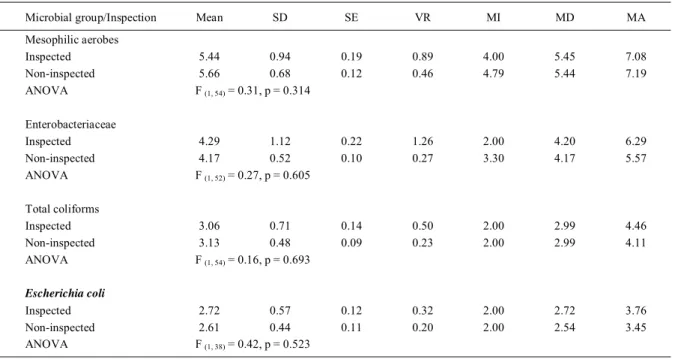
A descriptive analysis of the obtained counts of hygiene indicator microorganisms (MA, EB, TC, and E. coli) from chicken carcasses is presented in table 1. No significant differences were observed between the counts from inspected and non-inspected chicken samples (P>0.05). Compared to similar studies (GILL & BADONI, 2005; GILL et al., 2005; HUTCHISON
et al., 2006), higher counts of hygiene indicator microorganisms were observed in the present study. These results indicate inadequate conditions of production and/or storage at markets, independently of them being submitted or not to official inspection.
The frequency of positive results for E. coli
(higher than 2log10 cfu g
-1) is presented in table 2, with
no observed significant differences (P>0.05). In a similar study, GILL et al. (2005) verified that 12 of 25 chicken samples presented E. coli contamination at counts higher than 2log10 cfu g
-1. However, other studies have
shown higher numbers of chicken carcasses presenting
E. colicounts higher than 2log10 cfu g
-1, reaching in
some cases 100% of the analyzed samples (GILL & BADONI, 2005; GILL et al., 2006; GHAFIR et al., 2008). Despite having observed a high frequency of samples with high counts of E. coli, Salmonella
spp. was detected in only two chicken samples: one submitted to official inspection, and the other not submitted (Table 2). The suspect isolates obtained from these samples were confirmed by PCR (products with 204bp, according ALVAREZ et al., 2004), and after serological tests they were identified as Salmonella
Enteritidis. The obtained data indicate a smaller frequency of this pathogen in chicken carcasses, when compared to other studies. In a study conducted in
Table 1 - Statistical parameters of hygiene indicator microorganism counts in 60 chicken carcass samples, submitted (30) or not (30) to Brazilian inspection services (data in log10 cfu g-1).
Microbial group/Inspection Mean SD SE VR MI MD MA
Mesophilic aerobes
Inspected 5.44 0.94 0.19 0.89 4.00 5.45 7.08
Non-inspected 5.66 0.68 0.12 0.46 4.79 5.44 7.19
ANOVA F (1, 54) = 0.31, p = 0.314
Enterobacteriaceae
Inspected 4.29 1.12 0.22 1.26 2.00 4.20 6.29
Non-inspected 4.17 0.52 0.10 0.27 3.30 4.17 5.57
ANOVA F (1, 52) = 0.27, p = 0.605
Total coliforms
Inspected 3.06 0.71 0.14 0.50 2.00 2.99 4.46
Non-inspected 3.13 0.48 0.09 0.23 2.00 2.99 4.11
ANOVA F (1, 54) = 0.16, p = 0.693
Escherichia coli
Inspected 2.72 0.57 0.12 0.32 2.00 2.72 3.76
Non-inspected 2.61 0.44 0.11 0.20 2.00 2.54 3.45
ANOVA F (1, 38) = 0.42, p = 0.523
São Paulo state (Brasil), the prevalence of Salmonella
spp. in chicken meat was 19.1% (TESSARI et al., 2003). In Belgium, GHAFIR et al. (2008) conducted a chronologic study of Salmonella spp. in foods of animal origin and verified a variation between 9.5% and 25.6% of positive results for chicken carcasses and meat. In England, Salmonella spp. was isolated in 31% of the analyzed chicken carcasses (JØRGENSEN et al., 2002). Considering that the usual recommendation for microbiological safety of Salmonella spp. in foods is the absence of the pathogen in 25g of the sample (EC, 2005; LUBER, 2009), the two positive samples would represent a risk to consumers. In Brazil the industries must include in the package of the chicken carcasses an alert of the necessity of cooking properly the product due to the possible presence of foodborne pathogens, such as Salmonella spp. (BRASIL, 2001b); in counterpart, the consumers of non-inspected chicken are exposed to these risks without any warning. Usually, only some rules with standard parameters for the microbiological quality of chicken carcasses and meat are observed. In Brazilian legislation, the only official parameter is for chicken products for human consumption which are available at commercial sites, and only thermotolerant coliforms must be investigated and present counts lower than 4.0log10 cfu/g (BRASIL, 2001a). In Brazil, there is currently one official program for Salmonella
monitoring in chicken carcasses, aiming to obtain control at the industry level (National Program of Pathogens Reduction) (BRASIL, 2003c). According to this program, the observed frequencies of positive results for Salmonella spp. (Table 2) would be considered as tolerable. The European legislation states only that Salmonella spp. are to be investigated in avian products to be consumed by humans, and must be absent in 25g of the analyzed sample (EC, 2005). In the US, the sanitary control of chicken is conducted by the industry, with well-defined sampling plans and
specific parameters for EC (2 to 3log10 cfu g-1) and
Salmonella spp. (absent in 20% of the analysis)
(USDA, 2003).
Despite indicating the hygienic conditions of production, the distinct microorganisms groups present in chicken carcasses can also contribute to the spoilage of these products when present at high counts (ÁLVAREZ-ASTORGA et al., 2002; TSOLA et al., 2008). For avian products some guidelines are suggested, such as the limit of 6log10 cfu g-1 of MA and 3log10 cfu g-1 of
EC, specifically in Spain. In France, the usual recommendation is that MA contamination must not be higher than 5.7log10 cfu g-1 and EC not higher than
4log10 cfu g-1. A similar situation can be observed in the
USA, where some states adopt maximum levels of microbial contamination for chicken carcasses and avian products (ÁLVAREZ-ASTORGA et al., 2002; USDA, 2003). When the MA counts varies between 6 and 7log10 cfu g-1, meat products present a perceptible
odor, and counts higher than 8log10 cfu g-1 tend to form
lime on the surface, associated with alterations in color and consistency (GILL, 1998). So, these microbial parameters are important references to be followed in order to provide proper quality control for meat products, including avian carcasses.
Considering distinct levels of microbial contamination, the samples were grouped and the observed frequencies compared (Table 3). Significant differences (P<0.05) were observed between samples submitted or not to inspection for MA counts higher than 3, 4, and 5log10 cfu g-1. Eight samples submitted to
inspection and eight samples which were not submitted presented MA counts higher than 6log10 cfu g-1, the
reference parameter suggested by ÁLVAREZ-ASTORGA et al. (2002). For EB, a significant difference was observed between the samples only for counts higher than 3log10 cfu g-1 (Table 3), with the inspected
samples seen at a higher frequency. No significant differences were observed between the samples
Table 2 - Numbers of positive results for Escherichia coli and Salmonella spp. in chicken carcass samples, submitted or not to Brazilian
inspection services.
Samples/Inspection n Escherichia coli (at least 2.0log10 cfu g-1) Salmonella spp. (at least 1 Salmonella 25g-1)
All 60 40 2
Inspected 30 22 1
Non-inspected 30 18 1
χ2 1.2 0.0
P 0.273 1.000
submitted or not submitted to inspection considering the levels of contamination by TC and E. colihigher than 3log10 cfu g-1 (Table 3). Considering E. coli, seven
inspected and three non-inspected samples presented counts higher than 3log10 cfu g-1, reference level in
USA (USDA, 2003), and suggested by ÁLVAREZ-ASTORGA et al. (2002). No samples presented E. coli
counts higher than 4log10 cfu g-1 (Table 3).
In general, an expected result would be the higher counts of hygiene indicator microorganisms, and also higher frequencies of positive results for
Salmonella spp. and E. coli, in non-inspected chicken carcasses. However, it must be considered that the usual chicken slaughtering occurs in an industrial scale, which facilitates the microbiological contamination due to the automation and velocity of the process (MATIAS et al., 2010). In counterpart, non-inspected chicken carcasses are usually obtained from small producers that slaughter a little number of birds, minimizing the contamination. Despite the absence of significant differences concerning the microbiological contamination of the analyzed chilled chicken carcasses, it is necessary to emphasize that the inspection consider other aspects to assure the quality
and safety of the products of animal origin for human consumption. Animal sanitation and chemical residues, for instance, are factors that must be properly controlled as they are extremely necessary to guarantee avian production, and are included in other monitoring programs in Brazil (BRASIL, 2003a,b). Additionally, chemical residues pose as potential hazards and also can interfere in microbiological analysis (ANDREE et al., 2010).
CONCLUSION
The obtained results demonstrated that inspected and non-inspected chilled chicken carcasses commercialized in the Viçosa region did not present statistical differences when compared by some microbiological parameters. Only MA (counts higher than 3, 4, and 5log10 cfu g-1) were found more frequently
in non-inspected samples than in inspected ones.
ACKNOWLEDGMENTS
The authors thank Conselho Nacional de Desenvolvimento Científico e Tecnológico (CNPq), Fundação
Table 3 - Numbers of chicken carcass samples, submitted or not to Brazilian inspection services, presenting distinct levels of contamination by hygiene indicator microorganisms.
n ---Levels of contamination (log10 cfu g-1 )---Microbial group/Inspection
>3.0 >4.0 >5.0 >6.0 >7.0
Mesophilic aerobes
Inspected 30 26 22 16 8 1
Non inspected 30 30 30 25 8 1
χ2
4.29 9.23 6.24 0.00 0.00
P 0.038 0.002 0.012 1.000 1.000
Enterobacteriaceae
Inspected 30 22 13 6 3 0
Non inspected 30 28 18 2 0 0
χ2 4.32 1.67 2.31 3.16
-P 0.038 0.196 0.129 0.076
-Total coliforms
Inspected 30 13 3 0 0 0
Non inspected 30 15 1 0 0 0
χ2 0.27 1.07 - -
-P 0.605 0.301 - -
-Escherichia coli
Inspected 30 7 0 0 0 0
Non inspected 30 3 0 0 0 0
χ2 1.92 - - -
-P 0.166 - - -
de Amparo à Pesquisa do estado de Minas Gerais (FAPEMIG), and Coordenação de Aperfeiçoamento de Pessoal de Nível Superior (CAPES) by the financial support, and to Fundação Oswaldo Cruz (FIOCRUZ) (Laboratório de Enterobactérias, Rio de Janeiro, RJ, Brasil) for serotying.
REFERENCES
ALVAREZ, J. et al. Development of a multiplex PCR technique for detection and epidemiological typing of Salmonella in human clinical samples. Journal of Clinical Microbiology, v.42, p.1734-1738, 2004. Available from: <http://jcm.asm.org/ content/42/4/1734>. Accessed: Oct. 05, 2012. doi: 10.1128/ JCM.42.4.1734-1738.2004.
ÁLVAREZ-ASTORGA, M. et al. Microbiological quality of retail chicken by-products in Spain. Meat Science, v.62, p.45-50, 2002. Available from: <http://www.sciencedirect.com/ science/article/pii/S030917400100225X>. Accessed: Oct. 05, 2012. doi: 10.1016/s0309-1740(01)00225-x.
ANDREE, S. et al. Chemical safety of meat and meat products.
Meat Science, v.86, p.38-48, 2010. Available from: <http:// www.sciencedirect.com/science/article/pii/S030917401000152X>. Accessed: Oct. 05, 2012. doi: 10.1016/j.meatsci.2010.04.020. BRASIL. Agência Nacional de Vigilância Sanitária. Resolução RDC n.12, de 02 jan. 2001. Regulamento técnico sobre padrões microbiológicos para alimentos. Diário Oficial [da] União, Brasília, DF, Brasil, 10 jan., 2001a, seção 1, p.45.
BRASIL. Agência Nacional de Vigilância Sanitária. Resolução n.13, de 02 jan. 2001. Aprova o regulamento técnico para instruções de uso, preparo e conservação na rotulagem de carne de aves e seus miúdos crus, resfriados ou congelados. Diário Oficial [da] União, Brasília, DF, Brasil, 10 jan., 2001b, seção 1, p.54.
BRASIL. Ministério da Agricultura, Pecuária e Abastecimento. Instrução Normativa n.62, de 26 ago. 2003. Oficializa os métodos analíticos oficiais para análises microbiológicas para controle de produtos de origem animal e água. DiárioOficial [da] União, Brasília, DF, Brasil, 18 set., 2003a, seção 1, p.14. BRASIL. Agência Nacional de Vigilância Sanitária. Resolução RDC No. 253, de 16 set. 2003. Criação do Programa de Análise de Resíduos de Medicamentos Veterinários em Alimentos de Origem Animal - PAMVet. DiárioOficial [da] União, Brasília, DF, Brasil, 18 set., 2003b, seção 1, p.90.
BRASIL. Ministério da Agricultura, Pecuária e Abastecimento. Instrução Normativa n.70, de 06 out. 2003. Institui o programa de redução de patógenos, monitoramento microbiológico e controle de Salmonella sp. em carcaças de frangos e perus.
DiárioOficial [da] União, Brasília, DF, Brasil, 10 out., 2003c, seção 1, p.9.
BRASIL. Agência Nacional de Vigilância Sanitária - ANVISA. Brasília, 10 out. 2011a. Available from: <http://www.anvisa.gov.br>. Accessed: Oct. 10, 2011.
BRASIL. Ministério da Agricultura, Pecuária e Abastecimento
-MAPA. Brasília, 10 out. 2011b. Available from: <http:// www.agricultura.gov.br >. Accessed: Oct. 10, 2011.
EC. Comission Regulation, European Communities. Regulation n.2.073, of 15 nov. 2005. On microbiological criteria for foodstuffs.
Official Journal of European Communities, v.22 Dec. 2005,
L338/1. Available from: <http://eur-lex.europa.eu/LexUriServ/ LexUriServ.do?uri=OJ:L:2005:338:0001:0026:EN:PDF>. Accessed: Oct. 10, 2011.
GHAFIR, Y. et al. Hygiene indicator microorganisms for selected pathogens on beef, pork, and poultry meats in Belgium.
Journal of Food Protection, v.71, p.35-45, 2008. Available from: <http://www.ingentaconnect.com/content/iafp/jfp/2008/ 00000071/00000001/art00006>. Accessed: Oct. 05, 2012. GILL, C.O. et al. Microbiological sampling of poultry carcass portions by excision, rinsing, or swabbing. Journal of Food Protection, v.68, p.2718-2720, 2005. Available from: <http:/ /www.ingentaconnect.com/content/iafp/jfp/2005/00000068/ 00000012/art00033>. Accessed: Oct. 05, 2012.
GILL, C.O. et al. The effects on the microbiological condition of product of carcass dressing, cooling, and portioning processes at a poultry packing plant. International Journal of Food Microbiology, v.110, p.187-193, 2006. Available from: <http:/ /www.sciencedirect.com/science/article/pii/S0168160506002480>. Accessed: Oct. 05, 2012. doi: 10.1016/j.ijfoodmicro.2006.04.020. GILL, C.O. Microbiological contamination of meat during slaughter and butchering of cattle, sheep and pigs. In: DAVIES, A.; BOARD, R. The microbiology of meat and poultry. London: Blackie Academic and Professional, 1998. p.118-157. GILL, C.O.; BADONI, M. Recovery of bacteria from poultry carcasses by rinsing, swabbing or excision of skin. Food Microbiology, v.22, p.101-107, 2005. Available from: <http:// www.sciencedirect.com/science/article/pii/S0740002004000632>. Accessed: Oct. 05, 2012. doi: 10.1016/j.fm.2004.04.005. HUTCHISON, M.L. et al. An assessment of sampling methods and microbiological hygiene indicators for process verification in poultry slaughterhouses. Journal of Food Protection, v.69, p.145-153, 2006. Available from: <http://www.ingentaconnect.com/content/iafp/ jfp/2006/00000069/00000001/art00022>. Accessed: Oct. 05, 2012. JØRGENSEN, F. et al. Prevalence and numbers of Salmonella and
Campylobacter spp. on raw, whole chickens in relation to sampling methods. InternationalJournal of Food Microbiology, v.76, p.151-164, 2002. Available from: <http://www.sciencedirect.com/ science/article/pii/S0168160502000272>. Accessed: Oct. 05, 2012. doi: 10.1016/s0168-1605(02)00027-2.
MATIAS, B.G. et al. Salmonella spp. and hygiene indicator microorganisms in chicken carcasses obtained at different processing stages in two slaughterhouses. Foodborne Pathogens and Disease, v.7, p.313-318, 2010. Available from: <http:// online.liebertpub.com/doi/abs/10.1089/fpd.2009.0392>. Accessed: Oct. 05, 2012. doi: 10.1089/fpd.2009.0392. LUBER, P. Cross-contamination versus undercooking of poultry meat or eggs - which risks need to be managed first?
International Journal of Food Microbiology, v.134, p.21-28, 2009. Available from: <http://www.sciencedirect.com/ science/article/pii/S0168160509001263>. Accessed: Oct. 05, 2012. doi: 10.1016/j.ijfoodmicro.2009.02.012.
TESSARI, E.N.C. et al. Salmonella Enteritidis prevalence in broiler carcass industrially processed. Higiene Alimentar, v.17, p.52-55, 2003.
TSOLA, E. et al. Impact of poultry slaughter house modernisation and updating of food safety management systems on the microbiological quality and safety of products. Food Control, v.19, p.423-431, 2008. Available from: <http:// w w w . s c i e n c e d i r e c t . c o m / s c i e n c e / a r t i c l e / p i i / S0956713507001065>. Accessed: Oct. 05, 2012. doi: 10.1016/ j.foodcont.2007.05.003.
UBABEF. União Brasileira de Avicultura. Relatórios anuais. São Paulo, 10 Oct. 2011. Available from: <http://
www.abef.com.br/ubabef/publicacoes_relatoriosanuais.php>. Accessed: Oct. 10, 2011.
USDA. United States Department of Agriculture, Food Safety and Inspection Service. Federal Meat Inspection Act - Code of Federal Regulations, Title 9, animals and animals products.
Poultry products inspection regulations. Washington DC: USDA, 2003. Chapt.III, Part 381.
VANDEPLAS, S. et al. Salmonella in chicken: current and developing strategies to reduce contamination at farm level.