ABSTRACT: The first commercial herbicide-resistant trait in sunflower (Helianthus annuus L.) is known as ‘Imisun’. Imidazolinone resistance in Imisun cultivars has been reported to be genetically controlled by a major gene (known as Imr1 or Ahasl1-1) and modifier genes. Imr1 is an allelic variant of the Ahasl1 locus that codes for the acetohydroxyacid synthase, which is the target site of these herbicides. The mechanism of resistance endowed by modifier genes has not been characterized and it could be related to non-target-site resistance. The objective of this study was to evaluate the role of cytochrome P450 monooxygenases (P450s) in Imisun resistance. The response to imazapyr herbicide in combination with P450s inhibitor malathion was evaluated in 2 Imisun
PLANT PROTECTION -
ArticleContribution of non-target-site resistance in
imidazolinone-resistant Imisun sunflower
Gabriela Breccia1*, Mercedes Gil1, Tatiana Vega1, Emiliano Altieri2, Mariano Bulos2, Liliana Picardi1,
Graciela Nestares1
1.Instituto de Investigaciones en Ciencias Agrarias de Rosario - Universidad Nacional de Rosario - Consejo Nacional de Investigaciones Científicas y Técnicas - Zavalla (Santa Fe), Argentina.
2.Nidera - Departamento de Biotecnología - Venado Tuerto (Santa Fe), Argentina.
*Corresponding author: [email protected]
Received: Aug. 12, 2016 – Accepted: Dec. 6, 2016
lines, IMI-1 and RHA426. Malathion reduced herbicide efficacy in both lines, but IMI-1 was affected in a greater extent. A significant reduction in plant growth in response to P450s inhibitors 1-aminobenzotriazole and piperonyl butoxide treatment was detected in the Imisun line HA425. The increased susceptibility to imazapyr after P450s-inhibitor treatment indicates that herbicide metabolism by P450s is a mechanism involved in Imisun resistance. These results also suggest the involvement of different P450s isozymes in endowing resistance to imazapyr in Imisun cultivars.
INTRODUCTION
There are 2 primary mechanisms of herbicide resistance in plants: (i) resistance caused by mutations in target sites of the herbicide and (ii) resistance caused by non-target-site mechanisms (Baucom 2016). Target-site resistance involves a reduced sensitivity of target specific enzymes or proteins or, alternatively, it can be conferred by overexpression of the target site (Délye et al. 2015). Non-target-site resistance, on the other hand, involves several mechanisms such as reduced uptake or translocation of the herbicide, increased rate of herbicide detoxification, decreased rate of herbicide activation, or sequestration of the herbicide away from the target site into the vacuole or the apoplast. From a biochemical standpoint, non-target-site resistance can be caused by detoxification processes which involve the oxidation of the herbicide molecules, typically carried out by cytochrome P450 monooxygenases (P450s), conjugation of the activated xenobiotic using thiols or sugars, transport of the conjugated molecules into the vacuole or extracellular space by active transport, and degradation of the conjugated molecule into the vacuole or extracellular space (Yuan et al. 2007).
A wild sunflower (Helianthus annuus L.) population
(PUR H. annuus) resistant to imidazolinones was
discovered by Al-Khatib et al. (1998). The herbicide-resistant trait was introgressed into elite inbred lines of sunflower by conventional breeding methods for developing imidazolinone-resistant cultivars known as Imisun sunflowers (Miller and Al-Khatib 2002; Sala et al. 2012). The imidazolinone-resistant hybrids were commercialized as Clearfied® sunflowers in 2003, representing a major step
in advancing weed control for this species (Tan et al. 2005). Bruniard and Miller (2001) studied the inheritance of herbicide resistance in the Imisun HA425 inbred line. These authors demonstrated that this trait is controlled by 1 semi-dominant gene, named Imr1, and a second modifier gene, named Imr2. It was shown that Imr1 is an allelic variant of the Ahasl1locus coding for acetohydroxyacid synthase (AHAS) catalytic subunit (Kolkman et al. 2004). However, the nature of the resistance endowed by Imr2 has not been determined yet.
The AHAS target-site modification does not confer 100% of the Imisun resistance phenotype, and the background genotype must be conducive to resistance (Sala et al. 2012). P450s have been implicated in the metabolism of
different types of herbicides in several crops and weed species (Siminszky 2006; Yu and Powles 2014). Evidence of P450s involvement has been provided mainly by in vivo experiments using P450s inhibitors such as tetcyclacis, 1-aminobenzotriazole (ABT), piperonyl butoxide (PBO), and certain organophosphate insecticides such as malathion (Beckie et al. 2012; Letouzé and Gasquez 2003; Yang et al. 2016). These inhibitors also served as tools for creating an inhibitor profile of the isoforms participating in a given reaction (Siminszky 2006).
Only a few studies have described the role of P450s in metabolizing herbicides in the Helianthus genera. The CYP76B1 gene was isolated from Jerusalem artichoke (Helianthus tuberosus L.) and it was found to increase herbicide metabolism and resistance when expressed in tobacco and Arabidopsis (Didierjean et al. 2002). More recently, a cultivated sunflower line with multiple herbicide resistance was selected after the screening of 97 inbred lines with a combination of the herbicide imazamox and the insecticide malathion, an inhibitor of P450s (Kaspar et al. 2011).
The objective of this work was to determine the role of P450s herbicide detoxification in Imisun resistance. For this purpose, we evaluated the effect of P450s inhibitors on imidazolinone resistance in different Imisun sunflower genotypes.
MATERIAL AND METHODS
The response to herbicide and P450s inhibitors was analyzed in 2 different studies. Experiment 1 was conducted in a greenhouse with foliar application of malathion. In Experiment 2, shoot and root growth parameters of seedlings grown in semi-controlled conditions were evaluated in the presence of root-absorbed P450s inhibitors.
Experiment 1
PUR H. annuus (Miller and Al-Khatib 2002). R720 and B7838, restorer and maintainer inbred lines, respectively, are 2 CLPlus resistant lines expressing the Ahasl1-3 allele (Sala et al. 2008).
Seeds of each genotype were sown in Petri dishes. After germination, the seedlings were transplanted into potting media consisting of equal parts of vermiculite, soil and sand in 350 cm3∙pots−1. Plants were grown in a g re en hous e under natura l lig ht condit ions supplemented with 400 W s o dium halide lamps (300 μmol∙m−2∙s−1) to provide a 16 h photoperiod. Day/night temperatures were 25 and 20 °C, respectively. Plants of each inbred line at V2–V4 stage (2 to 4 expanded leaves) were sprayed with different rates of imazapyr (0, 160, 320, and 640 g∙ha−1) with or without malathion pre-treatment. Malathion was applied at 1,000 g∙ha−1, 4 h prior to herbicide application (Beckie et al. 2012). Malathion and herbicide treatments were applied at a constant pressure with a portable CO2 sprayer. Plants of each genotype were cut at the cotyledonal node and dried at 60 °C for 48 h for the time-zero dry weight determination. The remaining plants were maintained for 14 days after imazapyr treatment, and then the above-ground dry biomass was recorded. The above-ground biomass data from each line was converted into biomass accumulation following application by subtracting the appropriate average time-zero biomass from each sample. Dry biomass data were converted into percentages of the untreated control plants within each inbred line. The experimental design was completely randomized with 2 replications of 10 plants each.
Experiment 2
Two sunflower inbred lines were used: HA425 and HA89. The resistant line HA425 is a BC2F6 maintainer line derived from the cross HA89*3 and PUR H. annuus (Miller and Al-Khatib 2002). HA89 is a traditional inbred line released by the USDA.
Plants were grown in plastic pots (70 cm3) filled with commercial perlite. The pots were placed in plastic trays, watered by capillarity with 1.1 g∙L−1 of Murashige and Skoog’s basal salts (Murashige and Skoog 1962) and incubated at 25 ± 2 °C with a 12 h photoperiod (100 μmol∙m−2∙s−1). After 7 days, the plants were treated with 0, 10, and 100 μM imazapyr alone and in combination with 1 of 2
different P450s inhibitors: PBO (50 μM) and ABT (70 μM). Each P450s inhibitor was evaluated in an independent assay. Preliminary experiments were performed to determine the maximum levels of each inhibitor to be used without phytotoxic effects in the absence of herbicide (data not shown). Each P450s inhibitor was added to the nutrient solution 24 h before herbicide application. After 15 days, the plants were collected and their roots were washed to remove perlite debris. Plants were dissected, and images were obtained and recorded. The longest lateral root length was measured from scanned images using ImageJ version 1.44 (Abràmoff et al. 2004). Foliar area of the first pair of leaves was evaluated using the Tomato Analyzer 3.0 software (Rodríguez et al. 2010). The experimental design was a completely randomized block design with 3 replications of 10 plants each.
Statistical analysis
Data were subjected to 2-way analysis of variance (ANOVA) with imazapyr and P450s inhibitor as main factors (5% level of significance). ANOVA assumptions were checked for each variable. The effect of P450s inhibitors on herbicide efficacy was assessed using planned orthogonal contrasts (p < 0.05) for each imazapyr dose. Reduction in plant growth as a result of P450s inhibitor treatment was calculated as: [(imazapyr − imazapyr + P450s inhibitor)/imazapyr] × 100. Statistical analyses were performed using R software (R Development Core Team 2015).
RESULTS
Experiment 1
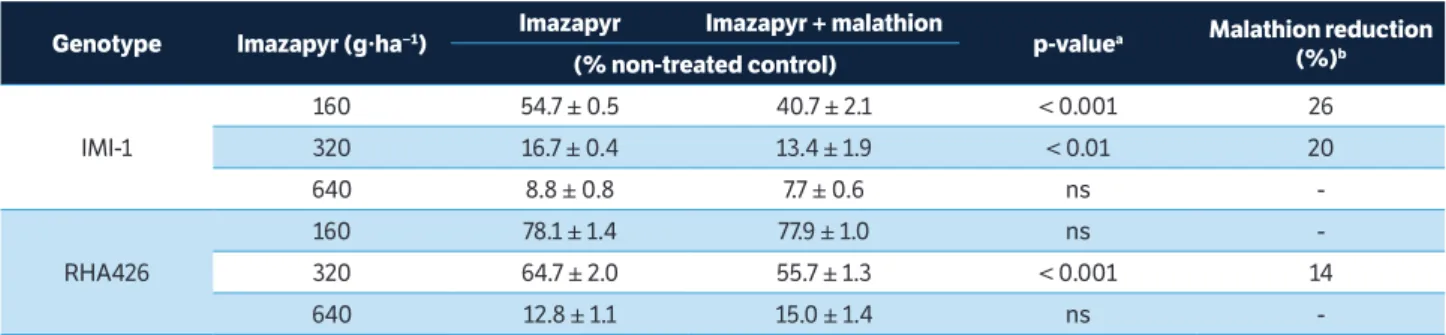
The ANOVA showed effect of herbicide concerning the 4 sunflower lines. Malathion had no effect on dry biomass of B7838 and R720 control lines (mean values are shown in Table 1). For Imisun lines (IMI-1 and HA426), the ANOVA showed effect of malathion and interaction between malathion and imazapyr.
Experiment 2
The ANOVA showed effect of imazapyr in both lines, HA89 and HA425. There was interaction between imazapyr and P450s inhibitors on lateral root growth only for the HA425 Imisun resistant line. Furthermore, for this line, there was effect of inhibitor and interaction between imazapyr and PBO on foliar area.
PBO and ABT had no effect on root growth and foliar area for the HA89 control line. This susceptible line was greatly affected by herbicide application (Table 3).
The Imisun line HA425 showed a significant reduction in lateral root growth as a result of PBO and ABT treatment at 10 μM imazapyr. Foliar area was affected by PBO treatment at 10 μM imazapyr (Table 4).
DISCUSSION
Differences between the response to P450s inhibitor of Imisun inbred lines used in Experiment 1 (IMI-1 and RHA426; Table 2) can be explained by the presence of different modifier genes due to their different genetic origin. As previously reported, differences in imidazolinone
resistance among Imisun hybrids were related to genetic background (Sala et al. 2012). In this way, the 2 Imisun resistant genotypes, IMI-1 (Experiment 1) and HA425 (Experiment 2), came from the same biparental cross involving HA89 and PUR H. annuus. Meanwhile, the Imisun resistant line RHA426 was obtained by forward crossing including 2 sunflower restorer lines and the resistant source PUR H. annuus. In a similar way, Volenberg et al. (2007) found that Solanum ptycanthum biotypes with the same mutation in ahas gene differed in imazamox resistance levels and had different mechanisms for increasing resistance. Consistent with previous results, CLPlus lines (used as control in Experiment 1) showed a strong level of resistance that was not modified by the inhibition of P450s (Table 1). The resistance level of CLPlus is the result of a target-site mechanism (Ahasl1-3 allele) without the involvement of modifier genes or background effect (Sala et al. 2008).
The inheritance study of Imisun resistance involved the cross HA89/HA425 and postulated the presence of 1 modifier gene (Imr2) (Bruniard and Miller 2001). These genotypes were evaluated in Experiment 2. The increased phytotoxicity after treatment with P450s inhibitors in the HA425 inbred line suggests that P450s mediate a detoxification mechanism that could be related to the effect of the modifier gene Imr2.
Genotype Imazapyr (g∙ha−1) Imazapyr Imazapyr + malathion
(% non-treated control)
B7838
160 98.33 ± 0.44 97.49 ± 0.39
320 91.91 ± 0.76 92.17 ± 1.01
640 78.53 ± 0.42 78.25 ± 1.2
R720
160 99.46 ± 0.19 99.65 ± 0.20
320 94.8 ± 1.16 94.63 ± 0.95
640 85.5 ± 1.35 84.67 ± 0.98
Table 1. Effect of malathion on shoot biomass response to imazapyr herbicide for the CLPlus sunflower lines used as controls in Experiment 1 (B7838 and R720).
Genotype Imazapyr (g∙ha−1) Imazapyr Imazapyr + malathion p-valuea Malathion reduction
(%)b
(% non-treated control)
IMI-1
160 54.7 ± 0.5 40.7 ± 2.1 < 0.001 26
320 16.7 ± 0.4 13.4 ± 1.9 < 0.01 20
640 8.8 ± 0.8 7.7 ± 0.6 ns
-RHA426
160 78.1 ± 1.4 77.9 ± 1.0 ns
-320 64.7 ± 2.0 55.7 ± 1.3 < 0.001 14
640 12.8 ± 1.1 15.0 ± 1.4 ns
-Table 2. Effect of malathion on shoot biomass response of Imisun sunflower lines (IMI-1 and RHA426) in relation to imazapyr herbicide.
.
aOrthogonal contrast; bThe reduction in biomass response as a result of malathion treatment was calculated when the orthogonal contrast was significant
P450s-mediated resistance mechanisms could be related to the overexpression of certain P450s genes as observed for Echinochloa phyllopogon (Iwakami et al. 2014).
Both PBO and ABT caused a reduction in the lateral root growth in Experiment 2. This trait was already described as a useful parameter for the selection of sunflower genotypes differing in imidazolinone resistance (Breccia et al. 2011). Interestingly, a differential response to ABT and PBO was observed for aerial growth (Table 4). A reduction in foliar area was observed only for PBO, and this may be explained by the fact that P450s isoforms have different inhibitor specificity. Moreover, isozymes are differently expressed between tissues (Siminszky 2006). Similar results were reported in a sunflower line with multiple herbicide resistance reversed by malathion (Kaspar et al. 2011). In that study, the P450s inhibitor only increased herbicide toxicity when the effect of this inhibition was measured on shoot length but not on root length at seedling stage.
The insecticide malathion belongs to the group of organophosphates. When crops are treated simultaneously with an herbicide and an insecticide that are recognized by the same P450, it could lead to crop destruction (Werck-Reichhart et al. 2000). For this reason, caution should be taken to avoid the application on Imisun sunflowers of an organophosphate insecticide together with imidazolinones.
Imisun sunflower represents the first example of a commercial herbicide resistance trait conferred by independent resistance mechanisms (Tan et al. 2005). Probably the intermediate level of resistance endowed by the target-site resistance (Imr1 or Ahasl1-1 allele) allowed the identification of the second resistance mechanism. On the other hand, the complex nature of the non-target-site mechanisms involved in Imisun resistance also allows to explain the difficulties that arise when converting conventional lines into their resistant counterparts using only a molecular marker-based approach (Bulos et al.2013).
P450s inhibitor Variable Imazapyr (µM) Imazapyr Imazapyr + inhibitor
(% non-treated control)
Piperonyl butoxide
Longest lateral root 10 48.11 ± 8.40 57.69 ± 10.78
100 58.95 ± 7.47 59.96 ± 6.46
Foliar area 10 5.47 ± 0.67 9.66 ± 6.34
100 1.39 ± 1.33 1.26 ± 1.20
1-aminobenzontriazole
Longest lateral root 10 44.47 ± 4.68 41.25 ± 1.24
100 30.40 ± 11.02 35.69 ± 3.41
Foliar area 10 23.84 ± 7.22 31.98 ± 12.97
100 8.55 ± 1.94 6.74 ± 1.78
P450s inhibitor Variable Imazapyr (µM)
Imazapyr Imazapyr + inhibitor
p-valuea Inhibitor reduction
(%)b
(% non-treated control)
Piperonyl butoxide
Longest lateral root
10 92.8 ± 2.6 66.1 ± 1.4 < 0.01 29
100 62.4 ± 4.1 48.5 ± 3.5 ns
-Foliar area 10 54.9 ± 3.9 35.0 ± 6.7 < 0.01 36
100 14.1 ± 2.5 12.5 ± 1.2 ns
-1-aminobenzontriazole
Longest lateral root
10 86.3 ± 6.0 54.0 ± 4.1 < 0.001 37
100 63.8 ± 2.5 68.0 ± 3.8 ns
-Foliar area 10 101.9 ± 6.0 102.4 ± 7.8 ns
-100 35.3 ± 4.4 29.1 ± 4.6 ns
-Table 3. Effect of piperonyl butoxide and 1-aminobenzontriazole on the longest lateral root length and foliar area of HA89 sunflower line in response to imazapyr herbicide.
Table 4. Effect of P450s inhibitors 1-aminobenzotriazole and piperonyl butoxide on the longest lateral root length and foliar area of Imisun sunflower line HA425 in relation to imazapyr herbicide.
.
aOrthogonal contrast; bThe reduction in biomass response as a result of P450s inhibitor treatment was calculated when the orthogonal contrast was significant
The diverse family of cytochrome P450 proteins has been suggested to be a source of novel herbicide metabolism in both weed and crop plants (Thyssen et al. 2014). Identification of the genetic basis of this mechanism will provide new opportunities for exploiting AHAS-inhibiting herbicides. This information would be useful to develop sunflower varieties and cultural strategies that allow crop to better compete with weeds, leading to sustainable and more efficient management of this crop. The deployment of genes involved in non-target-site resistance, which enhances the resistance provided by AHAS genes or other target-site resistance genes already in use, will allow to develop new weed control technologies based on a broad diversity of active ingredients or to use more active adjuvants or improved herbicide formulations.
CONCLUSION
This work contributes to understand the complexity of non-target-site resistance in Imisun sunflower. The increased
susceptibility to imazapyr herbicide after malathion treatment in IMI-1 and RHA426 Imisun lines and after PBO and ABT treatments in the Imisun HA425 line indicates that a non-target-site mechanism related to P450s contributes to herbicide resistance in these Imisun genotypes. Moreover, different responses to P450 inhibitors among lines suggest the possible involvement of different P450s isozymes in endowing resistance to imazapyr in Imisun cultivars. Comprehensive genomic approaches have been conducted to understand the molecular basis of non-target-site resistance in Imisun sunflower.
ACKNOWLEDGEMENTS
The authors are grateful to Carlos Sala for valuable comments and discussions and his constant guidance and encouragement. Thanks are due to Dr. Jerry Miller and to Dr. José María Bruniard for the kindly gift of seed material included in Experiment 2. The financial support from FONCyT (PICT 2013-1010) is also acknowledged.
Abràmoff, M. D., Magalhães, P. J. and Ram, S. J. (2004). Image
processing with ImageJ. Biophotonics International, 11, 36-42.
Al-Khatib, K., Baumgartner, J. R., Peterson, D. E. and Currie, R. S.
(1998). Imazethapyr resistance in common sunflower (Helianthus
annuus). Weed Science, 46, 403-407.
Al-Khatib, K. and Miller, J. F. (2000). Registration of four genetic
stocks of sunflower resistant to imidazolinone herbicides. Crop
Science, 40, 869-870.
Baucom, R. S. (2016). The remarkable repeated evolution of
herbicide resistance. American Journal of Botany, 103, 181-183.
http://dx.doi.org/10.3732/ajb.1500510.
Beckie, H. J., Warwick, S. I. and Sauder, C. A. (2012). Basis for
herbicide resistance in Canadian populations of wild oat (Avena
fatua). Weed Science, 60, 10-18. http://dx.doi.org/10.1614/ WS-D-11-00110.1.
Breccia, G., Vega, T., Nestares, G., Mayor, M. L., Zorzoli, R. and Picardi,
L. (2011). Rapid test for detection of imidazolinone resistance in
REFERENCES
sunflower (Helianthus annuus L.). Plant Breeding, 130, 109-113.
http://dx.doi.org/10.1111/j.1439-0523.2009.01756.x.
Bruniard, J. M. and Miller, J. F. (2001). Inheritance of imidazolinone
herbicide resistance in sunflower. Helia, 24, 11-16. http://dx.doi. org/10.1515/helia.2001.24.35.11.
Bulos, M., Sala, C. A., Altieri, E. and Ramos, M. L. (2013). Marker
assisted selection for herbicide resistance in sunflower. Helia, 36,
1-16. http://dx.doi.org/10.2298/hel1359001b.
Délye, C., Duhoux, A., Pernin, F., Riggins, C. W. and Tranel, P. J.
(2015). Molecular mechanisms of herbicide resistance. Weed
Science, 63, 91-115. http://dx.doi.org/10.1614/WS-D-13-00096.1. Didierjean, L., Gondet, L., Perkins, R., Lau, S. C., Schaller, H.,
O’Keefe, D. P. and Werck-Reichhart, D. (2002). Engineering
herbicide metabolism in tobacco and Arabidopsis with CYP76B1,
a cytochrome P450 enzyme from Jerusalem artichoke. Plant
Physiology, 130, 179-189. http://dx.doi.org/10.1104/pp.005801. Iwakami, S., Endo, M., Saika, H., Okuno, J., Nakamura, N.,
I. (2014). Cytochrome P450 CYP81A12 and CYP81A21 are
associated with resistance to two acetolactate synthase
inhibitors in Echinochloaphyllopogon. Plant Physiology, 165,
618-629. http://dx.doi.org/ 10. 1104/ pp. 113. 232843.
Kaspar, M., Grondona, M., Leon, A. and Zambelli, A. (2011).
Selection of a sunflower line with multiple herbicide tolerance
that is reversed by the P450 inhibitor malathion. Weed Science,
59, 232-237. http://dx.doi.org/ 10.1614/WS-D-10-00120.1. Kolkman, J. M., Slabaugh, M. B., Bruniard, J. M., Berry, S.,
Bushman, B. S., Olungu, C., Maes, N., Abratti, G., Zambelli, A.,
Miller, J. F., Leon, A. and Knapp, S. J. (2004). Acetohydroxyacid
synthase mutations conferring resistance to imidazolinone
or sulfonylurea herbicides in sunflower. Theoretical and
Applied Genetics, 109, 1147-1159. http://dx.doi.org/10.1007/ s00122-004-1716-7.
Letouzé, A. and Gasquez, J. (2003). Enhanced activity of several
herbicide-degrading enzymes: a suggested mechanism responsible
for multiple resistance in blackgrass (Alopecurus myosuroides Huds.).
Agronomie, 23, 601-608. http://dx.doi.org/10.1051/agro:2003036. Miller, J. F. and Al-Khatib, K. (2002). Registration of imidazolinone
herbicide-resistant sunflower maintainer (HA425) and fertility
restorer (RHA426 and RHA427) germplasms. Crop Science, 42,
988-989. http://dx.doi.org/10.2135/cropsci2002.988a.
Murashige, T. and Skoog, F. (1962). A revised medium for rapid growth
and bioassays with tobacco tissue cultures. Physiologia Plantarum,
15, 473-497. http://dx.doi.org/10.1111/j.1399-3054.1962.tb08052.x. R Development Core Team (2015). R: a language and environment
for statistical computing. Vienna: R Foundation for Statistical
Computing.
Rodríguez, G. R., Moyseenko, J. B., Robbins, M. D., Morejón, N. H.,
Francis, D. M. and van der Knaap, E. (2010). Tomato Analyzer: a useful
software application to collect accurate and detailed morphological
and colorimetric data from two-dimensional objects. Journal of
Visualized Experiments, 37, 1-9. http://dx.doi.org/10.3791/1856. Sala, C. A., Bulos, M., Altieri, E. and Ramos, M. L. (2012). Genetics
and breeding of herbicide tolerance in sunflower. Helia, 35, 57-70.
http://dx.doi.org/10.2298/hel1257057s.
Sala, C. A., Bulos, M., Echarte, M., Whitt, S. R. and Ascenzi, R. (2008).
Molecular and biochemical characterization of an induced mutation
conferring imidazolinone resistance in sunflower. Theoretical
and Applied Genetics, 118, 105-112. http://dx.doi.org/10.1007/ s00122-008-0880-6.
Siminszky, B. (2006). Plant cytochrome P450-mediated herbicide
metabolism. Phytochemistry Reviews, 5, 445-458. http://dx.doi. org/10.1007/s11101-006-9011-7.
Tan, S., Evans, R. R., Dahmer, M. L., Singh, B. K. and Shaner, D.
L. (2005). Imidazolinone-tolerant crops: history, current status
and future. Pest Management Science, 61, 246-257. http://dx.doi. org/10.1002/ps.993.
Thyssen, G., McCarty, J. C., Li, P., Jenkins, J. N. and Fang, D.
D. (2014). Genetic mapping of non-target-site resistance to a
sulfonylurea herbicide (Envoke®) in upland cotton (Gossypium
hirsutum L.). Molecular Breeding, 33, 341-348. http://dx.doi. org/10.1007/s11032-013-9953-6.
Volenberg, D. S., Tranel, P. J., Holt, J. F., Simmons, F. W., Weller,
S. C., Sharkhuu, A. and Riechers, D. (2007). Assessment of
two biotypes of Solanum ptycanthum that differ in resistance
levels to imazamox. Weed Research, 47, 353-363. http://dx.doi. org/10.1111/j.1365-3180.2007.00563.x.
Werck-Reichhart, D., Hehn, A. and Didierjean, L. (2000).
Cytochromes P450 for engineering herbicide tolerance.
Trends in Plant Science, 5, 116-123. http://dx.doi.org/10.1016/ S1360-1385(00)01567-3.
Yang, Q., Deng, W., Li, X., Yu, Q., Bai, L. and Zheng, M. (2016).
Target-site and non-target-site based resistance to the
herbicide tribenuron-methyl in flixweed (Descurainia sophia L.).
BMC Genomics, 17, 551-563. http://dx.doi.org/10.1186/ s12864-016-2915-8.
Yu, Q. and Powles, S. B. (2014). Metabolism-based herbicide
resistance and cross-resistance in crop weeds: a threat to herbicide
sustainability and global crop production. Plant Physiology, 166,
1106-1118. http://dx.doi.org/10.1104/pp.114.242750.
Yuan, J. S., Tranel, P. J. and Stewart, C. N. (2007). Non-target-site
herbicide resistance: a family business. Trends in Plant Science,