Faculdade de Ciências e Tecnologia
Departamento de Informática
Dissertação de Mestrado
Mestrado em Engenharia Informática
A Logic and Tool for Local Reasoning
about Security Protocols
Bernardo Parente Coutinho Fernandes Toninho
(aluno nº25858)
Faculdade de Ciências e Tecnologia
Departamento de Informática
Dissertação de Mestrado
A Logic and Tool for Local Reasoning about Security
Protocols
Bernardo Parente Coutinho Fernandes Toninho (aluno nº25858)
Orientador:
Prof. Dr. Luís Caires
Trabalho apresentado no âmbito do Mestrado em Engen-haria Informática, como requisito parcial para obtenção do grau de Mestre em Engenharia Informática.
I’d first like to thank Prof. Luis Caires for his support and unwavering guidance through the several areas and techniques used in this dissertation. I thank Hugo Vieira for his tutorial session and explanations of the initial implementation of the Spatial Logic Model Checker tool, even though some time had passed since the code was actually written.
I’d like to thank my friend Mário Pires for some suggestions and hacks I used in the tool implementation and for the tireless bouncing off of ideas, some more insane then others. I’d also like to mention Prof. Frank Pfenning for taking the time to look over my sequent calculus and suggesting improvements in some of the rules. I give great thanks to Luísa Lourenço for proof-reading this rather long (and perhaps tedious) document quite efficiently and I mention Prof. Pedro Adão for taking the trouble of reading my thesis and for the very interesting and motivating thesis defense discussion and for his suggestions.
I also greatly thank Cátia Ferreira for her deepest kindness and for her incredible friendship. Last but not least, I’d like to thank my family (including its canine members), but specially my parents, for their support and for their (non-academic yet fundamental) teachings throughout the whole of my life, which I suspect will endure in my memory longer then many of the academic ones.
On a broader note, I’d like to thank Prof. Edsger W. Dijkstra, whom I never met. His papers, lectures and letters simply never cease to reveal the spirit and mind of a true (computer) scientist and will always remain a great source of inspiration.
This work was supported by a CITI research grant.
Esta tese aborda o problema de desenvolver uma lógica e as técnicas de model-checking asso-ciadas de forma a verificar propriedades de segurança, e a sua integração na ferramenta Spatial Logic Model Checker (SLMC).
Nas áreas de desenho e análise de sistemas distribuídos, existe bastante trabalho relacionado com a verificação da correcção de propriedades de sistemas. Neste âmbito, grande parte do trabalho orientado para a verificação de propriedades de segurança recorre a métodos precisos mas informais.
Neste trabalho, apresentamos uma simplificação do cálculo de processos Appliedπ-calculus, introduzido por Abadi and Fournet, para o estudo de protocolos de segurança. Seguidamente, desenvolvemos uma lógica espacial para o cálculo, extendida com modalidades relacionadas com conhecimento, com o objectivo de analisar protocolos de segurança utilizando o conceito de conhecimento local de processos.
Adicionalmente, mostramos que as extensões são consistentes e completas em relação à semântica pretendida, não tornando a lógica indecidível, assumindo algumas hipóteses ra-zoáveis. Apresentamos também um algoritmo de model-checking e a prova da sua completude para uma classe considerável de processos.
Finalmente, apresentamos uma implementação em OCaml do algoritmo, integrada na menta SLMC, desenvolvida por Hugo Vieira e Luís Caires, produzindo assim a primeira ferra-menta orientada para a análise de protocolos de segurança baseada numa lógica espacial.
Palavras-chave: Análise de Protocolos, Lógicas e Linguagens Formais, Lógicas Espaciais, Model-Checking
This thesis tackles the problem of developing a formal logic and associated model-checking techniques to verify security properties, and its integration in the Spatial Logic Model Checker (SLMC) tool. In the areas of distributed system design and analysis, there exists a substan-tial amount of work related to the verification of correctness properties of systems, in which the work aimed at the verification of security properties mostly relies on precise yet informal methods of reasoning.
This work follows a line of research that applies formal methodologies to the verification of security properties in distributed systems, using formal tools originally developed for the study of concurrent and distributed systems in general. Over the years, several authors have proposed spatial logics for local and compositional reasoning about algebraic models of distributed sys-tems known as process calculi.
In this work, we present a simplification of a process calculus known as the Applied π-calculus, introduced by Abadi and Fournet, designed for the study of security protocols. We then develop a spatial logic for this calculus, extended with knowledge modalities, aimed at reasoning about security protocols using the concept of local knowledge of processes.
Furthermore, we conclude that the extensions are sound and complete regarding their in-tended semantics and that they preserve decidability, under reasonable assumptions. We also present a model-checking algorithm and the proof of its completeness for a large class of pro-cesses.
Finally, we present an OCaml implementation of the algorithm, integrated in the Spatial Logic Model Checker tool, developed by Hugo Vieira and Luis Caires, thus producing the first tool for security protocol analysis that employs spatial logics.
Keywords: Protocol Analysis, Mathematical Logic and Formal Languages, Spatial Logics, Model-Checking
1 Introduction 1
1.1 Motivation 2
1.2 Goals 3
1.3 Contributions 3
1.4 Document Structure 4
2 An Overview of Security Analysis 5
2.1 Security in Computer Science 5
2.1.1 Applications of Security 6
2.1.2 Analysis and Verification of Security Protocols 6 2.1.3 The Formal Symbolic Model: Scope and Limitations 7 2.2 Concurrent and Distributed System Analysis 9 2.2.1 Bridging Concurrency and Security Protocol Analysis 9
2.2.2 Theπ-calculus 9
2.2.2.1 Brief Examples 12
2.2.3 Spi-calculus 13
2.2.4 Appliedπ-calculus 14
2.2.4.1 A Brief Example Redux 16
2.2.5 Behavioural Logics 17
2.2.5.1 Hennessy-Milner Logic 17
2.2.5.2 Logics of Behaviour for theπ-calculus 18
2.2.6 Spatial Logics 19
2.2.6.1 Local Reasoning with Spatial Logics 20 2.2.6.2 Expressiveness and Decidability 22
2.2.6.3 The SLMC Tool 23
2.2.6.4 An Example with Spatial Logics 23
2.2.7 Epistemic Logics 24
3 A Logic for Local Knowledge Reasoning 27
3.1 Model 27
3.1.1 Syntax 28
3.1.2 Equational Theories and Term Rewriting 29
3.1.3 Operational Semantics 31
3.1.4 Defining Attackers 34
3.1.5 Example of a Protocol 35
3.2 Logic 36
3.2.1 Syntax 37
3.2.2 Semantics 39
3.2.3 Example 44 3.3 A Syntactical Approach to Knowledge Deduction 45
4 Extending the Spatial Logic Model Checker 53
4.1 The Spatial Logic Model Checker: Initial Version 53
4.1.1 Syntax 53
4.1.2 Implementation Details 56
4.2 The Spatial Logic Model Checker: Our Extension 57
4.2.1 Syntax 57
4.2.2 Internals 58
4.2.2.1 Model 59
4.2.2.2 Logic 60
4.3 Examples 61
4.3.1 A Simple Protocol 61
4.3.2 The Needham-Schroeder Protocol 63
4.3.2.1 The Man-in-the-Middle Attack 65
5 Closing Remarks 71
5.1 Future Work 72
A Selected Proofs 73
A.1 Proof of Lemma 3.2.1 73
A.2 Proof of Theorem 3.2.1 73
A.3 Proof of Lemma 3.3.3 75
A.4 Proof of Theorem 3.3.2 78
A.5 Proof of Theorem 3.3.3 79
A.6 Proof of Theorem 3.3.4 80
2.1 Theπ-calculus Syntax 10
2.2 Examples ofπ-calculus Processes 12
2.3 The Spi-calculus Cryptographic Extensions 13
2.4 Spi-calculus Example 13
2.5 Equational Theory and Signature 15
2.6 Example Using Encryption 16
2.7 Hennesy Milner Logic 17
2.8 HML Example 17
2.9 A Core Spatial Logic 20
2.10 Spatial Properties 20
2.11 Example for the SLMC 25
3.1 Equational Theories 29
3.2 A Simple Protocol 36
3.3 Logic Syntax 38
4.1 SLMC Process Syntax 54
4.2 SLMC Formula Syntax 55
4.3 Defining Equational Theories and Signatures 57
4.4 SLMC Extended Process Syntax 58
4.5 SLMC Extended Formula Syntax 59
4.6 Symmetric Cryptography in the SLMC 61
4.7 A Simple Protocol in the SLMC 62
4.8 Local Correctness 62
4.9 The World and the Attacker 63
4.10 Verification of thehellovalue 63
4.11 Auxiliary Properties 64
4.12 Key Leaking Absence 64
4.13 The Needham-Schroeder Protocol 64
4.14 Attack Message Sequence 66
4.15 Needham-Schroeder Signature and Eq. Theory 66 4.16 Needham-Schroeder Protocol: Bob and Alice 67
4.17 Needham-Schroeder Protocol: Server 68
4.18 Needham-Schroeder Protocol: Attacker 69
4.19 Needham-Schroeder Protocol: System 69
4.20 The Attack 69
4.21 Fixing the Attack 70
With the advent of the Internet, there has been a widespread dissemination of distributed sys-tems that take advantage of the flexibility and ubiquity of the Net to provide services to users such ase-commerce, home banking, etc. However, the ubiquity and distribution that these sys-tems require in order to fulfil their objectives introduces new problems. Several problems arise from the absence of a global state, which limits the information that the several components of a system can have about each other (e.g. it is impossible to distinguish a component failure from a network failure). Another great class of problems of distributed systems is related to the security of the systems themselves.
Since potentially anyone can access the Internet, all communications that take place over this medium are inherently insecure in the sense that they can be intercepted and produced by anyone. Therefore, if a system deals with sensitive information (such as financial systems) it is paramount that it be robust enough to prevent the openness of the medium from interfering neg-atively with the system’s operation. The research problem therefore lies in finding techniques that allow the development of systems in such a way that they are protected against these (and other) threats.
In distributed systems, security encompasses a great variety of fields such as access control, auditing and security protocols. A security protocol consists of a set of actions that aim at es-tablishing some security properties, inevitably using cryptographic techniques [58]. In protocol research, there are two naturally arising categories. One focuses on cryptography: drawing on information theory and number theory, for instance, to develop more sophisticated and elabo-rate crypto-techniques [37]; the other focuses on the protocols themselves [25]: how (and if) the message sequences work at achieving the desired properties and what practices can aid protocol engineering and design.
When focusing on protocols as a means to achieving security properties, there exist several approaches to the problem of analysing security protocols, with varying degrees of formalism. On the formal landscape, there exist many different ways of tackling this problem, and several have proved to be successful in validating or disproving security protocols [42, 56, 57]. Some techniques employ complexity-theoretic artefacts, others use formalisms crafted specifically for the problem and some are based on algebras and logics. Regardless, all these methods share the common goal of verifying if a protocol is correct in respect to its desired properties.
When considering the techniques based on process algebras we can distinguish at least two distinct types of approaches: one deals with a high-level specification of the protocol, with which its easier to observe the required properties, and then establishes an equivalence between the specification and the abstract representation of the protocol. The other, which this thesis focuses on, uses the same abstract representation (model) of the protocol but instead of proving equivalencies with specifications, checks that the desired properties (expressed through logical formulas) hold in the model.
to model and reason about interesting properties of distributed systems such as local deadlock freedom and safety in resource usage. A particularly interesting class of logics that have been proposed are spatial logics. These logics take advantage of the fact that many of the interesting properties of distributed systems can be interpreted in spatial terms. For example,connectivity, which states that there is always an access route between two different sites, can be viewed as a property of the spatial arrangement of systems. While the more traditional logics for concurrent and distributed systems deal with notions of behavior, spatial logics aim to characterize the spatial and temporal dynamics of systems, being able to separate and reason about different sub-components of a complex system.
When dealing with security protocol verification however, different types properties arise. For instance, its essential thatsecrecy(the critical information exchange performed in a protocol cannot be obtained by attackers), among other properties, holds in a protocol that seeks to establish secure communication channels.
1.1
Motivation
The underlying motivation for this thesis is that many interesting properties of security proto-cols can be interpreted as the possibility (or impossibility) of a participant (or attacker) of the protocol to obtain a certain piece of information, that is, the capability of some sub-component of a system toknowa piece of information. In fact, security protocols are fundamentally about ways of limiting knowledge (of attackers) and augmenting or certifying knowledge (of princi-pals). Therefore, since both attackers and principals can be interpreted as sub-components of larger systems, the combination of knowledge reasoning with the key notions of spatial logics (local reasoning) follows naturally as a way of verifying security protocols. While the concept of reasoning about knowledge isn’t necessarily new in this field, the usual approach deals with observable (and global) or exposed knowledge, which provides a much coarser analysis when compared to local knowledge reasoning. Also, most of the existing logics in this area that deal with knowledge are too separated from the underlying operational model, which can result in an increased difficulty to accurately represent properties that mix knowledge with (high-level) operational details of protocols.
1.2
Goals
The goal of this work is twofold: we seek to devise a logic that by combining the standard spatial connectives with knowledge (epistemic) modalities, allows local reasoning about information (both obtainable and constructible) of security protocols. It is also our intent to develop a model checking algorithm for the logic, in order to realise a tool for security protocol analysis.
Our logic operates over models represented by a process calculus. Therefore, we aim at developing a calculus with which to represent security protocols, by drawing inspiration from other established calculi with similar intent. This formal representation has enough expressive-ness to model security protocols by modeling the principals of the protocol as processes with the ability to exchange messages, composed by names or applications of functions to names (to model standard security techniques such as encryption or hashing).
The modalities allow us to write assertions about the information a process holds, by in-specting what values are present and what values can be obtained by applying functions to the messages (this can model the use of keys to decrypt cyphered messages). For instance, if a process has a cyphered message and the key used in the cypher, its possible to assert that the process also has (knows) the contents of the message.
Our logic hence aims to provide a detailed analysis of security protocols and their cor-rectness, since not only it allows reasoning about exposed knowledge (by reasoning about the exchanged messages), but also of the flow of information inside a closed system (with the aid of the spatial connectives).
Besides the development of the logic and a model-checking algorithm, we also develop correctness proofs for our algorithmic approach. Finally, we extended the Spatial Logic Model Checker tool (a model-checker for spatial logics) with the knowledge modalities developed for the logic, in order to provide a proof of concept tool that uses this framework for protocol verification.
1.3
Contributions
The contributions of this work are as follows:
• We developed a process calculus model for security protocols, inspired in existing
π-calculi. We augmented the standardπ-calculus with structured terms that can be used in communications, in order to model cryptographic operations. We also added a special output prefix that models non-deterministic attacker outputs.
• We introduced a spatial-behavioural-epistemic logic, oriented towards security protocol
analysis, with precisely defined syntax and semantics. Such a threefold approach is novel in the field, seeing as other related work in this area focuses solely on epistemic or spatial approaches.
• We developed a formal theory of knowledge deduction for ourπ-calculus models, realised
• We obtained soundness, completeness and decidability results for our formal theory,
which ultimately result in the decidability of the logic itself.
• We realised an implementation of a model-checking algorithm for the logic as an
exten-sion to the SLMC tool, thus producing the first tool aimed at security protocol analysis using spatial logic model checking.
We validate our approach with our formal correctness results and with analyses of examples, performed using our proof of concept tool.
1.4
Document Structure
This document is structured as follows: Chapter 2 describes in detail the context in which this thesis is inserted, going from the broader notions of security and distributed system analysis, to more concrete work on process calculi and logics, having the security protocol analysis “hori-zon" present along the presentation and throughout the examples.
Chapter 3 describes in detail the work developed in this dissertation, clarifying the mo-tivations and proceeding to present the model and logic developed in this dissertation, each accompanied with explanations and running examples. In Section 3.3 we present our sequent calculus formulation of a proof system for knowledge formulas and the theoretical results that aim at validating this work.
This chapter presents the areas and body of work in which this thesis is inserted. Section 2.1 gives a broad view on the aspects of security, its applications, the need for protocol verification and some of the methodologies used in these analyses. Section 2.2 starts by giving a brief introduction on the techniques used to study concurrency theory and introduces the unified view of concurrency theory and security analysis using process calculi. Sections 2.2.2 through 2.2.7 present several of the most relevant contributions to the fields of concurrency and distributed system analysis using formal methods, specifically with process calculi and process logics, showing the progress from the earlier process calculi and logics that focused specifically on concurrency, to the more modern and sophisticated frameworks that reason about distributed systems in general, and enable security protocol analysis using richer calculi and logics.
2.1
Security in Computer Science
The problem of security is present in almost every aspect of Computer Science. Be it in oper-ating system design, where the system level processes must be separated and secured from the user level ones, or in distributed systems, where complex security requirements such as authen-ticity of principals and message integrity are required, security is a concern of many fields in CS.
Despite being an aspect that touches many fields, the area in which security has had most of its application (and the area that generated most advances to security in general) is the area of distributed systems [27, 31, 61, 39, 41, 26]. While other areas have some security requirements, none have such a strong need for security as the distributed systems field of work. In this area, due to the uncertainty that is inherent to distributed systems, because of the absence of global state for example, security appears as a way of providing more information about this uncertain state, such as the exact identity of the emitter of a message, or a guarantee that only a certain number of principals can obtain some piece of information.
Realistically, distributed systems use a wide spectrum of tools developed in the field of se-curity because they are required to, due to the open medium over which communications take place (usually the Internet). Since, in theory, anyone could potentially intercept all informa-tion exchanged in a distributed system, security guarantees are required to protect sensitive information and to protect the systems against malicious users. For example, home-banking or e-commerce systems both provide services that deal with information that, if divulged, would have dire consequences to its users. Therefore, such systems require that the communications with clients respect certain properties in order to assure that no harm comes from their usage. For example, these systems commonly need to be certain that the entity they are communicat-ing with is in fact a valid client, or require that all communications with the clients are such that no eavesdropper can use them in a malicious way, or often a combination of both these re-quirements. In essence, security in distributed systems appears as a natural necessity due to the
nature of the medium used to support communication and information exchange, to circumvent malicious use of information and to control and monitor its access.
2.1.1 Applications of Security
Security in distributed systems focuses on specific properties which appear naturally as security requirements. These security properties, although being requirements of concrete systems, exist at a high level of abstraction, since they are general enough to be of interest to any system with security requirements. As mentioned previously, systems often require that communications are held secretly, in order to protect their contents. This property is known asconfidentiality, or se-crecy, and is standard in practically all contexts where security techniques are applied. Another common property,authenticity, relates to making sure that the participants in communications are “who they say they are”. Communicationintegrity relates to being able to certify that ex-changed messages are received exactly as they were emitted, that is, their data wasn’t tampered with in any way. The concepts ofauthorisationoraccess control, while of importance to secu-rity in general, are of a more concrete nature then the abstract notion of authentication, seeing as generally the authentication of a principal authorizes it’s access to generally inaccessible services or information.
Given some properties that must hold in a system, like authenticity and confidentiality, its necessary to devise a procedure that will establish the desired properties. This procedure is called a security protocol. Inevitably, security protocols employ cryptographic techniques to achieve said properties [58] and much work exists with the goal of improving the existing cryptographic schemes [51, 37, 50]. In fact, some sophisticated protocols such as the Transport Layer Security [27] protocol and the Secure Socket Layer [31] protocol combine several crypto-systems together to further strengthen its security guarantees. In some scenarios, protocols also enforce properties that are not specifically barriers against attacks but properties that focus on legal aspects such as non-repudiation [62] (assurance that a party cannot refute the validity of a message).
Most security protocols focus on establishing secure channels between parties with varying degrees of security: some focus specifically on message integrity and confidentiality [28], others on participant authentication [49], and several combine all these security properties [61, 39]. In general, security protocols use a variety of tools to accomplish their goals: cryptography to ensure confidentiality or integrity, timestamps (nonces) for freshness proofs [26], message sequence numbers, padding, among many other security artefacts.
2.1.2 Analysis and Verification of Security Protocols
A great number of successful analysis techniques actively employ formal methodologies to obtain the required analysis [10, 8, 38, 24, 57, 7].
Some formal approaches (for instance [10]), represent the protocol using message sequences and then reason if (or how) an attacker can exploit the messages exchanged in rounds of the pro-tocol. However, the relation of some of these techniques to the operational details is perhaps too tenuous. Several classes of attackers are usually considered, with varying degrees of attacking power. Other techniques are more implementation oriented (such as [49]) which focus more on the implementational aspects then on the conceptual problems of protocols - being valid analysis techniques nonetheless.
Formal reasoning frameworks prove to be useful since they provide a degree of rigourous-ness that is deeply relevant due to the critical nature of security protocols, leading to an increase of the confidence of some protocols and the discovery of limitations and flaws in others. Another interesting point of formal techniques is that in some cases they enable the use of automated tools like theorem provers [52] or model-checkers [7] to assist the analysis process. Formal methodologies require the development of an abstract representation of the fundamental con-cepts of interest to the analysis, in this case of the relevant security artefacts. To achieve such an abstract view of protocols, formal methods require amodel in which to focus their efforts. Ideally, this model (which encompasses the formal representation of protocols, cryptography, attackers, etc.) will be as complete as possible, in the sense that it should include as much relevant details as possible, all the while abstracting away details which are not relevant to the analysis of the protocol itself.
In the formal “world” of security there exist two fundamentally distinct models: the com-plexity-theoretic model and the symbolic model. In this work, we focus on the symbolic model of security due to its tractability. We will now approach the scope and limitations of the sym-bolic model, by motivating it against the complexity-theoretic one.
2.1.3 The Formal Symbolic Model: Scope and Limitations
The attacker model considered in the formal symbolic model stems from the work of Dolev and Yao [29]. This approach provides a simple solution to the guessing problem described earlier, by making every nondeterministic choice of keys and nonces generate a fresh value -one that by definition cannot have been used before. The formal representation of cryptographic operations usually relies on some assumptions that simplify the model (to a somewhat idealised level, as explained further below):
• Given a cypher key, anyone can produce a message encrypted with such a key.
• Given a cypher key and a message encrypted with that key, anyone can produce the
de-crypted values.
• Encrypted messages cannot be produced by agents who do not possess both the clear
values and the keys.
• Neither the key nor the clear contents of a cyphered message can be derived from it
without knowing the key.
• Decryptions with wrong keys result in evident failures.
This symbolic view of cryptography, despite being simplistic, is often effective because such an abstract view of the cryptographic operations is usually sufficient for the analyses. However, this simplification comes at a price: some types of attacks (such as bitwise shifts on keys or nonces, or pattern analysis in messages) are excluded by the model itself, making it impossible to analyse the occurrence of such attacks using these symbolic methodologies. This critique of the symbolic model is usually presented by the complexity-theoretic view of cryptography and security, that presents a much higher level of detail that takes into account complexity bounds on attackers and probabilities of analysing repeated patterns in cypher-texts, as mentioned pre-viously.
Despite the limitations present in the symbolic model regarding its idealisations, the method-ologies it provides can result in rich frameworks for the analysis of security protocols, success-fully testing for the occurrence of several classes of attacks (for example [42] where Lowe describes an attack on the Needham-Schroeder protocol using a tool called FDR). Additionally, there are currently some research efforts with the objective of providing a rigourous justification for such an abstract treatment of cryptography, such as [4], where Abadi and Rogaway prove that the symbolic representation of cryptographic operations is sound when analysed in lower level computational models, at least with high probability and against attackers of bounded computational power (as those studied in the complexity-theoretic models), under reasonable hypotheses.
2.2
Concurrent and Distributed System Analysis
In parallel to the efforts developed for security protocol analysis, a great amount of work has appeared regarding the systematic analysis and study of concurrent and distributed systems in general. This work generally branches in two areas (that very often intertwine): the one that deals with the formal and systematic modelling of relevant concerns in concurrent and distributed computation, such as the notion of process, communication, mobility; and the one that deals with the formal reasoning about properties of said systems.
Many approaches exist in the mathematical modelling of concurrent computation. However, the greatest body of work in this area most likely lies in the paradigm of process calculi. A process calculus is essentially a formal modelling language of concurrent systems, providing an abstract operational description of interactions between a set of independent agents or processes, combined with algebraic laws that allow processes to be manipulated in an equational fashion, thus allowing formal reasoning about equivalencies between processes.
2.2.1 Bridging Concurrency and Security Protocol Analysis
Process calculi provide such a rich framework in which to study concurrent and distributed sys-tems and their properties from an operational perspective, that they have begun to be used in the analysis of security protocols. The formal approach to security protocol analysis starts with a high-level representation of the protocol (with varying degrees of operational detail). Usually, this representation takes the form of a program-like description of the protocol, in which the relevant aspects of the protocol are represented (application of cryptographic operations, re-ceiving and sending messages, etc.). As will be presented later, process calculi provide similar representations of concurrent and distributed systems. Additionally, since security protocols are usually applied to distributed systems, process calculi with enough expressive power to rep-resent the operations required to model security protocols prep-resent themselves as a union point between the study of concurrency and distribution, and the analysis of security protocols, since a security protocol can essentially be viewed as an abstract distributed system.
We will now present the bulk of work in the area of process calculi and frameworks for reasoning about concurrent/distributed systems in general, moving towards the calculi and tech-niques developed for and used in security protocol analysis.
2.2.2 Theπ-calculus
Despite not being the first full fledged process calculus ever developed (that being Milner’s Calculus of Communicating Systems - CCS [43]), theπ-calculus is without a question the most influential and important of the foundational process calculi.
P,Q F 0 (Null process)
| P|Q (Parallel composition)
| (νn)P (Name restriction)
| α.P (Action prefix)
| !P (Replication)
α F m(x) (Input action)
| mhni (Output action)
Figure 2.1: Theπ-calculus Syntax
To address these concerns, Milner introduced theπ-calculus [44], a further development of the work on CCS, with the design goal of producing a minimal language, yet expressive enough to, unlike CCS, model the full spectrum of concurrent computations.
The language itself is similar to CCS, although with a few subtle differences. The core notion of theπ-calculus is that ofnames. A name in the calculus plays a dual role, representing both communication channels and variables. In fact, the minimality of the language results from this duality. In light of this binary notion of name, the core calculus allows (monadic) communication of a name through a channel (which is also a name), allows restriction of a name to the scope of a process, parallel composition of processes and replication of processes (potentially infinite copies of a process running in parallel). Name restriction can be viewed as fresh name creation, in the sense that a restricted name is such that no other equal name may exist. In Figure 2.1 we present the core syntax of theπ-calculus. PandQrefer to processes,n andmare names andxis a variable.
One of the most important features of the π-calculus is called scope extrusion of names. This relates to the capability of a process, given some name restricted in its scope, to commu-nicate this name through a channel, thereby broadening the scope of the name to that of the receiving process. This feature models mobility of names, and therefore of channels, allowing for a system’s configuration to change over time in the sense that channels can be created and exported to different components of the system.
through channels provides no greater expressive power than the standard version of the calculus. Essentially, these results motivate an approach to the study and analysis of concurrent sys-tems in general that is based on the π-calculus or on calculi that augment the π-calculus with some extra features of interest to the domain to be studied. Such is the approach chosen in this work.
Following the work on process equivalencies developed for CCS, several process equiva-lencies were introduced for the π-calculus, depending on the intended level of detail that the equivalence aims at capturing. A standard equivalence is structural congruence (≡), which
despite being mostly used as a technical device to simplify the operational semantics of the calculus, relates processes that are structurally identical, allowing for an algebraic treatment of processes.
Perhaps a more interesting set of process equivalencies, that equate processes up to be-haviour instead of up to structure, are theearlyandlatebisimilarities. The underlying principal of a bisimulation relation is a relation that equates systems that behave in the same way, in the sense that both can simulate the actions of the other. The idea is that two processes arebisimilar if they cannot be distinguished in any way from each other by an external observer.
The notions ofearlyandlatestem from the fact that inπ, processes can communicate names. In late bisimilarity, the intuition is that processes are equivalent if they behave the same way (in the simulation-sense) regardless of the names that are input, that is, the equated processes denote the same function of input names. Early bisimulation provides a simpler definition of bisimilarity in which the matching of actions depends on the name being communicated (the nameearlyderives from the fact that the input names are instantiated earlier in the bisimulation). Both these definitions were presented in [47, 48].
The intent of these equivalencies is to capture indistinguishability of processes under differ-ent contexts and to give a (much desired from an analysis perspective) compositional flavour to the semantics of the process operators of the calculus. However, neither early nor late bisimilar-ity are congruences for all operators of the calculus. To address this problem, a third definition of bisimilarity, calledopenbisimilarity, was presented by Sangiorgi in [55].
Bisimilarities in the π-calculus present themselves as tools for the analysis and study of concurrent and distributed systems, with the added bonus that the expressivity of theπ-calculus is much greater than that of previous calculi (like CCS). Tools for the automated verification of such equivalencies already exist, such as [59].
P(ch,msg),chhmsgi.ch(x).P(ch,msg)
Q(ch,ack),ch(y).chhacki.Q(ch,ack)
R,(νch)(P(ch,msg)|Q(ch,ack))
Alice,(νch)pubhchi.ch(x).0
Bob,pub(y).yhdatai.0 S ys,Alice|Bob
Figure 2.2: Examples ofπ-calculus Processes
2.2.2.1 Brief Examples
In Figure 2.2 we present two simple examples ofπ-calculus processes.
The system on the left hand side consists of three processes,P,QandR. ProcessPsends a messagemsgover a channelcand waits for a reply on the same channel, repeating this behavior indefinitely; processQbehaves symmetrically toP- receiving a message over a channelcand sending an acknowledge overc. ProcessRcomposesPandQin parallel, generating the channel cand restricting it to the scope ofPandQ.
The system on the right hand side consists of also three processes,Alice,BobandS ys. Alice generates a fresh channelchand sends it over the public channel pub, afterwards awaiting for an input on channelch. Bob waits for an input on the public channel and will then output on the received name the namedata. This example clearly illustrates thescope extrusionfeature. Alicestarts offwith the fresh namechrestricted to its scope and then extrudes the scope ofch by sending it over the public channel.
Even in these simples examples we can observe a limitation of π-calculus from a security perspective: ProcessesP andQ are communicating over a channel that is inaccessible by any other process (namely by attackers), therefore any communications throughcare guaranteed to be secure, and as long as neither Por Qsend the channel to any other process, one can argue that even authentication is guaranteed. On the right hand side example, afterAlicesuccessfully sends the new channel toBobwe can be sure that no other process can intercept communications over the channel, establishing secrecy and integrity of communications.
Such scenarios are unrealistic, in the sense that one cannot expect that two processes com-municate through a channel that only they can access, at least not without some previously ran protocol that establishes the security of the channel over which to communicate. Hence, from a security protocol analysis perspective, modelling secure communication channels with restricted names is not realistic.
P,Q F . . .
| caseLof{n}K inP (Decryption) α F . . .
| mh{n}Ki (Encrypted Output)
Figure 2.3: The Spi-calculus Cryptographic Extensions
A,ch{M}Ki
B,c(x).casexof{y}K inOp(y) S ys,(νK)(A|B)
Figure 2.4: Spi-calculus Example
2.2.3 Spi-calculus
While theπ-calculus does indeed have great expressive power, its foundational and minimality goals often result in many features of distributed protocols being very hard to appropriately encode: such as encryption and decryption of data, or more generally, arbitrary operations on values.
The possibility of reasoning about distributed protocols that use such features, namely secu-rity protocols, using process calculi is an appealing prospect. Despite the number of notations that exist to specify security protocols, they are either too implementation orientated [49], not providing a precise way of reasoning about the protocol itself, or, in spite of being more for-mal [10] are too unrelated of the operational details of the protocol itself. Therefore, due to the somewhat high-level implementational nature of process descriptions in process calculi, ex-pressing security protocols using process calculi would provide an interesting neutral ground.
The fundamental aspect of this calculus is the usage of restriction and scope extrusion to represent fresh secrets or values and the sharing of secrets, respectively, in order to accurately model security protocols (this representation interestingly coincides with the Dolev-Yao model of [29]); and of observational equivalencies to model security and integrity properties, therefore focusing on an observational view of the protocol, related to what an attacker can observe (or know) from the running protocol as a whole.
As mentioned, Abadi and Gordon express security and integrity guarantees through obser-vational equivalence. Essentially, if a run of a protocol with secret Dcannot be distinguished from a run of the protocol with secret data D′ (for any D′) - both runs are observationally equivalent - then D is kept safe by the protocol. The idea is that the “observer” is an implicit representation of an attacker that can interact with the protocol.
The spi calculus presents itself as a process calculus for reasoning about security proto-cols, using observational equivalence to model security and integrity properties. This approach therefore focuses (indirectly) on the knowledge obtainable by the environment (an arbitrary at-tacker), and it’s ability to discriminate this knowledge in different runs of the protocol, keeping the representation of the attacker implicit in the model. Some limitations of this approach lie in the global view of the protocol, which may be interesting for security and integrity, but not as much in the compositional correctness of the protocol itself, since it doesn’t allow for composi-tional reasoning. Also, the described observacomposi-tional equivalence isn’t clearly defined and may be very hard to prove, since it considers arbitrary terms. A more technical yet important limitation resides on the limited set of cryptographic operations, which limits the scope of analysable pro-tocols. Another possible limitation resides in the fact that while the attacker is mentioned as an arbitrary spi calculus process, it’s implicit representation introduces a degree of heterogeneity in the model, since it treats attackers in a special way.
Despite its limitations, the spi calculus provides an interesting framework in which to study and reason about security protocols, using key features of theπ-calculus (name restriction and scope extrusion), combined with operations on values relevant to the domain, and with obser-vational equivalence techniques that represent security and integrity property verification, in respect to an interfering attacker. This thesis, although not focusing on process equivalence techniques, shares some of the spi calculus approach to protocol modelling (although closer to the calculus of section 2.2.4), in the sense that it also uses restriction to represent fresh values such as nonces, or secret values like keys.
Many of the ideas presented in the spi calculus have been used (adapted) in the cryptographic protocol verification toolsProverif by Blanchet [7] and more directly in STAby Boreale [9], where given a model of a protocol using a language similar to the spi calculus, its possible to express and verify properties in terms of traces generated by the protocol.
2.2.4 Appliedπ-calculus
Σ,{enc,dec}
E,{dec(enc(x,y),y)=x}
Figure 2.5: Equational Theory and Signature
security protocols. However, one of the downsides of [3] is that it provides a limited set of cryptographic operations. Essentially, for each choice of cryptographic primitives, both calculus and proof techniques need to be crafted, therefore limiting the kinds of protocols that can be expressed and analysed with the calculus.
In [2], Abadi and Fournet present the appliedπ-calculus. This calculus, typically used for reasoning about security, provides a general extension of the standardπ-calculus by introducing functions, value passing and equations among terms, therefore bypassing the limitation of [3] in respect to the cryptographic primitives. Much like how the spi calculus allows for encrypted values to be transmitted over channels, the applied π-calculus allows for values constructed with names and functions to be transmitted. These functions are defined through signatures. A signature is a finite set of function symbols, that is then equipped with an equivalence relation on terms that is used to test for term equality. This equivalence relation can be generated from sets of equational axioms or rewrite rules. In essence, it is this feature of the applied π-calculus that gives it it’s generic qualities, seeing as one can now imbue arbitrary functions and their semantics in the calculus. For instance, with the signatureΣand equational theory E from Figure 2.5, we define symmetric encryption (with function symbol enc) and decryption (function symbol dec). The semantic of decryption is defined by the equation, that states that decrypting a value with the correct key succeeds in producing the encrypted value.
Another novel construct of [2] is that of an active substitution, which is essentially a per-sisting substitution that any process can apply. This is used in the calculus to capture the partial knowledge an environment may have on values. For example, a process upon outputting a term through a channel “creates” an active substitution that expresses this information. A set of these substitutions is called a frame, and therefore captures a chunk of partial knowledge an envi-ronment may have. Interestingly, Abadi and Cortier show in [1] that deduction from frames (the problem of whether a term is deducible from the knowledge of a frame and the equational theory) is decidable for a class of equational theories identified as subterm convergent. This class of equational theories imposes some restrictions on the types of functions that can be de-fined, but are rich enough to express a great deal of functions used in security protocols. The result obtained in [1] is relevant because it validates the possibility of reasoning about security protocols using knowledge (exposed or otherwise).
P(k,msg), letx=enc(msg,k) inchhxi.ch(z).lety=dec(z,k) inP(k,msg) Q(k,ack),ch(y).letm=dec(y,k) in letr=enc(ack,k) inchhri.Q(k,ack)
R,(νk)(P(k,msg)|Q(k,ack))
Figure 2.6: Example Using Encryption
(appliedπ) processes, Abadi and Fournet develop several equivalencies and proof techniques for the appliedπ-calculus, namely observational equivalence, which reflects indistinguishabil-ity in regard to actions; static equivalence, which reflects indistinguishabilindistinguishabil-ity of substitutions, in the sense that the processes deal with equal terms under the equational theory; and (labeled) bisimilarity, which is defined as standard bisimilarities but requires static equivalence to hold (to embody the equalities of the equational theory), and proved to coincide with observational equivalence.
The appliedπ-calculus, given its generic nature and comprehensive equivalence and proof techniques, provides an almost foundational calculus in which to reason about security proto-cols, since it consists of aπ-calculus that can represent (rather than encode) any operations that the protocol may require in an homogeneous fashion, all the while maintaining high-level and precise reasoning. These characteristics were the paramount source of inspiration to the calcu-lus used in this thesis, seeing as the goal was to use a calcucalcu-lus expressive and rich enough to express any protocol. Therefore, choosing a calculus much like the appliedπ-calculus seems a natural choice.
2.2.4.1 A Brief Example Redux
P|=T , ⊤
P|=¬A , not P|=A
P|=A∧B , P|=A and P|=B P|=hαiA , ∃Q.P→α Q and Q|=A
Figure 2.7: Hennesy Milner Logic
P,chi.vhi.0
P|=hcihviT P|=¬hviT
Figure 2.8: HML Example
2.2.5 Behavioural Logics
2.2.5.1 Hennessy-Milner Logic
Together with CCS, Milner and Hennessy presented a logic known as Hennessy-Milner Logic (HML) [35]. HML is a modal logic that can be used to specify temporal properties of CCS processes. HML consists of the standard minimal boolean connectives together with a temporal modality (known as diamond). This temporal connective expresses the possibility of a process performing an action and resulting in a process that satisfies some HML formula. The syntax and semantics for HML are presented in Figure 2.7. The boolean connectives are interpreted standardly. Formulas with the diamond modality are satisfied by processes that can perform actionαand whose continuations satisfy formulaA.
In essence, HML is a behavioural logic, in the sense that it can reason about the behaviour (through actions) of CCS processes. For instance, as shown in Fig. 2.8, given a process Pthat first outputs on channelcand then outputs on channelv, we can define such behaviour with the first HML formula. This formula states that after performing the action over channelc, one of the possible resulting processes (in this case there is only one possibility) can perform an action onv. We can also state thatPcannot perform actions onvfrom the start, which is done through the second formula.
in terms of on what level they can distinguish processes.
Using HML we can express properties of process behaviour and then check that the formulas hold in a given CCS model. If that is the case, then we can be sure that in all processes that are bisimilar to it (that observably behave in the same way) the properties will also hold. This feature induces a verification pattern based on properties that can (or not) be combined with the implementation/specification verification pattern mentioned previously, that uses processes as a specification.
In specification-based analysis where the specification is expressed through a process, usu-ally there exists a great deal of precision in the sense that only a single model exists for the given specification. However, verification is more often based on the necessity that certain high-level behavioural properties hold in a system. Therefore, a logical (higher level) view of the specifi-cation through a set of properties becomes very natural. One just needs to state the behavioural properties in HML formulas and then check if the formulas hold in the CCS process that models the system. This property based approach coincides with the one pursued in this thesis.
Additionally, due to the logical characterisation result mentioned earlier, one can perform these analyses on the specification of the system and assure that on all correct implementations of the system (i.e. implementations that are bisimilar to the specification), the properties will also hold. This analysis pattern allows a greater degree of flexibility in the ways of verifying system correctness.
2.2.5.2 Logics of Behaviour for theπ-calculus
As mentioned previously, a logical approach to specifications provides a more abstract and higher-level reasoning about process properties then that of process equivalencies. Such a logic characterisation of process behaviour also exists for theπ-calculus, using modal logics which very frequently are variants of HML ([46] by Milner, Parrow and Walker), adapted for the π-calculus. In essence, the fundamental intent of these logics is to specify processes up to bisim-ilarity, that is, to have the logical equivalence (satisfaction of the exact same set of formulas) of processes coincide with bisimilarity, not only to bridge both approaches on process analysis (none providing a greater discriminating power), but also to provide a framework equivalent to that described for CCS.
Another interesting set of logics combine variants of HML and [46] with the modal µ-calculus [40], which is a µ-calculus of fixed point operators. These logics (such as [23], proposed by Dam) allow the expressing of properties using co-induction, which allows the description of a system by dividing it into simpler sub-systems. For example, liveness properties (“a system can always perform some operation”) can be cleanly defined in this manner.
express and verify properties of protocols.
2.2.6 Spatial Logics
Despite the expressive power of the behavioural logics presented thus far, the types of prop-erties they can express are somewhat limited to the pure behaviour of systems. For instance, behavioural logics cannot reason about messages exchanged inside a closed system, since their observational power is limited to the external (observable) actions. Additionally, from a dis-tributed system perspective, it’s interesting to reason about properties related to resource usage in general, for example to state properties ofrace freedom- absence of simultaneous consump-tion of a resource in an uncontrolled way. Also, to verify the correctness of a distributed system, one has to consider the several (abstract or concrete) locations inside the system itself, instead of simply considering the interactions of the system with its environment. This lack of expres-siveness has motivated the development of a new class of logics: dynamic spatial logics for concurrent and distributed system analysis.
Dynamic spatial logics [12], instead of limiting their observational power to the labelled action dynamics of systems (states as nodes in a labelled graph or tree where transitions take place over time), explore structures where the states not only evolve in time, but possess an internal spatial arrangement that can be accessed through the spatial connectives [16]. While many spatial structures can be conceived, the structure usually considered in the scope of dis-tributed system analysis, using process calculi, is to interpret a system as a set of “threads” (this set is constructed by the static operators of the calculus such as parallel composition in [48, 47]) that can be bound together using name restriction.
A spatial behavioural logic, in addition to a set of behavioural modalities (usually similar to those of HML), possesses a set of spatial operators that relate to the static operators of the process calculus for which the logic is intended [19, 13, 14]. In the case of the π-calculus (the calculus that serves as a starting point for this thesis’ work), the static operators usually consid-ered are the parallel composition operator (P|Q), the null process0and name restriction (νn)P.
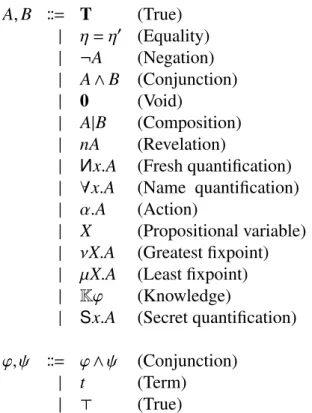
The logical counterpart of these operators (as defined in [13, 14] by Caires and Cardelli) are the composition formulaA|B, which holds in a process that can be separated into two processes in
parallel, one satisfying Aand the other satisfying B; the void formula0, that holds in the void process; and the hidden name quantifier Hx.Athat allows quantification over restricted names - such a formula holds in a process that has an hidden name such that the formulaAholds (in-stantiating the name variable xin Awith the hidden name in the process). A core spatial logic with these connectives is presented in Figure 2.9 (we denote by f n(P) the set of free names of processP). Notice that the semantics of the logic make use of the structural congruence relation
≡to inspect the structure of the models.
P|=T , ⊤
P|=¬A , not P|=A P|=0 , P≡0
P|=A|B , P≡Q|R and Q|=A and R|=B P|=Hx.A , P≡(νn)Q and Q|=A{x←n}
P|=@n , n∈ f n(P)
Figure 2.9: A Core Spatial Logic
P|=(¬0| ¬0)
P|=Hx.(¬0| ¬0)
Figure 2.10: Spatial Properties
The combination of the previously described spatial operators with a name occurrence pred-icate, recursion, propositional operators and behavioural modalities (like those of [23] by Dam) gives rise to what can be seen as a basic spatial behavioural logic expressive enough to rea-son about distributed systems in respect to properties that relate to resource usage or internal behaviour. Examples of such properties are presented in section 2.2.6.4, based on the running example presented previously.
2.2.6.1 Local Reasoning with Spatial Logics
this framework one can then write properties such asunique handling: by stating that internally, there never exists a configuration of the system where two of it’s subsystems attempt to read simultaneously offthe same channel;race freedom: by stating that there never exists an internal configuration of the system where more then one subsystem outputs on the same channel (that in turn is being read by some subsystem).
Spatial logics also allow one to count the number of components of a system by reasoning about the impossibility of dividing the system in a specific number of non-void components. This technique can be used to reason about more general properties of the components of a system: one can state that all components in the system satisfy some property, or that a certain set of components satisfies some property.
Another interesting feature of spatial logics is their adequacy in expressing contextual tests. In many process calculi, there exist notions of arbitrary contextual tests, since they provide a uniform and general approach to behavioural specifications and observational equivalencies - by stating the behaviour of processes i.r.t any context in which it can exist. In spatial logics there’s a logical primitive that expresses the concept of contextual test, coined as the “guarantee” operator in [14]. Used as A⊲B, this formula holds in a processPif, for every process Qthat satisfiesA, the parallel composition ofPandQsatisfiesB.
To some extent, one can even reason aboutsecrecyusing classic spatial logics, in the sense that it is possible to state that a process will never leak private (restricted) names on public channels, by using hidden name quantification. However, one should note that theπ-calculus isn’t the best calculus for analysing systems or protocols designed for security, thus when using a more security-friendly calculus such as those discussed in sections 2.2.3 and 2.2.4, secrecy cannot be interpreted in such a naive way. In a scenario where a process holds some private name, it may send it through an open channel and not leak it if the output issafelyencrypted, that is, it outputs a cyphered message that contains the private name and the cypher key is not known by undesired third parties. Also, it may be possible to output a private name by encasing it in an encrypted message that can be deciphered by attackers sometime in the future, that is, the attacker eventually obtains the key that was used to cypher the initial message.
While the discussion of spatial logics thus far has only presented the hidden name quanti-fier and a name occurrence predicate as a way of reasoning about restricted names, there exist alternative spatial operators able to express such properties, as proposed in [19] by Cardelli and Gordon. Such operators are the revelation operator, written as x®A, that holds in processes
that have a restricted namexand it’s underlying process satisfiesA; and the freshness quantifier N x.A, which quantifies over fresh names. Interestingly, the hidden name quantification can be expressed by combining the freshness quantifier with the revelation operator, and the name oc-currence predicate can be expressed by the revelation operator alone. Conversely, the freshness quantifier and revelation operators can be expressed using name occurrence and hidden name quantification. Its even possible to define validity and entailment within the logic itself using the guarantee operator [19]. In [13, 14], Caires and Cardelli develop in great detail the proof theory and meta-theoretic properties of a spatial logic for theπ-calculus, including a sequent calculus formulation of a (sound) proof system for the logic.
2.2.6.2 Expressiveness and Decidability
The aim of spatial logics is to give a greater degree of expressiveness than classical behavioural logics, essentially allowing to analyse processes in more detail. There exists much work regard-ing the expressiveness of spatial logics, in the sense of what exactly is their separation power for the model which they are designed for, or what equivalence on processes does the logical equivalence induce.
In [11], Caires concludes that the separating power of a dynamic spatial logic (with action modalities, fix-point iteration, fresh quantification and revelation) lies between structural con-gruence and strong bisimilarity, that is, its finer than bisimilarity and coarser than structural congruence. In fact, a logic characterisation of bisimilarity in the finiteπ-calculus was devel-oped in [36] by Hirschkoff, using a spatial logic without parallel composition but with name occurrence and the guarantee operator, used as a contextual testing primitive. Other characteri-sation results of spatial logics have been developed, such as [17] by Caires and Vieira, regarding extensional observational equivalencies.
As described, spatial logics, given their high degree of expressiveness, are undecidable and incomplete in general. However, spatial behavioural logics without the guarantee operator re-main very expressive and useful from a verification point of view (the presentation in section 2.2.6.1 for instance), and it’s shown in [11] that the model-checking problem is decidable and complete for bounded processes, which includes the class of processes with finite control (finite state space).
2.2.6.3 The Spatial Logic Model Checker
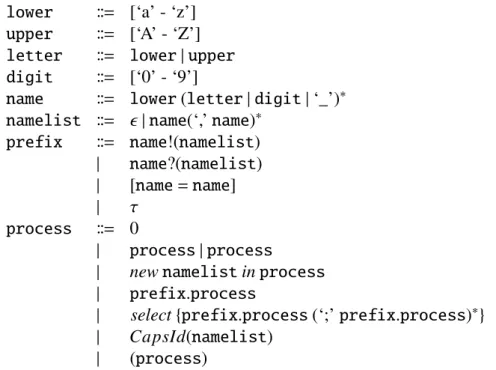
The initial version of the Spatial Logic Model Checker [60] consists of a model-checking tool for a spatial behavioural logic [11] for theπ-calculus. Its algorithm is both sound and complete for bounded processes (a process whose set of reachable processes after an arbitrary sequence of spatial/behavioural observations is finite). The syntax of the tool is similar to that of the π-calculus and of standard spatial-behavioural logics, although with some syntactic enrichments to provide a simpler use.
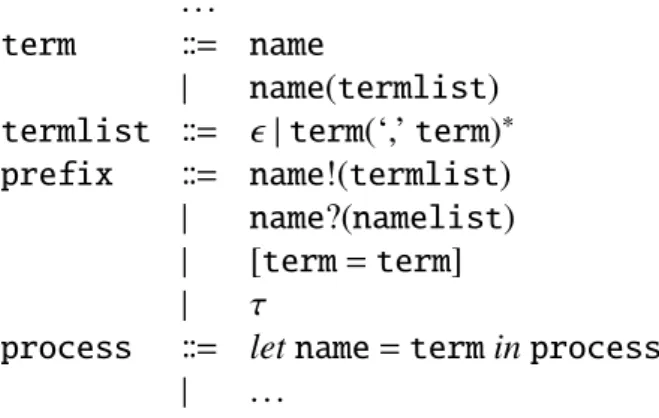
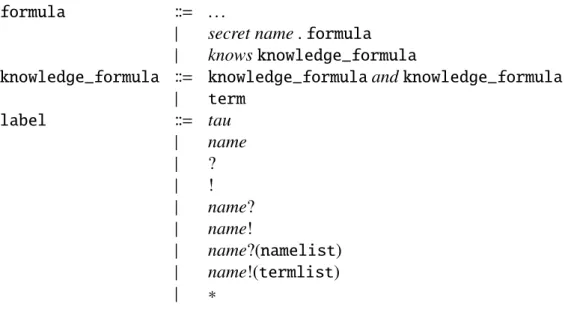
In this thesis, the tool has been extended with support for term communication (terms are values built from application of symbolic functions to names), and the ability to reason about the knowledge of a process. In this context, knowledge is interpreted as the set of terms a process holds, as well as those it can derive from them.
2.2.6.4 An Example with Spatial Logics
Considering the initial (and very simple) example of Figure 2.2, it’s interesting to see what kinds of spatial properties one can write, despite their triviality. For instance, we can state that the processRis composed of two distinct sub-components under a hidden name:
R|=Hx.(1|1) With:
1,¬0∧ ¬(¬0| ¬0)
We can also state thatRis composed of two sub-components, one that has a namemsgand sends it to the other (which can be expressed by the HML behavioural modalityhxiφ- “its possible to perform action xand after that φholds”), and the other that has a nameackand sends it to the other:
R|=Hx.(1∧@msg∧ hxhmsgii⊤ |1∧@ack∧ hx()ihxhackii⊤)
And more generally, we may want to state thatRnever opens the private communication chan-nel. This notion of invariant property is embodied by theφconnective that combines fix point iteration with the dual of diamond - “in every reachable state,φholds”:
NoLeak,¬∃p.Hx.hphxii⊤
These example properties show some of the expressive power of dynamic spatial logics. Al-though, considering the modified example of Figure 2.6, where instead of using a private chan-nel, communications take place over a public channel using cyphered messages, the NoLeak property wouldn’t have its intended meaning, since one could easily conceive an example where NoLeakholds, yet a private name is still leaked:
S ,((νpvt) let x= f(pvt) inchhxi)|ch(y).letz= f−1(y) in . . .
The process on the left-hand side of the composition has a private name pvt and outputs the result of applying some function f to pvt over a channel. The right-hand side process simply inputs over the channel and applies the reverse function f−1on the received message, therefore obtainingpvt. Despite this, formulaNoLeakholds inS, since it never directly outputs pvtover the channel. This counter-example clearly shows that great care is needed when considering spatial logics for process calculi that allow actions like function application.
As previously mentioned in Section 2.2.6.3, in the development of this thesis the SLMC tool has been modified at the model and the logic level, however, we present in Fig. 2.11 the original example of Figure 2.2 using the SLMC syntax without any of the new features. The SLMC tool provides a few syntactical facilities to ease the writing of properties, such as the insidepredicate, which lifts all restricted names of a process; the1predicate, which holds if a process is composed of a single “thread” (the SLMC implements a more generick predicate, which holds in a process that is composed ofk threads); the always A predicate, which is an implementation of the modal operator combined with fix-point iteration, which holds in a system whereAis true in every possible step; and theeventually Apredicate, which holds in a system whereAis true in a possible step of its execution.
In the process definitions, thenew construct defines restricted names; an output through a channel is writtenchannel!(x1, . . . ,xn), withx1, . . . ,xnbeing the names to be output ; and inputs are writtenchannel?(x1, . . . ,xn), withx1, . . . ,xnbeing the variables over which the input will be read.
2.2.7 Epistemic Logics
The several logics presented up to this point deal specifically with notions of behaviour and spatial dynamics of their intended models. However, some security properties aren’t naturally expressed solely as a function of the behaviour or the spatial dynamics of principals, as argued in Section 2.2.6.4. As such, there has been an effort to use different types of logics to reason about security properties in a more direct fashion. Specifically, epistemic logics, or logics of knowledge and belief, have been used to reason about security since many security properties can be understood as a function of the knowledge, or beliefs, of the principals involved in a protocol.
defproc P(ch) = ch!(msg).ch?(x);;
defproc Q(ch) = ch?(y).ch!(ack);;
defproc R = new c in (P(c) | Q(c));;
defprop noLeak = always not exists p.hidden x.<p!(x)> true;;
defprop twoComp = inside (1 | 1);;
defprop behaviorR = hidden x.(
(1 and @msg and <x!(msg)> true) | (1 and @ack and <x?><x!(ack)> true));;
check R |= noLeak;; check R |= twoComp;; check R |= behaviorR;;
Figure 2.11: Example for the SLMC
as knowing the sender of a message, anonymity can be read as not knowing the sender of a message, among other properties.
With this view of security in mind, BAN logic [10] was introduced. This logic, although lacking clearly and precisely defined semantics, deals in assertions of the belief of agents in a protocol. Another potential flaw of BAN (or other purely epistemic approaches [22]) is that modelling protocols using epistemic-based approaches is a non-trivial feat, essentially because logics are geared for specifying properties instead of operational steps of protocols. Considering this weakness of more classically based epistemic frameworks, several authors have proposed hybrid frameworks that model protocols using process calculi and reason about properties using epistemic modalities.
perspective isn’t a very natural interpretation of the operational definition of a protocol.
In a very recent development however, [20] introduces an epistemic logic for the applied π-calculus of Section 2.2.4, without replication. This logic has some similarities to the one developed in this thesis, in the sense that it has modalities to reason about terms. These modal-ities, however, are fundamentally different. The logic is separated in three types of formulas: term denotations, static formulas and epistemic formulas. Term denotations are logical repre-sentation of applied-π terms; static formulas consist of first order quantification, disjunction, negation and a predicate that can be used to reason about the set of terms the intruder possesses; finally, the epistemic formulas consist of past and future operators, and an epistemic knowledge (from the intruder point of view) operator. The epistemic component of the logic is interpreted over the set of all possible runs of a protocol, using a notion of maximal trace of a process -which coincides with all possible runs because the model lacks replication. This approach is essentially based in the intruder point of view, and interprets epistemic properties as properties of all the runs of a protocol (therefore being limited to finite traces).
In this chapter we present the bulk of the work developed during the course of this thesis. We begin by motivating the model that underlies our logic, followed by its syntax and some necessary term theory, as well as the calculus’ formal semantics.
We then step into our logic, presenting the syntax and denotational semantics for the core spatial-behavioural logic extended with the new term (epistemic) modalities. We follow by presenting some useful derived idioms, and we present some ways of stating some interesting properties from a security perspective.
Following the logic, we present our theory of the computational capabilities of principals and attackers in a sequent calculus formulation and present some important theoretical results that aim to validate the approach. We begin by showing that the sequent calculus formulation is sound in respect to the ability to derive new information from terms (through reduction and function application), present in the semantics of the logic. We then present a sound, com-plete and decidable procedure of calculating an approximation of the full (infinite) derivable knowledge of a process and we prove the sequent calculus to be complete in respect to this approximation. Through this result we are then able to prove the completeness of the sequent calculus in respect to the full derivable knowledge of processes. Thus proving our formal theory to be both sound and complete.
Finally, we present the extensions implemented in the SLMC tool and show how the previ-ous proofs provide a way to algorithmically determine if a term (or set of terms) can be derived from an initial set of terms.
3.1
Model
As mentioned in previous sections, we need a model that, while preserving abstraction, is ex-pressive enough to model security protocols with a high-level of operational detail, since that is the most straightforward way of modeling a protocol. As argued in Section 2.2.2.1, despite the Turing completeness of theπ-calculus, encoding cryptographic operations in it would be cum-bersome and too complex, therefore we follow an approach that is somewhat a hybrid between the Spi-calculus [3] and the Applied π-calculus. The idea is that we want a calculus that has the expressiveness ofπ but where we can easily model and use cryptographic operations such as symmetric and asymmetric encryption and hashing, in order to model the several principals and adversaries of a protocol as processes in the calculus. We therefore take theπ-calculus and extend it with the capacity to communicate arbitrary structured terms (built from the applica-tion of funcapplica-tion symbols to names), defined by a term algebra. These terms symbolically model the necessary cryptographic operations. We refrain from using some of the technical aspects (such as frames) of the Appliedπ-calculus due to simplicity, and because we aren’t exploring the equivalencies induced by the semantics of the calculus. To define the semantics of cryptog-raphy, we use a signature, which is a set of function symbols equipped with an arity, and a set