* Extracted from the thesis: “Efetividade de um programa de ensino para o cuidado domiciliar de pacientes submetidos à prostatectomia radical: ensaio clínico randomizado”, Escola de Enfermagem de Ribeirão Preto da Universidade de São Paulo, 2013.
1 Universidade Federal de Minas Gerais, Escola de Enfermagem, Belo Horizonte, MG, Brazil. 2 Universidade do Minho, Escola
de Psicologia, Braga, Portugal.
3 Universidade de São Paulo, Escola de Enfermagem de Ribeirão Preto, Ribeirão Preto, SP, Brazil.
ABSTRACT
Objective: To evaluate the effectiveness of a teaching program for hospital discharge of patients submitted to radical prostatectomy based on the self-efficacy construct of the Cognitive Social Theory. Method: A controlled clinical trial carried out on a 2-month follow-up of 68 prostatectomized men randomized into intervention group (n = 34) and control (n = 34). The intervention group received routine guidance from the service plus the teaching program. The control group only received routine guidance from the service. The data collection instruments were: sociodemographic and clinical questionnaire, self-efficacy scale, hospital depression and anxiety scale, household care knowledge questionnaire, and an item on satisfaction with a score of 1 to 5. Results: There was a significant difference between the intragroups for satisfaction (p<0.001) and knowledge (p<0.001) of the pre-test to the post-test. In the intervention group, there were significant changes between the times for anxiety (p=0.011) and knowledge (p<0.001). Conclusion: The teaching program with a combination of oral guidance, written instruction and telephone follow-up was effective in improving knowledge about home care and personal satisfaction. Brazilian Registry of Clinical Trials: RBR-5n95rm.
DESCRIPTORS
Oncology Nursing; Prostatic Neoplasms; Prostatectomy; Health Education; Patient Discharge; Clinical Trial.
Effectiveness of a home care teaching program for
prostatectomized patients: a randomized controlled clinical trial*
Efetividade de um programa de ensino para cuidado domiciliar de pacientes prostatectomizados: ensaio clínico controlado randomizado
Efectividad de un programa de enseñanza para cuidado domiciliario de pacientes prostatectomizados: ensayo clínico controlado randomizado
Luciana Regina Ferreira da Mata1, Cissa Azevedo1, Mariana Ferreira Vaz Gontijo Bernardes1,
Tânia Couto Machado Chianca1, Maria da Graça Pereira2, Emilia Campos de Carvalho3
How to cite this article:
Mata LRF, Azevedo C, Bernardes MFVG, Chianca TCM, Pereira MG, Carvalho EC. Effectiveness of a home care teaching program for prostatectomized patients: a randomized controlled clinical trial. Rev Esc Enferm USP. 2019;53:e03421. DOI: http://dx.doi.org/10.1590/S1980-220X2018012503421
Received: 04/05/2018 Approved: 08/07/2018
Corresponding author:
Luciana Regina Ferreira da Mata Escola de Enfermagem, Universidade Federal de Minas Gerais
Av. Prof. Alfredo Balena, 190
CEP 30130-100 – Belo Horizonte, MG, Brazil [email protected]
INTRODUCTION
Radical prostatectomy (RP) is considered the first choice option for patients with potentially curable pros-tate cancer and consists of removing the prospros-tate and seminal vesicles by open surgery, laparoscopic or lapa-roscopic surgery assisted by robots(1-2). After performing RP, patients may experience physical and psychologi-cal changes, including painful bladder spasms, fatigue, decreased physical capacity, urinary tract infection and surgical incision, constipation, sexual impotence, urinary incontinence, anxiety and depression(1,3-4). In this context, individuals submitted to RP are not always prepared for the challenges to be faced, which reinforces the need for the health team to be sensitive to the peculiarities of this care in order to offer support for male adaptation(3).
Nursing is responsible for planning and implementing training on post-discharge care, and the guiding ques-tion of such training refers to the stimulaques-tion of self-care capacity and the specificity of the challenges and psycho-logical needs of these individuals(1,5).
The current tendency to shorten the hospitalization period has an effect on the time spent on developing educational activities among patients and their families, which may negatively interfere with their preparation for discharge(1,6). Guidelines in the context of the post-operative needs of RP are important and should refer to surgical wound care, handling of the indwelling urinary catheter (IUC) procedure at home, exercises to reestab-lish urinary continence, as well as to allow the dialogue regarding complications such as erectile dysfunction and urinary incontinence, which cause suffering for both men and their partners(1,7).
The capacity for self-care is based on the construct of self-efficacy, which is defined as the “personal con-viction that one can successfully perform an action to produce desirable results in a given situation”(8-9). Thus, it is suggested that knowing and stimulating a patient’s self-efficacy in the postoperative period of RP are impor-tant, since this construct influences the patient’s choices regarding the courses of action that can be performed, as well as the effort made to achieve their objectives(1). It also influences “how long they will persevere in the face of obstacles and failures, how much stress, anxiety, and depression they experience with environmental demands, and ultimately the level of achievement they achieve”(1,10). Thus, the Cognitive Social Theory was the theoreti-cal reference used to support the accomplishment of this study, which is justified when proposing an evaluation of a teaching program that prepares nurses for discharging prostatectomized patients, structured from the belief of self-efficacy. It is hoped that the intervention will help the clinical performance of nursing in this stage of care and thus increase the knowledge, satisfaction and self-efficacy of these individuals in home care, and consequently reduce the psychological changes such as anxiety and depression
which when associated are called psychological morbid-ity. Thus, the objective of this study was to evaluate the effectiveness of a teaching program for hospital discharge of patients submitted to radical prostatectomy, based on the self-efficacy construct of the Cognitive Social Theory.
METHOD
Study deSign
This is an experimental, parallel, single-blind random-ized controlled trial that was performed in surgical units of three hospitals in the interior of Minas Gerais, Brazil, between January 2012 and February 2013.
PoPulation and SamPle
Patients submitted to RP, older than 18 years, with cognitive (Mini mental state exam)(11), locomotor, visual, auditory and self-care abilities were considered eligible, and who had a telephone (fixed or cellular) to follow-up the teaching program. Those who had difficulty receiving telephone calls were excluded.
The sample calculation was based on the expected difference between the control group (CG) and the intervention group (IG) in relation to self-efficacy after treatment and in an estimated annual population of 155 men submitted to RP. It considered a difference between the groups of approximately 30 points, with a standard deviation around 42(12), for a significance level of 5% and a power of 80%, thereby estimating a sample of 33 indi-viduals in each group.
Identification of the participants occurred through the surgical block agenda of the three hospital institutions, randomized into two groups: intervention and control. Weekly contact was made with the secretaries of the sur-gical blocks to survey the patients who would undergo RP in the following week. With the patient’s name, their bed was identified on the second postoperative day and an invitation to participate in the study was made.
The randomization was carried out by a draw, so that blocks of 20 individuals were adopted. Thus, 10 opaque mini-envelopes were placed in an opaque envelope, con-taining a card written “intervention group”, and another 10 identical mini-envelopes containing a card with the word “control group”. After applying the data collection instruments, the principal investigator asked the partici-pant to draw a mini-envelope, which randomly defined in which group he would be allocated.
Study Protocol
material with the participant, reinforcing the capacity to perform self-care. Devices used for urinary inconti-nence were also presented such as the leg bag, urinary collector and the male absorbent; Moment 1 (third to fifth day after hospital discharge): telephone contact to clarify doubts and reinforce the guidelines contained in the booklet, as well as reinforce the individual’s ability to perform care (average duration of the connection – 15 minutes); Moment 2 (30 days after hospital discharge): new telephone contact to clarify doubts, review the guide-lines contained in the booklet and reinforce the indi-vidual’s ability to perform care (average duration of the call – 12 minutes).
The booklet elaborated by the authors presents easy-to-understand language with illustrations to facilitate understanding, and contains information related to home care with UCD, surgical incision, bath and feeding, pain medications, identifying complications, guidelines on exercise practice, erectile dysfunction and strengthen-ing the pelvic muscles(13-14). The printed booklet was submitted for evaluation as to the appropriateness and adequacy of writing, content and visual appearance. The following evaluators participated in the evaluation stage: two nurses with doctorate degrees and researchers in the area of surgical and urology nursing; a urologist doctor, a doctor of surgery and a member of the clinical staff of urologist surgeons from one of the hospitals under study; a journalist with a master’s in communication sociology; and one patient who underwent radical prostatectomy 6 months earlier.
For the telephone contact, a script was drawn up based on the construct of the self-efficacy of the Cognitive Social Theory, from the persuasion source with the pur-pose of promoting positive reinforcement and incentives so that the learning was promptly translated into action. The script was evaluated by five nurse researchers who develop studies in the area of patient education from the adopted theoretical framework(9).
Men allocated into the CG received usual guidelines from the health professionals of the respective services. Normally, nursing professionals explained about UCD care, and the physician about returning for UCD with-drawal and outpatient follow-up. No participating health service provided booklets or telephone follow-up.
data collection
First, a pre-test was performed from a convenience sample of nine patients submitted to radical prostatec-tomy at the three hospitals in order to standardize the way
of implementing the intervention and applying the data collection instruments in order to improve the interview skills of the two researchers involved.
Data collection was performed in two different moments. The first moment occurred before starting the study interventions on the second postoperative day, and the second occurred on the second medical return before the medical appointment (60 days after discharge). In the first and second moments of the data collection, the two interviewers did not know (a priori) the allocation of the participants into the respective groups (CG and IG), which characterized their blindness in these data collection stages.
The following instruments were used to collect data: sociodemographic and clinical questionnaire, general and perceived self-efficacy scale (primary outcome)(15), hospital anxiety and depression scale (HADS) (second-ary outcome)(16), questionnaire to evaluate the knowledge (secondary outcome) of the participants about home care after RP, and an item to evaluate the satisfaction (second-ary outcome) regarding home care.
The general and perceived self-efficacy scale adapted and validated for application in Brazil(14) is composed of 10 items with Likert responses ranging from one to five, where the higher the score, the greater the perception of self-efficacy. Cronbach’s alpha in the present sample was 0.74(17).
The HADS scale evaluates the psychological morbid-ity of the individual, was validated in Brazil(16) and has 14 questions with Likert responses ranging from zero to three divided into two subscales, each with seven items. The overall score in each subscale ranges from zero to 21: no cases (score from zero to seven), doubtful or uncertain case (score of 8 to 10) and a case (score of 11 to 21). The interpretation of this instrument can also be made from the total score, with absence of anxiety and depression when the values are less than eight(18). Cronbach’s alpha in the present sample was 0.85(17).
data analySiS and ProceSSing
The data were processed in a database using the Statistical Package for Social Science (SPSS), version 20.0 for Windows. Verification of the equivalence between the groups regarding the sociodemographic and clinical char-acteristics and the variables-outcome in the pre-test was performed through descriptive analysis and the Chi-square, Student’s T and Mann-Whitney tests.
A comparison between the IG and the CG regarding the gains obtained in the post-test was performed using the ANCOVA variance analysis, with self-efficacy, anxiety and psychological morbidity as dependent variables at the post-test moment, and the value of these variables in the pre-post-test as covariates. The Mann-Whitney test was used regarding knowl-edge and satisfaction. It was used the General linear model analysis for repeated measures in order to verify if there were significant differences in the self-efficacy, anxiety and psycho-logical morbidity in the IG of the pre-test to the post-test when compared to the CG, considering the moment as the intra-subject factor (pre-test and post-test) and the group as the inter-subject factor (CG versus IG). Knowledge and satisfaction were evaluated by the Wilcoxon test for repeated measures in two moments (pre and post-test). Moreover, ANOVA and Kruskal-Wallis tests were used to verify the impact of the vari-ables that did not present equivalence between the groups in the
Hospitalized patients undergoing radical prostatectomy
Application of the instruments: - Sociodemographic characterization - Self-efficacy
- Anxiety/Total morbidity - Satisfaction
- Knowledge
Control group Intervention group
Teaching program (oral information + booklet)
Telephone contact 01 - 1st week post-discharge
Telephone contact 2 - 30 days post-discharge
Application of the instruments: - Self-efficacy
- Anxiety/Total morbidity - Satisfaction
- Knowledge Application of the instruments:
- Self-efficacy
- Anxiety/Total morbidity - Satisfaction
- Knowledge
Usual care
Randomization
---T0 (hospitalization)
---T1
---T2
---T3 (2nd return to the doctor - 60 days post-discharge) Figure 1 – Study scheme.
dependent variables studied in the pre-test and in the post-test. A significance level of 0.05 was adopted in all analyzes.
ethical aSPectS
The study was approved by the Research Ethics Committee of one of the institutions involved (Opinion No. 042/2011) and registered in the Brazilian Registry of Clinical Trials, number RBR-5n95rm. It should be empha-sized that the service offered in the three research sites does not differ in the treatment or guidance provided to the users.
reSultS
Evaluated for eligibity (n=96)
Not included:
Did not meet the inclusion criteria (n=14)
Did not accept to participate (n=7)
Randomized (n=75)
Intervention group (IG) (n=35) Allocation Control group (CG) (n=40)
Follow-up
Analysis
Loss of follow-up (n=1) Loss of follow-up (n=6)
Final evaluation (n=34) Final evaluation (n=34)
Figure 2 – Flowchart of study participants: sampling procedure.
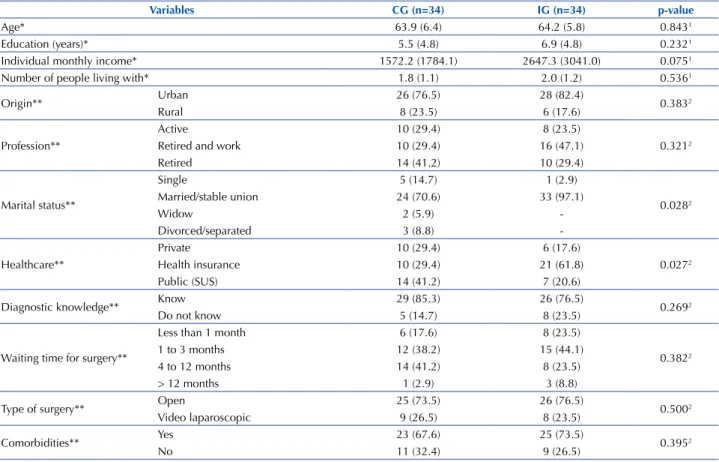
According to the characterization data of the 68 par-ticipants, there were no significant differences between CG and IG as to age, education, income, background, professional status, number of people living with them, knowledge of prostate cancer diagnosis, waiting time for surgery, type of surgery and presence of comorbidities, which shows homogeneity between the groups, except for
marital situation and type of care (p <0.05), according to data presented in Table 1.
We initially verified the equivalence of the groups in relation to self-efficacy, anxiety, psychological morbidity, sat-isfaction and knowledge, and observed significant differences between the IG and the CG in the post-test for satisfaction (p<0.001) and knowledge (p<0.001) (Table 2).
Table 1 – Characterization of the sample distributed into CG (control group) and IG (intervention group) regarding sociodemographic and clinical profile – Divinópolis, MG, Brazil, 2013.
Variables CG (n=34) IG (n=34) p-value
Age* 63.9 (6.4) 64.2 (5.8) 0.8431
Education (years)* 5.5 (4.8) 6.9 (4.8) 0.2321
Individual monthly income* 1572.2 (1784.1) 2647.3 (3041.0) 0.0751
Number of people living with* 1.8 (1.1) 2.0 (1.2) 0.5361
Origin** Urban 26 (76.5) 28 (82.4) 0.3832
Rural 8 (23.5) 6 (17.6)
Profession**
Active 10 (29.4) 8 (23.5)
0.3212
Retired and work 10 (29.4) 16 (47.1)
Retired 14 (41.2) 10 (29.4)
Marital status**
Single 5 (14.7) 1 (2.9)
0.0282 Married/stable union 24 (70.6) 33 (97.1)
Widow 2 (5.9)
-Divorced/separated 3 (8.8)
-Healthcare**
Private 10 (29.4) 6 (17.6)
0.0272
Health insurance 10 (29.4) 21 (61.8)
Public (SUS) 14 (41.2) 7 (20.6)
Diagnostic knowledge** Know 29 (85.3) 26 (76.5) 0.2692
Do not know 5 (14.7) 8 (23.5)
Waiting time for surgery**
Less than 1 month 6 (17.6) 8 (23.5)
0.3822
1 to 3 months 12 (38.2) 15 (44.1)
4 to 12 months 14 (41.2) 8 (23.5)
> 12 months 1 (2.9) 3 (8.8)
Type of surgery** Open 25 (73.5) 26 (76.5) 0.5002
Video laparoscopic 9 (26.5) 8 (23.5)
Comorbidities** Yes 23 (67.6) 25 (73.5) 0.3952
No 11 (32.4) 9 (26.5)
Table 2 – Results of the differences between the levels of self-efficacy, anxiety, psychological morbidity, satisfaction and knowledge on the post-test with IG (intervention group) compared to CG (control group) – Divinópolis, MG, Brazil, 2013.
Variables (n= 34)CG (n= 34)IG p-value
Self-efficacy* 39.7 (5.9) 40.9 (4.5) 0.0901
Anxiety* 6.9 (4.6) 5.9 (3.6) 0.1811
Psychological morbidity* 10.2 (6.4) 9.3 (5.1) 0.3761
Satisfaction** 4 (2.75–5.0) 5 (4.75-5.0) <0.0012
Knowledge** 13 (12-15) 22 (21-23) <0.0012
1ANCOVA test; 2 Mann-Whitney test; *Mean (SD); **Median (p25-p75).
In relation to satisfaction (p<0.001) and knowledge (p<0.001) in the IG, the changes from the pre-test to the post-test were statistically significant. There was a statis-tically significant change between the times only in the knowledge variable in the CG (p = 0.005).
No significant intra-subject differences were found in either group regarding the levels of self-efficacy, anxiety and psychological morbidity in the IG and CG from pre-test to post-test. However, when considering the analysis of anxiety from the cut-off point (values less than eight refer to the absence of anxiety), it was identified that anxiety presented a statistically significant difference from the pre-test to the post-test in the IG (p = 0.011).
As a result of the exploratory analyzes in order to analyze the impact of the variables marital situation and type of care, which did not present equivalence between the groups, it was found that there was an association of these with the dependent variables and the response to the intervention. Therefore, the type of care variable had a significant effect (p = 0.018) on the satisfaction with the guidelines received by the IG in the pre-test, and it was verified that individu-als in private care had a higher level of satisfaction than those attended by the Unified Public Health System (SUS – Sistema Único de Saúde) and by health insurance. In the
IG, the marital situation variable had a significant effect (p = 0.023) on satisfaction with the guidelines received in the post-test, and it was verified that married or consensual union individuals presented higher satisfaction compared to single individuals after the intervention.
Regarding the differences between the groups for the number of correct answers of the 23 questions on the knowl-edge assessment instrument, the IG subjects presented sta-tistically significant post-test knowledge gain for 14 items (p <0.001) (surgical incision care and handling of blad-der catheter, urinary incontinence and exercises for pelvic muscles, care during bowel movements, guidance on pain medications and proper nutrition, signs of complications, and clarification on problems with erection). It is noteworthy that there were no significant differences in the numbers of correct answers at the pre-test moment between the groups on the 23 questions.
DISCUSSION
This study evaluated the effect of an educational pro-gram for the home care of patients submitted to RP based
on self-efficacy, anxiety, psychological morbidity, satisfaction and knowledge. It was found that the teaching program car-ried out through a combination of oral, written and telephone counseling was effective in improving the knowledge of home care and the satisfaction of prostatectomized patients.
Regarding self-efficacy and psychological morbidity, no differences were identified between the groups in the post-test moment. However, scholars point out that providing teaching, exploring, and confronting specific disease/treatment issues and concerns leads to a significant increase in self-efficacy, emotional well-being, and disease-specific knowledge/treatment(19).
A clinical trial of 72 older adult males after RP identified increased self-efficacy and decreased levels of depression in these individuals from a peer support intervention. The inter-vention was based on Bandura’s theory of self-efficacy from the perspective of vicarious learning and social support. Eight meetings were held over eight weeks in order to discuss con-cerns and coping strategies of treatment effects. In the eighth week, the IG presented greater self-efficacy compared to CG (p = 0.005) and less depression (p = 0.02), which allowed the authors to conclude that support interventions based on vicari-ous experience are capable of increasing self-efficacy(12).
The results pointed to an increase in patient satisfaction and more knowledge by the individuals regarding postop-erative care from the teaching program. Researchers from other countries have also identified that the greatest benefits of educational interventions are related to knowledge gain and increased satisfaction with care(20-21).
A study conducted in the United States(20) aimed at determining if telephone educational follow-up after RP would increase overall patient satisfaction and understand-ing of home-based care management, as well as reduce the demand for health care resources; it identified that the understanding of health management was similar in both groups, however, all IG participants described the telephone call as a success, with a significant increase in satisfaction. Although the written materials addressed significant infor-mation about postoperative care, other concerns were identi-fied through the experience of each participant, which high-lights the importance of the telephone call post-discharge from the hospital. In addition, unplanned telephone calls were made more often to CG participants, who also had more doubts about their care(20).
rehabilitation and patient satisfaction, and no difference in overall intervention effectiveness was identified regarding patient satisfaction and the feeling of safety and discomfort in the postoperative period. However, participants reported that the intervention provided better rehabilitation regarding pain management, IUC, bowel function and wound care(21). Providing information to patients has been considered essential for promoting adequate health care in order to increase the capacity for self-care and thus enable treat-ment continuity outside the hospital environtreat-ment. Providing quality guidelines to the surgical patient implies increased knowledge, satisfaction and psychological well-being in the postoperative period, reducing the psychological morbid-ity resulting from the surgical experience and the physical changes after the procedure(22-23).
Regarding the difference in IG results in the pre- and post-test from the established cut-off point for anxiety levels, it is known that lower anxiety levels of prostatectomized patients are positively reflected in their mental health, and non-com-promised mental health can be associated with adequate devel-opment of coping mechanisms for stressors, which facilitates the management of post-operative physiological changes(1,24).
The higher satisfaction with the high guidance among married men/consensual union in the present study may be justified by the dependence they have on their women for understanding health information and for decision-making regarding care. The family generally presents itself as a fun-damental piece in the different phases of the disease. It is expected that the intervention of health professionals will not be limited only to the patient, but also to the family, including the wife(25). Including the partner in the guidelines for care enables making it more qualified to assist in the care of the patient after discharge, a situation which generates stress itself. Regarding the results that indicated the higher satisfac-tion level of the patients in private care, no studies were found that confronted or directly corroborated such finding. A possible justification for the greater satisfaction of indi-viduals in private care regarding pre-test guidelines may be related to the greater number of doctor-patient contact in private practices, and consequently more time available for questions about the surgical procedure and clarification of their uncertainties.
The men involved in this study expressed higher levels of knowledge according to the satisfaction degree. Educational
intervention studies also identified increased knowledge simultaneously with satisfaction with the guidelines, service and/or received care(19,26-28). A Scottish program of teaching and support to prostate cancer patients and their partners con-ducted through individual consultations, seminars and written guidelines, resulted in increased disease-related knowledge, positive perception about life and treatment satisfaction(29).
Thus, the idea that patient satisfaction is a multidimen-sional concept which includes interaction between patient and caregiver, the presence and competence of the caregiver, the offer and continuity of care, and the characteristics of communication(30) is reinforced. In addition, it is important to emphasize that a patient’s self-efficacy is also influenced by their relationship with the health professional through an exchange of information and increased knowledge about treatment, establishing trust and increasing satisfaction(31).
Regarding the limitations of this study, it is possible to mention a restriction of generalizing its results to other contexts. This study was developed with men attended in a municipality of the interior of Minas Gerais, and so may present characteristics inherent to the region. Therefore, it is important to implement the intervention in different Brazilian contexts.
CONCLUSION
The teaching program carried out through a combination of oral and written guidance with telephone follow-up was effective in improving the knowledge of home care and the satisfaction of individuals.
By the teaching program proposed in the present study with closer approximation and a connection established from the telephone contacts, it is possible to infer that the behav-ioral aspects, the increase in knowledge and the bond between professionals and patients contributed to increase satisfaction. Therefore, establishing effective communication between the patient and the nursing team is vitally important so that better postoperative results can be obtained given the complexity of the procedure, the required care and the association of RP with the beliefs that are involved in surgery.
This study contributes to nursing science because of the reduced number of clinical trials with proposals for educa-tional interventions after RP hospital discharge, both nation-ally and internationnation-ally. The findings are expected to stimulate implementing interventions in the nursing clinical practice.
RESUMO
Objetivo: Avaliar a efetividade de um programa de ensino para alta hospitalar de pacientes submetidos à prostatectomia radical, pautado no construto da autoeficácia da Teoria Social Cognitiva. Método: Ensaio clínico controlado, realizado em seguimento de 2 meses, com 68 homens prostatectomizados, randomizados em grupo-intervenção (n=34) e controle (n=34). O grupo-intervenção recebeu orientações de rotina do serviço mais o programa de ensino. O grupo-controle recebeu apenas orientações de rotina do serviço. Os instrumentos de coleta de dados foram: questionário sociodemográfico e clínico, escala de autoeficácia, escala de ansiedade e depressão hospitalar, questionário de conhecimento sobre cuidados domiciliares e um item sobre satisfação com pontuação de 1 a 5. Resultados: Houve diferença significativa entre e intragrupos para satisfação (p<0,001) e conhecimento (p<0,001) do pré-teste para o pós-teste. No grupo-intervenção, houve mudanças significativas entre os tempos para ansiedade (p=0,011) e conhecimento (p<0,001). Conclusão: O programa de ensino com combinação de orientação oral, escrita e acompanhamento telefônico mostrou-se efetivo na melhoria do conhecimento quanto aos cuidados em domicílio e satisfação dos indivíduos. Registro Brasileiro de Ensaios Clínicos: RBR-5n95rm.
DESCRITORES
RESUMEN
Objetivo: Evaluar la efectividad de un programa de enseñanza para alta hospitalaria de pacientes sometidos a la prostatectomía radical, pautado en el constructo de la autoeficacia de la Teoría Social Cognitiva. Método: Ensayo clínico controlado, realizado en seguimiento de dos meses, con 68 hombres prostatectomizados, aleatorizados en grupo de intervención (n=34) y de control (n=34). El grupo de intervención recibió orientaciones de rutina del servicio más el programa de enseñanza. El grupo de control recibió solo orientaciones de rutina del servicio. Los instrumentos de recolección de datos fueron: cuestionario sociodemográfico y clínico, escala de autoeficacia, escala de ansiedad y depresión hospitalaria, cuestionario de conocimiento sobre cuidados domiciliarios y un ítem sobre satisfacción con puntaje de 1 a 5. Resultados: Hubo diferencia significativa entre e intra grupos para satisfacción (p<0,001) y conocimiento (p<0,001) de la pre prueba a la post prueba. En el grupo intervención, hubo cambios significativos entre los tiempos para ansiedad (p=0,011) y conocimiento (p<0,001). Conclusión: El programa de enseñanza con combinación de orientación oral, escrita y seguimiento telefónico se mostró efectivo en la mejoría del conocimiento en cuanto a los cuidados domiciliarios y satisfacción de los individuos. Registro Brasileño de Ensayos Clínicos: RBR-5n95rm.
DESCRIPTORES
Enfermería Oncológica; Neoplasias de la Próstata; Prostatectomía; Educación en Salud; Alta del Paciente; Ensayo Clínico.
REFERENCES
1. Mata LRF, Carvalho EC, Gomes CRG, Silva AC, Pereira MG. Postoperative self-efficacy and psychological morbidity in radical prostatectomy.
Rev Lat Am Enfermagem [Internet]. 2015 [cited 2018 Mar 13];23(5):806-13. Available from: https://www.ncbi.nlm.nih.gov/pmc/articles/ PMC4660401/
2. Ilic D, Evans SM, Allan CA, Jung JH, Murphy D, Frydenberg M. Laparoscopic and robotic-assisted versus open radical prostatectomy for the treatment of localised prostate cancer. Cochrane Database Syst Rev. 2017;(9):CD009625.
3. Kong EH, Deatrick JA, Bradway CK. Men’s experiences after prostatectomy: a meta-synthesis. Int J Nurs Stud. 2017;74:162-71.
4. Wang W, Huang QM, Liu FP, Mao QQ. Effectiveness of preoperative pelvic floor muscle training for urinary incontinence after radical
prostatectomy: a meta-analysis. BMC Urol [Internet]. 2014 [cited 2018 Mar 13];14:99. Available from: https://www.ncbi.nlm.nih.gov/ pmc/articles/PMC4274700/
5. Wang C, Song Z, Li S, Tai S. Extended nursing for the recovery of urinary functions and quality of life after robot-assisted laparoscopic radical prostatectomy: a randomized controlled trial. Support Care Cancer [Internet]. 2017 [cited 2018 Mar 13];26(5):1553-60. Available from: https://www.ncbi.nlm.nih.gov/pmc/articles/PMC5876261/
6. Delatorre PG, Sá SPC, Valente GSC, Silvino, ZR. Planning for hospital discharge as a strategy for nursing care: integrative review. Rev Enferm UFPE on line [Internet]. 2013 [cited 2018 Mar 13];7(n.spe)(12):7151-9. Available from: https://periodicos.ufpe.br/revistas/ revistaenfermagem/article/view/12387/15148
7. Brito-Brito PR, Oter-Quintana C, Martín-García A, Alcolea-Cosín MT, Martín-Iglesias S, Fernández-Gutiérrez DÁ. Case study: community nursing care plan for an elderly patient with urinary incontinence and social interaction problems after prostatectomy. Int J Nurs Knowl. 2014;25(1):62-5.
8. Salvetti MG, Pimenta CAM. Dor crônica e a crença de auto-eficácia. Rev Esc Enferm USP. 2007 [citado 2018 jul. 27];41(1):135-40.
Disponível em: http://www.scielo.br/pdf/reeusp/v41n1/v41n1a17.pdf
9. Bandura A. Social foundations of thought and action: a social cognitive theory. Englewood Cliffs: Prentice Hall; 1986.
10. Nunes MFO, Noronha APP. Escala de Auto-eficácia para atividades ocupacionais: construção e estudos exploratórios. Paidéia. 2008 [citado 2018 jul. 27];18(39):111-24. Disponível em: http://www.scielo.br/pdf/paideia/v18n39/v18n39a11.pdf
11. Bertolucci PH, Brucki SM, Campacci SR, Juliano Y. O mini-exame do estado mental em uma população geral: impacto da escolaridade.
Arq Neuro Psiquiatr [Internet]. 1994 [citado 2018 mar. 13];52(1):1-7. Disponível em: http://www.scielo.br/pdf/anp/v52n1/01.pdf 12. Weber BA, Roberts BL, Yarandi H, Mills TL, Chumbler NR, Wajsman Z. The impact of dyadic social support on self-efficacy and depression
after radical prostatectomy. J Aging Health. 2007;19(4):630-45.
13. Mata LRF, Napoleão AA. Nursing interventions for patients discharged from prostatectomy: an integrative review. Acta Paul Enferm
[Internet]. 2010 [cited 2018 Mar 13];23(4):574-79. Available from: http://www.scielo.br/pdf/ape/v23n4/en_21.pdf
14. Mata LRF, Carvalho EC, Napoleão AA. Validação por peritos de intervenções de enfermagem para a alta de pacientes submetidos à
prostatectomia. Texto Contexto Enferm [Internet]. 2011 [citado 2018 mar. 13];20(n.esp):36-44. Disponível em: http://www.scielo.br/pdf/ tce/v20nspe/v20nspea04.pdf
15. Souza I, Souza MA. Validação da Escala de Auto eficácia Geral Percebida. Rev Univ Rural Ser Ciênc Human. 2004;26(1):12-7.
16. Botega NJ, Bio MR, Zomignani MA, Garcia JRC, Pereira WAB. Transtornos do humor em enfermaria de clínica médica e validação de escala de medida (HADS) de ansiedade e depressão. Rev Saúde Pública [Internet]. 1995 [citado 2018 mar. 13];29(5):355-63. Disponível
em: http://www.scielo.br/pdf/rsp/v29n5/04.pdf
17. Tavakol M, Dennick R. Making sense of Cronbach’s alpha. Int J Med Educ [Internet]. 2011 [cited 2018 Mar 15];2:53-5. Available from: https://www.ncbi.nlm.nih.gov/pmc/articles/PMC4205511/
18. Zigmond A, Snaith RP. The Hospital Anxiety and Depression Scale. Acta Psychiatr Scand. 1983;67(6):361-70.
19. Song L, Dunlap KL, Tan X, Chen RC, Nielsen ME, Rabenberg RL, et al. Enhancing survivorship care planning for patients with localized prostate cancer using a couple-focused mHealth symptom self-management program: protocol for a feasibility study. JMIR Res Protoc [Internet]. 2018 [cited 2018 Mar 13];7(2):1-11. Available from: https://www.ncbi.nlm.nih.gov/pmc/articles/PMC5847815/ 20. Inman DM, Maxson PM, Johnson KM, Myers RP, Holland DE. The impact of follow-up educational telephone calls on patients after radical
21. Jensen BT, Kristensen SA, Christensen SV, Borre M. Efficacy of tele-nursing consultations in rehabilitation after radical prostatectomy: a
randomized controlled trial study. Int J Urol Nurs. 2011;5(3):123-30.
22. Mata LRF, Silva AC, Pereira MG, Carvalho EC. Telephone follow-up of patients after radical prostatectomy: a systematic review. Rev Latino Am Enfermagem [Internet]. 2014 [cited 2018 Mar 30];22(2):337-45. Available from: http://www.scielo.br/pdf/rlae/v22n2/0104-1169-rlae-22-02-00337.pdf
23. Hedden L, Wassersug R, Mahovlich S, Pollock P, Sundar M, Bell RH, et al. Evaluating na educational intervention to alleviate distress amongst men with newly diagnosed prostate cancer and their partners. BJU Int. 2017;120(5B):E21-E29.
24. Perry LM, Hoerger M, Silberstein J, Sartor O, Duberstein P. Understanding the distressed prostate cancer patient: role of personality. Psychooncology. 2018;27(3):810-6.
25. Rossen S, Hansen-Nord NS, Kayser L, Borre M, Borre M, Larsen RG, et al. The impact of husbands’ prostate cancer diagnosis and participation in a behavioral lifestyle intervention on spouses’ lives and relationships with their partners. Cancer Nurs. 2016;39(2):E1-9. 26. Watson E, Shinkins B, Frith E, Neal D, Hamdy F, Walter F, et al. Symptoms, unmet needs, psychological well-being and health status in
survivors of prostate cancer: implications for redesigning follow-up. BJU Int. 2016;117(6B):E10-9.
27. Hyde MK, Newton RU, Galvão DA, Gardiner RA, Occhipinti S, Lowe A, et al. Men’s help-seeking in the first year after diagnosis of localised
prostate cancer. Eur J Cancer Care. 2017;26(2):e12497.
28. Ferguson J, Aninj J. Prostate cancer survivorship: a nurse-led service model. Br J Nurs. 2015;24(18):S14-21.
29. Primeau C, Peterson C, Nabi G. A qualitative study exploring models of supportive care in men and their partners/caregivers affected by metastatic prostate cancer. Oncol Nurs Forum. 2017;44(6):E241-9.
30. Kane P, Jasperse H, Boland P, Herst P. A pathway to empowerment: evaluating a cancer education and support programme in New Zealand. Eur J Cancer Care (Engl). 2014;23(5):668-74.
31. Watson EK, Shinkins B, Matheson L, Burns RM, Frith E, Neal D, et al. Supporting prostate cancer survivors in primary care: findings from
a pilot trial of a nurse-led psycho-education intervention (PROSPECTIV). Eur J Oncol Nurs. 2018;32:73-81.
Financial support
Conselho Nacional de Desenvolvimento Científico e Tecnológico (CNPq). Doctoral scholarship.