Laboratório de Educação em Ambiente e Saúde, Departamento de Biologia, Instituto Oswaldo Cruz, Av. Brasil 4365, 21045-900 Rio de Janeiro, RJ, Brasil
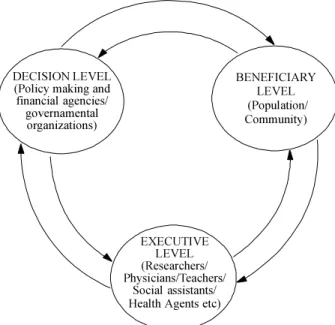
Some municipalities in Brazil have been requesting orientation for the implementation of health education programsrelated to the control ofschistosomiasis. This demand was based on experiencesin the development of health education researches, strategies and materialsforschool-age children, i n-volving the communities and secretaries of health and education. Motivated by thisrequest and the recently implemented plan of health services (Unified Health System - Sistema Único de Saúde - SUS) that gives autonomy to the municipalitiesto utilize health resources and servicesin Brazil, this paper presents an interactive perspective of planning health education research and programs. The purpose of this perspective isto stimulate a reflection on the needs and actions ofinstitutions and people involved in health education research and/or programsto obtain sustainability, commitment and effectiveness -not only in the control of schistosomiasis, but also in the improvement of environmental conditions, quality oflife and personal health. This perspective comprisesinteraction among three levelsrelated to health education programs: the decision level, the executive level and the beneficiary level. The needs and lines of action at each ofthese levels are discussed, aswell asthe waysin which they can interact with each other. This proposal may lead to usefulinteractive ways of planing, organizing, executing and evaluating health education research and/or program, not only towardsthe prevention and control of the disease atstake, but also to promote health in general.
Key words: health education - schistosomiasis
Recent reports fromthe World Health Organi -zation (WHO 1993, 1995) state thatthe control of schistosomiasis hasto be an integrated effort which
includes methodologies and managerial tools to
improve preventive strategies, and emphasizes health education, information and communication. This should be achieved by using the primary health care approach, mainly in endemic areas deprived of basic sanitation (Kloos 1995). Since
the late 50’s, the importance of combined control measures, which include health education, was re-ferred to as essential for the successful control of schistosomiasis (Hollanda 1958, MacDonald 1965, Garcia 1966, Sandbach 1975, Schall 1987, 1995, Kloos 1995). However, few experiencessucceeded
in integrating socio-cultural, economic and
educa-tional frameworksto promote awareness,
preven-tion and control of the disease (Dunn 1979, Huang &Maderson 1992, Kloos et al. 1993, Kloos 1995).
Further efforts are required towardsthe im prove-ment of preventive action and effective evaluation
measures. This paper intends to demonstrate the role and possible applications of health education
in the integrated control of schistosomiasis. It also proposes a simple way to identify and plan the needs and actions for each level of participation
involved in a research project or in a control pro-gram.
CONTROL OF SCHISTOSOMIASIS AND HEALTH EDUCATION: A SHORT PARALLEL
Establishing a parallel between the evolution of measures of schistosomiasis control and the s pe-cific field of health education, itis noteworthy that,
in the course of this century, the methodologies have been transformed, superseding the paradigm of medical and biologicalsciences, incorporating
the methodologies of social and human sciences (Glanz et al. 1990).
Concerning the control of shistosomiasis, the focus used to be restricted to vector control until approximately the first half of this century. Until
then, the drugs developed for human treatment were difficultto administer and had seriousside effects.
Following the development of new effective drugs and diagnostic techniquesin the 70’s, emphasis on vector control was replaced by the control of m or-bidity through patienttreatment. Atthat time, some authors were already recommending strategies of
integrated control. They suggested multiple ass o-ciated measures, which included control of
vec-tors, treatment of patients, as well as environm
en-talimprovements, basic sanitation and health edu-cation (Hollanda 1958, MacDonald 1965, Garcia 1966, Sandbach 1975). During the lasttwo decades (80 and 90), some experiments were reported as being initiatives of integrated control. However, many of those experiments failed since the beliefs, attitudes, behavioral patterns, knowledge and mis -conceptions of local populations and ecological features inherent to each environment were not
taken into consideration (Huang & Manderson 1992, Kloos 1995). These features yielded con-siderable variationsin the epidemiology of schis
-tosomiasis (Huang & Manderson 1992). In addi
-tion, up to a certain point, the paradigm of epi de-miology becomesinsufficient and calls for met h-odologies used in social and human sciences, as was reported by Huang and Manderson (1992), Kloos (1995) and Schall (1995). Since the 80s,
the knowledge of peculiar factors related to schis
-tosomiasis has been discussed through the study of economic, social and behavioral variables of the disease. However, according to Huang and
Manderson (1992), water contact and soci oeco-nomic studies drew little academic attention and sometimes being one-sided, focused on a sole vari -able and would call for larger investment in the field. On the other hand, culturalstudies on schis
-tosomiasis are amazingly rare.
Officially established in 1919 at an American
Childhood InternationalConference (Melo 1987), the health education field tended to emphasise health as an individual responsibility. Only much later, this area hasincluded socioeconomic and cultural vari -ables (Briceño-Leon 1996). As well as epidemiol -ogy, health education wasinfluenced by socialmedi -cine that created a macro framework for underst
and-ing the process of health and disease (Barata 1997).
The socialmedicine movement generated in indus
-trialized Europe was anchored in some landmarks
including: the health of the population is a social responsibility, economic and social conditions have
important consequencesto health and disease. Thus, health and disease are viewed as aspects of the s o-cialstructure which require social and medicalm ea-suresto promote health and disease control. In this way, health sciences are given an ‘ethical’ connot
a-tion necessary to overcome the gaps among social classes (Barata 1997). With thismacro framework,
the biological agents of the diseases became under-stood as necessary but notsufficientto cause a dis -ease, since they are dependent on other factors to
lead to functionalmorphological alterations and dis -ease. Therefore, preventive and control measures
that are restricted to eliminate the biological agents
often become unsuccessfully because they require educational investment and socio and economic
improvements.
In this way, we observe a change in methods and strategies concerning research and programs which comprise health education, superseding emphasis on the individual and discussing the im -portance of dealing with the variablesthat account for the socialincidence of the disease. Fromthis perspective, health education hasto stimulate com -munity participation and it is necessary to have knowledge of individuals and their living circum -stancesin order to take efficient action in health, promoting individual responsibility and collective cooperation, as pointed out by Briceño-Leon
(1996). Such orientation requires an investment
in studiesthat establish a better comprehension of human beings and their relationships, which i n-clude psychological and affective investigations associated with the necessary knowledge
concern-ing the specific socio-economic and cultural as -pects related to health (Schall 1996). However, focusing specifically on schistosomiasis, only re-cently have the methodologies of socialsciences been used in the process of investigation (Kloos et al. 1987, Schall 1987, Patwari & Aneja 1988,
Rozemberg 1994, Barbosa 1996).
THEOBJECTIVESOF HEALTHEDUCATION WITHIN THE FRAMEWORKOF AN INTEGRATED PROGRAM OF SCHISTOSOMIASIS CONTROL
If we consider the influence of socioeconomic, cultural and geographical factors on how schist o-somiasis prevails, intensifies and perpetuates, the researcher or technician committed to health edu-cation has a fundamental role in integrated control programs. He/she can be the professional who pro-motes interaction among specialists of different study areas, thus encouraging an integrated
con-trol program. This professional shall be present during the planning of research and programs, en-couraging a wide-ranging local diagnosis of the variables associated with the risks of contami
na-tion. These variablesshallinclude age, sex, reli -gion and occupation, focusing on their relation to behaviorssuch as: (1) exposure and contact with water, specifying whether its use is domestic or for pleasure as well as religious practice and s ub-sistence work (2); behavioral pattern of transmis -sion; (3) compliance or resistance to measures of prevention and/or treatment; (4) economic impact of the work, (5) knowledge and beliefs regarding
items 1 to 4.
Thus, the health educator shall encourage shared planing between the technical staff involved
in the research or program, community members and politicalleaders, in order to attain the foll
• clarify concepts and methodologies regarding
the role played by human behavior in the trans -mission and control of the disease, including the discussion of the health concept, focusing on the social, mental/emotional and physics aspects and
the importance of health promotion;
• provide assistance in the planning, execution and assessment of lines of action, based upon an awareness of specific ecological conditions and diversity related to each endemic area;
• encourage local government and communities
to take partin the planning and development of control programs by using local resourcesin or-der to improve sanitation and/or taking other nec-essary measures;
• provide assistance and cooperation in vector
con-trol programs as well asimplementing
preven-tive measures and compliance with parasitologi -cal examinations and treatment, encouraging l o-cal communitiesto take partin these projects; • use entertainment and cultural resourcesso asto
promote reflection as well asindividual and col
-lective commitment along with participation in environmentalimprovements;
• encourage a build-up of knowledge and
behav-ior modification so asto reduce the risks of
con-tamination and exposure, taking into accountl o-cal beliefs, thus avoiding being confined to ex-planations based only in a medicalmodel; • encourage communities motivation in order to
keep up with programs and increase self-confi -dence in health-related activities.
Most health education and shistosomiasis
con-trol programs failed by regarding the intrinsic
fea-ture of each individual case, since such knowledge
isinsufficient with respectto the inherent aspects of affected communities and their divergentlogic (Kloetzel 1989). As Kloos (1995) warned, “an edu-cationalmethod shall be effective solely if itsuits
the local conditions where itis applied”. Moreover,
there is an inherent tendency to blame the indi -vidual at risk instead of understanding the social conditions that favors the disease. What is com -monly observed is a number of projectsin which priority is not given to specific disease control, this being the case for both communities and health authorities, combined with the inefficiency of
pub-lic health services and lack of political and com -munity participation (Rosenfield 1990).
BELIEFS AND ATTITUDES RELATED TOSCHISTO -SOMIASISTHAT MAY CAUSE DIFFICULTIESIN THE IMPLEMENTATION OF CONTROL PROGRAMS
Success in health education along with com -munity participation is influenced by knowledge and the perception of the disease, how itistrans -mitted, the way symptoms occur and their degree
of gravity. A large number of studies reported the difficulties of control associated with the diversity of interpretation of the disease and the peculiar models to deal with it. An extensive revision by Kloos (1995) comprisesinformation from research done in many parts of the World, notably in Kenya and Tanzania where ethnic groups associate der-matitis caused by cercariae as a result of water
con-tact. They tend to favor treatment at home by us
-ing various medicinal plantsto treat cases of he-maturia (S. haematobium) and intestinal disorder
(S. mansoni) and thus do not resortto medicaltreat
-ment (Kloos et al. 1987). In Cameroon, people from rural areas used to relate hematuria to exces -sive exposure to sunlight and sexualintercourse, dismissing medicaltreatmentin local hospitals as a result of such beliefs (Robert et al. 1989). In Ni
-geria, infected women believed that S.
haemetobium wassexually transmissible, and as a result did not consult a physician for fear of
be-ing expelled from home by their husbands (Vogel 1992). In southeastBrazil, the name given to the disease: ‘snail disease’ leadsto the belief that the snailitself entersthe human body, and this belief acting as an overwhelming influence diverts
popu-lar attention fromthe role played by human faeces
in the transmission (Rozemberg 1994). Religious beliefs can also be the source of secular behaviors and are not likely to be dismissed since they are rooted within traditional cultures. Arabia issuch an example, were there is a permanent residual percentage of 1% of schistosomiasis prevalence associated to a few Muslim communities with pe-culiar customs. According to Rey (1997), in these communitiesthe habit of having picnicsis wi de-spread and people use to take bath after urination or defecation near the picnic sites. They have to wash themselves in flowing water (which ism an-datory for religious reasons). This custom ends up causing the contamination of natural watercourses and contributes to the maintenance of schistos o-miasis. This behavior was also observed by Farroq and Nallat (1966). Besides popular creedsthere is also the problem of turning information into pre-ventive behavior in places where environmental
improvements do not always keep up with
educa-tionalmeasures.
Surveys performed in Egypt with young st u-dents and adults have shown they had good i nfor-mation on schistosomiasis. Despite the fact they knew they had to avoid being exposed to contami -nated water, exposure was occurring for lack of other alternatives (Kloos 1993). The same sit
ua-tion occurred in northeast Brazil, where a major attemptto implement an integrated program of
sanitation. Consequently, information on the dis -ease caused what Coutinho and Pimont (1981) called cognitive dissonance, since individuals were notin possession of meansto avoid contact with
the water that caused the disease. They remained exposed to the water, despite being aware of the
threatto their health.
Information can be basic for the decision about seeking or not a treatment. In Malasia, awareness of the seriousness of the disease along with i
nfec-tion control was correlated to compliance towards controlmeasures (Ager 1992). In the Philipines,
those people less wellinformed aboutschistos o-miasis were more afraid of the disease and took more drastic measures to prevent infection than others (Herrin 1988). In Brazil, people from rural endemic areasshowed disbelief in the clinical ex-planations that a tiny worm could penetrate the body through the skin and even when accepting
this hypothesis, most people kept the belief that
the worm could also be swallowed with drinking water. As a result, families felt protected by avoi
d-ing drinking water directly fromstreams but were stepping continuously into contaminated water, were being continually reinfected (Schall 1995,
Rozemberg 1995, Barbosa 1996). There is also
the factthatshistosomiasisis considered a minor disease by many communities when compared with poverty, starvation and lack of basic needssuch as schools, electricity, roads and employment (Kloos 1995). Morbidity studies have shown thatin some endemic communities, shistosomiasisis rarely con-sidered a major health issue. These communities end up living with the symptoms (Rozemberg 1994).
HEALTHEDUCATION MODELS
Applying knowledge of health education to the control of schistosomiasis requires from educators
the establishment of a conceptual and philosophi -cal basisthat may be flexible and readily adapt -able to the various ecological conditions of trans -mission, taking into accountthe cultural features of the communities from endemic areas. There is more than just one philosophical standpoint or practical orientation thatmay be applied to allsit u-ations arising in health education - thus, the chal
-lenge for the health educator isto understand the principles of educational processes and how such principlesmay effectively be applied to each
par-ticular situation. Although this paper does noti
n-tend to be an in-depth discussion of the theoretical principlesthat provide a basis of health education,
the purpose isto outline a synthesis with respectto modelsthat enable practicallines of action and to discuss how they can be applied to the control of schistosomiasis. Bedworth and Bedworth (1992)
presented some of the models to be applied in health education, based upon learning principles of psychology and fromthe theory of communi
ca-tion and sociology.
The modelsthat focus on the health behavior of the individual are based on intrapersonalt heo-ries emphasizing the expectations and lay expl
ana-tory models about health and diseases. One of them,
the health belief model, assumesthat an individual hasthe capacity to change his/her behavior by fo-cusing on the cognition and motivation processes. Health education actions based on this orientation are often criticized as unrealistic, especially in the case of schistosomiasis control, which requirest
ak-ing into account both social and economic factors which are involved in the disease, as pointed out by Kloos (1995). Another model based on this micro approach, is called Consumer Information
Process, and focuses on how individuals use i n-formation for health education, asthe aspectto be considered in a research or program.
Other models focus on the interpersonal health behavior and pay attention on how individualsi
n-teractin their environments. Interpersonal m od-els are based on the sociallearning theory, the pur-pose of which isto understand how individuals and environmentinteractto influence the health
behav-ior. One model called “patient-provider interaction and health care” triesto understand the health pro-fessionals’ influence on the health behavior of the population as well asto develop practicesto pro-mote behavioral changesthrough interactive sit u-ations.
Another group of models are called int
erven-tion models of health behavior change. These m od-els are based on theories of organizational changes and search to improve health through: (1) comm u-nity organization, (2) mobilization of health orga-nizations, or (3) mass communication. In the
ex-tensive review of Kloos (1995) about human be-havior, health education and schistosomiasis
con-trol, the author gives examples of the applicability of some models on the control of shistosomiasis,
including one fromBrazil (Schall 1987, “em pow-ering education model”) and another from Egypt (Loza 1993, “socialmarketing model”). The
au-thor also suggests the possibility of reaching the middle ground between the opposite modelsthat focus on the individual (micro view) or on the sys
-tem (macro perspective). Kloos recommends the “community”, asthe optimal point of intervention,
integrating the person and the environment to health promotion, incorporating regional and