THE RISE AND FALL OF SHIGA DYSENTERY IN EL SALVADOR, 1969-1973l
Gerald A. Faith, M.D.,2 Eduardo Navarro Rivas, M.D.,3 and Eugene J. Gangarosa, M.D.4
A large Shiga dysentery epidemic began in El Salvador in July 1969, peaked in July 1970, and then declined rapidly to near-endemic levels in 1973. Over 19 7,000 cases and an estimated 11,570 excess deaths occurred.
Introduction
In late 1968 an epidemic of bacterial dysen- tery began in southwestern Guatemala; during
1969 it spread rapidly to surrounding countries; and by 1970 cases had been reported through- out Central America and Mexico. Investigations of the pandemic revealed that it had several unique features (1, 2).
The agent responsible was the Shiga bacillus (Shigella dysenteriae, type l), which spread rapidly and extensively through a population with little previous exposure to it. The disease was severe and carried an unusually high case- fatality rate. The causative organism was hard to identify at the start of the epidemic because it did not grow well on routine laboratory media such as Shigella-Salmonella medium. Moreover, the Shiga bacillus strain in question was resistant to various antibiotics-including tetracycline, sulfonamides, chloramphenicol, and streptomycin.
Another important feature of the Central l Also appearing in Spanish in Boletin de la Oficina Sanitaria Panamericana.
zEpidemiologist, Central America Research Sta- tion, San Salvador, El Salvador (Tropical Disease Program of The U.S. Center for Disease Control, Public Health Service, U.S. Department of Health, Education, and Welfare).
3Director Division of Epidemiology, Department of Health. Mhtistry of Health and Social Assistance, El Salvador.
4Deputy Chief, Bacterial Disease Branch, Bureau of Epidemiology, U.S. Center for Disease Control, Public Health Service, U.S. Department of Health, Education, and Welfare, Atlanta, Georgia.
20
American dysentery epidemic is that it involved re-emergence of a Shigella serotype that, except for scattered cases, had almost vanished from the earth over the past 40 years. Before the 1930’s Shiga bacillus was common in many parts of the world and was an important cause of dysentery. It was, for example, the most frequent etiologic agent of bacterial dysentery in Europe during the first 25 years of this century (3). Since that time Shigella flexneri and S. sonnei have tended to replace it through- out the world. Nevertheless, because of the pandemic propensity and unique virulence of the Shiga bacillus, the evolution of the Central American epidemic is of great historical and scientific importance.
Reller, et al., have already described the early development of El Salvador’s epidemic in 1969 and early 1970 (4). The present paper considers subsequent events in El Salvador, including the peaking of the epidemic in 1970 and its subsequent decline.
Methods
from the main adult referral facility in El Salvador, Rosales Hospital.
All dysentery cases, regardless of whether the reported etiology was amoebic, bacterial, or unspecified, have been lumped together in this paper. There are several reasons for this. First, the etiologic diagnosis of dysentery cannot be made on clinical grounds. Since laboratory facilities in El Salvador are limited, only a small portion of reported dysentery cases are diag- nosed in the laboratory. Second, 20 per cent or more of all Salvadoreans carry amoebae (Enta- moeba histolytica) asymptomatically (5), so that a finding of amoebae in stools of dysentery patients-m the absence of adequate bacte- riologic culturing-does not establish a diagnosis of amoebiasis. And third, the bacteriologic isolation of ShigeZZa dysenteriae, type 1, is difficult because the organism is both fragile and fastidious.
The Course of the Epidemic Morbidity
,
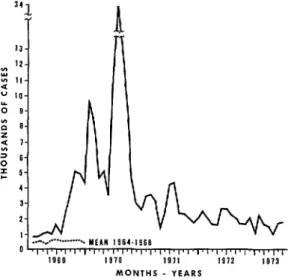
Beginning in August 1969, the number of reported clinical cases of dysentery in El Salvador began to far exceed that anticipated from previous years. Figure 1 shows the num- ber of reported cases from January 1969 to June 1973 and, for comparison, the mean number of reported cases that occurred be- tween 1964 and 1968. In the five-year period before the epidemic the average monthly inci- dence of dysentery was 522 cases. Usually the number of reported cases of enteric disease declines with the start of the dry season in October, but in late 1969 the dysentery count continued to rise. In February it reached an initial peak of over 9,000 reported cases, a level 1.5 times greater than that preceding the epi- demic. Then, after a brief respite in the early months of 1970, a very high peak of 33,822 reported cases occurred in July. However, this was followed by a period of sharp decline, resulting in a monthly case count for December
1970 of only 2,778. Overall, the national
FIGURE l-Reported dysentery cases in El Salva- dor (all etiologies) showing the monthly figures for
1969-1973 (solid line) and the mean monthly fiires for 1964-1968 (broken line).
MONTHS - YEARS
Source: Weekly Epidemiologic Summary,
1964-1973. Division of Epidemiology, Department of
Health of El Salvador.
dysentery morbidity rate for 1970 was 319.4 per 10,000 inhabitants, as compared to a mean rate of 26.5 for the five-year period preceding the epidemic.
During 197 1 there was a relatively low mean monthly case count of 2,800. Then in 1972 and the first 6 months of 1973 the mean number of cases reported per month fell even further, to 1,828 and 1,591, respectively. A total of 197,020 dysentery cases were reported in the four-year period beginning in July 1969 and ending in June 1973.
22 PAHO BULLETIN . Vol. VII, No. 4, I973
The seasonal distribution of dysentery cases from 1970 to 1973 was similar to that of general enteric disease before the epidemic; i.e., peak counts occurred in the rainy months of June, July, and August and were followed by declining counts during the dry season. This pattern contrasts with the initial rise in the dysentery rate that accompanied the outbreak during the relatively dry months of October, November, and December of 1969.
Mortality
Dysentery deaths in El Salvador are recorded as being due to amoebic, bacterial, or unspeci- fied etiologies. Data for deaths of unspecified etiology were tabulated together with those due to enteritis and other diarrheas and could not be separated for purposes of this report. How- ever, deaths reported as being due to amoebic and bacterial dysentery increased greatly in
1969 and 1970 (Figure 2) and then declined in 1971 and 1972. In 1969 a total of 608 amoebic and bacterial dysentery deaths (18.3 per
100,000) were reported to the Department of Health Statistics, as contrasted with a mean of 123 deaths per year (4.1 per 100,000) for the preceding five-year period. This total rose fur- ther-to 990 deaths in 1970-before falling back in succeeding years. In 1971 and 1972, respectively, only 164 and 149 dysentery deaths were reported.
Reported deaths from enteritis and other diarrhea diseases (including unspecified dysen- tery) likewise rose with the epidemic, reaching a rate of 175.7 deaths per 100,000 in 1970 as compared to 56.5 for the pre-epidemic years 1964-1968. Since the incidence of non-dysen- tery diarrhea cases in 1969-72 was relatively similar to the incidence in previous years (6), most of the reported increase in enteritis and other diarrhea deaths was probably caused by the Shiga bacillus. Because less than 35 per cent of the death certificates filed in El Salvador are completed by physicians, many deaths due to Shiga bacillus may have been recorded as due to dysentery of unspecified etiology or enteritis (7). Combining diarrhea1 and dysenteric deaths,
FIGURE 2-Reported amoebic and bacterial dysen- tery deaths in El Salvador, showing the monthly figures for 1969-1973 (solid line) and the mean monthly figures for 1964-68 (broken line).
110 - I60 - 150 -
140 -
130 -
100 - 90 - ; 2 to- 2
70 -
60 - 50 - 40 _ 30 -
MONTHS - YEARS
Source: Division of Health Statistics, Department
of Health of El Salvador.
subtracting the 1964-1968 mean, and allowing for 3.6 per cent annual population growth, there were 1,779 “excess” diarrhea1 and dysen- teric deaths in 1969, 5,191 in 1970, 2,220 in 1971, and 2,382 in 1972.
Of the 1,721 amoebic and bacterial dysen- tery deaths reported nationally from 1969 to 1971, 45.9 per cent occurred in children under 5 years of age and 23.3 per cent occurred in persons 50 years of age or more. The mortality rates for these groups were 125.0 and 120.9 per
Y
1
4
3
‘(r
k
were quite similar. Males accounted for 57 per cent of all dysentery deaths, both in the pre-epidemic period 1964-1968 and during the epidemic years 1969-1971.
Case-fatality ratios for Shiga dysentery de- clined markedly in late 1969 with the in- creasing utilization of appropriate antibiotics. The Rosales Hospital case-fatality ratio, for example, dropped from 2 1.8 per hundred in 1969 to 6.6 per hundred in 1970.
Discussion
What will be the future course of this disease in El Salvador? The Shiga bacillus has persisted at low levels in Central America since the early part of the century, a fact already documented by a few scattered studies. In 1914 and 1915 a large Shiga bacillus epidemic in El Salvador resulted in 2,779 recorded deaths (8); small localized outbreaks occurred in Honduras in
1928 (9) and in Guatemala in 1960 (10); and serologic surveys in different areas of Guatema- la in 1966 showed Shiga bacillus positivity rates of between 0 and 4.4 per cent (II), attesting to the endemicity of the disease.
Several previously noted interrelated factors have probably contributed to the re-emergence of epidemic dysentery in Central America (I, 2, 4). First, the organism itself has changed, as reflected by the fact that pre-epidemic strains were sensitive to tetracycline and chloram- phenicol while those causing the epidemic were resistant to these antibiotics. Second, a suscep-
tible, previously unexposed human population had grown tremendously. And third, the mo- bility of this population over recently con- structed roads contributed to rapid spread of the disease. These factors, taken together, probably explain why the epidemic occurred and why it was so severe.
Conclusions
Since the height of the epidemic in 1969-1970, dysentery mortality and morbidity, as well as isolations of the Shiga bacillus, have steadily decreased. It thus appears likely that the Shiga bacillus may again revert to low endemic levels, even though morbidity, mortal- ity, and Shiga bacillus isolations are still far above pre-epidemic rates.
One can only speculate about the reasons for this sudden decline of the Shiga bacillus in El Salvador. Dr. Shiga himself admitted in 1936 that the reasons for the previous disappearance of the Shiga bacillus were obscure (12). Perhaps the organism has become attenuated and has lost its startling epidemic potential. Considering the very high attack rates which occurred, it is also possible that the number of susceptible persons has dropped below the critical level necessary to maintain the disease at epidemic strength. In other words, a combination of parasite and host factors could be responsible for causing the disease to revert to an endemic state.
SUMMARY A large epidemic, part of a Central American
pandemic of dysentery, began in El Salvador in July 1969, peaked in July 1970, and then declined to near-endemic levels in 1973. The epidemic was caused by the previously rare Shiga bacillus (Shigella dysenteriae, type 1); this organism was highly virulent and proved to have multiple resistance to antibiotics. During the peak month of July 1970, 33,822 cases of dysentery were reported. This contrasts with a pre-epidemic dysentery case count of about
24 PAHO BULLETIN . Vol. VII, No. 4, I973
REFERENCES (I) Mata, L.J., E.J. Gangarosa, A. Ca’ceres, D.R.
Perera, and M.L. Mejicanos. “Epidemic Shiga Bacillus Dysentery in Central America; I. Etiologic Investigations in Guatemala, 1969.” J. InfectDis 12.2: 170-180, 1970.
(2) Gangarosa, E.J., D. R. Perera, L.J. Mata, Mendi- zribal Morris, G. Guzman, and B.L. Reller. “Epidemic Shiga Bacillus Dysentery in Central America; II. Epidemiologic Studies, 1969.” J Infect Dis 122: 181-190, 1970.
(3) Kostrzewski, J., and H. Stypulkowska-Misiure- wicz. “Changes in the Epidemiology of Dysen- tery in Poland and the Situation in Europe.” Arch Imm Ther Exp 16: 429-451,1969. (4) Reller, B.L., E. Navarro, R. Masferrer, M. Bloch,
and E. J. Gangarosa. “Epidemic Shiga Bacillus Dysentery in Central America. Evolution of the Outbreak in El Salvador 1969-1970.“Am J Trop Med Hyg 201 934-940, 1971.
(5) Instituto de Nutrici6n de Centro America y Panama (INCAP). Evaluation nutritional de la poblacidn de Centro America y Panama: El Salvador. Guatemala City, Guatemala, 1969, pp. 109-l 14.
(6) Faith, G.A., E. Navarro, and E. J. Gangarosa. “An Epidemiologic Analysis of the Dysentery
Epidemic in El Salvador, 1969-1971.” Revista de1 Instituto de Investigaciones Medicas I:
116-140, 1972.
(7) Ministerio de Economia, Direction General de Estadistica y Censos. Anuario estadistico 1968: Vol. II. Demografia, salud. San Salva- dor, El Salvador, 1969.
(8) Rivera, A.A. Tksis de doctoramiento: Apuntes sobre la disenteria bacilar epidemica de 1915 en la Republica de El Salvador. San Salvador, El Salvador, 1916.
(9) Whitaker, E.J. “El carbon de madera en el tratamiento de la disenteria bacilar.” Revistu Medica Hondureiia 1: 24-25, 1930.
(IO) Gordon, J.E., W. Ascoli, V. Pierce, A. Guzmin, and L. J. Mata. “Studies of Diarrhea1 Diseases in Central America; VI. An Epidemic of Diarrhea in a Guatemalan Highland Village.” Am J Trop Med Hyg 14: 404-411,1965. (II) Mata, L.J., A. Ca’ceres, and M.F. Torres. “Epi-
demic Shtga Dysentery In Central America.” Lancet 1: 600-601, 1971.
(12) Shiga, K. ‘The Trend of Prevention, Therapy and Epidemiology of Dysentery Since the Discovery of Its Causative Organism.” New Eng J Med 215. 1205-1211.