MEATING POINT, THE DEVELOPMENT OF A NEW
CULINARY CONCEPT IN BORDEAUX
Kim Phei-Linn Hoeu
Development of an innovative business plan submitted as partial requirement for the conferral of
Master’s in International Management
Supervisor:
Prof. Reiner Bernard Arnold Starink
Co-supervisor:
Prof. António Augusto da Silva, ISCTE Business School, Departamento de Marketing, Operações e Gestão Geral
M
EA
T
IN
G P
OI
N
T,
THE
DE
V
EL
OP
M
EN
T OF
A
N
E
W C
U
L
IN
A
R
Y
C
O
N
C
E
P
T IN
BO
R
D
E
A
U
X
Ki
m
P
hei
L
inn
H
o
eu
I
Acknowledgments
I would like to express my recognition and gratitude to all the people who contributed and helped me in my personal and professional growth during my studies at Kedge Business School and ISCTE Business School.
I would like to show my appreciation to all the professors I had the chance to study with. They brought us knowledge and insights of the business world and its surrounding. I would like to express my gratitude to Reiner Bernard Arnold Starink, my advisor, and to Antonio de Silva Robalo, my Co-Advisor with whom I had the chance to work on my entrepreneurial skills by working on a business plan. I would also like to thank Joao Marques Guerreiro, Joao Carlos Menezes, Boris Lezhava, Ma Shaozhuang, Jorge Guzman, Pedro Fontes Falcao, and Elisabeth Reis. They all strived for the development of their students’ interpersonal skill and helped them to get out of their comfort zone.
Furthermore, studying at Kedge Business School, Kozminski University and ISCTE-IUL required more than just academic support. Indeed, I could not have been through that without the wise advice, listening and understanding of people that are either friends, family or acquaintances. Primarily, I would like to thank Etienne Jonquière, Laurent Jonquière, Aurélien Delsuc, Harmony Boda, Marion Gilles, Nicolas Songeur, Sarah Baglione, Camille Calassou, Camille Supery, Lucie Blanchard, Isabel Riley, Chloé Chauvel and Léopoldine Canétos for their friendship but also for their personal and professional support during my studies.
Finally, and most importantly, my family has shown great support and encouragement. I would like to express my countless gratitude and acknowledgement to my mother, Eam Pheng Hoeu, and father, Peng Hong Hoeu, without whom I would not be where I am today. But also, to my sisters Kim Davy and Kim Leng Hoeu, to my brother-in-law Edouard Gaury and to my cousins Annie Lim, Victor Ea, William Ea and Marc Mehenni for their endless love, caring and support.
II
Abstract
English version
This paper presents the development of an innovative business plan with the creation of a new restaurant concept in Bordeaux, France. The purpose is to offer a new concept that does not exist in Bordeaux yet: cooking meat of fish on individual sizzling volcanic rocks. Located in the heart of Bordeaux, the restaurant, called Meating Point, aims to propose a memorable experience from the food to the service quality and general atmosphere. Regarding the food and drinks, all the products used are fresh and of high quality, and most of them local and seasonal. Meating point does its best to support local businesses and reduce its CO² emissions.
To assess the industry, a market analysis was built to better understand its business environment. Then, to know if this project entices people and is viable, a survey was conducted on 100 participants worldwide. 64% of the respondents were interested to highly interested in this project and showed great enthusiasm.
To attract and retain customers, the establishment of a virtual presence is necessary with a website and social media fan pages such as Facebook and Instagram in order to interact with customers and followers.
Additionally, the prices offered are within the spending range of the participants. By having control over the production costs, it is possible to operate a high margin to cover the initial investments. With a weekly occupancy of 91%, the breakeven point is reached in only 29 weeks, which means that from this point Meating Point is profitable.
Key words: Restaurant, Concept, Sizzling volcanic rocks, Experience. JEL: C83, L83
Portuguese version
Este trabalho apresenta o desenvolvimento de um plano de negócios inovador com a criação de um novo conceito de restaurante em Bordeaux, em França. O objetivo é oferecer um novo conceito que ainda não existe em Bordeaux: cozinhar carne de peixe em rochas vulcânicas escaldantes individuais. Localizado no coração de Bordeaux, o restaurante, chamado Meating Point, tem como objetivo de propor uma experiência memorável desde a
III
comida até a qualidade do serviço e a atmosfera geral. Em relação aos alimentos e bebidas, todos os produtos utilizados são frescos e de alta qualidade, sendo a maioria local e sazonal. O ponto de aquecimento faz o melhor possível para apoiar os negócios locais e reduzir as suas emissões de CO².
Para avaliar a indústria, uma análise de mercado foi construída para perceber melhor o seu ambiente de negócios. Então, para saber se este projeto irá atrair pessoas e se for viável, uma pesquisa foi realizada com 100 participantes em todo o mundo. 64% dos entrevistados estavam interessados no projeto e demonstraram grande entusiasmo.
Para atrair e reter clientes, o estabelecimento de uma presença virtual é necessário com um site e páginas de fãs de mídia social, como Facebook e Instagram, para interagir com clientes e seguidores.
Além disso, os preços oferecidos estão dentro do intervalo de gastos dos participantes. Para ter o controle sobre os custos de produção, é possível operar uma margem alta para cobrir os investimentos iniciais. Com uma ocupação semanal de 91%, o ponto de equilíbrio seria alcançado em apenas 29 semanas, o que significa que, a partir deste ponto, o Ponto de Concentração é lucrativo.
Palavras-chave: Restaurante, Conceito, Rochas vulcânicas escaldantes, Experiência. JEL: C83, L83
IV
Table of contents
Acknowledgments ... I Abstract ... II English version ... II Portuguese version ... II List of Tables ... VII 1 Executive Summary ... XI English version ... XI Portuguese version ... XI 1.1 Business Objectives ... XII 1.2 Mission Statement ... XII 1.3 Keys to Success ... XIII2 Company Description ... 14
2.1 Ownership and legal form ... 14
2.2 Start-Up Summary ... 14
2.3 Location and Facilities ... 15
3 Services ... 16
3.1 Concept ... 16
3.2 Services ... 17
3.3 Sample menu ... 18
3.4 Daily Operations and Production ... 19
3.5 Competitive Comparison ... 20 3.6 Suppliers ... 21 3.7 Administrative Systems ... 26 4 Market Analysis ... 27 4.1 Industry Analysis ... 28 4.1.1 Market Size ... 29 4.1.2 Market Growth ... 29 4.1.3 Industry Participants ... 30 4.1.4 Main Competitors ... 30 4.1.5 Market Segments ... 31 4.1.6 Market Trends ... 32
V
4.2.1 Methodology ... 34
4.2.2 Market sample ... 34
4.2.3 Market Sample Eating Habits ... 36
4.2.4 Market Needs ... 38
4.2.5 Market Test ... 39
4.3 Positioning ... 43
5 Marketing Strategy and Implementation ... 45
5.1 SWOT analysis ... 45
5.1.1 Strengths ... 45
5.1.2 Weaknesses ... 46
5.1.3 Opportunities ... 46
5.1.4 Threats ... 47
5.2 Unique Selling Proposition (USP): Meating Point – A Place to Remember ... 47
5.3 Competitive Edge ... 49
5.4 Marketing Strategy and Positioning ... 49
5.4.1 Positioning Statement ... 50
5.4.2 Pricing Strategy ... 50
5.4.3 Promotion and Advertising Strategy ... 51
5.4.4 Website ... 52 5.5 Sales Strategy ... 53 5.5.1 Sales Forecast ... 53 5.5.2 Sales Programs ... 54 5.6 Legal ... 54 5.7 Milestones ... 54
6 Organization and Management ... 56
6.1 Organizational Structure ... 56 6.2 Management Team ... 56 6.3 Personnel Plan ... 56 7 Financial Plan ... 58 7.1 Important Assumptions ... 58 7.2 Start-Up Costs ... 59
7.3 Source and Use of Funds ... 61
7.4 Average Cost and Spending ... 62
VI
7.6 Hourly Labour Schedule ... 65
7.7 Break-Even Analysis ... 66
7.8 Projections ... 67
7.8.1 Projected Profit and Loss ... 68
7.8.2 Projected Balance Sheet ... 69
7.8.3 Projected Cash Flow ... 70
7.9 Business Ratios ... 71
7.10 Assumptions versus Reality ... 72
8 Can we launch Meating Point? ... 74
9 Bibliography ... 75
VII
List of Tables
Table 1 - France restaurants industry value: € billion, 2010-2014 ... 27
Table 2 - France restaurants industry value forecast: € billion, 2014-2019 ... 27
Table 3 - France restaurants industry category segmentation: $ billion, 2014 ... 31
Table 4 - Population by age groups in Bordeaux ... 32
Table 5 - Spending repartition by age groups... 38
Table 6 - Annual Sales Forecast ... 53
Table 7 - Meating Point's milestones ... 55
Table 8 - Start-up Costs ... 60
Table 9 - Source and Use of Funds ... 62
Table 10 - Loan Repayment ... 62
Table 11 - Panel of customers ... 63
Table 12 - Average Costs and Prices per Individuals ... 63
Table 13 - Weekly Sales Projections ... 64
Table 14 - Hourly Labour Projection ... 66
Table 15 - Break Even Analysis ... 67
Table 16 - Pro Forma Profit and Loss ... 69
Table 17 - Pro Forma Balance Sheet ... 70
Table 18 - Pro Forma Cash Flow ... 71
Table 19 - Ratio Analysis ... 72
List of Figures
Figure 1 - Volcanic rock example ... 81Figure 2 - Sample menu ... 82
Figure 3 - Logo ... 82
Figure 4 - Business card ... 83
Figure 5 - Restaurants in Bordeaux ... 83
Figure 6 - Salads' prices at Coeur de Frais ... 84
Figure 7 - Oak-leaf salad price at La Compagnie Fermière ... 84
Figure 8 - Batavia salad price at La Compagnie Fermière ... 85
Figure 9 - DINERA plate (30x20 cm) ... 85
Figure 10 - LERHAMN table for two (74x74 cm) ... 85
VIII
Figure 12 - NORDMYRA chair ... 86
Figure 13 - VARDAGEN glasses (20cL) ... 86
Figure 14 - SVALKA wine glasses (30cL) ... 87
Figure 15 - HEDERLIG champagne glasses (22cL) ... 87
Figure 16 - OANVÄND beer glass (63cL) ... 87
Figure 17 - KARAFF water jug (1L) ... 87
Figure 18 – Shunstone’s volcanic rock cooking set details ... 88
Figure 19 - Volcanic rock cooking set prices ... 88
Figure 20 - Colt Cola details ... 88
Figure 21 - Café Regus' invoice ... 89
Figure 22 - Leading foodservice companies in France in 2017, based on net sales (in million euros) ... 90
Figure 23 - Social Security and unemployment contribution rates ... 91
Figure 24 - Example of a pay slip ... 92
Figure 25 - Le Pressoir des Chartrons juices' prices ... 92
Figure 26 - Entrecôte under vacuum ... 93
Figure 27 - Entrecôte price ... 93
Figure 28 - Sunflower oil price for 25 litres ... 93
Figure 29 - Blanc de Boeuf price for 1kg ... 94
Figure 30 - The evolution of French people' eating behaviours ... 94
Figure 31 - Industry turnover in 2016 in million euros ... 95
Figure 32 - Enterprises deaths between 2011 and 2016 ... 95
Figure 33 - Enterprises births between 2011 and 2016 ... 95
Figure 34 - Percentage of newly born companies that survived or failed their first year ... 96
Figure 35 - Brasérade, an individual charcoal barbecue at La Meule du Berger ... 96
Figure 36 - Main dishes à la carte at L'encoche Yakiniku ... 96
Figure 37 - Japanese barbecue menu at L'encoche Yakiniku ... 97
Figure 38 - Japanese barbecue at L'encoche Yakiniku ... 97
Figure 39 - Maison Darnauzan's entrecôte ... 97
Figure 40 - Maison Darnauzan's barbecue ... 97
Figure 41 - Maison Darnauzan's sides and sauces ... 98
Figure 42 - Le Grill Bordelais’ main dishes ... 98
Figure 43 - Le Grill Bordelais' barbecue in a chimney ... 98
IX
Figure 45 - Restaurants' revenue forecast ... 99
Figure 46 - Facebook's statistics for professional pages ... 100
Figure 47 - Instagram's statistics for professional pages ... 101
Figure 48 - Daily penetration rate of social networks in France in 2018-2019, by platform ... 102
Figure 49 - Forecast of the number of social media users in France from 2015 to 2022 (in millions) ... 102
Figure 50 - Promoting a Page on Facebook ... 103
Figure 51 - Cash Register ... 104
Figure 52 - Fees to have a domain at Wix ... 104
Figure 53 - Meating Point's website, desktop version ... 107
Figure 54 - Meating Point's website, mobile version ... 109
Figure 55 - Google Form's data collection ... 110
Figure 56 - Participants' profile ... 110
Figure 57 - Participants' nationality ... 110
Figure 58 - Participants' age ... 110
Figure 59 - Participants' meat consumption in a week ... 111
Figure 60 - Participants' eating out frequency ... 111
Figure 61 - Participants' eating out habits ... 111
Figure 62 - Participants' menu preferences ... 111
Figure 63 - Participants' spending on meals ... 112
Figure 64 - Participants' interest in the launch of Meating Point ... 112
Figure 65 - Participants' preferences regarding meat options ... 112
Figure 66 - Participants' opinion about having the option to cook fish on sizzling volcanic rocks ... 113
Figure 67 - Participants' knowledge about the Place Saint Michel in Bordeaux ... 113
Figure 68 - Participants' who know Place Saint Michel and their preferences in spending time there or not ... 113
Figure 69 - Participants' preferences for Meating Point's menu ... 114
Figure 70 - Participants' opinion regarding the addition of starters ... 114
Figure 71 - Participants' opinion regarding Meating Point's prices ... 114
Figure 72 - Spending by age groups ... 114
Figure 73 - Comparison between two menus' design (Menu 1 on the left and Menu 2 on the right) ... 115
X
Figure 74 - Leasing details ... 116
Figure 75 - Meating Point's educational poster ... 117
Figure 76 - Metro's oven ... 117
Figure 77 - Metro's refrigerated counter ... 117
XI
1 Executive Summary
English version
Meating point is an innovative and original restaurant that does not exist in Bordeaux yet. Indeed, we offer the concept of cooking your own delicious and tender piece of entrecôte, meat or fish of the day on a sizzling volcanic rock. The main will be accompanied with homemade sides and sauces made from high-quality, fresh, and mostly seasonal and local ingredients. We will have a set menu that will change seasonally and suggestion boards to offer variety to the customers that will be moderately priced. Meating Point will offer high quality table service to 40 seats within a cosy atmosphere where the customers will feel at ease.
Meating Point will be an SARL (Société à Responsabilité Limitée) which is the Limited Liability Company equivalent. It will be owned by Kim Phei Linn Hoeu and the Head Chef. We would both have several years of experience on the restaurant industry.
We will be leasing premises of 125 square metres located in the neighbourhood Saint Michel situated in the heart of Bordeaux. In this property, we have to possibility to install an extraction to run a restaurant. The premises are unfurnished so we will need to install all the kitchen appliances and do the interior design of the restaurant. The decor of the restaurant will feature wood accentuated furniture that are white and brown.
The sales projections foresee 439 customers weekly which would represent weekly sales of 11 160,47€ and therefore, 580 344,83€ for the first year. The fixed costs amount to 319 778,30€ in total with 15 000€ from our own personal investment. The remaining amount will be from a secured bank loan.
Portuguese version
Meating point é um restaurante inovador e original que ainda não existe em Bordeaux. De fato, oferecemos o conceito de cozinhar sua própria deliciosa e tenra peça de entrecosto, carne ou peixe do dia numa rocha vulcânica escaldante. O prato principal será acompanhado de acompanhamentos caseiros e molhos feitos com ingredientes frescos, de alta qualidade e principalmente sazonais e locais. Teremos um menu que mudará sazonalmente e os painéis de sugestões para oferecer variedade aos clientes que terão preços
XII
moderados. O Meating Point oferecerá um serviço de mesa de alta qualidade para 40 lugares num ambiente aconchegante, onde os clientes se sentirão à vontade.
Meating Point será uma SARL (Société à Responsabilité Limitée) que é o equivalente de uma Sociedade de Responsabilidade Limitada. O restaurante será propriedade de Kim Phei Linn Hoeu e do Chefe de Cozinha. Nós dois teríamos vários anos de experiência na indústria de restaurantes.
Estaremos alugando instalações de 125 metros quadrados, localizado no bairro Saint Michel, situado no centreo de Bordeaux. Nesta propriedade, teremos a possibilidade de instalar uma extração para executar um restaurante. As instalações são sem mobília, pelo que teremos de instalar todos os utensílios de cozinha e fazer o design interior do restaurante. A decoração do restaurante contará com móveis de madeira acentuada de cores brancas e marrons.
As projeções de vendas prevêem 439 clientes por semana, o que representaria vendas semanais de 11 160,47 € e, portanto, 580 344,83 € no primeiro ano. Os custos fixos ascendem a 319 778,30 € no total, com 15 000 € a partir do nosso investimento pessoal. O valor restante será de um empréstimo bancário garantido.
1.1 Business Objectives
The business plan’s key objectives for Meating Point are the following: > To become the leading home-style restaurant in Bordeaux
> To deliver high quality, fresh, and mostly local and seasonal meals for a reasonable price
> To offer excellence services
> To have a yearly increasing turnover 1.2 Mission Statement
Meating Point’s mission is to create a memorable and innovative cooking experience that will make the customers feel at ease, as if they were at home. To do that, we created a cosy atmosphere where they can share pleasant moments. To offer our customers the best experience possible we will emphasize on our staff trainings in order to provide an excellent customer service. The employees will be able to answer any inquiries or needs.
XIII
We chose to offer an affordable minimalist menu with further options on suggestion boards to propose variety. It is crucial for us to provide high quality ingredients that are fresh, and mostly seasonal and local. We also made the choice to not sell popular mainstream drinks like Coca-Cola as we will do our best to support local businesses and short distribution channels to reduce our CO2 emissions.
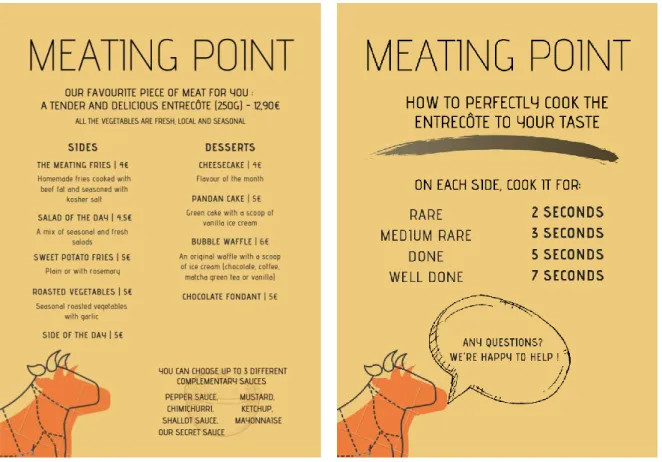
Moreover, we will share educational content on little boards that will be displayed on every table in the restaurants. The customers will be able to learn how to cook their meat perfectly to their taste. For instance, if they wish to have it rare, they should only cook it for two seconds on each side. For a medium rare, each side should be cooked for three seconds.
1.3 Keys to Success
Our keys to success are based on several factors. Indeed, if we are able to provide a satisfying experience to the customers, every client who came once should want to come back and recommend us. In this situation, our powerful allies are word of mouth, online feedbacks and social media platforms where individuals can share pictures. To maintain tasty and high-quality products, we will offer trainings to our staff to always keep them on top. Additionally, their wages will increase with their work experience within our premises. The location choice is also crucial for our business to be convenient and close to our target market segment. We want our customers to easily have access to our facilities, either by foot, public transportations or car.
14
2 Company Description
Meating Point is a home-style restaurant located in the heart of Bordeaux at Place Saint Michel, 25 Rue Gaspard Philippe – 33000 Bordeaux. The restaurant will be owned and ran by Kim Phei Linn Hoeu and the head chef. The restaurant will offer a unique and original concept of cooking meat or fish on sizzling volcanic rocks. The main will be accompanied with complementary homemade sauces and sides made from high-quality, fresh, and mostly seasonal and local ingredients. Likewise, we offer classic desserts and original one with an Asian twist. The drinks we sell at the restaurants are also from local businesses.
Meating Point will be open six days a week from Monday to Saturday for lunch and dinner. We will open from 12h to 14h and 19h to 22h.
2.1 Ownership and legal form
Meating Point will be owned and directed by Kim Phei Linn Hoeu and her work associate, the head chef. We both would have experience in the restaurant industry and business knowledge on how to smoothly run a company. I currently have a Bachelor’s degree in International Management specialised in Entrepreneurship and I am in progress of obtaining a double Master’s degree in International Management and Global Management. I started working in the restaurant industry in 2010 by working in my parents’ restaurant, Le Tri Délice. I worked in both in the kitchen and as a front of house. Today, my current position is Chef de Rang at Le Tri Délice. I oversee the support in the supervision and training of staff to ensure an excellent customer service experience is achieved. I also have an active contribution in the elaboration of innovative menus and monitoring the restaurant fan page on Facebook and Instagram.
Meating Point will be created as an SARL (Société à Responsabilité Limitée) which is the Limited Liability Company equivalent. Choosing the legal status SARL allows us to have advantages such as: the company can be created with little own capital and the associates’ responsibility is limited to the value of their contribution.
2.2 Start-Up Summary
To create the restaurant Meating Point, the fixed costs amount to 319 778,30€ in total. As the location is unfurnished, we need to install all the supplies and facilities required
15
to smoothly run the restaurant. All the work constructions that we can do ourselves will be carried out by us and our family and friends.
Regarding the start-up costs contribution, we will both invest 15 000€. Our source of funds come from our savings and donations.
2.3 Location and Facilities
Meating Point will be located in the heart of Bordeaux, at 25 Rue Gaspard Philippe – 33000 Bordeaux, in the Saint Michel neighbourhood, with a surface of 125 square metres. The premises are well located as it is easily accessible by foot, public transportations and car.
In 2015, Bordeaux had a population of 249 712 inhabitants mostly represented by people between 15 and 29 years old. The same year, the median household income amounted to 21 404€.
16
3 Services
In this part, we will present you our business plan idea with the explanation of the concept and services. We will also do a demonstration with a sample menu, and a description of daily operations and productions, our competitive comparison, suppliers and administrative system.
3.1 Concept
Meating point is a casual dining restaurant where customers can expect moderate prices with table service and a cosy atmosphere thanks to a unique, yet simple decor. The predominant colours would be brown and white thanks to the tables, and chairs. The restaurant is inspired from a concept seen in Lisbon, Portugal where customers cook sliced raw meat on sizzling individual volcanic rocks laid on a wooden board (see Figure 1 - Volcanic rock example).
The values of the restaurant are to serve high quality meat from France, more precisely entrecôte, which is the French steak rib equivalent, along with seasonal sides that mostly come from local markets or farmers. Our objective is to create a memorable and innovative experience of cooking sliced entrecôte on a sizzling volcanic rock that they cannot find anywhere else in Bordeaux. The volcanic rocks are heated in the oven at a high temperature to keep them hot long enough for the customers to enjoy their meal. After a certain time period, approximately 15 to 20 minutes, the rocks will cool down and if the clients are not finished cooking their meat, we will change their volcanic rock for a sizzling one. Thanks to this concept, it prevents having strong odours in the restaurant and on clothes.
We want our customers to leave the restaurant with a smile and a full satisfied stomach. The other key is to offer high-quality tasty products by respecting the seasons. This will allow us to have a menu that changes approximately every three months. Customers will be able to choose three different sauces to eat with the meat and sides. Thus, they will have the feeling that they can personalise the meal to their taste. Furthermore, the clients will be able to cook the meat the way they like it thanks to the hot volcanic rock, which will enhance their satisfaction. If they are not sure how to properly cook the meat, we will explain to them the different timings to respect depending on how they want their meat to be cooked.
17
Meating point’s menu is quite simple and straightforward as we only offer a main dish with different choices of sides, desserts and drinks. We will have suggestion boards where customers will be able to choose between two starters if desired, another choice of main to cook such as fish or duck for instance, and a side of the day. The part Sample menu will show in detail what is offered. The logo and restaurant card are in the continuum of the restaurant’s style. (see Figure 3 - Logo and Figure 4 - Business card). The address of the restaurant would appear at the back of the card.
The restaurant does not offer takeaway services because it requires a high number of containers and even if they are made from recycled material and compostable, there are still issues of garbage in the streets. We will have a limited number of takeaway boxes in order to prevent food waste for the customers who eat-in.
3.2 Services
Meating point provides table service with waiters and waitresses that will be formed by me. The customers will receive the best experience possible thanks to pleasant employees that will be polite and smiling. They will be able to answer questions from customers, either regarding the food or a personalisation of a drink for instance. If someone has an allergy or dietary requirements, the staff will be able to answer to the need, give alternatives if needed and in case of any doubt, they will ask the chef. During the meal, they will ensure that the consumer is having a good time and enjoying the food.
A typical meal would start with a warm welcome and sitting the customers either according to a plan or by seating preferences. The menus will be handed out and the waiters will let the clients know that they are available for any inquiries. Shortly after, someone will ask if they would like any drinks. Observation is key in the restaurant business to see if customers need anything and if we can provide help or what is needed even before the customers call us. Then, when we feel that they are ready to order we will take it. The order will be sent in the kitchen following a chronological order. There will be one sheet for the cooks and one for the waiters in order to keep track of the orders and what has been served or not. Once an order is complete, the waiters can hang the order papers on a different board. The restaurant will take reservations through phone calls and also accept people who come to the restaurant without reservations if there is still space. By accepting reservations, we can organize better a sitting plan and sometimes we can organise the service in two
18
services with time constraints when necessary. The aim is to have customers who become regulars thanks to a relationship built through time and enjoyable experiences.
3.3 Sample menu
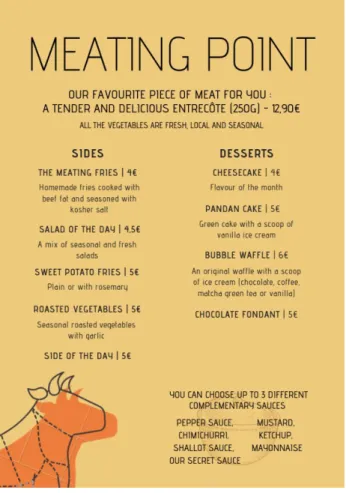
The menu is simple and straightforward. If customers have any questions, every staff member will be able to answer them. The concept of the restaurant is that we selected the best piece of beef to be cooked on a volcanic rock, which is the entrecôte (rib steak equivalent) for 12,90€. However, the meat is cooked, whether is it rare or well cooked, it will stay tender and tasty. The customers will only need to choose the sides they desire with a price range between 4€ and 5€. They can pick sweet potato fries, either plain or with rosemary, roasted vegetables, a salad or the side of the day. Then, they can select up to three different sauces to go along with the meat and sides. We offer the following ones: pepper sauce, chimichurri, shallot sauce, our secret sauce, mustard, ketchup, mayonnaise. To offer more variety without burdening the menu, we will offer another meat of fish of the week presented on a suggestion board. To offer more variety to our customers, we will also offer different starters, main and side of the day on our suggestion boards. To make it easier for the customers, we also created a little educational poster where clients can learn how to perfectly cook the entrecôte to their taste.
To finish the meal, the customers can choose between four different desserts ranging between 4€ and 6€. They can either pick a cheesecake (flavour of the month), a pandan cake, a bubble waffle or a chocolate fondant. Every side of the day or flavour of the month will be displayed on a chalkboard.
19
Figure 2 - Sample menu Figure 75 - Meating Point's educational poster
3.4 Daily Operations and Production
In any business, it is crucial to be organised and plan daily operations and production correctly. Indeed, without a shift timetable, checklist, weekly checking of the stocks or ordering schedules, a business will have difficulty to run smoothly on a daily basis.
Meating point will be open 6 days a week for lunch from 12h to 14h and diner from 19h to 22h which will require multiple shifts. I will oversee the planning of shifts for the front of the house employees and, my partner, the head chef will take care of the back of the house ones. However, we will always consult each other to have matching agendas and have transparent communication. The schedules will be created in a way that will allow us to increase or decrease hourly labour in accordance with the restaurant’s busyness and its sales volume to maintain a steady labour cost control.
We will check daily that we have enough fresh high-quality products to meet the demands during peak business hours. It will take some time to have an estimation and overview of the restaurant’s busyness during the week and weekend. To facilitate our working conditions and to be more efficient, proper labelling and rotation techniques will be applied. Furthermore, during off peak business hours, employees will take care of
20
replenishments and ongoing preparation for the following service. It would be between 10h-12h, 14h-16h and 18h-19h.
The head chef and I will be in charge for ordering, receiving and maintaining enough inventory to meet production demands. To do that correctly and to have constant fresh products, such as the meat and the seasonal vegetables, we will order multiple times a week. Regarding standard grocery, such as oil, and non-perishable products, orders and going shopping will be less often depending on the flow of the stocks. The front of the house staff is responsible for keeping track of the non-perishable quantities and will warn me when there are only three items left of them. It is important to take into consideration the storage capacity to have enough and not be packed either.
To ensure that the restaurant stays clean, is always ready to welcome customers and prepared for the services, an operational checklist that includes clean up, restocking and preparation is handed to every employee. It will allow them to have a clear vision of their mission and to be able to verify that nothing is missing. The restaurant layout, from the dining room to the kitchen, is designed for a maximised efficiency and flexibility to accommodate the variation of customers and peak meal periods.
3.5 Competitive Comparison
Restaurants are under the “Restaurants & Nightlife – NAF 56” industry according to the French NAF (Nomenclature d’activité française). (Staffa & Sánchez, 2018) The NAF indicates the main activity of a company and was elaborated for the purpose of harmonising Europeans nomenclatures with the main objective to improve the transparency of economic information. More precisely, the code for “traditional restaurants” is 56.10A that regroups full services at the table in establishments, food truck services and similar services on boats. (Michaud, Chemarin, & Césard, 2018)
In 2016, the traditional restaurant industry in France gathered 73 450 listed restaurants, which represents 30 352k€ of sales revenue. (Michaud, Chemarin, & Césard, 2018) The same year, Bordeaux counted one restaurant for 285 inhabitants which represented in total of 2 749 restaurants with 1 396 traditional restaurants and 1 353 fast-food restaurants (see Figure 5 - Restaurants in Bordeaux) Between 2015 and 2016, more than 340 establishments opened in the city. (Mairie de Bordeaux, 2017)
21
In Bordeaux, there are many restaurants specialised in meat and grilled meat but there are very few with individual volcanic rocks. Today, there is only one restaurant that has a similar service in Bordeaux. It is called Cromagnon and offers one main dish called “Le Carnivore” which is a dish with Galician beef that people can cook on a Himalayan salt rock for the price of 25€. (Cromagnon, 2019) We will see the competitors in further details in part
Main Competitors.
3.6 Suppliers
Different suppliers will be used depending on our needs and the quality of the products offered. We will favour food markets that offer fresh, seasonal, and local products as this will allow us to have tastier products. Furthermore, privileging short cycles is also better for the local economy.
Regarding the vegetables, our main suppliers will be:
> Cœur de Frais: is a greengrocer that opened in 2016 in the southwest of France (Cœur de frais, 2019). Today, the company has four shops where they offer fruits, vegetables and fresh products originating mostly from local producers. The prices are highly interesting as they are very competitive. For instance, whole salads such as the Batavia or the Oak-leaf are at 1,05€ at the supermarket Auchan, (Auchan Drive, 2019) at 0,99€ at Carrefour, (Carrefour, 2019) and respectively 1,05€ and 0,99€ at Leclerc. (E.Leclerc, 2019) On the other hand, Cœur de Frais sells them for 0,75€ (see Figure 6 - Salads' prices at Coeur de Frais). The company offers a loyalty card for individuals that can cumulate different advantages that will lead to a discount for groceries above 10€. There is also one version for professionals that provides a 10% discount on the total amount (Cœur de frais, 2019).
> Grand frais: is a bigger distributor as it has 133 stores (Grand Frais, 2019) across France since 1992 (Cieslinksi, 2019). It is inspired by the atmosphere and spirit of traditional covered markets by gathering a greengrocer, a global grocer, a butcher, a dairyman and a fishmonger. The company adapts its offer seasonally and favours short distribution cycles to sell mostly local and fresh products. Grand frais also offers exotic products ranging from fresh fruit and spices to condiments.
> La Compagnie Fermière: is a community market present in two locations, in Gradignan since 2012 and Mérignac since 2016. (La Compagnie Fermière, 2019) It
22
preaches the shortest distribution channel possible with fair prices thanks to direct selling and reduced fees that emit additional margins. Most of the products come from the Vallée de Garonne, situated in the southeast of Bordeaux.1 To compare the prices of the salads, La Compagnie Fermière sells the Batavia and the Oak-leaf for 0,80€ (see Figure 7 - Oak-leaf salad price at La Compagnie Fermière and Figure 8 - Batavia salad price at La Compagnie Fermière). The company does not have a loyalty card for individuals nor professionals.
About the meat supplier, we contacted many independent and local butcheries to support local businesses. However, they all redirected us towards the food wholesaler Metro as they were not able to support our high demand in entrecôte (rib steaks) on a weekly basis. Therefore, we will work with the butchery from Metro which sells local entrecôte from France. It will also allow us to have the most interesting prices. It is crucial to build a relationship with them in order to have a reliable and flexible supplier that will always provide fresh, high quality entrecôtes (rib steaks) on time. The advantage is that the meat will be in a vacuum packaging which helps maintaining the meat fresh for a longer time as it is not in contact with air. As an example, you can see on Figure 26 - Entrecôte under vacuum that the meat can be preserved for one month and a half. The other advantage is that it will be easier to control our stock and do the groceries. The prices of the Entrecôte varies during the year and is more expensive during summertime between end of June and September. Here the prices are at 16,99€ without VAT but can be at 9€ without VAT during the winter season (see Figure 27 - Entrecôte price).
To deep fry the fries and sweet potato fries we will use a mix of vegetable oil, such as the sunflower oil, with beef fat, called Blanc de Boeuf, to bring a subtle and original taste to the sides. Those products can be found at Metro for the prices of 32€ for 25 litres of sunflower oil and 3,32€ for one kilogram of beef fat (see Figure 28 - Sunflower oil price for 25 litres and Figure 29 - Blanc de Boeuf price for 1kg).
For the drinks’ suppliers, we chose to work with different ones depending on the soft drinks, juices and wines. We prefer to privilege working with local companies whose values fit with mine. The VAT on non-alcoholic drinks served in closed containers such as bottles or cans is at 5,5% in France. For non-alcoholic drinks to take away or for immediate
1 Ibid.
23
consumption such as in cups, the VAT is at 10%. The VAT for alcoholic drinks is at 20% (Service Public, 2018). For the non-alcoholic beverages, we chose four distinct companies:
> unaju: offers original and organic sparkling drinks made from fruits and plants that have been carefully selected. Their drinks are made without added flavours, colours, nor preservatives. Today, unaju offers nine different flavours going from kiwi and saffron to apricot and thyme and they come in two different sizes, either 25cL or 75cL (unaju, 2019). For the restaurant, we will choose the 25cL size at the price of 2€ without VAT (unaju, 2019).
> Le Pressoir des Chartrons: produces artisan fruit juices without any added sugar, water nor preservatives. The fruits come from local farms. All year long the company has four main flavours such as apple, pear, kiwi and grape (white or red) and depending on the seasons, they also offer different juices. The juices can come in three sizes, either 1L, 50cL or 25cL (Le Pressoir des Chartrons, 2019). For the restaurant, we will choose three 25cL flavours (apple, pear and kiwi) which are at the price of 0,97€ without VAT if we order by 32 pieces. As the bottles are returnable, 0,20€ will be deducted on the following order by number of bottles returned (see Figure 25 - Le Pressoir des Chartrons juices' prices).
> Brasserie d’Olt: offers different beverages such as beers, lemonades and colas. From this company, we are interested in their colas called Colt Cola that are made from natural vegetal extracts and without additives, preservatives nor colours(Brasserie d’Olt, 2019). The drink comes in two sizes, 27,5cL and 1L. For the restaurant, we will choose de 27,5cL size at the unit price of 1,003€ without VAT which means it is at 1,058€ with VAT. The delivery packaging for the 27,5cL bottles is by 24 bottles (see Figure 20 - Colt Cola details).
> Café Régus: is a family company from Bordeaux that selects and roasts the coffee beans itself. We will select the category called Régus Or at the price of 12€ without VAT for professionals (see Figure 21 - Café Regus' invoice). The advantage to use this company is that they do the delivery free of charge.
For the alcoholic drinks we will work with the company called MONDOWINE and change the wine selection depending on the seasonal sides we offer (Mondowine, 2019). We will also use the alcoholic products from Brasserie d’Olt such as a specific range of beers that combine well with the main.
24
The furniture and some tableware will be sourced from Ikea, using the Ikea business card. It is a fidelity card for professionals with different benefits such as reductions on a selection of products, a warranty for breakage and assembly, and the right to reconsider a purchase for 365 days (Ikea, 2019). From Ikea, the following products will be purchased as it fits with our vision of a low-key familial restaurant:
> Rectangular white plates for the mains, side dishes and desserts for 2,59€/unit (Ikea, 2019) (see Figure 9 - DINERA plate (30x20 cm)). The dimensions are ideal as everything needs to fit on the table, from the stone sets to the plates, cutlery and glasses. Regarding the cutlery, my parents are currently trying to sell their restaurants and plan to make a donation of all their cutlery to me.
> Two size matching tables for two or four people for respectively 69€ and 89€ (Ikea, 2019) (see Figure 10 - LERHAMN table for two (74x74 cm) and Figure 11 - LERHAMN table for four (118x74 cm)). The tables are white at the bottom with a light brown solid pine top. Having two different sizes for the tables will allow us to better play with the space management of the restaurant and to assemble them if there are groups.
> The chairs, which cost 39,95€, will be matching the tables in terms of colours and style (Ikea, 2019) (see Figure 12 - NORDMYRA chair). The advantage is that they are easy to store as we can stack them on top of each other.
> Water glasses made of tempered glass can also be used as soft drink glasses or even for hot drinks. The pack of six glasses costs 2,99€ so one piece is 0,50€ (Ikea, 2019) (see Figure 13 - VARDAGEN glasses (20cL)).
The wine glasses are large which allows the wine flavours to develop and are at 4,50€ for a set of six, which represents 0,75€ a glass (Ikea, 2019) (see Figure 14 - SVALKA wine glasses (30cL)).
The champagne glasses are in a high and elongated shape to preserve the bubbles and are at 1,99€ each (Ikea, 2019) (see Figure 15 - HEDERLIG champagne glasses (22cL)).
The beer glasses, that are at 1,99€ (Ikea, 2019) (see Figure 16 - OANVÄND beer glass (63cL)), have a tighten upper top in order to have a nice foam whereas the bottom part of the glass is long and thin to bring forward the flavours of the beer.
25
The 1L jugs of water are made of glass and cost 1,50€ each (Ikea, 2019) (see Figure 17 - KARAFF water jug (1L)).
Concerning the volcanic rock cooking sets’ supplier, we will use the Chinese company called Shunstone. It was created in 2009 as a professional provider engaged in the research and development, production, sale and services of different item such as steak stone cooking sets and stone crafts for instance (Shunstone, 2019). The set is composed of seven pieces: a bamboo base plate, a stainless-steel plate that goes under the lava stone, a ceramic dish and three little ceramic pots for the sauces (Alibaba, 2019) (see Figure 18 – Shunstone’s volcanic rock cooking set details). We will buy their sets through the online commerce company Alibaba as the prices are quite attractive including the shipping costs. Indeed, for an order of 100 sets, one set costs USD 24$ (21,46€) and the shipping cost for the total amount is at USD 1 450$ (1 296,63€). The sum of the sets and the shipping amounts to USD 3 850$ (3 442,57€) (see Figure 19 - Volcanic rock cooking set prices).
All the kitchen supplies and some interior decor appliances will be purchased at Metro. Some supplies, like the coffee machine and grinder, will also come from a donation that my parents will make due to the sale of their restaurant. From Metro, we will purchase the following supplies, with VAT included: an oven for 418,80€ (see Figure 76 - Metro's oven), an extractor hood for 624€, kitchen materials with a set of knife for 48,90€, chopping boards for 10,36€, and pans for 13,44€ and 15,48€. We will also need saucepans at 21,72€, mops at 9,98€, cloths at 5,59€, and dishcloths at 8,52€. Additionally, we will need a deep fryer at 415,20€, an electric furnace at 2 743,80€, a set of fridge and cabinets for 1 962,90€ (see Figure 77 - Metro's refrigerated counter), a fridge for the drinks at 478,80€, a dishwasher for 1 572€ and a glasswasher for 968,40€. The restaurant will also require machines to make the desserts, especially a bubble waffle machine at 859,20€ and a multifunction mixer/blender that we can use both for our desserts and sauces at 125,99€. TO preserve ice creams, we will also invest in a small freezer for the amount of 221,20€ (Metro, 2019).
For the card machine, we will buy it on VTPE for the price of 357,60€ with VAT (VTPE, 2019). For the cash register, we will buy it on JDC as it sells machines dedicated to restaurants for the price of 1 490€ without VAT (see Figure 51 - Cash Register).
26
3.7 Administrative Systems
Taking in consideration that we will be a limited number of staffs; it is essential for the restaurant Meating Point to be up to date with every daily cash expenses.
In order to do that efficiently, every spending will be recorded in an Excel sheet. This will also be useful in the following of the revenues throughout a report. The company will also need an accountant to make monthly balance sheets. We will carry out a daily cash control thanks to the sales and receipts that are recorded in the cash register. These will be compared to the actual cash and debit card deposits to make sure there are not over nor short amounts. We will accept discrepancies of maximum 5€ per day.
We will also ask the accountant to prepare a weekly prime cost report to have a better overview of the gross margin after cost of goods sold and labour costs have been deducted from the sales revenue. For a full-service restaurant, the ideal prime cost target is around 60% (Aber, 2017). Doing this will allow us to have a measure of our management’s performance on operating the restaurant. Regarding the wages, we will deliver them monthly at the end of the month by checks. A report will be created as a system to record time and attendances.
27
4 Market Analysis
The restaurant industry is based on the total sales of food and drink, which can be soft and alcoholic. Those can be consumed in restaurants, cafes, fast foods, drinking places such as bars or brasseries that are the French equivalent of pubs (MarketLine, 2015).
Between 2011 and 2014, the French restaurants industry endured a decline going from 76 57,3 to 54,6 billion euros (see Table 1 below).
Table 1 - France restaurants industry value: € billion, 2010-2014
However, between 2015 and 2019, the industry was expected to improve slowly of 1,5%. In further details, the French restaurants industry reached total sales of 65,13 billion euros in 2014 which represented a compound annual rate of change (CARC) of -0,4% between 2010 and 2014. However, the performance of the industry is expected to accelerate with an estimated compound annual growth rate (CAGR) of 1,3% between 2014 and 2019. This would lead the industry to a value of 58.2 billion euros by the end of 20192 (see Table
2 below).
Table 2 - France restaurants industry value forecast: € billion, 2014-2019
2 Ibid.
28
4.1 Industry Analysis
The scope of this analysis is based on the French NAF (Nomenclature d’activités française) whose code is NAF 56 for Restaurants & Nightlife. It involves food and beverage serving activities that deliver complete meals or drinks adequate for immediate consumption. It can be in traditional, self-service or take-away restaurants with or without seating (Staffa, Sánchez, 2018).
In this industry three subcategories exist to define in further details what the business status are:
> 56.1: Restaurants and mobile food services activities > 56.2: Event catering and other food service activities > 56.3: Beverage serving activities
After the economic crisis of 2008, households changed their consumptions habits by going less often to traditional restaurants offering full services. More recently, French people became more demanding regarding the quality of the products used, the service and atmosphere while continuing to make the price an essential criterion. In more details, there are five criteria that changed in French people’ eating behaviours:
> The race against the clock: the will to optimise time, as well as in their professional or personal lives. People are looking for time saving meals during lunch time as they have a limited time break.
> Appeal for healthy and qualitative meals: increasing preoccupations regarding health and dietary requirements encourage more and more consumers to go towards meals that look healthier or homemade.
> They seek an experience: it is more often that customers want to go to a restaurant to live an experience. It is not only about eating well, it is also about the setting, atmosphere, decoration and menu that are part of a concept.
> Awareness about the costs: customers always pay attention to prices. They are looking for the right balance between the quality, quantity and price while continuing to enjoy oneself.
29
> Trend to do things at home: it consists of staying at home to have an aperitif or a meal between friends and family. Having a homemade meal rather than going to the restaurant is more and more frequent (Michaud, Cheramin & Césard, 2018) (see Figure 30 - The evolution of French people' eating behaviours).
4.1.1 Market Size
In 2017 the industry revenue was estimated at 70,8 billion euros with a growth of +0,4% between 2016 and 2017. Between 2017 and 2022, the CAGR is expected to increase of +0,2%. From the latest data available from 2016, there were 218 796 companies is this industry with 771,2 thousand employees (Staffa, Sánchez, 2018).
Furthermore, restaurants and mobile food services activities accounted for 74,1% of the industry turnover which represented 52 213 million euros in 2016 (Staffa, Sánchez, 2018) (see Figure 31 - Industry turnover in 2016 in million euros).
Between 2011 and 2016 the restaurants’ deaths decreased by 21,1%. Indeed, it went from 17 348 deaths in 2011 to 13 681 in 2016. A death is defined as a business that was active in a year T but was no longer active in T+1 and T+2 (see Figure 32 - Enterprises deaths between 2011 and 2016). On the other hand, between the same years, the number of companies’ births increased by 21,8% going from 19 614 to 23 893. A birth is defined as a business that was present in year T but did not exist in years T-1 and T-2 (see Figure 33 - Enterprises births between 2011 and 2016). Additionally, the survival of newly born restaurants after the first year over time has increased between 2012 and 2016 going from 83,1% to 87,6% (see Figure 34 - Percentage of newly born companies that survived or failed their first year) (Staffa, Sánchez, 2018).
4.1.2 Market Growth
In 2017, the estimated total revenue of restaurants soared at 70,8 billion euros which represented a growth of 0,4% compared to 2016. For the period between 2017 and 2022, Statista expects revenues to rise by an annual average of 0,2% (see Figure 45 - Restaurants' revenue forecast). Employment numbers have also improved by 32,4% between 2015 and 2017 which resulted in 771,2 thousand employees earning an average salary of 25,6 thousand euros. In 2016, over 200 000 businesses were active in the industry and it was 1,6% above 2015 (Staffa & Sánchez; 2018).
30 4.1.3 Industry Participants
In 2017, the leading foodservice companies, based on net sales, were McDonald’s, the Goupe Bertrand that includes Burger King, Quick and Bert’s for instance, and Agapes that gathers Flunch, Amaerine, Pizza Pai and many more. Their net sales were respectively at 4 858, 1 719, and 757 million euros (Statista, 2017) (see Figure 22 - Leading foodservice companies in France in 2017, based on net sales (in million euros)).
4.1.4 Main Competitors
As written in part Competitive Comparison, the main competitor of Meating point is the restaurant Cromagnon that offers a dish with Galician beef that people can cook on a Himalayan salt rock for the price of 25€ (Cromagnon, 2019).
The other competitors offer a service with grilled meat only or with different types of cooking sets:
> La Meule du Berger: would be our second closest competitor as it offers “brasérades” which is an individual charcoal barbecue from Savoy (see Figure 35 - Brasérade, an individual charcoal barbecue at La Meule du Berger). Different meats, such as chicken, beef, and duck, can be cooked on it for the prices of 16€, 19€ and 21€. The dishes either come with potatoes or seasonal vegetables and a homemade sauce (La Meule du Berger, 2019).
> L’encoche Yakiniku: is a fusion restaurant of French and Japanese cuisine. They offer dishes à la carte and Japanese barbecue menus. For the main dishes à la carte, customers can choose between fish or meat and the entrecôte with chips are at 23€ (see Figure 36 - Main dishes à la carte at L'encoche Yakiniku). Regarding the Japanese barbecue, it is a set menu at 39€ with nibbles, a starter, main with sides and dessert. In the main course, customers can grill various types of meat such as black angus, Wagyu, and entrecôte for instance (TripAdvisor, 2015) (see Figure 37 - Japanese barbecue menu at L'encoche Yakiniku and Figure 38 - Japanese barbecue at L'encoche Yakiniku).
> Maison Darnauzan: is a French restaurant with dishes à la carte ranging from starters, sharing platers, mains, barbecued meat and desserts. The entrecôte they offer weights around 400 grams, is barbecued and costs 26€ with a side and a sauce (Maison Darnauzan, 2019) (see Figure 39 - Maison Darnauzan's entrecôte, Figure 40 -
31
Maison Darnauzan's barbecue and Figure 41 - Maison Darnauzan's sides and sauces).
> Le Grill Bordelais: is also a French restaurant similar to Maison Darnauzan with dishes à la carte and meat cooked on a barbecue. However, at Le Grill Bordelais, the barbecue is in a chimney (see Figure 43 - Le Grill Bordelais' barbecue in a chimney). The restaurant offers a 300 grams piece of entrecôte with chips and salad for the price of 19€ (TripAdvisor, 2018) (see Figure 42 - Le Grill Bordelais’ main dishes).
4.1.5 Market Segments
The largest segment of the restaurants industry in France is the restaurants and cafés category as it accounted for 59,1% of the industry’s total value in 2014, which represented 42,8 billion dollars (38,2 billion euros) (MarketLine, 2015) (see Table 3 below).
Table 3 - France restaurants industry category segmentation: $ billion, 2014
Meating Point will attract a large base of consumers in a residential and business community. The location, in Bordeaux’s city centre, was picked because of the number of households, businesses, accessibility and popularity of the neighbourhood.
In Bordeaux, the population is predominantly young, between 15 and 29 years old, as they represented 31,2% of the total population in 2015 which is 77 869 people (Insee, 2019). Furthermore, the median household income in 2015 amounted to 21 404€ (Insee, 2019).
32 Table 4 - Population by age groups in Bordeaux
4.1.6 Market Trends
Since 2016, nutrition developed in France through changes in people’ behaviours, consumption habits and way of life.
More and more people choose to be flexitarian to eat healthier, and for ethical reasons such as to combat climate change, reduce pollution and promote sustainable food (CGAAER, 2016). A flexitarian diet is when people limit their meat and fish consumption. It would be to have a least one meatless day by having a plant-based diet (de Bakker & Dagevos, 2011). Therefore, people eat less meat but when they do, they buy high-quality products from their butcher, treat themselves at restaurants or privilege short distribution channels. By eating less meat, they are able to save money to later invest in better products (Bordenet, 2017).
The second thing that changed is that people try to consume local products from short distribution channels and inform themselves more about seasonal products. Through this change, their aim is to help local economy and employment (CGAAER, 2016).
People’ awareness regarding food waste has also increased and are committed to fight food waste for economic, environmental and societal reasons (alim’agri, 2017). This is why Meating Point’s customers will be able to take away the food they were not able to finish. Additionally, compared to our competitors the weight of the meat we offer is lower, but it is a choice as our wish is to offer the right quantities to our customers. We do not want to overfeed them with oversized portions, and we privilege quality over quantity.
Today’s modern society characterises itself by individuals suffering a lack of identity and landmarks which make them perceive the future as uncertain. Individuals evolve in a world that is more globalised and complex than before. Their need for reassurance, comfort
33
and identity is translated in their consumption habits. Today, people are looking for authenticity, traditions and nostalgic brands (alim’agri, 2017). One of the reasons we wanted to have a minimalist menu was because we need to keep things authentic and be able to have control at any time.
Last but not least, French people are attached to their gastronomic heritage but are always eager to try other culinary cultures. With the increase of cultural exchanges and information, it creates an opening towards the foreign. Youth generations, under 60 years old, are in search of innovative products and experiences (alim’agri, 2017).
4.2 Presentation of the issue
Meating Point is an innovative restaurant that offers homemade meals using high quality, fresh, and mainly local and seasonal ingredients. Additionally, we will be the first restaurant in Bordeaux to offer the concept of cooking meat or fish on sizzling volcanic rocks.
We chose the best entrecôte (rib steak equivalent) for the customers. Depending on the suggestions of the day, the customer will have the possibility to have a second choice of main such as fish or another meat. Then, they can personalize their plate in 3 simple steps:
> They complement their entrecôte with homemade seasonal sides ranging from fries to roasted vegetables.
> They can pick from a variety of delicious homemade sauces to complement their meat and side
> They cook the entrecôte on a sizzling hot volcanic rock and control how perfect they would like it to be
It is important to take note of individuals’ behaviours and consumption habits in order to adapt our business offer to people’s beliefs and way of life. Indeed, assessing that the number of French people who become flexitarian is increasing, it means that the number of people who reduce their meat or fish consumption rises as well.
The next question arises, would Meating Point, a restaurant specialised in meat, be viable in today’s society?
34 4.2.1 Methodology
To see if the business can be successful, we realised a survey with 24 questions to collect data about the respondents’ profile, their consumption habits when they eat out, and their possible interest in Meating Point. Our aim is to gather a mix of quantitative and qualitative data through close and open-ended questions. The purpose is to have the best perception of the potential customers’ behaviours and thoughts about the restaurant’s concept.
The use of an online questionnaire was decided for several reasons. The first one is that it is easily sharable on social media platforms such as Facebook. We posted it on our wall and our friends and family were able to willingly participate and share the survey. Doing an online questionnaire allows respondents to answer anonymously as they do not need to share their email addresses and we do not ask for that information. Another advantage is that it allows us to gather results quickly. The limitations of using a survey are that the respondents can give unclear or irrelevant answers.
We chose to use Google Forms to run our questionnaire as it is easy to use and read. Furthermore, the data results come in two different forms. The first one is a summary of the total responses with pie charts and graphs. The second one is the detailed individual answers that we can also open in an excel sheet (see Figure 55 - Google Form's data collection). Having general and detailed results will allow us to have a general overview of the responses and thorough answers.
We will analyse the results in three main parts with the respondents’ profile, their consumption habits and opinion about Meating Point.
4.2.2 Market sample
The survey was conducted on acquaintances, friends, family, and people we did not know. We gathered 100 responses with 62 female and 37 male participants. One participant preferred not to say.
35 Figure 56 - Participants' profile
The majority of the people who took part of the questionnaire are French as they are 79 out of 100, 4 are German, and the rest of the participants either come from the U.K., the U.S.A., Portugal, Spain, Switzerland, Indonesia, India, Thailand, Singapore, Korea, China or the Netherlands. However, they do not necessarily live in their country of origin, some live abroad. Among the participants, 24 currently live in Bordeaux.
Half of the participants are between 24 and 30 years old, 21% are between 31 and 40 years old, 17% are between 19 and 23. The remaining participants are 41 years old or over.
Figure 58 - Participants' age
We also wanted to learn if the participants knew the Place Saint Michel. If yes, if they liked spending time in this neighbourhood for drinks or meals. It was important to know as it is the neighbourhood where we will launch the restaurant. Among the respondents, 69% knew the Place Saint Michel and 62,7% enjoy spending time in this neighbourhood to have a drink or meal. Most people who like to spend time there are the participants who are between 19 and 40 years old.
36 Figure 67 - Participants' knowledge about the Place Saint Michel in Bordeaux
4.2.3 Market Sample Eating Habits
After having established a general profile of the participants, we will now learn about their personal consumption habits at home or when they are eating out.
First, we wanted to know how often the participants consumed meat in a week. The most popular response was three times a week by 21%. It was followed by four times a week by 20%. With equal number of answers, 12% eat meat six times and seven times a week, which is almost daily. Then, the consumption of meat decreased at twice a week for 10% of the participants. The rest of the participants respectively consumed meat five times a week (9%), once a week (8%) and never (8%). In total, 74% of the people who answered the survey eat meat at least three times a week.
Figure 59 - Participants' meat consumption in a week
Then, we wanted to learn about the frequency at which the participants ate out in a restaurant. 49% of them eat out every week and it is mostly those who are 24 years old and
37
over. 21% of the participants go to restaurants once every two weeks, 10% once every three weeks, 9% once a month, and 8% rarely. The remaining is represented by people who eat out almost daily, often or twice a week.
Figure 60 - Participants' eating out frequency
After learning how often participants eat out in restaurants, we wanted to know when their preferred time is to eat out. The most popular time to eat out is at dinner during the weekend for 34% of the respondents. The second most popular time, by 31%, is at dinner during the week. It is followed by 18% at lunch during the week and at lunch during the weekend for 14% of the people.
Figure 61 - Participants' eating out habits
To go deeper in the participants’ consumption habits, we will now study the most popular cuisines that were chosen amongst the large variety of cuisines that exists. We asked the respondents to rank up to three preferences. The three main popular cuisines were:
> Asian. 90 people selected this cuisine with a mix of Japanese, Chinese, Korean, Thai and Vietnamese.
38
> Italian. 66 nominated this cuisine as their first or second choice > French. 54 people chose this cuisine as one of their favourites
The other popular cuisines were American, Indian, Middle Eastern, Mediterranean, and Mexican.
Furthermore, 59% of the participants spend between 20€ and 30€ for a meal, including the drinks. 23% spend less than 20€, 13% spend between 30€ and 40€ and only 5% spend above 40€ for a complete meal. We can distribute in the following way the spending by age groups.
Table 5 - Spending repartition by age groups
Figure 72 - Spending by age groups 4.2.4 Market Needs
Subsequently, to learn the key factors that potential customers look for in a restaurant, we asked them their top three criteria:
> High quality/tasty products were the most important factors for 74 people > Price with affordable meals came second for 54 participants
> Cosy atmosphere/ambiance came third for 38 respondents Age groups < 20€ 20€ - 30€ 30€ - 40€ > 40€ 19 - 23 7 10 0 0 24 - 30 13 31 5 1 31 - 40 2 12 5 2 41 - 50 0 4 2 2 > 50 1 2 1 0
Spending per meal including drinks
0 10 20 30 40 < 20€ 20€ - 30€ 30€ - 40€ > 40€
Spending by age groups
39
The other popular criteria that people take into consideration are the location, the service quality, the reviews and word of mouth, the menu, the originality of the restaurant and a fast service.
In order to answer customer needs and to create the most attractive restaurant possible, we also asked which type of menu they preferred between a minimalist menu and a menu with many options. 74% of the participants chose a minimalist menu.
Figure 62 - Participants' menu preferences 4.2.5 Market Test
Half of the survey was constructed to gather information about the participants, their profile and consumption habits. The other half was created to a focus on the restaurant Meating Point in order to gather results and feedbacks about the participants’ opinions.
First, we asked if the survey participants would be interested in a restaurant concept where they cook sliced beef on volcanic rock. 64% responded that they were interested to highly interested in the concept. 24% had a mild opinion as they were neither highly interested nor not interested. 12% were not interested at all or a little bit attracted.