AGFORWARD (Grant Agreement N° 613520) is co-funded by the European Commission, Directorate General for Research & Innovation, within the 7th Framework Programme of RTD. The views and opinions expressed in this report are purely those of the writers and may not in any circumstances be regarded as
PROJECT PERIODIC REPORT
Grant Agreement number: 613520
Project acronym: AGFORWARD
Project title: AGroFORestry that Will Advance Rural Development
Funding Scheme: 7
thFramework Programme of RTD, 2 – Biotechnologies, Agriculture and Food
Date of Annex I against which the assessment will be made: 8 Nov 2013
Periodic report: 1
stX 2
nd□ 3
rd□
Period covered: 1 January 2014 to 31 December 2014
Name, title and organisation of the scientific representative of the project's coordinator:
Dr Paul Burgess, Cranfield University, Cranfield, Bedfordshire, UK, MK43 0AL
Tel:
+44 1234 750111
Fax: +44 1234 752971
E-mail: [email protected]
Project website address:
www.agforward.eu
Reference:
Burgess PJ, Crous-Duran J, den Herder M, Dupraz C, Fagerholm N, Freese D, Garnett K, Graves AR, Hermansen JE, Liagre F, Mirck J, Moreno G, Mosquera-Losada MR, Palma JHN, Pantera A, Plieninger T, Upson M (2015). AGFORWARD Project Periodic Report: January to December 2014. Cranfield University: AGFORWARD.
Project acronym: AGFORWARD Grant Agreement number: 613520
Project title: AGroFORestry that Will Advance Rural Development Funding Scheme: Collaborative Project
Dr Paul Burgess Cranfield University
Cranfield, Bedfordshire, UK, MK43 0AL Tel: +44 1234 750111
Fax: +44 1234 752971
E-mail: [email protected] Project website: www.agforward.eu
The AGFORWARD project (Grant Agreement N°613520) is co-funded by the European Commission, Directorate General for Research & Innovation, within the 7th Framework Programme of RTD, Theme 2 - Biotechnologies, Agriculture & Food.
The views and opinions expressed in this report are purely those of the writers and may not in any circumstances be regarded as stating an official position of the European Commission.
Declaration by the scientific representative of the project coordinator
I, as scientific representative of the coordinator of this project and in line with the obligations as stated in Article II.2.3 of the Grant Agreement declare that:
The attached periodic report represents an accurate description of the work carried out in this project for this reporting period;
The project (tick as appropriate):
has fully achieved its objectives and technical goals for the period;
has achieved most of its objectives and technical goals for the period with relatively minor deviations.
□
has failed to achieve critical objectives and/or is not at all on schedule. The public website, if applicable is up to date
□
is not up to date To my best knowledge, the financial statements which are being submitted as part of this report are in line with the actual work carried out and are consistent with the report on the resources used for the project (submitted electronically) and if applicable with the certificates on financial statement.
All beneficiaries, in particular non-profit public bodies, secondary and higher education establishments, research organisations and SMEs, have declared to have verified their legal status. Any changes have been reported under section B.10 (Project Management) in accordance with Article II.3.f of the Grant Agreement.Name of scientific representative of the Coordinator: Paul Burgess
Table of contents
List of acronyms ... 5
Note on the numbering of milestones and deliverables ... 6
SECTION A: Publishable summary of AGFORWARD (Jan-Dec 2014) ... 7
SECTION B Project objectives, work progress and achievements, and management ... 15
Work progress and achievements during the period ... 15
1 Work package number 1 ... 15
2 Work package number 2 ... 19
3 Work package number 3 ... 26
4 Work package number 4 ... 32
5 Work package number 5 ... 39
6 Work package number 6 ... 44
7 Work package number 7 ... 48
8 Work package number 8 ... 52
9 Work package number 9 ... 55
10 Project management during the period ... 72
SECTION C Deliverables and milestones tables ... 81
List of acronyms
Participantno.
Participant organisation name Acronym Country
1. Cranfield University CRAN UK
2. European Forest Institute EFI International
Third party : Sveriges Lantbruksuniveritet SLU Sweden 3 Association de Coordination Technique Agricole ACTA France
Third party: Centre National de la Propriete Forestiere
IDF France
Third party: Institut de L’elevage IDELE France
4 University of Santiago de Compostela USC Spain
5 TEI Stereas Elladas TEI Greece
6 Institut National de la Recherche Agronomique INRA France
7 Organic Research Centre ORC UK
8 BTU Cottbus-Senftenberg BTU Germany
9 Universidad de Extremadura UEX Spain
10 Instituto Superior de Agronomia, University of Lisbon
ISA Portugal
11 University of Copenhagen UCPH Denmark
12 Research Station FDEA-ART Zurich FDEA Switzerland
13 Werkgroep voor Rechtvaardige en Verantwoorde Landbouw (Wervel vzw)
WER Belgium
14. Aarhus University AU Denmark
15 Agri Food and Biosciences Institute AFBI UK
16 Consiglio per la Ricerca e la Sperimentazione in Agricoltura
Renamed: Consiglio per la Ricerca in Agricoltura
e l'Analisi dell'Economia Agraria
CRA Italy
17 Louis Bolk Institute LBI The Netherlands
18 Consiglio Nazionale delle Ricerche CNR Italy
19 Nyugat-Magyarorszagi Egyetem Kooperacios Kutatasi Kozpont Nonprofit KFT
NYME Hungary
20 Universitatea Babes Bolyai UBB Romania
21 Veneto Agricoltura VEN Italy
22 Agroof AGROOF France
23 Assemblée Permanente des Chambres d’Agriculture
APCA France
24 Association Française d’AgroForesterie AFAF France
25 World Agroforestry Centre (International Centre for Research in Agroforestry)
ICRAF International
Note on the numbering of milestones and deliverables
For the AGFORWARD Description of Work (19 September 2013), the milestones and deliverables of the project were given two numbers: the number of the work-package and the number of the milestone or deliverable within the work-package. Hence Deliverable or Milestone 9.2 was the second deliverable or milestone in work-package 9.
However, there is a different numbering system for the milestones and deliverables on the European Commission (EC) portal. For example Deliverable 9.2 became Deliverable 9.25, a deliverable from work-package 9 and the 25th deliverable on the project (Table A.1). In the new system, the milestones are now numbered in order (Table A.2). For example Milestone 9.2 becomes MS39. This report uses the numbering system on the EC Portal. A summary of the conversions are provided in the tables below.
Table A.1. Numbering of the deliverables in the Description of Work (DOW) and the new numbering system in this report to match the EC portal system (ECnew).
DOW EC(new) DOW EC(new) DOW EC(new) DOW EC(new) DOW EC(new) D1.1: D1.1 D3.2: D3.8 D5.3: D5.15 D7.4: D7.22 D9.5: D9.29 D1.2: D1.2 D3.3: D3.9 D6.1: D6.16 D8.1: D8.23 D9.6: D9.30 D1.3: D1.3 D4.1: D4.10 D6.2: D6.17 D8.2: D8.24 D9.7: D9.31 D2.1: D2.4 D4.2: D4.11 D6.3: D6.18 D9.1: D9.25 D2.2: D2.5 D4.3: D4.12 D7.1: D7.19 D9.2: D9.26 D2.3: D2.6 D5.1: D5.13 D7.2: D7.20 D9.3: D9.27 D3.1: D3.7 D5.2: D5.14 D7.3: D7.21 D9.4: D9.28
Table A.2. Numbering of the deliverables in the Description of Work (DOW), and the new numbering system in this report to match the EC portal system (ECnew).
DOW EC(new) DOW EC(new) DOW EC(new) DOW EC(new) DOW EC(new)
M1.1: MS1 M3.3: MS10 M4.6: MS19 M6.3: MS28 M8.2: MS37 M2.1: MS2 M3.4: MS11 M5.1: MS20 M6.4: MS29 M9.1: MS38 M2.2: MS3 M3.5: MS12 M5.2: MS21 M6.5: MS30 M9.2: MS39 M2.3: MS4 M3.6: MS13 M5.3: MS22 M7.1: MS31 M9.3: MS40 M2.4: MS5 M4.1: MS14 M5.4: MS23 M7.2: MS32 M10.1: MS41 M2.5: MS6 M4.2: MS15 M5.5: MS24 M7.3: MS33 M10.2: MS42 M2.6: MS7 M4.3: MS16 M5.6: MS25 M7.4: MS34 M3.1: MS8 M4.4: MS17 M6.1: MS26 M7.5: MS35 M3.2: MS9 M4.5: MS18 M6.2: MS27 M8.1: MS36
SECTION A: Publishable summary of AGFORWARD (Jan-Dec 2014)
Context
The European Union has targets to improve the competitiveness of European agriculture and forestry, whilst improving the environment and the quality of rural life. At the same time there is a need to improve our resilience to climate change and to enhance biodiversity. During the twentieth century, large productivity advances were made by managing agriculture and forestry as separate practices, but often at a high environmental cost. In order to address landscape-scale issues such as biodiversity and water quality, we argue that farmers and society will benefit from considering land-use as a continuum including both agriculture and trees, and that there are significant opportunities for European farmers and society to benefit from a closer integration of trees with agriculture. Agroforestry is the practice of deliberately integrating woody vegetation (trees or shrubs) with crop and/or animal systems to benefit from the resulting ecological and economic interactions.
Project goal and objectives
The AGFORWARD project (Grant Agreement N° 613520) is co-funded by the European Commission, Directorate General for Research & Innovation, within the 7th Framework Programme of RTD, Theme 2 - Biotechnologies, Agriculture & Food. The project started in January 2014 and will end in December 2017. The overall goal of the project is to promote agroforestry practices in Europe that will advance sustainable rural development, i.e. improved competitiveness, and social and environmental enhancement.
The project has four objectives which are addressed through ten work packages (Figure A.1): 1. To understand the context and extent of agroforestry in Europe (work-package 1);
2. To identify, develop and field-test innovations to improve the benefits and viability of agroforestry systems in Europe. This is being achieved through four participatory networks focused on four sectors described on the next page (work-packages 2 to 5);
3. To evaluate innovative agroforestry designs and practices for locations where agroforestry is currently not practised or is declining and to quantify the opportunities for uptake at a field and farm scale (work-package 6) and at a landscape scale (work-package 7);
4. To promote the wider adoption of appropriate agroforestry systems in Europe through policy development (work-package 8) and dissemination (work-package 9).
There is also a project management activity (work-package 10).
Description of work against the four objectives (January to December 2014) Objective 1: Context of agroforestry
The context of European agroforestry (work-package 1) is being led by Dr Michael den Herder from the European Forest Institute. In the first year, we have completed a preliminary stratification and quantification of European agroforestry systems using existing data sources (MS1). Whilst there are European estimates of grassland, arable crop, and forested areas, estimating the area of significant tree-crop and tree-livestock interactions is difficult. The report concludes that the CORINE land cover map suggests that there is 3.3 million ha of agroforestry in Europe, but this ignores the area covered by annual crops associated with permanent crops, and agriculture mosaics. Depending on the definition, the current area is in excess of 8.4 million hectares (i.e. greater than 5.4% of the utilisable
The temperatures and rainfall patterns experienced by agroforestry areas are changing due to increases in greenhouse gas concentrations. In Deliverable 1.2, ICRAF reports that some agroforestry areas in Southern Spain are predicted to have climate patterns currently found in parts of Northern Africa. The report also concludes that the understanding of agroforestry systems in such areas is typically less than in Europe. A detailed analysis of agroforestry in one of the “climate analogue” areas in Morocco, describes some of the agroforestry practices and their site-specific nature. The same report also shows that modelling activity can help provide guidance on when trees, for example, may have a positive effect on crop yields.
Objective 2: Identify, develop and field-test agroforestry innovations
Work-packages 2, 3, 4 and 5 are identifying, developing, and field-testing agroforestry innovations within four participatory research and development networks (Figure A.2). These are:
• Existing agroforestry systems of high nature and cultural value such as the dehesa and montado systems in Spain and Portugal, and other European wood-pastures (work-package 2).
• The integration of grazing or intercropping in high value tree systems including olives, fruit trees, and walnut and chestnut grown for high value timber (work-package 3).
• The integration of trees in arable systems (work-package 4). • The integration of trees in livestock systems (work-package 5).
During 2014, the AGFORWARD project established 42 stakeholder groups involving 824 stakeholders with different agroforestry practices across 13 European countries. This is double the number of stakeholders (380) envisaged in the Description of Work. This includes 227 stakeholders across ten groups focused on agroforestry systems of high nature and cultural value, and 178 stakeholders across ten groups focused on the grazing and intercropping of orchard, olive and other high value tree systems. The thirteen agroforestry for arable systems groups involved 283 stakeholders, and 136 people were involved in the initial eight groups focused on agroforestry for livestock systems. An initial report has been written for each stakeholder group and each one has been reviewed and is available on the AGFORWARD website. Each report describes an agroforestry system and the key positive and negative aspects as perceived by farmers and other stakeholders. The full analysis is still on-going but it appears that the production, environmental, and societal benefits of agroforestry are generally well recognised. The key negative issues often revolve around management, administration, labour costs, and issues of complexity.
During December 2014 and January 2015, the four participative research and development networks have each synthesised a list of innovations and research topics. Sharing existing knowledge and tree regeneration and protection were recognised as priorities within work-packages 2, 4 and 5. Livestock management (including the use of GPS and “invisible fencing”), securing a premium price for the agroforestry product and new products were also highlighted in work-package 2. The use of sheep in apple orchards is the focus of three groups in work-package 3, and has synergies with work-package 5. Work-package 3 also focused on the intercropping and grazing of olive or citrus groups in four groups. Weed management near trees was highlighted in work-package 4, and system design and the nutritional value of woody vegetation were highlighted issues in work-package 5. The
Figure A.1. Schematic diagram showing the key components of the AGFORWARD project
Figure A.2. Rather than monocultures of crops, trees, and livestock and grassland, AGFORWARD focuses on identifying opportunities to benefit from interactions of trees with livestock and/or crops. The four participative work-packages (WP2, WP3, WP4, and WP5) focus on different starting points.
Evaluation of agroforestry designs and practices at field- and landscape-scale
Now that the key agroforestry systems and innovations have been identified, the project will increasingly focus on the evaluation of the innovations. Whilst some evaluation will be completed in the field, because tree responses can take years, if not decades, we are also making use of bio-economic models. Because climate change could be critical to some systems, where appropriate, the systems will be modelled using climate projections. Hence Joao Palma, the leader of work-package 6, which focuses on the field- and farm-scale evaluation, has collated a climate database called “Clipick” (MS26) for use in the modelling work.
To allow the research to be up-scaled to a European level, the landscape-scale analysis in work-package 7 has identified 12 sample sites using stratification. The stratification comprises a 3 x 4 matrix across three agro-ecological zones (Mediterranean, Atlantic, and Continental) and four agroforestry practices (agroforestry of high nature and cultural value, high value trees, agroforestry for arable systems, and agroforestry for livestock systems). An initial description of the 12 samples has been reported (MS32) and a protocol for describing the biodiversity, ecosystem services and farm profitability of the sites has been agreed (MS31). During 2015, the research will focus on two pilot areas: one in Spain and one in Switzerland.
Policy development and dissemination
Objective 4 of promoting agroforestry is focused on policy development (work-package 8) and dissemination activities (work-package 9).
Prof Rosa Mosquera Losada, leader of work-package 8, was elected as the President of the European Agroforestry Federation in early June 2014. Work is proceeding with the evaluation of agroforestry-related policies within the 2007-2013 Common Agricultural Policy and the associated rural development programmes (Deliverable 8.23). The project is also synthesising current developments of the new 2014-2020 programme. In order to allow the integration of the new measures, we are recommending that whilst a report on the 2007-2013 will still be available for April 2015, we propose that Deliverable 8.23 should also address the 2014-2020 programme. Hence we recommend that the submission date is delayed to October 2015. AGFORWARD member, EURAF, has also promoted agroforestry within selected Civil Dialogue Groups of the European Commission. Within AGFORWARD, dissemination is not an activity left to the end of the project, but has probably been a key focus of activity in the first 12 months. An internal dissemination and stakeholder engagement protocol (Milestone 38) was circulated on 2 April 2014. The AGFORWARD project website (www.agforward.eu) (Deliverable 9.25) was launched in March 2014. The webpage hosts an individual web-page for each of the 42 stakeholder groups, and includes two European agroforestry videos which have been subtitled in a range of languages. The news page of the website has been updated monthly. In February 2015, the resource page was expanded to include an interactive on-line European map (Deliverable 9.26) including each agroforestry stakeholder group (Figure A.3). Task 9.6 is to co-ordinate regional conferences and workshops. Although it was not specified as a specific deliverable, AGFORWARD members led the organisation and delivery of the Second
proceedings have been published. The conference occurred immediately after the General Assembly Meeting of AGFORWARD (2-4 June 2014) to maximise the synergies. AGFORWARD staff have also made presentations describing the project to a wider scientific audience, including the World Agroforestry Congress, which took place in New Delhi on 10-14 February 2014.
In October 2014, we also released the AGFORWARD project Facebook page (https://www.facebook.com/AgforwardProject), where we have been posting an average of 3-4 items per week. Three electronic newsletters (Milestone 40) have also been circulated to 500 people across Europe with a demonstrated interest in agroforestry.
Within this report (Table 9.4) we also list the key dissemination activities of the project. This includes our social media activities, the second European Agroforestry Conference, TV and radio interviews, 25 oral presentations, 22 poster presentations, 16 newsletter articles, four policy activities, 19 workshop activities (in addition to the stakeholder groups), and eight training activities.
Project management
The last work-package relates to the management of the project, which is led by the Co-ordinator, Dr Paul Burgess, from Cranfield University. Dr Kenisha Garnett, also of Cranfield University, is the Project Administrator. A successful launch meeting was held at Cranfield University in the UK on 21-23 January 2014, which was attended by 44 participants (Figure A.5). The General Assembly meeting was held on 2-4 June 2014 at Cottbus in Germany, and was attended by 50 delegates (Figure A.6). The day-to-day running of the project by the Co-ordinator is overseen by an Executive Committee which meets monthly via Skype, and the External Expert Panel is scheduled to meet in March 2015. A Sharepoint site has been established to manage the documentation associated with the project. Communication within the project is also supported using the e-mail discussion forum provided by jiscmail.ac.uk.
Socio-economic impact and wider societal implications of the project
Within the first 12 months, we believe that the project has created real regional synergies between many farmers, landowners, researchers, and extension advisors (through the creation of the 42 stakeholder groups). As the project develops, we anticipate that the opportunities for trans-national collaboration of these groups will increase. The project has also created an exciting and stimulating forum for European researchers engaged at the interface of agriculture and forestry. We also believe that the project provides a strengthening resource for policy makers to ascertain how they can identify, encourage and promote the use of agroforestry in those areas where it provides agricultural, environmental and societal benefits. Lastly the project is raising the profile of European agroforestry on the international stage, for example at the World Agroforestry Congress.
Address of website
The research and promotional activities of the AGFORWARD website can be viewed at the following internet address: www.agforward.eu
Figure A.3. The stakeholder groups range from Central Sweden in the North-East, Northern Ireland in the North-West, Portugal in the South-West and Crete in the South-East (Note the circles represent the mid-point of multiple sites)
Figure A.5. The launch meeting at Cranfield University in the UK (21-23 January 2014) was attended by 44 participants
Figure A.6. The 2014 General Assembly was held at Cottbus in Germany (2-4 June 2014) and included 50 participants
SECTION B Project objectives, work progress and achievements, and
management
Work progress and achievements during the period
This section provides an overview of the progress of the work in line with the structure of the Grant Agreement. For each of the first nine work-packages, we provide a summary of progress towards the objectives and details of each task, highlighting significant results where appropriate. During the first months, there were no significant deviations from the plan, and where there are small deviations these are explained.
1 Work package number 1
Work-package number 1Work-package name Existing Agroforestry Systems in Europe
Leader Michael den Herder
Organisation European Forest Institute (EFI) Report period 1 January to 31 December 2014 Objectives and tasks within work package 1
Michael den Herder, who took over from Marcus Lindner, is leading this work package which sets the context for the project. The work-package comprises four objectives and associated tasks which are covered in turn (Table 1.1). The work-package has completed the two milestone and deliverables planned in the first year (Table 1.2).
Table 1.1. Work-plan of activities, milestones (M), and deliverables (D) for work-package 1 for the first 12 months (indicated in orange), and plan for the second year (indicated in grey)
Month 1 2 3 4 5 6 7 8 9 1 0 1 1 1 2 1 3 1 4 1 5 1 6 1 7 1 8 1 9 2 0 2 1 2 2 2 3 2 4 WP1 Context T1.1 Inventory of AF in EU (D1.2) D T1.2 External AF innovations (D1.1) D T1.2 Stratification of agroforestry (MS1) M T1.4 Framing AF development (D1.3) T1.5 Co-ordination of WP1
Table 1.2. Summary of the status of milestones and deliverables due within first 12 months
Description Due date Status
MS1 Preliminary stratification and quantification of agroforestry use
Dec 2014 Completed D1.1 Report on possible technology transfer from
Mediterranean Partner countries to European countries
Dec 2014 Completed
1.1 Extent of and recent changes of agroforestry systems in Europe (on-going)
Objective 1.1 is to provide an inventory and explain the extent and recent changes of agroforestry systems in Europe. This objective is being achieved by Task 1.1, which is to provide an inventory of
agroforestry by using existing EU28 land use classifications and surveys including an assessment of the location and quantification of agroforestry systems of high nature value.
EFI, which is leading this work, has produced a first outline of the report on the current extent and trends of agroforestry use in the EU28 (Deliverable 1.2), which is planned for June 2015. This includes a literature review and examination of databases. The methodology for the mapping has been developed and a first outline of the deliverable has been produced. Gerardo Moreno has carried out an initial analysis of CORINE and LUCAS data. UEX has also drafted a first map based on LUCAS data, which is available on the internal AGFORWARD intranet site. AFAF has also produced a map of farms and plots where agroforestry systems are used in France. A lecturer in landscape ecology at Cranfield University also spent 0.27 person months investigating how the level of resolution for different levels of tree cover affects the calculated proportion of land with a certain level of tree cover, and the intention is write this up as a research paper.
EFI was also instrumental in creating a photographic database for the AGFORWARD project using the FLICKR website facility (https://www.flickr.com/photos/agforward/). At the time of this report, 288 photographs had been uploaded.
1.2 Agroforestry practices bordering Europe (completed)
Objective 1.2 is to identify and describe successful agroforestry practices in areas bordering Europe, which may be used to encourage European agroforestry. The review (Task 1.2), which was led by ICRAF, was internally reviewed by EFI and CRAN, and is available to the public on the AGFORWARD website (Table 1.3).
Table 1.3. Reference for Deliverable 1.2
Pagella, T., Kmoch, L., Leudeling, E., Mulia, R., Sinclair, F. (2014). Agroforestry from Mediterranean Partner Countries: Report on possible technology transfer from Mediterranean Partner countries to European countries. (Eds. M den Herder and P.J. Burgess). Deliverable for EU FP7 Research Project: AGFORWARD 613520. 35 pp. Available online:
http://agforward.eu/index.php/en/agroforestry-in-north-africa.html
The report comprised four key areas of work which are briefly summarised below.
Review of agroforestry practices: the report highlights some of the agroforestry practices in the
Mediterranean areas of North Africa and Western Asia, as described in 18 peer-reviewed documents. The key systems comprise olive, argan, and cork oak agroforestry systems (Morocco, Tunisia and Algeria) and alley cropping with saltbush (Morocco).
Climate analogues: a climate analogue approach was used to look at potential climates for four
existing dehesa sites in Spain. The predicted climate in 2050 and 2080 for some of the dehesa sites was predicted to resemble the current climate in some areas in Morocco.
Case study in northern Morocco: a participatory investigation was undertaken by Laura Kmoch
on options to increase tree cover and tree diversification along an altitudinal transect in the Zerhoun region of Morocco in collaboration with International Centre for Agricultural Research
plantings with olives on cropland and the use of prickly pear, agave or cape gum around homesteads and fields. There were also examples of intercropping vegetables, legumes and forages in fruit and olive orchards and livestock grazing under mature olive and carob trees. The farmers could be grouped into five “strata”. Although each group expressed an interest to increase and diversify the tree cover, the mechanisms to support increased use of trees varied between the groups.
Modelling agroforestry parkland systems: the fourth activity describes the use of field data and
the WaNuLCAS (Water, Nutrient and Light Capture in Agroforestry Systems) model to understand how trees and annual crops adapt to climate variability across three sites in the Sahel where the mean annual rainfall is between 550 and 1070 mm. The model was used to examine how the sensitivity of the tree canopy to water stress can affect subsequent crop yields. The findings are relevant to coping with increasing climate variability in Europe with the take home message that agroforestry trees may be net contributors or competitors with crops for water depending on rainfall distribution in any particular season.
The conclusions to the report focus on the contribution agroforestry can make to improve the resilience of farming systems, the need to account for fine-scale variation, and the importance of institutional capacity.
1.3 Stratification of the EU28 into regions
Objective 1.3 is to stratify the EU28 into regions with different combinations of high nature (associated with work-package 2), fruit tree and olive orchards (associated with work-package 3), arable (associated with work-package 4), and livestock (associated with work-package 5) systems. This is being completed through Task 1.3, with the objective that this stratification will help inform where particular agroforestry systems are most appropriate.
EFI provided the lead on the report (MS1) which was completed in November 2014. In December, the report was reviewed and uploaded onto the internal AGFORWARD intranet site. Once some additional checks have been made, the aim is that this milestone will be made publicly available during March 2015.
Table 1.4. Reference for Milestone 1
den Herder M, Burgess PJ, Herzog F, Viholainen I (2014) Preliminary stratification and quantification of agroforestry according to systems studied in WP2-WP5. Milestone for EU FP7 Research Project: AGFORWARD 613529. Available on AGFORWARD intranet site.
1.4 Framework conditions under which agroforestry operates and develops
Objective 1.4 is to analyse the framework conditions under which agroforestry operates and develops. This is being achieved by Task 1.1, and EFI is working on a review of literature and databases containing indicators which may explain the success or failure of agroforestry. A poster presentation on agroforestry indicators was presented at the 2nd European Agroforestry Conference in Cottbus, Germany on 4-6 June 2014 (Rois Díaz et al., 2014). A survey form to explore the opinions and experiences of farmers (which will feed into this deliverable and also a deliverable in work-package 8) has been developed, and the plan is that the survey will be completed during the spring of 2015. The research will result in a report (Deliverable 1.3) in March 2016.
1.5 Co-ordination and synthesis of work
The fifth task (Task 1.5) in this work-package, led by Michael den Herder, has been to co-ordinate and synthesise the research across the work-package. He has also attended the monthly Executive Board meetings held via Skype.
Staff from EFI, and other work-package 1 partners, attended the AGFORWARD launch meeting at Cranfield University in the UK on 21-22 January 2014. The WP leader, and at least partner from each work-package 1 partner, attended the General Assembly meeting and a work-package 1 workshop at Cottbus in Germany on 2-3 June 2014. Michael (EFI) and Gerardo Moreno (UEX) also attended the Executive Committee meeting in Beauvais, France on 5 December 2014. At this meeting Gerardo presented the CORINE and LUCAS data to be analysed in Deliverable 1.2 and Michael presented Milestone 1, and highlighted the key findings from Deliverable 1.1 on the technology transfer options from Mediterranean partner countries.
1.6 Use of resources in work-package 1
At the end of December 2014, 20.18 person months had been allocated to work-package 1, equivalent to 48% of the total. Although EFI has used a relatively large share of its person-months (75%), it has made good progress on delivering Milestone 1, and good progress has been made on Deliverables 1.2 and 1.3. As planned, ICRAF has fully utilised its person-day allocation through the completion of Deliverable 1.1. Time allocation of the other partners is as planned and they will divide their remaining time working on Deliverables 1.2 and 1.3.
Table 1.5. Person-month inputs to work-package 1
Organisation Indicated (Jan-Dec 2014) WP1 total
EFI 11.46 15 ICRAF 6.00 6 UEX 1.00 3 EURAF 0.35 3 CRAN 0.27 1 AFAF 0.27 2 TEI 0.26 2 ISA 0.25 1 USC 0.20 4 CRA 0.12 1 UPCH 0.00 3 FDEA 0.00 1 Total 20.18 42 1.7 Issues/actions
2 Work package number 2
Work-package number 2Work-package name High Nature and Cultural Value Agroforestry
Leader Gerardo Moreno
Organisation Universidad de Extremadura (UEX) Report period 1 January to 31 December 2014 Objectives and tasks within work package 2
Gerardo Moreno is leading this work package which is focused on established agroforestry systems that are recognised as having high nature and cultural value (HNCV); most of the systems are a form of wood pasture. The key objective during the first year has been the establishment of a participatory research and development (PRD) network and to identify testable innovations (Table 2.1). During this first reporting period, 10 stakeholder groups were established and a report on testable innovations has been produced (Table 2.2).
Table 2.1. Work-plan of activities, milestones (MS), and deliverables (D) for work-package 2 for the first 12 months (indicated in orange), and plan for the second year (indicated in grey)
Month 1 2 3 4 5 6 7 8 9 1 0 1 1 1 2 1 3 1 4 1 5 1 6 1 7 1 8 1 9 2 0 2 1 2 2 2 3 2 4 WP2 HNCV agroforestry T2.1 Establish PRD network (MS2) M T2.2 Characterise system (D2.4) D T2.3 Identify testable innovations
(MS3) and establish protocols (MS4)
M M T2.4 Test, analyse, interpret and cost
innovation (MS5; D2.5)
T2.5 Evaluate innovations on-farm to
produce guidelines (MS6; D2.6)
T2.6 Dissemination of results (MS7) T2.7 Co-ordination of WP2
Table 2.2. Summary of the status of milestones and deliverables due within first 12 months
Description Due date Status
MS2 Establishment of PRD network Aug 2014 Completed and on website MS3 Identification of innovations to be tested Dec 2014 Completed and on website
2.1 Establish a participatory research and development network (completed)
Objective 2.1 was to identify examples of existing best practice, the key challenges, and possible innovations to improve the resilience and reinforce the ecosystem services of HNCV agroforestry systems across Europe. This objective was achieved by establishing the network and to hold stakeholder workshops in selected countries (Task 2.1). In combination with work-packages 3, 4, and 5, Louis Bolk Institute (LBI) led the development of a stakeholder protocol (Bestman et al., 2014), which was circulated to all project partners on 25 April 2014 (Table 2.3).
Table 2.3. Reference for the stakeholder protocol
Bestman M, Burgess PJ, Graves A, Delobel V, Vieweger A, Smith J, Pisanelli A, Rois M Paulo JA, Moreno G, Pantera, A (2014). Participatory Research and Development Network Protocol. The first objective has been achieved and the partners have established ten stakeholder groups (Table 2.4) and an associated report which has been used to prioritise innovations (Table 2.6). Each stakeholder group held at least one meeting with an open discussion on the main concerns and challenges for the respective agroforestry system. In total about 227 stakeholders were involved. Some of the work has also involved detailed discussions with policy advisors. For example Tibor Hartel (UBB) met the the Environment Minister of Romania and the Head of the Environmental Protection Agency of Romania on 5 June 2014 to discuss formal protection of wood-pastures in Romania. He also met with the WWF office at Brasov in Romania on 26-27 June and 7-8 July to discuss the sustainability of the wood-pastures from Southern Transylvania.
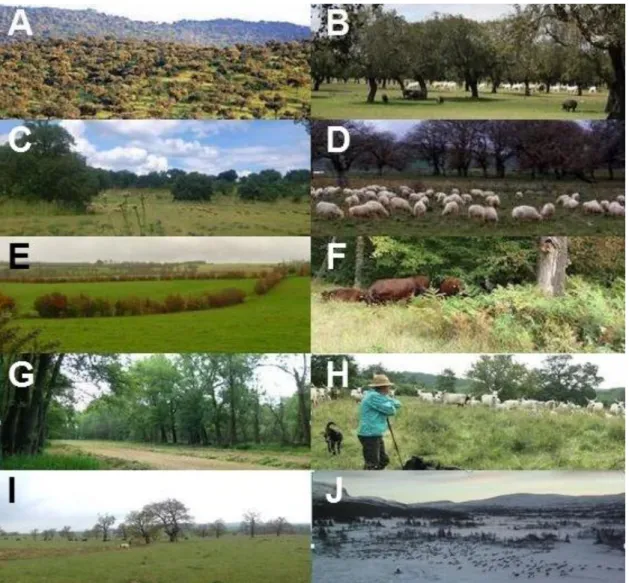
Figure 2.1. Agroforestry systems of high nature and cultural value across Europe; in A) Spain, B) Portugal, C) Greece, D) Sardinia, Italy, E) Brittany, France, F) UK, G) Germany, H) Hungary, I) Romania
Table 2.4. Acronym of the organisation and country, the name of the group and number of stakeholders for the groups on agroforestry of high nature and cultural value in 2014
Acronym Name of group Date of meeting Number of
stakeholders ISA, Portugal Montado (grazed oak pastures) 24 July 2014 22
UEX, Spain Dehesa (grazed oak pastures) 30 May 2014 80
CNR, Italy Grazed oak woodlands in Sardinia 9 July 2014 15 TEI, Greece Valonia oak silvopastoral systems 29 July 2014 25
BTU, Germany Spreewald flood plain 16 Oct 2014 5
NYME, Hungary Wood pasture 29-30 Aug 2014 17
UBB, Romania Wood pastures in Southern Transylvania
12 June 2014 5
INRA, France Bocage agroforestry in Brittany 26 Nov 2014 42
CRAN, UK Wood pasture and parkland 23 Sept 2014 10
EFI and SLU, Sweden
Wood pastures and reindeer 1-2 Oct 2014 6
Total 227
Reports, comprising Milestone 2, confirm the stakeholder working groups have been established and the first meetings held, where outputs have been placed on individual web-pages describing key aspects of each stakeholder group (Table 2.5). The challenges identified by the ten groups can be grouped under nine topics: low farm profitability, a need for new system design and management, reduction of the costs of tree protection and regeneration, improvement of pasture quality, adaptation of grazing schemes and cost-efficient herding, increased animal production, measures for nature conservation, more efficient mechanisms for knowledge dissemination among stakeholders, and policy and governance.
2.2 Characterising the systems (started)
Objective 2.2 is to describe the key inputs, outputs and ecosystem service flows for case study systems in the selected countries. This is a key focus of work (Task 2.2) during the next twelve months, culminating in a report (Deliverable D2.4) describing the components, structure and outputs of the systems in December 2015. A first round of the descriptive parameters was circulated among the work-package partners in December 2014. Examples of some of the initial research include the compilation of data on carbon pools and biodiversity for Iberian dehesas by UEX, and CRAN is progressing with soil and aboveground carbon measurements at a parkland site at Clapham in the UK.
Table 2.5. References for the ten stakeholder reports comprising Milestone 2
Moreno G (2014). Initial Stakeholder Meeting Report: Dehesa farms in Spain. 17 September 2014. 19 pp. Available online: http://www.agforward.eu/index.php/en/dehesa-farms-in-spain.html
Crous-Duran J, Amaral Paulo J, Palma J (2014). Initial Stakeholder Meeting Report: Montado in Portugal. 4 September 2014. 12 pp. Available online:
http://www.agforward.eu/index.php/en/montado-in-portugal.html
Pantera A (2014). Initial Stakeholder Meeting Report: Valonia oak silvopastoral systems in Greece. 17 September 2014. 9 pp. Available online: http://www.agforward.eu/index.php/en/valonia-oak-silvopastoral-systems-in-greece.html
Pisanelli A, Camilli F, Seddaiu G, Franca A (2014). Initial Stakeholder Meeting Report: Grazed oak woodlands in Sardinia. 15 October 2014. 9 pp. Accessed online:
http://www.agforward.eu/index.php/en/grazed-oak-woodlands-in-sardinia.html
Thenail C, Viaud V, Hao H (2014). Initial Stakeholder Meeting Report: Bocage agroforestry in Brittany, France. 2 December 2014. 10 pp. Available online:
http://www.agforward.eu/index.php/en/bocage-agroforestry-in-brittany-france.html
Upson M, Burgess PJ (2014). Initial Stakeholder Meeting Report: Wood pasture and parkland in the UK. 2 October 2014. 10 pp. Available online: http://www.agforward.eu/index.php/en/wood-pasture-and-parkland-in-the-uk.html
Tsonkova P, Mirck J (2014). Initial Stakeholder Meeting Report: Agroforestry in the Spreewald Flood Plain, Germany. 20 October 2014. 8 pp. Available online:
http://www.agforward.eu/index.php/en/agroforestry-in-the-spreewald-flood-plain-germany.html
Vityi A, Varga A (2014). Initial Stakeholder Meeting Report: Wood pasture in Hungary. 13 pp. 18 October 2014. Available online: http://www.agforward.eu/index.php/en/wood-pasture-in-hungary.html
Hartel T (2014). Initial Stakeholder Meeting Report: Wood Pastures in Romania. (Ed. PJ Burgess). 16 November 2014. 8 pp. http://www.agforward.eu/index.php/en/wood-pastures-in-southern-transylvania-romania.html
Berg S, Lind T (2014). Initial Stakeholder Meeting Report: Wood pasture and reindeer in Sweden. 27 October 2014. 13 pp. Available online: http://www.agforward.eu/index.php/en/wood-pastures-and-reindeer-in-sweden.html
2.3 Identify testable innovations and establish protocols (nearing completion)
Objective 2.3 is to agree, within the PDRN, the key innovations or improvements in quantification that could promote the uptake of high nature and cultural value agroforestry. This was addressed by Task 2.3, which was to agree the innovations to be tested by each stakeholder group either at experimental sites or on-farm in December 2014.
Gerardo Moreno presented the initial innovations at the Executive Committee Meeting at Beauvais, France on 5 December 2014. This was followed by review meetings via Skype and e-mail correspondence, and the release of a report (Milestone 3) on the AGFORWARD website in January 2015. This report highlights that research is needed both to close the knowledge gap and to undertake new experimental and field-trials work (Table 2.6).
collect information on the components of the system, estimates of the effect of the tree canopies on pasture production and carbon storage, and key sources of revenue and costs.
Table 2.6. Reference for the reports describing innovations for high nature and cultural value agroforestry (Milestone 3)
Moreno G, Berg S, Burgess PJ, Camilli F, Crous-Duran J, Franca A, Hao H, Hartel T, Lind T, Mirck J, Palma J, Amaral Paulo J, Pisanelli A, Seddaiu G, Thenail C, Tsonkova P, Upson M, Valinger E, Varga A, Viaud V, Vityi, A (2015). Innovations to be examined for High Nature and Cultural value Agroforestry. Milestone 2.2 (MS 3) for EU FP7 Research Project: AGFORWARD 613520. 20 pp.
http://www.agforward.eu/index.php/en/innovations-to-be-examined-for-high-nature-and-cultural-value-agroforestry.html
A number of experiments and field trials are also planned, which are considered within seven headings. Some examples are given below, but a fuller description of the planned experiments and field trials can be found in the report (Moreno et al, 2015) (Table 2.6):
System design and management: in France, the interest is on “bocage” agroforestry and
research will focus on developing modular models of hedgerow systems, and the role of hedgerows in preventing soil erosion.
Tree regeneration: in Spain, there is an interest in promoting tree regeneration through the use
of seeding and the use of dead branch and wood mulches for protection.
Livestock management: in the UK and Sweden, there is an interest in the use of GPS collars for
cattle and/or the use of “invisible fencing”. Invisible fencing involves the use of an underground electric wire and a sensor on a collar in areas of high public use. In Italy there is interest in the effects of grazing exclusion.
Fodder resources: selection of legume pastures and winter forages is of interest in Spain, Italy,
and Greece.
New products: surveys to assess the willingness to pay a premium price for agroforestry
products are a focus of work in Spain, Portugal, and Greece.
Conservation: the choice of livestock species and breed is of interest in Romania and Hungary.
Governance: new co-operative models for developing agroforestry are of interest in France.
The next step on the project is to develop research and development protocols for each stakeholder group and this is a current focus of work.
SLU (EFI) has developed a protocol for testing the GPS-based innovation to assist reindeer herding.
CNR, UEX, and TEI have elaborated a protocol for the examination of shading tolerance of fodder species (legumes and grasses) in Mediterranean silvopastoral systems.
UEX has prepared a protocol for the evaluation of alternative procedures to reinforce the natural tree regeneration in wood-pastures.
CRAN in working on a protocol for the technical suitability and profitability of the invisible fencing system.
TEI is preparing a protocol to examine the effect of tree protection on regeneration.
UEX has prepared a protocol for the evaluation of consumer willingness to purchase or consume HNCV agroforestry products and explore best branding strategies.
2.4-2.5 Test and analyse innovations to provide guidelines (started)
Now that the key innovations have been established, the participants of the work-package will start to address Objective 2.4 which is to implement the protocols to develop and test the proposed innovations, and to then analyse and interpret the results. This will be achieved through Task 2.4 involving testing experimentally with replicates, and Task 2.5 involving the use of on-farm experiments. This will lead to a report (MS5) describing the preliminary results of the innovations and wider perspectives in August 2016.
As of December 2014, some field tests have been initiated by UEX, CNR and TEI. For example CNR have started a field experiment on shading tolerance of legumes and grasses in a silvopastoral context. UEX has started an evaluation of the response of different varieties of Triticale (double-cropping fodder crop) intercropped among oak trees. UEX is also evaluating new models of natural and artificial protector for oak regeneration in Iberian dehesas. Lastly UEX is developing a prototype of GPS collar to help automate livestock management in extensive wood-pastures.
2.6 Dissemination of results (on-going)
An on-going objective of the work-package (Objective 3.5) is to provide and promote guidelines for farmers on how to establish economically viable agroforestry practices to improve the resilience of wood-pasture and other agroforestry systems of high nature value. Some of the principal dissemination activities are described in Table 9.4.
2.7 Co-ordination of the work in work-package 2
The work-package leader (Gerardo Moreno) has participated in Executive Board meetings and WP 2 Skype meetings, which aided the clarification of responsibilities across countries. All of the partners attended the launch meeting at Cranfield University in the UK on 21-22 January 2014. This was followed by a field visit (23 January 2014) to a parkland agroforestry site that has been the focus of detailed carbon measurements by Cranfield University.
Between 2 and 4 June 2014, there was also an AGFORWARD project meeting in Cottbus, Germany, including a dedicated WP 2 workshop. This included a field visit to the WP2 Spreewald agroforestry system (led by BTU) which is the focus of a stakeholder group in this work-package.
One key area of co-ordination is the links between work-package 2 and the landscape analysis in work-package 7. Gerardo Moreno has played a key role in establishing these links, and at meetings in Cottbus (2-4 June 2014) and in Copenhagen (10-11 November 2014). UEX, ISA, BBU, EFI and INRA have identified HNCV landscapes for joint WP2 and WP7 research to evaluate ecosystem services. Gerardo Moreno also attended the Executive Committee meeting held at Beauvais in France on 5 December.
2.8 Use of resources in work-package 2
At the end of December 2014, 29.09 person months had been allocated to work-package 3, equivalent to 27% of the total (Table 2.7).
Table 2.7. Person-month inputs to work-package 2
Indicated (Jan-Dec 2014) Project total
UEX 6.10 28 INRA 5.34 11 BTU 3.14 8 CRAN 2.93 8 ISA 2.50 10 CNR 2.25 9 NYME 1.64 9 EFI 1.47 6 EFI (SLU) 1.24 TEI 1.21 9 UBB 1.07 9 EURAF 0.20 2 Total 29.09 109
2.9 Issues and actions
Now that the stakeholder groups have identified key innovations, the next task is to create and publish the associated research and development protocols, explaining the systems, the objectives, the trial or experimental design, and the planned measurements and analysis. In general, the use of resources and personnel months is in line with expectations. Both the work-package leader and the Co-ordinator have discussed the high input from INRA-Rennes at this stage of the project. INRA has confirmed that the current rate of allocating person-months will not affect their ability to fully contribute to the milestones and deliverables of work-package 2.
3 Work package number 3
Work-package number 3Work-package name Agroforestry for High Value Tree Systems
Leader Anastasia Pantera
Organisation TEI Stereas Elladas (TEI)
Report period 1 January to 31 December 2014 Objectives and tasks within work package 3
Anastasia Pantera is leading this work package that focuses on intercropping or grazing in high value tree systems such as apple orchards, olive groves or walnut and chestnut trees. The key objective during the first year has been the establishment of the participatory research and development networks and to identify testable innovations (Table 3.1). During the reporting period, 10 stakeholder groups were established and some key researchable innovations were identified (Table 3.2).
Table 3.1. Work-plan of activities, milestones (M), and deliverables (D) for work-package 3 for the first 12 months (indicated in orange), and plan for the second year (indicated in grey)
Month 1 2 3 4 5 6 7 8 9 1 0 1 1 1 2 1 3 1 4 1 5 1 6 1 7 1 8 1 9 2 0 2 1 2 2 2 3 2 4 WP3 High value tree agroforestry T3.1 Establish PRD network (MS8) M T3.2 Characterise system (D3.7) D T3.3 Identify testable innovations
(MS9) and establish protocols MS10)
M M T3.4 Test, analyse, interpret and cost
innovation (MS11; D3.8)
T3.5 Evaluate innovations on-farm to
produce guidelines (MS12; D3.9)
T3.6 Dissemination of results (MS13) T3.7 Co-ordination of WP3
Table 3.2. Summary of the status of milestones and deliverables due within first 12 months
Description Date Status
MS8 Establishment of PRD network Aug 2014 Completed and on website MS9 Identification of innovations to be tested Dec 2014 Completed and on website 3.1 Establish a participatory research and development network (completed)
Objective 3.1 was to identify examples of existing best practice, the key challenges, and possible innovations to address those challenges, within stakeholder working groups within this Participatory Research and Development Network (PDRN). This was to be achieved by establishing 10 relevant stakeholder groups (Task 3.1). At the initial meeting of each stakeholder group, the plan was to i) identify the most prominent issues and challenges, ii) identify best practice examples, iii) identify stakeholder-led innovations, and iv) identify producers willing to participate in the innovation research.
All of the initial meetings were held between April and August 2014, with the exception of the December meeting held by AFBI in Northern Ireland. The meetings across the PDRN for high value trees have involved about 145 stakeholders (Table 3.3). ORC played a key role in developing the templates for the initial stakeholder reports distributed across the project on 25 April 2014. In addition ISA has had input in order to ensure that the data collected will feed into work-package 6. UEX has also followed up their initial meeting with farm visits and EURAF has started to collate a list of people outside of the countries represented by the stakeholder groups.
Figure 3.1. Agroforestry systems of high nature and cultural value across Europe; in A) Western Spain, B) Galicia, Spain, C) Italy, D) Greece, E) Greece, F) Normandy, France, G) Crete, Greece, H) England, UK and I) Northern Ireland, UK
FDEA in Switzerland has also been involved in setting up a stakeholder group that includes the combination of apple trees into arable systems. This has been done in collaboration with a Swiss agroforestry extension project run by AGRIDEA, which is working with about 15 farms. ORC in the UK is also working on the integration of apple trees within arable systems. In both these cases, although the research and development contributes to the outputs of work-package 3, the stakeholder group and the meetings are reported (in both cases) in work-package 4.
Table 3.3. The livestock type, acronym and country, the name of the group and number of stakeholders for the stakeholder meetings focused on agroforestry for high value tree systems in 2014.
Acronym Name of group Dates of
workshops
Number of stakeholders CRAN, UK Grazed orchard in England and Wales 9 June 2014 14
AFBI, UK Grazed orchard in Northern Ireland 3 Dec 2014 9
APCA, France Grazed orchards 31 July 2014 25
TEI, Greece Intercropping of olive groves, Molos 25 June 2014 18 TEI, Greece Intercropping of olive groves, Kassandreia 27 June 2014 14 CRA, Italy Intercropping and grazing of olive orchards 27 June 2014 21 UEX, Spain Grazing and intercropping of plantation trees 30 May 2014 27
TEI, Greece Intercropping of walnut trees 29 May 2014 19
USC, Spain Chestnut agroforestry in Galicia 25 Aug 2014 26
TEI, Greece Intercropping of orange groves 2 and 4 Aug 2014 5
Total 178
As detailed under work-package 4, AFAF and ACTA-IDF have also organised a stakeholder group in France focused on “bordure” or hedgerow trees, which covers some of the themes covered in this work-package. AFAF also supported APCA orchard grazing workshop in Normandy in Northern France on 31 July 2014. Philippe van Lerberghe at IDF (Third Party to ACTA) has also been working with a farmer in the French Department of Lot to establish an agroforestry system with oak and walnut in an area currently grazed by sheep; a system that intersects work-package 3 and 5 (van Lerberghe, 2014). This work will be useful when producing farmer-applicable booklets.
Reports, comprising Milestone 8, confirm the stakeholder working groups have been established and the first meetings held, where outputs have been placed on individual web-pages describing key aspects of each stakeholder group (Table 3.4).
3.2 Characterising the systems (started)
Objective 3.2 is to describe the key inputs, outputs and ecosystem service flows for the selected systems. This is a key focus of work (Task 3.2) during the next twelve months, culminating in a report (Deliverable 3.7) describing the components, structure and outputs of the systems in December 2015. A first round of the descriptive parameters was circulated among the work-package partners in December 2014. Cranfield has started to collect data at its trial site with grazed orchards in Herefordshire in the UK. AFBI in Northern Ireland, UK, has also started to characterise its orchard system within and without sheep at Loughgall in pre- and post-harvest situations. CRA in Italy has started to characterise the traditional and high-density olive orchards that it is investigating with asparagus.
Table 3.4. References for the ten stakeholder reports (Milestone 8) produced in work-package 3 Moreno G (2014). Initial Stakeholder Meeting Report Grazing and intercropping of plantation trees
in Spain. 17 September 2014. 12 pp. Available online:
http://www.agforward.eu/index.php/en/grazing-and-intercropping-of-plantation-trees-in-spain.html
Mosquera Losada R, Ferreiro-Domínguez N, Fernández Lorenzo JL, González-Hernández P, Rigueiro Rodríguez A (2014). Initial Stakeholder Meeting Report: Chestnut agroforestry in Galicia, Spain. 23 September 2014. 9 pp. Available online: http://www.agforward.eu/index.php/en/chestnut-agroforestry-in-galicia-spain.html
Rosati A (2014). Initial Stakeholder Meeting Report Intercropping and grazing of olive orchards in Italy. 6 August 2014. 7 pp. Available online:
http://www.agforward.eu/index.php/en/intercropping-and-grazing-of-olive-orchards-in-italy.html
Pantera A (2014). Initial Stakeholder Meeting Report: Intercropping of olive groves in Greece (Kassandreia). 20 October 2014. 8 pp. Available online:
http://www.agforward.eu/index.php/en/intercropping-of-olive-groves-in-greece.html
Pantera A (2014). Initial Stakeholder Meeting Report: Intercropping of olive groves in Greece (Molos). 20 October 2014. 9 pp. Available online:
http://www.agforward.eu/index.php/en/intercropping-of-olive-groves-in-greece.html
Pantera A (2014). Initial Stakeholder Meeting Report: Intercropping of Walnut Trees in Greece. 20 October 2014. 8 pp. Available online: http://www.agforward.eu/index.php/en/intercropping-of-walnut-trees-in-greece.html
Pantera A (2014). Initial Stakeholder Meeting Report Intercropping of Orange Groves in Greece. 18 November 2014. 7 pp. Available online: http://www.agforward.eu/index.php/en/intercropping-of-orange-groves-in-greece.html
Corroyer N (2014). Initial Stakeholder Meeting Report: Grazed Orchards in France. 1 December 2014. 8 pp. Available online: http://www.agforward.eu/index.php/en/grazed-orchards-in-france.html
Burgess PJ (2014). Initial Stakeholder Meeting Report: Grazed Orchards in the UK. 18 July 2014. 8 pp. Available online: http://www.agforward.eu/index.php/en/Grazed_Orchards.html
McAdam J (2014). Initial Stakeholder Meeting Report: Grazed orchards in Northern Ireland, UK. 4 December 2014. 9 pp. Available online: http://www.agforward.eu/index.php/en/grazed-orchards-in-northern-ireland-uk.html
3.3 Identify testable innovations and establish protocols (nearing completion)
Objective 3.3 is to agree, within the PDRN, the key innovations or improvements in quantification that could promote the uptake of agroforestry involving high value tree systems. The agreement on the innovations to be tested (Task 3.3) started in December 2014 and Anastasia Pantera presented the initial innovations at an Executive Committee Meeting at Beauvais, France on 5 December 2014. This was followed by a review meeting via Skype and the release of a report describing the innovations (Milestone 9) on the AGFORWARD website in January 2015 (Table 3.5).
Table 3.5. Reference for the report describing agroforestry innovations for high value tree systems
Pantera A, Burgess PJ, Corroyer N, Ferreiro-Domínguez N, Fernández Lorenzo JL, González-Hernández P, Graves AR, McAdam J, Moreno G, Mosquera Losada MR, Rigueiro Rodríguez A, Rosati A, Upson M (2015). Innovations to be examined for Agroforestry for High Value Tree Systems. Milestone 3.2 (MS 9) for EU FP7 Research Project: AGFORWARD 613520. 14 pp.
http://www.agforward.eu/index.php/en/agroforestry-innovations-to-be-examined-for-high-value-tree-systems.html
Three of the stakeholder groups (CRAN, AFBI, and APCA) will be focusing on sheep grazing in apple orchards in France and the UK. Identified research topics include the creation of grazing management guidelines, the effect of grazing of the lower leaves on apple production, the development of a bio-economic model, and the impact of reduced leaf litter on apple scab infection. AFBI research will include replicated experiments on sheep grazing (mixed breed) in dessert and cider orchards in comparison to normal management and mechanical mowing. CRAN is focusing on the effect of Shropshire sheep on the productivity of bush apple orchards and the initial protocol has been agreed.
Four of the stakeholder groups (TEI and CRA) are focusing on the intercropping and grazing of olive or citrus groves in Greece and Italy. Identified research topics include the interactions between olive trees and wheat compared to non-intercropped olives, best practices for growing wild asparagus and rearing poultry within olive groves, and the use of aromatic or leguminous intercrops.
Three of the stakeholder groups (UEX, USC, and TEI) are working with walnut or chestnut, either in Greece or Spain. Identified innovations include the use of legumes or aromatic species, and the use of sheep with walnut in Spain. The use of grafted plants of selected varieties of chestnut and techniques to increase mushroom production are also of interest in Spain.
3.4-3.5 Test and analyse innovations to provide guidelines (started)
Now that the key innovations have been established, the participants of the work-package will start Objective 3.4 to implement the protocols, to develop and test the proposed innovations, and to analyse and interpret the results. This will be achieved through Task 3.4 of testing experimentally with replicates, and Task 3.5 the use of on-farm experiments. This will lead to a report (Milestone 11) describing the preliminary results of the innovations and wider perspectives in August 2016. As of December 2014, some field tests have been initiated by UEX, TEI, CRAN and CRA. ACTA has also worked with IDF to assess wood biomass production in an agroforestry system.
3.5 Dissemination of results (on-going)
An on-going objective of the work-package (Objective 3.5) is to provide and promote guidelines for farmers on how to establish economically viable agroforestry practices within high value trees. Some of the dissemination activities are described in Table 9.4.
3.6 Co-ordination of the work in work-package 3
The work-package leader (Anastasia Pantera) has participated in Executive Board meetings and WP3 Skype meetings. All of the partners attended the launch meeting at Cranfield University in the UK on 21-22 January 2014, and Anastasia Pantera (TEI) and Jo Smith (ORC) made platform presentations. Representatives from each group also attended the AGFORWARD project meeting in Cottbus, Germany (2-3 June 2014), including a dedicated WP3 workshop. Anastasia also attended the Executive Committee Meeting in Beauvais on 5 December 2014. There have also been a number of satellite meetings. For example in France, staff from ACTA, AGROOF, APCA and AFAF attended a French AGFORWARD coordination meeting in Paris on 31 March 2014.
3.7 Use of resources in work-package 3
At the end of December 2014, 21.31 person months had been allocated to work-package 3, equivalent to 19% of the total (Table 3.6). There are no significant deviations from the planned schedule. Those organisations allocated the most person months have established stakeholder groups as described. ORC is also closely working with apple trees (their report can be found in work-package 4), and they helped to develop the templates for the initial stakeholder reports. AFAF and ACTA have established a stakeholder group focused on “bordure” trees, which cross-links with work-package 4.
Table 3.6. Person-month inputs to work-package 3
Organisation Indicated (Jan-Dec 2014) Project total
CRA 5.25 28 TEI 3.92 23 CRAN 2.70 12 AFBI 2.09 5.5 UEX 2.05 8 USC 1.80 12 ORC 1.34 6 APCA 0.68 3 ACTA 0.44 1 AFAF 0.41 3.5 ISA 0.25 3 EURAF 0.20 2 FDEA 0.18 6 Total 21.31 113
3.8 Issues and actions
The only significant change within the work-package relates to some planned subcontracting by ACTA. The original plan involved a 10K€ sub-contracting budget for ACTA to use the experimental work at Laxou within work-package 3. Unfortunately since the project inception, a change in priorities for the new management team at Laxou has meant that this site is not available. Following discussion with the Co-ordinator, ACTA now proposes to use this budget to sub-contract research on the evaluation of the total biomass production of pollarded trees compared to non-pollarded trees. It is proposed to use the services of a forest contractor, and the statistical analysis and modelling services of the Catholic University of Louvain. A proposal for this change will be submitted to the EU, via the Co-ordinator, prior to commencing the work.
4 Work package number 4
Work-package number 4Work-package name Agroforestry for Arable Farmers Leader Jaconette Mirck (and Dirk Freese)
Organisation Brandenburg University of Technology Cottbus-Senftenberg Report period 1 January to 31 December 2014
Objectives and tasks within work package 4
The focus of this work-package, led by BTU, is to develop innovations that will promote agroforestry for arable farmers. As Dirk Freese was ill for part of 2014, Jaconette Mirck (also of BTU) has led this work-package. The key objective during the first year has been the establishment of the participatory research and development network and the identification of testable innovations (Table 4.1). By the end of the year, the first two milestones had been achieved (Table 4.2).
Table 4.1. Work-plan of activities, milestones (M), and deliverables (D) for work-package 4 for the first 12 months (indicated in orange), and plan for the second year (indicated in grey)
Month 1 2 3 4 5 6 7 8 9 1 0 1 1 1 2 1 3 1 4 1 5 1 6 1 7 1 8 1 9 2 0 2 1 2 2 2 3 2 4 WP4 T4.1 Establish PRD network (MS14) M T4.2 Characterise system (D4.10) D T4.3 Identify innovations (MS15)
and establish protocols MS16)
M M T4.4 Test, analyse, interpret and
cost innovation (MS17; D4.11) T4.5 Evaluate innovations to produce guidelines (MS18; D4.12) T4.6 Disseminate results (MS19) T4.7 Co-ordination of WP4
Table 4.2. Summary of the status of milestones and deliverables due within first 12 months
Description Date Status
MS14 Establishment of PRD network Aug 2014 Completed
MS15 Identification of innovations to be tested Dec 2014 Completed
4.1 Establish a participatory research and development network (completed)
Objective 4.1 was to identify examples of existing best practice, the key challenges, and possible innovations to address those challenges, within stakeholder working groups within a Participatory Research and Development Network (PRDN). This was achieved by establishing (Task 4.1) 13 stakeholder groups focused on agroforestry in arable systems. Each meeting sought to i) identify the most prominent issues and challenges, ii) identify best practice examples, iii) identify stakeholder-led innovations, and iv) identify producers willing to participate in the innovation research. The original plan was to hold the first meetings between April and August 2014. However to maximise the