UNIVERSIDADE DO ALGARVE
FACULDADE DE CIÊNCIAS DO MAR E AMBIENTE
EXPERIMENTAL STUDY OF THE MACROBENTHIC COLONISATION
AND SECONDARY PRODUCTION IN THE ARTIFICIAL REEFS OF
ALGARVE COAST
(Tese para a obtenção do grau de doutor no ramo de Ciências do Mar, especialidade de Ecologia Marinha)
ANA CRISTINA BARROSO MOURA
Orientador: Doutor Luís Cancela da Fonseca
Co-orientador: Doutor Miguel Neves dos Santos; Doutora Diana Boaventura Constituição do Júri:
Presidente: Doutor João Pinto Guerreiro
Vogais: Doutor Luís Chícharo; Doutor António Múria dos Santos; Doutora Maria Alexandra Chícharo; Doutor Carlos da Costa Monteiro;
To those I love…….
Na luz do seu olhar tão lânguido, tão doce, Havia o que quer que fosse
D’um íntimo desgosto:
Era um cão ordinário, um pobre cão vadio Que não tinha coleira e não pagava imposto.
Acostumado ao vento e acostumado ao frio, Percorria de noite os bairros da miséria
À busca dum jantar.
E ao ver surgir da lua a palidez etérea, O velho cão uivava uma canção funérea, Triste como a tristeza ossiânica do mar. Quando a chuva era grande e o frio inclemente,
Ele ia-se abrigar às vezes nos portais; E mandando-o partir, partia humildemente,
Com a resignação nos olhos virginais. Era tranquilo e bom como as pombinhas mansas;
Nunca ladrou dum pobre à capa esfarrapada: E, como não mordia as tímidas crianças,
As crianças então corriam-no a pedrada.
Uma vez casualmente, um mísero pintor Um boémio, um sonhador, Encontrara na rua o solitário cão; O artista era uma alma heróica e desgraçada,
Vivendo numa escura e pobre água furtada, Onde sobrava o génio e onde faltava o pão. Era desses que têm o rubro amor da glória,
O grande amor fatal,
Que umas vezes conduz às pompas da vitória, E que outras vezes leva ao quarto do hospital.
E ao ver por sobre o lodo o magro cão plebeu, Disse-lhe: - "O teu destino é quase igual ao meu:
Eu sou como tu és, um proletário roto, Sem família, sem mãe, sem casa, sem abrigo;
E quem sabe se em ti, ó velho cão de esgoto, Eu não irei achar o meu primeiro amigo!..."
No céu azul brilhava a lua etérea e calma; E do rafeiro vil no misterioso olhar Via-se o desespero e ânsia d’uma alma, Que está encarcerada, e sem poder falar. O artista soube ler naquele olhar em brasa
A eloquente mudez dum grande coração; E disse-lhe: - "Fiel, partamos para casa: Tu és o meu amigo, e eu sou o teu irmão."
E viveram depois assim por longos anos, Companheiros leais, heróicos puritanos, Dividindo igualmente as privações e as dores. Quando o artista infeliz, exausto e miserável,
Sentia esmorecer o génio inquebrantável Dos fortes lutadores;
Quando até lhe acudiu às vezes a lembrança Partir com uma bala a derradeira esp’rança, Pôr um ponto final no seu destino atroz; Nesse instante do cão os olhos bons, serenos, Murmura-lhe: - Eu sofro, e a gente sofre menos,
Quando se vê sofrer também alguém por nós.
Mas um dia a Fortuna, a deusa milionária, Entrou-lhe pelo quarto, e disse alegremente: "Um génio como tu, vivendo como um pária,
Agrilhoado da fome à lúgubre corrente! Eu devia fazer-te há muito esta surpresa,
Eu devia ter vindo aqui p’ra te buscar; Mas moravas tão alto! E digo-o com franqueza
Custava-me subir até ao sexto andar. Acompanha-me; a glória há de ajoelhar-te aos pés!..."
E foi; e ao outro dia as bocas das Frinés
Abriram para ele um riso encantador; A glória deslumbrante iluminou-lhe a vida
Como bela alvorada esplêndida, nascida A toques de clarim e a rufos de tambor!
Era feliz. O cão
Dormia na alcatifa à borda do seu leito, E logo de manhã vinha beijar-lhe a mão,
Ganindo com um ar alegre e satisfeito. Mas aí! O dono ingrato, o ingrato companheiro,
Mergulhado em paixões, em gozos, em delícias, Já pouco tolerava as festivas carícias
Do seu leal rafeiro.
Passou-se mais um tempo; o cão, o desgraçado, Já velho e no abandono,
Muitas vezes se viu batido e castigado Pela simples razão de acompanhar seu dono.
Como andava nojento e lhe caíra o pelo, Por fim o dono até sentia nojo ao vê-lo, E mandava fechar-lhe a porta do salão. Meteram-no depois num frio quarto escuro, E davam-lhe a jantar um osso branco e duro,
Cuja carne servira aos dentes d’outro cão. E ele era como um roto, ignóbil assassino, Condenado à enxovia, aos ferros, às galés: Se se punha a ganir, chorando o seu destino,
Os criados brutais davam-lhe pontapés. Corroera-lhe o corpo a negra lepra infame. Quando exibia ao sol as podridões obscenas,
Poisava-lhe no dorso o causticante enxame Das moscas das gangrenas.
Até que um dia, enfim, sentindo-se morrer, Disse "Não morrerei ainda sem o ver;
A seus pés quero dar meu último gemido..." Meteu-se-lhe no quarto, assim como um bandido.
E o artista ao entrar viu o rafeiro imundo, E bradou com violência:
"Ainda por aqui o sórdido animal! É preciso acabar com tanta impertinência, Que esta besta está podre, e vai cheirando mal!"
E, pousando-lhe a mão cariciosamente, Disse-lhe com um ar de muito bom amigo:
"Ó meu pobre Fiel, tão velho e tão doente, Ainda que te custe anda daí comigo."
E partiram os dois. Tudo estava deserto. A noite era sombria; o cais ficava perto; E o velho condenado, o pobre lazarento,
Cheio de imensas mágoas Sentiu junto de si um pressentimento O fundo soluçar monótono das águas.
Compreendeu enfim! Tinha chegado à beira Da corrente. E o pintor,
Agarrando uma pedra atou-lh’a na coleira, Friamente cantando uma canção d’amor.
E o rafeiro sublime, impassível, sereno, Lançava o grande olhar às negras trevas mudas
Com aquela amargura ideal do Nazareno Recebendo na face o ósculo de Judas. Dizia para si: "È o mesmo, pouco importa.
Cumprir o seu desejo é esse o meu dever: Foi ele que me abriu um dia a sua porta: Morrerei, se lhe dou com isso algum prazer."
Depois, subitamente
O artista arremessou o cão na água fria.
E ao dar-lhe o pontapé caiu-lhe na corrente O gorro que trazia
Era uma saudosa, adorada lembrança Outrora concedida
Pela mais caprichosa e mais gentil criança, Que amara, como se ama uma só vez na vida.
E ao recolher à casa ele exclamava irado: "E por causa do cão perdi o meu tesouro! Andava bem melhor se o tinha envenenado!
Maldito seja o cão! Dava montanhas d’oiro, Dava a riqueza, a glória, a existência, o futuro,
Para tornar a ver o precioso objecto, Doce recordação daquele amor tão puro." E deitou-se nervoso, alucinado, inquieto.
Não podia dormir.
Até nascer da manhã o vivido clarão, Sentiu bater à porta! Ergueu-se e foi abrir.
Recuou cheio de espanto: era o Fiel, o cão, Que voltava arquejante, exânime, encharcado,
A tremer e a uivar no último estertor, Caindo-lhe da boca, ao tombar fulminado,
O gorro do pintor!
ACKNOWLEDGEMENTS
I would like to thank Dr. Carlos Costa Monteiro, Director of the IPIMAR, for accepting, encouraging and providing all the adequate conditions necessary for the development of this study in the facilities of this Institute. The present work was financially supported by MARE Program, within the project “Implantação e estudo integrado de sistemas recifais”.
To my supervisors, Prof. Luís Cancela da Fonseca (University of Algarve), Dr. Miguel Neves dos Santos (IPIMAR) and Prof. Diana Boaventura (Higher School of Education of João de Deus), for accepting the supervision of this PhD project. Also, I would like to express my gratitude for their help and guidance throughout the period of this study. Particularly, I would like to specially thank to Prof. Luís Cancela da Fonseca for his vast knowledge on a variety of ecological issues, which was helpful to highlight some of the results of this study; to Dr. Miguel Neves dos Santos I’m grateful for the strong encouragement and dedication since the beginning of this work, and for the continuous interest an enthusiasm in the results; and I would like to Diana for her constructive comments and suggestions on the experimental designs and statistical advices.
To the expertise diving team of CRIPSul, Dr. Miguel Neves dos Santos, Dr. Miguel Gaspar, Pedro Lino, João Cúrdia, Francisco Leitão, Marco Cerqueira and Tata Regala and research vessel RV Tellina crew, and the technicians Tibério Simões and José Luís Sofia for their field support and helping during sample collection; Also, I’m grateful to Susana Carvalho, João Cúrdia, Francisco Leitão, Marco Cerqueira, Ana Barradas, Carlos Campos, Paula Pereira, Rita Cosntantino, Mafalda Ferreira for their help during sampling processing and species identifications. Also to Dr. Miguel Gaspar and Dra. Manuela Falcão for always kindly answering my queries.
Besides the aforementioned friends and collegues in IPIMAR, my gratitude extends to Fábio Pereira, Marisa Barata, João Guerra, Ana Silva, Alexandra Garcia, Paulo Vasconcelos, Dalila Serpa, Cristina Martins, Milú Inácio, Jorge Ramos, Alexandre Pereira, Hugo Saldanha, Natália Dias and Marta Rufino for such a great time!!!
A special thank you goes to family (my parents, my sister Paula and my aunt Arilia) for their encouragement, support and for believing in me. Also to João, Ana & Mikas & Belinha, Isabel & Emanuel, Ana & Ricardo for being my craziness friends. To Nuno for always putting up with my stress and frying!! Thanks go also to Rafael & Rita for their warm and furry friendship!!
NOME: Ana Cristina Barroso Moura
FACULDADE: Faculdade de Ciências do Mar e do Ambiente ORIENTADOR: Prof. Doutor Luís Cancela da Fonseca
CO-ORIENTADOR: Doutor Miguel Neves dos Santos, Doutora Diana Boaventura DATA: 2010
TÍTULO DA TESE: Estudo experimental da colonização e produção secundária
macrobentónica em recifes artificiais da costa algarvia
RESUMO:
Os sistemas de recifes artificiais, implantados em todo o mundo, desempenham um papel importante no aumento da produção natural de recursos biológicos marinhos recursos. A implantação de recifes artificiais na costa Sul do Algarve teve como objectivo contribuir para a gestão e ordenamento das pescarias litorais, aumentar a produtividade natural das áreas circundantes, promover a biodiversidade e aumentar a protecção dos juvenis que migram para o litoral. Ao longo da costa sul do Algarve, sete sistemas artificiais foram implantados. No entanto, a investigação tem-se concentrado principalmente em populações de peixes, particularmente aquelas de importância económica. O presente estudo pretende contribuir para um melhor conhecimento das comunidades macrobentónicas associadas a estes sistemas de recifes artificiais. Estas comunidades que se encontram na base do sistema ecológico desempenham um importante papel ao nível da cadeia alimentar e da camuflagem das estruturas artificiais, tornando os recifes artificiais em locais mais atractivos para as populações piscícolas.
Várias experiências foram desenvolvidas com o intuito de recolher informação sobre as comunidades macrobentónicas, em particular em diversos grupos recifais no recife artificial de Faro/Ancão, e contribuir para o conhecimento sobre o funcionamento e ecologia dos recifes artificiais. Assim, um dos objectivos principais do presente trabalho foi analisar os diversos factores que poderão influenciar a colonização e sucessão das comunidades macrobentónicas, nomeadamente: 1) caracterizar a evolução espaço-temporal da colonização de espécies macrobentónicas; 2) estudar o efeito da orientação das superfícies na sucessão macrobentónica (horizontal vs. vertical); 3) testar o efeito da profundidade (16 m vs. 20 m profundidade) e da estrutura recifal (camada superior vs. inferior do recife) na sucessão macrobentónica; 4) estimar a produção secundária; 5) analisar a estrutura trófica das comunidades macrobentónicas; 6) comparar a sequência de colonização entre recifes artificiais em diferentes estados de “maturação”; 7) o efeito do meio circundante para a colonização nos recifes artificiais; e 8) testar se as comunidades dos recifes artificiais se assemelham às comunidades dos recifes naturais. Como unidade de amostragem utilizou-se cubos de betão (15x15cm), de material idêntico ao da construção dos recifes artificiais. Estas unidades foram suspensas nos módulos recifais aquando da imersão destes. Foram recolhidas por mergulho autónomo, consoante o tempo delineado para cada experiência. Salienta-se que no estudo de comparação com o recife natural, estas unidades
de amostragem não foram utilizadas, mas foram raspado quadrats com 15cm de lado. No laboratório, como métodos não-destrutivo, foi utilizado o método do ponto de intersecção, onde os dados de percentagem de cobertura total foram recolhidos das faces dos cubos. De seguida, estas faces foram raspadas, para recolha e identificação dos organismos. Para este trabalho, analisaram-se quatro das seis faces amostradas, correspondendo à orientação horizontal: face superior vs. face inferior, e à orientação vertical: face interior vs. face exterior. Em termos estatísticos realizou-se a análise univariada (ANOVA) e/ou análise multivariada (ANOSIM, MDS, CLUSTER e SIMPER) com os diferentes tipos de dados, principalmente dados de percentagem de cobertura, abundância, biomassa e número de espécies.
De um modo geral, os valores de taxa de cobertura, número de taxa, de diversidade, de abundância e de biomassa aumentaram ao longo do tempo. A colonização e sucessão da comunidade epibêntica foi afectada pela orientação das superfícies, onde foi detectada diferenças na orientação horizontal, onde a superfície superior apresenta os valores mais elevados em relação ao número de espécies e de abundância média, excepto quando se utilizado o método não destrutivo de taxa de cobertura que apresenta valores inversos. Os dados de percentagem de cobertura dos grupos taxonómicos, foi observado que na superfície inferior teve uma colonização significativamente mais elevada, devido à dominância dos valores de cobertura por cirrípedes, favorecidos, provavelmente, pelos baixos níveis de sedimentação. Cirrípedes, briozoários e serpulídeos dominaram as amostras imediatamente após o início da experiência. A partir dos seis meses de colonização, a diversidade de espécies de invertebrados aumenta.
Organismos, consoante a sua mobilidade, parecem também ser afectados de modo diferentes. As espécies vágeis geralmente são negligenciadas, e apenas os organismos sésseis e espécies mais conspícuas são analisadas em estudos das comunidades de substrato rochoso. Portanto, o desenvolvimento dos componentes vágil e séssil da comunidade epibiótica foi analisado separadamente. As diferenças foram detectadas entre as amostras de superfícies horizontais, mas não em superfícies verticais. A análise multivariada detectou diferenças na estrutura da comunidade de macroinvertebrados bentónicos, quer considerando a componente séssil ou móvel. No entanto, só a fauna vágil apresentou diferenças significativas quando a análise de variância foi aplicada. Além disso, este estudo sugere que para as comunidades de substrato rochoso, a análise da fauna vágil é de extrema importância e deve ser tida em conta como uma característica importante no funcionamento do recife artificial.
A colonização da comunidade epibêntica foi também afectada pela profundidade e estrutura do RA, onde foi detectada que existem espécies que são afectadas com a profundidade, levando a concluir que mesmo pequenas diferenças na profundidade são importantes nestas comunidades; Em ambos os grupos recifais a diferentes profundidades foram caracterizados por Balanus
amphitrite, Gregariella subclavata, Musculus cf. subpictus, Paleanotus bellis e Syllidia armata.
Além disso, Jassa marmorata e Bugula neritina foram espécies típicas de 16 m, principalmente na camada superior do recife artificial, enquanto Anomia ephippium foi particularmente comum aos 20 m, especialmente na camada inferior. Em ambas as profundidades, a biomassa nas superfícies horizontais foi mais elevada na face superior do que na inferior. Nas superfícies verticais, os valores de biomassa obtidos foram semelhantes para ambas as camadas e profundidades.
A presença de uma comunidade preestabelecida, parece afectar a colonização, especialmente durante o primeiro ano; a inexistência de comunidade mais madura circunvizinha irá promover a colonização de novos substratos por organismos pioneiros (serpulídeos, cirrípedes, Hiatella
substratos serão colonizados por outras espécies mais competitivas (Filograna implexa,
Pomatoceros triqueter e cnidários).
As capacidades de replicar um recife natural, mesmo para uma comunidade recifal com 16 anos, diferenças foram detectadas entre as duas comunidades, tanto em número de espécies, como na composição específica, estrutura trófica e da própria comunidades; no entanto, as duas comunidades em estudo apresentam espécies comuns, mas em proporções bastante diferentes. Na verdade, o recife natural apresentou valores mais elevados relativamente ao número de espécies de moluscos e biomassa de esponjas. Por outro lado, os substratos artificiais foram dominados por espécies de poliquetas (principalmente serpulídeos) e apresentaram os maiores valores de biomassa de antozoários. As estruturas tróficas de ambas as comunidades foram dominadas por organismos suspensívoros, principalmente nos recifes naturais (devido aos valores elevados de biomassa de esponjas), onde na comunidade do recife artificial, o domínio da suspensão foi compartilhada com organismos carnívoros (devido à elevada biomassa de antozoários).
Um dos aspectos menos estudos no domínio da investigação sobre o funcionamento dos recifes artificiais prende-se com a sua produção secundária. Nesse sentido, ao longo dos primeiros 12 meses após a implantação do recife artificial, estudou-se o efeito da orientação do substrato na produção secundária de epibentos. Verificou-se que a produção epibêntica foi mais elevada na superfície horizontal. No entanto, no final do período de estudo, a produção média apresentou valores semelhantes. As superfícies de orientação horizontal tiveram uma produção média entre 128 e 103 g m2yr1, enquanto as superfícies de orientação vertical apresentaram uma produção média entre 103 e 98 g m2 yr1. A partir destes valores extrapolou-se a produção média anual para o complexo recifal da costa algarvia, que após um ano de implantação geram cerca de 5 ton de fauna epibêntica.
De acordo com o presente estudo, e com a informação recolhida, pretendeu-se uma melhor compreensão dos padrões de colonização macrobentónica em recifes artificiais, de modo a melhor a gestão e funcionamento de recifes artificias para futuras implantações. Assim, a diferente exposição destas faces nomeadamente à luz, correntes e sedimentação poderá estar na origem dos resultados obtidos. Também outros factores, tais como profundidade, disponibilidade de larvas, ovos ou esporos no meio circundante, competição por uma comunidade pré estabelecida parecem afectar a colonização e sucessão destas comunidades. O tempo de imersão parece ser um dos factores determinantes nos processos de sucessão destas comunidades. Tornou-se evidente que, dos vários estudos abrangidos nesta tese, os recifes artificiais, de uma perspectiva ecológica, são um instrumento complementar de gestão e reabilitação de ecossistemas litorais.
Palavras-chave: Recifes artificiais, comunidade macrobentónica, padrões de colonização,
Algarve
Experimental study of the macrobenthic colonisation and secondary production in the artificial reefs of Algarve coast
ABSTRACT
In the southern coast of the Algarve, the deployment of artificial reefs was undertaken to protect and enhance coastal fishery resources. It is extremely important to understand the factors, shaping macrobenthic communities, as they provide food and shelter for fish and other organisms economically important. These communities that if find in the base of the ecological system play an important role to the level of the alimentary chain and the camouflage of the artificial structures. This study provided the opportunity to understand the effectiveness and the biodiversity associated to these systems. Thus, another major goal was the analysis of the factors that will be able to affect the settling and succession of the macrobenthic communities in artificial reefs, namely, the effect of surfaces orientation, of depth and of the relative position inside reef, the effect of the surrounding habitats for the settling and if artificial reefs communities can imitate the natural reefs communities. This work will hopefully provide important data for understanding the patterns of benthic colonisation on artificial substrata for better management and functioning for future deployment.
Key-words:
TABLE OF CONTENTS
Chapter I. General introduction and objectives………..1 Chapter II. Macrobenthic community colonisation patterns on artificial reefs: analysis of the
influence of surface orientation………..14 Section1. Benthic succession on an artificial reef in the south of Portugal - Preliminary results………15
Section 2. Macrobenthic Colonisation of Artificial Reefs on the Southern Coast of Portugal (Ancão, Algarve)………30
Section 3. Is surface orientation determinant for colonisation patterns of vagile and sessile macrobenthos in artificial reefs?...46
Chapter III. Macrobenthic community colonisation patterns on artificial reefs: analysis of the
influence of depth and of the reef structure………73 Section1. Effect of depth and reef structure on early macrobenthic communities of the Algarve artificial reefs (southern Portugal)………74
Section 2. Biomass production of early macrobenthic communities at the Faro/Ancão artificial reef (Portugal): effect of depth and reef layer………..89
Chapter IV. Estimation of secondary production of the Faro/Ancão artificial reefs…………..106 Chapter V. A four year study on the macrobenthic colonisation of artificial reefs: influence of
surrounding habitats……….115
Chapter VI. Are artificial reefs macrobenthic communities’ alike to those of natural reefs?....138 Chapter VII. General conclusions………..157
CHAPTER I.
Chapter I
The European Artificial Reef Research Network (EARRN; see Jensen, 1997) defines artificial reefs as “submerged structures placed deliberately on the seabed to mimic
some characteristics of natural reefs”. The use of the word submerged is deliberate;
excluding structures such breakwaters, piers and jetties. Likewise, the requirement for reef deployment to be a deliberate act disassociates the true artificial reef from structures, which may claim that title in order to gain some ecological credibility. Structures that mimic natural reefs characteristics but have another primary purpose (such as piers and the steel jackets of oil/gas production platforms) may be described as secondary artificial reefs (Pickering et al., 1998).
Artificial reefs are employed for the purpose of promoting marine life in featureless bottom areas, primarily for fisheries enhancement. However, artificial reefs can fill a variety of roles beyond this, for example, as tools for: environmental mitigation, preservation and rehabilitation of natural habitats, aquaculture, tourism, control of coastal erosion, improvement of hydrodynamics for surfing and anti-trawling protection (Guillén et al., 1994; Antsulevich et al., 2000; Ramos-Esplá et al., 2000; Angel and Spanier, 2002; Ditton et al., 2002; Bacchiocchi and Airoldi, 2003). These structures have been deployed worldwide and, according to Seaman and Sprague (1991), the major areas presenting this kind of activity include the Mediterranean and Caribbean Seas, South-eastern Asia, Japan, North America, Australia and some islands in the South Pacific.
Regardless of the construction method, artificial reefs are generally designed to provide hard surfaces to which algae and invertebrates attach; the development of macrobenthic communities provides intricate structure and food for assemblages of fish (Pickering et
al., 1998). For a better artificial reef management, a whole-ecosystem approach is
necessary, incorporating studies of all aspects of hard substratum ecology, including
General introduction and objectives
both structural and functional variables, such as how quickly the substratum is colonised by epifauna and what factors influence rates of colonisation (Svane and Petersen, 2001). The capacity of food production is one of the potential parameters to evaluate artificial habitats as a feeding area (Itosu et al., 1999). Despite its importance, few productivity studies were undertaken (Steimle et al., 1999). The understanding of this aspect is of practical importance as epibiotic organisms are sources of food and shelter for many types of organisms (e.g. Connell and Andersen, 1999) and are an important component of subtidal systems. The recruitment onto artificial reefs will be structured by physical factors such as currents (which carry eggs, larvae and spores), water depth, distance to the shore or natural reefs, quality of the substratum material properties, orientation and its heterogeneity (Eckman, 1983; Roughgarden et al., 1988; Koehl, 2007). These in association with biological factors, like space competition and predation, may be important for ecology of these communities, influencing the subsequent recruitment, colonisation, succession and development (Svane and Petersen, 2001). The comprehension of artificial reefs as marine habitats and how to improve them as a replacement for natural reef, is an area of urgent need in coastal ecology. An immediate priority is the identification of the factors that affect species to differ between artificial and natural reefs. However, there is little understanding of the artificial reef structures on epibiota, and even less on how our current understanding of their ecology relates to natural reef. Composition of substratum appears as an obvious factor that may explain differences in taxa between artificial structures and rocky reef. Artificial reefs are made of materials naturally foreign to the marine environment (concrete) and are quite different from rocky reefs. Although differences in composition of substratum correlate with differences in epibiotic assemblages, this is also true for several other factors (e.g. age: introduced structures vs. seasoned reef) (Connell and Glasby, 1999). Artificial and
Chapter I
natural reefs comparison is important in order to assess the performance of artificial reefs. Not only do artificial reefs provide surfaces of different compositions, but they may also provide surfaces of various orientations. Very different types of epibiotic assemblages have been shown to occur on surfaces of different orientations, and it is therefore likely, that the combined effects of surface composition and orientation may greatly influence the development of epibiotic assemblages (Glasby, 2000 and references there in; Glasby and Connell, 2001). The developing fouling assemblages are not necessary similar to epibioses on natural hard substrata. However, the effectiveness of artificial reefs deployment is to support assemblages and ecological processes similar to those of adjacent rocky shores. Promoting the establishment of assemblages, that are as similar as possible to those occurring on adjacent natural rocky substrata, could be a way to reduce the impacts of these structures (Bulleri, 2005). The artificial reefs will be colonised mainly by settling larvae and spores of a large number of epibenthic organisms as a consequence of the introduction of vacant hard substratum. Moreover, the effects of deploying artificial reefs clearly depend on the reef type and the surrounding environment. The neighbouring substrate may act as an important intermediate habitat that influences the spores and larvae availability (Svane and Petersen, 2001). As well, the presence of an established community in the artificial reef vicinity may increase both predation on larvae and space-competition, influencing the growth of species on a new substratum (Boaventura et al., 2002). The structure of the reef, offering several kinds of niches, in association with depth, will strongly influence the development rate of artificial reef epibioses. Relini et al. (1994) asserted that the epifauna density, biomass and cover decrease as a function depth. The highest rate is expected closer to the surface, primarily due to algal growth, with subsequent reduction with increasing depth (Svane and Petersen, 2001).
General introduction and objectives
With so many known causes of variability in developing epifaunal assemblages, it is essential that any method used in studies of this nature provides a sensitive, accurate, and robust estimate of the assemblage structure. The study of sessile epibiotic communities of the subtidal hard substrate is complex as they cannot be studied easily by the normal quantitative methods applicable to infauna, due to the predominance of colonial organisms which are often of a complex topography (Hatcher, 1995, Steimle et
al., 1999). A wide variety of techniques are routinely used in epifaunal studies to
quantify the assemblage structure. These include percentage cover estimates, abundance counts and biomass determination (Beaumont et al., 2007 and references therein). Quantification using biomass measurements is considered to be more appropriately to examine such community (Hatcher, 1995). However, despite the variety of techniques that have been used to determine the extent of epifaunal fouling, there has been little comparative evaluation between the techniques used. The measurement of secondary production has assumed a fundamental role in the quantification of ecosystem dynamics, since production is one of the major pathways of energy flow (Möller et al., 1985; Morin et al., 1987; Ricciardi and Bourget, 1998). The estimation of secondary production is of basic importance to the rational management of natural resources, because it is the primary instrument for the evaluation of trophic potential of the components of each ecosystem (Tumbiolo and Downing, 1994).
The present study was conducted in the Algarve (Portugal) artificial reef complex. Currently, this artificial reef is composed of seven reef systems, spread over a total area of more than 43km2. Each artificial reef system consists of a protection reef (PR) and an exploitation reef (ER). The PR consists of small concrete cubic units (2.7 m3 each unit, weighting 3 tonnes), distributed by reef sets, each composed of 3 reef groups of 35 unit each, at depths ranging from 16 to 25 m. The ER consists of large concrete blocks (174
Chapter I
each unit, weighting over 40 tonnes), distributed in reef groups of 4 blocks each, at depths that range from 25 m to 40 m (for details see Monteiro and Santos, 2000; Santos and Monteiro, 2007). These multipurpose systems are used as a useful tool for management of local fisheries, both in terms of the protection of small fish and the enhancement of fishing ground. This coastal zone was selected for the deployment of the artificial structures due to the lack of high relief rocky bottom, lower fishing yield and the existence of natural features along the coast (e.g. Ria Formosa, Rio Arade, Ria de Alvor and Guadiana estuary), through the extension of their nursery potential offshore (Santos and Monteiro, 1997; Monteiro and Santos, 2000). In Portugal, research regarding these systems has been mainly focused on icthyological fauna, especially on commercial species (Santos, 1997; Santos et al., 1995; Santos and Monteiro, 1997, 1998 among others) and, until 2003, the ecology of mobile invertebrates, epifauna and epiflora, as integrant part of the food chain, had been disregarded (Wergikoski, 1999; Cancela da Fonseca et al., 2007).
General introduction and objectives
Thesis rationale and aims
The present thesis attempts to investigate the artificial reef in relation to hard substratum ecology, with special emphasis on the role of fouling assemblages and epibioses. In 2002, the deployment of new reefs in the Algarve coast became an opportunity to understand the artificial reefs’ epibioses. The first part of the present study corresponds to the results of a short-term colonisation (up to one year of study) (Chapter II and III). Various factors that influence the recruitment, such as surface orientation and depth of deployment of artificial reefs, were analysed. The evaluation of some techniques used in the assessment of subtidal epibiotic assemblage structure was studied. Also, to evaluate the Faro/Ancão artificial reefs communities function, the estimation of secondary production of epibenthic organisms was assessed (Chapter IV).
The second section of the thesis addresses the analysis of medium-term colonisation (between four and sixteen years of macrobenthic colonisation) (Chapter V and VI), mainly the influence of surrounding habitats in colonisation and potential mimic of the macrobenthic colonisation of artificial reefs as those on natural rocky area.
This thesis is developed in seven main sections. The present chapter (Chapter I) gives a general overview of the importance and background of the research theme, indicates the main objectives of the study and presents the structure of the thesis.
Chapter II presents several approaches to investigate the surface orientation effect in macrobenthic communities’ colonisation, especially concerning the use of non-destructive and non-destructive methods to assess the percentage cover, abundance and biomass of macrobenthic organisms.
Chapter III illustrates the importance of depth on the distribution of the epibentic species. Depth alters light conditions and temperature, among others. In addition, morphological complexity of the artificial reefs will offer a great variety of conditions
Chapter I
for the colonisation of the epibenthic fauna. Particularly, the effects on abundance and biomass production are discussed. It is critical to understand how the implantation of Faro/Ancão artificial reefs, will contributed to mitigate the natural reef-scarcity. Effects of substratum orientation on secondary production of epibenthos were evaluated over the following 12 months of deployment and the rough secondary production of the reef epifauna was estimated (Chapter IV).
Chapter V assesses the importance a nearby established community in the vicinity of the artificial reef on the recruitment, settlement and colonisation of macrobenthic communities. The effect of the presence/absence of pre-established nearby communities on the abundance, biomass and community structure of the epibenthic fauna are discussed.
Chapter VI focuses on the capacity of macrobenthic communities of the artificial reef structures to mimic those on natural rocky areas. It is important to evaluate the ecological value of the artificial reef surfaces as habitat for epibenthic fauna, in comparison to the natural rocky surfaces, which they intent to imitate. Therefore, species composition, community and trophic structure of both communities were compared.
Finally, Chapter VII presents the general conclusions of this work.
General introduction and objectives
References
Angel DL, Spanier E. 2002. An application of artificial reefs to reduce organic enrichment caused by net-cage fish farming: preliminary results. ICES Journal of Marine Science 59: S324-S329.
Antsulevich A, Laihonen P, Vuorinen I. 2000. Employment of artificial reefs for environmental maintenance in the Gulf of Finland. In: Jensen AC, Collins KJ, Lockwood APM, editors. Artificial reefs in European seas. Southampton: Kluwer Academic Publishers. p. 319-329.
Bacchiocchi F, Airoldi L. 2003. Distribution and dynamics of epibiota on hard structures for coastal protection. Estuarine, Coastal and Shelf Science 56: 1157-1166.
Beaumont JC, Brown CJ, Sayer MDJ. 2007. Evaluation of techniques used in the assessment of subtidal epibiotic assemblage structure. Biofouling 23: 343-356.
Boaventura D, Alexander M, Della Santina P, Smith ND, Ré P, Cancela da Fonseca L, Hawkins SJ. 2002. The effects of grazing on the distribution and composition of low-shore algal communities on the central coast of Portugal and on the southern coast of Britain. Journal of Experimental Marine Biology and Ecology 267: 185-206.
Bulleri F. 2005. The introduction of artificial structures on marine soft- and hard-bottoms: ecological implications of epibiota. Environmental Conservation 32: 101-102.
Cancela da Fonseca L, Boaventura D, Ré P, Pereira P, Santos MN. 2007. Caracterização das comunidades de macroinvertebrados bentónicos no sistema recifal do Alvor (costa Sul do Algarve). 13º Congresso do Algarve. 403-413.
Chapter I
Connell SD, Anderson MJ. 1999. Predation by fish on assemblages of intertidal epibiota: effects of predator size and patch size. Journal of Experimental Marine Biology and Ecology 241: 15-29.
Connell SD, Glasby TM. 1999. Do urban structures influence local abundance and diversity of subtidal epibiota? A case study from Sydney Harbour, Australia. Marine Environmental Research 47: 373-387.
Ditton RB, Osburn HR, Baker TL, Thailing CE. 2002. Demographics, attitudes, and reef management preferences of sport divers in offshore Texas waters. ICES Journal of Marine Science 59: S186-S191.
Eckman JE. 1983. Hydrodynamic processes affecting benthic recruitment. Limnology and Oceanography 28: 241-257.
Glasby TM. 2000. Surface composition and orientation interact to affect subtidal epibiota. Journal of Experimental Marine Biology and Ecology 248: 177-190.
Glasby TM, Connell SD. 2001. Orientation and position of substrata have large effects on epibiotic assemblages. Marine Ecology Progress Series 214: 127-135.
Guillén JE, Ramos AA, Martínez L, Sánchez Lizaso JL. 1994. Antitrawling reefs and the protection of Posidonia oceanica (L.) Delile meadows in the western Mediterranean Sea: Demand and aims. Bulletin of Marine Science 55: 645-650.
Hatcher AM. 1995. Trends in the sessile epibiotic biomass of an artificial reef. ECOSET'95. Proceedings of the International Conference on Ecological System Enhancement Technology for Aquatic Environments; Oct 29-Nov2 1995; Tokyo, Japan: International Marine Science and Technology Federation 1: 125-130.
General introduction and objectives
Itosu C, Komai Y, Sakai H. 1999. Estimation of food organism production on steel-made artificial reef. In: Relini G, Ferrara G, Massaro E, editors. Proceedings of the Seventh International Conference on Artificial Reefs and Related Aquatic Habitats (7th CARAH). Erredi Grafiche Editoriali, Genova, 150-157.
Jensen AC. 1997. European artificial reef research. Proceedings of the First EARRN Conference, March 1996 Ancona, Italy. Southampton Oceanographic Centre, Southampton.
Koehl MAR. 2007. Mini review: Hydrodynamics of larval settlement into fouling communities. Biofouling 23: 357-368.
Möller P, Pihl L, Rosenberg R. 1985. Benthic faunal energy flow and biological interaction in some shallow marine soft bottom habitats. Marine Ecology Progress Series 27: 109-121.
Monteiro CC, Santos MN. 2000. Portuguese artificial reefs. In: Jensen AC, Collins KJ, Lockwood APM, editors. Artificial reefs in European seas. Southampton: Kluwer Academic Publishers. p. 249-261.
Morin A, Mousseau TA, Roff DA. 1987. Accuracy and precision of secondary production estimates. Limnology and Oceanography 32: 1342-1352.
Pickering H, Whitmarsh D, Jensen A. 1998. Artificial reefs as a tool to aid rehabilitation of coastal ecosystems: investigating the potential. Marine Pollution Bulletin 37: 505-514.
Ramos-Esplá AA, Guillén JE, Bayle JT, Sánchez-Jérez P. 2000. Artificial anti-trawling reefs off Alicante, South-Eastern Iberian Peninsula: evolution of reef block and set
Chapter I
designs. In: Jensen AC, Collins KJ, Lockwood APM, editors. Artificial reefs in European seas. Southampton: Kluwer Academic Publishers. p. 194-218.
Relini G, Zamboni N, Tixi F, Torchia G. 1994. Patterns of sessile macrobenthos community development on an artificial reef in the Gulf of Genoa (northwestern Mediterranean). Bulletin of Marine Science 55: 745-771.
Ricciardi A, Bourget E. 1998. Weight-to-weight conversion factors for marine benthic macroinvertebrates. Marine Ecology Progress Series 163: 245-251.
Roughgarden J, Gaines S, Possingham H. 1988. Recruitment dynamics in complex life cycles. Science 241: 1460-1466.
Santos MN. 1997. Ichthyofauna of the artificial reefs of the Algarve coast. Exploitation strategies and management of local fisheries. PhD Thesis, Faro. Universidade do Algarve. Pp. 268.
Santos MN, Monteiro CC. 1997. The Olhão artificial reef system (south Portugal): Fish assemblages and fishing yield. Fisheries Research 30: 33-41.
Santos MN, Monteiro CC. 1998. Comparison of the catch and fishing yield from an artificial reef system and neighbouring areas off Faro (Algarve, south Portugal). Fisheries Research 39: 55-65.
Santos MN, Monteiro CC. 2007. A fourteen-year overview of the fish assemblages and yield of the two oldest Algarve artificial reefs (southern Portugal). Hydrobiologia 580: 225-231.
Santos MN, Monteiro CC, Erzini K. 1995. Comparison of natural reef and artificial reef fish assemblages in Algarve waters (south Portugal). ECOSET'95. Proceedings of the
General introduction and objectives
International Conference on Ecological System Enhancement Technology for Aquatic Environments; Oct 29-Nov2 1995; Tokyo, Japan: International Marine Science and Technology Federation 1, 210-214.
Seaman WJr, Sprague L. 1991. Artificial habitats practices in aquatic systems. In: Seaman WJr, Sprague L, editors. Artificial habitats for marine and freshwater fisheries. Academic Press Inc: 1-29.
Steimle FW, Foster KL, Kropp RK, Conlin BE. 1999. An artificial reef in Delaware Bay, USA. I. benthic macrofauna secondary productivity enhancement. In: Relini G, Ferrara G, Massaro E, editors. Proceedings of the Seventh International Conference on Artificial Reefs and Related Aquatic Habitats (7th CARACH). Erredi Grafiche Editoriali, Genova, 131-140.
Svane I, Petersen JK. 2001. On the problems of epibioses, fouling and artificial reefs: a review. Marine Ecology 22: 169-188.
Tumbiolo ML, Downing JA. 1994. An empirical model for the prediction of secondary production in marine benthic invertebrate populations. Marine Ecology Progress Series 114: 165-174.
Wergikoski BC. 1999. Estudo experimental da colonização de recifes artificiais por espécies rnacrozoobentónicas (Algarve, Sul de Portugal). Tese de Licenciatura, Faro. Universidade do Algarve. Pp. 48.
CHAPTER II.
Macrobenthic community colonisation patterns on artificial reefs:
Analysis of the influence of surface orientation
Section 1.
Benthic succession on an artificial reef in the south of Portugal -
Preliminary results
Chapter II
16 Introduction
Artificial reefs are submerged structures deployed on the sea bottom to provide a substratum, minimizing the scarcity of natural reefs (Svane and Petersen, 2001). They have become an important resource enhancement technique to attract fish, to increase natural production of biological resources and also to improve fishing yields (Bohnsack and Sutherland, 1985). The deployment of artificial reefs has been associated not only with the exploitation of commercial fish resources, but also with the preservation and rehabilitation of marine habitats (Guillén et al., 1994; Allemand et al., 2000; Barnabé et al., 2000). Although the importance of these systems is recognised worldwide, little information is available regarding their biological and ecological features (Bohnsack and Sutherland, 1985). To date, most of the studies undertaken on artificial reefs have been focused on the enhancement of fishing success (Kevern et al., 1986; Polovina, 1991; Bombace, 1995; Lamadrid et al., 1995; Santaella and Revenga, 1995; Santos et al., 1995; Santos and Monteiro, 1998; Walker et al., 2000). Quantitative data regarding biological communities associated to these systems is scarce, particularly concerning the study of benthic communities (Badalamenti et al., 2000; D’Anna et al., 2000; Relini, 2000; Relini et al., 1994).
Since 1990, seven artificial reef systems have been deployed off the south coast of the Algarve by the INIAP/IPIMAR (Portuguese Institute for Agriculture and Fisheries Research) (Figure 1). These multipurpose systems were deployed to enhance local fisheries. The potential increase of food resources and shelter may extend the nursery effect provided by estuarine-lagoon systems along the coast (Monteiro and Santos, 2000). In Portugal, research regarding these systems has been mainly focused on icthyological fauna, especially on commercial species (Santos et al., 1995; Santos and Monteiro, 1997, 1998). The spatial and temporal patterns of macrobenthic communities
Section 1. Benthic succession on an artificial reef – Preliminary results
within artificial reef systems are an important goal of a multidisciplinary project undertaken by the INIAP/IPIMAR. These communities are of particular interest as they are an important food resource for most of the commercial fish species associated with the artificial reef systems. Succession of the macrobenthic communities in the Faro/Ancão reef system will be analysed over the next several years, since artificial reef submersion. This paper presents results on early macrobenthic colonisation and succession within two artificial reef groups.
Figure 1. Study site. Artificial reefs on the southern coast of Portugal. The box indicates the Faro/Ancão reef where the study was conducted.
Material and methods
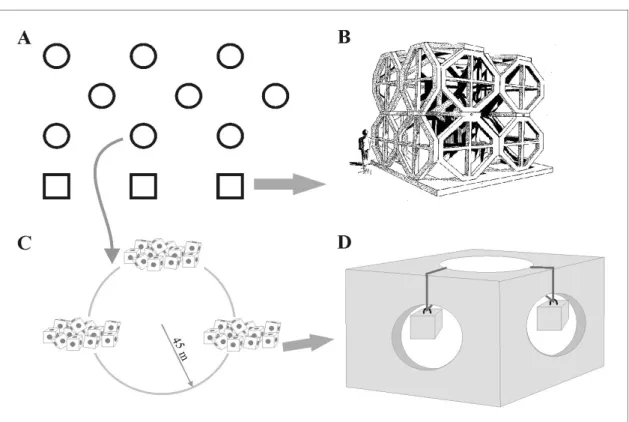
The Algarve artificial reef systems consist of both small (2.7m3) and large concrete modules (174m3) (Figure 2). Both structures were deployed along four distinct parallel lines to the coast, where small modules were placed at lower depths (18-25m) and the large ones on deeper waters (30-40m). The present work was carried out on the “Faro/Ancão” artificial reef, located off Faro (Algarve, southern Portugal) (cf. Figure 1), particularly on 2 adjacent small artificial reef groups (groups A10 and A11) of 35 modules each. These reef modules were deployed in August 2002, at approximately 20m depth.
Chapter II
18
Figure 2. A -Faro/Ancão artificial reef system. B – Large module. C – Reef group with 3 groups of 35 small modules each. D – Small module detail with the cubic sample units used in this study.
The study of macrobenthic colonisation was performed using 15 x 15cm cubic sample units made of the same concrete material of reef modules. These units were suspended on the reef blocks at the time of the reef immersion to ensure that the colonisation patterns would be representative of those occurring throughout the reef modules (cf. Figure 2). Three replicate samples were retrieved by scuba diving 3 and 6 months after immersion (November 2002; February 2003). The different surfaces of the cubic samples were scraped to analyse macrobenthic colonisation and succession. Four out of the six cube surfaces (horizontal: top and bottom; vertical: inside and outside) were compared during the study to analyse surface orientation role on benthic colonisation. Horizontal and vertical surfaces are not compared together in the present study. This methodology ensures that only non-adjacent surfaces are compared, minimising contamination. Only a quarter of the material collected from each face was analysed in
Section 1. Benthic succession on an artificial reef – Preliminary results
some of the samples. On those samples, extrapolated values for the total surface area are used. Bryozoans, hydroids, sponges, barnacles and ascidians were not quantified.
Data analysis
The community structure of the two artificial reef groups and on contrasting surfaces (horizontal and vertical) was evaluated throughout the sampling period using multivariate analyses. PRIMER v.5.0 software package was used for multivariate analyses (Clarke and Warwick, 1994). Similarity between faunal data was analysed by cluster and ordination techniques (non-metric multidimensional scaling - MDS) based on the Bray-Curtis similarity coefficient after fourth root transformation (Clarke, 1993). The cluster analysis used the unweighted pair group average algorithm (UPGMA) (Clarke and Warwick, 1994). To test for statistically significant differences between the macrobenthic colonisation on surface orientation and period of immersion, a two-way crossed ANOSIM test was performed using the same similarity matrix used for CLUSTER and MDS ordination. Species having the greatest contribution to dissimilarity among the pairs of surfaces, top vs. bottom and inside vs. outside, and period of immersion were determined using the similarity percentages routine (SIMPER) of the same statistical package.
Results
To date, 126 taxa have been identified in the “Faro/Ancão” artificial reef. 52 from class Polychaeta, 30 from phylum Mollusca and 35 Crustacea. Although barnacles and colonial taxa such as bryozoans, hydroids, sponges and ascidians were not analysed in this study, they were also found to be present in all samples. Data analysis showed that in both reef groups (A10 and A11), the mean abundance and the total number of species
Chapter II
20 were higher on the top than on bottom surfaces (Figure 3A and 4A). These parameters tend to increase with submersion time, particularly on the top surface. The mean abundance of the outside and inside surfaces showed similar colonisation patterns for both reef groups (Figure 3B and 4B).
Figure 3. Mean abundance values (±SE) of the two studied reef groups (A10 and A11). A – Top vs. Bottom surfaces; B – Outside vs. Inside surfaces.
Figure 4. Number of species of the two studied reef groups (A10 and A11). A – Top vs. Bottom surfaces; B – Outside vs. Inside surfaces.
Diversity and evenness indices (Table I) increased with time in both groups studied and on all surfaces. The strongest increase in these indices occurred on the bottom surface. The A11 group generally presented higher diversity and evenness values than the A10 group. 0 200 400 600 800 1000 0 3 6
Time of colonization (months)
M e a n a b u n d a n c e
A10 - Top A10 - Bottom A11 - Top A11 - Bottom
A 0 200 400 600 800 1000 0 3 6
Time of colonization (months)
M e a n a b u n d a n c e
A10 - Outside A10 - Inside A11 - Outside A11 - Inside
B 0 10 20 30 40 50 0 3 6
Time of colonization (months)
N u m b e r o f sp e c ie s
A10 -Top A10 - Bottom
A11 - Top A11 -Bottom
A 0 10 20 30 40 50 0 3 6
Time of colonization (months)
N u m b e r o f sp e c ie s
A10 - Outside A10 - Inside A11 -Outside A11 - Inside
Section 1. Benthic succession on an artificial reef – Preliminary results
Table I. Species diversity (H’log2 Shannon-Wiener index) and Pielou’s evenness (J’) values on the two studied reef groups (A10 and A11). Top vs. Bottom surfaces; Outside vs. Inside surfaces.
Throughout the sampling period, bivalves, amphipods and polychaetes, dominated the top surface, whereas on the bottom surface, polychaetes and bivalves were the more important taxonomic groups (Figure 5A and B). Amphipods were always present throughout the sampling period on both vertical surfaces. In general, polychaetes were the most abundant group on both inside and outside surfaces, even though there was a dominance shift from polychaetes to bivalves 6 months after submersion (Figure 5C and D).
Figure 5. Relative abundance on the two studied reef groups (A10 and A11). A – Top vs. Bottom surfaces of the A11 reef group; B – Top vs. Bottom surfaces of the A10 reef group; C – Outside vs. Inside surfaces of the A11 reef group; D - Outside vs. Inside surfaces of the A10 reef group.
Time (month) A11 Top A10 Top A11 Bottom A10 Bottom A11 Top A10 Top A11 Bottom A10 Bottom
3 3.5 3.3 3.2 3.0 0.7 0.6 0.6 0.6
6 3.9 3.7 4.0 4.0 0.7 0.7 0.9 0.8
Time (month) A11 Outside A10 Outside A11 Inside A10 Inside A11 Outside A10 Outside A11 Inside A10 Inside
3 3.8 3.3 3.3 3.0 0.7 0.7 0.6 0.6 6 4.0 3.3 3.5 3.3 0.8 0.6 0.8 0.6 H'(log2) J' A11 0% 20% 40% 60% 80% 100%
Top Bottom Top Bottom
R e la ti v e a b u n d a n c e 3 months 6 months A10 0% 20% 40% 60% 80% 100%
Top Bottom Top Bottom
R e la ti v e a b u n d a n c e 3 months 6 months A11 0% 20% 40% 60% 80% 100%
Outside Inside Outside Inside
R e la ti v e a b u n d a n c e 3 months 6 months A10 0% 20% 40% 60% 80% 100%
Outside Inside Outside Inside
R e la ti v e a b u n d a n c e 3 months 6 months
Others Polychaeta Amphipoda Decapoda Gastropoda Bivalvia
A B
Chapter II
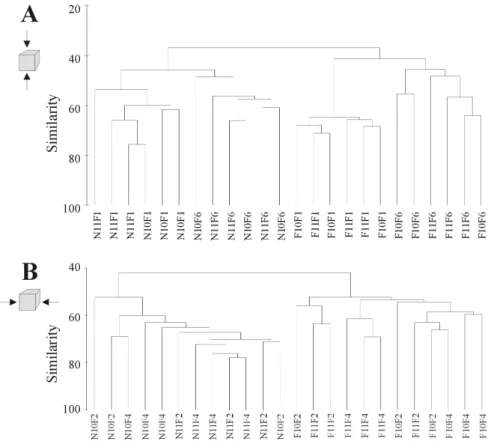
22 Cluster analysis (Figure 6A) individualised two main groups corresponding to the two sampling periods (3 and 6 months). Within both groups, the samples corresponding to each surface (top and bottom) cluster together, with no differentiation of the two reef groups. For vertical surfaces (inside and outside surfaces) only two groups were distinguished, corresponding to the different sampling periods (3 and 6 months) (Figure 6B). The configuration of the groups of samples obtained by MDS supported the results of the cluster analysis (Figures 7A and B). Thus, ordination and cluster diagrams for the macrofauna data suggests that differences on orientation and time of submersion were determinant for community composition. The results obtained with a two-way crossed ANOSIM showed that only the horizontal surfaces were significantly different (R = 0.74; p = 0.001), whereas for the vertical surfaces, the ANOSIM test showed no significant difference (R = 0.042; p = 0.265). The time of immersion was significant both for horizontal (R = 0.87; p = 0.001) and vertical surfaces (R = 0.89; p = 0.001).
Figure 6. CLUSTER dendrograms of the fourth root transformed species-abundance data of the two studied reef groups (10 and 11). A – Top (F1) vs. Bottom (F6) surfaces, B – Outside (F2) vs. Inside (F4) surfaces, during sampling period (3 months – N; 6 months - F).
Section 1. Benthic succession on an artificial reef – Preliminary results
Figure 7. MDS ordination plots of the fourth root transformed species abundance data. Black symbols – A10 reef group; Grey symbols – A11 reef group; Non-filled symbols – 3 months of colonisation; Filled symbols – 6 months of colonisation. A – Top vs. Bottom surfaces; Square symbols – top surface; Triangles – bottom surface. B – Outside vs. Inside; Square symbols – outside surface; Triangles – inside surface.
Regarding horizontal surfaces, SIMPER analysis identified the bivalves Hiatella arctica (Linnaeus), Musculus costulatus (Risso), Musculus cf. marmoratus (Forbes) and undetermined Anomiidae, the amphipod Microdeutopus versiculatus (Bate) and the serpulids [und. Serpulidae, Pomatocerus triqueter (Linnaeus), P. lamarckii (Quatrefages), Serpula concharum Langerhans and Serpula vermicularis Linnaeus], as the species having the greatest contribution to the MDS ordination plot and ANOSIM results. Although most species were present on both horizontal surfaces, macrobenthic assemblages were significantly different especially due to the differences observed in
Chapter II
24 the relative abundance. Top surfaces were characterised by H. arctica, M. costulatus, M. cf. marmoratus, und. Anomiidae and Microdeutopus versiculatus. In bottom surfaces, polychaete serpulids were the most characteristic taxa. Vertical surfaces presented a similar faunal composition, clearly dominated by serpulids and by H. arctica, especially on the inside surface. With submersion time increase, different species are present, such as the polychaetes Capitella spp.. Furthermore, the average abundance increases on all surfaces, except for serpulids and the amphipod M. versiculatus that after six months, were less abundant.
Discussion
Biodiversity on artificial reefs is related to different environmental and structural factors, such as morphological complexity of the reef, substratum composition, depth and distance from natural reef areas (Ardizzone et al., 1997). To evaluate the success of an artificial reef it is necessary to calculate its capacity as a feeding ground for demersal and rockfishes (Itosu et al., 1999). Thus, the efficiency of an artificial reef is related to biological colonisation, particularly biomass, species richness, number of ecological niches and food webs (Relini et al., 1994). The present study on the colonisation patterns of the “Faro/Ancão” artificial reef showed a general increase of the average abundance, number of species and diversity during the first six months of immersion. Three months after immersion the samples already presented 26-47 macrobenthic taxa, excluding colonial taxa and barnacles species. After sixth months of immersion 25-49 taxa were collected, whereas in the Loano reef (Ligurian sea, Italy), Relini et al. (1995) reported only 57 species after twelve months, including colonial taxa and barnacles. The top surface of the cubic samples presented higher number of species and mean abundance than the other surfaces in study. Similar patterns were also found by D’Anna
Section 1. Benthic succession on an artificial reef – Preliminary results
et al. (2000) and by Glasby and Connell (2001). According to several other authors (Baynes et al., 1989; Ardizzone et al., 2000; Relini, 2000) the different exposure of each surface namely to light, currents and sedimentation strongly influences settlement and evolution patterns of benthic communities, arguing in favour of the present results. Time of submersion, however, appeared to be the main factor influencing the succession of these communities, with both artificial reef groups showing a similar pattern.
Vertical and bottom surfaces of the cubic samples have a similar faunal composition, with a clear dominance by serpulids after three months. D’Anna et al. (2000) observed that the early stages of the settlement are driven by encrusting forms like the serpulid worm Pomatocerus triqueter, a common species encroaching on clear surfaces. In that study the development of significant colonies of encrusting filter feeders, such as serpulids occurred inside the reef structure and in shaded niches. These organisms abundance decreased with time of submersion, and Hiatella arctica becomes the dominant species. These taxonomical groups are common colonizers of artificial reefs in many other artificial reef structures (e.g. Ardizzone et al., 2000; D’Anna et al., 2000). Contrasting with the results obtained for other European reefs, macroalgae were not found to colonize the reef during these first six months of study. Other studies in progress on the Algarve artificial reef system, addressing the comparison between different artificial reef groups, depth and temporal variation will hopefully provide important data for understanding the patterns of benthic colonisation on artificial substrata.
Chapter II
26 References
Allemand D, Debernardi E, Seaman WJr. 2000. Artificial reefs in the principality of Monaco: protection and enhancement of coastal zones. In: Jensen AC, Collins KJ, Lockwood APM, editors. Artificial reefs in European seas. Southampton: Kluwer Academic Publishers. p. 151-166.
Ardizzone G, Somaschini A, Belluscio A. 1997. Biodiversity of European artificial reefs. In: Jensen AC, editor. European artificial reef research. Proceedings of the First EARRN Conference, March 1996 Ancona, Italy. Southampton Oceanographic Centre, Southampton: 39-59.
Ardizzone G, Somaschini A, Belluscio A. 2000. Prediction of benthic and fish colonization on the Fregene and other Mediterranean artificial reefs. In: Jensen AC, Collins KJ, Lockwood APM, editors. Artificial reefs in European seas. Southampton: Kluwer Academic Publishers. p. 113-128.
Badalamenti F, D’Anna G, Riggio S. 2000. Artificial reefs in the Gulf of Castellammare (north-west Sicily): a case study. In: Jensen AC, Collins KJ, Lockwood APM, editors. Artificial reefs in European seas. Southampton: Kluwer Academic Publishers. p. 75-96.
Barnabé G, Charbonnel E, Marinaro J-Y, Ody D, Francour P. 2000. Artificial reefs in France: analysis, assessments and prospects. In: Jensen AC, Collins KJ, Lockwood APM, editors. Artificial reefs in European seas. Southampton: Kluwer Academic Publishers. p. 167-184.
Baynes TW, Szmant AM. 1989. Effect of current on the sessile benthic community structure of an artificial reef. Bulletin of Marine Science 44 (2): 545-566.
Section 1. Benthic succession on an artificial reef – Preliminary results
Bohnsack JA, Sutherland DL. 1985. Artificial reef research: a review with recommendations for future priorities. Bulletin of Marine Science 37(1): 11-39.
Bombace G. 1995. Le barriere artificiali nella gestione razionale della fascia costiera italiana. Biol. Mar. Medit., 2 (1):1-14.
Clarke KR. 1993. Non-parametric multivariate analysis of changes in community structure. Australian Journal of Ecology 18: 117-143.
Clarke KR, Warwick RM. 1994. Change in marine communities: an approach to statistical analysis and interpretation. National Environment Research Council, UK. Pp.144.
D’Anna G, Badalamenti F, Riggio S. 2000. Artificial reefs in North-West Sicily: comparisons and conclusions. In: Jensen AC, Collins KJ, Lockwood APM, editors. Artificial reefs in European seas. Southampton: Kluwer Academic Publishers. p. 97-112.
Glasby TM, Connell SD. 2001. Orientation and position of substrata have large effects on epibiotic assemblages. Marine Ecology Progress Series 214: 127-135.
Guillén JE, Ramos AA, Martínez L, Sánchez Lizaso JL. 1994. Antitrawling reefs and the protection of Posidonia oceanica L. Delile meadows in the western Mediterranean Sea: demand and aims. Bulletin Marine Science 55 (2-3): 645-650.
Itosu C, Komai Y, Sakai H. 1999. Estimation of food organism production on steel-made artificial reef. In: Relini G, Ferrara G, Massaro E, editors. Proceedings of the Seventh International Conference on Artificial Reefs and Related Aquatic Habitats (7th CARAH). Erredi Grafiche Editoriali, Genova, 150-157.
Chapter II
28 Kevern NR, Biener WE, Vanderlaan SR, Cornelius SD. 1986. Preliminary evaluation of an artificial reef as a fishery management strategy in Lake Michigan. In D'Itri FM, editors. Artificial reefs - Marine and freshwater applications. 2nd Edition. Lewis Publishers, Inc., Chelsea, USA: 443-458.
Lamadrid AS, Zaragoza V, Vioque JE. 1995. Stock enhancement of gilthead sea bream Sparus aurata L. at south Atlantic Spanish coast. ECOSET'95. Proceedings of the International Conference on Ecological System Enhancement Technology for Aquatic Environments; Oct 29-Nov2 1995; Tokyo, Japan: International Marine Science and Technology Federation, 2: 593-598.
Monteiro CC, Santos MN. 2000. Portuguese artificial reefs. In: Jensen AC, Collins KJ, Lockwood APM, editors. Artificial reefs in European seas. Southampton: Kluwer Academic Publishers. p. 249-261.
Polovina JJ. 1991. Fisheries applications and biological impacts of artificial habitats. In: Seaman WJr, Sprague L, editors. Artificial habitats for marine and freshwater fisheries. Academic Press Inc: 153-176.
Relini G. 2000. The Loano artificial reef. In: Jensen AC, Collins KJ, Lockwood APM, editors. Artificial reefs in European seas. Southampton: Kluwer Academic Publishers. p. 129-149.
Relini G, Relini M, Torchia G, Tixi F, Nigri C. 1995. Coal ash tests in Loano artificial reef. ECOSET'95. Proceedings of the International Conference on Ecological System Enhancement Technology for Aquatic Environments; Oct 29-Nov2 1995; Tokyo, Japan: International Marine Science and Technology Federation, 1: 107-113.
Section 1. Benthic succession on an artificial reef – Preliminary results
Relini G, Zamboni N, Tixi F, Torchia G. 1994. Patterns of sessile macrobenthos community development on an artificial reef in the Gulf of Genoa (northwestern Mediterranean). Bulletin Marine Science 55 (2-3): 745-771.
Santaella E, Revenga S. 1995. Les recifs artificiels dans la politique de structures de la peche en Espagne. Biol. Mar. Medit. 2 (1): 95-98.
Santos MN, Monteiro CC. 1997. The Olhão artificial reef system (south Portugal): fish assemblages and fishing yield. Fisheries Research 30: 33-41.
Santos MN, Monteiro CC. 1998. Comparison of the catch and fishing yield from an artificial reef system and neighbouring areas off Faro (Algarve, south Portugal). Fisheries Research 39: 55-65.
Santos MN, Monteiro CC, Erzini K. 1995. Comparison of natural and artificial reef fish assemblages in Algarve waters (south Portugal). ECOSET'95. Proceedings of the International Conference on Ecological System Enhancement Technology for Aquatic Environments; Oct 29-Nov2 1995; Tokyo, Japan: International Marine Science and Technology Federation, 1: 210-214.
Svane I, Petersen JK. 2001. On the problems of epibioses, fouling and artificial reefs, a review. P.S.Z.N.: Marine Ecology 22(3): 169-188.
Walker BK, Henderson B, Spieler RE. 2002. Fish assemblages associated with artificial reefs of concrete aggregates or quarry stone offshore Miami Beach, Florida, USA. Aquatic Living Resources 15: 95-105.
Boaventura, D.; Moura, A.; Leitão, F.; Carvalho, S.; Cúrdia, J.; Pereira, P.; Cancela da Fonseca, L.; Santos, M. N., and Monteiro, C. C. 2006. Macrobenthic colonisation of artificial reefs on the southern coast of Portugal (Ancão, Algarve). Hydrobiologia. 555(1):335-343.
Section 2.
Macrobenthic colonisation of artificial reefs on the southern coast of
Portugal (Faro/Ancão, Algarve)
Chapter II
Introduction
Artificial reefs are submerged structures placed on the seabed deliberately to imitate some characteristics of natural reefs, as defined by the European Artificial Reef Research Network (Jensen, 1997). Artificial reef systems are usually developed for fish exploitation, for protection of marine areas from illegal fisheries, and more recently, for preservation and rehabilitation of natural habitats (Pickering et al., 1998). These structures have been deployed worldwide and, according to Seaman and Sprague (1991), the major areas presenting this kind of activity include the Mediterranean and Caribbean Seas, South-eastern Asia, Japan, North America, Australia and some islands in the South Pacific. The expansion of this activity is related to the evolution of the structures and materials used in the reef’s construction, as well as their purposes.
In Europe, the construction of artificial reefs started in the late 1960s. However, only in the 1980s and 1990s their use has increase significantly, especially in the Mediterranean (Allemand et al., 2000; Badalamenti et al., 2000; Barnabé et al., 2000; Moreno, 2000; Revenga et al., 2000).
In Portugal, seven artificial systems have been implanted along the southern coast of the Algarve over the last decade. The grounds for initiating this programme and for locating it on the southern coast of Portugal included the presence of several highly productive lagoon and estuarine systems in this region, the relative scarcity of natural reefs (especially on the south-eastern part of this coast), the high fishing intensity offshore, and the need to provide alternative means that would minimise the effect of fishing in order to yield a sustainable management of this coastal region (Monteiro and Santos, 2000). Research to date on these Portuguese artificial reefs has focussed mainly on fish populations, particularly those of economical importance (e.g. Santos, 1997; Santos and Monteiro, 1997, 1998). The present work aims to study the macrobenthic communities