J. res.: fundam. care. online 2015. out./dez. 7(4): 3487-3495
3487
Contribuições de uma pesquisa-intervenção para a assistência de enfermagem a usuários dedrogas.
Contributions to a research intervention for nursing care to drug users
Aportes para una investigación-intervención para la atención de enfermería a los usuarios de drogas Ana Maria da Silva Gomes 1, Ana Lúcia Abrahão 2, Ana Paula de Andrade Silva 3
Objective: Describe the professional and family contexts present in the drug user rehabilitation process in treatment in a military institution and the interventions proposed by the nursing team in this scenario. Method: This descriptive study in a military Recovery Center. Data collected from semi-structured interviews with a script. Results: It observed that the approach of the nursing staff with the situation experienced by individuals under their care favors the creation of links and ties confidence. Conclusion: Interventions focused on drug users using motivational approaches and group therapies, lead to reducing the risks and vulnerabilities of chemical dependency. Descriptors: Disorders related to substance use, Military personnel, Employee performance appraisal.
Objetivo: Descrever os contextos profissionais e familiares presentes no processo de recuperação de usuários de drogas em tratamento numa instituição militar e as intervenções propostas pela equipe de enfermagem nesse cenário. Método: Estudo descritivo, realizado num Centro de Recuperação militar. Os dados foram coletados a partir de entrevista semi-estruturada, com um roteiro. Resultados: Evidenciou-se que a aproximação da equipe de enfermagem com o contexto vivenciado pelos indivíduos sob o seu cuidado favorece a criação de vínculos e laços de confiança. Conclusão: As intervenções junto aos usuários de drogas que utilizam abordagens motivacionais e terapias de grupo levam a redução dos riscos e vulnerabilidades da dependência química. Descritores: Transtornos relacionados com o uso de substâncias, militares, Avaliação de desempenho profissional.
Objetivo: Describir los contextos profesionales y familiares presentes en el proceso de rehabilitación de usuarios de drogas en tratamiento en una institución militar y las intervenciones propuestas por el equipo de enfermería en este escenario. Método: Estudio descriptivo realizado en un Centro de Recuperación militar. Los datos se obtuvieron de entrevistas semi-estructuradas con un guión. Resultados: Se observó que el enfoque del personal de enfermería con la situación vivida por las personas bajo su cuidado favorece la creación de vínculos y lazos de confianza. Conclusión: Las intervenciones centradas en los usuarios de drogas que utilizan enfoques motivacionales y terapias de grupo conducen a riesgos y vulnerabilidades de la dependencia química reducidos. Descriptores: Trastornos relacionados con el consumo de sustancias, Evaluación del desempeño militar, Evaluación del rendimiento de empleados.
1 Mestre em Enfermagem- UFF. Capitão Enfermeira. E-mail: [email protected] 2 PhD in public health management and health planning. – Director of EEAAC- UFF. E-mail: [email protected] 3 Alumn of UNESA. Professional Master's Student Health Education - MPES- UFF-. E-mail: [email protected]
J. res.: fundam. care. online 2015. out./dez. 7(4): 3487-3495
3488
he exponential growth of chemical dependency at all social group’s demand specialized health actions. Effective interventions must prioritize the user host and integrated follow-up of the cases, in order to provide emotional support and social support for the confrontation of this therapeutic process. Thus, the efficiency and effectiveness of these actions, health can be assessed for risk reduction.1.The expansion of the scientific production carried out by nurses brought innovation and improvement for nursing care. Yet few academic productions cover the treatment of soldiers who abuse drugs. In this sense, the social impact of this study centered on strengthening assistance practices with drug users, in military institutions.
The production of health always permeates various forces imposed and such Act becomes more complex when issues of normative nature, related to military culture,impose a greater complexity for the accomplishment of thisWatch. 2
Health work with drug addicts need tools that provide significant improvements in activities of differences the psychological, family and social spheres of these individuals. 3 Whereas the scientific evidence should be the Guide for the choice of strategies used4, we
chose to develop as one of the by-products of this study, a motivational slant reflective activity, coordinated by nursing. Therefore, after the team's qualification, there was the creation of therapeutic activity entitled as "daily reflection" group and character based on motivational interview technique.
This activity proposes a change in the perception of the user, as the health-disease process to perform reflexive readings and techniques that based on the five principles of the Motivational Interview: Express empathy, develop the discrepancy between this behavior and the goals of the client, avoid arguments, follow the resistance and promote self-efficacy. 5
The goal is to describe the professional and family contexts present in the recovery process of drug users in treatment in a military institution and the interventions proposed by the nursing staff in this scenario.
J. res.: fundam. care. online 2015. out./dez. 7(4): 3487-3495
3489
This is a descriptive study with a qualitative approach. The present study carried out in the second half of 2011 in ahealth Institution of the Brazilian Army. Participated in the study thirteen-drug users, admitted to the infirmary for treatment of compulsion, situated in thatinstitution.It used as a tool for data collection, semi-structured interviews. Such interviews recorded so that the interviewer could focus its attention on the user. It was subsequently performed the total transcript speeches, respecting the construction of sentences, grammatical errors and pauses during speech.
As a research-intervention, also used in the construction of this article, a field journal, used as another resource when searching, for allowing a better record of the observed behaviors during the interpersonal relationships of the health professional, with the user and their families. Thus, the field journal allowed the registration of movements, observations, conversations and perceptions, allowing the researchers rebuild relations experienced at the time of research.
After transcription of the talk and the Organization of the content, a reading of the empirical material floating and the separation lines. Later made reflective readings, in which the issues arose.
The study submitted to the approval of the Research Ethics Committee of the Faculty of Medicine/University Hospital Antônio Pedro in the CAAE 0414.0.258.000-11.
Characteristics of the population investigated
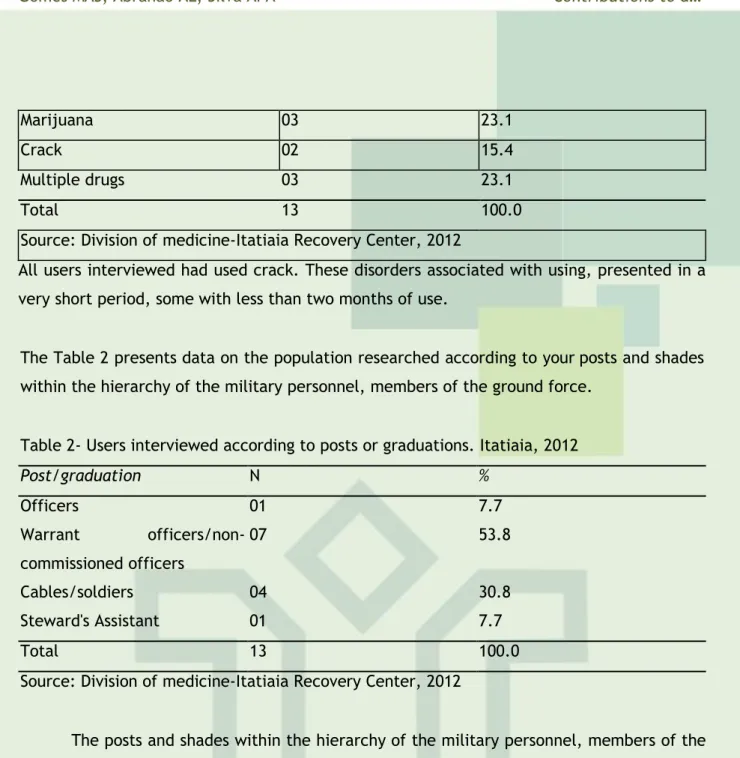
The Table 1 presents the characteristics of the population investigated and the pattern of consumption.
Table 1- Users interviewed according to type of substance. Itatiaia, 2012
Type of drugs N %
Alcohol 02 15.4
J. res.: fundam. care. online 2015. out./dez. 7(4): 3487-3495
3490
Marijuana 03 23.1
Crack 02 15.4
Multiple drugs 03 23.1
Total 13 100.0
Source: Division of medicine-Itatiaia Recovery Center, 2012
All users interviewed had used crack. These disorders associated with using, presented in a very short period, some with less than two months of use.
The Table 2 presents data on the population researched according to your posts and shades within the hierarchy of the military personnel, members of the ground force.
Table 2- Users interviewed according to posts or graduations. Itatiaia, 2012
Post/graduation N % Officers 01 7.7 Warrant officers/non-commissioned officers 07 53.8 Cables/soldiers 04 30.8 Steward's Assistant 01 7.7 Total 13 100.0
Source: Division of medicine-Itatiaia Recovery Center, 2012
The posts and shades within the hierarchy of the military personnel, members of the ground force, follow the following framework: senior officers, represented by the ranks of Major, Lieutenant Colonel and Colonel; intermediate officers, represented by Captain and stations; junior officers, lieutenant’s classification. Sergeants, Taifeiros, corporals and Soldiers, in turn, represent the graduates.
Reports of Experiences
The need for recovery of self-esteem and a desire to get more tools for the return of social life without the use of drugs was the most prevalent in the lines of the users interviewed.
During the interviews with users investigated, asking if there were conflicts at work because of using, we obtained similar themed speeches. The recurring idea was the existence of prejudice in everyday work and loss of labor capacity for military service.
"It's very hard to get to the Commander and say that you're a chemical dependent. The hardest, even more than the treatment is prejudice. “(And User).
"At first, I found it difficult to solve my problem. Hiding from everyone, especially from my boss. I thought I could be fired. In my first
J. res.: fundam. care. online 2015. out./dez. 7(4): 3487-3495
3491
hospitalization, I said I had problem with alcohol (...). To this day, there in my headquarters, few people know that I also made use of cocaine. “(F)There is yes. I was punished in the barracks, but was because of delay. Even if I go back to live me to perform certain functions, lost confidence you know? I felt that if I had not come treat me I would be out of the army, because I have had a lot of punishment for being late. The drug cannot be on my record, but delays and shortages have led to many disorders with my superiors. (Z)
The ambiguity and the breaking of rules were characteristics of drug addicts. This pattern of adaptive behavior hardly brings conflicts in all spheres, becoming a trigger for relapse. 6
Even if I go back to live to perform certain functions, lost confidence you know? I felt that if I had not come treat me I would be out of the army, because I have had a lot of punishment for being late. The drug cannot be on my record, but delays and shortages have led to many disorders with my superiors. (Z)
As for the topic related to care provided by nursing, to ask about how to process the production of this caution, the lines pointed out the prevalence of mechanistic approaches. However, there is the recognition of those who establish a relationship with the user, providing an improved case management.
I do not like the way some sergeants talk to me, do you have another that give you an idea, talk, and it is not just this one thing: take your medicine. However, I have no complaints, no. (T)
I consider the work of very good nurses. They listen to us. Now, it is a matter of empathy, because some who take military service here do not give a lot of openness to talk. (User)
Sometimes beats nervousness, then I need to talk about what I feel or I am gone. (Z).
When we approach the theme about family relationships, we realize that all the respondents presented a dysfunctional family. Other data that was prevalent in this study was the existence of problems with drugs or alcohol by other family members. So, the family support that the participants have obtained was harmed.
In this way, participants produced senses that we approach the idea that family disputes act as a risk factor, as in the speeches below:
I decided to stop after seeing the suffering of my mother. (User) The family by linking their emotional needs to recover that user found feelings of fear, uncertainty, ambivalence, anger and frustration.
J. res.: fundam. care. online 2015. out./dez. 7(4): 3487-3495
3492
My wife told me it was my last chance, which I will not ever improve. Ever thought of suicide know of some military in the same situation that I who have tried suicide. ((R)One of the users interviewed produced several poems during hospitalization and used the space for daily reflection activity to disclose it to other users.
The use of poetry as an expression of thought was prevalent during the hospitalization for that user. His speech, now marked by gestures of reflection, sadness, revealed that his poetic inspirations suffer direct influence your emotional state.
Below are two poems, titled "recovery, resentment, and tolerance, which according to the same, approaches the subject of the present study:
Recovery
I shudder like an earthquake that basements destroyed, freed me from myself.
Gradually, I feel like everything is a world, in his hands to anything. Thinking about the universe, we find,
Were mistakes and so just as lies, broken? I do not see myself, so try, selfish, I went In the broken mirror with blood,
So many voices I hear and what I am? When I follow my heart,
Speech hoarse, vague coherence and sadness Until: blind, deaf, and dumb,
Who was I?
Without ever knowing the truth, I tried to find me
In another, the things in death... Insanity, pleasures the flesh.
Little is little, helpless, harmed, thwarted.
(And the user)
Resentment and tolerance
No power forgives my wishes resentful Hurt me, I share what I feel
There is no point the shadow attacks In Jesus lived
The playful sheet music
Deliver it to me; I will come in truth, How will springs art,
The quiet arrogance oblique
Cancel me or enter me, resolute in the compass, And the rule my steps
Deep understand me
Clausuro proud that condemns Pain fatigue escort
Sheets that embrace without luck, Fallen, the spirit intolera,
Augusta presence, In a distant called,
The myopia minor valance When looking for,
Perverse, tactile
The charitable search rescues, A book that opens the my sins, The lightness that the wall nude,
The macula, wounds that the past designs, I ask nothing more than one day,
Do not carry this desire to rule.
J. res.: fundam. care. online 2015. out./dez. 7(4): 3487-3495
3493
We realize all the time the expression of motivations and subjectivations involving the family, friends, co-workers and the military career in various stanzas, as well as in workshops. The military culture brings with it own models of representations. Therefore, analyzing the dependency of course a user belonging to the military career brings up a history of personal and professional losses.Study was conducted about chemical dependency in a military Institution. In this work, there was recognition of the need for an expanded approach, changing the punitive character of disciplinary changes involving the disease, in addition to the adoption of harm reduction practices in order to meet the needs of users. 2
The family system, when structured, gives individuals the perception of an emotional support and social belonging. In this context,parental monitoring and the harmony in the marital relationship of parents act as protective factors that young people from drug abuse.6
The chemical dependency experienced by other members of the family brings a huge problem that generates interference in the issues of adherence to the treatment and maintenance of abstinence, as cited by authors. 6
Build a therapeutic plan that includes the family care family support improves and increases the chances of not falling back in difficult situations involving family disputes.
The construction of empathy is the ability to express a therapeutic alliance, which must be conquered by reflective listening, respectful, along with an understanding of the patient's fears. 5
Work with the user's creativity means use it as a tool to know and understand nuances of social history, clinical or professional user. Therefore, the motivation is crucial to the recovery and can be crafted in their different stages through the motivational interview technique.
The Motivational Interview is based on client-centered therapy and has as main objective the behavior change. It consists of a tech widely used in user management and family, because assists in the long and difficult process of adherence to the treatment and maintenance of abstinence. 5
Such an approach allows the ressignification of the values and the sense of their daily activities and daily simply uses techniques that promote the expression of feelings, leading to decreased anxiety and an increase in thewell-being.
J. res.: fundam. care. online 2015. out./dez. 7(4): 3487-3495
3494
We conclude that the understanding the process experienced by the user and his family, reduces emotional overload experienced in situations involving drug abuse.It was clear that there is an intervention that is effective for all users, yes; there are skills that can be developed by nursing staff along to users who will reflect on the sphere motivational and training links and social support network.
The experience in the field of mental health, the absence of trials, the concern with the aspirations and needs of the other, are skills and professional skills that facilitate the therapeutic relationship.
The use of the motivational interview by nursing staff allowed the customer proximity and if configured in a fundamental tool for reducing d the fear and anxiety produced by unpleasant situations determined by misfit behavior within a military environment.
J. res.: fundam. care. online 2015. out./dez. 7(4): 3487-3495
3495
1. Ministério da Saúde – O crack: como lidar com este grave problema(I)- pela Coordenação Nacional de Saúde Mental, Álcool e outras Drogas do Ministério da Saúde; 2009.
2. Gomes AMS. Atenção ao uso abusivo de drogas à luz da esquizoanálise: Um olhar sobre os dispositivos de produção de saúde numa Organização Militar de Saúde. [Dissertação]. Niterói: Universidade Federal Fluminense; 2013.
3. Schneider DR, Lima DS. Implicações dos modelos de atenção à dependência de álcool e outras drogas na rede básica em saúde. Psico; 42(2), p. 168-78; 2011.
4. Scochi C, GS et al. Pós-graduação Stricto Sensu em Enfermagem no Brasil: avanços e perspectivas. Rev. Bras. Enferm, Brasília, v. 66, n. spe, Set. 2013.
5. Sales CMB, Figlie N B. Revisão de literatura sobre a aplicação da entrevista motiva-cional breve em usuários nocivos e dependentes de álcool. Estud. Psicol. Maringá, v. 14, n. 2, Jun; 2009. 6. Schenker M, Minayo MCS. Fatores de risco e de proteção para o uso de drogas na adolescência. Cienc. Saúde Colet. 10(3): 707-17; 2005.
Received on: 11/05/2015 Required for review: No Approved on: 04/08/2015 Published on: 01/10/2015
Contact of the corresponding author: Ana Maria da Silva Gomes Rua 11 número 11, Jardim Itatiaia. Itatiaia. Rio de Janeiro, Cep:27580-000 E-mail: [email protected]