Interfaces in Entrepreneurship Development:
between tradition and innovation
Maria de Fátima Ferreiro
#1, Cristina de Sousa
#21Instituto Universitário de Lisboa (ISCTE-IUL) and Dinâmia’CET-IUL 1[email protected]
2Dinâmia’CET-IUL, and Universidade Portucalense 2[email protected]
Abstract - The linkage between tradition and innovation involves specificities and different degrees of complexity, depending on the entrepreneurial activity and economic sector. The paper adopts an institutionalist approach to study the relation between tradition and innovation through the discussion of a specific case: the introduction of innovations in cork production and transformation in a Portuguese territory: Coruche.
Keywords: innovation, tradition, cork, institutions.
1. Introduction
Past knowledge transmitted through various
generations, or, more precisely, the delivery of knowledge stored up in various traditions, possesses enormous value. Tradition, as many scholars contend, appears to be an important feature in the identification of new forms of appropriation of natural resources, historic and landscape heritage, farm products, knowledge and technology and, therefore, in entrepreneurship processes. The ‘invention’
of tradition, or traddinovation, takes diverse
manifestations and has become an important research area.
The paper adopts an institutionalist approach to study the relation between tradition and innovation. It presents and discusses the interplay between tradition and innovation in a specific context through the discussion of a case study related to cork production and transformation in a Portuguese territory - Coruche. It draws on the conviction that institutionalism offers important insights for the research on the interactions between tradition and innovation in the following issues: i) the appraisal of innovation in relation to an institutional-traditional background and, therefore, within a context and rule’s based perspective; ii) the acknowledgement of the role of historical institutions, both in their restrictive and enabling
nature, in the emergence and development of innovations; iii) the role of innovation in the maintenance and/or revival of tradition.
We are dealing with an apparent paradox: institutions involve tradition and stability but they also favour change and innovation. Their stable and routinized nature creates the conditions for change and innovation: “We look backward because we look forward” (Reisman, 2012: 11; 18). Past experiences create knowledge, competencies and routines, which are societally specific (McKelvey, 1982) and can be used when individuals or organizations face specific problems or have to make choices (Magnusson and Ottosson, 2009). The linkage between past and present, routine and change is related to the simultaneously constraint and enabling nature of institutions. However, the interplay and dynamics between what seems to be opposite aspects of institutions (stability and change; restriction and freedom) should be assessed in particular cases considering that the production and reproduction of the ‘material means of life’ (Commons, 1934 [2003]) work within different and specific institutional frameworks.
The intentional or accidental nature of change, or ‘the purposefulness and choice’ of actors (Hodgson, 1988), corresponds to other central issue in institutional theory. In this respect, institutionalism offers an alternative to the rational choice model in the conception of actors, society and change. Being socially embedded, actors are influenced by pre-existing institutions and deal with them in creative ways, transforming tradition in new forms. This dynamic is at the core of Veblen concept of habits and instincts. Thus, Institutionalist vision of change combines purposive and intentional change with surprise and ‘unintended by-products’. According to Hodgson, “there are external influences moulding the purposes and actions of individuals, but action is not entirely determined by them (Hodgson, 1988: 12).
The contribution of innovation to the persistence of tradition may be one of the results of the interplay between tradition and innovation. But the result can be distinct: the creative power that emerges from traditional institutions ____________________________________________________________________________________
International Journal of Latest Trends in Finance & Economic Sciences IJLTFES, E-ISSN: 2047-0916
can destroy them. Thus, the evolution of institutions presents a complex dynamics related not only to the contribution of tradition to innovation, the more or less enabling nature of prevailing institutions and their intentional or accidental achievement, but also to the diversity of the result of this interplay, that is, the reproduction or decay of tradition where the novelties were rooted in. As mentioned by Hodgson, the adoption of an institutionalist approach envisages “[…] processes whereby for long periods the reining habits of thought and action are cumulatively reinforced. But this very process can lead to sudden and rapid change (Hodgson, 1988: 139-140).
The paper considers these thoughts on tradition and innovation in the following sections: section 2 presents Institutionalist theory, in its Old and New views, aiming the reference to concepts and perspectives with analytical potentialities in the research about the relation between tradition and innovation; section 3 presents the empirical analysis, including the methodological aspects; section 4 addresses the research questions and presents the main findings of the case study analysis; section 5 concludes.
2. Tradition and innovation: an Institutionalist approach
We find different definitions of institutions among Old and New Institutionalists. In his Institutional Economics, Commons refers that “Sometimes an institution seems to be analogous to a building, a sort of framework of laws and regulations, within which individuals act like inmate themselves”(Commons, 1934 [2003]: 69). For Veblen, institutions are “widely prevalent habits of thought in a given community such that they are analogous to cultural themes […]” (in Morgan et al [eds.], 2012: 25). This definition has influenced Hamilton to whom an “Institution is a verbal symbol which for want of a better describes a cluster of social uses. It connotes a way of thought or action of some prevalence or permanence, which is embedded in the habits of a group or the customs of a people. In ordinary speech it is another word for procedure, convention or arrangement; in the language of books it is the singular of which the mores or the folkways are the plural. Institutions fix the confines of and impose form upon the activities of human beings” (Hamilton, 1932 [1993]: 3, in Reisman, 2012: 5). North and “other neo-institutional economists define institutions as (rational) ‘rules of the game in a society’ of ‘more formally the humanly devised constraints that shape human interaction” (North, 1990; North, 2005, in Reisman, 2012: 25). Hodgson defines “social” institutions as “a social organization which, through the operation of tradition, custom or legal constraint, tends to create durable and routinized patterns of behavior” (Hodgson, 1988: 10) or “durable systems of established and
embedded social rules that structure social interactions” (Idem: 113).
Despite this conceptual diversity, it is possible to identify some common aspects among the definitions, which we consider to present analytical potential for the analysis of the interplay between tradition and innovation, namely the fact that they (i) remit to the social embeddedness of human action, “situated social actor” (Reisman, 2012: 23); (ii) mediate human interaction; and (iii) involve traditional and routinized patterns of behavior.
The deterministic and the restrictive nature of institutions correspond to one of the main sources of criticism and debate inside institutionalist theory and it is particularly important in the discussion of the interplay between tradition and innovation, particularly because that innovation remits to change.
On the one hand, scholars stress the role of institutions’ stable and routinized nature in creating the conditions to change and innovation. “Institutions, Douglas North has stressed, are matter in motion: ‘They evolve incrementally, connecting the past with the present and the future; history in consequence is largely a story of institutional evolution in which the historical performance of economies can only be understood as a part of sequential story” (North, 1991, in Reisman, 2012: 11). According to Reisman, “Institutions produce order, encode knowledge, reconcile expectations, promote cooperation, reduce transaction costs and keep down uncertainty. They are the fixed points that make it possible for the economy to evolve. […]. We look backward because we look forward” (Reisman, 2012: 11; 18). This linkage between past and present, routine and change is related to the simultaneously constraining and enabling nature of institutions. Rules are fixed (“The only stability that we know is that which man himself creates by collective action” [Commons, 1934: 213]) and also variable (“The individual is a system of relations, and changes with the collective action of which he is part and product” [Idem: 117]. “The heroic individual is schooled down to size. Inventors and innovators do what they do in spite of but because of coordinated expectations and the on-going life in common” (Reisman, 2012: 27). In other words, “Stable expectations do not so much stifle new departures as provide the firm foundation upon which dynamic entrepreneurship can confidently build” (Reisman, 2012: 28). Thus, there seems to be no contradiction between tradition and innovation or between constraint and freedom in Old Institucionalist view. However, we consider that the interplay and dynamics between what seems to be opposite aspects of institutions (stability and change; restriction and freedom) should be assessed in particular cases, considering that the production and reproduction of the ‘material means of life’ takes place within different and specific institutional
frameworks thus leading to “context-specific decisions and solutions” (Djelic, 2011: 29).
The debate on institutional change is also closely related to that of ‘action and agency’. According to Djelic (2011) it is visible an attempt in the “re-incorporating (of the) old institutionalim’s assertions” in this debate, namely the “attempt at reconciling a theory of institutional constraints and a theory of action” (Djelic, 2011: 30). This is the case of Greif‘s idea of “embedded form of agency where ‘past institutional elements provide opportunities as well as constraints in the process of institutional change that able coordinators take advantages of” (Greif, 2006, in Djelic, 2011: 30). The integration of a theory of agency in historical and cultural variants of neo-institutionalism highlights relevant dimensions related to the heterogeneity of institutional resources, spheres and constraints, social networks and social movements, temporal insights (“multiple and stages and sequences”), and ‘institutional work’ (“institutionalization and deinstitutionalization as combination and aggregation of situated practices”) (Djalic, 2011: 31-32). As a result, the recent developments of Neo-institutionalism related to ‘agency’ remit to an embedded action, institutions as constraints but also as resources, institutional entrepreneurship as a result of a “spatially dispersed, multimodal, and complex process”
(“collective kind”) with “several stages and
consequences” and “unexpected results” (Djalic, 2011: 34).
The contribution of innovation to the persistence of tradition may be one of the results of the interplay between tradition and innovation. But the result can be a different one: the creative power that emerges from traditional institutions can destroy them. Thus, the evolution of institutions presents a complex, and even conflicting, dynamics related not only to the contribution of tradition to innovation, the more or less enabling nature of prevailing institutions and their intentional or accidental achievement, but also to the diversity of the result of the process, that is, the reproduction or decay of tradition where the novelties were rooted in. As mentioned by Hodgson, the adoption of an institutionalist view envisages “[…] processes whereby for long periods the reining habits of thought and action are cumulatively reinforced. But this very process can lead to sudden and rapid change. […]. Economic institutions are complexes of habits, roles and conventional behavior. However, because of the momentum of technological and social changes in modern industrial society, and the clashing new conceptions and traditions thrown up with each innovation in management and technique, the cumulative character of economic development can mean crisis on occasions rather continuous, gradual change or advance” (Hodgson, 1988: 139-140).
Summing up, the conceptual insights that have been developed so far envisage an institutionalist approach to
the interplay between tradition and innovation in particular cases (case studies analysis) and remit to the following analytical dimensions and research questions:
i) What is the context, e.g., actors and their role in innovation dynamics?
ii) What is the balance between restrictive and enabling nature of tradition (e.g., knowledge, practices, culture) in the emergence and development of innovations?
iii) What is the impact of innovation in terms of reproduction and persistence of tradition?
These research questions are empirically addressed in a specific context - a case study of the cork industry located in a Portuguese rural territory.
3. The empirical setting: cork industry in a Portuguese rural territory
Coruche (town and head of the county) belongs to a predominantly rural area, contiguous to the Lisbon Metropolitan Area and located 38.5 km from the district capital Santarém. It presents socio-economic indicators typical of a rural territory, a low population density, which is substantially below the national average: 17.8 inhabitants per square kilometre (versus 114.3 for Portugal, according to the last Census (2011)). The economic base of Coruche is marked by the presence of a large number of medium and large size companies dedicated to agroforestry and cork businesses (Ferreiro and Oliveira, 2014).
Coruche plays an important role in cork production worldwide. Portugal contains about 32% of the world’s area of cork woodland or montados and Coruche represents a large share of this area: 69% of the county is covered by montado. For this reason, Coruche, denominated world capital of cork, provides an excellent example of an innovation ecosystem based on the value-chain of cork. Montado is an ecosystem with multi-dimensional impacts such as the creation of employment, the preservation of cultural identity and ecological values in Mediterranean countries (Rives et al, 2013; González-Garcia, Dias and Arroja, 2013).
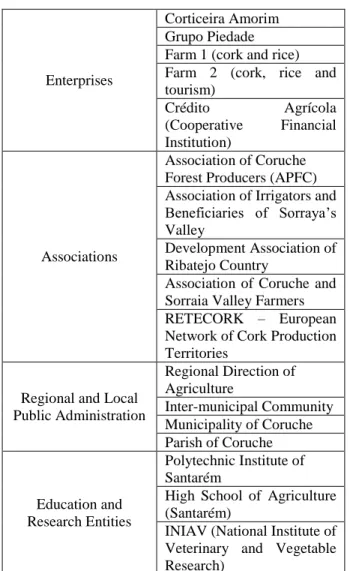
The empirical analysis uses both primary and secondary data. Primary data was collect through semi-directed interviews, conducted in 17 organizations between January and September 2014 (Table 1). Interviewees were asked to identify the main innovations they have developed and introduced, the relations they have maintained in their innovation processes, the importance of cork in the territory as well as it main potentialities, problems and development perspectives. Secondary data was collect through the analysis of websites, reports, newsletters and press articles.
Enterprises: forest producers, companies and a cooperative financial institution focused in rural business.
Regional and local associations related with territory development.
Public planners and local public
administration involved in the governance of the territory in different policy areas and with influence on the socio-economy of cork based activities.
Education and research entities, with relevant competences and skills related with cork in all the valued chain.
Table 1. Interviewed organizations
Enterprises
Corticeira Amorim Grupo Piedade Farm 1 (cork and rice) Farm 2 (cork, rice and tourism) Crédito Agrícola (Cooperative Financial Institution) Associations Association of Coruche Forest Producers (APFC) Association of Irrigators and Beneficiaries of Sorraya’s Valley
Development Association of Ribatejo Country
Association of Coruche and Sorraia Valley Farmers RETECORK – European Network of Cork Production Territories
Regional and Local Public Administration Regional Direction of Agriculture Inter-municipal Community Municipality of Coruche Parish of Coruche Education and Research Entities Polytechnic Institute of Santarém
High School of Agriculture (Santarém)
INIAV (National Institute of Veterinary and Vegetable Research)
4. Tradition and innovation in Portuguese cork industry: contexts, dynamics and tensions
4.1. The context and the players
Within the Institutionalism perspective economic actors and innovation processes are contextualized, that is, they are actors in context, establishing interactions that are
designed in a more or less formal way. The institutionalized forms of action and interaction give place to dynamics of innovations and development with diverse and sometimes complex interfaces with tradition. This is evident in our particular case: cork production and transformation in Coruche.
The interviewed companies are active players in the innovation system under analysis. Furthermore, other actors are actively engaged in this system at local level: not only universities, but also associations, financial institutions and public authorities. Most innovations in the studied territory are related to cork production and transformation. But we also have found innovations related to the promotion and preservation of local products and landscape. Regarding the variety of innovation practices in the studied context, we have uncovered several types of innovation (technological, both at product and process levels, market and social) and identified the role of actors in innovation process. In fact, we are dealing with a context composed by actors with different roles in the innovation system (innovators, innovation promoters, project leaders, project managers, knowledge producers, knowledge disseminators, policy makers, funding actors, information disseminators, and collective action) and responsible for a diversity of innovation types: from technological to social and institutional innovation (e.g., stoppers, cork composites, equipment for the mechanic extraction of cork, promotion of rural development, and ecological preservation related to the cork tree).
One of the most central actors in the innovation system is Corticeira Amorim. The company is developing and exploiting several innovations in the cork industry. It is a Portuguese multinational corporation present in the five continents. Starting in 1870, the history of Corticeira Amorim reveals an evolution towards internationalisation, vertical integration and innovation. The company has its headquarters in the North of Portugal, but has two industrial units in Coruche. Stoppers correspond to its main product with an historical relation to wine industry (particularly to Porto wine). This multinational company has its own R&D units. Nevertheless, the connection with the Portuguese scientific system is strong and relevant in terms of knowledge production and innovation. It also establishes important partnerships with international clients and cork users. Therefore, we can observe that Corticeira Amorim corresponds to a centre of a multinational innovation complex focused on cork and that some of the key players of cork innovation are external to the territory under analysis.
Besides Corticeira Amorim, other non-local actor is very prominent in this innovation system: INIAV. This is the Portuguese public research laboratory on agricultural and veterinary sciences, which is a relevant knowledge provider to this innovation system.
entities in the innovation process. In fact, regional and local administrative and political entities have been engaged in reinforcing the visibility of Coruche territory in the world, through the valorisation and promotion of traditional local resources, particularly cork. The World Capital of Cork brand is based on partnerships between private economic agents related to cork production and transformation, local infrastructures (e.g., Observatory of Cork and Cork Oak), and initiatives involving important national and international players of the sector like Ficor.
We are dealing with an innovation system with a multi-actor and multi-scale nature with clear and established innovation goals (Ferreiro and Sousa, 2015). The innovations are based on traditional elements like the raw material (cork), the local know-how related to cork extraction and transformation, and other material and
immaterial traditional cultural aspects, like the
preservation of a particular ecosystem (montado) and landscape which are being exploited through several marketing and social innovations.
4.2. Tradition and Innovation: dynamics and tensions
As proposed by Insitutionalist theories it is precisely the stable and routinized nature of institutions, or tradition, that creates the conditions to change and innovation. This linkage between past and present, routine and change is related to the simultaneously constraining and enabling nature of institutions. The case under analysis presents interesting elements to address these institutional aspects. First, tradition seems to present both enabling and restrictive elements to the development of innovations in cork based activities. In fact, and on one hand, cork, the ecosystem and the local know-how constitute the base of a very dynamic innovation system related with ‘conventional’ products (e.g., stoppers), but also of new products and markets (e.g., architecture and design, components to transport and airspace industries); on the other hand, there are research projects aiming at the substitution of traditional aspects of cork production and extraction. This is the case of a research project on cork genome with the purpose of decreasing the time span between extractions (traditionally in a nine years period), and the development of an extraction machine, which allows the substitution of human (traditional) work and know-how.
These innovations seem to overcome the limits of tradition, both in nature and ecological rhythms and in human work, related to the economic exploration of the raw material and aiming at introducing more effectiveness in the process. It seems, therefore, that the pressure on the availability of cork explains the research on genome modification of the tree and the mechanization on cork extraction. Nevertheless, raw material availability and quality depend on the maintenance of a traditional
ecosystem and specific knowledge related to forest management and raw material extraction. In fact, and so far, the tests performed on the extraction machine that is being developed reveal several problems, namely that its use can cause several damages in the trees, compromising its future development and, therefore, cork’s future supply both in terms of quantity and quality. These restrictive aspects of tradition in the development of innovations have to be addressed carefully. In fact, the design of the machine replicates the techniques of human work, but so far, and as mentioned above, it does not achieve the quality of human work. The traditional local know-how related to cork extraction, often passed from father to son, is difficult to mechanize and, therefore, substitute.
The previous analysis introduces important elements to evaluate the contribution of innovation in tradition preservation (e.g., ecosystem, local know-how and other material and immaterial components involved in cork production and transformation). In fact, and secondly, the identified tension between tradition and innovation highlights the enabling and restrictive factors present in that relation, introducing what seems to be a certain paradox in the case under analysis: cork industry is based on a traditional natural and socio-cultural system and depends on its preservation - the use of cork as a raw material contributes to the development and investment in cork oak trees; consequently, innovations should contribute to its preservation. Otherwise the availability and quality, that is cork supply in habitual standards, can be compromised with impacts on one of the most important sectors of Portuguese economy, both at local and macroeconomic levels. On one hand, cork industry contributes to the investment in the sector, namely within the European Structural Funds related with Agriculture and Rural Development through forest oriented measures; on the other hand, recent research and innovation developments may compromise the maintenance of a traditional ecosystem and local know-how as previously mentioned. Besides, nowadays Portuguese cork oak trees and the related ecosystem (montado) present several problems related with desertification and serious diseases that explain quality decreasing and the high level of annual cork oak trees mortality.
There are positive signs in this respect related with the evolution of innovation developed and exploited mainly by Corticeira Amorim, the biggest player in the sector. The company’s research is nowadays more centred in forest, that is, raw material – cork. In fact, the concerns with forest production and certification and the problems related with cork (e.g., cork’s quality change, trees’ diseases) are recent and constitute a novelty in terms of the innovation purposes and players. Besides Corticeira Amorim, these problems have being researched by public entities like INIAV, a public research centre and an important actor of the cork innovation system, as
previously mentioned. Nevertheless, the novelty of the research related to cork oak tree and the still exploitation nature of this research is critical considering the challenges involved and the importance of this sector not only for the Portuguese economy but also for the preservation of a traditional ecosystem.
5. Conclusions
Portuguese cork industry located in Coruche, the world capital of cork, corresponds to a dynamic innovation system, which results from the interplay and connections between different actors actor) and scales (multi-scale) through several institutions. Results show that cork companies located in Coruche are exploiting different product innovations, some of which are related to cork’s main product: stoppers. The world sector leader – Corticeira Amorim – is also very active in developing new cork applications, namely for transport and housing purposes in partnerships with international actors. There is also research on cork genome with the purpose of reduction of the time span between extractions, involving research consortium with a Portuguese University.
This economic activity is based on a traditional ecosystem (montado) and traditional local knowledge: cork extraction involves very specific techniques and tools done by men and transmitted from generation to generation. Therefore, the maintenance and success of the Portuguese cork industry depends strongly on traditional aspects with a multidimensional nature: ecological, social and economic nature. Some of the restrictive elements of tradition regarding the development of innovation are founded in the particularities of a raw material - cork - in ecological and social terms. The natural rhythms in cork regeneration, the complexity of the ecosystem that allows the maintenance of cork’s quality and the specificity of know-how may collide with the challenges of global markets and competition. Some of the innovations developed may present a threat to the preservation of the traditional elements identified. This is the case of the genome modification and the mechanization of cork extraction, which aim to overcome the ‘limits’ of nature and human rhythms and may result in negative impacts in cork quality. To these eventual treats on should add the real problems of cork oak trees like the diseases and cork oak tree’s mortality rate, something that is being researched but is far from a scientific and political priority. That is, the innovation enable the preservation of tradition as far as the research under way (e.g., INIAV) achieves effective responses and solutions to one of the biggest sources of Portuguese wealth as well as ecological and cultural value.
References
[1] Campbell, John L. (2012) “Institutional Reproduction and Change”, The Oxford Handbook of Comparative [2] Institutional Analysis, Oxford University Press,
Oxford.
[3] Commons, John (1934 [2003]) Institutional
Economics: its place in political economy, New Jersey, Transaction Publishers.
[4] Commons, John R. (1934, 2003), Institutional Economics, Macmillan, New York.
[5] Djelic, Marie-Laure (2012), “Institutional
Perspective – Working towards Coherence of Irreconcilable Diversity?”,
[6] Glenn Morgan, Campbell, John L., Crouch, Colin Crouch, Pedersen, Ove Kaj, Whitley, Richard (eds.), The Oxford
[7] Handbook of Comparative Institutional Analysis, Oxford University Press, Oxford.
[8] Ferreiro, Maria de Fátima and Oliveira, Pedro (2014) “Innovation and rural areas: an exploratory approach to the case of Coruche”, KITAB 2014 Conference (Knowledge, Innovation and Technology Across Borders: an emerging agenda), June 23-24, ISCTE-IUL, Lisbon.
[9] Ferreiro, M.F. and Sousa, C. (2015), Innovation networks and the governance of rural territories: the case of Coruche, Proceedings of 10th European Conference on Innovation and Entrepreneurship, pp. 205-213.
[10] Gonzalez-Garcia, S., Dias, A. C. and Arroja, L (2013) “Life-cycle assessment of typical Portuguese cork oak woodlands”, Science of the Total Environment, 452: pp 355-364.
[11] Hodgson, Geoffrey (1988), Economics and
Institutions, Polity Press, Cambridge.
[12] Magnusson, L. and Ottosson, J. (2009) “Path dependence: some introductory remarks”, in Lars Magnusson and Jan Ottosson (eds), The Evolution of Path Dependence, Cheltenham and Northampton: Edward Elgar.
[13] McKelvey, B. (1982), Organizational Systematics: Taxonomy, Evolution, Classification, Berkeley, CA: University of California Press, Berkeley, CA. [14] Morgan, Glenn, Campbell, John L., Crouch, Colin,
Pedersen, Ove Kaj, Whitley, Richard (eds.) (2012) The Oxford Handbook of Comparative Institutional Analysis, Oxford University Press, Oxford.
[15] Reisman, David (2012) The Social Economics of Thorstein Veblen, Edward Elgar.
[16] Rives, J., Fernandez-Rodriguez, I., Rieradevall, J., and Gabarrell, X. (2013) “Integrated environmental analysis of the main cork products in southern Europe”, Journal of Cleaner Production, Vol 51, pp 289-298.
[17] Streeck, W. and Thelen, K. (2005), Beyond Continuity, Institutional Change in Advanced Political Economies, Oxford.