Occurrence and molecular characterization of
Cucumber green mottle mosaic virus
in cucurbit crops of KPK, Pakistan
Asad Ali
1,2, Adil Hussain
2, Musharaf Ahmad
21
Laboratory of Plant Pathology, Faculty of Agriculture, Utsunomiya University, Mine Campus, Japan. 2
Department of Plant Pathology, The University of Agriculture, Peshawar, Pakistan.
Submitted: August 9, 2013; Approved: April 17, 2014.
Abstract
Field survey of the cucurbit crops revealed a high incidence ofCucumber green mottle mosaic virus (CGMMV) in Khyber Pakhtunkhwa Province (KPK), Pakistan. Among the seven districts surveyed, average percent incidence of CGMMV was recorded up to 58.1% in district Nowshera, followed by 51.1% in district Charsada, 40.5% in district Swabi and 37.3% in district Mardan. In Swat and Dir districts average incidence CGMMV was recorded upto 31.2% and 29.4%, respectively. Among the different crops highest incidence in plain areas of KPK was recorded in bottle gourd (59.3%) fol-lowed by 56.3% in Squash, 54.5% in Pumpkin, 45.5% in Melon, 41.7% in Cucumber and 29.9% in Sponge gourd. In Northern hilly areas highest incidence of CGMMV (52.9%) was observed in pump-kin, followed by 49.6% in bottle gourd, 47.3% in squash, 45.1% in Melon 42.3% in cucumber and 41.6% in sponge gourd. Little variability was observed in the coat protein amino acid sequence iden-tities of CGMMV Pakistan isolate, when compared with other reported isolates.
Key words:cucurbit, CGMMV, incidence, tobamovirus, Pakistan.
Introduction
Plants of the familyCucurcbitaceae, including many edible and non-edible species, are native in most countries of the world, especially in the tropics and in areas with rela-tively warm temperature. Cucurbit fruits have yellow, white or orange flesh, which is rich in carotenoids, the com-pounds humans need to make vitamin A, and the visual pig-ment rhodopsin. Cucurbit crops, including summer squash (Cucurbita pepo), bottle gourd (Lagenaria siceraria), cu-cumber (Cucumis sativus), sponge gourd (Luffa acutangula), bitter gourd (Momordica charantia) and snake/serpent gourd (Cucumis melo var. flexuosus), pro-duced throughout Pakistan including the Khyber Pakhtunkhwa (KPK) and are regarded as important sum-mer and winter vegetables.
In KPK cucurbits are grown on 3140 ha (does not in-clude the figures for lufa, long-melon and cucumber at pro-vincial level, as these were not available) with an annual estimated production of 29544 tons, while in Pakistan cu-curbit occupies an area of 28600 ha with a total annual
pro-duction of 261,306 tons (MINFAL, 2008). The average yield of such crops (approximately 9 tons/ha) in the region is quite low. A number of biotic and abiotic factors are re-sponsible for this low yield. The cultural practices adapted by the growers, conducive environmental conditions for disease epidemic development, lack of awareness of grow-ers both about viral disease epidemiology and the precau-tions required for control and the use of uncertified seeds are the major factors that result in high incidence of viral diseases. High population of weeds also plays an important role in virus epidemiology and is a common problem in vegetable growing areas of KPK.
Cucurbit viral diseases are a worldwide problem and induce major economic losses in commercial cucurbit pro-duction around the world (Lovisolo, 1980). Specially the vector transmitted viruses that may causes losses as high as 100% (Ullman et al., 1991). Almost 35 different viruses have been isolated from Cucurbitaceae (Provvidenti, 1996). In Pakistan cucurbit viruses are quite prevalent in the different cucurbit crops of KPK (Aliet al., 2004; Khalid and Ahmad, 1997).
Send correspondence to A. Ali. Laboratory of Plant Pathology, Faculty of Agriculture, Utsunomiya University, Mine Campus, Japan. E-mail: [email protected].
Cucumber green mottle mosaic virus(CGMMV) is member ofTobamovirusgenus, and is commonly reported in different cucurbit crops throughout the world (Namethet al., 1986; Ullmanet al., 1991; Desbiez and Lecoq, 1997; Choi, 2001; Lecoqet al., 2001; 2003; Aliet al., 2004). The virus is also seed transmitted in different cucurbits and is usually present on the surface of the seed as seed contami-nant. The very high stable genome coupled with transmis-sion through seeds and contact makes this virus a big menace causing heavy losses across the world wherever cu-curbits are grown. Presence of the inoculum right from the beginning of the crop growth results in a very high infec-tion/incidence level and usually it is very difficult for plants to resist infection under such circumstances (Coutts and Jones, 2005). According to a preliminary pilot study CGMMV infection was high in cucurbit crops of KPK (Ali et al., 2004). The present study is first ever effort to deter-mine the detailed incidence and status of CGMMV in dif-ferent cucurbit crops as well as difdif-ferent agro ecological zones of KPK, to characterize the virus at molecular level and to know the phyhlogenetic status of the Pakistani iso-lates.
Material and Methods
Field survey
A total of 22 fields in seven districts of the KPK viz; District Peshawar (Tarnab, Budni and Taru), District Nowshera (Jehangira, Nowshera, Pirsabaq), District Mardan (Shelgazi Baba Mumtaz Abad, Takhtbhai), District Swabi (Kalu Khan, Shewi Adda, Tordheri,), District Charsada (Sheikhabad, Umerzai, Serdheri), District Swat (Manyar, Bahrain, Kaidam Kalam, Batkhela) and District Dir (Gulabad, Talash, Timergarah, Chakdara) were sur-veyed to find out the incidence and distribution of CGMMV in Pakistan for two consecutive years (2007-2009) collecting randomly a total of 35 samples from each field. Major crops surveyed for the collection of samples were bottle gourd (Lagenaria siceraria), sponge gourd (Lufa acutangula), cucumber (Cucumis sativus), pumpkin (Cucurbita pepo), squash (Cucurbita muschata) musk melon (Cucumis melo) etc. The collected samples were brought to the plant virology laboratory and stored at -80 °C till further processing.
Disease incidence
All the collected plant samples were tested for the presence of Cucumber green mottle mosaic virus (CGMMV) using DAS-ELISA [Double Antibody Sand-wiched-Enzyme Linked Immunosorbent Assay (Clark and Adams, 1977). Commercial kits from (Agdia, USA) were used for analysis of the samples. All the buffers, coating an-tibodies and conjugated anan-tibodies were diluted as per the recommendations of the manufacturer. Following proce-dure was used to assay the samples. 100mL of the
antibod-ies, diluted in coating buffer (1:2000 v/v), were coated in each well of the ELISA plates and the plates were incubated at 37 °C for 2 h. After incubation the plates were washed three times with the help of washing buffer. -The collected samples were crushed thoroughly in the extraction buffer (1:5 w/v) and 100mL of the sap was applied to the wells.
The plates were incubated at 4 °C overnight and were washed thrice again with the help of washing buffer. After washing, 100 mL of the diluted conjugate antibodies
(1:1000 v/v) were applied to the wells and the plates were incubated at 37 °C for 1 h. Washing was repeated again three times using washing buffer and finally 100mL of
sub-strate (p-nitro-phenyl phosphate @ 1 mg/mL) were applied to each well. The plates were incubated at about 25 °C (or room temperature) in dark. Data were taken after 30 min and after 60 min.
Disease incidence was calculated using the following formula;
% Disease incidence= Ip ´
Np 100
whereIp= number of infected plants andNp= total number of plants.
RT-PCR amplification and sequence analysis of the coat protein gene of CGMMV
The cDNA of the selected positive samples was syn-thesized using iScript cDNA synthesis kit (Bio-Rad, USA) according to the manufacturer’s instructions with 3’-end virus-specific primer. CGMMV RNA was isolated by sim-ple direct tube (SDT) method (Suehiro et al., 2005) by crushing the symptomatic leaf (0.1 g) in 1 mL of PBST (PBS + 1%, Tween 20) pH 7.4. 50mL sap was transferred to
a 1.5 mL microfuge tube and incubated at room tempera-ture for 15 min. The tubes were then washed twice with PBST and 30mL of nuclease free water was added into the
tube through pipetting. The contents were placed on hot water bath at 95 °C for 3 min. After heating, 8mL were
transferred to a PCR tube with 0.5mL reverse transcriptase
enzyme, 2mL of 5x reaction mix and 0.5mL 3’ specific
primer, to make a total of 11mL reverse transcription
reac-tion mixture. cDNA synthesis was performed in three steps including primer annealing at 25 °C for 5 min followed by extension at 42 °C for 30 min and finally treatment of 85 °C for 5 min. This cDNA was then used to amplify the coat protein region of CGMMV, using Super-Hot master mix (Bioron, Germany) in 50mL PCR mixture containing 1mL
cDNA, 22mL nuclease free water, 1mL (25 pmol) each of
the CP-F (GATGCATTCTGTTGCAGAGG) and CP-R (TCAACCTCACACACGTAAGA GG) virus specific primers and 25mL of 2x PCR Super-Hot master mix (1 unit
each at 94 °C for 1 min, 55 °C for 30 s and 72 °C for 1 min, followed by a final extension step at 72 °C for 1 min using MJmini Thermal Cycler, Bio RAD, USA. The (RT) PCR products were separated in 2% agarose gel electrophoresis and detected by ethidium bromide staining under UV light in UVITEC, Gel Doc, UK.
Following PCR amplification, the RT-PCR products of three isolates from different divisions were electro-eluted from the gel using standard procedures (Sambrook and Russell, 2001) and cloned into pUC19 cloning vector for transformation. Competent cells of Escherichia coli strain NEB 5-a(New England biolabs) were transformed
with the cloned DNA according to the recommendations of the manufactures. Standard alkali lyses method was used to isolate plasmid DNA (Sambrook and Russell, 2001). Plasmids with the desired DNA insert were selected and se-quenced using ABI sequencer. The sequence was analyzed to determine the phylogenetic status of Pakistani Isolate.
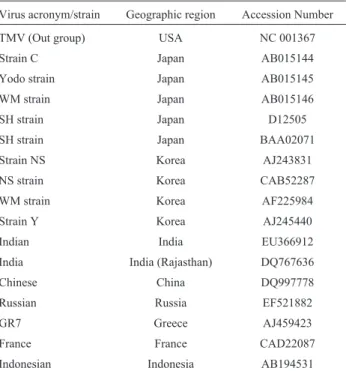
Alignment of amino acid (aa) and nucleotide (nt) se-quences, representing the coat protein (CP) region of CGMMV-Pak with sequences reported in the data bank (Table 1) were constructed using protein and DNA align-ment program in GENETYX Win Version 5.1 (Software Development, Tokyo, Japan). The deduced aa and nt se-quences were compared with the sese-quences reported in the DNA database and the phylogenetic relationship was estab-lished using the CLUSTAL-W program (Thompsonet al., 1994), by the Neighbor Joining Method. The phylogenetic trees were viewed in Treeview (win32) 1.6.6 program. The amino acid sequence of the Pakistani isolate was compared with the sequences reported elsewhere in the world (Ta-ble 1).
Results and discussion
Field surveys of the cucurbit crops revealed a high in-cidence of leaf mosaic, mottling, chlorosis and deformation in KPK, Pakistan. The newly growing apical leaves were small with very conspicuous symptoms.L. sicerariaplants mostly exhibited mosaic symptoms. Interveinal chlorosis and severe mosaic symptoms were observed onC. sativus. Squash plants were also showing severe mosaic, mottle, de-formation and filiformism. In some of the fields with severe infection leaves were having shoe-string appearance. The prevalence of such symptoms in cucurbit crops have al-ready been reported by Aliet al.(2004); Khalid and Ahmed (1997) and Maliket al.(2006).
Among the seven districts surveyed, the highest inci-dence of CGMMV was recorded in Charsada (57.05%) during the final survey of the first season as compared to 29.3% incidence at district Swabi during the earlier survey, the same season. Farmers cultivated different cucurbits in the same fields. Bottle gourd, sponge gourd and squash were often seen cultivated in the same field thereby increas-ing the crop density makincreas-ing virus transmission more easy
and quick. Also the cucurbit season lasted a little longer in district Charsada compared to district Swabi which might be responsible for the high incidence. In the early survey of the first season incidence was in the range of 12.50% (cu-cumber) to 37.50% (pumpkin) which increased up to 66.66% (bottle gourd). The least percent infection was found in district Mardan (46.52%). CGMMV infection dur-ing the first survey of the second season ranged from 6.6% in cucumber to 36.6% in squash. Highest average percent incidence of 25.6% was observed in district Charsada fol-lowed by 27.4% in district Nowshera, 23.6% in Peshawar, 18% in district Swabi and 15.9% in district Mardan. How-ever, during the late survey of the second season average percent incidence of CGMMV increased up to 58.1% dis-trict Nowshera, followed by 51.1% in disdis-trict Charsada, 40.5% in district Swabi and 37.3% in district Mardan (Ta-ble 2).
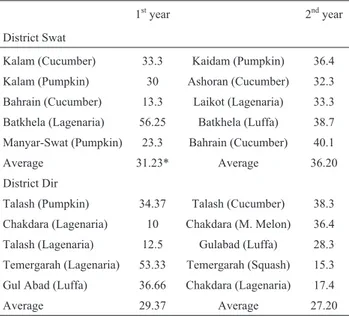
In Swat and Dir districts the highest incidence of CGMMV during the first season was observed in district Swat where average percent incidence of 31.23% was re-corded. In district Dir virus incidence was recorded as 29.37%. Percent incidence in district Swat ranged from 13.3% in cucumber to 56.25% in bottle gourd, while in dis-trict Dir percent incidence in different crops ranged from 10% to 53.33% in bottle gourd crop during the first season of crop growth. However, during the second season highest average percent incidence (36.20%) was recorded in dis-trict Swat and 27.20% in disdis-trict Dir (Table 3)
Average percent incidence in the plain areas of KPK was the highest in Pumpkin (35.65%) during the first sur-vey of the first season, followed by 25.80% in Bottle gourd, Table 1- List of sequences used in the phylogenetic analysis of CGMMV.
Virus acronym/strain Geographic region Accession Number
TMV (Out group) USA NC 001367
Strain C Japan AB015144
Yodo strain Japan AB015145
WM strain Japan AB015146
SH strain Japan D12505
SH strain Japan BAA02071
Strain NS Korea AJ243831
NS strain Korea CAB52287
WM strain Korea AF225984
Strain Y Korea AJ245440
Indian India EU366912
India India (Rajasthan) DQ767636
Chinese China DQ997778
Russian Russia EF521882
GR7 Greece AJ459423
France France CAD22087
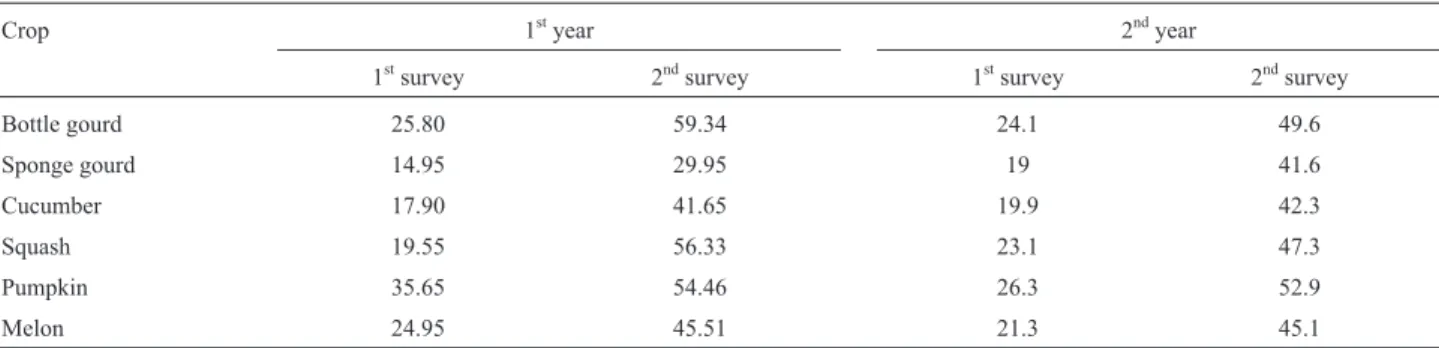
24.95% in Melon, 19.55% in Squash, 17.90% in Cucumber and 14.95% in bottle gourd (Table 4). Percent incidence of CGMMV increased rapidly upto 59.34% in Bottle gourd, 56.33% in Squash, 54.46 in Pumpkin, 45.51 in Melon, 41.65 in Cucumber and 29.95 in Sponge gourd during the second survey (Table 4). During the second season highest incidence of CGMMV (52.9%) was observed in pumpkin, followed by 49.6% in bottle gourd, 47.3% in squash, 45.1% in Melon 42.3% in cucumber and 41.6% in sponge gourd (Table 4).
In the northern areas of KPK the highest average per-cent infection during the first season, was recorded in bottle gourd where 41.66% incidence was recorded, followed by 37.1% in pumpkin, 36.66% in cucumber and 26.66% in sponge gourd. However, during the second year highest in-cidence (36.9%) was recorded in cucumber, followed by 36.4% in pumpkin, 33.5% in sponge gourd, 25.4% in bottle gourd and 15.3% squash (Table 5)
The most severely infected field was observed at Pirsabaq, where the percent infection was 66.66% (bottle Table 2- Percent incidence of CGMMV in the plain areas of KPK.
Districts surveyed 1st year 2nd year
1stsurvey 2ndsurvey 1st survey 2ndsurvey
District Peshawar Tarnab (Squash) 25 65.6 26.6 56.25
Taru (Squash) 16.6 56.6 19.4 41.4
Budni (Bottle gourd) 23.3 53.14 21.87 48.2
Taru (Sponge gourd) 13.3 26.6 26.6 30.5
Average 19.55 50.49 23.6 44.1
District Nowshera Jehangira (Squash) 13.3 50 36.6 66.6
Pirsabaq (Bottle gourd) 26.6 66.66 23.3 56.6
Nowshera (Cucumber) 12.5 33.33 16.6 46.6
Azakhel (Pumpkin) - - 33.3 62.5
Average 17.47 49.99 27.4 58.1
District Mardan Takhtbahi (Bottle gourd) 33.3 53.14 25 40.5
Katlang (Sponge gourd) - - 12.5 41.4
Takhtbahi (Sponge gourd)) 16.6 33.3 -
-Mumtaz Abad (Squash) 23.3 53.12 19.6 45.2
Sher Garh (Cucumber) - - 6.6 22.1
Average 24.4 46.52 15.9 37.3
District Charsada Serdheri (Bottle gourd) 20 64.5 26.6 53.3
Sheikhabad (M. Melon) 33.3 56.66 23.3 45.4
Umerzai (Cucumber) 23.3 50 33.3 62.5
QaziKhel Jadid (Sponge gourd) - - 19.4 43.3
Average 25.53 57.05 25.6 51.1
District Swabi Tordher (M.Melon) 16.6 34.37 19.4 44.9
Kernal Sher Keli (Pumpkin) 37.5 65.62 13.3 27.4
Kalu Khan (Pumpkin) 33.8 43.3 19.4 43.3
Zaida (Sponge gourd) - - 20 46.3
Average 29.3 47.76 18 40.5
Table 3- Percent incidence of CGMMV in the hilly areas of KPK.
1styear 2ndyear
District Swat
Kalam (Cucumber) 33.3 Kaidam (Pumpkin) 36.4 Kalam (Pumpkin) 30 Ashoran (Cucumber) 32.3 Bahrain (Cucumber) 13.3 Laikot (Lagenaria) 33.3 Batkhela (Lagenaria) 56.25 Batkhela (Luffa) 38.7 Manyar-Swat (Pumpkin) 23.3 Bahrain (Cucumber) 40.1
Average 31.23* Average 36.20
District Dir
Talash (Pumpkin) 34.37 Talash (Cucumber) 38.3 Chakdara (Lagenaria) 10 Chakdara (M. Melon) 36.4 Talash (Lagenaria) 12.5 Gulabad (Luffa) 28.3 Temergarah (Lagenaria) 53.33 Temergarah (Squash) 15.3 Gul Abad (Luffa) 36.66 Chakdara (Lagenaria) 17.4
gourd) during the second survey of the first season (Ta-ble 2). CGMMV has been reported as the most prevalent vi-rus besides other diseases in cucurbits in many cucurbit growing areas (Yukiet al., 2000; Namethet al., 1986). The farmers of the plain as well as the northern hilly areas had a little or no knowledge about viral diseases as well as their mode of transmission and spread. During our survey of the cucurbit growing areas of KPK it was observed that major-ity of the farmers used uncertified seeds available in the open market. These seeds have neither been given any treatment, nor are they tested for the presence of seed trans-mitted viruses, especially CGMMV and CMV. The contact transmission of the CGMMV coupled with the poor phyto-sanitary measures, the connecting irrigation channels among the fields and use of contaminated tools exacerbate the situation. High population of weed was found in the fields of district Swabi and Charsada which may serve as alternate hosts of the virus. Also, at the early stage of crop growth most of the cucurbit fields were surrounded by crops like maize, tomato, chilies and tobacco and such a cropping pattern in the area also favours the build-up of vi-rus inoculum. Egg plants, tomato, okra and a number of weed plants are the potential reservoirs of CGMMV which contribute to a great extent for the high incidence of viral diseases (Guerini and Murphy, 1999).
Molecular characterization of CGMMV
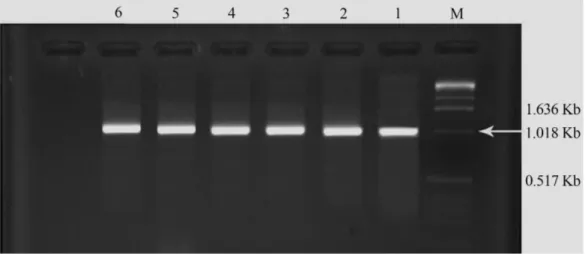
RT-PCR results revealed the presence of CGMMV in all the samples collected from areas like Tarujaba, Budni, Jehangira, Serdheri, Swat and Chakdara. Using CG-F and CG-R primers, we were able to amplify an expected band of
approximately 1 kb comprising the full coat protein and partial movement protein region (Figure 1).
The nt (nucleotide) and deduced aa (amino acid) se-quences for the CP gene of the three CGMMV isolates when compared with other reported isolates showed very low diversity. All the three isolates showed 100% amino acid sequence identity among themselves. The aa identities of CGMMV-pk isolates with the isolates reported in the GenBank
http://www.ncbi.nlm.nih.gov/sites/entrez?db=Protein) were in range of 98.052% (Korea, India and Greece) to 99.351% (Japan, France, Korea, China, Indonesia and In-dia). CGMMV-pk showed 98.01% aa identity with the GR7 strain reported from Greece. The amino acid sequence was highly conserved when aligned in the coat protein re-gion sharing high aa sequence identity with a difference of only two amino acids at position 2 and 13 in N-terminal re-gion of coat protein sequence and 5 amino acids in core coat protein region in between amino acid number 64 to 125 (data not shown). Isolates of CGMMV in particular and tobamoviruses in general are very much conserved and show very little variability (Yoonet al., 2008).
The phylogenetic tree based on CP gene sequence of CGMMV with the other reported sequences resulted in two clusters. All the CGMMV isolates were clustered in a sin-gle group (Cluster B). This cluster contains isolates re-ported from Korea, India, Japan, France, Indonesia, Russia and Greece (Figure 2). Lack of variability in the genome of all these isolates indicates that most of these isolates might have originated from common ancestors or they may be a single strain with recent spread and/or result of high nega-tive selection pressure on CGMMV genome. These results are in agreement with the findings of Yoonet al. (2008) who also reported no remarkable diversity among the re-ported isolates of CGMMV across the world.
Yodo strain and strain-C (reported from Japan) showed high variability and clustered independently, how-ever they were close to each other in the tree (Cluster A; Figure 2). These two isolates were previously grouped as CGMMV but now they are classified as an independent ge-nus and were renamed asKuyri Green Mottle Mosaic Virus (KGMMV). This first ever detailed survey of CGMMV in cucurbit growing areas of the KPK province clearly reflects Table 4- Incidence of CGMMV in different crops of the plain areas of KPK.
Crop 1styear 2ndyear
1stsurvey 2ndsurvey 1stsurvey 2ndsurvey
Bottle gourd 25.80 59.34 24.1 49.6
Sponge gourd 14.95 29.95 19 41.6
Cucumber 17.90 41.65 19.9 42.3
Squash 19.55 56.33 23.1 47.3
Pumpkin 35.65 54.46 26.3 52.9
Melon 24.95 45.51 21.3 45.1
Table 5- Incidence of CGMMV in different crops of the northern hilly ar-eas of KPK.
Crop 1styear 2ndyear
Lagenaria 41.66 25.4
Cucumber 36.66 36.9
Pumpkin 37.1 36.4
Luffa 26.6 33.5
Figure 1- Agarose (2%) sho-wing the amplified bands of app: 1 kb encoding coat proteinand partial movement protein region in the genome of CGMMV. (1 = Tarujaba,2 = Budni, 3 = Jehangira, 4 = Serdheri, 5 = Swat and 6 = Chakdara).
the alarming situation, with such a high prevalence of the virus in almost all the districts where cucurbits are grown, and it further emphasizes the need of implementing a quick and effective integrated control management to bring this menace under control.
References
Ali A, Natsuaki T, Okuda S (2004) Identification and molecular characterization of viruses infecting cucurbits in Pakistan. J Phytopathol 152:677-682.
Choi GS (2001) Occurrence of two tobamovirus diseases on cu-curbits and control measures in Korea. Pl Pathol J 17:243-248.
Clark MF, Adams AN (1977) Characteristics of the microplate method of the enzyme-linked immunosorbent assay for the detection of plant viruses. J Gen Virol 34:475-483. Coutts BA, Jones RAC (2005) Incidence and distribution of
vi-ruses infecting cucurbit crops in the Northern territory and Western Australia. Australian. J Agricultural Research 56:847-858.
Desbiez C, Lecoq H (1997)Zucchini yellow mosaic virus. Plant Pathol J 46:809-829.
Guerini MN, Murphy JF (1999) Resistance ofCapsicum annum ‘Avelar’ toPepper mottle potyvirusand alleviation of this resistance by co-infection with Cucumber mosaic cucumovirusare associated with virus movement. J Gen Virol 80:2785-2792.
Khalid S, Ahmad I (1997) Occurrence ofZucchini yellow mosaic virus (ZYMV) in Pakistan. Int. Conf. Integ. Plant Dis. Manag. For sustainable Agric. Nov. 10-15. New Delhi, In-dia.
Lecoq H, Desbiez C, Wipf-Scheibel, C, Girard M (2003) Potential involvement of melon fruit in the long distance dissemina-tion of cucurbit potyviruses. Plant Dis 87:955-959. Lecoq H, Dafalla G, Desbiez C, Wipf-Scheibel C, Delecolle B,
Lanina T, Ullah, Z, Grumet R (2001) Biological and
molec-ular characterization ofMorrocan watermelon mosaic virus and a potyvirus isolate from eastern Sudan. Plant Dis 85:547-552.
Lovisolo O (1980) Virus and viroid diseases of cucurbits. Acta Hort 88:33-71.
MINFAL. 2008. Agric. Statistics of Pakistan. Ministry of Food, Agric. and Livest. (Econ. Wing), Islamabad.
Nameth ST, Dodds JA, Paulus AO, Laemmlen FF (1986) Cucur-bit viruses of California: An ever-changing problem. Plant Dis 70:8-11.
Provvidenti R (1996) Diseases caused by viruses. In: Zitter TA, Hopkins DL, Thomas CE. (eds) Compendium of Cucurbit Diseases. APS Press, St. Paul, pp 37-45.
Sambrook J, Russell DW (2001) Molecular Cloning: A Labora-tory Manual. Cold Spring Harbor LaboraLabora-tory, Cold Spring Harbor.
Suehiro N, Matsuda K, Okuda S, Natsuaki T (2005) A simplified method for obtaining plant viral RNA for RT-PCR. J.Virol. Methods 125:67-73.
Thompson JD, Higgins DG, Gibson TJ (1994) CLUSTAL W: im-proving the sensitivity of progressive multiple sequence alignment through sequence weighting, position-specific gap penalties and weight matrix choice. Nucleic Acids Res 22:4673-4680.
Ullman DE, Cho JJ, German TL (1991) Occurrence and distribu-tion of cucurbit viruses in the Hawaiian Islands. Plant Dis 75:367-370.
Yoon JY, Choi GS, Choi SK, Hong JS, Choi JK, Kim W, Lee GP, Ryu KH (2008) Molecular and Biological Diversities of Cu-cumber green mottle mosaic virus from Cucurbitaceous Crops in Korea. J Phytopathol 156:408-412.
Yuki VA, Rezende JAM, Kitajima EW, Barroso PAV, Kuniyuki H, Groppo GA, Pavan MA (2000) Occurrence, distribution, and relative incidence of five viruses infecting cucurbits in the state of Sao Paulo, Brazil. Plant Dis 84:516-520.