651
Departamento de Sistemática e Ecologia, Centro de Ciências Exatas e da Natureza, Universidade Federal da Paraíba, 58059-900 João Pessoa, Paraíba, Brazil. [email protected]
Effects of tourist visitation and supplementary feeding on fish assemblage
composition on a tropical reef in the Southwestern Atlantic
Martina Di Iulio Ilarri, Allan Tainá de Souza, Paulo Roberto de Medeiros, Renato Grotta
Grempel and Ierecê Maria de Lucena Rosa
The effects of tourist visitation and food provisioning on fish assemblages were assessed by visual censuses (stationary tech-nique) carried out in a tropical reef in Northeastern Brazil. Comparisons of species abundance, richness, equitability, and trophic structure in the presence (PT) and absence (AT) of tourists suggest that tourist visitation and supplementary food influenced the structure of the fish assemblage, as follows: (a) diversity, equitability and species richness were significantly higher on the AT period, while the abundance of a particular species was significantly higher during PT; (b) trophic structure differed between the AT and PT periods, omnivores being more abundant during the latter period, while mobile invertivores, piscivores, roving herbivores and territorial herbivores were significantly more abundant on AT. Reef tourism is increasingly being regarded as an alternative to generate income for human coastal communities in the tropics. Therefore, closer examination of the consequences of the various components of this activity to reef system is a necessary step to assist conservation and management initiatives.
Os efeitos da visitação turística e da alimentação suplementar sobre a ictiocenose foram avaliados por meio de censos visuais (técnica estacionária) em um recife tropical no nordeste do Brasil. Comparações entre a abundância das espécies, riqueza, equitabilidade e estrutura trófica na presença (PT) e na ausência (AT) de turistas sugerem que a visitação turística e a alimen -tação suplementar influenciam a estrutura da ictiocenose, como segue: (a) diversidade, equitabilidade e riqueza de espécies foram significativamente maiores no período AT, enquanto a abundância de uma única espécie foi significativamente maior durante o período PT; (b) a estrutura trófica foi diferente entre os períodos AT e PT, com os onívoros sendo mais abundantes no último período, enquanto invertívoros móveis, piscívoros, herbívoros errantes e herbívoros territoriais foram significativa-mente mais abundantes no período AT. O turismo em ambientes recifais é cada vez mais uma opção na geração de renda para diversas comunidades costeiras nos trópicos. Conseqüentemente, investigações mais detalhadas sobre as conseqüências dos vários componentes desta atividade sobre o sistema recifal são necessárias para subsidiar iniciativas de manejo e conservação.
Key words: Fish behavior, Tourism, Human impact, Northeastern Brazil, Abudefduf saxatilis.
Introduction
Tourism is the fastest growing economic activity of the world, natural area visitation being its most rapidly growing segment. These areas are visited to “get away from it all”, and this involves many recreational activities (Newsome et al., 2002).
Wildlife viewing and equivalent types of nature-based tourism are often promoted as the option of choice for the direct use of wildlife (Honey, 1999), a view that is increasingly being embraced by the promoters of reef tourism - a form of marine recreational tourism that according to Alevizon (2004), generally encompasses activities to “facilitate client viewing and/or other human-wildlife interactions, such as touching and handling”.
Food provisioning by tourists is among the different forms of human-wildlife interaction in reef areas (Newsome et al., 2004), and has been considered a source of disruption or al-teration to the natural distribution and abundance patterns of marine fishes (see Perrine, 1989; Cole, 1994; Hawkins et al., 1999), as well as of the “fed” individuals and the ecosystems of which they are part of (Alevizon, 2004). Furthermore, New -some et al. (2002) have drawn attention to a real danger of
wildlife becoming accustomed to, and dependent on humans for food in tourism areas, due to the potentially serious health and behavioral implications, particularly for a rare species or a species with a restricted population.
al., 1995; Allison, 1996; Harriot et al., 1997), reef tourism is often regarded as an important income source to fishermen communities where fisheries have declined (Cesar, 1996; Vogt, 1996), while helping to protect reefs by providing an incentive to their conservation (Hawkins et al., 1999). In fact, different human coastal communities in the tropics are already in the process of shifting from dependence on fishing to dependence on tourism (e.g., Diedrich, 2007).
In this paper we examine the relationships between fish assemblage composition, tourist visitation, and food provi-sioning in a tropical reef in Northeast Brazil. The study site (Picãozinho reef) is a highly sought after tourist destination where fish are usually fed by visitors with bread, cookies or fish food (MII, pers. observ.).
Our main goal was to assess the effects of supplementary feeding on the reef fish assemblage structure by comparing its abundance and diversity between two periods (presence
versus absence of visitors).
Material and Methods
Study site
Picãozinho (07°06’15”S, 34°48’45”W) is a coastal tropical reef with a maximum depth of 6 m, located about 1500 m off the coast of João Pessoa, Paraíba, Northeastern Brazil. The seascape in the study area is mostly characterized by seaweeds such as Caulerpa racemosa, Halimeda opuntia and Dyctiop-teris delicatula, while corals such as Palythoa caribaeorum,
Zoanthus spp., Siderastrea stellata and Musimilia hartii are the dominant components of the benthic community (Young, 1986; Medeiros et al., 2007). Recreational tourism has been occurring at Picãozinho reef since the mid 80’s, without any supervision. Supplementary feeding, trampling, boat anchor-ing and water turbidity increase are problems commonly observed in the area during visitation (Ilarri et al., 2007).
The fish assemblage was assessed using the stationary visual census method adapted from Bohnsack & Bannerot (1986). At each point sampled, the numerical abundance of ac-tive reef-associated fishes was estimated. Sites were randomly chosen within the area mostly visited by tourists, from a set of sites with comparable zonation and tourist influence. All censuses were carried out at low tide (-0.2 to 0.3 m). In order to avoid bias due to tidal amplitude, censuses were conducted within small intervals from one another.
Visual censuses were carried out from February 2006 through August 2006 (dry season), at depths between 0.5 and 3 m. In total we performed 72 censuses (2.5 m radius), 36 during tourist visitation (PT) and 36 when tourists were not present (AT). Prior to visitation, samples were classified as AT, and subsequently as PT. No distinction was made between weekdays and weekends, as tourism took place throughout the week at the reef. The reef was open for tourist visitation while the census data of PT were being undertaken and for the AT, we sampled the exact same area.
Numerical abundances of targeted species were determined by counting all individuals sighted, while size (total length)
of individual fish was visually estimated and assigned to one of the following five size classes: 1-5 cm, 6-10 cm, 11-15 cm, 16- 20 cm and 21-25 cm. Species were visually identified in situ or through underwater photographs, which were compared with the descriptions found in Humann & Deloach (2002) and Carvalho-Filho (1999).
Species were grouped according to trophic categories well-established in the literature (Randall, 1967; Hobson, 1975; Ferreira et al., 2004), as follows: carnivores, mobile
invertivores, omnivores, piscivores, planktivores, roving herbivores, sessile invertivores, and territorial herbivores. Statistical analyses were performed with the program Statistica version 5.1 (Statsoft Corp., United States).
Species richness is expressed as the number of species (S), while diversity and homogeneity were estimated by the Shannon Wiener’s diversity index (H´), using the software PRIMER 5.0. Since most data departed from normality (Shapiro-Wilk’s W test), comparisons between PT and AT were made using the non-parametric Mann-Whitney U-test (in some cases Z-adjusted values and P-values were considered). A non-metric multidimensional scaling (MDS) was applied to the similarity matrix to visualize the relationships among samples within PT and AT, considering the abundance data of all fish census replicates. Prior to the analysis, a double square-root transformation was applied to the abundance in order to normalize and avoid skew in the data set. Addition -ally an analysis of similarity percentages of particular species (SIMPER) was conducted to examine potential differences in fish assemblage structure between PT and AT, following Field
et al. (1982). Essentially, this procedure computes the aver-age dissimilarity between all pairs of inter-group (PT vs. AT) periods, and then breaks this average down into the separate contributions from each species. These analyses were carried out using the software PRIMER 5.0.
Results
Throughout the study, 5006 specimens (33 species, 20 families), were sighted (Table 1), 3003 of which (22 species, 14 families) during visitation by tourists. The most species rich families were Haemulidae (4 species), Pomacentridae (3) and Acanthuridae (3), and the 10 most frequent species, in decreasing order, were Abudefduf saxatilis, Stegastes fuscus,
Sparisoma spp., Haemulon parra, Halichoeres brasiliensis,
Acanthurus coeruleus, Haemulon aurolineatum, Ophioblen-nius trinitatis, Stegastes variabilis and Coryphopterus glau-cofraenum. Occasional and rare species (<10% of occurrence) represented 0.42% of all fishes recorded. The most abundant species were Abudefduf saxatilis (n = 2482) and Stegastes fuscus (n = 377), which together represented 86.5% of all
individuals recorded.
Sparisoma spp., Halichoeres brasiliensis, Haemulon parra,
Acanthurus coeruleus, Ophioblennius trinitatis, Halichoeres poeyi, Caranx latus, and Acanthurus chirurgus. Occasional and rare species (<10% of occurrence) represented 1.22% of all fishes recorded. The most abundant species were Abudefduf saxatilis (n = 629) and Stegastes fuscus (n = 389), which to -gether made up 59.5% of all individuals recorded while the other 27 species represented 40.5%.
Of the 33 species recorded, 18 were found at PT and AT periods, while four were found exclusively during PT ( Syno-dus intermedius, Scorpaena sp., Haemulon squamipinna, and
Bothus lunatus) and 12 were found exclusively during AT
(Mugil curema, Holocentrus adscencionis, Myripristis jaco-bus, Ocyurus chysurus, Anisotremus moricandi, Pseudupe-neus maculatus, Haemulon plumieri, Chaetodon striatus, Gobionellus stomatus, Acanthurus bahianus, and Sphoeroides testudineus) (Table 1).
The abundance of seven species was significantly differ -ent between PT and AT periods, most of them being more abundant when no visitation was taking place (Table 1). Only
Abudefduf saxatilis was significantly more abundant during
PT (Z = 4.93; p < 0,001). The other six species were more abundant during AT, as follows: Acanthurus chirurgus (Z = -2.33; p < 0.05), Anisotremus virginicus (Z = -3.18; p < 0.01), Caranx latus (Z = -1.96; p < 0.05), Epinephelus adscencionis
(Z = -2.03; p < 0.05), Halichoeres poeyi (Z = -2.64; p < 0.01),
and Sparisoma spp. (Z = -2.42; p < 0.05).
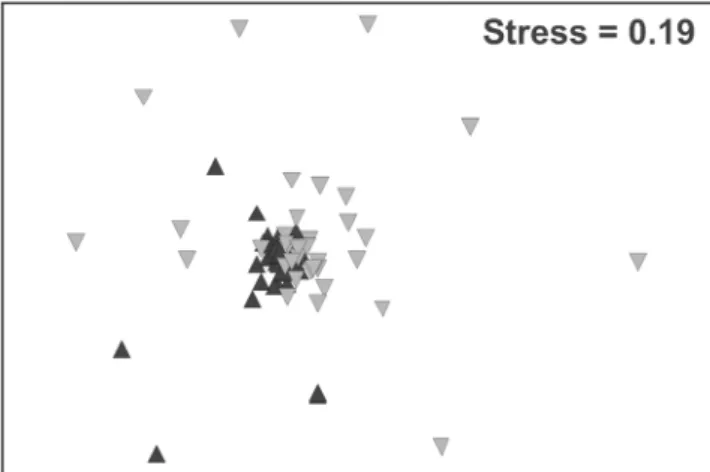
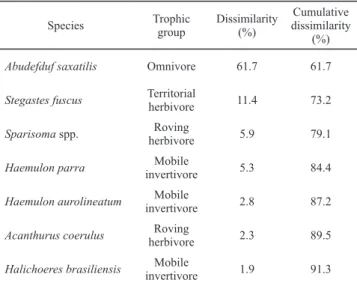
The MDS analysis revealed some segregation between the periods, with most of the assemblage samples from PT located in the middle of the plot, indicating that the samples which are closer together are less distinct; conversely, the AT samples exhibited a more heterogeneous pattern with dissimi -larity between samples during tourist visitation at the study site (Fig. 1). The SIMPER analysis revealed that A. saxatilis
contributed more to the dissimilarity (61.73%) than any other species (Table 2).
Fig. 1. Non-Metric Multi-Dimensional Scaling (MDS) plot of fish assemblages samples of the Picãozinho reef in each of the two studied situations. Dark triangles = PT (presence of tourists) and light triangles = AT (absence of tourists).
A comparison of the fish assemblage attributes indicated that fish diversity, equitability and richness were lower in the presence tourist, while only the total number of fish was higher (Table 3).
The mean number of individuals in each trophic category differed between PT and AT periods as follows: omnivores were nearly four times more abundant during PT than during AT, while five out of the eight trophic categories recorded (mobile invertivores, omnivores, piscivores, roving herbivores and territorial herbivores) exhibited significant differences between periods (Table 4).
During PT, fishes in the 6-10 cm size class comprised over 31.95% of the total abundance. The 11-15 cm size class contained 30.36% of the fishes, while the 1-5 cm size class made up over 26.11%. During AT, fishes in the 6-10 cm size class made up over 32.15% of the fishes, the 1-5 cm size class contained 27.38% while the 11-15 cm size class constituted 24.24% of the total abundance. The least abundant size class both during PT and AT was the 21-35 cm class, contributing only 0.73% and 1.21%, respectively. The abundance of three size classes (6-10 cm, 11-15 cm and 16-20 cm) was signifi-cantly higher at PT period, while the other size classes showed no statistical differences between the periods (Table 5).
Discussion
The consequences of ill-planned, uncontrolled recre-ational tourism to coastal ecosystems have been increasingly acknowledged, however there have been few attempts to specifically examine the possible effects of supplementary feeding on reef fish assemblages. Our findings corroborated the results of previous studies (Cole, 1994; Millazzo et al., 2005), which have shown that food provisioning plays a role in shaping the structure of the fish assemblages. The consistent discrepancies in fish abundance, diversity, evenness and size classes abundance between the AT and PT periods at the study site were mainly related to the extremely high abundance of a single species (Abudefduf saxatilis), commonly known as
sergeant major. Although usually abundant in many tropical Atlantic reefs (Humann & Deloach, 2002), A. saxatilis is seldom found in high abundances on Brazilian Northern reefs (Molina et al., 2006). Due to its generalist omnivorous feed-ing habits, that species is able to feed on a diverse array of food items and normally shows clear patterns of opportunistic behavior (Deloach & Humann, 1999), being also capable of shifting between food sources as a result of seasonal and historical environmental disturbances (Ferreira et al., 2004). At Picãozinho reef, A. saxatilis was the only fish species
Table 1. Trophic categories, number of individuals (N), frequency and relative abundance (% of total number of individu-als) of reef fishes in the two periods, at presence of tourists (PT) and at absence of tourists (AT). The families are listed in phylogenetic order, following Nelson (2006); species are alphabetically organized within each family. Rov. Herbiv. = Roving herbivore; Mob. Invert. = Mobile Invertivore; Plankt. = Planktivore; Ter. Herbiv. = Territorial herbivore.
Presence of tourists (PT) Absence of tourists (AT) Family/Species Trophic group N Frequency % Abundance % N Frequency % Abundance % Synodontidae
Synodus intermedius Piscivore 1 2.8 0 0 0 0
Mugilidae
Mugil curema Rov. Herbiv. 0 0 0 4 2.8 0.2
Holocentridae
Holocentrus adscencionis Mob. Invert. 0 0 0 3 8.3 0.2
Myripristis jacobus Planktivore 0 0 0 1 2.8 0.1
Scorpaenidae
Scorpaena sp. Carnivore 1 2.8 0 0 0 0
Serranidae
Epinephelus adscensionis Carnivore 2 5.6 0.1 8 22.2 0.5
Carangidae
Caranx latus Piscivore 5 13.9 0.2 13 33.3 0.8
Lutjanidae
Ocyurus chysurus Carnivore 0 0 0 3 8.3 0.2
Gerreidae
Eucinostomus argenteus Omnivore 4 11.1 0.1 9 25 0.5
Hemulidae
Anisotremus moricandi Mob. Invert. 0 0 0 1 2.8 0.1
Anisotremus virginicus Mob. Invert. 7 11.1 0.2 13 25 0.8
Haemulon aurolineatum Mob. Invert.Plankt. 45 47.2 1.4 53 50 3.1
Haemulon parra Mob. Invertiv. 59 69.4 1.8 138 72.2 8.1
Haemulon plumierii Mob. Invert. 0 0 0 1 2.8 0.1
Haemulon squamipinna Mob. Invert. 2 5.6 0.1 0 0 0
Mullidae
Pseudupeneus maculatus Mob. Invert. 0 0 0 1 2.8 0.1
Chaetodontidae
Chaetodon striatus Sessile Invert. 0 0 0 2 5.6 0.1
Pomacentridae
Abudefduf saxatilis Omnivore 2482 100 75.1 629 97.2 36.8
Stegastes fuscus Ter. Herbiv. 377 100 11.4 389 97.2 22.7
Stegastes variabilis Ter. Herbiv. 21 36.1 0.6 25 50 1.5
Labridae
Halichoeres brasiliensis Mob. Invert. 42 75 1.3 59 83.3 3.5
Halichoeres poeyi Mob. Invert. 3 8.3 0.1 16 44.4 0.9
Scaridae
Sparisoma spp. Rov. Herbiv. 149 97.2 4.5 218 97.2 12.8
Labrisomidae
Labrisomus nuchipinnis Carnivore 12 27.8 0.4 10 25 0.6
Blennidae
Entomacrodus nigricans Ter. Herbiv. 7 13.9 0.2 1 2.8 0.5
Ophioblennius trinitatis Omnivore 19 41.7 0.6 24 47.2 1.4
Gobiidae
Coryphopterus glaucofraeunum Planktivore 16 33.3 0.5 6 16.7 0.4
Gobionellus stomatus Mob. Invert. 0 0 0 1 2.8 0.1
Acanthuridae
Acanthurus bahianus Rov. Herbiv. 0 0 0 2 2.8 0.1
Acanthurus chirurgus Rov. Herbiv. 4 11.1 0.1 18 33.3 1.1
Acanthurus coeruleus Rov. Herbiv. 40 58.3 1.2 61 72.2 3.6
Bothidae
Bothus lunatus Carnivore 5 8.3 0.2 0 0 0
Tetraodontidae
the physiological and, possibly, the genetic constitution of fish communities, by promoting natural selection on the most aggressive individuals (Orams, 2002).
According to Ferreira et al. (2004), Northeastern Brazil-ian fish assemblages are dominated by roving herbivores and mobile invertivores. Yet, in our investigation we recorded a remarkable dominance of omnivores - a difference perhaps directly related to the type of supplementary food provided by tourists, which could act selecting species of that trophic group. Differential effects caused by food provisioning on trophic groups have also been found in the studies by Millazzo
et al. (2005) and Cole (1994), who detected an increase in the
abundance of carnivores and invertivores at their study sites. Furthermore, at the Picãozinho reef, sergeant majors were sighted actively following divers and snorkelers while feed-ing - a behavioral alteration also possibly triggered by food provisioning. Such behavioral shifts have been documented in the literature (Cole, 1994) and need to be further investigated.
Although the behavior of reef fish species could lead to a differential spatial distribution, probably triggered by olfac-tory cues and visual stimuli (Bond, 1979), it is very likely that uncontrolled tourist visitation contributed to the shift in the reef fish assemblage structure pattern at the study site. These shifts probably have started primarily as a mere concentration of A. saxatilis individuals in a short period of time, due to the supplementary feeding by the tourists. However, over the years this pattern probably has been incorporated to the fish assem-blage structure of the reef, leading to the absolute dominance of A. saxatilis, even in the absence of tourists. This pattern was highlighted by Medeiros et al. (2007), which compared
fish assemblages between Picãozinho and a neighboring reef submitted to a different level of tourism influence, and which presented a remarkably distinct fish assemblage structure.
It should be noted, however, that artisanal fishery - which has historically occurred in Picãozinho reef (Ilarri et al., 2007) - may have also played a role in structuring fish assemblage at the study site. Nevertheless, the negative consequences of fishing will be apparent regardless of tourist presence, thus, not influencing our results, where differences between AT and PT are strongly correlated to tourism alone.
Table 2. SIMPER percentages of the top seven fish species that most contributed to the differences between PT (presence of tourists) and AT (absence of tourists) periods.
Species Trophic
group
Dissimilarity (%)
Cumulative dissimilarity
(%) Abudefduf saxatilis Omnivore 61.7 61.7 Stegastes fuscus Territorial herbivore 11.4 73.2 Sparisoma spp. Roving
herbivore 5.9 79.1
Haemulon parra Mobile
invertivore 5.3 84.4
Haemulon aurolineatum Mobile
invertivore 2.8 87.2
Acanthurus coerulus Roving
herbivore 2.3 89.5
Halichoeres brasiliensis Mobile
invertivore 1.9 91.3
Table 3. Summary of reef fish community structure variables (median ± SD) plus the Mann-Whitney U-test results of comparisons between the two periods, at presence of tourists (PT) and at absence of tourists (AT). Statistical significance: p < 0.001(*).
PT AT Mann-Whitney
U-test Fish diversity (H’) per
census 0.9 ± 0.34 1.7 ± 0.52 Z = -4.88* Fish equitability (E)
per census 0.4 ± 0.17 0.8 ± 0.14 Z = -5.15* Number of species per
census 7.5 ± 2.39 9.0 ± 2.21 Z = -3.18* Total number of fish
per census 73.0 ± 65.64 37.0 ±28.49 Z = 3.82*
Table 4. Differences in number of species and abundance (me-dian of the number of individuals ± SD) per census of the eight trophic groups between periods with the presence of tourists (PT) and absence of tourists (AT). Statistical significance: p < 0.001(*); P < 0.05 (**), P > 0.05 (ns, not significant).
Number of
species Abundance (median ± SD)
PT AT PT AT Mann-Whitney
U-test Carnivores 4 3 0.0 ± 1.75 0.0 ± 1.61 Z = -1.33ns
M. invertivores 6 10 4.2 ± 7.02 12.6 ± 16.01 Z = -4.34* Omnivores 3 3 76.4 ± 23.56 28.9 ± 19.13 Z = 5.19* Piscivores 2 1 0.0 ± 0.52 0.0 ±1.83 Z = -2.04* Planktivores 2 2 0.0 ± 1.46 0.0 ± 0.99 Z = 1.19ns
R. herbivores 3 5 5.5 ± 7.30 18.7 ± 46.88 Z = -5.13* S. invertivores - 1 0.0 ± 0.00 0.0 ± 0.83 Z = -0.41ns
T. herbivores 3 3 9.9 ± 16.92 24.1 ± 16.86 Z = -3.06*
Table 5. Size classe abundance (median of the number of individuals ± SD) per census within the two periods, with the presence of tourists (PT) and absence of tourists (AT). Statistical significance: p < 0.001(*); P < 0.05 (**), P > 0.05 (ns, not significant).
Abundance (median ± SD) Mann-Whitney
Size class (cm) PT AT U-test
1-5 16.0 ± 24.27 7.0 ± 15.03 Z = 2.02** 6-10 20.0 ± 25.69 12.0 ± 8.47 Z = 2.95* 11-15 21.5 ± 27.89 10.0 ± 6.74 Z = 3.07* 16-20 7.5 ± 11.17 3.0 ± 13.79 Z = 1.71ns
Reefs are vitally important to the tourism industry in Brazil, particularly in the Northeastern region of the country. Recognizing this, and the need to address the problems result-ing from the increased use of reef resources, continued efforts to assess the condition of Brazilian reefs at local, regional, and national scales should be prioritized, particularly through long-term programs. Local management action at the study site should encompass, at minimum, setting areas closed for visitation, limiting the number of visitors, and monitoring of recreational activities.
Acknowledgements
We are indebted to Dr. Cláudio L. S. Sampaio for all his encouragement. Special thanks are due to the fisherman Dag for his help during field work, and to CNPq (Conselho Nacio -nal de Desenvolvimento Científico e Tecnológico), CAPES (Coordenação de Aperfeiçoamento de Pessoal de Nível Supe-rior) and PADI foundation for their essential financial support.
Literature Cited
Alevizon, W. 2004. Divers Feeding Fishes: A Continuing Issue in
MPA Management. MPA News, 6(5): 1.
Allison, W. R. 1996. Snorkeller damage to coral reefs in the Maldive
islands. Coral Reefs, 15: 215-218.
Bohnsack J. A. & S. P. Bannerot. 1986. A stationary visual census
technique for quantitatively assessing community structure of
coral reef fishes. NOAA Technical Report, 41: 1-15.
Bond, C. E. 1979. Biology of Fishes. Philadelphia, Saunders College Publishing, 514p.
Carvalho-Filho, A. 1999. Peixes: costa brasileira. São Paulo, Editora
Melro, 320p.
Cesar, H. 1996. Economic analysis of Indonesian coral reefs.
Wash-ington, D.C., The World Bank, 97p.
Cole, R. G. 1994. Abundance, size structure and diver-oriented
behaviour of three large benthic carnivorous fishes in a marine reserve in northeastern New Zealand. Biological Conservation, 70: 93-99.
Deloach, N. & P. Humann. 1999. Reef fish Behavior: Florida, Carib
-bean, Bahamas. Jacksonville, New World Publications, 359p.
Diedrich, A. 2007. The impacts of tourism on reef conservation
awareness and support in coastal communities in Belize. Coral
Reefs, 26: 985-996.
Ferreira, C. E. L., S. R. Floeter, J. L. Gasparini, B. P. Ferreira & J. C. Joyeux. 2004. Trophic structure patterns of Brazilian reef fishes: a latitudinal comparison. Journal of Biogeography, 31: 1093-1106. Field, J. G., K. R. Clarke & R. M. Warwick. 1982. A practical strategy
for analyzing multispecies distribution patterns. Marine Ecology
Progress Series, 8: 37-52.
Harriot, V. J., D. Davis & S. A. Banks. 1997. Recreational diving
and its impact in marine protected areas in eastern Australia.
Ambio, 26: 173-179.
Hawkins, J. P., C. M. Roberts, T. Van’t Hof, K. De Meyer, J. Trata
-los & C. Aldam. 1999. Effects of recreational scuba diving on Caribbean coral and fish communities. Conservation Biology, 13: 888-897.
Hobson, E. S. 1975. Feeding patterns among tropical reef fishes. American Scientist, 63: 382-392.
Honey, M. 1999. Ecotourism and sustainable development: Who
owns paradise? Washington, D.C., Island Press, 416p. Humann, P. & N. Deloach. 2002. Reef fish identification: Florida, Ca
-ribbean, Bahamas. Jacksonville, New World Publications, 481p.
Ilarri, M. I., A. T. Souza, P. R. Medeiros, R. G. Grempel& C. L. S. Sampaio. 2007. Recife de Picãozinho: um aquário natural ameaçado. Ciência Hoje, 41: 70-72.
Medeiros, P. R., R. G. Grempel, A. T. Souza, M. I. & C. L. S. Sampaio. 2007. Effects of recreational activities on the fish assemblage
structure in a northeastern Brazilian reef. Pan-American Journal
of Aquatic Sciences, 2(3): 288-300.
Millazzo, M., F. Badalamenti, T. Vega-Fernández& R. Chemello. 2005. Effects of fish feeding by snorkellers on the density and size distribution of fishes in a Mediterranean marine protected area. Marine Biology, 146: 1213-1222.
Molina, W. F., O. A. Shibatta& P. M. Galetti-Jr. 2006. Multivariate morphological analyses in continental and islands populations of Abudefduf saxatilis (Linnaeus) (Pomacentridae, Perciformes) of Western Atlantic. Pan-American Journal of Aquatic Sciences, 1(2): 49-56.
Nelson, J. 2006. Fishes of the World. John Wiley & Sons Inc, New
Jersey, 624p.
Newsome, D., A. Lewis, D. Moncrieff. 2004. Impacts and Risks as
-sociated with developing, but unsupervised, stingray tourism at
Hamelin Bay, Western Australia. International Journal of Tourism
Research, 6(5): 305-323.
Newsome, D., S. A. Moore, K. Dowling. 2002. Natural Area Tour -ism: Ecology, Impacts and Management. Clevedon, Channel
View Publications, 340p.
Orams, M. B. 2002. Feeding wildlife as a tourist attraction: a review of issues and impacts. Tourism Management, 23: 281-293. Perrine, D. 1989. Reef fish feedings: amusement or nuisance? Sea
Frontiers, 35(5): 272-279.
Prior, M., R. Ormond, R. Hitchen& C. Wormald. 1995. The impacts on natural resources of activity tourism: a case study of diving in Egypt. International Journal of Environmental Studies, 48: 201-209.
Randall, J. E. 1967. Food habits of reef fishes of the West Indies.
Studies in Tropical Oceanography, 5: 665-847.
Roberts, L. & V. J. Harriot. 1994. Recreational scuba diving and its
potential for environmental impact in a marine reserve. Pp.
695-704. In: Bellwood, O., H. Choat & N. Saxena. (Eds.). Recent
advances in marine science and technology 94. Honolulu, Pacon International, 754p.
Salvat, B. 1987. Human impacts on coral reefs: facts and
recom-mendations. Antenne Museum EPHE, French Polynesia, 253p. Samoilys, M. A. 1992. Review of the underwater visual census
method developed by DPI/ACIAR project: visual assessment
of reef fish stocks. Conference and Workshop Series, QC92006,
Department of Primary Industries, 55p.
Vogt, H. 1996. The economic benefits of tourism in the marine reserve of Apo Island, Philippines. Sea Wind, 10: 13-19.
Young, P. S. 1986. Análise qualitativa e quantitativa da fauna as-sociada a corais hermátipicos (Coelenterata: Scleractinia) nos recifes de João Pessoa, PB. Revista Brasileira de Biologia, 46: 99-126.