ENZYMATIC ACTIVITY, HYDROLYTIC PERCENTAGE AND BIODEGRADATION INDEX
*Nivedita Sharma, Richa Kaushal, Rakesh Gupta, Sanjeev Kumar
Department of Basic Science, Dr. Y. S. Parmar University of Horticulture and Forestry, Nauni, Solan (HP) – 173 230, India.
Submitted: January 06, 2011; Approved: June 07, 2012.
ABSTRACT
Aspergillus niger F7 isolated from soil was found to be the potent producer of cellulase and xylanase. The
residue of forest species Toona ciliata, Celtris australis, Cedrus deodara and Pinus roxburghii was selected as substrate for biodegradation study due to its easy availability and wide use in industry. It was subjected to alkali (sodium hydroxide) treatment for enhancing its degradation. Biodegradation of forest waste by hydrolytic enzymes (cellulase and xylanase) secreted by A. niger under solid state fermentation (SSF) was explored. SSF of pretreated forest biomass was found to be superior over untreated forest biomass. Highest extracellular enzyme activity of 2201±23.91 U/g by A. niger was shown in pretreated C. australis wood resulting in 6.72±0.20 percent hydrolysis and 6.99±0.23 biodegradation index (BI). The lowest BI of 1.40±0.08 was observed in untreated saw dust of C. deodara having the least enzyme activity of 238±1.36 U/g of dry matter. Biodegradation of forest biomass under SSF was increased many folds when moistening agent i.e. tap water had been replaced with modified basal salt media (BSM). In BSM mediated degradation of forest waste with A. niger, extracellular enzyme activity was increased up to 4089±67.11 U/g of dry matter in turn resulting in higher BI of 15.4±0.41 and percent hydrolysis of 19.38±0.81 in pretreated C. australis wood. A. niger exhibited higher enzyme activity on pretreated biomass when moistened with modified BSM in this study. Statistically a positive correlation has been drawn between these three factors i.e. enzyme activity, BI and percent hydrolysis of forest biomass thus proving their direct relationship with each other.
Key words:Aspergillus niger, SSF, enzyme activity, percent hydrolysis, biodegradation index
INTRODUCTION
Energy consumption has increased steadily over the last century as the world population has grown and more countries have become industrialized. The imminent shortage of fossil fuels and their skyrocketing prices have intensified research for bioconversion of lignocellulosic biomass to fuels (2).
Biodegradation of lignocellulosics to maximum fermentable sugar is a major factor for any bioconversion industry (19, 16). The bioconversion of lignocellulosic material into fermentable sugar can be achieved by employing cellulase and hemicellulase secreted from degrading microorganisms which in turn can be converted to biofuel - ethanol for clear transportation (12). SSF of biomass has some advantages over
Sharma, N. et al. Biodegradation of forest biomass by A. niger
submerged cultivation including conditions that are similar to those of the natural habitat of the microorganisms, lower costs and improved enzyme stability (9). Some features like crystallinity, lignifications and capillary structure of cellulose are known to inhibit the degradation of natural lignocellulosic materials. Therefore suitable pretreatment is a prerequisite to alter native biomass at macroscopic and microscopic size and structure so that hydrolytic fraction of carbohydrates to monomeric sugars can be achieved more rapidly with greater yields (14).
With an inevitable depletion of the world’s energy supply, there has been an increasing worldwide interest in alternative sources of energy. In the current time, the importance of alternative energy source has become even more necessary not only due to the continuous depletion of fossil fuel stocks but also for the safe and better environment. The production of liquid biofuels from lignocellulosic biomass can significantly reduce the world dependence on oil, so it has become a research area of great interest globally to many governments, academic groups and companies. Today it is possible to propose the inexpensive production of ethanol as biofuel due to many advances in biotechnology. However, the cost of ethanol as an energy source is relatively high compared to fossil fuels. A potential source of low cost ethanol production is to utilize lignocellulosic materials such as forest biomass, crop residues and grasses, etc. due to their abundance, low cost, easy availability and regenerative capacity for bioconversion to sugars (3, 8).
In the present investigation, an attempt has been made to utilize forest waste as substrate for its degradation by hypercellulolytic and hemicellulolytic fungus isolated from soil under solid state fermentation and to enhance its rate of hydrolysis which is a key step for its bioconversion to ethanol. Different substrates used for bioconversion were wood chippings of P. roxburghii, C. deodara, T. ciliata and C. australis. SSF of biomass moistened with modified basal salt media (BSM) by A. niger had produced high titres of
hydrolytic enzymes - cellulase and xylanase resulting in its efficient hydrolysis as well as biodegradation index.
MATERIALS AND METHODS
Isolation and screening of hypercellulolytic and xylanolytic
microorganisms
A. niger was isolated along with other 10 fungal isolates from degrading wood/humus rich soil sample collected from northern parts (Himalayan Belt) of India from average height of 1275 to 2398 m. The isolation was done by enrichment of 100g of soil sample in a petri dish with 2g of cellulose powder and water was sprinkled in the petri dish. The petri dishes were
incubated at 28±2C for one week. 1 g of enriched soil sample was serially diluted from 10-2 to 10-8 times using sterilized distilled water. Diluted inoculums (0.1 ml) were plated on the surface of Riviere’s medium (17) (composition:1.0 g NaNO3,
1.18 g Na2HPO4.7H2O, 0.9 g KH2PO4, 0.5 g MgSO4.7H2O, 0.5
g KCl, 0.5 g yeast extract, 1.0 g cellulose powder, 20.0 g agar. Final volume was made 1000 ml and pH was adjusted to 6.8) by spread plate technique and petri dishes were incubated at
28±2C for 7 days. Pure cultures of isolates were maintained on
malt extract medium. These isolates were tested for the production of cellulase and xylanase on Riviere’s broth containing 1% cellulose (cellulase assay) and 1% xylan (xylanase assay) as carbon source. Among 11 fungi isolated, A. niger showed good response with respect to cellulase and xylanase production and was used for further studies.
Physico-chemical pretreatment of substrate
Four different forest species were selected for biodegradation study depending upon their wide abundance and easy availability in local forests. Lignocellulosics namely
separately with 100 ml of 1 % (w/v) sodium hydroxide solution for 2 h at room temperature (7), washed repeatedly with water, then dried in an oven and stored in air tight containers for further use.
Biodegradation of lignocellulosic biomass under solid state fermentation (SSF)
Solid state mode of fermentation was opted for degradation of forest biomass because of its superior nature over submerged fermentation (18). In the present study, biodegradation of the untreated and pretreated forest biomass was done by using 2 types of moistening agents i.e. tap water and modified BSM (20) (composition: 6.0 g Na2HPO4, 3.0 g
KH2PO4, 0.5 g NaCl, 1.0 g NH2Cl and separately sterilized
solution of 1 M MgSO4 (2 ml) and 1 M CaCl2 (0.1 ml) was
added after the medium was autoclaved. It was supplemented with 2% urea, 1% yeast extract, 0.1% peptone, 0.1% NaNO3,
1M CoCl2 (0.2 ml). Final volume was made 1000 ml) in fixed
ratio of 1:2 i.e. substrate: moisture.
The fungus was grown in plates containing malt extract
medium and incubated for one week at 28±2C, in order to get
spores. 10 ml of autoclaved distilled water was added to the plate and slightly scratched with a loop to obtain spore suspension. This spore suspension was used as inoculum. The 250 ml Erlenmeyer flasks containing 5 g of one of the following untreated and pretreated biomass i.e. T. ciliata, C. australis, C. deodara,P. roxburghii, mixed substrates (all the four biomass mixed in the ratio of 1:1:1:1) and 10 ml of water
or modified BSM were autoclaved at 121C for 20 min, cooled and then inoculated with 1.5 ml of spore suspension (107-108
spores/ml). The inoculated flasks were incubated at 28±2C for
15 days and control was run without inoculum.
After degradation, 50 ml of phosphate buffer (0.1 M, pH 6.9) was added to the flasks. The contents were shaken at 120 rpm for 1 h and then filtered through muslin cloth. The process was repeated twice. After filtration, contents were centrifuged
at 5000 rpm for 15 min at 4C. The supernatant was collected
for further studies. The same procedure was carried out for control.
Estimation of reducing sugars and proteins
The total reducing sugars were determined by method described by Miller (13) and protein was determined by Lowry method (11). Biodegradation index (20) and Percent hydrolysis (21) of biomass was calculated using the formulas as given below:
Biodegradation index is a standard term to measure biodegradation of lignocellulosic biomass. Percent reducing sugars released is the reducing sugars formed after biodegradation of lignocellulosic biomass. Percent proteins formed is the microbial biomass produced by utilizing simple sugars in the supernatant after biodegradation.
Enzyme assays
The sub-enzymes of cellulase were measured by following standard assays. CMCase activity was determined by Reese and Mandel method (15) by incubating 0.5 ml of culture supernatant with 4.5 ml of 1.1% CMC in citrate buffer
(0.055M, pH 5) at 50C for 1 h. After incubation, 1ml was drawn and 3 ml of 3, 5-dinitrosalicylic acid (DNS) reagent was added. The tubes were boiled in boiling water bath and removed after 15 min. The optical density was read at 540 nm. FPase activity was measured by Reese and Mandel method (15). The reaction mixture containing 0.5 ml of culture supernatant, 50 mg strips of filter paper (Whatmann no. 1) and
1 ml of citrate buffer (0.05 M, pH 5.0) was incubated at 50C
Sharma, N. et al. Biodegradation of forest biomass by A. niger
and removed after 15 min. The OD was read at 540 nm. β -glucosidase activity was assayed by Berghem and Petterson method (1). The reaction mixture containing 1 ml of 1 mM p-nitrophenol β-D-glucosidase in 0.05 M sodium acetate buffer
(pH 5) and 100 µl of enzyme solution was incubated at 40C
for 10 min. After incubation, 2 ml of 1 M Na2CO3 was added
and the mixture was heated in boiling water bath for 15 min and OD was read at 400 nm.
Xylanase activity was determined according to Miller method (13). The reaction mixture containing 0.5 ml of xylan
solution (which was incubated overnight at 37C, centrifuged
and clear supernatant was used), 0.3 ml citrate buffer and 0.2
ml of culture supernatant was incubated at 45C for 10 min. After incubation, 3 ml of DNS reagent was added to it and heated on boiling water bath for 30 min. After cooling down to room temperature absorbance of reaction mixture was recorded at 540 nm.
Statistical Analysis
a) Effect of treatment and moistening agent on enzyme activity, BI and percent hydrolysis was estimated and compared statistically by using Complete Randomized Design (CRD). Eight treatment combinations of untreated biomass, pretreated biomass, water and BSM were replicated thrice in the laboratory.
b) BI and percent hydrolysis on the basis of enzyme activities were predicted by following regression models
Linear: Y = a + bX, Compound: Y = abX, Power: Y = aXb, Exponential: Y = aExpbX
Where Y is BI /percent hydrolysis and X is enzyme activity
RESULTS AND DISCUSSION
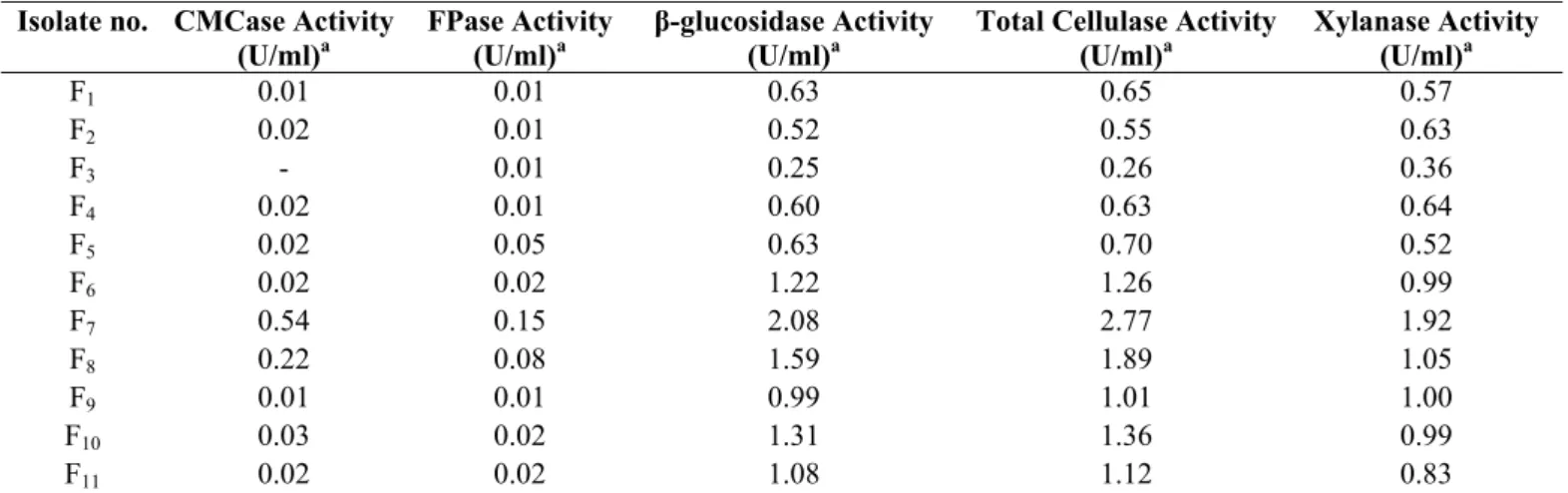
The fungal strain A. niger F7was isolated from soil and
selected among 11 strains of fungi, due to higher production of cellulase and xylanase for degradation of biomass. A. niger F7
exhibited 2.77 and 1.92 U/ml of cellulase and xylanase activity respectively (Table 1). Biodegradation of biomass was carried out under SSF mode because it has some advantages over submerged fermentation. It could reduce the cost of downstream processing, usability of simple and cheap media for the fermentation, lower risk of contamination due to the ability of contaminants to grow in absence of free-flowing water, high concentration of the product and simple fermentation equipment as well as low effluent generation and low requirements for aeration and agitation during enzyme production (22). SSF offers advantages over liquid cultivation especially for fungal cultures because the filaments of the fungi can penetrate deep into the substrate but in case of bacteria, it acts only on the outer surface of the substrate (12).
Table 1. Screening of fungal isolates for cellulase and xylanase enzyme production Isolate no. CMCase Activity
(U/ml)a
FPase Activity (U/ml)a
β-glucosidase Activity (U/ml)a
Total Cellulase Activity (U/ml)a
Xylanase Activity (U/ml)a
F1 0.01 0.01 0.63 0.65 0.57
F2 0.02 0.01 0.52 0.55 0.63
F3 - 0.01 0.25 0.26 0.36
F4 0.02 0.01 0.60 0.63 0.64
F5 0.02 0.05 0.63 0.70 0.52
F6 0.02 0.02 1.22 1.26 0.99
F7 0.54 0.15 2.08 2.77 1.92
F8 0.22 0.08 1.59 1.89 1.05
F9 0.01 0.01 0.99 1.01 1.00
F10 0.03 0.02 1.31 1.36 0.99
F11 0.02 0.02 1.08 1.12 0.83
In the present study, various cheap and easily available
lignocellulosics (T. ciliata, C. australis, C. deodara and P.
roxburghii) have been used as carbon sources. The process of
conversion of lignocellulosic biomass to sugars is complicated, so
to enhance biodegradation of forest biomass, it was pretreated with
alkali solution and SSF of pretreated and untreated biomass with
A. niger F7 was compared. When SSF was carried out with water
as moistening agent, maximum BI (6.99±0.23) and percent
hydrolysis (6.72±2.26) in pretreated C. australis was observed
along with the extracellular enzyme activity of 2201±23.91 U/g
(cellulase=1239.72±33.13 and xylanase=961.29±7.14) and the
lowest BI (1.40±0.08) and percent hydrolysis (0.84±0.07) was
observed in untreated C. deodara with the enzyme activity of
238±1.36 U/g (cellulase=160.26±1.40 and xylanase=77.76±0.46)
(Figure 1 & 2; Table 2). In this study notably high production of
extracellular enzymes was obtained while in other reports lower
cellulase activity had been reported where A. niger expressed
292.7 U/g of substrate (5)
Figure 1. BI of untreated and pretreated forest biomass after SSF by A. niger
Sharma, N. et al. Biodegradation of forest biomass by A. niger
Table 2. Enzyme activity of cellulase and xylanase of untreated and pretreated forest biomass after SSF by A. niger using water and
modified BSM as medium
a On dry matter basis
b Per cent increase is over untreated forest biomass c standard error of mean
With a view to improve the degradation, the modified BSM was used as moistening agent in the ratio of 1:2 (substrate: moisture). It has been reported that degradation of lignocellulosic biomass is affected by moisture level and has been shown to be reduced significantly if its optimum level is shifted to either side (19). Biodegradation of biomass soaked with modified BSM showed higher BI and percent hydrolysis 15.40±0.41 and 19.38±0.81 repectively in pretreated C. australis with enzyme activity of 4089±67.11 U/g of dry matter (cellulase=2991.58±42.39, xylanase=1097±24.6) and the minimum BI (2.63±0.09) and percent hydrolysis (1.32±0.08) has been reported in untreated C. deodara with enzyme activity of 328.10±3.62 U/g (cellulase=229.05±5.02 and xylanase=153.06±4.04) (Figure 1 & 2; Table 2). It is clear from the results that the overall biodegradation is enhanced when moistening medium is supplemented with essential nutrients for growing microorganisms. This study was proved
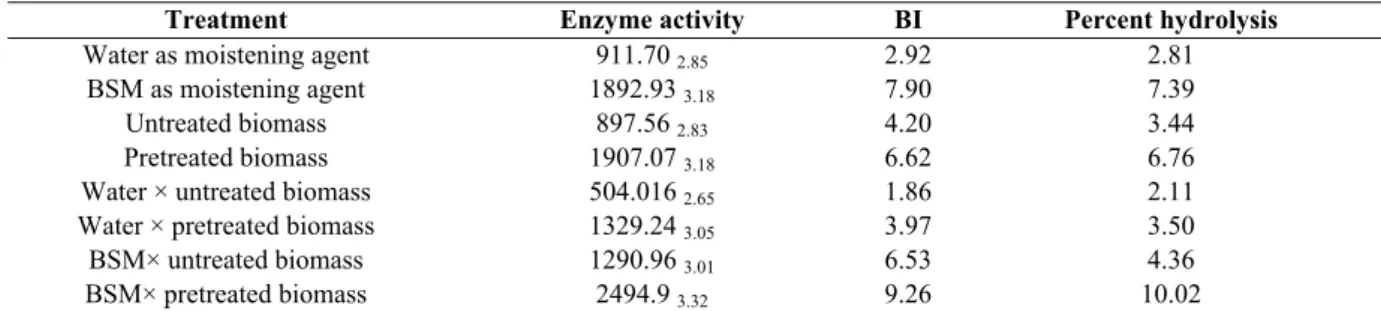
statistically by using CRD. When modified BSM was used as moistening agent, the mean value of enzyme activity i.e. 1892.93 3.16 is higher as compared to mean value i.e. 911.70 2.85
when water was used. These values were further transformed using logarithmic transformation and shown in subscript (Table 3a). This clearly indicates that modified BSM is a better moistening agent for SSF of forest biomass. The significant increase in biodegradation of forest lignocellulosics by SSF with modified BSM was due to the various supplements added to medium viz. yeast extract, peptone, urea etc. in the form of nitrogen source which had a direct promoting role in the growth of microorganisms and consequently in enzyme production. The elements like Na+ and Co++ in modified BSM probably helped in stabilization of extracellular hydrolytic enzymes (19). da Silva et al (3) also reported that supplementation with different nutrient sources resulted in increase in enzyme production.
Table 3a. Estimation of enzyme activity, BI and percent hydrolysis by CRD
Water Modified BSM
Untreated biomass (U/g)a Pretreated biomass (U/g)a Untreated biomass (U/g)a Pretreated biomass (U/g)a Substrate Cellulase Xylanase Cellulase + Xylanase Cellulase Xylanase Cellulase + Xylanase percent increase in total enzyme activityb Cellulase Xylanase Cellulase + Xylanase Cellulase Xylanase Cellulase + Xylanase percent increase in total enzyme activityb Toona ciliata 336.81 ±6.32c 188.75 ±1.34 525.60 ±3.64 978.28 ±12.87 729.56 ±6.49 1708.00 ±19.69 224.96 ±7.01 987.98 ±11.68 688.42 ±8.62 1676.00 ±20.68 2533.13 ±21.68 936.40 ±11.38 3470.00 ±46.42 107.04 ±1.02 Celtris australis 682.15 ±7.48 307.86 ±2.78 990.00 ±7.87 1239.72 ±33.13 961.29 ±7.41 2201.00 ±23.91 122.32 ±0.98 1612.46 ±19.44 906.08 ±11.32 2519.00 ±23.42 2991.58 ±42.39 1097.00 ±24.60 4089.00 ±67.11 62.33 ±0.73 Cedrus deodara 160.26 ±1.40 77.76 ±0.46 238.00 ±1.36 306.73 ±8.94 198.14 ±2.13 504.90 ±8.67 112.14 ±0.96 229.05 ±5.02 153.06 ±4.04 382.10 ±3.62 486.11 ±8.62 325.42 ±6.42 811.50 ±9.86 112.38 ±0.95 Pinus roxburghii 186.75 ±0.98 96.90 ±0.97 283.70 ±2.67 259.07 ±7.34 211.27 ±3.07 507.30 ±7.64 101.02 ±0.96 291.80 ±4.87 190.94 ±2.13 487.70 ±4.42 707.88 ±7.69 398.51 ±4.68 1106.00 ±11.32 129.13 ±1.32 Mixed substrate 305.02 ±1.02 178.52 ±0.88 483.50 ±2.32 930.91 ±14.24 681.23 ±8.78 1612.00 ±16.98 233.40 ±7.32 773.39 ±10.69 621.86 ±11.32 1395.00 ±12.36 2095.70 ±29.64 902.19 ±12.62 2998.00 ±21.62 114.91 1.26
Treatment Enzyme activity BI Percent hydrolysis
Water as moistening agent 911.70 2.85 2.92 2.81
BSM as moistening agent 1892.93 3.18 7.90 7.39
Untreated biomass 897.56 2.83 4.20 3.44
Pretreated biomass 1907.07 3.18 6.62 6.76
Water × untreated biomass 504.016 2.65 1.86 2.11
Water × pretreated biomass 1329.24 3.05 3.97 3.50
Forest waste pretreated with 1% sodium hydroxide responded better to biodegradation as compared to untreated ones. Highest percent increase of 129.13±1.32 was exhibited by P. roxburghii in enzyme titres while 60.11±2.46 percent increase in BI by mixed substrate and 127.46±3.62 percent increase in percent hydrolysis by C. australis was observed when modified BSM was used as moistening agent (Table 2; Figure. 3). The pretreatment of lignocellulosic biomass with 1% sodium hydroxide causes swelling and leads to dispersion
of bonds thus lowering down the crystallinity of cellulose and increasing the capillary size of the biomass (7). It has further been proved by interaction study shown in Table 3a that pretreated forest biomass moistened with water during SSF showed more enzyme activity (1329.24 3.05) as compared to
untreated biomass (504.16 2.65) moistened with water. Goyal et al (8) also found that alkali treatment of lignocellulosics resulted in increase in enzyme production as compared to untreated ones.
Figure 3. Percent increase in BI and percent hydrolysis of pretreated over untreated forest biomass after SSF by A. niger using water and modified BSM as medium
The main aim of our study was to enhance the biodegradation of forest biomass so that later it can be used for its bioconversion into high value compounds like bioethanol. Thus lignocellulosic biomass viz. forest biomass has emerged as an attractive substrate for biofuel production and can replace direct food chain items due to worldwide controversy generated on the use of direct food chain items. When lignocellulosic raw materials are used, the main by-product is lignin, which can also be used as an ash-free solid fuel for production of heat and/or electricity. The potential of using
lignocellulosic biomass for energy production is even more apparent because it is the most abundant renewable organic component in the biosphere (6). Among hardwood (T. ciliata
Sharma, N. et al. Biodegradation of forest biomass by A. niger
ethanol lays the stress to improve the focus by using robust and
more active hydrolytic enzymes. Different forest materials used in
the present studyhave been proven to be attractive and also cost
effective carbon source for enzyme production under solid state
fermentation by A. niger after subjecting them to suitable
pretreatment and using modified BSM as moistening agent and
thus can be recommended for further bioethanol production. When
critically observed, an interesting trend has been noticed between
three important factors i.e. enzyme activity, BI and percent
hydrolysis of forest biomass showing a positive correlation with
each other. As enzyme activity increased from 990±7.51 U/g in
untreated to 2201±47.81 U/g in pretreated C. australis during SSF
with H2O, its BI and percent hydrolysis values also escalated from
4.07±0.11 and 4.38±0.16 to 6.99±0.23 and 6.72±0.20 respectively.
Similarly in modified BSM, the higher enzyme production
4089±67.11 U/g (pretreated C. australis) from 2519.00±23.42 U/g
(untreated C. australis) has resulted in 15.40±0.41 BI and
19.40±0.81 percent hydrolysis over untreated one. Different
regression models were fitted to predict BI and percent hydrolysis
on the basis of enzyme activity in water and modified BSM
separately (Table 3b). High value of coefficient of determination
(R2) was found in enzyme activity (X). Thus BI can be predicted
by using Y=0.005X0.918 in water and Y=0.03X0.744 in modified
BSM. Percent hydrolysis in water can be predicted by exponential
function i.e. Y=0.001 exp (0.952X) where as in BSM power
functions can be used.
Table 3b. Parameters of various models to predict enzyme activity, BI and percent hydrolysis
Prediction model for BI (Y) on the basis of enzyme activity
Y =a + bX Y = abX Y =aXb Y =aExpbX
Characters
a b R2
a b R2
a b R2
a b R2
1 0.27 0.003 0.84 .878 1.001 0.769 .005 0.918 0.822 .878 0.01 0.769
2 1.600 0.03 .896 2.822 1.000 .868 .030 .744 .930 2.822 .000 .868
Prediction model for per cent hydrolysis (Y) on the basis of enzyme activity
1 .418 .003 .898 1.179 1.001 0.952 .025 .699 .875 1.179 .001 .952
2 1.488 0.05 .946 1.336 1.001 .933 .001 1.127 .947 1.336 .001 .933
Where X = enzyme activity, Y = BI/percent hydrolysis, R2 = coefficient of determination
CONCLUSION
In this work we demonstrated that A. niger responded better for degradation and is a good producer of cellulase and xylanase. The production of cellulase and xylanase by SSF can be made cost effective by using lignocellulosic biomass as carbon source. Biodegradation can further be improved by pretreating biomass with 1% NaOH as it turns the biomass more accessible to the enzymatic attack and by the supplementation of nutrients in the form of modified BSM. Moreover, results obtained in this work point a positive correlation between three important factors i.e. enzyme activity, BI and percent hydrolysis of forest biomass.
REFERENCES
1. Berghem, L.E.R.; Petterson, L.G. (1973). Mechanisms of enzymatic
cellulose degradation: purification of a cellulolytic enzyme from
Trichoderma viridae active on highly ordered cellulose. J. Biochem. 37 (1), 21-30.
2. Chandel, A.K.; Chan, E.S.; Rudravarun, R.; Lakshmi, M.; Ventakesh, L.; Rao, R. (2007). Economics and environmental impact of bioethanol: production technologies. Biotechnol. Mol. Bio. Rev. 2 (1), 14-32. 3. da Silva, R.; Lago, E.S.; Merheb, C.W.; Macchione, M.M.; Park, Y.K.;
Gomes, E. (2005). Production of xylanase and CMCase on solid state fermentation in different residues by Thermoascus aurantiacus miehe.
Braz. J. Microbiol. 36:235-241.
4. Dudkin, M.S.; Danilova, E.I.; Shchelkunov L.F. (2002). Isolation and characterization of holocellulose from Alfalfa. Prikl. Biokhim. Mikrobiol.
38(1), 83-89.
5. Fadel, M. (2000). Production physiology of cellulose and β-glucosidase enzymes of A. niger grown under solid state fermentation conditions.
Online J. Biol. Sci. 1 (5), 401-441.
6. Galbe, M.; Zacchi, G. (2002). A review of the production of ethanol from softwood. Appl Microbiol Biotechnol. 59, 618-628.
Biotechnol. Bioeng. 25, 157-172.
8. Goyal, M.; Kalra, K.L.; Sareen, V.K.; Soni, G. (2008). Xylanase production with xylan rich lignocellulosic wastes by a local soil isolate of
Trichoderma viride.Braz. J. Microbiol. 39:535-541.
9. Heck, J.X.; Hertz, P.F.; Ayub, M.A.Z. (2002). Cellulase and xylanase production by isolated amazon Bacillus strains using soyabean industrial residue based solid state cultivation. Braz. J. Microbiol. 33, 213-218. 10. Lee, J.S.; Parameswaran, B.; Lee, J.P.; Park, S.C. (2008). Recent
development of key technologies on cellulosic ethanol production. J. Sci. Ind.Res. 67, 865-873.
11. Lowry, O.H.; Rosebrough, N,J.; Faer, A.L.; Randell, R.J. (1951). Protein measurement with folin phenol reagent. J. Biol. Chem. 193, 265-275. 12. Maciel, G.S.; De-silva, L.P.; Windson, C.; Haminik, I.; Fendrich, R.C.;
Biaanca, B.E.D.; Pandey, A. (2008). Xylanase production by Aspergillus niger LPB326 in SSF using statistical experimental designs. Food Technol. Biotech. 46 (2), 183-686.
13. Miller, G.L. (1959). Use of dinitrosalicylic acid reagent for determination of reducing sugars. Anal. Chem. 31, 426-428.
14. Moiser, N.; Wyman, C.; Dale. B.; Elander, R.; Lee, Y.Y.; Holtaplle, M.; Ladish, M. (2005). Feature of promising technologies for pretreatment of lignocellulosic biomass. Bioresource Technol. 96, 673-686.
15. Reese, E.T.; Mandel, M. (1963). Enzymatic hydrolysis of cellulose and
its derivative. In: Whistler, R.L. (ed). Methods of carbohydrate chemistry. Academic Press, London,p. 139-143.
16. Rezende, M.I.; Barbosa, A.M.; Vasconcelos, A.F.D.; Endo, A.S. (2002). Xylanase production by Trichoderma harzianum rifai by solid state fermentation on sugarcane bagasse. Braz. J. Microbiol. 33:67-72. 17. Riviere, J. (1961). Isolement of purification desbacteris cellulolytiques
aerobies du sol. Ann. Inst. Pasteur. 253-258.
18. Sharma, N.; Bansal, K.L. (2005). Comparison of forest waste degradation under solid state fermentation and submerged fermentation by co-culture of Bacillus licheniformis and Bacillus coagulans. Asian J. Microbiol Biotechnol. Environ. Sci. 7 (3), 387-390.
19. Sharma, N.; Bansal, K.L.; Neopany, B. (2006). Effect of moisture level on biodegradation of forest waste under solid state fermentation. J. Sci. Ind. Res. 65, 675-679.
20. Sharma, N.; Bhalla, T.C.; Aggarwal, H.O.; Bhatt, A.K. (1996). Saccharification of physio-chemically pretreated lignocellulosic by partially purified cellulase of Trichoderma viridae. Sci. Lett. 19, 141-144. 21. Szczodeak, J.; Rogalsik, J.; Liczuk, Z. (1984). Cellulolytic activity of
mold. Acta Microbiol. Pol. 33, 217-225.
22. Viniegra, G.; Favela, E.; Aguilar, C.; Romero, S.; Diaz, G.; Augur, C. (2003). Advantages of fungal enzyme production in solid state over liquid fermentation systems. Biochem. Eng. J. 13 (2-3), 157-167.