O
RIGINALA
RTICLE Revista Brasileira de FisioterapiaEvaluation of a multimedia online tool for
teaching bronchial hygiene to physical
therapy students
Avaliação de um recurso multimídia para ensino de higiene brônquica para
estudantes de fisioterapia
Cibele C. B. Marques da Silva1, Sonia L. P. Toledo2, Paulo S. P. Silveira3, Celso R. F. Carvalho1
Abstract
Background: Advances in information technology have been widely used in teaching health care professionals. The use of multimedia resources may be important for clinical learning and we are not aware of previous reports using such technology in respiratory physical therapy education. Objectives: Our approach was to evaluate a conventional bronchial hygiene techniques (BHTs) course with an interactive online environment, including multimedia resources. Methods: Previous developed audiovisual support material comprised: physiology, physiopathology and BHTs, accessible to students through the Internet in conjunction with BHTs classes. Two groups of students were compared and both attended regular classes: the on-line group (n=8) received access to online resources, while the control group (n=8) received conventional written material. Student’s performance was evaluated before and after the course. Results:
A preliminary test (score 0 to 10) was applied before the beginning of the course, showing that the initial knowledge of both groups was comparable [online, 6.75 (SD=0.88) vs. control, 6.125 (SD=1.35); p>0.05]. Two weeks after the end of the course, a second test showed that the online group performed significantly better than the control group [respectively, 7.75 (SD=1.28) vs. 5.93 (SD=0.72); p>0.05].
Conclusions: The use of a multimedia online resource had a positive impact on student’s learning in respiratory therapy field in which instrumental and manual resources are often used and can be explored using this technology.
Keywords: physical therapy modalities/education; internet/utilization; multimedia/utilization.
Resumo
Contextualização: As novas tecnologias da informação têm sido amplamente utilizadas no ensino em saúde. O uso de recursos multimídia pode ser importante para o aprendizado clínico, no entanto não há descrição na literatura da aplicação e relevância desses recursos para o ensino de fisioterapia respiratória. Objetivos: Avaliar o impacto de um recurso didático multimídia no ensino de manobras de higiene brônquica (MHB). Métodos: O material didático multimídia previamente elaborado foi dividido em três módulos: “princípios fisiológicos”, “fisiopatologia” e “MHB”, disponibilizado em diversos formatos (páginas on-line, apostila e recursos audiovisuais) e inserido em um ambiente colaborativo de aprendizagem na internet, compondo um curso sobre MHB. Foram comparados dois grupos de estudantes que tiveram aulas presenciais convencionais sobre MHB. Durante o curso, um grupo (on-line, n=8) teve acesso ao recurso multimídia, enquanto o outro (controle, n=8) teve acesso ao material teórico convencional (textos e apostilas). O desempenho dos estudantes foi avaliado por dois testes (escore de 0 a 10) realizados antes e após o curso. Resultados: Nossos resultados mostram que o desempenho dos dois grupos foi similar no primeiro teste (on-line, 6,75 (±0,88) vs. controle, 6,125 (±1,35); p>0,05). Duas semanas após o fim do curso, um segundo teste mostrou que o grupo on-line teve um desempenho melhor que o controle (respectivamente, 7,75 (±1,28) vs. 5,93 (±0,72); p<0,05). Conclusões: O uso de um recurso multimídia on-line teve um impacto positivo no aprendizado de estudantes de fisioterapia respiratória, área na qual os recursos instrumentais e manuais são frequentemente utilizados e podem ser explorados no contexto deste tipo de tecnologia.
Palavras-chave: modalidades de fisioterapia/educação; internet/utilização; multimídia/utilização.
Received: 07/27/2011– Revised: 10/21/2011 – Accepted:10/25/2011
1 Physical Therapy Departament, School of Medicine, Universidade de São Paulo (USP), São Paulo, SP, Brazil 2 School of Medicine, USP, São Paulo, SP, Brazil
3 Medical Informatics, Department of Pathology, School of Medicine, USP, São Paulo, SP, Brazil
Introduction
Traditionally, the teaching of health professionals is per-formed through theoretical and practical classes, and the consultation material consists of books and scientiic journals. Now with the availability of new technologies and opportuni-ties to teachers and students are opened. he use of these new technologies, however, have been a target of ongoing debate1-3,
as well as the need for the development of new strategies that favor the improvement of teaching standards4.
A variety of studies have acknowledged the beneits of using information technology as a teaching tool in various health-related ields, such as osteopathy5,6, dentistry7-9, and nursing10,11.
In Physical herapy (PT), studies involving the application of information technology have evaluated the impact of the use of computers12-14 and compared its use with traditional learning15.
hese studies suggest that computer may be used to improve PT students’ learning. To the best of our knowledge, although these new technologies seem to provide a variety of teaching opportunities16, there are no reports of applications designed
to teach bronchial hygiene techniques (BHT) to PT students. Here, we compared the performance of two groups of PT students before and after a BHT’s course. Our interest was to evaluate potential learning beneit when the students had online or conventional consultation materials.
Methods
Online resources available
he online course was developed and organized in mod-ules as previous decribed for Marques da Silva, Carvalho and Carvalho17. he modules are available in a system named COL
– “Cursos On-Line – Online courses” (www.col.usp.br), and its exclusive access to online users via login and password. Each module consisted of a theoretical component (booklet), multimedia resources ( igures, videos, and graphic anima-tions), and interactive components (discussion list among instructors and students, a system with online tests, and links to selected information of other websites). he booklets con-taining evidence-based information was based on Medline and EMBASE databases18-21. Videos were, on average, three
minutes in length and 3 MB in size. Some videos were accom-panied by animation sequences illustrating physiopathologi-cal conditions. External links were used to guide the students to further references. All resources were developed taking into account uniformity of approach, clarity for the student, easi-ness of use, and were integrated through a collaborative learn-ing environment, where students could exchange information
and discuss with the teachers. he booklets were available in PDF version created in Adobe Acrobat Writer 6.0 software; the hypertext interface was written using XML Notepad 2007; online pages were developed in HTML, JavaScript and CSS; igures and pictures were produced in Adobe Photoshop CS 8.0; and videos were edited in Sony Vega 7.0 software. Access to the online interface was accomplished using Microsoft Internet Explorer 7.0.
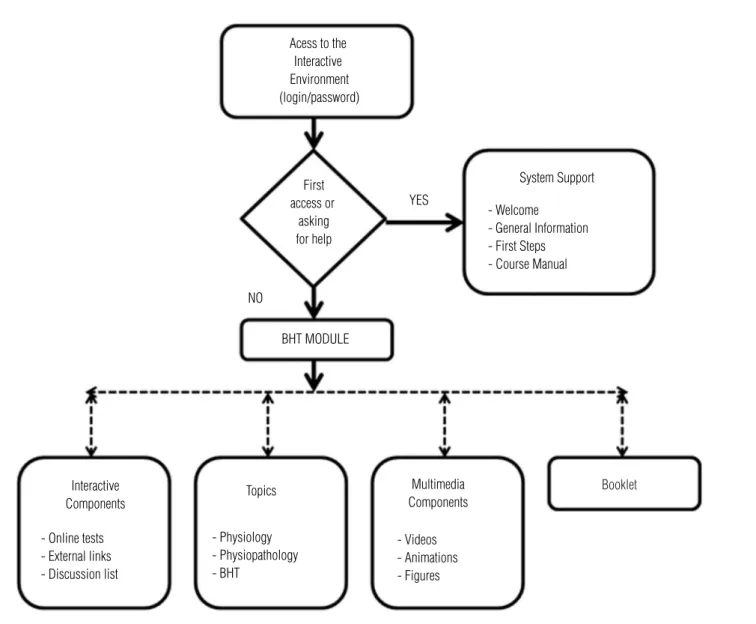
he BHT module comprised three topics: physiology of the mucociliary system, physiopathology of diseases that lead to hypersecretion, and BHTs (Figure 1). he physiology of the mu-cociliary system included mumu-cociliary function, mucous func-tions, mucous formation and structure, and factors that afect the defense mechanisms. he physiopathology of diseases that lead to hypersecretion approached bronchitis, bronchiectasis, cystic ibrosis, asthma, immotile cilia syndrome, and postop-erative proile; clinical proile of each disease was discussed. Finally, the BHTs module comprised vibration/compression, high-frequency oscillation, use of a vibrating vest, percussion, total slow expiration with open glottis, active cycle of breathing, autogenic drainage, cough, postural drainage and aerosol ther-apy. he deinition, application, positioning, materials needed and contraindications for each technique were presented. he most relevant information was highlighted, as suggested by Pallof, Pratt and Rapp22.
Evaluation of the teaching resources
Sixteen students (12 females; 25.43 SD=5.42 years) from the 4th year of an undergraduate degree in Physical herapy
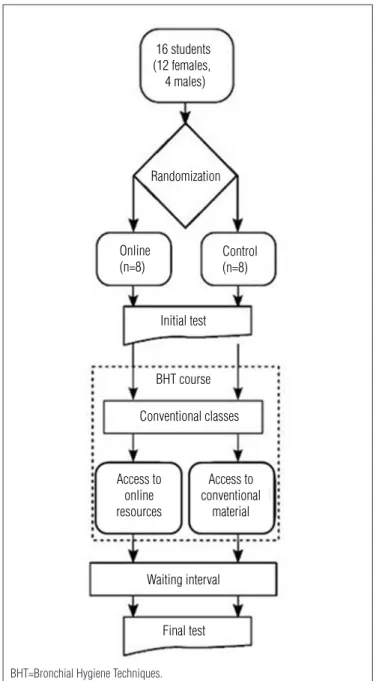
at a public university agreed to participate in the study. hey signed written informed consent according to the Ethics Com-mittee of the Clinics Hospital (Comissão de Ética para Análise de Projetos de Pesquisa do Hospital das Clínicas da Faculdade de Medicina da Universidade de São Paulo (USP), São Paulo, SP, Brazil – CAPPesq - Process 1043/03). he participants were randomly assigned (by coin toss) into two groups. he online group (n=8) was allowed online access to the system described above, while the control group (n=8) was provided with con-ventional written material (Figure 2). An initial, supervised multiple-choice test in a computer room at the University was performed to ensure that the control and the online groups had no initial knowledge diferences.
Both groups attended the conventional course classes. After the end of the course both groups had access to the teachers to ask questions and to study, respectively, their online or conven-tional material along two weeks. he access to the online mate-rial was then discontinued, and, after two additional weeks, all students were submitted to a inal test, which was similar to the irst test. Both tests scored from 0 to 10 points.
A two-weeks interval between the end of the online ac-cess and the final test was intended to avoid short-term memory influences. The questions for the initial and final tests were independently developed by five physical thera-pists, who did not attend the course. The 20 questions as-sessing the knowledge of the students addressed the three divisions of the module, as it follows: therapeutic indications (eight questions); contraindications for the use of BHTs (six questions); and concepts (six questions). Each correct ques-tion scored 0.5.
Statistical analysis
he scores of each group were submitted to the Kolmogorov-Smirnov and Levene tests to evaluate the normality and
Figure 1. Overview of student’s access to the module BHT (Bronchial Hygiene Techniques) in the interactive learning environment. Solid arrows
indicate the mandatory direction to be followed by the students during the online access. Dashed arrows indicate student´s free choice access according to their better interest.
Acess to the Interactive Environment (login/password)
System Support
- Welcome - General Information - First Steps - Course Manual YES
NO
First access or
asking for help
BHT MODULE
Interactive Components
- Online tests - External links - Discussion list
Topics
- Physiology - Physiopathology - BHT
Multimedia Components
- Videos - Animations - Figures
Booklet
homogeneity of the data, respectively. The initial and final performances of each participant were evaluated using a one-way analysis of variance (ANOVA) and submitted to the Holm-Sidak post hoc test. The level of significance was set at 5%.
Results
Discussion
Our results showed that the use of a multimedia online resource had a positive impact on student’s learning in respira-tory therapy, ield in which instrumental and manual resources are often used and can be explored using this technology. To our knowledge, this is the irst study evaluating the use of online support through the Internet for teaching BHTs to PT students. In a previous study17, our group described, step by
step, the development of a multimedia tool for teaching bron-chial hygiene available on the internet, however, this was only a descriptive study and this tool’s efectiveness in the student’s learning was unknown. Our approach was not to compare conventional versus distance courses23-26, but to ofer a hybrid
course where a conventional course was combined with online support and multimedia resources.
Increased motivation of the students27, cost-efectiveness
and user preferences15 may be partial explanations for such
better performance. Even when no diference is found, students may still rather prefer to use the system15 and augmented
mo-tivation may favour improved student scores or make students to inish the tests faster than the control group14. Specially,
when questions of the test show igures, students that had ac-cess to computer aided instructions tend to have higher scores, suggesting that the computers can reinforce visual comprehen-sion13. In addition, tools that allow tutor-student interaction
also seem to be important in improving learning28.
he use of these technologies has been frequently mentioned in other health-related ields. For instance, Chamberlain and Yates5 developed teaching materials and
found increased recognition of ostheopaty principles in daily practice. Lowe, Wright and Bearn7 compared the beneits of
classroom instruction with those of a program of computer-ised learning for orthodontics and found that students using the computerised program acquired knowledge in a similar or even more eicient manner. Most studies evaluating ef-fectiveness of the use of new technologies have compared distance learning with regular classroom learning23-26.
In-stead, the present study evaluated improvements in student learning using online tools as adjuvants to regular learning, because we understand that distance learning cannot replace the clinical qualiication of a good teacher. In order to get the best of two worlds, the knowledge acquired by the students must be complemented by the advantages of online learn-ing, which includes the facility of formatting and easiness of access, material tailored to individual needs, access from multiple sources, capacity to access links and other websites, incorporation of multimedia materials, relatively low cost, non-linear mode of learning and promotion of high
inter-Figure 3. Performance of the Online and Control groups on the initial
and final tests. 10
8
6
4
2
0
Initial Final
Online Control Online Control
Scores
Figure 2. Flowchart of student’s participation.
16 students (12 females, 4 males)
Randomization
Online (n=8)
Control (n=8)
Initial test
BHT course
Conventional classes
Access to online resources
Access to conventional
material
Waiting interval
Final test
BHT=Bronchial Hygiene Techniques.
activity between students and tutors as well as among the students themselves8.
The educational process has been a target of ongoing de-bate, as has the need to develop new strategies that favour the improvement of teaching standards4. A major concern
regarding the use of new technologies is the development of critical thinking, defined as the capacity to analyse, evalu-ate, question, investigate and experiment29,30. A number of
studies have demonstrated that applying new technologi-cal tools to teaching promotes crititechnologi-cal thinking6,31,32. In the
teaching-learning process, information technology and communication have a diversity of uses that go beyond the transfer of information through classes and from textbooks to students through distance learning33. In the resource
developed, a written material providing scientific evidence of the effectiveness of the BHTs was also made available to students. Although the effectiveness of some BHTs is still in question18-21; we understand that it is essential for students
to have access to this evidence-based knowledge and use it to reflect on their practice. Some studies evaluating the impact of online multimedia resources used to improve the qualification of health care professionals have shown promising results12,34. In addition, access to written
mate-rial also seems to be important for stimulating review and reinforcing the knowledge imparted in the classroom, when necessary1,34. In the present study, this educational aspect
was taken into consideration, which is why we made it pos-sible to access and print the booklet.
Studies carried out in the ields of health care have dem-onstrated improved learning among students taught using technological resources5-11. However, although technology can
facilitate and enrich learning, it can create problems as well. One of the biggest problems faced was the access to the BHTs videos, which were, on average, 3 MB in size. Some participants of the online group, who did not have access to broadband internet reported diiculties in viewing these videos. hese
technological issues must be solved with online support, sup-plied, in our course, through a collaborative learning environ-ment, where students could exchange information and discuss with the teachers and the technical assistance team. Various studies have suggested that similar technical problems, as well as social factors and poor skills in using technological resources are the major barriers encountered by students in using these technologies12,35,36. Allen et al.1 identiied possible reasons why
students resist using this technology: they might consider it susceptible to failure; they might be incapable of working with computers; and they might believe the computer experience incapable of replacing traditional classes. his last argument does not apply to our material, since it was developed as ad-juvant to the traditional learning. One of the advantages of our approach is that teachers continue to be essential to the success of the teaching-learning process, where the technology does not have the role of teaching but facilitating it. Students do not learn from technology, but from instructors who must be trained to communicate through technology37. Despite the
beneits obtained by the students in our study, we consider the sample size is a limitation and the use of this technology in a larger number of students should be further tested.
Acknowledgments
he computer team, Cintia Medeiros Ferreira, Ethel Shuna Queiroz and Rogerio Alexandre Scripnic Xavier Santos, for their support along the course development. he development of the system was provided by the Discipline of Telemedicine and by the Executive Director of the School of Medicine, José Agenor Mei Silveira, who made the necessary human resources available.
he Fundação de Amparo à Pesquisa do Estado de São Paulo (FAPESP), São Paulo, SP, Brazil and Conselho Nacional de Desen-volvimento Cientíico e Tecnológico (CNPQ), Brasília, DF, Brazil.
References
1. Allen M, Bourhis J, Burrell N, Mabry E. Comparing student satisfaction with distance education to traditional classrooms in higher education: a meta-analysis. Am J Distance Educ. 2002;16(2):83-97.
2. Williams P, Nicholas D, Gunter B. E-learning: what the literature tell us about distance education: An overview. Aslib Proc. 2005;57(2):109-22.
3. Premkumar K, Ross AG, Lowe J, Troy C, Bolster C, Reeder B. Technology-enhanced learning of community health in undergraduate medical education. Can J Public Health. 2010;101(2):165-70.
4. Jones LE. Introducing the ICF: the development of an online resource to support learning, teaching and curriculum design. Physiotherapy. 2011;97(1):55-8.
5. Chamberlain NR, Yates HA. Use of computer-assisted clinical case (CACC) SOAP note exercise to assess students’ application of osteopathic principles and practice. J Am Osteopath Assoc. 2000;100(7):437-40.
6. Brahler CJ, Quitadamo IJ, Johnson EC. Student critical thinking is enhanced by developing exercise prescriptions using online learning modules. Adv Physiol Educ. 2002;26(1-4): 210-21.
7. Lowe CI, Wright JL, Bearn DR. Computer-aided learning (CAL): an effective way to teach the Index of Orthodontic Treatment Need (IONT)? J Orthod. 2001;28(4):307-11.
8. Grimes EB. Student perceptions of an online dental terminology course. J Dent Educ. 2002;66(1):100-7.
9. Browne L, Mehra S, Rattan R, Thomas G. Comparing lecture and e-learning as pedagogies for new and experienced professionals in dentistry. Br Dent J. 2004;197(2):95-7.
11. Harrington SS, Walker BL. The effects of computer-based training on immediate and residual learning of nursing facility staff. J Contin Educ Nurs. 2004;35(4):154-63.
12. Williams P. The learning web: the development, implementation and evaluation of internet-based undergraduate materials for the teaching of key skills. Active Learning in Higher Education. 2002;3(1):40-53.
13. Sanford MK, Hazelwood SE, Bridges AJ, Cutts JH 3rd, Mitchell JA, Reid JC, et al. Effectiveness of computer-assisted interactive videodisc instruction in teaching rheumatology to physical and occupational therapy students. J Allied Health. 1996;25(2):141-8.
14. Kinney P, Keskula DR, Perry JF. The effect of a computer assisted instructional program on physical therapy students. J Allied Health. 1997;26(2):57-61.
15. Veneri D. The role and effectiveness of computer-assisted learning in physical therapy education: a systematic review. Physiother Theory Pract. 2011;27(4):287-98.
16. Goldschalk DR, Lacey L. Learning at distance. Technology impacts on planning education. Journal of Planning Education and Research. 2001;20(4):476-89.
17. Marques Da Silva CCB, Carvalho SLPT, Carvalho CRF. Desenvolvimento de um recurso didático multimídia para o ensino de higiene brônquica. Fisioter Pesqui. 2009;16(1):76-81.
18. American Association for Respiratory Care. AARC Clinical Practice Guideline. Postural Drainage Therapy. Respir Care. 1991;36(12):1418-26.
19. Fink JB, Mahlmeister MJ. High frequency oscillation of the airway and chest wall. Respir Care. 2002;47(7):797-807.
20. Goodfellow LT, Jones M. Bronchial hygiene therapy. From traditional hands-on techniques to modern technological approaches. American Journal of Nursing. 2002;102(1):37-43.
21. Lapin CD. Airway physiology, autogenic drainage, and active cycle of breathing. Respir Care. 2002;47(7):778-85.
22. Palloff R, Pratt K, Rapp C. Building learning communities in cyberspace: effective strategies for the online classroom. San Francisco: Jossey-Bass Inc.; 1999.
23. Ritchie H, Newby T. Classroom lecture/discussion vs. live televised instruction: A comparison of effects on student performance, attitude, and interaction. Am J Distance Educ. 1989;3(3): 36-45.
24. Cheng HC, Lehman J, Armstrong P. Comparison of performance and attitude in traditional and computer conferencing classes. Am J Distance Educ. 1991;5(3):51-64.
25. Köymen U. Comparison of learning and study strategies of traditional and open-learning-system students in Turkey. Distance Education. 1992;13(1):108-17.
26. Souder WE. The effectiveness of traditional vs. satellite delivery in three management of technology master’s degree programs. Am J Distance Educ. 1993;7(1):37-53.
27. Thomas KJ, Denham BE, Dinolfo JD. Perceptions among occupational and physical therapy students of a nontraditional methodology for teaching laboratory gross anatomy. Anatomical Sciences Education. 2011;4(2):71-7.
28. Wen CL, Silveira PSP, Azevedo RS, Böhm GM. Internet discussion lists as an educational tool. J Telemed Telecare. 2000;6(5):302-4.
29. Facione NC, Facione PA. Externalizing the critical thinking in knowledge development and clinical judgment. Nurs Outlook. 1996;44(3):129-36.
30. Jacobs PM, Ott B, Sullivan B, Ulrich Y, Short L. An approach to defining and operationalizing critical thinking. J Nurs Educ. 1997;36(1):19-22.
31. Loos G, Diether JW. Occupational safety and health training on the Internet. Developing quality instruction. AAOHN J. 2001;49(5):231-4.
32. Peters MW, Smith MF, Smith GW. Use of critical interactive thinking exercises in teaching reproductive physiology to undergraduate students. J Anim Sci. 2002;80(3):862-5.
33. Guri-Rosenblit S. Distance education’ and ‘e-learning’: not the same thing. Higher Education. 2005;49(4):467-93.
34. Donnelly AB, Agius RM. The distance learning courses in occupational medicine – 20 years and onwards. Occup Med (Lond). 2005;55(4):319-23.
35. Comeaux P. The impact of an interactive distance learning network on classroom communication. Communication Education.1995;44(4):353-61.
36. Howard D. Enhanced by technology, not diminished: a practical guide for effective, distance communication. New York, NY: McGraw-Hill; 2002.
37. Cyrs TE. New directions for teaching and learning. San Francisco: Jossey-Bass; 1997.