Eect of Polar Molecules on the Transport and
Localization of Charge Carriers in Molecular Materials
Juliusz Sworakowski
Institute of Physical and Theoretical Chemistry, Technical University of Wroclaw,
50-370 Wroclaw 51, Poland
Received 23 March, 1998; received in revised form 20 August, 1998
The inuence of polar species on the transport of charge carriers in molecular solids is reviewed. Guest molecules with permanent dipole moments introduced into molecular crystals can act as traps localizing carriers provided certain energetic conditions are fullled. In this case their polar character may manifest itself in a eld-dependent decrease of the trap depth. Moreover, irrespective of the positions of their energy levels, polar impurities may locally modify the polarization energy thus creating traps on neighbouring molecules. The eect of polar dopants in disordered molecular solids can be described within the model due to Bassler: the presence of polar species broadens the density-of-states function thus decreasing the eective mobility of charge carriers.
I Introduction
Research on electrical properties of molecular solids has been carried out for over half a century in many labora-tories: early studies were carried out predominantly on polycrystalline or amorphous materials, often of natural origin (e.g., carnauba wax [1,2]) and aimed at gather-ing basic information about generation, transport and storage of charge carriers in these materials (see, e.g., [3- 7] for extensive reviews). The research carried out in the sixties and seventies on systems of controlled pu-rity and structural perfection helped to answer many questions related to microscopic models of charge gen-eration and transport (cf. [8- 10]). The last 10-15 years have witnessed a revival of the interest in disordered molecular solids and polymers, stimulated by numerous current and emerging applications of these materials in, e.g., electrophotography, nonlinear optics, electrolumi-nescent devices etc. [11-15].
The role of localization of charge carriers in deter-mining the electrical properties of molecular materials has been recognized quite early, resulting in numerous papers devoted to the determination of parameters of centres that localize carriers [8,9,16]. The localization of electrons and/or holes inuences in a direct way the
transport of the carriers, hence a way to determine pa-rameters of local centres is to employ direct methods of determination of the carrier mobility and its depen-dence on such parameters as biasing eld, temperature etc. One should invoke the commonly used time-of-ight (TOF) technique, applicable in its simplest mod-ication to photoconducting solids. The principle of the technique, rst employed to organic solids by Ke-pler [17] and LeBlanc [18], has been described in sev-eral monographs [4,8-10,22]. Typically, a plane-parallel photoconducting sample is sandwiched between a semi-transparent electrode and a collecting one, and is con-nected to a system capable of recording the temporal evolution of the current in the time scale of the experi-ment. The experiment itself consists in illuminatingthe sample with a pulse of a strongly absorbed light through the semitransparent electrode and following the evolu-tion of the photocurrent transient. Within the small-signal regime, the mobilityis determined from the equa-tion
=
L 2 Vt
tr
; (1)
L standing for the sample thickness,V for the biasing voltage, andt
tr for the transit time.
In the introductory discussion, let us consider the situation in crystalline solids, in which the charge trans-port can be described within the band model [8- 10]. The presence of local centres manifests itself in the TOF experiment in changes of the shape in the time dependence of the transient currents. For the purpose of the present discussion, it would be useful to introduce two characteristic parameters describing the transport of charge carriers in a sample containg local centres: time of localization (residence in a local state)
t and free carrier lifetime
f : If t
tr >> (
t ;
f)
; carriers are subject to multiple trapping events before traversing the sample length; the centres fullling these conditions are often referred to as shallow traps. Another limiting case is that of deep traps: in this case
t >> t
tr, and carriers, once localized, are not released within the time scale of the experiment. If additionally
f <<t
tr, the determination of the transit time becomes impossible.
One of the questions which should be addressed in this context is the one concerning the nature of local centres. Based on the electrostatic model due to Lyons [19, 4], Silinsh [20] and Sworakowski [21] put forward a model explaining the appearance of traps for charge carriers (see also the discussion in [9,22,23] ), whose ba-sic features will be invoked in the following section of this article.
The situation in disordered molecular solids is more complicated as their behaviour can seldom be described (even for a qualitative description) within models de-veloped for nearly-perfect single crystals. Here, basic ideas stem from the pioneering work of Bassler and his collaborators (see [24,25] and references therein) who put forward a model describing the transport of charge carriers in disordered molecular solids. Principal re-sults conrming the validity of this model have been reviewed in several books and articles (see, e.g., [12, 24-27]).
The aim of this article is to present a short review of papers devoted to studies of the inuence of polar molecules on the transport and localization of charge carriers in molecular solids - both in single crystals and in highly disordered systems such as glassy samples and molecularly doped polymers.
II Centres localizing carriers in
single-crystalline solids
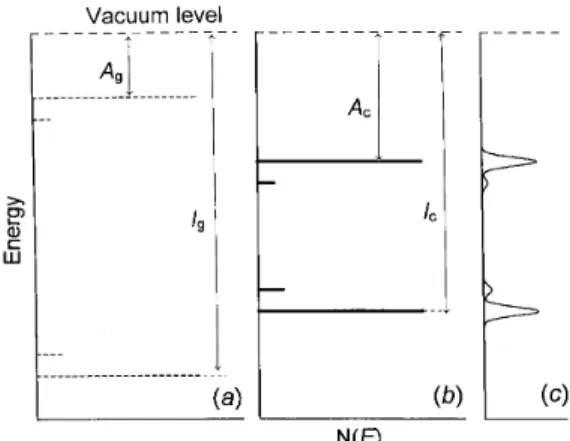
Figure 1. Energy levels in an isolated molecule (a)., in a nearly-perfect molecular solid (b)., and in a disordered molecular solid (c).. Indicated are also the positions of en-ergy levels of guest molecules which may act as chemical traps.
A discussion of the theories describing the transport of charge carriers in perfect molecular solids is beyond the scope of this article, and the reader is referred to a rich literature existing on the subject (e.g., [8,10] and references therein). For the purpose of the present dis-cussion it is sucient to mention that the theory pre-dicts that the transport of charge carriers in perfect molecular solids occurs in narrow bands, the carriers being strongly coupled to lattice phonons. Experimen-tally determined room-temperature mobilities are of the order of 10,1
,10
0cm2/Vs, and are weak functions of temperature. A good example of such a behaviour is the temperature dependence of the drift mobility of holes and electrons in single crystals of polycyclic hy-drocarbons. Careful measurements performed on high-purity single crystals (see the list in [28]) demonstrate that the mobilities (
0) follow a T
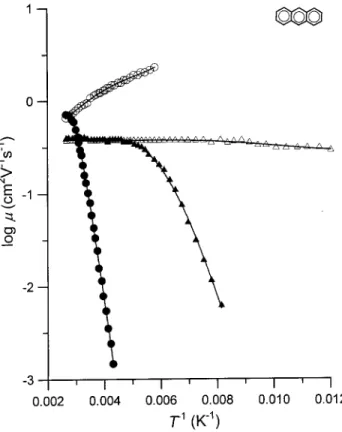
,ndependence, with 0 < n 3 but mostly ranging between 0 and 1.5. Temperature dependences measured in anthracene by Probst and Karl [29] are shown in Fig. 2.
Doping of molecular solids with a small amount (of the order of 10,7
,10
,4mole/mole) of suitably chosen guest molecules may give rise to a dramatic reduction of the eective drift mobilities due to trapping of charge carriers. In case of shallow traps controlling the trans-port, the eective mobility (
eff) is reduced by the factor
f =(
t+
temperature dependence [30]
eff =
0 1 +x
gexp( E
t =k T)
(2) where x
g is the mole fraction of the guest molecule, andE
t stands for the depth of the trap formed by the dopant (assumed monoenergetic). It follows from the equation that at low temperatures the mobility should be temperature-activated with a slope determined by the trap depth, whereas at suciently high tempera-tures it should attain its \lattice" value equal to that in a pure crystal. The results shown in Fig. 2 demon-strate that this is indeed the case.
Figure 2. Temperature dependences of the drift mobilities of electrons (triangles). and holes (circles). in pure an-thracene crystals (open symbols). and in tetracene-doped anthracene (closed symbols, dopant mole fraction amount-ing to ca.10,7). Data taken from [29].
The depths of chemical traps (i.e. traps formed by guest molecules introduced into a host lattice) deter-mined from such experiments can be compared with respective values estimated from a Haber-Born type cycle based on the electrostatic model of Lyons [19]. It was pointed out [20-23,31,32] that electrons can be localized on crystal sites (molecules) exhibiting a lo-cal electron anity (A
loc
c ) greater than the respective value in a perfect crystal (A
c). Similarly, a molecule in
a crystal can act as a hole trap if its local ionization energy (I
loc
c ) is smaller than that in a perfect crystal (I
c). The trap depths for electrons and holes ( E
e t and E
h
t, respectively) are given by simple relations E e t = A c ,A loc c E h t = I loc c ,I c (3)
(throughout this paper, we shall adopt the convention according to which the depths of local states are posi-tive values). The values ofA
cand I
care related to the respective molecular ones (A
g and I
g, respectively) by the relations A c = A g ,P I c = I g+ P (4)
The parameter P(P < 0), referred to as the polar-ization energy, is the energy of interaction between a charge localized on a given site and the surrounding po-larizable medium; in many non-polar crystals its value ranges between -1.5 and -2.5 eV [19,4,9]. It becomes evident from Eqs. (3) and (4) that molecules will local-ize charge carriers if their molecular ionization energy is smaller and/or their electron anity greater than the respective values of the host molecules (i.e., if they are chemically dierent from the host ones),
E e t A g uest c ,A host c E h t I host c ,I g uest c (5)
or if the absolute value of the polarization energy is locally greater than that in a perfect crystal (i.e., if a carrier encounters a physical defect of the crystal struc-ture containing regions in which distances between the host molecules are smaller than in the perfect lattice).
E e t E h t P
per fect ,P
local (6)
good agreement with experimental results obtained for doped anthracene crystals (cf. tables in [21-23]).
Of particular interest to the main topic of this article is the situation when a crystal consisting of non-polar molecules is doped with polar guest molecules. One may envisage the following eects associated with the presence of polar dopants in a non-polar lattice:
(i) If the electron anities and/or ionization energies of the host and guest molecules full at least one relation given by Eq. (5), then the guest molecule itself may act as a chemical trap. In this case the detrapping of charge carriers from such traps may be eld-enhanced due to a charge-permanent dipole interaction.
(ii) Independently of the positions of the energy levels of the guest molecule with respect to those of the host, its permanent dipole moment locally modi-es the polarization energy due to a contribution to the local eld acting on a localized carrier, re-sulting in the appearance of local states in the vicinity of the dopant.
(iii) If the shape of the dopant molecule is dierent from that of the guest, then one should expect an additional local modication of the polarization energy due to a (static) distortion of the crystal lattice. This eect is equivalent to the appear-ance of a structural trap [9,20,31,32] and will not be discussed here.
III Polarization energy in the
vicinity of a polar dopant
The energy of polarization of the lattice by a charge localized on a k-th molecule can be expressed as
Pk =, 1 2
X j6=k
F
jpj (7)wherepj is the total (permanent + induced) dipole mo-ment of aj-th molecule, and
F
jis the eld acting on the molecule, consisting of contributions from the ion, other permanent and induced dipoles, higher-order multi-poles etc. Methods of calculation of the polarization energy were discussed by Silinsh et al. [33,9,10], and by Bounds and Munn [34,35]. For a semi-quantitative discussion it is, however, sucient to adopt a simplermethod rst employed by Lyons [19,4]: the polariza-tion energy can be expressed as a sum of interacpolariza-tions between a localized charge and multipoles (permanent and induced), and between multipoles of various orders, and it is sucient to retain only the lowest terms. Such an approach was used in model calculations reported in [36,37], performed on a cubic lattice of non-polar glob-ular molecules characterized by a scalar polarizability , with some sites replaced by polar molecules possess-ing a permanent dipole moment
m
. The polarization energy of the perfect lattice was calculated by taking into account only interactions between the charge and induced dipoles (Pid), with numerical values of rele-vant parameters chosen so as to mimic the situation in anthracene crystals doped with guest molecules of var-ious polarities; in particular, the lattice constant was assumed to be equal to 0.62 nmP =Pid =, e
2 2
X j6=k r
,4
jk (8)
where rjk is the distance between the charge situated on the k-th molecule, and a neutral polarizable j-th molecule. This procedure, neglecting the contribution of higher terms, overestimates the polarization energy by some 20-30% [4,19]. Within the model, introduction of polar dopants results in the appearance of additional terms in the expression for the local value of the polar-ization energy, describing interactions between the per-manent dipole(s) and the charge (Pim), and between the permanent dipole(s) and the induced ones (Pmd)
crystals from low-temperature thermally stimulated lu-minescence (TSL) experiments [41]. It should be noted that the presence of dipolar impurities necessarily dis-turbs the electrostatic interactions between charges and the crystal lattice and is likely to result in the creation of local states even though the guest molecules them-selves do not act as traps.
Figure 3. (a). Local values of the polarization energy in a model crystal due to the presence of an isolated dipole [36,37]. The diagram represents a cross-section through a three- dimensional perturbation. The heights of the vertical bars are proportional to dierences between the local val-ues of the polarization energy and the value calculated for a perfect crystal . The dipole is directed along one of the principal crystal axes, its permanent moment amounting to 4 D. (b). Depths of traps (upper curve). and number of molecules perturbed by the presence of an isolated dipole, i.e. a parameter related to the cross-section for trapping (lower curve).. The diamonds and full lines are the results of the calculations [36,37], crosses are experimental results obtained on doped anthracene crystals [41].
IV Transport of Charge
Carri-ers in Disordered Molecular
Solids
Experiments performed on intentionally doped molec-ular crystals have been rather scarce and limited to a few model systems, usually with anthracene serving as the host. This is due to diculties with growing doped single crystals of a good and controlled quality on one hand, and to their limited use on the other. At the same time, a widespread use of disordered molecular solids (predominantly polymers) in electrophotography [12], as well as their emerging applications in non-linear optics [11,13] and electroluminescence [14] has stimu-lated continued interest in the electrical properties of this class of materials.
Most of the experimental results reviewed in this section have been obtained on so-called \molecu-larly doped polymers" (MDP) and on glassy charge-transporting materials. MDP are amorphous solid so-lutions of molecules of electron- or hole-transporting materials (electron acceptors or electron donors, respec-tively) dissolved in a polymer hosts acting as a binder. Typically, the concentrations of charge-transporting materials in the \molecularly doped polymers" range between a few % and several tens of % (often signi-cantly exceeding 50%), one should therefore realize that in this case the notion of "doping" diers from that em-ployed in conventional solid state physics.
Early results, reviewed in [42,43], indicated that the mobilities in disordered molecular solids are eld- and temperature-dependent, the dependences being well de-scribed by the empirical equation
=
0exp
, E
a;0
,F
1=2 k T
eff
(10) where
o and
are constants,E
a;0is the zero-eld ac-tivation energy, andT
eff is an \eective temperature": 1=T
eff = 1
=T ,1=T 0,
T
molecular solids diering in physical order, chemical structure and the nature of conducting moieties.
In recent years, most of the rich experimental ma-terial have been interpreted within the model due to Bassler (see [24,25] and references therein, [58-60]). The model assumes that, due to disorder, energies of inter-action of an excitation with the surrounding medium may be locally modied in a molecular solid. In case of charge carrier transport, this translates into local (ran-dom) modications of the polarization energy. As a result, narrow energy bands in which the transport of charge carriers occurs in molecular single crystals split into a manifold of local states, the transport between them occurring via hopping. Additionally, the spread of intersite distances (rij) must inevitably inuence the respective transfer rates. Bassler [24] assumed that the jump rate betweeni-th anj-th sites can be described by an expression, originally proposed by Miller and Abra-hams [61],
ij = 0
f(Eijr)g(rij); (11) where,
f(Eij) = (
exp ,
Ej ,E
i kT
forEj >Ei 1 forEj Ei
(12) and
g(rij) = exp(,2rij): (13) The functionsf(Eijr) andg(rij) describe a Boltz-mann probability of thermally assisted jumps between sites of dierent energies, and an overlap of the elec-tronic wave functions of the initial and nal states, re-spectively. In the above equations,
0 and
are con-stants representing a frequency factor and the wave function decay constant, respectively. Apart from as-suming explicitly the validity of the Miller- Abrahams equation, the Bassler's model also assumes that (i) dis-tributions of intersite distances and site energies are Gaussian ones (cf. Fig. 1c); (ii) the process is inco-herent; (iii) polaronic eects are insignicant although there exists a sucient coupling to the lattice vibra-tions. The latter assumption is equivalent to neglecting the inuence of dynamic disorder (polaronic eects) on the transport of charge carriers. The condition (i) de-nes the shape of the density-of-states (DOS) function
N(E) = Ntot (2 2)1=2exp
,
(E,Em) 2 2
2
; (14)
Ntotstanding for the total density of states,Em for the energy of the distribution maximum,and the dispersion being a measure of the disorder; typically,0:1 eV. The distribution of site energies is often referred to as due to diagonal disorder, whereas the distribution of in-tersite distances is due to an o-diagonal disorder. One can show that the parameters characterizing the diago-nal and o-diagodiago-nal disorder are not independent. For example, assuming that the material under study con-sists of non-polar molecules and employing Eq. (8), one may relate the latter parameter to the polarization en-ergy and the distribution of molecular positions [20,24]; qualitative estimation yields
= 4P
r r
; (15)
where <r =r >is the average relative uctuation of the intersite distances.
Analytically, the Bassler's model is tractable only under special conditions [62,63] and solutions are not given in a closed analytical form. Thus most results have been obtained from computer simulations employ-ing the Monte Carlo technique. The calculations were performed on a primitive cubic lattice built of non-polar isotropic molecules, with the lattice constant equal to 0.6 nm. The main results are [24,25,58-60,64,65]:
(i) the diagonal and o-diagonal disorder contribute independently to the mobility,
(ii) at suciently high temperatures, time-of-ight signals should be non- dispersive, changing to dis-persive at a transition temperature whose parame-ters are determined by the disorder and the sample thickness.
(iii) biasing elds, modifying the transfer probability may inuence the mobility.
The following heuristic equation, based on the re-sults of the simulations and valid in the non-dispersive transport region, has been put forward
=
0exp "
,
2 3k T
2
#
c
(T;) = 8 < :
1 forF<F
tr expfC[( =k T)
2
,
2] F
1=2
g forF >F tr
; 1:5 expfC[( =k T)
2
,2:25]F 1=2
g forF >F tr
; <1:5
(17)
d In the above equations, F
tr is a transition voltage be-tween the low-eld and high- eld regimes (typically, F
tr is of the order of 10
5 V/cm),
C is a temperature-and eld-independent constant being a function of the intersite distance and assuming the value of 2:910
,4 (cm/V)1=2for the distance equal to 0.6 nm, and is a temperature-independent parameter related to the dis-persion of the functiong(r
ij) describing the o-diagonal disorder (Eq. 13). A similar equation, valid for the dis-persive transport, has also been derived, diering es-sentially in the-dependence of the mobility [64,65].
The above equations predict that (i) at high elds, the mobility should be eld-dependent, following a Poole-Frenkel-type dependence, independently of the polarity of the molecules in the material; (ii) tem-perature dependences of the mobility should be non-Arrhenius; (iii) the zero-eld mobilities are dependent on the diagonal disorder only, following a ln
0 /T
,2 dependence. Thus, analyzing the eld and tempera-ture dependences of the drift mobility of holes in a dis-ordered photoconducting material, one should be able to extract information concerning both diagonal and o-diagonal disorder. It is necessary to point out that the model predicts the high-eld mobilities to obey a Poole-Frenkel type dependence without directly assum-ing any Coulombic interaction between the local centres and the carriers.
The model presented above provides a basis for in-terpreting the ample experimental material published so far. Experiments performed by several groups [66-115] are at worst in qualitative agreement with the model, in most cases following quantitatively its pre-dictions. The experimental material gathered during recent years was obtained on MDP using in most cases polystyrene (PS) and bisphenol-A-polycarbonate (PC) as binders (other polymers have been used less fre-quently), and several groups of donors [66-84,103-107, 109-115] and acceptors [85-89,108] as charge transport
materials. Similar experiments have also performed on glassy lms of the charge-transporting materials [84,90-102]; bearing in mind the concentrations of the charge-transporting materials in the MDP samples, it comes as no surprise that results obtained on the latter systems would not be qualitatively dierent from those obtained using molecular glasses.
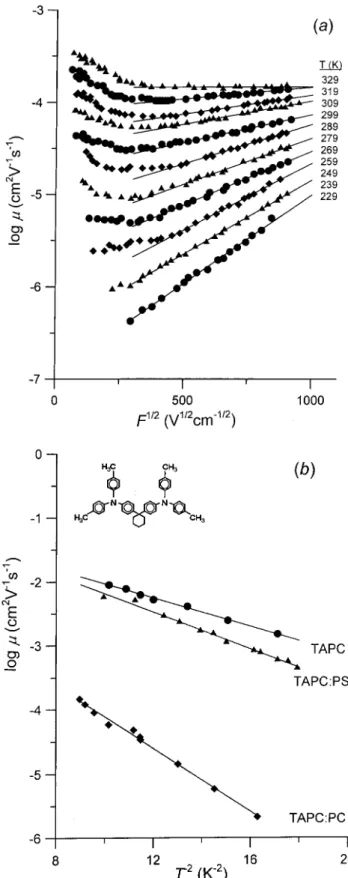
Results obtained on 1,1-bis((di-4-tolylamino)phenyl) cyclohexane (TAPC - see insert to Fig. 4) by Borsen-berger, Bassler and Pautmeier [67,68], shown in Fig. 4, are a good example of the agreement between the predictions of the model and the experiment: mea-sured mobilities indeed follow the ln / F
1=2 and ln
0 /T
,2 dependences. It should be noted that the experimentally determined values of the parameters of the model: pre-exponential mobility
0, and the dis-order parameters and were found to depend on the nature of the polymer used as binder: for TAPC dissolved in polar PC the mobilities were orders of magnitude inferior to those obtained on glassy TAPC, and TAPC in a weakly polar PS. This feature points to a role of the polarity of the components in both MDP and molecular glasses in controlling the transport of carriers.
V Eect ofPolar Specieson the
Transport of Carriers in
Dis-ordered Molecular Materials
Figure 4. Field and temperature dependences of drift mo-bilities of holes in TAPC-containing polymers. (a). Field dependence of the mobility in bisphenol-A-polycarbonate: TAPC (w
TAPC = 0
:75) at various temperatures [66]. (b). Temperature dependence of the zero-eld mobility in bisphenol-A- polycarbonate: TAPC (wTAP
C = 0 :75), polystyrene: TAPC (wT
APC= 0
:75), and glassy TAPC [67].
and Fitzgerald [103,104,108] Kanemitsu et al. [53,57,109-111], and Nishizawa et al. [54,113,114] demonstrate that the polarities of both, charge transporting materials [56,57,72,75,76,78,80-82,85,109,111,113] and the polymer binders [52-54,67,69,71,74,76,85,86,110] modify the mobilities. The eect has been explained by introducing a dipolar con-tribution in the DOS function: Dieckmann et al. [116] assumed that the width of the DOS is a superposition of a van der Waals component (v dW) and a dipolar one (dip); taking both of them being independent, and neglecting any possible displacements of the maxima of the two Gaussian distributions, one may write
2= 2 v dW+
2
dip (18)
with the dipolar component related to the permanent dipole moment of the species (m) and its concentration (expressed here as the mole fraction x)
dip= x bm a2
0
(19)
Figure 5. Concentration dependence of the width of the DOS function in TAPC-containing polymers. Data taken from [70]. The open square represents the value obtained for pure TAPC. The lines serve only to guide the eye.
Valerian et al [112] put forward a model attempt-ing to rationalize experimental results obtained on poly(methylphenylsililene) (photoconducting by itself) doped at low concentrations (x0:072) with highly po-lar 1-(benzamido)-4-nitronaphthalene (m 6D). The model qualitatively reproduces the concentration de-pendence of the width of DOS calculated from the ex-periment. It also comes from the model that the eect of polar additives should depend on their shapes: with input parameters mimicking those of the dopant, the reduction of the mobility should be more ecient for spherical molecules than for elongated ones.
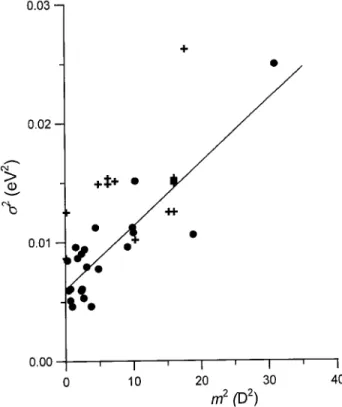
The results obtained for one-component amorphous samples of charge- transporting materials are similar. The available experimental material, obtained by Bors-enberger et al. [90-102] conrms qualitatively the appli-cability of the model. According to Eqs. (18) and (19), one should expect a linear dependence of 2 on m2. The dependence is reasonably fullled for several hole-transporting materials (donors), as is demonstrated in Fig. 6, the agreement between the model and the ex-perimental results being much worse in the case of ac-ceptors. Borsenberger et al. [98,99,101] explain the
dis-crepancy assuming that the width of the dipolar con-tribution should be associated with the group dipole moments rather than with the dipole moment of the molecule taken as a whole. This is essentially equiva-lent to admitting that the point dipole approximation breaks down in case of suciently large molecules, as was postulated by Kanemitsu and Sugimoto [111]. An-other source of possible discrepances are the dierences in molecular packing resulting in dierences of the van der Waals component (and also inuencing the eective dipole moments of the molecules in glasses).
Figure 6. Inuence of the dipole moment of the dopant on the width of the DOS function. Circles: hole-transporting materials (donors)., crosses: electron-transporting materi-als (acceptors). The gure, similar to that shown in [94], contains experimental results collected from [84,90-102].
pa-per). Due to disorder, the trap depths will also be dis-tributed around a centroid, as is shown schematically in Fig.1c. The eect of chemical traps on charge transport in molecularly doped polymer was examined by Wolf et al. [83]. The results of computer simulations show that for suciently shallow traps their eect may be incor-porated into an eective (broader) density of states: in other words, the trap free and shallow trap-controlled temperature dependences of mobilities should be indis-tinguishable, contrary to the situation in ordered solids. These conclusions are in agreement with experimental results obtained on tri-p-tolylamine:polystyrene system containing small amounts of tri-p- anisylamine which should act as a chemical hole trap (E
t
0:24 eV). It is therefore not unconceivable that at least some re-sults reported in the literature contain a contribution of eects due to the presence of traps (introduced in-tentionally or - more often - uninin-tentionally).
While highly successful in explaining most basic fea-tures of charge transport in disordered molecular solids, the Bassler's disorder model [24,25,58-60] fails in some cases to provide aquantitativeexplanation of dierences (often quite small) between computer simulations and experimental results obtained on various systems. A detailed discussion of these dierences is beyond the scope of this article, one should, however, point to at least two possible sources of discrepancies.
First, the Bassler's model assumes that both, diag-onal and o-diagdiag-onal disorder are described by specic (Gaussian) functions, the inter-site transfer rates being given by the Miller-Abrahams function [61]; these equa-tions, qualitatively correct, may not necessarily provide a good quantitative description of real cases [107,25]. Also, work of Gartstein and Conwell [119-121] points out to a sensitivity of the carrier transport to the model of o-diagonal (positional) disorder.
Secondly, the disorder model in its orthodox form neglects any inuence of a dynamic disorder on the eld and temperature dependences of the mobility. This as-sumption may hold in the case of rigid polymer net-works doped with relatively small and rigid molecules, one may, however, intuitively suppose that for large and exible dopants and/or for polymer binder around and above their glass transition temperatures the inuence of vibrations (polaronic contribution) must not be ne-glected a priori.
The inuence of polarons on the transport in disor-dered solids has been considisor-dered in several papers (see the literature cited in [26]). At present, both theoreti-cal work [122,123] and experimental results (e.g., [124-127]) seem to indicate that the polaronic contribution should be taken into account as a signicant but sec-ondary factor to explain details of the charge transport in disordered molecular solids.
VI Dipolar Traps
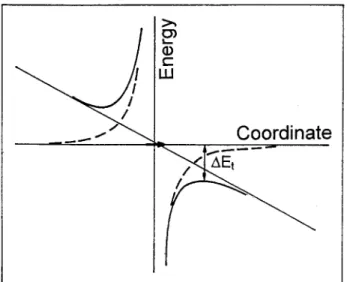
It has already been mentioned in Section II of this paper that polar character of a chemical trap should manifest itself in a dipolar analogue of the Poole-Frenkel eect [16]. Such an eect has been predicted several years ago [128,129]: the authors suggested that electrostatic interactions of a charge carrier released from a chemical trap with the permanent dipole moment of the molecule constituting the trap should result in a eld-assisted lowering of the trap depth (cf. Fig. 7). Contrary to the "conventional" Poole-Frenkel eect, however, the eect should be directional, reaching its maximum value in the case when the biasing eld is parallel to the orien-tation of the dipole. Moreover, the eld dependence of the trap depth, reecting itself in the eld dependence of the carrier mobility, should be of the ln / F
2=3 type. Such an eect has not been observed in experi-ments: no experimental results have been published to date reporting on the eld dependence of the depth of chemical traps in single crystalline molecular materials intentionally doped with polar molecules, whereas al-most all available experimental results obtained on dis-ordered solids (molecularly doped polymers and glassy lms) [43- 117] show that the mobility is either eld-independent or, at high elds, follows a ln / F
1=2 dependence. The latter dependence, taken in early pa-pers for a signature of charged species acting as traps, is apparently an inherent property of the transport of charge carriers in disordered molecular materials, even those formed by non-polar molecular species [25].
dependent, led the authors to the following conclusions: at low elds the lowering of the trap depth is propor-tional toF
2=3, changing into F
1=3 at high elds. Thus there exists a suciently broad transition range where the eld dependence becomes undistinguishable from the experimentally observed F
1=2 dependence. This model implicitly assumes that there exist in abundance species in samples acting as chemical traps, which ad-ditionally possess a signicant freedom of orientation. In view of a general validity of theF
1=2 dependence in disordered solids, it seems that the eects taken into account by the dipolar trap model cannot be consid-ered generally responsible for the eld and tempera-ture dependences of charge carrier mobilities in these materials. It is, however, worth mentioning that more recent Monte Carlo simulations of the carrier transport in disordered dipolar lattices carried out by the same authors [132,133] predict a temperature dependence of the mobility slightly diering from the T
,2 one found by Bassler [24,25, 58-60]: Novikov and Vannikov ob-tain a (T
,2 ,T
,2
o ) dependence ( T
0 being a constant). Interestingly, such a dependence was found in the ex-periments reported by Mack et al [49].
Figure 7. Field-induced modication of the depth of a chem-ical trap formed by a polar molecule. The eld is parallel to the direction of the dipole.
VII Final remarks
The purpose of the article was to review recent work carried out on ordered and disordered molecular solids containing polar species. The presence of polar
molecules in single crystalline materials should result in the appearance of traps localizing charge carriers on and/or in the vicinity of the dopant. The latter eect should be observed even if the dopant molecule itself does not act as a chemical trap.
The most convenient framework to describe the transport of charge carriers in disordered materials is the disorder model due to Bassler. The presence of po-lar species in disordered molecupo-lar solids - molecupo-larly doped polymers and glassy samples - reects itself pri-marily in increasing both the diagonal and o-diagonal disorder. Traps due to polar species are likely to be present in these materials but their eect on the trans-port cannot, in principle, be separated from the domi-nating eect of static disorder reected in the broaden-ing of the DOS function.
Acknowledgements
The author wishes to express his thanks to H. Bassler, P.M. Borsenberger, A.K. Kadashchuk and N. Karl for permissions to use their results in the gures shown in this paper. The paper was supported by the Technical University of Wroclaw.
References
1 B. Gross, Phys. Rev. 67, 253 (1945). 2 B. Gross, J. Chem. Phys. 17, 866 (1949).
3 G. Gross, Charge Storage in Dielectrics, Else-vier, Amsterdam 1964
4 F. Gutmann and L.E. Lyons, Organic Semicon-ductors, J. Wiley, New York 1967; F. Gutmann, H. Keyzer, L.E. Lyons and R.B. Somoano, Or-ganic Semiconductors, Part B, R.E. Krieger Publ., Malabar, FL 1983
5 H. Meier, Organic Semiconductors, Verlag Chemie, Weinheim 1974.
6 M. Kryszewski, Semiconducting Polymers, Else-vier, Amsterdam 1980.
7 Proc. Oji Int. Seminar on Org. Semiconductors -40 Years, Okazaki 1988; Mol. Cryst. Liq. Cryst. 171(1989).
8 M. Pope and C.E. Swenberg,Electronic Processes in Organic Crystals, Clarendon Press, Oxford 1982; M. Pope and C.E. Swenberg, Annu. Rev. Phys. Chem. 35, 613 (1984).
10 E.A. Silinsh and V. Capek, Organic Molecular Crystals. Interaction, Localization and Transport Phenomena, AIP Press, New York 1994.
11 P.N. Prasad and D.R. Ulrich (Eds.), Nonlin-ear Optical and Electroactive Polymers, Plenum Press, New York 1988.
12 P.M. Borsenberger and D.S. Weiss,Organic Pho-toreceptors for Imaging Systems,M. Dekker, New York 1993.
13 V. Shibaev (Ed.), Polymers as Electrooptical and Photooptical Active Media, Springer Verlag , Berlin 1996.
14 S. Miyata and H.S. Nalwa (Eds.),Organic Electro-luminescent Materials and Devices, Gordon and Breach, London 1996.
15 F. Kajzar, V.M. Agranovich and C.Y.-C. Lee (Eds.), Photoactive Organic Materials. Science and Application, Kluwer Acad. Publ., Dordrecht 1996
16 K.C. Kao and W. Hwang,Electrical Transport in Solids, Pergamon Press, Oxford 1981.
17 R.G. Kepler, Phys. Rev. 119, 1226 (1960). 18 O.H. LeBlanc, Jr., J. Chem. Phys. 35, 1275
(1961).
19 L.E. Lyons, J. Chem. Soc. 5001 (1957).
20 E.A. Silinsh, Phys. Stat. Sol. (a)3, 817 (1970). 21 J. Sworakowski, Mol. Cryst. Liq. Cryst. 11, 1
(1970).
22 N. Karl, Adv. Solid State Phys. (Festkorperprobleme) 14, 261 (1974).
23 J. Sworakowski, Sci. Papers Inst. Org. Phys. Chem. Tech. Univ. Wroclaw6, 3 (1974).
24 H. Bassler, Phys. Stat. Sol. (b)107, 9 (1981). 25 H. Bassler, Phys. Stat. Sol. (b)175, 15 (1993). 26 P.M. Borsenberger, E.H. Magin, M. van der
Au-veraer and F.C. de Schryver, Phys. Stat. Sol. (a) 140, 9 (1993).
27 A.V. Vannikov, A.D. Grishina and S.V. Novikov, Uspekhi Khim. (Russian Chem. Rev.) 63, 107 (1994).
28 N. Karl, Organic Semiconductors, in: Landoldt-Burnstein Numerical Data and Functional Rela-tionships in Science and Technology, Group III, Vol. 17i, Springer Verlag, Berlin 1985.
29 K.H. Probst, thesis, Univ. Stuttgart 1974; K.H. Probst and N. Karl, Phys. Stat. Sol. (a) 27, 499 (1975); erratum: Phys. Stat. Sol. (a) 31, 739 (1975).
30 D.C. Hoesterey and G.M. Letson, J. Phys. Chem. Solids24, 1609 (1963).
31 J. Sworakowski, Mol. Cryst. Liq. Cryst. 19, 259 (1973).
32 J. Sworakowski, Mol. Cryst. Liq. Cryst. 33, 83
(1976).
33 A. Jurgis and E.A. Silinsh, Phys. Stat. Sol. (b) 53, 735 (1972).
34 P.J. Bounds and R.W. Munn, Chem. Phys. 44, 103 (1979).
35 R.W. Munn, Materials Sci (Poland)7, 61 (1981). 36 J. Sworakowski, Proc. 7th International
Sympo-sium on Electrets, Berlin 1991, p. 45
37 J. Sworakowski, Diel. and Related Phen'98, Proc. SPiE, in print.
38 J. Kalinowski, J. Godlewski and P. Mondalski, Mol. Cryst. Liq. Cryst. 175, 67 (1989)
39 J. Kalinowski and J. Godlewski, Mol. Cryst. Liq. Cryst. 205, 101 (1991).
40 J. Kalinowski, J. Godlewski, P.G. Di Marco and V. Fattori, Japan. J. Appl. Phys. 31, 818 (1992). 41 A.K. Kadashchuk, N.I. Ostapenko, Yu. A. Skry-shevskii, V.I. Sugakov and M.T. Shpak, Pis'ma v Zh.E.T.F. (USSR) 46, 165 (1987); JETP Lett. 46, 207 (1987).
42 W.D. Gill, in: J. Mort and D.M. Pai, (Eds.), Pho-toconductivity and Related Phenomena, Elsevier, Amsterdam 1976.
43 J. Mort and G. Pster, in: J. Mort and G. Pster (Eds.), Electronic Properties of Polymers, Wiley, New York 1982.
44 G. Pster, Phys. Rev. B 16, 3677 (1977). 45 M. Stolka, J.F. Yanus and D.M. Pai, J. Phys.
Chem. 88, 4707 (1984).
46 D.M. Pai, J.F. Yanus and M. Stolka, J. Phys. Chem. 88, 4714 (1984).
47 A. Hirao, H. Nishizawa and M. Sugiuchi, Phys. Rev. Lett. 75, 1787 (1985).
48 A. Hirao and H. Nishizawa, Phys. Rev. B 54, 4755 (1986).
49 J. X. Mack, L.B. Schein and A. Peled, Phys. Rev. B39, 7500 (1989).
50 A. Peled, L.B. Schein and D. Glatz, Phys. Rev. B41, 10835 (1990).
51 M. Abkowitz, M. Stolka and M. Morgan, J. Appl. Phys. 52, 3453 (1981).
52 T. Sasakawa, T. Ikeda and S. Tazuke, J. Appl. Phys. 65, 2750 (1989).
53 Y. Kanemitsu and J. Einami, Appl. Phys. Lett. 57, 673 (1990).
54 A. Hirao, H. Nishizawa and M. Sugiuchi, J. Appl. Phys. 74, 1083 (1993).
55 H.-J. Yuh and D.M. Pai, Mol. Cryst. Liq. Cryst. 183, 217 (1990).
56 T. Kitamura and M. Yokoyama, J. Appl. Phys. 69, 821 (1991).
Appl. Phys. Lett. 59, 697 (1991).
58 G. Schonherr, H. Bassler and M. Silver, Phil. Mag. B44, 47 (1981).
59 H. Bassler, G. Schonherr, M. Abkowitz and D.M. Pai, Phys. Rev. B26, 3105 (1982).
60 H. Bassler, Phil. Mag. B50, 347 (1984).
61 A. Miller and E. Abrahams, Phys. Rev. 120, 745 (1960).
62 B. Movaghar, H. Grunewald, B. Riess, H. Bassler and D. Wurtz, Phys. Rev. B33, 5545 (1986). 63 B. Riess, H. Bassler, H. Grunewald and B.
Movaghar, Phys. Rev. B37, 5508 (1988). 64 P.M. Borsenberger, L.T. Pautmeier and H.
Bassler, Phys. Rev B46, 12145 (1992).
65 P.M. Borsenberger, L.T. Pautmeier and H. Bassler, Phys. Rev B48, 3066 (1993).
66 P.M. Borsenberger, L. Pautmeier and H. Bassler, J. Phys. Chem. 94, 5447 (1991).
67 P.M. Borsenberger and H. Bassler, J. Phys. Chem. 95,5327 (1991).
68 P.M. Borsenberger, R. Richert and H. Bassler, Phys. Rev B47, 4289 (1993).
69 P.M. Borsenberger E.H. Magin and J.J. Fitzger-ald, J. Phys. Chem. 97, 8250 (1993)
70 P.M. Borsenberger E.H. Magin and J.J. Fitzger-ald, J. Phys. Chem. 97, 9213 (1993).
71 P.M. Borsenberger and L.B. Schein, J. Phys. Chem. 98, 233 (1994).
72 P.M. Borsenberger and M.B. O'Regan, Chem. Phys. 200, 257 (1995).
73 P.M. Borsenberger, W.T. Gruenbaum, J.E. Kaed-ing and E.H. Magin, Phys. Stat. Sol. (b) 191, 171 (1995).
74 P.M. Borsenberger, W.T. Gruenbaum, E.H. Ma-gin and L.J. Sorriero, Chem. Phys. 195, 435 (1995).
75 S. Heun and P.M. Borsenberger, Physica B216, 43 (1995).
76 P.M. Borsenberger, E.H. Magin M.B. O'Regan and J.A. Sinicropi, J. Polym. Sci. B34, 317 (1996).
77 P.M. Borsenberger, W.T. Gruenbaum and E.H. Magin, Physica B228, 233 (1996).
78 W.Gruenbaum, E.H. Magin and P.M. Borsen-berger, Japan. J. Appl. Phys. 35, 2704 (1996). 79 ] E.H. Magin, W. Gruenbaum and P.M.
Borsen-berger, Japan. J. Appl. Phys. 35, 3930 (1996). 80 P.M. Borsenberger and D.S. Weiss, J. Imaging Sci.
Technol. 41, 185 (1997).
81 P.M. Borsenberger, J.R. Cowdery-Corvan, E.H. Magin and J.A. Sinicropi, Thin Solid Films,307, 215 (1997).
82 W.T. Gruenbaum, L.-B. Lin, E.H. Magin and
P.M. Borsenberger, Phys. Stat. Sol. (b) 204, 729 (1997).
83 U. Wolf, H. Bassler, P.M. Borsenberger and W.T. Gruenbaum, Chem. Phys. 222, 259 (1997). 84 J.A. Sinicropi, J.R. Cowdery-Corvan, E.H. Magin
and P.M. Borsenberger, Chem. Phys. 218, 331 (1997).
85 P.M. Borsenberger and L.J. Rossi, J. Chem. Phys. 96, 2390 (1992).
86 P.M. Borsenberger, H.-C. Kan, E.H. Magin and W.B. Vreeland, J. Imaging Sci. Technol. 39, 6 (1995).
87 P.M. Borsenberger, E.H. Magin and M.R. Detty, J. Imaging Sci. Technol. 39, 12 (1995).
88 P.M. Borsenberger, W.T. Gruenbaum, M.B. O'Regan and L.J. Rossi, J. Polym. Sci. B 33, 2143 (1995).
89 P.M. Borsenberger and W.T. Gruenbaum, J. Polym. Sci. B34, 575 (1996).
90 M. van der Auwerauer, F.C. de Schryver, P.M. Borsenberger and J.J. Fitzgerald, J. Phys. Chem. 97, 8808 (1993).
91 P.M. Borsenberger and J.J. Fitzgerald, J. Phys. Chem. 97, 4815 (1993).
92 S. Heun and P.M. Borsenberger, Chem. Phys. 200, 245 (1995).
93 P.M. Borsenberger and J. Shi, Phys. Stat. Sol. B, 191, 461 (1995).
94 P.M. Borsenberger, E.H. Magin and J. Shi, Phys-ica B217, 212 (1996).
95 P.M. Borsenberger, W.Gruenbaum and E.H. Ma-gin, Japan. J. Appl. Phys. 35, 2698 (1996). 96 P.M. Borsenberger, W.T. Gruenbaum and E.H.
Magin, Physica B228, 226 (1996).
97 P.M. Borsenberger, L.-B. Lin and E.H. Magin, Phys. Stat. Sol. (b) 204, 721 (1997).
98 P.M. Borsenberger, W.T. Gruenbaum and E.H. Magin, Phys. Stat. Sol. (b) 190, 555 (1995). 99 P.M. Borsenberger, M.R. Detty and E.H. Magin,
Phys. Stat. Sol. (b) 185, 465 (1994).
100 P.M. Borsenberger, E.H. Magin, M. van der Auw-erauer and F.C. de Schryver, Phys. Stat. Sol. (b) 186, 217 (1994).
101 M.B. O'Regan, P.M. Borsenberger, W.T. Gruen-baum, Phys. Stat. Sol. (a) 148, 259 (1995). 102 P.M. Borsenberger, W.T. Gruenbaum, E.H.
Ma-gin and L.J. Rossi, Japan. J. Appl. Phys. 35, 6135 (1996).
103 R.H. Young and J.J. Fitzgerald, J. Phys. Chem. 99, 4230 (1995).
105 R.H. Young and J.J. Fitzgerald, J. Chem. Phys. 102, 2209 (1995).
106 R.H. Young and J.J. Fitzgerald, J. Chem. Phys. 102, 6290 (1995).
107 R.H. Young and J.J. Fitzgerald, J. Chem. Phys. 102, 9380 (1995).
108 R.H. Young, Teh-Ming Kung, J.A. Sinicropi, N.G. Rule, J.J. Fitzgerald, J.E. Eilers, C.H. Chen and N.W. Boaz, J. Phys. Chem. 100, 17923 (1996). 109 Y. Kanemitsu, H. Funada and Y. Masumoto, J.
Appl. Phys. 71, 300 (1992).
110 Y. Kanemitsu, J. Appl. Phys. 71, 3033 (1992). 111 Y. Kanemitsu and Y. Sugimoto, Phys. Rev. B
46, 14182 (1992).
112 H. Valerian, E. Brynda, S. Nespurek and W. Schn-abel, J. Appl. Phys. 78, 6071 (1995).
113 M. Sugiuchi and H. Nishizawa, J. Imaging Sci. Technol. 37, 245 (1993).
114 A. Hirao and H. Nishizawa, Phys. Rev. B 56, R2904 (1997).
115 A.V. Vannikov, Yu.A. Kryukov, A.G. Tyurin and T.S. Zhuravleva, Phys. Stat. Sol. (a) 115, K47 (1989).
116 A. Dieckmann, H. Bassler and P.M. Borsenberger, J. Chem. Phys. 99, 8136 (1994).
117 R.H. Young, Phil. Mag. B72, 435 (1995). 118 P.M. Borsenberger and H. Bassler, Phys. Stat.
Sol. (b)170, 291 (1992).
119 Yu. N. Gartstein and E.M. Conwell, Phys. Rev. B 51, 6945 (1995).
120 Yu. N. Gartstein and E.M. Conwell, Chem. Phys. Lett. 245, 351 (1995).
121 Yu. N. Gartstein and E.M. Conwell, J. Chem. Phys. 100, 9175 (1995).
122 D.H. Dunlap and V.M. Kenkre, Chem. Phys. 178, 67 (1993).
123 D.H. Dunlap, P.E. Parris and V.M. Kenkre, Phys. Rev. Lett. 77, 542 (1996).
124 L.Th. Pautmeier, J.C. Scott and L.B. Schein, Chem. Phys. Lett. 197, 568 (1992).
125 M. Van der Auweraer, G. Verbeek, F.C. De Schryver and P.M. Borsenberger, Chem. Phys. 190, 31 (1995).
126 B. Hartenstein, H. Bassler, S. Heun, P. Bors-enberger, M. Van der Auweraer and F.C. De Schryver, Chem. Phys. 191, 321 (1995).
127 S. Heun, H. Bassler and P. Borsenberger, Chem. Phys. 200, 265 (1995).
128 J. Sworakowski, Proc. Polish Conf. on Mol. Crys-tals, Blazejewko 1979, p. 266.
129 P.A. Martin, B.G. Streetman and K. Hess, J. Appl. Phys. 52, 7409 (1981).
130 S.V. Novikov and A.V. Vannikov, Khim. Fiz. (Russia). 10, 1692 (1991).
131 S.V. Novikov and A.V. Vannikov, Chem. Phys. Letters 182, 598 (1991).
132 S.V. Novikov and A.V. Vannikov, Khim. Fiz. (Russia). 12[1], 90 (1993).
133 S.V. Novikov and A.V. Vannikov, Chem. Phys. 169, 21 (1993).
134 S.V. Novikov and A.V. Vannikov, Khim. Fiz. (Russia). 13[3], 92 (1994).
135 S.V. Novikov and A.V. Vannikov, J. Imaging Sci. Technol. 38, 355 (1994).
136 S.V. Novikov and A.V. Vannikov, Khim. Fiz. (Russia). 13[8-9], 47 (1994).