Complications of classical liposuction performed
for cosmetic purposes
Complicações em lipoaspiração clássica para ins estéticos
ABSTRACT
Liposuction for esthetic purposes aims to remove fat in healthy patients and reduce localized fat accumulation, called lipodystrophy, in order to improve body contour. In the last 3 decades, the liposuction technique has improved dramatically. However, like any other surgical procedure, it is not without complications. Here, we reviewed the literature on PubMed to identify complications after classic liposuction performed solely for esthetic purposes. In total, 210 articles were found using the term “complication in liposuction,” 86 with “complication after liposuction,” 27 with “fat embolism after liposuction,” 7 with “fat embolism following liposuction,” and 16 with “deaths related to liposuction.” Among these articles, only 84 including cases of fat embolism after liposuction, visceral perforation, vascular in jury, blindness, and herpes zoster infec-tion among others were considered to be related to the subject. Based on the analyzed articles, we can conclude that liposuction is a highly effective procedure when well indicated and performed accurately. Despite this, there are inherent risks. This review found many articles addressing complications, predominantly pulmonary fat embolism, after liposuction for esthetic purposes.
Keywords: Lipectomy. Postoperative complications. Fat embolism.
RESUMO
A lipoaspiração realizada para procedimentos estéticos tem como objetivo a retirada de gordura em pacientes saudáveis e redução do acúmulo de gordura localizada, a chamada lipodistroia, levando à melhora no contorno corporal. Nas últimas três décadas, a lipoaspi -ração vem sendo aperfeiçoada; porém, como qualquer outro procedimento cirúrgico, não é isenta de complicações. O objetivo deste estudo é realizar revisão da bibliograia, por meio do PubMed, identiicando as complicações após lipoaspiração clássica, incluindo apenas aquelas realizadas com inalidade estética. Foram encontrados 210 artigos empregando a expressão “complication in liposuction”, 86 artigos com “complication after liposuction”, 27 artigos com “fat embolism after liposuction”, 7 artigos com “fat embolism following liposuction” e 16 artigos com “deaths related to liposuction”. Dentre esses artigos, ape-nas 84 foram considerados relacionados ao assunto, sendo encontrados casos de embolia gordurosa após lipoaspiração, perfuração visceral, lesão vascular, cegueira e infecção por herpes zoster, entre outros relatos. Com base nos artigos analisados foi possível concluir que a lipoaspiração é um procedimento altamente eicaz quando bem indicado e bem realizado, porém existem riscos inerentes ao ato cirúrgico. Este levantamento constatou que existem
Study conducted in the Plastic Surgery Course at the Department of Surgery of the Faculdade de Ciências Médicas da Universidade Estadual de Campinas (Faculty of Medical Sciences at the State University of Campinas) – FCM-Unicamp, Campinas, SP, Brazil.
Submitted to SGP (Sistema de Gestão de Publicações/Manager Publications System) of RBCP (Revista Brasileira de Cirurgia Plástica/Brazilian Journal of Plastic Surgery).
Article received: April 28, 2011 Article accepted: October 6, 2011
1. Expert member of the Sociedade Brasileira de Cirurgia Plástica (Brazilian Society of Plastic Surgery) – SBCP, Doctorate in Surgery Sciences, Faculdade de Ciências Médicas da Universidade Estadual de Campinas (Faculty of Medical Sciences of the State University of Campinas) – FCM-Unicamp, volun-teer plastic surgeon of the Plastic Surgery Course at FCM-Unicamp, Campinas, SP, Brazil.
2. Full member of SBCP, post-graduate student of the Department of Surgery of FCM-Unicamp, volunteer plastic surgeon of Plastic Surgery Discipline at FCM-Unicamp, Campinas, SP, Brazil.
3. Associate professor and teacher of Head and Neck Surgery Course of FCM-Unicamp, Campinas, SP, Brazil.
4. Full member of SBCP, Professor Doctor of Plastic Surgery Course of FCM-Unicamp, Chief of Plastic Surgery Service of FCM-Unicamp, Campinas, SP, Brazil.
Fernando Fabrício Franco1
raFaelde campos Ferreira
basso2
alFio José Tincani3
muitos artigos abordando complicações após lipoaspiração para ins estéticos, e a embolia gordurosa pulmonar apresenta alta incidência.
Descritores: Lipectomia. Complicações pós-operatórias. Embolia gordurosa.
INTRODUCTION
Liposuction performed as an esthetic procedure for the removal of fat in healthy patients is intended to re duce localized fat accumulation, called lipodystrophy, and improve body contour. In the last 3 decades, the li posuction procedure has undergone improvements to reduce the invasiveness of the surgery and preserve local cir culation1,2. According to the statistics of the American
Society of Plastic Surgeons (ASPS), approximately 198,000 individuals underwent liposuction in the United States in 20093, making it the 4th most common esthetic procedure.
The Datafolha Institute and the Brazilian Society of Plas tic Surgery (BSPS)4, which is among the largest plastic surgery
entities worldwide, re port that 629,000 plastic surgeries per year are performed in Brazil, and 73% of them are esthetic and 27% are reconstructive. Among the esthetic surgical pro cedures, 20% are liposuctions, second only to breast augmentation. More than 90,000 liposuction surgeries per year are carried out in Brazil4.
However, like any other surgical procedure, liposuction is not without local or systemic complications. Among several local complications, the most predominant are irre -gularities in the skin (visible and tangible), prolonged edema, ecchymosis, hyperpigmentation, changes in skin sensitivity, seromas, hematomas, lipodystrophy, insuficient correc -tion, ulcers, necrosis of the skin, local infections, contact dermatitis, unesthetic scars, and persistent edema. Systemic complications of classic liposuction include visceral perfo-rations, allergic reactions to medications during intra- and postoperative care, fever, systemic infection, cardiac arrhyth-mias, tachycardia, anemia, hypovolemic shock, pulmonary thromboembolism, severe vein thrombosis, fat embolism, fat embolism syndrome, sepsis, and even death5-8. Cases of
complications, especially severe ones, are discussed exten-sively by the media and general population.
The objective of this study was to review the literature on PubMed to identify the complications associated with classic liposuction performed solely for esthetic purposes.
METHODS
The research was performed using the MEDLINE/ PubMed database from July 2010 to March 2011. All pu blished articles assessing complications in liposuction car -ried out for esthetic purposes were evaluated regardless of
whether other surgical procedures were performed. The fol lowing search terms were used: “complication after li -posuction,” “complication in li-posuction,” “fat embolism after liposuction,” “fat embolism following liposuction,” and “deaths related to liposuction.”
Articles were divided into case reports, experimental studies, complications in isolated liposuctions, or complica -tions associated with other procedures. In total, 84 articles of interest were found after excluding all duplicate and irrelevant works and those not meeting the aim of the pre -sent study.
RESULTS AND DISCUSSION
In total, 210 articles were found using the expression “com plication in liposuction,” 86 with “complication after li posuction,” 27 with “fat embolism after liposuction,” 7 with “fat embolism following liposuction,” and 16 with “deaths related to liposuction.”
After careful selection and 5 different searches, we found 41 case reports9-17. Of these, 3 reported death after
liposuc-tion for esthetic purposes, and 2 of these reports were publi-shed in the last 5 years13,16. We also found 4 experimental
studies on liposuction complications18-21.
Unusual complications were as follows: 1 case of vas -cular injury with perforation of a large vessel during li po suc-tion9; 2 cases of intestinal perforation22; 4 articles reporting
severe bacterial infections after liposuction23,24; 1 case of
herpes zoster25; 1 case of urethral injury26; and 3 articles
on vision loss associated with liposuction. However, there was 1 article which described a patient who previously had idiopathic intracranial hypertension, being two of these symptoms presented in the last five years27,28.
Four well-executed experimental studies addressing the complications of liposuction were selected18-21; 3 of these
studies were carried out using Wistar rats, while the other 1 used pigs. These works assessed the variable incidence of pulmonary embolism after liposuction. The incidences of pulmonary embolism in rats after liposuction are higher in the studies performed by El-Ali & Gourlay18 and Senen
et al.21 than that in the study carried out by Franco et al.19.
failure and death. Its symptoms are nonspecific and often confused with those of pulmonary thromboembolism, thus resulting in severe vein thrombosis10,12,17,19. Although the
exact risk of developing fat pulmonary embolism has not been established, death occurs in 15% of diagnosed cases. Mentz14 poses a relevant question: “how many subclinical
cases were undetected, thus not being diagnosed and publi-shed so far?”
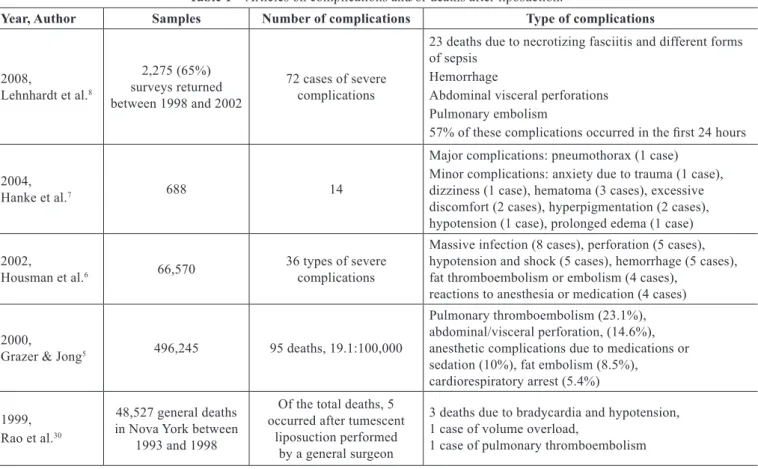
Grazer & Jong5 present a table of articles detailing the
highly variable incidence of mortality in liposuction: from 3 per 100,000 cases of elective abdominal wall hernia and up to 162 per 100,000 cases.
Teimourian & Rogers29 retrospectively studied 75,000
cases and report the incidence of complications to be >0.1%; the complications include severe venous throm-bosis, pulmonary thromboembolism, fat embolism, skin loss, anesthetic complications, cardiac arrhythmias, organ perforation, bleeding, and transfusion-related complica-tions. They reported that 2 patients died as a result of fat embolism and thromboembolism, with an incidence of 2.6 per 100,000.
Costa et al.10 describe the case of a Caucasian woman,
who underwent bilateral mastopexy, abdominal liposuction, and fat grafting in the gluteus; on the third postoperative day, she developed progressive dyspnea and dry cough without other symptoms and was hospitalized in the inten-sive care unit. Clinical examination revealed tachypnea, tachycardia, and hypoxia in room air without alterations in pulmonary auscultation; radiography showed minimal bila-teral interstitial infiltrate. The patient’s condition worsened on the second day of hospitalization with the development of respiratory acidosis and was intubated and placed on assisted ventilation. After several examinations, she was diagnosed with acute respiratory failure secondary to fat embolism syndrome. The patient’s condition improved after 8 days of intubation; she was then extubated and discharged after 1 month of hospitalization.
Although fat embolism is a rare complication of liposuc-tion, it has serious consequences and several cases have been reported. However, its symptoms are nonspecific and often underestimated because the exact risk of developing this complication after liposuction has not been established. Fat embolism syndrome is defined as the presence of 2 of the following 3 clinical symptoms in the first 48 hours after trauma: petechiae on the skin, pulmonary discomfort, and mental disorder. According to Costa et al.10, these findings
are defined according to the criteria of Gurd and Wilson and are used to aid diagnosis. According to Mentz14, a lesion
in the fatty tissues and blood vessels can occur during the li posuction procedure, causing a massive release of fat em boli into the bloodstream. After liposuction, the residual particles of fat globules and lipids in the treated area enter
the circulation. The fat particles and/or triglycerides that enter the venous circulation mechanically obstruct the pulmonary circulation or promote an inlammatory local reaction; in turn, these conditions trigger endothelial damage, causing pulmonary spasms, hemorrhage, edema, and pulmonary impairment. Emboli passing through the pulmonary circulation may damage the brain, kidneys, liver, and other or -gans, leading to further complications. The presence of fat droplets in both lung lavage and urine has been detected in fat embolism syndrome and is associated with symptoms such as tachycardia, tachypnea, elevated temperature, hy -poxia, thrombocytopenia, and neurological disorders. After suspected diagnosis, clinical support is the designated treat ment14.
The collected data are presented in Tables 1 to 3.
CONCLUSIONS
Liposuction is a highly effective procedure when well indicated and performed accurately. However the risks asso ciated with this surgical procedure need to be studied and understood in greater detail. We searched MEDLINE/ PubMed and selected 84 articles of interest addressing the complications of liposuction performed solely for esthetic purposes. Fat embolism is a major complication reported in the articles studied and has also been demonstrated in experimental studies. Therefore, it should receive more atten tion since it’s incidence after liposuction is relatively high regardless of whether it is associated with fat graf-ting. The experimental study of Franco et al.19 highlights
this potential risk; moreover, several other studies report patients that developed respiratory distress as a result of pul monary embolism.
The incidence of complications resulting from fat em -bolism in humans is still low, probably due to the lack of studies or difficulty in diagnosis, especially in cases with unclear clinical symptoms. The postoperative period follo-wing liposuction surgery in humans requires more atten-tion and a higher commitment of doctors who perform this procedure. Moreover, when diagnosed, these cases should be published in proper medical literature to further esta-blish the actual incidence and complications of fat mobi-lization, which are very evident in several experimental studies18-21. New studies emphasizing clinical significance
are needed as well as experimental research and clinical studies on this controversial issue; these studies will be of great interest for general population and surgeons who work in this area.
Table 1 – Articles on complications and/or deaths after liposuction.
Year, Author Samples Number of complications Type of complications
2008,
Lehnhardt et al.8
2,275 (65%) surveys returned between 1998 and 2002
72 cases of severe complications
23 deaths due to necrotizing fasciitis and different forms of sepsis
Hemorrhage
Abdominal visceral perforations Pulmonary embolism
57% of these complications occurred in the irst 24 hours
2004,
Hanke et al.7 688 14
Major complications: pneumothorax (1 case) Minor complications: anxiety due to trauma (1 case), dizziness (1 case), hematoma (3 cases), excessive discomfort (2 cases), hyperpigmentation (2 cases), hypotension (1 case), prolonged edema (1 case)
2002,
Housman et al.6 66,570
36 types of severe complications
Massive infection (8 cases), perforation (5 cases), hypotension and shock (5 cases), hemorrhage (5 cases), fat thromboembolism or embolism (4 cases),
reactions to anesthesia or medication (4 cases)
2000,
Grazer & Jong5 496,245 95 deaths, 19.1:100,000
Pulmonary thromboembolism (23.1%), abdominal/visceral perforation, (14.6%), anesthetic complications due to medications or sedation (10%), fat embolism (8.5%),
cardiorespiratory arrest (5.4%)
1999, Rao et al.30
48,527 general deaths in Nova York between
1993 and 1998
Of the total deaths, 5 occurred after tumescent
liposuction performed by a general surgeon
3 deaths due to bradycardia and hypotension, 1 case of volume overload,
1 case of pulmonary thromboembolism
Table 2 – Case reports.
Year, Author Type of complication Number of cases Evolution
2011,
Erba et al.11 Fat embolism syndrome 1 Multiple organ failure
2011,
Heinze et al.13 Necrotizing fasciitis
2 (one after liposuction,
one after trauma) Death
2010,
Kattapuram & Avery26
Ureteral injury in the ureteropelvic
junction 1 Surgical treatment with improvement
2010,
Park et al.24 Necrotizing fasciitis 1 Scar
2009,
Zandi28 Blindness 1 Loss of vision
2009, Choi & Shin9
Rupture of the iliac circumlex
deep artery 1
Artery embolization with good outcome
2008, Costa et al.10
Respiratory distress syndrome
due to fat embolism 1
Positive evolution after 1 month of admission
2006, Sharma et al.22
Intestinal perforation and
necrotizing fasciitis 1 Emergency surgery
2004,
Andrews et al.25 Herpes zoster affecting the skin 1
Table 3 – Experimental studies.
Year, Author Number of operated cases and type of animal Results
2011, Franco et al.19
30 rats divided into 3 groups: 1. control group, 10 animals 2. liposuctioned group, 10 animals
3. liposuctioned and fat-grafted group, 10 animals
• 6 (60%) cases of pulmonary fat embolism in liposuctioned and fat-grafted rats
• 3 (30%) cases of pulmonary embolism in liposuctioned rats
2009, Senen et al.21
40 rats divided into 5 groups of 8 each:
1. Tumescent procedure – organs harvested at 1 hour 2. Dry procedure – organs harvested at 1 hour 3. Tumescent procedure – organs harvested at 48 hours 4. Dry procedure – organs harvested at 48 hours 5. Control group
• Fat embolism Lungs
• 4 (50%) cases in group 1 • 8 (100%) cases in group 2 • 3 (37.5%) cases in group 3 • 3 (37.5%) cases in group 4 Kidneys
• 4 (50%) cases in group 1 • 8 (100%) cases in group 2 • 3 (37.5%) cases in group 3 • 5 (62.5%) cases in group 4 Liver
• 0 cases in group 1 • 2 (25%) cases in group 2 • 3 (37.5%) cases in group 3 • 0 cases in group 4 Brain
• 0 cases in group 1 • 6 (75%) cases in group 2 • 0 cases group in 3 • 0 cases group in 4 Skin
• 2 (25%) cases in group 1 • 0 cases in group 2 • 0 cases in group 3 • 0 cases in group 4 2006,
El-Ali & Gourlay18 13 rats, 3 of which were controls
• 10 (100%) cases of fat pulmonary embolism
• 1 (10%) case of cerebral embolism in the study group 2004,
Kenkel et al.20 10 pigs, 1 of which was a control
Fat embolism in the lungs and kidneys in all animals (100%), except the control
REFERENCES
1. Illouz YG. Body contouring by lipolysis: a 5-year experience with over 3000 cases. Plast Reconstr Surg. 1983;72(5):591-7.
2. Katz BE, Bruck MC, Coleman WP 3rd. The beneits of powered
lipo-suction versus traditional lipolipo-suction: a paired comparison analysis. Dermatol Surg. 2001;27(10):863-7.
3. American Society of Plastic Surgeons. Top 5 cosmetic procedures: statistics. Disponível em: http://www.plasticsurgery.org/Documents/ news-resources/statistics/2009-statistics/2009-top-5-cosmetic-sur-gery-procedures-graph.pdf.
4. Sociedade Brasileira de Cirurgia Plástica. Cirurgia plástica no Brasil. Pesquisa Datafolha 2009. Disponível em: http://www2.cirurgiaplastica. org.br/images/Docs/pesquisa2009.pdf.
5. Grazer FM, Jong RH. Fatal outcomes from liposuction: census survey of cosmetic surgeons. Plast Reconstr Surg. 2000;105(1):436-46. 6. Housman TS, Lawrence N, Mellen BG, George MN, Filippo JS,
Cer-veny KA, et al. The safety of liposuction: results of a national survey. Dermatol Surg. 2002;28(11):971-8.
7. Hanke W, Cox SE, Kuznets N, Coleman WP 3rd. Tumescent liposuction
report performance measurement initiative: national survey results. Dermatol Surg. 2004;30(7):967-77.
8. Lehnhardt M, Homann HH, Daigeler A, Hauser J, Palka P, Steinau HU. Major and lethal complications of liposuction: a review of 72 cases in Germany between 1998 and 2002. Plast Reconstr Surg. 2008; 121(6):396e-403e.
10. Costa AN, Mendes DM, Toufen C, Arrunátegui G, Caruso P, Carvalho CR. Adult respiratory distress syndrome due to fat embolism in the postoperative period following liposuction and fat grafting. J Bras Pneu mol. 2008;34(8):622-5.
11. Erba P, Farhadi J, Schaefer DJ, Pierer G. Fat embolism syndrome after combined aesthetic surgery. J Plast Surg Hand Surg. 2011;45(1):51-3. 12. Gravante G, Araco A, Sorge R, Araco F, Nicoli F, Caruso R, et al.
Pulmonary embolism after combined abdominoplasty and lank lipo-suction: a correlation with the amount of fat removed. Ann Plast Surg. 2008;60(6):604-8.
13. Heinze S, Püschel K, Tsokos M. Necrotizing fasciitis with fatal out -come: a report of two cases. Forensic Sci Med Pathol. 2011;7(3):278-82. 14. Mentz HA. Fat emboli syndromes following liposuction. Aesthetic Plast
Surg. 2008;32(5):737-8.
15. Sherman JE, Fanzio PM, White H, Leifer D. Blindness and necrotizing fasciitis after liposuction and fat transfer. Plast Reconstr Surg. 2010; 126(4):1358-63.
16. Terranova C, Sartore D, Snenghi R. Death after liposuction: case report and review of the literature. Med Sci Law. 2010;50(3):161-3. 17. Wessman DE, Kim TT, Parrish JS. Acute respiratory distress following
liposuction. Mil Med. 2007;172(6):666-8.
18. El-Ali KM, Gourlay T. Assessment of the risk of systemic fat mobiliza-tion and fat embolism as a consequence of liposucmobiliza-tion: ex vivo study. Plast Reconstr Surg. 2006;117(7):2269-76.
19. Franco FF, Tincani AJ, Meirelles LR, Kharmandayan P, Guidi MC. Occurrence of fat embolism after liposuction surgery with or without lipografting: an experimental study. Ann Plast Surg. 2011;67(2): 101-5.
20. Kenkel JM, Brown SA, Love EJ, Waddle JP, Krueger JE, Noble D, et al. Hemodynamics, electrolytes, and organ histology of larger-volume
liposuction in a porcine model. Plast Reconstr Surg. 2004;113(5): 1391-9.
21. Senen D, Atakul D, Erten G, Erdogan B, Lortlar N. Evaluation of the risk of systemic fat mobilization and fat embolus following liposuc-tion with dry and tumescent technique: an experimental study on rats. Aesthetic Plast Surg. 2009;33(5):730-7.
22. Sharma D, Dalencourt G, Bitterly T, Benotti PN. Small intestinal per-foration and necrotizing fasciitis after abdominal liposuction. Aesthetic Plast Surg. 2006;30(6):712-6.
23. Araco A, Zaccheddu R, Araco F, Gravante G. Methicillin-resistant superinfection of the wound after body-contouring abdominal surgery. Aesthetic Plast Surg. 2008;32(4):681-3.
24. Park SY, Jeong WK, Kim MJ, Lee KM, Lee WS, Lee DH. Necrotising fasciitis in both calves caused by Aeromonas caviae following aesthetic liposuction. J Plast Reconstr Aesthet Surg. 2010;63(9):e695-8. 25. Andrews TR, Perdikis G, Shack RB. Herpes zoster as a rare
complica-tion of liposuccomplica-tion. Plast Reconstr Surg. 2004;113(6):1838-40. 26. Kattapuram TM, Avery LL. Ureteral tear at the ureteropelvic junction:
a complication of liposuction. Emerg Radiol. 2010;17(1):79-82. 27. Ribeiro Monteiro ML, Moura FC, Cunha LP. Bilateral visual loss
com-plicating liposuction in a patient with idiopathic intracranial hyperten-sion. J Neuroophthalmol. 2006;26(1):34-7.
28. Zandi I. Blindness: a rare complication of liposuction: report of a case of unilateral blindness; notes on the effect of compassionate care. Plast Reconstr Surg. 2009;123(6):211e-2e.
29. Teimourian B, Rogers WB 3rd. A national survey of complications asso
-ciated with suction lipectomy: a comparative study. Plast Reconstr Surg. 1989;84(4):628-31.
30. Rao RB, Ely SF, Hoffman RS. Deaths related to liposuction. N Engl J Med. 1999;13;340(19):1471-5.
Correspondence to: Fernando F. Franco
State University of Campinas, Faculty of Medical Science, Department of Surgery, Plastic Surgery Course, Rua Tessália Vieira de Camargo, 126 – Cidade Universitária Zeferino Vaz – Barão Geraldo –