Brazilian Journal of Physics, vol. 34, no. 2B, June, 2004 659
Photophysics of Poly(p-Phenylene Vinylene) Films
M. Anni
1, G. Gigli
1, R. Cingolani
1, Y. Galv˜ao Gobato
2, A. Vercik
2, A. Marletta
3,
F.G. E. Guimar˜aes
4, and R. M. Faria
41
National Nanotechnology Laboratory, Dip. Ingegneria dell’Innovazione Universit`a degli Studi di Lecce, Via per Arnesano 73100 Lecce, Italy
2
DF–Universidade Federal de S˜ao Carlos, C.P. 676, 13565-905, S˜ao Carlos, SP, Brazil
3
FaFis–Universidade Federal de Uberlˆandia, C.P. 593, 38400-902, Uberlˆandia, MG, Brazil
4
IFSC–Universidade de S˜ao Paulo, C.P. 369, 13660-970, S˜ao Carlos, SP, Brazil
Received on 31 March, 2003
We report on time resolved photoluminescence (PLRT) measurements in poly(p-phenylene vinylene) (PPV) films irradiated by laser in the presence of air. We observe a PL intensity enhancement and a biexponential decay dynamics of PL signal for all irradiated films. These results can be understood in terms of a chain shortening process due to carbonyl incorporation and formation of an energy profile that extends and migrates into the film and enables efficient spectral diffusion of excited carriers to a non-degraded PPV segments by F¨orster energy transfer.
1
Introduction
Organic semiconductors such as poly(p-phenylene vinylene) (PPV) are of great interest due to their potential device ap-plications such as light-emitting devices and photocells [1-4]. Many of the photophysical processes underlying the photodegradation of luminescent polymer devices have been satisfactorily explained [1-4]. Models of photoluminescence (PL) decay dynamics [1,5,6] and photoluminescence exci-tation spectroscopy (PLE) [2,7-9] reveal details of carrier dynamics, quenching mechanisms and oxidation processes. The quenching process was accounted by attributing an ad-ditional non radiative decay channel to excitons [1-7]. This effect has been ascribed to the creation of carbonyl groups. However, PL intensity enhancement induced by a proper laser irradiation has been recently demonstrated in a PPV cast film [10]. This effect can be understood in terms of the chain shortening process due to carbonyl incorporation and formation of an energy profile that extends and migrates into the film and enables efficient spectral diffusion of excited carriers to a non-degraded PPV layer.
In this paper, we have studied time resolved photolumi-nescence in the picosecond time scale in poly(p-phenylene vinylene) (PPV) cast films upon laser irradiation in air with PL intensity enhancement. Several films of different thick-ness and different exposure times have been compared to fresh not irradiated samples. All the irradiated films show a biexponential decay dynamics with a fast non radiative pro-cess of about 50 ps and a longer decay time of about 250 ps. The PL efficiency is higher when the slow relaxation process is more important, thus indicating that the quick relaxation is non radiative. The radiative recombination importance
increases in some irradiated samples, despite the increased defect density, indicating that a transfer process to a pure region is occurring.
2
Experiment
The poly(xylylidene tetrahydrothiophenium chloride) cursor was synthesized following a precursor route pre-sented in Ref [11]. The precursor films were prepared by casting on hydrophobic substrates and were dried under vac-uum for 24 hours. PPV-cast films were obtained by a ther-mal conversion at 230◦C under vacuum for 2 hours. The samples thicknesses characteristics used in this work are 0.68µm (samples A1,A2,A3), 0.98µm (samples B1,B2,B3) and 1.51µm (sample C1,C2,C3). PPV-cast films were pho-toirradiated using a 458 nm Ar ion laser at several inten-sities under atmosphere conditions and room temperature. The PL spectra were recorded by a Spex 500M single spec-trometer. A Coherent Ar ion laser was used as excitation source and the PL signal was detected by a photo count-ing system connected to a thermoelectrically cooled R5108 Hamamatsu photomultiplier. In the time-resolved photolu-minescence experiments, the samples were excited by the second harmonic (390 nm) of a mode locked Ti-sapphire laser (Spectra Physics Tsunami) delivering 2 ps pulses at 780 nm. The measurements were performed under vacuum. The PL signal was dispersed by a 0.24m single monochro-mator coupled with a streak camera equipped with a two-dimensional CCD. The time resolution was about 10 ps.
660 M. Anniet al.
3.2 mm2. The PL measurements were performed to control the laser irradiation process for different films in air. The effects of the laser irradiation on time resolved photolumi-nescence have been studied in samples of different thick-ness and for different irradiation condition. The samples A1 (0.68µm), B1 (0.98µm), C1 (1.51µm) are non-irradiated samples. Samples A2 and A3 were irradiated during 35 min with laser intensities of 340 mW/cm2and 510 mW/cm2, re-spectively. Samples B2, B3 were irradiated with laser inten-sity of 340 mW/cm2during 37 min and 8 min, respectively. Samples C2 and C3 were also irradiated for laser intensity with 340mW/cm2during 3 min and 16 min respectively. To verify the effect of the ambient light, since all the samples used in this work were exposed to this condition, the PLRT measurements were carried out in the irradiated and non-irradiated sample centers and in a region protected by a mask (unmasked region).
3
Results and discussion
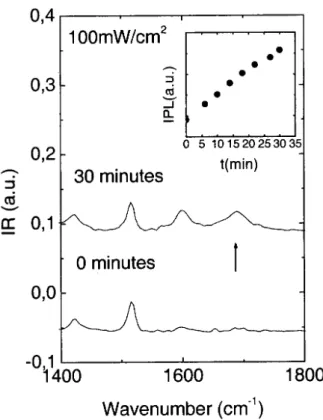
Figure 1 shows typical infrared spectra for the PPV film be-fore and after laser exposure. The insert displays the in-crease of the integrated PL intensity during the period of excitation. The increase of the infrared peak related to carbonyl group C=O stretch at 1690 cm−1 suggests that a photo-oxidative reaction with carbonyl formation occurs during the PL enhancement process.
Figure 1. Typical infrared spectrum before and after photo irradia-tion during 30 minutes at 100 mW/cm2. The insert shows the time dependence of PL integrated intensity.
The PL enhancement process depends strongly on the experimental constraints used, i.e., the ratiod/λobetween
sample thickness (d)and light penetration depth (λo), which
imposes a geometric limit for the defect formation and the carrier recombination [10]. The PL enhancement observed for film thickness d ≥ λo could be explained as follows.
As the oxidation is not oxygen limited, the film is not uni-formly oxidized. A carbonyl concentration profile is formed [7] following the laser intensity decay in accordance with the Beer-Lambert law. As a consequence of chain short-ening process, an inhomogeneous profile of PPV segments of different sizes is continuously generated from the inter-face air/polymer into the film. The electronic structure of smaller segments is modified through theπ-electron spatial localization, increasing the energy gap between theπ−π∗ states [12]. Thus, the exciton energy differs from site to site along the film and an energy profile following the excita-tion intensity decay is built during irradiaexcita-tion. This energy profile and the strong overlap of vibrational states enables the carriers to relax energy efficiently through F¨orster trans-fer mechanisms [1,9,13] towards sites of lower energy. This process favors the transfer of carriers to a non-degraded re-gion in the bulk [9,13]; once in the non-degraded rere-gion, the carriers are confined in a thin layer due to the slow diffusion process [1] between long conjugated segments. The fact that shape and spectral position of PL emissions do not change over the entire temporal range we have studied is a strong evidence of carrier diffusion to a non-degraded layer. For the case of thin films (d ≤λo), the degradation would
ex-tent across the whole film after the progressive migration of the degraded profile that reaches the interface film/substrate. The total PL emission begins to decrease as a consequence of the decrease of the effective absorption/emission thick-ness and of the recombination via carbonyl centers.
Brazilian Journal of Physics, vol. 34, no. 2B, June, 2004 661
to some variation in the molecular geometry, evidenced by the slight line-shape variation in the low energy part of the PL spectrum, due to an oscillator strength redistribution be-tween the different vibronic replicas of the 0-0 transition.
Figure 2. Time integrated PL spectra of samples A2, A3. The spectrum of sample A1 in the exposed to air region is reported as reference (continuous line).
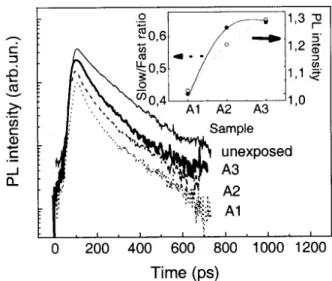
Figure 3. Transient PL dynamics at 550 nm of samples A1, A2, A3. The time resolved PL of sample A1 in a point not exposed to sun light is also reported (continuous line). The signal is multiplied for a normalization factor for clarity. Inset: Relative slow/fast relax-ation weight (dotted line) and integrated PL intensity normalized to the reference sample (A1exposed to air). The lines are guide for the eyes.
We have similar results for samples B and C. Sample B3 irradiated for 8 min at laser intensity of 340mW/cm2 presents an increase of PL intensity of 29% with a biexpo-nential PL decay with 60±3 ps and 200±5 ps decay times. The PL time constants are not affected by the irradiation but the importance of the slow relaxation increases again in the irradiated sample. The PL spectrum is slightly blue shifted by about 7 meV indicating that the effective con-jugation length in the emission region is increased. Sam-ple B2 shows a strongly quenched PL(-59%) together with
a biexponential decay dynamic with unchanged time con-stants but with a lower relative slow/fast relaxation weight of 0.32. This feature is again in agreement with your model, the defect density is high everywhere due to the longer irra-diation and then the excitation mainly decays trough defect trapping. We have also a correlation between the emission intensity and the slow/fast relative weight.
Samples C2 and C3, irradiated for laser intensity of 340mW/cm2 during 3 min and 16 min respectively, show a PL spectrum with a more resolved vibronic progression. The PL intensity slightly decreases (about 9 %) in sample C2 indicating that something is changing in the nature of the emitting specie, which could be a morphological change, or a geometrical change of the molecule, which changes the exciton phonon coupling. We also observe a biexponential PL decay with 46±1 ps and 235±7 ps decay times. Sample C3 is in agreement with the trend observed in the series A and B, the density of defects increases but a resonant trans-fer to the deep region of the film allows to obtain higher ef-ficiency and higher contribution of the slow decay process. This sample presents a biexponential PL decay with 60±1 ps and 210±7 ps decay times. A similar correlation between PL intensity and relative importance of the slow relaxation is observed.
4
Conclusions
In conclusion, we have studied the photophysics of photo oxidized conjugated polymers for films with thickness that exceed the excitation penetration depth. The irradiated sam-ples show a PL intensity increase despite the presence of photo-generated defects during the irradiation. We propose that these results can be explained in terms of the chain shortening process due to carbonyl incorporation and forma-tion of an energy profile that extends and migrates into the film and enables efficient spectral diffusion of excited carri-ers to a non-degraded PPV layer. This model is confirmed by transient photoluminescence measurements showing in all the irradiated samples a biexponential decay with a fast decay time of about 50 ps attributed to diffusion on defects and a slower decay time attributed to radiative recombina-tion. In all the irradiated samples we observe that the PL en-hancement is accompanied by a decrease of the importance of defects quenching. The decreased importance of the de-fect trapping despite the increased dede-fect density indicates that some competitive relaxation process is transferring the excitation in a defect free region.
Acknowledgements
The authors acknowledge the financial support from FAPESP, FAPEMIG, CAPES and CNPq (Brazil).
References
662 M. Anniet al.
[2] A. T. H. Koch, N. T. Harrison, N. Haylett, R. Daik, W. J. Feast, and R. H. Friend, Synth. Met. 100, 113 (1999). [3] S. M. Lipson, D. F. O’Brien, H. J. Byrne, A. P. Davey, and
W. J. Blau, Thin Solid Films 370, 262 (2000). [4] K. Tada, M. Onoda, J. Appl. Phys. 86, 3134 (1999). [5] M. Yan, L. J. Rothberg, F. Papadimitrakopoulos, M. E.
Galvin, T. M. Miller, Phys. Rev. Lett. 73, 744 (1994). [6] R. Kersting, U. Lemmer, R. F. Mahart, K. Leo, H. Kurz, H.
B¨assler, and E. O. G¨obel, Phys. Rev. Lett. 70, 3820 (1993). [7] N. T. Harrison, G. R. Hayes, R. T. Philips, and R. H. Friend,
Phys. Rev. Lett. 77, 1881 (1996).
[8] E. G. J. Staring, A. J. M. Berntsen, S. T. R. Romme, G. L. J. A. Rikken, and P Urbach, Phil. Trans. R. Soc. Lon. A 355, 695 (1997).
[9] M. C. J. M. Vissenberg, M. J. M. de Jong, Phys. Rev. B 56, 6681 (1997).
[10] Y. Galv˜ao Gobato, A. Marletta, R.M. Faria, F.E.G. Guimar˜aes, J.M. de Souza, and E.C. Pereira, Appl. Phys. Lett. 81, 942 (2002).
[11] A. Marletta, D. Gonc¸alves, O. N. Oliveira Jr., R. M. Faria, and F. E. G. Guimar˜aes, Adv. Mater. 12, 69 (2000).
[12] W. Z. Wang, A. Saxena, and A. R. Bishop, Phys. Rev. B 50, 6068 (1994).