Epidemiologic evaluation
of head and neck patients
in a university hospital of
Northwestern São Paulo State
Summary
Larissa de Melo Alvarenga1, MariangelaTorreglosa Ruiz2, Érika Cristina
Pavarino-Bertelli3, Maurício José Cabral Ruback4, José
Victor Maniglia5, Eny Maria Goloni-Bertollo6
1 Undergraduate Nurse.
2 Master’s degree in Biological Science, Biologist - Sao Jose do Rio Preto Medical School. 3 Doctorate in Biological Science, Adjunct Professor of Genetics - Sao Jose do Rio Preto Medical School.
4 Physician, Otorhinolaryngology and Head & Neck Surgery Specialist.
5 Associate Professor (livre-docente habilitation) of Otorhinolaryngology and Head & Neck Surgery.
[6] Associate Professor (livre-docente habilitation) of Human and Medical Genetics, Associate Professor (livre-docente) of the Genetics Discipline, Sao Jose do Rio Preto Medical School.
Address for correspondence: Faculdade de Medicina de Sao Jose do Rio Preto - FAMERP UPGEM - Unidade de Pesquisa em Genética e Biologia Molecular. Av. Briga-deiro Faria Lima 5416 Bloco U-6 São José do Rio Preto SP 15.090-000.
Scientific Initiation Scholarship - CNPq/PIBIC.
Paper submitted to the ABORL-CCF SGP (Management Publications System) on December 4th, 2006 and accepted for publication on August 11th, 2007. cod. 3543.
H
ead and neck cancer accounts for nearly 200.000 new cases worldwide. A mean of 13.470 new cases of cancer in the oral cavity for 100.000 inhabitants is observed in Brazil. Aim: To analyze clinical and epidemiological aspects in patients consulted in the Otorhinolaryngology and Head and Neck Surgery ward in a University hospital of Northwestern São Paulo, Brazil. Materials and Methods: A total of 427 patients consulted in the hospital in the period from 2000 to 2005 were investigated. The variables analyzed included: age, gender, occupation, skin color, tobacco and alcohol consumption, primary site of the tumor, clinical staging, degree of histological differentiation and outcome. The data was analyzed by descriptive and exploratory statistics. Results: Prevalence was found among men (86%), white color (90%), smokers (83.37%), and alcoholics (65.80%); the average age was 61 years, 24.25% of men were farmers and 60% of women, housekeepers. Primary site of tumor was usually in the oral cavity (35.37%), with histological squamous cell. The incidence of deaths was 164. Conclusion: This study has provided the profile of the patients assisted in this hospital; moreover, it has contributed to outline further programs for preventing this disease.Keywords: epidemiology, and neck neoplasia, tobacco and alcohol.
ORIGINAL ARTICLE
INTRODUCTION
Head and neck cancer is a collective term based on anatomical and topographic definitions for describing malignant tumors of the upper aerodigestive tract. This anatomical region comprises the oral cavity, the pharynx and the larynx. “Oral cancer” is one of the major subgroups of head and neck carcinomas; it involves the mucosa of the mouth (lips, base of tongue, tongue, floor of the mouth and the hard palate) and pharynx (oropharynx, hypopharynx and nasopharynx). About 40% of head and neck cancers occur in the oral cavity, 15% occur in the pharynx, 25% occur in the larynx and the remaining tumors occur in
other sites (salivary glands and thyroid)1. The most frequent
histological type, occurring in over 90% of cases, is the
squamous cell carcinoma.2
This disease is responsible for many deaths worl-dwide; it is the sixth cause of death by cancer. Each year approximately 200 thousand new cases of head and neck
cancer are diagnosed worldwide.3 In Brazil, estimates
in-dicate that there will be approximately 13,470 new cases of oral cavity cancer for each 100 thousand persons in 2008 (10,060 estimated in males and 3,410 estimated cases in females).4 The incidence of mouth cancer in Brazil is 2% of all cancers, one of the highest in the world, and
significant in Latin America.5 The estimated mortality rate
is approximately 12,300 deaths per year;6 the survival rate
is 40 to 50% for diagnosed patients.7,8
Epidemiological evidence shows that the incidence of head and neck cancer increases with age. In Europe, 98% of the patients are aged over 40 years.1 This type of tumor is rare in young patients, involving only 4 to 6% of persons aged below 40 years, although this incidence has
increased in a number of countries,9 The carcinogenetic
mechanisms in this age group are still little known.1,8,10
Smoking and alcohol drinking are well-established
risk factors for head and neck cancer.11 Although this form
of cancer affects mostly males, there has been a significant increase in the incidence in females, probably reflecting
changes in smoking and drinking habits.12
The aim of this paper was to describe the social and demographic profile of head and neck cancer patients at a university hospital, and to identify the risk factors (smoking and alcohol drinking) to support disease pre-vention programs.
SERIES AND METHOD
The Research Ethics Committee of our institution approved the research project (protocol 5566/2005).
A retrospective study was done of the medical files of head and neck cancer patients of the hospital Otorhinolaryngology Unit comprising six years between 2000 and 2005.
Variables were age, sex, occupation, skin color,
smoking and alcohol drinking habits, primary tumor site, clinical staging, histological differentiation, treatment and patient mortality.
Tumors were classified according to the anatomi-cal site in the mouth, the pharynx and the larynx. The oral cavity was divided into the lips, the anterior 2/3 of the tongue, the palate, the oral mucosa, the gingiva, the retromolar trigone and the hard palate. The pharynx was divided into the following three separate regions: the oropharynx (soft palate and uvula, the tonsils, and the lateral and posterior walls), the hypopharynx (piriform sinuses, hypopharyngeal wall, the postcricoid region and non-postcricoid areas), and the nasopharynx (lateral walls, choanae). The larynx is subdivided into the supraglottis,
the glottis and the subglottis.13
Tumor staging (TNM) was done according to the guidelines of the American Joint Committee on Can-cer (AJCC).14,15 Initially, the files of 427 patients were analyzed, but only 372 were TNM-staged.
Data were compiled in the software Microsoft Excel and analyzed by exploratory descriptive statistics.
RESULTS
Data were collected from 427 patients seen between 2000 and 2005.
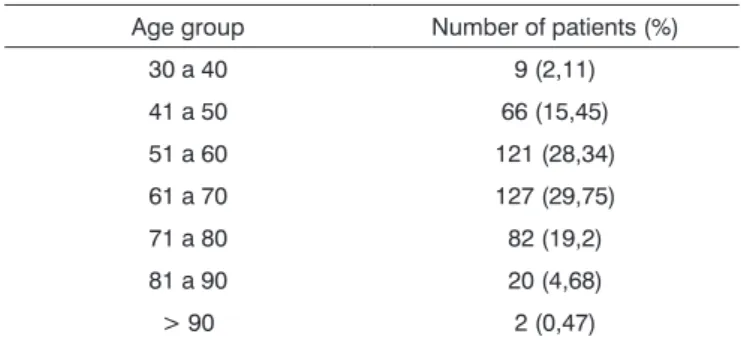
There were 367 male patients (86%) and 60 female patients (14%). Age ranged from 30 to 94 years (mean - 61.77 years; standard deviation - 11.44 years). Table 1 shows the age distribution of patients for each age group. Skin color was subdivided into two types (white and non-white). Non-white subjects were those with black, brown and oriental skin colors. In this study 90% of the subjects were white.
Table 1. Age distribution of head and neck cancer patients. Age group Number of patients (%)
30 a 40 9 (2,11) 41 a 50 66 (15,45) 51 a 60 121 (28,34) 61 a 70 127 (29,75) 71 a 80 82 (19,2) 81 a 90 20 (4,68) > 90 2 (0,47)
as to the previous occupation was reported by 8.17% of males and 15% of females (Table 2 and 3).
Smoking was a habit in 83.37% of the sample; 65.8% reported using alcoholic beverages; 55.27% of the sample reported having both habits; and 6.18% reported having neither habit. Quantities consumed were not do-cumented.
Table 2. Occupation of male head and neck cancer patients. Occupation of males Number of patients (%)
Grower 89 (24,25) Bricklayer 51 (13,9)
Driver 41 (11,17) Retired 30 (8,17) Shopkeeper 16 (4,36) Non-specialized services 13 (3,55) Carpenter 11 (3)
Painter 9 (2,45) Guard 9 (2,45) Other 98 (26,7)
Table 3. Occupation of female head and neck cancer patients. Occupation of females Number of patients (%)
Housewife 36 (60) Retired 9 (15) Grower 5 (8,3) Other 10 (16,7)
Table 4 shows the primary tumor sites in 427 pa-tients. The oral cavity had the highest rate, 35.37% (151 of the 427 cases).
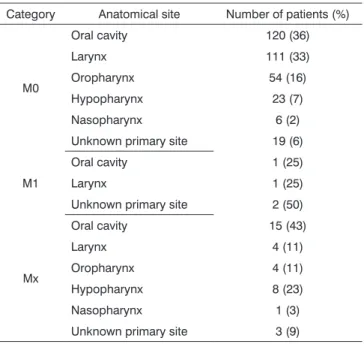
Tables 5, 6 and 7 present tumor staging according to the malignant tumor classification (TNM) and their fre-quency in the primary tumor sites. This information was not reported in the files in 55 cases.
Table 4. Primary anatomical site in head and neck cancer patients. Anatomical site Number of patients (%)
Oral cavity 151 (35,37) Larynx 133 (31,15) Oropharynx 69 (16,15) Hypopharynx 36 (8,43) Nasopharynx 8 8 (1,88) Unknown primary site 30 (7,02)
Table 5. Distribution of primary tumor anatomical sites according to the TNM classification (category T).
Category Anatomical site Number of patients (%)
T1
Oral cavity 26 (38) Larynx 26 (38) Oropharynx 9 (13) Hypopharynx 4 (6) Nasopharynx 3 (4)
T2
Oral cavity 39 (48) Larynx 27 (33) Oropharynx 11 (14) Hypopharynx 2 (2) Unknown primary site 2 (2)
T3
Oral cavity 32 (30) Larynx 38 (36) Oropharynx 17 (16) Hypopharynx 15 (14) Nasopharynx 2 (2) Unknown primary site 3 (3)
T4
Oral cavity 39 (41) Larynx 23 (24) Oropharynx 21 (22) Hypopharynx 10 (11) Nasopharynx 1 (1) Unknown primary site 1 (1)
Tx
Larynx 2 (9,5) Nasopharynx 1 (4,75) Unknown primary site 18 (85,75)
There was a predominance of squamous cell car-cinomas (SCC), which was present in 96.7% of cases. Other histological types were also found, such as non-Hodgkin’s lymphoma, undifferentiated carcinomas and others (Table 8).
Indications for radiotherapy or surgery generally balanced out for T1 and T2 tumors; most of the T3 and T4 tumors, however, required multimode treatment, usually surgery and adjuvant radiotherapy. On the other hand, other factors may have influenced somewhat the choice of treatment, such as age, professional voice users, un-controlled smoking or alcohol drinking, as well as social and economic factors that might have required short-term solutions. At our unit treatment includes surgery, chemo-therapy and radiochemo-therapy. Most of the patients underwent surgery associated with radiotherapy (33.25%).
DISCUSSION
Most of the subjects in our sample were aged betwe-en 51 and 70 years, which is similar to the data reported by the Head & Neck Unit of the Oncology Center, Oswaldo Cruz University Hospital, in the state of Pernambuco; their data shows that 55.82% of these tumors occur in this age
group.16
Our finding that there is a higher incidence of head and neck tumors in males is similar to existing reports in
the literature.2 Head and neck tumors are relatively rare
in females,17 particularly in developing countries, where
males predominate.18 In recent years there has been a
significant increase in the incidence of head and neck tu-mors in females, probably due to changes in smoking and
alcohol drinking habits.12 There were more rural workers
among males, and more housewives among females. A survey undertaken at the Head & Neck Surgery Unit of the Heliopolis Hospital in the state of Sao Paulo revealed that the most frequent occupation among males was that
Table 6. Distribution of primary tumor anatomical sites according to the TNM classification (category N).
Category Anatomical site Number of patients (%)
N0
Oral cavity 94 (40)
Larynx 87 (37)
Oropharynx 31 (13) Hypopharynx 15 (6) Nasopharynx 4 (2) Unknown primary site 2 (1)
N1
Oral cavity 25 (42)
Larynx 13 (22)
Oropharynx 13 (22) Hypopharynx 6 (10) Unknown primary site 3 (5)
N2
Oral cavity 12 (23)
Larynx 9 (17)
Oropharynx 12 (23) Hypopharynx 7 (13) Nasopharynx 3 (6) Unknown primary site 9 (17)
N3
Oral cavity 5 (21)
Larynx 6 (25)
Oropharynx 2 (8) Hypopharynx 3 (13) Unknown primary site 8 (33)
Nx Larynx 1 (33) Unknown primary site 2 (67)
Table 7. Distribution of primary tumor anatomical sites according to the TNM classification (category M).
Category Anatomical site Number of patients (%)
M0
Oral cavity 120 (36) Larynx 111 (33) Oropharynx 54 (16) Hypopharynx 23 (7) Nasopharynx 6 (2) Unknown primary site 19 (6)
M1
Oral cavity 1 (25)
Larynx 1 (25)
Unknown primary site 2 (50)
Mx
Oral cavity 15 (43)
Larynx 4 (11)
Oropharynx 4 (11) Hypopharynx 8 (23) Nasopharynx 1 (3) Unknown primary site 3 (9)
Table 8. Histological differentiation of head and neck cancer pa-tients.
Histological differentiation Number of patients (%) Squamous cell carcinoma (SCC) 413 (96,7) Non-Hodgkin’s lymphoma 3 (0,69) Undifferentiated carcinoma 3 (0,69)
Other * 8 (1,92)
* adenocarcinoma, cystic adenoid carcinoma, clear cell carcinoma, mucoepithelioid carcinoma, poorly differentiated carcinoma.
of bricklayer, with rural activities in sixth place; the most frequent occupation for females was that of housewife,
followed by rural activities.19 It should be noted that rural
work exposes individuals constantly to the sun and to
carcinogens, which helps promote cancer development.19,20
Another study done at the same hospital showed that about
85% of male and female patients were white.19 White was
also the predominant skin color in our sample (90%). Most of our patients were smokers (83.37%) and alcohol drinkers (65.8%), which strengthens the association between alcohol drinking and smoking and head and neck cancers.1 Many studies have shown a consistent relation between tobacco and alcohol, and cancer of the larynx
and oral cavity.1,21-23
The most frequent tumor site in our series was the oral cavity (35.37%), followed by the larynx (31.15%). Epidemiological studies have also reported that 40% of
finding appears to reflect smoking and alcohol drinking habits, which may increase two or threefold the risk of
these diseases in the oral cavity.9,11
The TNM classification of our series revealed that 25% of the cases were T3, 35.65% of the cases had lymph node involvement, and 2% presented metastases, showing that advanced disease was present upon the diagnosis. The literature reports that a high frequency of head and neck cancer cases are diagnosed at an advanced stage,24 as we ourselves also demonstrated. A Brazilian study, taking place in a developing country, shows statistically significant differences in these features compared to the findings of studies about patients from institutions in
de-veloped countries.17
The most representative histological type was the squamous cell carcinoma (96.7% of cases). Another study done in the state of Pernambuco has reported this type
as the most frequent.16 The literature shows that over 90%
of the cases of head and neck cancer are squamous cell
carcinoma.22
Open surgery and external radiotherapy are
fun-damental approaches to treat carcinomas.25 Radiotherapy
associated with surgery was the predominant approach in our series (33.25%), followed by radiotherapy only (28.10%). In another study, 528 out of 1,010 cases un-derwent surgery, 335 were treated by both surgery and radiotherapy, and 67 were treated by surgery, radiotherapy and chemotherapy.25 In our sample only 23 cases were treated with surgery associated with chemotherapy.
There were 164 deaths (38.4%) between 2000 and 2005. Head and neck cancer is characterized by local ag-gressiveness and by a high recurrence rate of secondary
tumors with a high mortality rate.10
High-risk populations should be targeted for educational and surveillance programs. These programs and measures can attenuate the unfavorable outcomes in patients with mouth cancer, and decrease the risk of developing secondary tumors.
CONCLUSION
The analysis of 427 patients seen at a university hospital between 2000 and 2005 is in agreement with data reported in the literature showing that head and neck cancer is more frequent in male smokers aged over 40 years. Medical data reveal that the primary site in most of the patients is the oral cavity. Identifying the risk factors for these patients may enable strategies for implementing prevention programs against this disease.
REFERENCES
1. Dobrossy L. Epidemiology of head and neck cancer: magnitude of the problem. Cancer and Metastasis Rev 2005;24:9-17.
2. Dedivitis RA, França CM, Mafra ACB, Guimarães FT, Guimarães AV. Características clínico-epidemiológicas no carcinoma espinocelular de boca e orofaringe. Rev Bras Otorrinolaringol 2004;70:35-40. 3. Walker DM., Boey G, Mcdonald LA. The pathology of oral cancer.
Pathology 2003;35:376-83.
4. Home Page:Instituto Nacional do Câncer. [citado em 2005 Nov]. Disponível em http://www.inca.gov.br.
5. Wunsch V. Epidemiologia do câncer de laringe no Brasil. Sao Paulo Med J 2004;122:188-94.
6. McMahon S, Chen AY. Head and neck cancer. Cancer and Metastasis Rev 2003;22:21-4.
7. Franceshi S, Bidoli E, Herrero R, Munoz N. Comparision of cancers of the oral cavity and pharynx worldwide: Etiological clues. Oral Oncol 2000;36:106-15.
8. Zender CA, Petruzzelli GJ. Why do patients with head and neck squamous cell carcinoma experience distant metastases: can they be prevented? Curr Opin Otolaryngol Head Neck Surg 2005;13:101-4. 9. Iamarrom A, Pattanaporn K, Pongsiriwet S, Wanachantararak SW,
Prapayasatok S, Jittidecharaks S, et al. Analysis of 587 cases of oral squamous cell carcinoma in northern Thailand with a focus on young people. Int J Oral Maxillofac Surg 2004;33:84-8.
10. Kim ES, Hong WK, Khuri FR. Chemoprevention of aerodigestive tract cancers. Annu Rev Med 2002;53:223-43.
11. Llewelly CD, Linklater K, Bell J, Johnson NW, Warnakulasuriua S. An analysis of risk factors for oral cancer in young people: a case-control study. Oral Oncol 2004;40:304-13.
12. Bradley PJ, Raghavan U. Cancer presenting in the head and neck during pregnancy. Curr Opin Otolaryngol & Head Neck Surg 2004;12:76-81.
13. Lee KJ. Essential otolaryngology: head e neck surgery. 8th ed. New Haven (Connecticut): McGraw-Hill; 2003.
14. Instituto Nacional do Câncer. UICC- União Internacional Contra o Câncer, 2002 - TNM - Classificação de Tumores Malignos 6ª. Edição. Ministério da Saúde. Rio de Janeiro: INCA 2004.
15. Greene FLPD, Fleming ID, Fritz A, Balch CM, Haller DG, Morrow M. AJCC Cancer Staging Manual 6 ed. Springer (NY), 2002.
16. Antunes AA, Antunes AP. Estudo retrospectivo e revisão de literatura dos tumores dos lábios: experiência de 28 anos. Rev Bras Cancero-logia 2004;50:295-300.
17. Carvalho AL, Bruvanesh S, Spiro RH, Kowalski LP, Shah JP. Cancer of the oral cavity: a comparison between institutions in a developing and a developed nation. Head Neck 2004;26:31-8.
18. Stewart BW, Kleihues P. World Cancer Report, WHO International Agency for Research on Cancer, IARC Press, Lyon, 2003.
19. Carvalho MB, Lenzi J, Lehn CN, Fava AS, Amar A, Kanda JL, Walder F, Menezes MB, Franzi AS, Magalhães MR, Curioni OA, Marcel R, Szeliga S, Sobrinho J, Rapoport A. Características clínico-epidemiológicas do carcinoma epidermóide de cavidade oral no sexo feminino. Rev. Assoc Med Bras 2001;47:208-14.
21. Ahrendt SA, Chown JT, Yang SC, Wu L, Zhang M-J, Jen J Sidransky D. Alcohol consumption and cigarette smoking increase the fre-quency of p53 mutations in non-small cell lung cancer. Cancer Res 2000;60:3155-9.
22. Casiglia J, Woo SB. A comprehensive review of oral cancer. Gen Dent 2001;49:72-82.
23. Zain RB. Cultural and dietary risk factors of oral cancer and precancer - a brief overview. Oral Oncol 2001;37:205-10.
24. Herchenhorn D, Dias FL. Avanços no tratamento quimioterápico e radioterápico do câncer de cabeça e pescoço. Rev Hosp Clin Fac Med São Paulo 2004;59:39-46.
25. Filho FSA, Sobrinho JA, Rapoport A, Ferreira NN, Juliano Y. Paradig-ma da disseminação linfática no carcinoParadig-ma espinocelular da base de língua. Rev Col Bras Cir 2006;33:79-83.