Tool and ideological knowledge in Street Outreach Office working process
* Extracted from the dissertation “Saberes ideológicos e instrumentais dos proissionais que atuam no Consultório na Rua: subsídios para a elaboração de uma funcionalidade no prontuário eletrônico”, Graduate Nursing Program, Master’s degree, Universidade Federal do Paraná, 2015. 1 Secretaria Municipal da Saúde de Curitiba, Departamento de Atenção Primária, Curitiba, PR, Brazil.
2 Universidade Federal do Paraná, Departamento de Enfermagem, Curitiba, PR, Brazil.
3 Universidade Federal do Paraná, Departamento de Saúde Comunitária, Curitiba, PR, Brazil.
ABSTRACT
Objective: To identify ideological knowledge and tool knowledge that provide support to the Street Outreach Oice working process. Method: Qualitative and exploratory research. Twenty Street Outreach Oice professionals and six users collected the data, applying diferent semi-structured interview schedules for each category of participants. he resulting categories were analyzed in light of tool and ideological knowledge presented in the working process. Results: From the participant discourses the following ideological knowledge emerged: public policies and the needs of the person in a street situation and tool knowledge, as well as devices and tools for the care of people in street situations and a weekly schedule. Conclusion: he focus on the working process discourse, supported by ideological knowledge, was veriied. he structural dimension of the objective reality of the population in street situations was perceptible in the social determination of being situating on the street. When daily situations were revealed, the limitations to be overcome in the working process context were noticed.
DESCRIPTORS
Homeless Persons; Primary Health Care; Patient Care Team; Health Personnel; Qualitative Research.
Tool and ideological knowledge in Street
Outreach Office working process*
Saberes ideológicos e instrumentais no processo de trabalho no Consultório na Rua Saberes ideológicos e instrumentales en el proceso laboral en el Consultorio en la Calle
Maria Terumi Maruyama Kami1, Liliana Muller Larocca2, Maria Marta Nolasco Chaves2, Laura Christina Macedo
Piosiadlo2, Guilherme Souza Albuquerque3
How to cite this article:
Kami MTM, Larocca LM, Chaves MMN, Piosiadlo LCM, Albuquerque GS. Tool and ideological knowledge in Street Outreach Office working process. Rev Esc Enferm USP. 2016;50(3):440-447. DOI: http://dx.doi.org/10.1590/S0080-623420160000400010
Received: 03/08/2016 Approved: 04/05/2016
ORIGINAL ARTICLE DOI: http://dx.doi.org/10.1590/S0080-623420160000400010
Kami MTM, Larocca LM, Chaves MMN, Piosiadlo LCM, Albuquerque GS
INTRODUCTION
In Brazil, there is a substantial and increasing number of people in street situations (PSS), with varied lifestyles and relationships with and on the street. his reality implies structural challenges in order to ensure citizenship for this population in the context of social invisibility.
In this multicenter study entitled “National Survey on Populations in Street Situations”(1), conducted in 71 Brazilian cities in the year 2008, it was estimated that 31,922 adults were in this situation. In Curitiba, 2,776 people in street situations were identiied(1).
People in street situations have diiculty accessing ben-eits guaranteed by public policies, including health care resources(2-3). In order to facilitate access to the health care system, the Street Outreach Oice (CR – its acronym in Portuguese), in conformity with the guidelines deined by the National Primary Health Care Policy (PNAB – its ac-ronym in Portuguese), was created to serve as the entrance for health care services, providing longitudinal and full at-tention, coordinating care and health care provision to the population in street situations in loco, or in other points of the health care network(4).
People living on the streets are exposed to risks that re-quire a speciic approach from health teams for this popula-tion. Since it is an innovative proposal for providing care to people in street situations, the work carried out by the CR team (CRT) shows aspects that were not totally revealed by other authors(5).
he health care working process can be unfolded in terms of purpose, means, tools, and subject, in which two kinds of knowledge are put forward: tool knowledge and ideological knowledge(6).
herefore, the current study aims to identify the ide-ological and tool knowledge that subsidizes the Street Outreach Oice working process.
his objective is justiied because the format of the CRTs is heterogeneous, and because it is necessary to pro-vide visibility to the product that was changed by the action of these agents. Taking into consideration the particularities of the street population, it is fundamental to qualify infor-mation management. hese are the elements that have led to the following basic question: Which knowledge subsides the Street Outreach Oice’s working process?
METHOD
Qualitative and exploratory research was conducted in four CR teams in the city of Curitiba. Twenty CRT profes-sionals registered in the National Health Facility Census and six CR users took part in the study. Selected partici-pants signed an informed consent form (IC).
Regarding the users treated by the CRTs, the inclusion criterion applied were the key informant interview, with the following characteristics: referred by CRT professionals and having received assistance by the CRT within a period of 30 days prior to the interview.
All CRT professionals who were on vacation or on leave during the scheduled period were excluded.
Regarding the key informants, those under 18 years of age, those with signs of legal drug use, and those under the inluence of medications or illicit drugs during interview were also excluded.
To maintain the transparency of the data collecting process, aiming at assuring the accuracy, comprehen-siveness, and credibility of the study, the consolidated criteria for qualitative research in the health care ield proposed by Tong, Sainsbury, and Craig, in an article entitled Consolidated criteria for reporting qualitative re-search (COREQ): a 32-item checklist for interviews and focus groups(7) were followed.
Data collection was carried out from January to February of 2015, through audio recorded interviews with semi-structured schedules diferent for each category of participants. he interviews were conducted with leading questions constructed by the author herself.
Regarding the professionals, the purpose was to learn in detail about the typical weekly work at the CR. herefore, the participants were asked to talk about the facilities and the diiculties they face at work. he inter-views were previously scheduled by phone call and lasted 15 to 37 minutes.
he interviews with CR users, characterized as key in-formants, were carried out through active search, varying from six to 22 minutes in duration. he aim was to identify the situations in which they sought out the CR service, and to verify other issues related to their conditions in terms of living on the streets.
After transcribing and printing the interviews, a new meeting was scheduled with CRT professionals for verii-cation and validation of the transcribed discourses. It was not possible to carry out this step with the users because the researcher was unable to locate them during the period available for data collecting.
After the transcription and validation stages of the interviews, the material was analyzed using the soft-ware IRAMUTEQ (Interface de R pour les Analyses Multidimensionnelles de Textes et de Questionnaires). he use of speciic software for helping with textual data analysis has becoming increasingly common in Human and Social Sciences qualitative studies(8-9).
Applying the Descending Hierarchical Classiication (DHC) allowed a lexicographic analysis of the textual ma-terial (corpus), providing contexts (lexical categories) charac-terized by their terminology and textual segments that share this vocabulary. he corpus-based study (professionals and users) was considered separately.
Data were analyzed according to the theoretical frame-work adopted for this study (frame-working process) and the categories previously deined: ideological knowledge and tool knowledge.
Tool and ideological knowledge in Street Outreach Office working process RESULTS
CR pRofessionals
he corpus of this segment consisted of 20 interviews, which led to four diferent lexical categories. Analyzing
the textual segments of these categories according to the theoretical framework adopted, the ideological knowl-edge (Chart 1) and the tool knowlknowl-edge (Chart 2) pre-sented in the working process of the CR professionals were understood.
Chart 1 – Ideological knowledge evidenced by the discourses of CR professionals – Curitiba, PR, Brazil, 2016
Category Sub-category Text segment
Category 1
Public policies that guides the CR
T w
ork
Access to health
(…) what we have seen is some speciic issues within the Health Department itself,for example Health Units somewhat resistant to provide service, red tape issues when handling legal documents for this population. (P 12) (…)however, in Primary Care, I believe there is more work to be done. In some cases, the Primary Care team doesn’t understand that the homeless belong to Primary Care; in the FHCS it is easier. (P 02)
Health as constitutional right
(…) maybe our job has to do with social inclusion, bringing into the Health Unit a person in street situation that has the right to be assisted. (P 01) (…) to ensure the care, responsibility must be given to and shared between the Health Unit and the Street Outreach Ofice team, that people in street situation have their rights, regardless of not having a ixed address. (P 19)
Intersectoral work
(…) so this patient had a pending litigation and we advised him to seek the public defender; there they would not arrest him. We send them everywhere; the Street Outreach Ofice is not just about health. (P 11)
(…) one problem we also have has to do with the issue of intersectoral lows that have not been established yet—undocumented people, red tape in the hospitals. (P 01)
Category 3 PSS needs
Natural needs
(…)sometimes they have a broken bone and don’t seek assistance. We guide them. Yesterday the girls took a patient with a broken bone to the Hospital Cajuru emergency room. (P 18) (…) the person stays there for two, three days, and then runs away from the hospital looking for alcohol or drugs, and this is very sad because they suffer from serious clinical complications: heart complications, lung complications. (P 10)
Chart 2 – Tool knowledge evidenced by the discourses of CR professionals – Curitiba, PR, Brazil, 2016
Category Sub-category Text segment
Category 2
Tools and devices for PSS caring
Teamwork
(…) I think the working process is the Street Outreach Ofice’s greatest asset, due to its multi-professional approach. As a result, according to a given situation, a multi-professional takes more responsibility than the other; the team has to be tuned up. (P 16)
(…) this means that you can be the best specialist in your area, but in a multidisciplinary scenario the professional has dificulties sharing the care. (P 19)
Relationship
Several examples were given showing that the relationship is built gradually, but if one word is expressed untimely by a member of the team, the entire team can end up losing this relationship. (P 14)
(…) when we get the data from the homeless. We simply don’t approach them asking their names right away, so it takes a lot of time to get the data from this person (…) a lot of time is like this, in the irst meeting, in the second meeting, no one asks “What’s your name?”, “Good morning! My name is J., I’m a psychologist and work for the Street Outreach Ofice. How can I call you?” (P 01)
Registration
We have to go from room to room looking for a place for registering, so we really need a sort of a mobile unit. (P 04)
(…) the approaches we carry out with patients that we don’t have a relationship yet. In other words, we don’t even know the name of the homeless person being assisted and, in order to register this service, we have to start with the name of the patient irst. So our work becomes invisible. (P 19)
Health planning (…) we discuss cases that lasted a week, those [where] we had some dificulties. Then we discuss, gather everyone’s opinion, and make a memo. (P 05)
Category 4 W
eekly
sc
hedule Weekly schedule
(…) On Monday afternoon we have a staff meeting for work planning and evaluation. On Monday morning we visit the same main points. We have a weekly schedule, so on Mondays we actually hit the streets. (P 17)
CRT useRs
he corpus, consisting of six interviews, generated six categories of text segments diferent from one another. Categories 2, 3, 5, and 6 were not considered, since such
Kami MTM, Larocca LM, Chaves MMN, Piosiadlo LCM, Albuquerque GS
DISCUSSION
herefore, it became clear that the circumstances in which the person in a street situation sought out the CR service were varied, as well as how the issues related to their living on the street conditions were diferent.
Learning about the reality of the working process in the CRTs, through the discourses of professionals who are part of the teams and from its users, allowed identifying the tools and ideological knowledge presented in the practices these
workers undertake. his knowledge is more than converting tools about subject: it is about constructive elements of the working process(6).
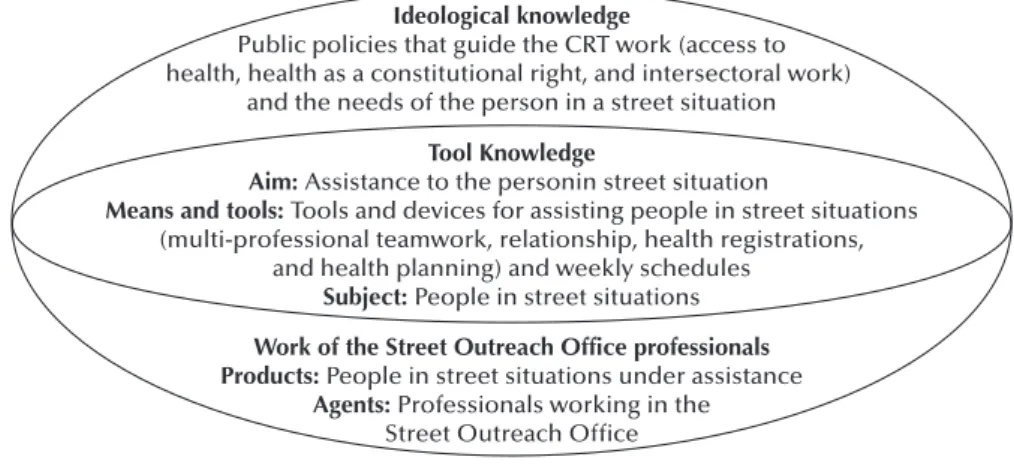
he ideological knowledge is based on theoretical health work and legislative principles in themselves, including their agents and products(6), in this study case, profession-als working in the CR and the assisted PSS, respectively. Figure 1 shows the tools and ideological knowledge drawn from the discourses.
Chart 3 – Ideological knowledge evidenced in the discourses of CR users – Curitiba, PR, Brazil, 2016
Category Text segment
Category 1
Natur
al needs
Look, the Street Outreach Ofice assisted me about three times, only in these last few days. The last time it was because of a pain in my arm and they took me to Hospital Cajuru. My arm was actually broken. (U 1) I have been treated two or three times, I’m not sure, but with alcohol issues and dentist, too (…). The doctor here at the Street Outreach Ofice referred me to CAPS, (U 4)
I have been treated by the Street Outreach Office several times. They put some bandage on my foot. It was hurting a lot after a street fight: I tried to protect myself with my foot and something got in the sole of my foot. (U 6)
Category 4 Basic needs
When I was almost winning, I got a kick in my belly and the baby died. They fought against me. I drink a lot; living on the street is very sad. (U 3)
(…)two weeks that I’ve been here in the CAPS I was referred by the Street Outreach Ofice. I got better, got my mind a bit balanced, in my memory. I want to go back to work. (U 2)
The Street Outreach Ofice should [have] sent him to another place, because he’s willing to sober up, he has strength for that (…) I’m living on the street since I separated (…), (U 5)
(…) I never like studying: I managed to get to the ifth grade only. Then, my mother die[d], and I never got back to school. (U 6)
Ideological knowledge
Public policies that guide the CRT work (access to health, health as a constitutional right, and intersectoral work)
and the needs of the person in a street situation
Tool Knowledge
Aim: Assistance to the personin street situation
Means and tools: Tools and devices for assisting people in street situations (multi-professional teamwork, relationship, health registrations,
and health planning) and weekly schedules
Subject: People in street situations
Work of the Street Outreach Office professionals Products: People in street situations under assistance
Agents: Professionals working in the Street Outreach Office
Source: Adapted from Egry(6)
Figure 1 – Working process constructive elements of Street Outreach Office professionals, according to the tool and ideological knowledge – Curitiba-PR, 2015.
From the respondents’ discourses a tool and ideological knowledge emerged. heir work centrality was particularly aimed at public policies that guide CRT work (access to health, health as a constitutional right, and intersectoral work), as well as the needs of the person in a street situation, which was categorized as ideological knowledge.
his result suggests that the social determination to live on the street was structural, which explains the structural dimension of the objective reality of these workers and users, and these issues not only afect the social structure but become more evident than the organization of the CR service itself. hese indings difer from a study conducted with nurses working in the epidemiology hospital units in a capital located in southern Brazil, in which the centrality
of the discourses of the nurses on tool knowledge related to the working process were veriied(11).
In the working process of CRT professionals, supported by ideological knowledge, the access to health by the popu-lation in street situations was one of the important top-ics raised by the participants’ discourses. Access is one of the Primary Health Care’s (PHC) main attributes(12). he creation of the CRT in the surveyed city is in conformity with the National Policy for Population in Street Situations, supported by the National Primary Care Policy references and guidelines. herefore, the CR aims to increase access to health services to the population in street situation.
Tool and ideological knowledge in Street Outreach Office working process showed by Health Care Units (HCU) professionals in pro-viding assistance and receiving the PSS, which was simi-lar to the results of a study conducted in the countryside of the state of São Paulo: the authors observed that PHC professionals collectively raised questions that thwart the efective services provided to the PSS, practically excluding this possibility(13).
As an organizational barrier, the current format of health services was pointed out. his a factual situation despite the city having a normative ruling in which the PSS may regis-ter in the HCU of his/her own choice, without the need to provide a ixed address or even a photo ID, since he/she is entitled to use just his/her social name. his result shows that access to the health system is an example where the legality of the proposal does not guarantee its implementation(14-15).
Another limitation to HCU access is the failure of HCU professionals to acknowledge that the PSS has rights. he ideological and political conception of the Brazilian Sanitary Reform movement claimed that health was not an exclusively biological issue under the responsibility of the health services, but rather a social and political issue that must be addressed in the public arena: in other words, health is not seen as a right of citizenship(16).
his aspect is the key point for the efectiveness of ac-cess, because both the professional and the user must be considered as part of the Uniied Health System (SUS). In order to achieve social justice, it is necessary to have equality in the organization of health services(17).
Although the SUS, as public policy, had been formu-lated under the perspective of universal access, social jus-tice, and equality regarding the health care needs of the population, the equality concept should stand out “even if it has not be mentioned by the health legislation, for it is considered one of the elements of justice”(17).
However, there is still a limited understanding about the concept of equality and the initial resistance towards its implementation as a criterion for the elaboration of public guidelines(18). he creation of public policies aimed at population in street situations is somewhat recent and, in the hard reality that the major Brazilian cities face, the PSS in general does not have access to the SUS(3). Within the context of reducing health access inequalities, the study suggested that the SUS could promote equality from the point of view of ethics and justice, without compromising its universal and egalitarian aspects(18).
It is important to strengthen the work of the CRTs, be-cause these are tools capable of drawing attention to related public health and policies, through interventions that allow adjustments in the environment in which the PSS belongs. Analyzing the PHC structure in the city, the respon-dents airmed that the HCU with Family Health Care Strategy (FHCS), when compared to traditional HCU, received them better. In a study on the presence and exten-sion of the PHC attributes in the city of Curitiba, which compared traditional HCS with FHCS HCU, the results showed that the FHCS had a higher presence and better extension of attributes than the PHC. However, accessibil-ity was the attribute with a lower mean score, despite better
results in the units with FHCS(19). he accessibility attribute showed a lower score in a study conducted in Canada as well(20). hese results indicate that users’ access to health care still faces some barriers to be overcome.
Among the issues raised about the CR work, several pro-fessionals mentioned advances and challenges in this area, emphasizing the importance of intersectoral work as a nec-essary condition for dealing with PSS’ complex demands.
Intersectoral action is deined as the alignment of in-tervention strategy and resources among players from two or more sectors at the public level, in order to reach addi-tional objectives that are relevant to and valued by all par-ties. Health is a product of daily life and, therefore, it goes beyond the exclusive boundaries of health sector practice(21).
he ideological knowledge, the needs of PSS, having as reference the concepts of needs under the collective health perspectives, and based on the typology of needs(10), as well as the comprehensiveness of the discourses from CRT pro-fessionals in this category, evidenced acknowledgment in the area of natural needs – in other words, related to pres-ervation and perpetuation of life.
he abusive use of alcohol and other drugs by the PSS was reported by several professionals, and it was conirmed by CR users.
Living on the streets increases the risk of substance abuse. Such behavior is common among this population, and it was addressed as a way of mitigating the perception on breakdowns and losses sufered, and as a means for es-tablishing closer ties with other PSS(3).
While serving as a health service network reference for the population in street situations, the CR is also involved in issues related to infectious diseases – such as STDs/HIV/ AIDS and tuberculosis – as fully explained in conversations with CRT professionals.
he prevalence of HIV among populations in situations of risk within hosting institutions in São Paulo was 4.9% (e.g., 17.4% were seropositive for syphilis), and 55.4% had access to preventive actions(22). As the CRTs provide care to this group, questions related to sex life and exposure to STDs/AIDS, including diagnosis and treatment of theses illnesses, must be addressed by professionals(3).
he treatment of HIV/AIDS infection is protected by Law number 9.313/96, which regulates universal access to antiretroviral therapy (ART). In order to be eligible for these treatments, the irst request from the HCU is reg-istration: the user must have, in addition to a referral for treatment, a photo ID issued by the public agency(23).
Under this adversarial context, CRT professionals face diiculties with follow-ups and adherence to the treatment. Users without IDs cannot obtain ART dispensation due to the criteria already mentioned.
Kami MTM, Larocca LM, Chaves MMN, Piosiadlo LCM, Albuquerque GS
Similar to natural needs, basic needs are socially deter-mined(10). A study conducted with women in street situa-tions in São Paulo revealed that the most common forms of violence were amongst themselves on the streets – for having debts with drug dealers, ighting for space, and petty theft – as what motivated them most(24).
According to the typology of needs(10), only one dimen-sional category in the discourse of CR profesdimen-sionals was observed. On the other hand, it was possible to identify two categories in the discourse of the CR users.
he result suggests that the professional point of view is a “biologicizing” view of care, even though it had the con-ception that the way people live on the street determines their health status, and that the population in street situ-ations see their needs diferently from what a professional might see.
As for tool knowledge, the multidisciplinary teamwork was considered to be the decisive factor for the CR working process. It represents the potential for resolute interven-tion on health care, when the aim is to promote integrainterven-tion among professionals and with users(25). According to other studies, the presence of a multidisciplinary team serve as a facilitating element for the care of PSS(24,26-27).
From this perspective, the need for investment in spe-cialized professionals with training in Mental Health and Collective Health, to join the teams working in the CRs(26), and the need for implementing practices that cause an im-pact on the processes for determining undesired health re-alities in our society, were pointed out(28).
One of the practices used to meet the demands of PSS that took into consideration the speciicities of working in the Street Outreach Oice was the construction of relation-ships between professionals and users, a practice considered essential and necessary by the respondents. he emphasis on the relationship with health care practices has been acknowledged by several studies on population in street situations(24,26-27). In this study, the focus was on building relationships and trust-based relations between CRT pro-fessionals and users, which would enable meeting the users’ needs and their inclusion in the HCU.
However, training and maintaining the relationship have been reported as demanding and tenuous, and these factors remain a challenge for the CRTs. he complex na-ture of building relationships is related to the social invis-ibility characteristic of this group, making the PSS more re-luctant to participate, and thus enhancing the fragile nature that involves this kind of approach. Several aspects have an inluence on the relationship between the subjects involved in the CR, such as experience, knowledge, and access to available resources. he relationship, by itself, leads to brief responses, and not to a qualitative change in people’s lives(29).
Because the team is itinerant, the availability of portable electronic devices, such as tablets or notebooks, was viewed as a troublesome element for recording possible activities to be included in the records, according to respondent conir-mation (P 04), followed by poor HCU infrastructure, which lacks rooms and computers.
Monitoring practices as well as evaluation of the actions carried out by the team that subsidizes health planning are directly related to the record-keeping information about the work. In the CRTs, such practices are associated with the organization of the working process, based on diagnosis of the territory, PSS’ needs, and identiication of problems in the teams’ everyday lives.
For a typical work week, the respondents reported us-ing a weekly activities calendar, based on the implemented planning and the time for approaching the PSS in loco in diferent working shifts.
Finally, the practices presented by the CR professionals correspond to the indings of the authors(30), which empha-size the pursuit of a form of care that covers the principles of universality, equality, and quality, because there is no single health care format possible.
CONCLUSION
his study has enabled the identiication of tool and ideological knowledge that make up the working process of the Street Outreach Oice’s professional teams.
According to the adopted framework, the centrality of the discourses was in the working process, supported by ideological knowledge. he structural dimension of the ob-jective reality of the population in a street situation was vis-ible in the social determination of situating the process on the street, to the extent that it corresponded with the pre-dominant demand expressed by the respondents’ discourses (CR professionals and users). Consequently, in the work-ing process, the ideological knowledge stood out more than the CR organization itself as a care scenario, although this multi-professional team and the itinerant working format are still a recent concept.
he PSS cannot count on the PHC as his/her entrance door to the system, whether due to diiculties accessing it, as evidenced by the aspects related to the resistance of HCU professionals in assisting the PSS, or due to issues related to organizational barriers and the unavailability of ART mediations.
As these daily work contradictions are unveiled, the limi-tations to be overcome at the CRT working level are noticed. In order to move forward towards comprehensive care, it is up to the city government and workers to take the respon-sibility for reorganizing the health care model through the implementation of the PHC’s guiding principles.
RESUMO
Tool and ideological knowledge in Street Outreach Office working process
As classes resultantes foram analisadas à luz dos saberes ideológicos e instrumentais presentes no processo de trabalho. Resultados: Dos discursos dos participantes emergiram os saberes ideológicos: políticas públicas e necessidades da pessoa em situação de rua e os saberes instrumentais: dispositivos e instrumentos no cuidado à pessoa em situação de rua e agenda semanal. Conclusão: Constatou-se a centralidade dos discursos no processo de trabalho, sustentado pelos saberes ideológicos. A dimensão estrutural da realidade objetiva da população em situação de rua foi perceptível na determinação social do situar-se na rua. Ao descortinar contradições no cotidiano, apontam-se limites a serem superados no âmbito do processo de trabalho.
DESCRITORES
Pessoas em Situação de Rua; Atenção Primária à Saúde; Equipes de Assistência ao Paciente; Pessoal de Saúde; Pesquisa Qualitativa.
RESUMEN
Objetivo: Identiicar los saberes ideológicos e instrumentales que subsidian el proceso laboral en el Consultorio en la Calle. Método: Investigación cualitativa y exploratoria. La recolección de datos fue llevada a cabo con 20 profesionales y seis usuarios del Consultorio de la Calle de un municipio del sur de Brasil, mediante entrevistas con guiones semiestructurados distintos para cada categoría de participantes. Las clases resultantes fueron analizadas a la luz de los saberes ideológicos e instrumentales presentes en el proceso laboral. Resultados: Desde los discursos de los participantes emergieron los saberes ideológicos: políticas públicas y necesidades de la persona en situación de calle y los saberes instrumentales: dispositivos e instrumentos en el cuidado a la persona en situación de calle y agenda semanal. Conclusión: Se constató la centralidad de los discursos en el proceso laboral, sostenido por los saberes ideológicos. La dimensión estructural de la realidad objetiva de la población en situación de calle fue perceptible en la determinación social de ubicarse en la calle. Al desvelar contradicciones en el cotidiano, se apuntan los límites que superar en el marco del proceso laboral.
DESCRIPTORES
Personas sin Hogar; Atención Primaria de Salud; Grupo de Atención al Paciente; Personal de Salud; Investigación Cualitativa.
REFERENCES
1. Brasil. Ministério do Desenvolvimento Social e Combate à Fome. Pesquisa Nacional sobre a População em Situação de Rua: sumário executivo [Internet]. Brasília; 2008 [citado 2016 jan. 23]. Disponível em: http://www.direito.mppr.mp.br/arquivos/File/Curitiba_pesquisa_ sobre_moradores_em_situacao_de_rua.pdf
2. Raoult D. Infection in homeless people. Lancet Infect Dis [Internet]. 2012 [cited 2016 Jan 21];12(11):822-3. Available from: http://www. thelancet.com/journals/laninf/article/PIIS1473-3099(12)70186-X/fulltext
3. Lopes LE. Caderno de atividades: curso atenção integral à saúde de pessoas em situação de rua com ênfase nas equipes de Consultórios na Rua. Rio de Janeiro: EAD/ESP; 2014.
4. Brasil. Decreto n. 7.053, de 23 de dezembro de 2009. Institui a Política Nacional para a População em Situação de Rua e seu Comitê Intersetorial de Acompanhamento e Monitoramento, e dá outras providências [Internet]. Brasília; 2009 [citado 2016 jan. 21]. Disponível em: http://www.planalto.gov.br/ccivil_03/_Ato2007-2010/2009/Decreto/D7053.htm
5. Souza D. Especiicidades do atendimento à população em situação de rua. In: Brasil. Ministério da Saúde; Secretaria de Atenção à Saúde,
Departamento de Atenção Básica. Manual sobre o cuidado à saúde junto à população em situação de rua. Brasília: MS; 2012. p. 51-4.
6. Egry EY. Necessidades em saúde como objeto da TIPESC. In: Garcia TR, Egry EY, organizadoras. Integralidade da atenção no SUS e sistematização da assistência de enfermagem. Porto Alegre: Artmed; 2010. p. 70-7.
7. Tong A, Sainsbury P, Craig J. Consolidated criteria for reporting qualitative research (COREQ): a 32-item checklist for interviews and focus groups. Int J Qual Health Care [Internet]. 2007 [cited 2016 Jan 22];19(6):349-57. Available from: http://www.ncbi.nlm.nih.gov/ pubmed/17872937
8. Nascimento ARA, Menandro PRM. Análise lexical e análise de conteúdo: uma proposta de utilização conjugada. Estudos Pesq Psicol [Internet]. 2006 [citado 2016 jan. 22];6(2):72-88. Disponível em: http://www.revispsi.uerj.br/v6n2/artigos/pdf/v6n2a07.pdf
9. Lahlou S. Text mining methods: an answer to Chartier and Meunier. Pap Soc Represent [Internet]. 2012 [cited 2015 Dec 20];20:38.1-39.7. Available from: http://www.psych.lse.ac.uk/psr/PSR2011/20_39.pdf
10. Heller A. Teoría de las necessidades en Marx. 2. ed. Barcelona: Península; 1986.
11. Chaves MMN, Medeiros ARP, Larocca LM, Peres AM. Saberes instrumentais e ideológicos no processo de trabalho de enfermeiros na vigilância epidemiológica hospitalar. Ciênc Cuid Saúde [Internet]. 2015 [citado 2015 ago. 10];14(2):1091-6. Disponível em: http:// periodicos.uem.br/ojs/index.php/CiencCuidSaude/article/view/28141/pdf_355
12. Starield B. Atenção primária: equilíbrio entre necessidades de saúde, serviços e tecnologia. Brasília: UNESCO/Ministério da Saúde; 2002.
13. Borysow IC, Furtado JP. Access, equity and social cohesion: evaluation of intersectoral strategies for people experiencing homelessness. Rev Esc Enferm USP [Internet]. 2014 [cited 2016 Jan 23];48(6):1069-76. Available from: http://www.scielo.br/pdf/reeusp/v48n6/0080-6234-reeusp-48-06-1069.pdf
14. Assis MMA, Jesus WLA. Acesso aos serviços de saúde: abordagens, conceitos, políticas e modelo de análise. Ciênc Saúde Coletiva [Internet]. 2012 [citado 2015 ago. 23];17(11):2865-75. Disponível em: http://www.scielo.br/pdf/csc/v17n11/v17n11a02.pdf
15. Rehem TCMSB, Egry EY, Ciosak SI. Internações sensíveis à Atenção Primária: uso de ferramenta decodiicadora para estudo das percepções dos proissionais da saúde, São Paulo, Brasil. Indagatio Didactica [Internet]. 2013 [citado 2015 jul. 26];5(2). Disponível em: http://revistas.
ua.pt/index.php/ID/article/view/2448/2319
Kami MTM, Larocca LM, Chaves MMN, Piosiadlo LCM, Albuquerque GS
17. Santos L, Andrade LOM. Acesso às ações e aos serviços de saúde: uma visão polissêmica. Ciênc Saúde Coletiva [Internet]. 2012 [citado 2015 abr. 04];17(11):2876-8. Disponível em: http://www.scielo.br/pdf/csc/v17n11/v17n11a03.pdf
18. Paim JS. Equidade e reforma em sistemas de serviços de saúde: o caso do SUS. Saúde Soc. 2006;15(2):34-46.
19. Chomatas E,Vigo A, Marty I, Hauser L, Harzheim E. Avaliação da presença e extensão dos atributos da atenção primária em Curitiba. Rev Bras Med Família Comunidade. 2013;8(29):294-303.
20. Haggerty JL, Pineault R, Beaulieu MD, Brunelle Y, Gauthier J, Goulet F, et al. Practice features associated with patient-reported accessibility, continuity and coordination of primary health care. Ann Fam Med [Internet]. 2008 [cited 2015 Feb 27];6(2):116-23. Available from: http:// www.ncbi.nlm.nih.gov/pmc/articles/PMC2267415/
21. Potvin L. Intersectoral action for health: more research is needed! [editorial]. Int J Public Health. 2012;57(1):5-6.
22. Grangeiro A, Holcman MM, Onaga ET, Alencar HDR, Placco ALN, Teixeira PR. Prevalência e vulnerabilidade à infecção pelo HIV de moradores de rua em São Paulo, SP. Rev Saúde Pública. 2012;46(4):674-84.
23. Brasil. Ministério da Saúde. Lei n. 9.313, de 13 de novembro de 1996. Dispõe sobre a distribuição gratuita de medicamentos aos portadores do HIV e doentes de Aids [Internet]. Brasília; 1996 [citado 2015 ago. 22]. Disponível em: http://www.planalto.gov.br/ccivil_03/ leis/L9313.htm
24. Rosa AS, Brêtas ACP. Violence in the lives of homeless women in the city of São Paulo, Brazil. Interface (Botucatu) [Internet]. 2015 [cited 2015 Aug 22];19(53):275-85. Available from: http://www.scielo.br/pdf/icse/v19n53/en_1807-5762-icse-19-53-0275.pdf
25. Chaves MMN, Egry EY. Competência avaliativa do enfermeiro para o reconhecimento e enfrentamento das necessidades em saúde das famílias. Cogitare Enferm. 2013;18(4):729-35.
26. Silva FP, Frazão IS, Linhares FMP. Práticas de saúde das equipes dos Consultórios de Rua. Cad Saúde Pública. 2014;30(4):805-14.
27. Hauff AJ, Turner MS. Homeless health needs: shelter and health service provider perspective. J Community Health Nurs. 2014;31(2):103-17.
28. Chaves MMN, Larocca LM, Peres AM. Collective Health Nursing: the construction of critical thinking about the reality of health. Rev Esc Enferm USP [Internet]. 2011 [cited 2014 Sep 05];45(n.spe2):1701-4. Available from: http://www.scielo.br/pdf/reeusp/v45nspe2/en_11.pdf
29. Guedes RN, Fonseca RMGS, Egry EY. The evaluative limits and possibilities in the family health strategy for gender-based violence. Rev Esc Enferm USP [Internet]. 2013 Apr [cited 2014 Sep 01];47(2):304-11. Available from: http://www.scielo.br/pdf/reeusp/v47n2/en_05.pdf
30. Merhy EE, Malta DC, Santos FP. Desaios para os gestores do SUS, hoje: compreender os modelos de assistência à saúde no âmbito da