ABSTRACT The study describes perceptions and attitudes of primary healthcare workers on interprofessional relations in dental care during the prenatal period. It is a descriptive obser-vational study using administrative records and semi-structured interviews, which addressed issues of hierarchy, ability to prevent conflicts, and interprofessional collaboration. In con-clusion, despite the general perception in favor of interprofessional collaboration, formal and organizational resources are not being employed, reflecting a gap between the potential per-ceived by the interviews and the practice supported by the instruments used in antenatal care.
KEYWORDS Prenatal care; Interprofessional relations; Dental care.
RESUMO O estudo descreve percepções e atitudes de profissionais da atenção primária sobre as relações interprofissionais na assistência odontológica durante o pré-natal. Trata-se de um estudo analítico, observacional transversal, utilizando registros administrativos e entrevistas semiestruturadas abordando questões sobre hierarquia, habilidade para evitar conflitos e co-laboração interprofissional. Conclui-se que, apesar da percepção geral favorável à coco-laboração interprofissional, recursos formais e organizacionais não estão sendo empregados, refletindo um distanciamento entre o potencial percebido pelas entrevistas e a prática apoiada pelos instru-mentos utilizados nas ações de atenção ao pré-natal.
PALAVRAS-CHAVE Cuidado pré-natal; Relações interprofissionais; Assistência odontológica.
Perceptions and attitudes on
interprofessional relations in dental care
during prenatal care
Percepções e atitudes sobre relações interprofissionais na assistência
odontológica durante o pré-natal
Juliana pereira da Silva Faquim1, paulo Frazão2
1 Universidade Federal de Uberlândia (UFU), Escola Técnica de Saúde – Uberlândia (MG), Brasil.
2 Universidade de São Paulo (USP), Faculdade de Saúde Pública, Departamento de Prática de Saúde Pública – São Paulo (SP), Brasil.
Introduction
Pregnancy is a special situation for the di-agnosis of changes in the structures that support the teeth. On one hand, the immu-nocompetence changes during pregnancy can create an exaggerated inflammatory re-sponse of periodontal supporting structures. Immune mediators at high levels can reach the fetal-placental unit, resulting in prema-turity and low birth weight. On the other hand, the periodontal condition prior to the pregnancy, due to the fluctuation in the level of circulating hormones, may influence the progression and severity of periodontal disease, a major cause of tooth loss (HUCK; TENENBAUM; DAVIDEAU, 2010).
Approximately 40% of pregnant women experience some sort of periodontal disease. Data from an important System of Monitoring of Risk Assessment in Pregnancy showed that fewer than half of pregnant women (44%) reported receiving guidance/care in oral health during pregnancy (LACHAT ET AL., 2011).
Observations in Jordan and in the US have shown that doctors, besides not address-ing oral health issues duraddress-ing prenatal visits, advise to postpone dental treatment until after delivery (MORGAN ET AL., 2009).
A Brazilian study reported that, despite the obstetricians being aware of the asso-ciation between gingival inflammation and adverse effects during pregnancy, their atti-tudes were not accordingly to the knowledge informed on periodontal disease and its pos-sible repercussions (ROCHA ET AL., 2011). Dentists
and obstetricians diverge from the scientific literature and from each other in a number of recommendations related to dental care as, for example, the use of local anesthetics, pre-natal fluoride supplementation, and radio-graphs of the mouth cavity (ZANATA; FERNANDES; NAVARRO, 2008). A study of about a thousand
pu-erperal mothers in a Brazilian metropolitan area showed that only 12% of them received proper dental care during the prenatal care
(SANTOS NETO ET AL., 2012).
Access to dental care during pregnancy is fraught with obstacles and involves, on the one hand, anxiety, fear and beliefs of pregnant women and, on the other hand, scientific ig-norance and insecurity of professionals in planning and lack of preparation in the treat-ment of pregnant women. The overcoming of the distance and the pursuit of greater coordi-nation of actions depend, among other things, on how primary health care is structured in each country and on the degree of interpro-fessional collaboration in the development of prenatal care activities.
Interprofessional collaboration concerns the nature of the interaction between profes-sionals from different fields of knowledge, providing a more comprehensive health care
(MATUDA ET AL., 2015). It involves open and direct
communication, respect for different per-spectives and the pursuit of a shared solution to the problems. Collaboration is one of the crucial aspects for a health care focused on the needs of individuals and families and has been the agenda in the discussion of health poli-cies, in order to improve quality and access to services, in the perspective of a more continu-ous and comprehensive health care (D’AMOUR ET AL., 2008), being identified as a resource that can
be mobilized to increase the effectiveness of health systems. As an innovative strategy, it can play an important role in addressing the care model and health workforce problems, contribute to strengthen the health system, and improve the achieved results (WHO, 2010).
A literature review concluded that interpro-fessional collaboration improves patient care, especially those with complex and/or chronic conditions, but is still far from being an inte-grant part of the practice of primary care in work routines (MORGAN; PULLON; MCKINLAY, 2015).
collaboration in primary care (SUPPER ET AL., 2015).
Furthermore, formal features to support col-laboration, such as planning meetings and medical records/forms, can be set up to facili-tate interaction (D’AMOUR ET AL., 2008). However,
collaborative work faces difficulties related, inter alia, with the traditional business logic and the model of care focused on specialized procedures (MATUDA ET AL., 2015).
Although the production of scientific in-formation on how certain perceptions and at-titudes are distributed among workers before situations regarding interprofessional rela-tions is essential for the planning of acrela-tions in the field of labor management in primary care aimed at a high level of collaboration, there are few studies exploring aspects related to the change in the perception and attitude of professionals in a health system with multiple units of primary care.
Considering the relevance of the theme for the quality of the health care of women during pregnancy, this study aimed to de-scribe perceptions and attitudes of doctors, dentists, nurses and technicians in oral health on interprofessional relations in dental assis-tance during pre-natal care in health units of a Brazilian medium-sized municipality, col-lating with the use of formal resources and tools that facilitate interaction.
Method
This is a descriptive observational study of exploratory nature conducted as part of a larger study entitled ‘Oral health in maternal and child care: a glimpse at interprofessional cooperation and the quality of care’. For the present study, we used administrative records relating to resources at the level of prenatal primary care and data obtained from semi-structured interviews. Administrative records were examined to allow the char-acterization of the resource structure that the municipality has to attend pregnant women, and included the outpatient records
of the Unified Health System (SUS) related to maternal and child actions, such as the percentage of registered pregnant women, gestational age and the age of the pregnant woman. They were also used to identify the units that held attention to prenatal care. The interviews were conducted to obtain data on the training of professionals, the or-ganization of work, the production of care, and professional interaction. The study was approved by the Ethics Committee of the Public Health College of the University of São Paulo (number: 312.904). Its achieve-ment was authorized by the Primary Health Care Coordination of the Municipality of Uberlândia. All participants signed an in-formed consent form.
Study population
The study population comprised four cate-gories of health professionals (doctors, den-tists, nurses and technicians in oral health) of 13 primary health care units of the city of Uberlândia that are part of the Family Health Strategy (ESF). Those units were selected assuming that the principles that guide the ESF represent an adequate space to increase the level of interprofessional collaboration.
Indicators used
were employed: one on whether the team members collaborated together to develop a joint action plan and the other on whether the various professional team requested support (advice, opinion etc.) among themselves, when necessary. On a scale of five points, like the previous one, the respondent had to define the option that best portrayed the attitudes of professionals in their work rela-tionships within the health unit. Those issues were selected based on previous studies (SAN MARTÍN-RODRÍGUEZ; D’AMOUR; LEDUC, 2007).
Still regarding attitude, comparing the previous answers, respondents were asked how many times out of ten patients, on average, the professional requested or re-coursed to other professionals from other areas to plan or perform the service.
Regarding the formal resources of inter-professional collaboration used in the orga-nization of work for the production of care, four questions were applied: the first on the existence of planning meetings for the care of the population assisted; the second on whether the medical records of preg-nant women was shared among health unit staff; the third whether the medical record of pregnant women contemplated questions about oral health; and the fourth if there was a specific record for oral health.
Data collection
The collection lasted 45 days and was con-ducted by means of semi-structured inter-views in a private room in the work space itself to ensure privacy. An interviewer has been specially trained for this purpose. The training had a theoretical phase and a prac-tical phase in a pilot plant. The form con-tained 56 questions and 20 items, totaling 76 responses. Of this total, 55 questions had closed answers and 21 questions had opened answers. It consisted of four blocks of ques-tions: including general and professional data; data on the health unit; on the organi-zation of work and production of care; and
on professional interaction.
The issues addressed age, gender and training of workers, functions performed in the unit, years of experience, working time and employment contracts, assistance modalities offered at the facility, growth and professional achievement, support in the workplace, action planning, groups of pregnant women, medical records and the working relationships among professionals. In this paper, we present and discuss the results for the indicators of perception and attitude of professionals and of work organi-zation and production of care.
Data analysis
In the data analysis, two hypotheses were explored: one on the presence of differences relating to the professional category of the respondent, and the other about possible differences related to the health unit. The first is based on the assumption that the professional categories do not realize the interprofessional collaboration under the same perspective and tend to adopt attitudes that reproduce inequalities founded in deci-sion-making patterns linked to the classical model of professional autonomy (SAN MARTÍN-RODRIGUEZ ET AL., 2005). The second was related
to the notion that work groups or teams whose agents have wide autonomy in deci-sion-making are traversed by aspects related to interpersonal relationships between team members, such as willingness to cooperate, mutual trust, respect and open communica-tion, that undervalue possible differences linked to professional categories (SAN MARTÍN-RODRIGUEZ ET AL., 2005).
to decide whether these differences between samples mean effective differences between populations or represent only random varia-tions which can be expected from random samples from the same population. The test assumes that the variable under study has continuous distribution and requires mea-surement at least at the ordinal level. To check the differences in age, Fisher’s exact test was applied, which tests differences between two independent groups, in rela-tion to a variable which admits two alterna-tives in response.
A synthesis measure contained in scale of -100 to +100 (200 points) was obtained. The adoption of this type of scale is of greater interest in the event than in its manifesta-tion categories. We accept the premise that the best strategy derives from the reduc-tion of the measurement to the category of maximum expression of the event and of the calculating of standard average and error
to interpret a set of measures (PEREIRA, 2001).
Given the exploratory nature of the study, differences between estimates were ana-lyzed assuming the 10% level to reject the null hypothesis (p <0.10).
Results
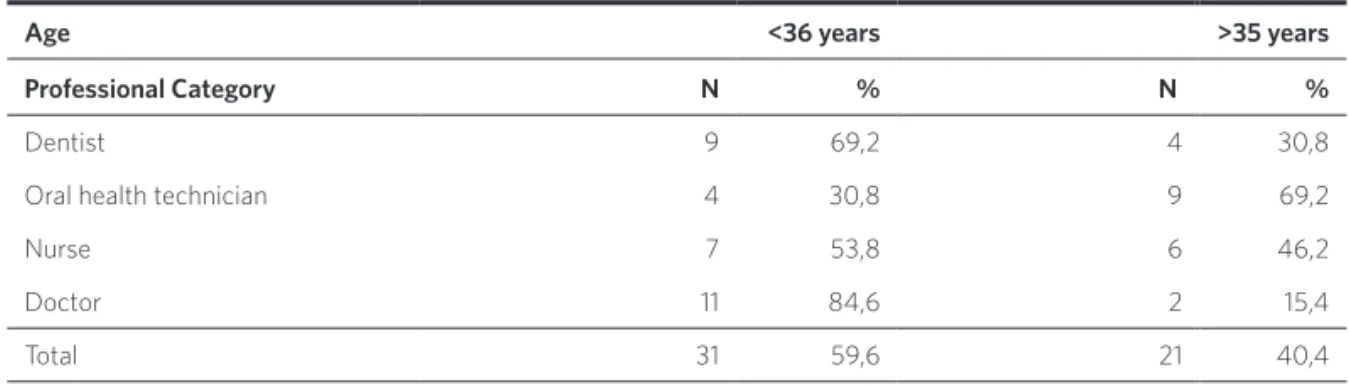
Participants of the interview were the fol-lowing health professionals who work in maternal and child care: dentist, technician in oral health, nurse and doctor, from the total of 13 family health care units visited, totaling 52 professionals, of which 43 (82, 7%) were women and 9 (17.3%) were men, 31 (59.6%) were up to 35 years old and 21 (40.4%) were 36 years old or more. For doctors and dentists, the younger age group was predominant, and for technicians in oral health the age group above 35 years of age was predominant (table 1).
Source: The authors.
note: value of p = 0,044 (Fisher’s exact test).
Age <36 years >35 years
Professional Category N % N %
dentist 9 69,2 4 30,8
oral health technician 4 30,8 9 69,2
nurse 7 53,8 6 46,2
doctor 11 84,6 2 15,4
Total 31 59,6 21 40,4
Table 1. Distribution of respondents by professional category and age
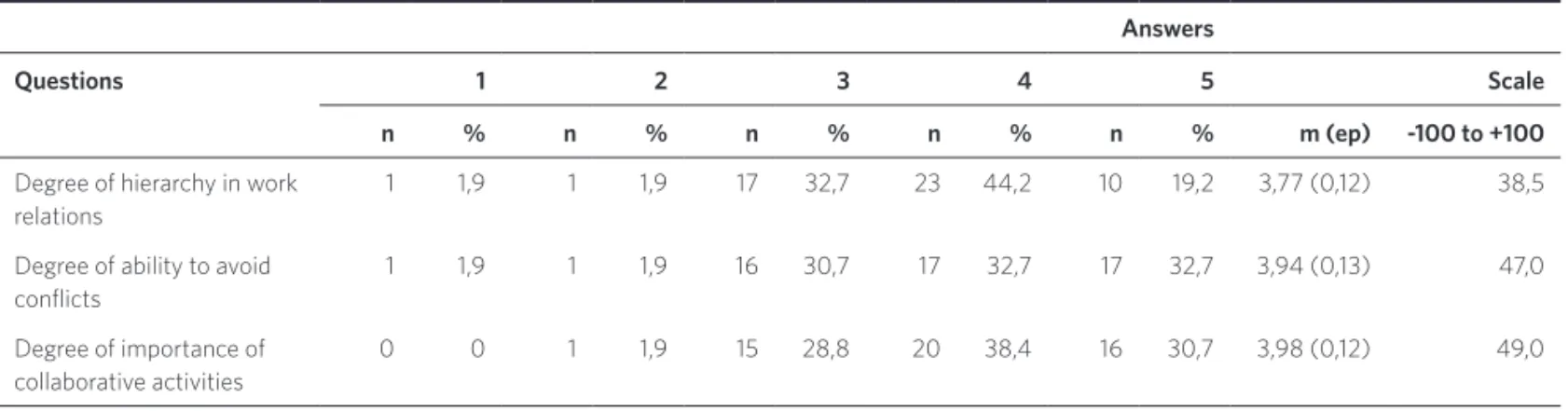
Regarding the perception, the degree of hi-erarchy in labor relations had an average (A) equal to 3.77 and standard error (SE) equal to 0.12. The value 38.5 in the range of 200 points indicates the presence of hierarchy in relations, an unfavorable factor for interpro-fessional collaboration. The average values
Source: The authors.
note: answers (1, 2, 3, 4, 5): 5 point scale, where 1 corresponds to the lowest level and 5 to the higher level. a= average value; se= standard error.
Answers
Questions 1 2 3 4 5 Scale
n % n % n % n % n % m (ep) -100 to +100
degree of hierarchy in work relations
1 1,9 1 1,9 17 32,7 23 44,2 10 19,2 3,77 (0,12) 38,5
degree of ability to avoid conlicts
1 1,9 1 1,9 16 30,7 17 32,7 17 32,7 3,94 (0,13) 47,0
degree of importance of collaborative activities
0 0 1 1,9 15 28,8 20 38,4 16 30,7 3,98 (0,12) 49,0
Table 2. Distribution of respondents according to the degree of perception of the hierarchy, ability to avoid conflict and importance of collaborative activities
There was difference of perception by professional (Kruskal-Wallis p=0.064) in lation to the degree of hierarchy in labor re-lations, finding to doctors the lowest average (A= 3.31 and SE=0.23), and to dentists the highest (A=4.23 and SE=0.23). For the degree of skill to avoid conflicts, the highest average was found to dentists (A=4.23 and SE=0.25), and to doctors the lowest (A=3.69 and SE=0.20) with no statistically significant differences. To the degree of importance of collaborative activities, the highest average was for doctors (A= 4.38 and SE=0.18), and the lowest for dentists (A=3.69 and SE=0.28) with no statistically significant differences.
Regarding the differences of perception between the units, there was a difference both to the degree of skill to avoid conflicts (Kruskal-Wallis p=0.053) as to the degree of importance attributed to the collaborative
activities (Kruskal-Wallis p=0.021). For the first item, the highest average value was 4.50 (SE=0.28), and the lowest 2.75 (SE=0.62), whereas for the second the highest average was 4.5 (SE=0.28), and the lowest 2.75 (SE=0.25).
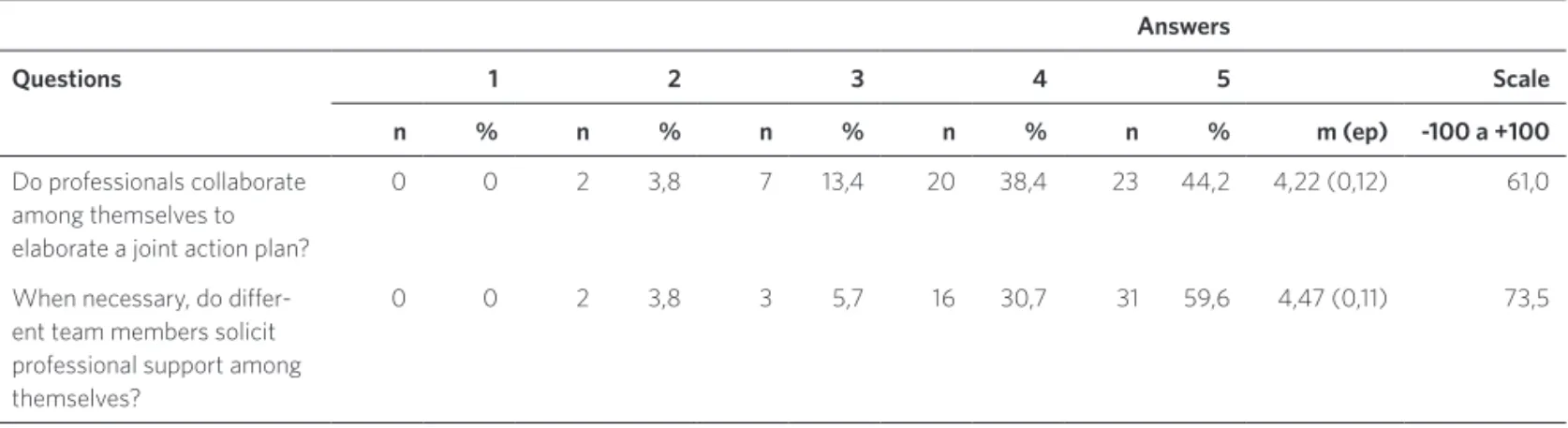
There was no difference by professional category in the reported attitude, but signifi-cant differences between the units were ob-served (p <0.10). In relation to the question ‘do professionals work together to develop a joint action plan?’, the highest average was 5.00 (SE = 0.01), and the lowest 3.00 (SE = 0.40). As to the question whether ‘team members solicit professional support among themselves’, the highest average was 5.00 (SE = 0.01), and the lowest was 3.5 (SE = 0.64).
When asked about the average frequency with which they request/resorts to other professionals from other areas, every 10 patients, the average value was 3.2 with no
significant difference by professional cat-egory, however there was difference per unit (Kruskal-Wallis p = 0.020), with the lowest average of 2.00 (SE = 0.01) and the highest equal to 4.50 (SE = 0.50).
Regarding the formal resources of in-terprofessional collaboration used in the organization of work for the production of care, 44 (84.62%) professionals said there are no planning meetings; 47 (90.38%) an-swered that the records are not shared; 39 (75.00%) indicated that the records do not include oral health issues, and 38 (73.08%) stated that there are specific records for the registration of dental care actions (table 4). Source: The authors.
note: answers (1, 2, 3, 4, 5): 5 point scale, where 1 corresponds to the lowest level and 5 to the higher level. a= average value; se= standard error.
Answers
Questions 1 2 3 4 5 Scale
n % n % n % n % n % m (ep) -100 a +100
do professionals collaborate among themselves to elaborate a joint action plan?
0 0 2 3,8 7 13,4 20 38,4 23 44,2 4,22 (0,12) 61,0
When necessary, do difer-ent team members solicit professional support among themselves?
0 0 2 3,8 3 5,7 16 30,7 31 59,6 4,47 (0,11) 73,5
Table 3. Distribution of respondents according to attitude regarding interprofessional collaboration
Source: The authors.
Answers Yes No No answer
Questions n % n % n %
are there planning meetings? 7 13,46 44 84,62 1 1,92
is the medical record of pregnant women care shared among health unit staf?
3 5,77 47 90,38 2 3,85
does the medical record of pregnant women care con-template issues regarding oral health?
12 23,08 39 75,00 1 1,92
is there a speciic medical record for oral health? 38 73,08 9 17,31 5 9,61
Discussion
The perceptions and attitudes of doctors, dentists, nurses and technicians in oral health on interprofessional relations in dental assistance during prenatal care in a medium-sized Brazilian municipality were described in this study in order to identify their meaning in relation to interprofession-al collaboration and to explore whether the pattern of responses was different accord-ing to professional category and the primary care unit.
In general, it was observed that the per-ception of professionals is overall favorable to interprofessional collaboration both in the degree of skill to avoid conflict in the di-vision of activities and responsibilities as in the degree of the importance of cooperation activities, though the hierarchical relations and asymmetries perceived differently by certain professional categories may repre-sent a subjective barrier to the implementa-tion of protocols that would require a greater degree of collaborative work.
The study that investigated the percep-tions on communication and collaboration showed that nurses and doctors do not share the same opinions and that the most important barrier to the establishment of good relations between these professions was that doctors did not recognize the professional role of nurses. The study also indicated that the absence of interprofes-sional collaboration can result in a greater chance of errors and omissions in the care of patients and that both nurses and phy-sicians should recognize the importance of effective communication and shared work (MATZIOU ET AL., 2014).
In this study, we observed significant differences in the perception of the profes-sionals concerning the degree of hierarchy in labor relations. Interprofessional col-laboration in health teams can be attrib-uted to several factors, including the work processes in interpersonal relationships
within the team (interactional determi-nants), the conditions within the organi-zation (organiorgani-zational determinants) and the organization’s environment (systemic determinants). Among the systemic deter-minants, we highlight the professional and educational systems (SAN MARTÍN-RODRIGUEZ ET AL., 2005). The professional system based
on rigid boundaries between health pro-fessional categories could mean a major barrier to the development of collaborative practice. The dynamics of professionaliza-tion tends to produce a professional dif-ferentiation strengthening territorial and disciplinary behaviors within the team, a prospect that is in direct opposition to the collaboration logic.
On the other hand, the development of a collaborative practice depends on the mutual recognition of professional inter-dependence, as well as the acceptance of interdisciplinary areas and ‘gray areas’ of multidisciplinary action, in which their con-tributions can be shared bringing benefits to both the patient and the organization
(NANCARROW; BORTHWICK, 2005).
When the results were analyzed per unit of primary care, we noted significant differ-ences related to both the degree of skill to avoid conflict in the division of activities/re-sponsibilities as to the degree of importance of collaborative activities, showing that certain teams of primary care share differ-ent perceptions that are probably linked to the internal dynamics of the team in which intragroup factors are more important than any differences associated with the model of autonomy or the tradition of each profes-sional category.
Van Schaik et al. (2014), in a study on
perceptions of multidisciplinary health teams, show that the perceptions of each member contribute to effective teamwork and reveal some potential barriers to ef-fective work in interprofessional team, such as tensions regarding hierarchy, se-curity, and leadership.
According to Vygotsky (1998), the
develop-ment of perception fundadevelop-mentally as it ap-prehends the meanings, senses, ultimately, the knowledge stored in the language. The perception, that is, the subjective image that man has of reality, is defined in and through social practice, because in addition to their individual activities with the objects, men relate, communicate and, in this interactive activity, appropriate from the knowledge of how to understand and interpret their culture and the environment in which they live. According to the experience of each in-dividual and the larger, more articulate and more reasoned knowledge is, the more en-hanced the perception tends to be.
In collating the findings on the per-ceptions and attitudes of professionals working in prenatal care with formal re-sources of interprofessional collaboration employed in the organization of work for the production of care, it was observed that most professionals do not betake tools such as planning meetings and unified medical record under the guidance of a shared care protocol.
Studies have shown that those features, combined with other tools, such as dis-cussion of cases in a regular and formal manner and management activities of support through supervision, monitoring and/or permanent education are essential to raise the level of interprofessional col-laboration in health services (SAN MARTÍN-RODRIGUEZ ET AL., 2005). Managers of health
services need to understand how to act to support clinicians to work interdisci-plinarily, developing leadership skills for collaborative interprofessional practice
(PROCTER ET AL., 2015).
In fact, studies have shown that profes-sional interaction problems in primary care may adversely affect the results of the care provided to patients. Among the factors that can prevent effective collaboration among professionals, we highlight aspects related professionals (lack of knowledge and confi-dence in the skills and experience of other professionals, and lack of understanding of the roles of other professionals), as well as external factors, such as a professional culture, time constraints and problems of getting in contact with other professionals
(FEWSTER-THUENTE; VELSOR-FRIEDRICH, 2008). In a
survey about health care resoluteness in primary care, Costa et al. (2014) pointed out
that professionals relate resoluteness with the action carried out by a multidisciplinary team, producing bond and autonomy in the work process, showing that a multidisci-plinary team connects different knowledge, establishes bonds based on knowledge of the other’s work, and that promotes un-derstanding between professionals and the enhancement of their participation in the production of care, making the work more resolute.
When services are very limited in range or depth, and do not explore interdisciplin-arity, preventable diseases may not be pre-vented, diseases may evolve for longer than justified, the quality of life may be put at risk. Therefore, engaging the health teams in an interprofessional collaborative work within the health services can improve the quality of prenatal care. A simple action of directing pregnant women to prevent and control periodontal disease can reduce the gingival inflammation levels, improve oral health and systemic health, elevating the quality of prenatal care to an important condition to reduce adverse pregnancy outcomes, as, for example, prematurity and low birth weight.
composition of the professional categories under study. Another limitation concerns the number of respondents that do not let us to extract more robust estimates and to deepen the conclusions beyond an explor-atory study. On the other hand, this study is one of the first works in the oral health field investigating interprofessional collabora-tion, looking at the relationships and inter-actions between professionals of prenatal care. Without considering nursing, collabo-ration between health professionals groups remains relatively unexplored in literature
(SUPPER ET AL., 2014).
Conclusion
Considering the results found, it can be con-cluded that despite the general perception of the professionals having been in favor of interprofessional collaboration, formal resources and tools such as planning meet-ings and unified records under the guidance of a shared care protocol are not being used to enhance interprofessional relations, re-flecting a clear gap between the perceived potential captured by the interviews and the practice supported by the instruments used for the actions of prenatal care. s
References
COSTA, J. P. et al. Resolubilidade do cuidado na aten-ção primária: articulaaten-ção multiprofissional e rede de serviços. Saúde Debate, Rio de Janeiro, v. 38, n. 103, p. 733-743, out./dez., 2014.
D’AMOUR, D. et al. A model and tipology of collabo-ration between professionals in healthcare organiza-tions. BMC Health Services Research, London, v. 8, n. 188, set. 2008.
FEWSTER-THUENTE, L.; VELSOR-FRIEDRICH, B. Interdisciplinary collaboration for healthcare profes-sionals. Nurs Adm Q., Germantown, v. 32, n. 1, p. 40-48, 2008.
HUCK, O.; TENENBAUM, H.; DAVIDEAU, J. L. L. Relationship between periodontal diseases and pre-term birth: recent epidemiological and biological data. Journal of pregnancy, Cairo, v. 2011, 2010.
LACHAT, M. F. et al. Periodontal disease in pregnancy: review of the evidence and prevention strategies. The Journal of Perinatal & Neonatal Nursing, Frederick, v. 25, n. 4, p. 312-319, 2011.
MATZIOU, V. et al. Physician and nursing perceptions concerning interprofessional communication and colla-boration. J Interprof Care, Abingdon, v. 28, n. 6, p. 526-533, 2014.
MORGAN, M. et al. Oral health during pregnancy. Journal of Maternal-Fetal and Neonatal Medicine, Boca Raton, v. 22, n. 9, p. 733-739, 2009.
MORGAN, S; PULLON, S.; MCKINLEY, E. Observation of interprofessional collaborative practice in primary care teams: an integrative literature review. Int. J. Nurs. Stud., Oxford, v. 52, n. 7, p. 1217-1230, 2015.
NANCARROW, S. A.; BORTHWICK, A. M. Dynamic professional boundaries in the healthcare workforce. Sociol Health Illn, Boston, v. 27, n. 7, p. 897-919, 2005.
PEREIRA, J. C. R. Análise de dados qualitativos: estratégias metodológicas para as ciências da saúde humanas e sociais. São Paulo: Edusp, 2001.
PROCTER, S. et al. A case study of asthma care in school age children using nurse-coordinated multidisciplinary collaborative practices. Journal of Multidisciplinary Healthcare, Auckland, v. 8, p. 181-188, 2014.
ROCHA, J. M. et al. Obstetricians’ knowledge of periodontal disease as a potential risk factor for preterm delivery and low birth weight. Braz. Oral Res., São Paulo, v. 25, n. 3, p. 248-254, jun. 2011.
SAN MARTÍN-RODRIGUEZ, L.; D’AMOUR, D.; LEDUC, N. Validación de un instrumento de medida de la intensidad de la colaboración entre los profesionales de la salud traducido al español. Enferm Clin,
Barcelona, v. 17, n. 1, p. 24-31, 2007.
SAN MARTÍN-RODRIGUEZ, L. et al. The determinants of successful collaboration: A review
of theoretical and empirical studies. Journal of Interprofessional Care, Abingdon, supl. 1, p. 132-147, maio 2005.
SANTOS NETO, E. T. et al. Acesso à assistência odontológica no acompanhamento pré-natal. Ciênc. Saúde Coletiva, Rio de Janeiro, v. 17, n. 11, p. 3057-3068, 2012.
SUPPER, O. et al. Interprofessional collaboration in primary health care: a review of facilitators and barriers perceived by involved actors. Journal of Public Health, Oxford, v. 37, n. 4, p. 716-727, 2015.
VAN SCHAIK, S. M. et al. Perceptions of
interprofessional teamwork in low-acuity settings: a qualitative analysis. Medical Education, Oxford, v. 48, p. 583-592, 2014.
VYGOTSKY, L. S. O desenvolvimento psicológico na infância. São Paulo: Martins Fontes, 1998.
WORLD HEALTH ORGANIZATION (WHO). Framework for Action on Interprofessional Education and Collaborative Practise. Genebra: WHO/HRH/ HPN, 2010. Disponível em: <http://www.who.int/hrh/ nursing_midwifery/en/>. Acesso em: 7 jun. 2012.
ZANATA, R. L.; FERNANDES, K. B.; NAVARRO, P. S. Prenatal dental care: Evaluation of Professional knowledge of obstetricians and dentists in the cities of Londrina/PR and Bauru/SP, Brazil, 2004. J. Appl. Oral Sci., Bauru, v. 16, n. 3, p. 194-200, 2008.
received for publication in: october, 2015 Final version: February, 2016
Conlict of interests: non-existent