THE ROLE OF FAMILY RELATIONS, SPIRITUALITY AND
ENTERTAINMENT IN MODERATING PEER INFLUENCE AND DRUG USE
AMONG STUDENTS OF EIGHT UNIVERSITIES FROM FIVE COUNTRIES
IN LATIN AMERICA AND THREE FROM THE CARIBBEAN
Jaime Alonso Caravaca Morera1, Aydee Rivera de Parada2, Bridgt Ogowewo3, Howard Gough4, Maria Magaly Scott Alava5, Maria Terezinha Zeferino6, Mia Jules7, Rashalee Mitchell8, Rolando Salazar Sarmiento9,
Anadergh Barbosa-Branco10, Akwatu Khenti11
1 M.Sc. Associate Professor, School of Nursing, University of Costa Rica. San Jose, Costa Rica. E-mail: [email protected] 2 Doctoral Student, Associate Professor, School of Education, Evangelica University of El Salvador. San Salvador, El Salvador.
E-mail: [email protected].
3 Ph.D. Associate Professor, School of Education, University of Guyana. Georgetown, Guyana. E-mail: [email protected] 4 Doctoral Student, Former Faculty of University of West Indies, Mona Campus. Kingston, Jamaica. E-mail: misemiewasdere@
yahoo.com.
5 Ph.D. Associate Professor, School of Nursing, Technical University. Manabi, Ecuador. E-mail: [email protected] 6 Ph.D. Associate Professor, Nursing Department, Federal University of Santa Catarina. Florianopolis, Santa Catarina, Brazil.
E-mail:[email protected]
7 Doctoral Student, Assistant Professor, Psychology Department, University West Indies, Cave Hill Campus. Barabados. E-mail: [email protected]
8 M.Sc. Assistante Professor, Psychology Department, University of West Indies, Mona Campus. Kingston, Jamaica. E-mail: [email protected]
9 M.Sc. Associate Professor, Psychology, Health Science University Foundation. Bogota, Colombia. E-mail: rsalazarsarmiento@ yahoo.com
10 Ph.D. Associate Professor, University of Brasilia (retired), CAMH External Consultant. Toronto, Canada. E-mail: anadergh@ hotmail.com
11 Doctoral Student, Associate Professor, University of Toronto, Director Transformative Global Health Ofice. Toronto, Canada. E-mail: [email protected]
ABSTRACT: This study is a multi-centric investigation on the role of family relations, spirituality and entertainment in moderating the
relationship between peer inluence and drug use (licit and illicit) among students from eight universities from ive countries in
Latin-America and three from the Caribbean. The sample was composed by 2198 university students from faculties of Social Sciences and
Humanities/Health Sciences. Drug use was the dependent variable and the level of peer inluence (number of friends who use drugs)
was the independent variable. The results showed that problematic family relationship, high number of party-based entertainment and
high number of friends on drugs use (peer inluence) increased the odds of youths using illicit drugs. The only interaction statistically signiicant for licit and illicit drug use was party-based entertainment and friends on drugs. The use of licit drugs presented large variability among universities in the sample, potentially inluenced by cultural/religious aspects.
DESCRIPTORS: Drug abuse. University. Family. Cultural factors. Peer group.
O PAPEL DAS RELAÇÕES FAMILIARES, ESPIRITUALIDADE E DIVERSÃO
COMO MODERADORES ENTRE A INFLUÊNCIA DE PARES E O USO DE
DROGAS ENTRE ESTUDANTES DE OITO UNIVERSIDADES DE CINCO
PAISES DA AMÉRICA LATINA E TRÊS DO CARIBE
RESUMO: Trata-se de estudo multicêntrico, que analisa o papel das relações familiares, espiritualidade e entretenimento-festas como
moderadores da relação entre a inluência dos pares e o uso de drogas entre estudantes de oito universidades de cinco países da América Latina e três do Caribe. A amostra foi composta por 2198 estudantes de Faculdades de Ciências Sociais e de Ciências da Saúde. Uso de drogas foi a variável dependente e inluência dos pares (número de amigos usando drogas), a independente. Os resultados
mostraram que relações familiares problemáticas, participar de muitas festas e ter muitos amigos usando drogas aumentou a chance
dos estudantes universitários da amostra usarem drogas ilícitas. A única interação estatisticamente signiicante para o uso de drogas lícitas ou ilícitas foi o entretenimento-festas/amigos usando drogas. O uso de drogas lícitas apresentou grande variabilidade entre as universidades da amostra, potencialmente inluenciada por aspectos culturais/religiosos.
EL PAPEL DE LAS RELACIONES FAMILIARES, ESPIRITUALIDAD Y
DIVERSIÓN COMO MODERADORES ENTRE LA INFLUENCIA DE
PARES Y EL USO DE DROGAS ENTRE ESTUDIANTES DE OCHO
UNIVERSIDADES DE CINCO PAÍSES DE AMERICA LATINA Y TRES DEL
CARIBE
RESUMEN: Estudio multicéntrico que analiza el papel de las relaciones familiares, la espiritualidad y la diversión-iestas como moderadores de la relación entre la inluencia de pares y el uso de drogas entre estudiantes de ocho universidades de cinco países de America Latina y tres del Caribe. La muestra fue composta de 2198 estudiantes de Facultades de Ciencias Sociales y de Ciencias de la
Salud. El Uso de drogasfue la variable dependiente y la inluencia de pares (número de alumnos usando drogas) la independiente.
Los resultados indicaron que las relaciones familiares problemáticas, participar de muchas iestas y tener muchos amigos utilizando drogas aumentó la oportunidad de los estudiantes de la muestra a utilizaren drogas ilícitas. La única interacción estadísticamente signiicante para el uso de drogas lícitas e ilícitas fue la diversión/iestas/amigos usando drogas. El uso de drogas lícitas presenta grande variabilidad entre las universidades de la muestra, potencialmente inluenciada por aspectos culturales/religiosos.
DESCRIPTORES: Consumo de drogas. Universidad. Familia. Factores culturales. Grupo paritario.
INTRODUCTION
Drug use has been a public health issue of broader community concern for some time. However, despite countries’ proclaims regarding successful initiatives to control the demand for illicit drugs, drug abuse throughout the world continues to grow. There is also the recognition that illicit drug use particularly in some devel-oping countries has increased dramatically and this is especially true in Latin America and the Caribbean.1-2
In 2010, UNODC3 reported that the global market for illicit drugs is valued at over US$ 300 billion annually. In this context, a research study4 on the prevalence of illicit drugs showed an unprecedented increase in drug use by diverse groups of young people from all socioeconomic backgrounds. This appears to be occurring within a scenario of increasing rates of other social chal-lenges such as youth crime and violence, fam-ily disorganization, domestic or famfam-ily violence, among others.
The consumption of drugs by youth is also recognized a behavior which involves culturally mediated learning processes5 cultural agents of socialization such as the family, peers, religion and the entertainment industry are among the social institutions from which young adults and adolescents cognitively assimilate information and become inluenced, and, by extension, inlu -ence the behaviors of others.6 Therefore, cultural factors have the potential to affect the traditional uses of alcohol, tobacco and other drugs, as well as the norms or social practices governing the use of speciic substances within its speciic culture.7
This research study revolves around the
moderating effect presented by socio-cultural fac-tors within the relationship between peer inluence and drug use among the student population from eight different countries.
Noted that various studies have provided evidence to show the importance of peers in the development of substance use and abuse and the university environment seems to promote this strong peer inluence.8 Some evidences show that the university environment provides a safe haven for experimentation with substance use.9 On the other hand, there are some protective factors to the use of drugs such as the effect of positive parenting practices inluenced by the strength of family ties.10
This Multi-centric research study attempts to explore the cultural factors which correlate with drug consumption as well as the interactions of a speciic set of psycho-social factors as modera -tors, namely religion/spirituality, entertainment and family relations among university students in seven universities across eight countries in Latin American and the Caribbean.
METHOD
The dependent variable of the study was drug use. The licit drugs investigated were tobacco and alcohol and the illicit drugs were cannabis, cocaine and amphetamines. The independent vari-able of the study was the level of peer inluence (number of friends who use drugs). The moder-ating variables were: quality of family relations, party-based entertainment (number of parties at-tended with the presence of drugs licit/illicit) and level of spirituality. The demographic variables investigated were: age, sex, academic registration status, marital/civil status, faculty, year of study/ semester and working status.
The students completed a retrospective, self-reported questionnaire about their substance use, entertainment, spiritual and family experi-ences. The questions were adapted from the Peer Inluence Scale, the Index of Family Relations, the Spirituality Involvement and Beliefs Scale, a self-developed summated rating scale to measure entertainment engagement and an adaptation of questions one and two from the Alcohol, Smoking and Substance Involvement Screen Test. Statistical package for the Social Sciences (SPSS) version 15 was used for the design of the database and for data analysis. Descriptive statistical analyses, fre-quencies of categorical variables, measures of cen-tral tendency (means) and measures of dispersion (standard deviation) for numeric variables were conducted. Correlations and logistic regression analyses were also conducted to determine the relationship between friends who use drugs (peer inluence) and drug use and the moderating effects of the socio-cultural factors on this relationship.
The indings of this study are intended to make inferences about the sample chosen from each university and not about the general uni-versity or wider populations. Therefore, the data obtained are limited in their ability to allow for predictive conclusions about any population be-yond the samples.
Instrument and measurement
A self-report questionnaire was used to col-lect the data. The English version of the question-naire was translated into Spanish and Portuguese taking into consideration the cultural meanings of words as well as the grammatical structure of sen-tences. The questionnaire, in the three languages of the study (English, Spanish and Portuguese) was piloted among persons within the 18-24 year age group and it took approximately 20-30 min-utes to complete. The questionnaire consisted of
six sections with 86 questions including: socio-demographic information (10 questions), peer inluence (1), family relations (24), entertainment (1), spirituality (26), and drug consumption (5).
The Index of Family Relations (IFR)
The Index of Family Relations- IFR11 is a 25 items scale designed to measure the extent, sever-ity, or magnitude of problems that family members have in their relationships with one another. The 25 items were responded on a 5-point scale rang-ing from “rarely or none of the time”, to “most or all of the time.”
The total score was computed by summing item scores and subtracting 25. If items have been omitted, the score were calculated as S=(Y–N) (100)/[(N)(4)], where N was the number of items properly completed by the respondent.
The Spiritual Involvement and Beliefs Scale
(SIBS)
The Spirituality Involvement and Beliefs Scale (SIBS) was developed by Hatch et al.12 The authors gave their authorization to use the scale via email on Thursday 25th August, 2011. The Spanish and Portuguese versions of the scale were also used in this multi-centric study. The instru-ment was a questionnaire containing 26 items in a modiied Likert-type format. Therefore, the overall measure of spirituality was obtained by averaging the total response scores across the 26 items to arrive to a mean.
The Alcohol, Smoking and Substance
Involvement Screen Test (ASSIST)
A modiication of question one and two of the ASSIST was used in the study. These questions were developed by the World Health Organiza-tion.13 The questions relating only to alcohol, to-bacco, cocaine, cannabis and amphetamines were selected. Questions F1 to F5 combined to form a 5 item measure in which the respondent was asked about the use of ive drugs over the past 12 months. The respondent was expected to answer either “yes” or “no” to the use of drugs over this time period.
Data collection
from November 2011 to April 2012. Data were collected in and/or outside of classroom settings, on the conditions of the participating universities.
Data analysis
The data were analyzed using frequency, percentage, mean, measure of dispersion (stan-dard deviation), median, cross tabulations, t-tests, correlation and logistic regressions. All demo-graphic variables were analyzed and presented individually by University/City/Country. The data from all universities/cities/countries were combined in the evaluation of independent and moderating factors. Due to problems with the data collection in some countries and in order to ensure the quality of the data, there were some restrictions in the process of analysis:
- Drug use was considered only regarding the past 12 months.
- Peer inluence was measured only by the number of friends who use drug.
- Entertainment was measured only by the number of parties with potential presence of drugs attended by the student in the past three months.
- In the evaluation of Family relationship the item The members of my family rarely care about each other was not considered in the analysis.
Ethical approval was obtained from the Research Ethics Board (REB) of the Centre for Ad-diction and Mental Health (CAMH) on November 2011 # n. 136 and from the Ethical Committees from each participating university.
RESULTS
Sociodemographic characteristics
The sample in relation to age, sex and mari-tal status distribution presented similar age pat-terns among the students from the different city/ countries, with very small deviation (average of 19.8-20.9 years old); the sample was composed predominantly (50.0-79.1%) by females and single (62.4-82.0%) students.
Regarding attendance to classes, the majority of students attended the university on full-time basis at all the studied universities, except in the university in Georgetown, Guyana, where only 12.2% of students fulilled this condition.
In relation to the employment status of the sampled students, it was composed mainly by non-workers, independently of the university/ city/country, except for students from George-town/Guyana which have reported a percentage of employment superior to 30.0%.
Regarding to the place of residence of the students and with whom they lived during the time of the study, in ive of the eight sites studied, the majority of students lived at home with their families, but students from Florianopolis/Brazil referred to live predominantly in other places than with family, relatives or at the university residence. Students from San Jose, Costa Rica and from Kingston, Jamaica presented the higher percentage of them living at the university hall residence (22.4%), in contrast to students from Bogota, Colombia, of which 89.4% lived at home with their families.
The distribution of area of study and aca-demic year of enrollment of students participating in the study, by city and by country has pointed at some predominance of students attending courses in the Health Sciences area in the irst two academ -ic years; Bridgetown /Barbados, Georgetown/ Guyana and Kingston/Jamaica (69.2%, 63.9% and 84.8%, respectively) had greater participation of Social Science students. Universities from San Salvador, Manabí and Florianopolis were those with higher participation of veteran students (3rd year onwards) in the study.
Use of licit and illicit drugs
Table 1 - Distribution of licit and illicit drug use in the past 12 months among the students participating in the study, by City and Country
City/Country
Licit drugs Illicit drugs
Alcohol Tobacco Cannabis Cocaine Amphetamines
n % n % n % n % n %
Bridgetown, Barbados
(n=250) 193 77.2 37 14.8 38 15.2 5 2.0 2 0.8
Florianopolis/SC, Brazil
(n=250) 229 91.6 86 34.4 76 30.4 1 0.4 7 2.8
Bogota, Colombia
(n=350) 319 91.1 131 37.4 42 12.0 9 2.6 6 1.7
San Jose, Costa Rica
(n=250) 213 85.2 139 55.6 160 64.0 35 14.0 63 25.2
Manabi, Ecuador
(n=250) 132 52.8 61 24.4 14 5.6 10 4.0 10 4.0
San Salvador, El Salvador
(n=250) 104 41.6 53 21.2 9 3.6 4 1.6 5 2.0
Georgetown, Guyana
(n=263) 159 60.5 29 11.0 24 9.1 11 4.2 7 2.7
Kingston, Jamaica
(n=335) 262 78.2 51 15.2 47 14.0 1 0.3 3 0.9
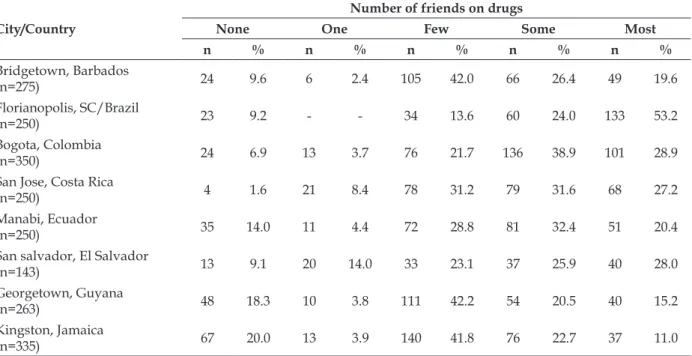
Table 2 presents the average number of friends on drugs of the students participating in the study, by city and by country. Independently of university, there was a predominance of some and most friends on drugs (50.4%) and students from Florianopolis,
Brazil (77.2%) reported the highest percentage of most friends on drugs while university students from Kingston, Jamaica reported the lowest percent-age of most friends on drugs (11.0%), as well as the highest percentage of no friends on drugs (20.0%).
Table 2 - Distribution of Peer inluence (number of friends on drugs) of the students participating
in the study, by City and by Country
City/Country
Number of friends on drugs
None One Few Some Most
n % n % n % n % n %
Bridgetown, Barbados
(n=275) 24 9.6 6 2.4 105 42.0 66 26.4 49 19.6
Florianopolis, SC/Brazil
(n=250) 23 9.2 - - 34 13.6 60 24.0 133 53.2
Bogota, Colombia
(n=350) 24 6.9 13 3.7 76 21.7 136 38.9 101 28.9
San Jose, Costa Rica
(n=250) 4 1.6 21 8.4 78 31.2 79 31.6 68 27.2
Manabi, Ecuador
(n=250) 35 14.0 11 4.4 72 28.8 81 32.4 51 20.4
San salvador, El Salvador
(n=143) 13 9.1 20 14.0 33 23.1 37 25.9 40 28.0
Georgetown, Guyana
(n=263) 48 18.3 10 3.8 111 42.2 54 20.5 40 15.2
Kingston, Jamaica
Moderating and independent variables
Table 3 presents the average scores from the moderating and independent variables referred by university students according to city and country. Considering a scale varying from 0-100, the fam-ily relationship results varied from 21.20 in San Salvador, El Salvador to 46.90 in Georgetown, Guyana. These scores were designed in such way that higher scores indicated greater magnitude or severity of problems. Party based entertainment, measured as the number of parties where alcohol, tobacco, or mood altering substances may have been present in parties attended by the student
in the past three months, varied from 1.70 in San Salvador, El Salvador to 8.16 in Florianopolis, Bra-zil. Peer inluence was measured as the number of friends who smoke, drink alcohol or use other forms of drugs. It varied from 2.02 in Kingston, Jamaica to 3.12 in Florianopolis, Brazil. Peer inlu -ence in San Salvador, El Salvador showed a large number of missing data (42.80%). Spirituality was measured on a scale from 0-5, where ive shows the greater spirituality and presented the most stable results of all variables between cities, varying from 3.21 in Manabi, Ecuador to 3.74 in San Salvador, El Salvador.
Table 3 - Moderating and Independent variables of the study by City/Country
Item
Bridgetown Barbados
Florianopolis Brazil
Bogota Colombia
San Jose Costa
Rica
Manabi Ecuador
San Salvador El Salvador
Georgetown Guyana
Kingston Jamaica
(n=250) (n=250) (n=350) (n=250) (n250) (n=250) (n=250) (n=332)
Mean Mean Mean Mean Mean Mean Mean Mean
(sd) (sd) (sd) (sd) (sd) (sd) (sd) (sd)
Friend who
use drugs 2.44 3.12 2.79 2.74 2.41 2.5 2.11 2.02
(Independent) (1.13) (1.22) (1.11) (1.00) (1.26) (1.28) (1.26) (1.24) Family
relationship 36.5 33.2 22.1 45.1 34.5 21.2 46.9 33.8
(Moderating) (22.8) (22.8) (16.4) (28.5) (23.5) (21.5) (24.7) (23.1) Party based
entertainment 2.49 8.16 3.95 6.88 2.33 1.7 1.54 2.52
(Moderating) (4.58) (8.00) (5.56) (7.69) (3.10) (2.95) (3.61) (3.79)
Spirituality 3.52 3.47 3.42 3.5 3.21 3.74 3.64 3.63
(Moderating) (0.58) (0.5) (0.5) (0.49) (0.44) (0.55) (0.54) (0.56)
Relationship between friends who use drugs, spirituality, family relationship, party ased enter-tainment and licit and illicit drug use in the last 12 months
Table 4 presents the association between friends who use drugs, family relationship, spiri-tuality and party-based entertainment and licit and illicit drug use in the last 12 months, adjusted for demographic, school and work status charac-teristics. The results indicated that friends who use drugs are signiicantly associated with licit drug use (p<0.000). More speciically, individuals with a greater number of friends who use drugs are at greater odds of using alcohol or tobacco (OR=1.582). Greater party-based entertainment activities are also associated with greater odds
Table 4 - Relationship between friends who use drugs, spirituality, family relationship, party based entertainment and licit and illicit drug use in the last 12 months
Variables
Licit drugs Illicit drugs
p-Value OR Lower IC 95%
Upper IC 95%
p-Value OR
Lower IC 95%
Upper IC 95%
Age 0.328 1.043 0.959 1.134 0.002 0.878 0.809 0.954
Faculty-Health Sci (ref=social sc) 0.736 1.046 0.804 1.363 0.189 0.839 0.646 1.090 Gender – female (ref=male) 0.902 0.982 0.741 1.303 0.000 0.482 0.375 0.620 Marriage status – single (ref=other) 0.177 0.826 0.626 1.091 0.030 1.382 1.032 1.851 Registration status – full-time
(ref=part-tm) 0.225 1.212 0.888 1.653 0.063 1.371 0.983 1.911
Residence – at home (ref=other) 0.833 0.969 0.723 1.299 0.000 0.498 0.386 0.644 Work status – working (ref=no wrk) 0.373 0.864 0.627 1.191 0.761 0.950 0.683 1.321
Year of study 0.014 0.862 0.765 0.971 0.305 1.067 0.943 1.206
Friends who use drugs 0.000 1.582 1.422 1.76 0.000 1.581 1.397 1.790 Family relationship 0.290 0.997 0.992 1.002 0.000 1.016 1.010 1.021
Spirituality 0.000 0.637 0.500 0.812 0.206 0.857 0.675 1.089
Party based entertainment 0.000 1.393 1.287 1.507 0.000 1.080 1.058 1.102
Intercept 0.321 0.005
Table 5 outlines the association between friends who use drugs, spirituality, family re-lationship, party based entertainment and licit drug use last 12 months including the interac-tion party based entertainment friends who use drugs. Findings indicate that the interaction between party-based entertainment friends who use drugs (p=0.001) are signiicantly associated with licit drug use. This interaction indicates that the effect of friends who uses drugs on the
odds (OR=0.897) of students using alcohol and/ or tobacco is reduced as the number of parties at-tended increases. The association between family relationship, party-based entertainment, friends who use drugs and spirituality on youths’ illicit drug use in the 12 months preceding the survey, after adjusting for demographic, school and work status characteristics indicate that the interaction between spirituality and friends who use drugs (p>0.05) was not associated with illicit drug use.
Table 5 - Relationship between friends who use drugs, spirituality, family relationship, party based entertainment and licit drug use last 12 months including the interaction of party based entertainment and friends who use drugs
Variables Estimate Standard
error p-value Odds Ratio
Lower 95% C.I. Odds Ratio
Upper 95% C.I. Odds Ratio
Age 0.046 0.043 0.285 1.047 0.962 1.139
Faculty- Health Sci (reference=social sc) 0.044 0.136 0.746 1.045 0.800 1.364 Gender – female (reference=male) -0.010 0.145 0.945 0.990 0.745 1.316 Marriage status – Single (ref=other) -0.196 0.143 0.171 0.822 0.621 1.089 Registration status – Full-time (ref=part-tm) 0.162 0.160 0.313 1.175 0.859 1.609 Residence – at home (ref=other) -0.010 0.151 0.950 0.991 0.737 1.331 Work status – Working (ref=no wrk) -0.160 0.165 0.333 0.853 0.617 1.178
Year of study -0.151 0.061 0.014 0.860 0.762 0.970
Friends who use drugs 0.564 0.063 0.000 1.758 1.553 1.990
Family relationship -0.003 0.003 0.323 0.997 0.992 1.003
Spirituality -0.441 0.125 0.000 0.643 0.504 0.821
Party based entertainment 0.631 0.105 0.000 1.879 1.530 2.308
Party friends who use drugs -0.109 0.032 0.001 0.897 0.842 0.956
Table 6 describes the association between family relationship, party-based entertainment, friends who use drugs and spirituality on youths’ illicit drug use in the 12 months preceding the survey, after adjusting for demographic, school and work status characteristics. The indings show that the interaction between party-based entertain-ment friends who use drugs lowered the odds of university students using illicit drugs (p=0.015; OR=0.975). The association between family
re-lationship, party-based entertainment, friends who use drugs, spirituality and the interaction Family Relationship*Friends who use drugs on youths’ illicit drug use in the 12 months preced-ing the survey, adjusted for demographic, school and work status characteristics, showed that the interaction between family relationship* friends who use drugs was not associated with illicit drug usage (p>0.05).
Table 6 - Relationship between friends who use drugs, spirituality, family relationship, party based entertainment and illicit drug use last 12 months, including the interaction party based entertainment friends who use drugs
Variables Estimate Standarderror Wald Chi-Square
Prob> Chi-Square
Odds Ratio
Lower 95% C.I. Odds
Ratio
Upper 95% C.I. Odds
Ratio
Age -0.125 0.042 8.850 0.003 0.883 0.813 0.958
Faculty -0.177 0.134 1.754 0.185 0.838 0.645 1.089
Family relationship 0.015 0.003 33.996 0.000 1.015 1.010 1.021
Gender -0.721 0.128 31.587 0.000 0.486 0.378 0.625
Intercept -0.339 0.989 0.118 0.732 0.000 <0.001 <0.001
Marriage status 0.351 0.150 5.477 0.019 1.421 1.059 1.907
Party friends who use drugs -0.025 0.011 5.864 0.015 0.975 0.955 0.995 Party based entertainment 0.157 0.035 20.058 0.000 1.170 1.092 1.253 Friends who use drugs 0.566 0.079 51.186 0.000 1.761 1.508 2.056
Registration status 0.306 0.170 3.240 0.072 1.358 0.973 1.896
Residence -0.680 0.131 26.964 0.000 0.507 0.392 0.655
Spirituality -0.151 0.122 1.519 0.218 0.860 0.677 1.093
Work status -0.051 0.168 0.093 0.761 0.950 0.683 1.321
Year of study 0.052 0.063 0.686 0.408 1.054 0.931 1.193
DISCUSSION
The indings showing alcohol and/or to -bacco as the main drugs used by the students are corroborated by a previous study developed among South American and Caribbean university students on simultaneous polydrug use. The re-sults of this study showed that alcohol and tobacco were the most prevalent association of drugs reported in the past year as well as in the past 30 days prior to the survey.14 The different pattern of alcohol and/or tobacco use presented by the coun-tries and in particular by regions (South America and Caribbean) could be explained partially by social cultures and social acceptance of alcohol and tobacco among each culture. Therefore, in some cultures the use of alcohol at social occasions and in small to moderate amounts seems natural and part of the culture. Also, the differences between Latin American and Caribbean Countries could be explained due to different religious patterns
and in this direction, several studies have shown the protective effect of religion regarding alcohol use.15-17 According to these authors, higher religios-ity is associated with a less likelihood to initiate or to use/abuse alcohol and or tobacco. This fact may also explain the protective inluence of higher spirituality on use of licit drugs.
cultural aspects could have played statistically a more important role on alcohol and tobacco use than Family relationship, and these aspects ap-pear to be independent of the quality of family relationship.
The statistically significant interaction identiied on Friends who use drugs Party based entertainment showing a decrease in the odds of students using alcohol and/or tobacco as the number of parties increases could have resulted from the fact that the variable Peer inluence, measured as the number of friends on drugs, did not separate friends who use licit drugs (alcohol and tobacco) from friends who use illicit drugs (cannabis, cocaine, Amphetamine-type stimu-lants). Since the use of alcohol (not the abuse) is present in the everyday life of most students and families houses as well as in the large majority of parties, it may have contributed to these results. In relation to the association of high number of friends who use drugs, problematic family re-lationship and high number of parties attended with the increased odds of use of illicit drugs by the university students, it is dificult to identify the individual variables associations, since they are very closely associated between themselves. It has been found that teenagers with a good rela-tionship with their parents are less likely to choose friends who use drugs.10 The selection of friends who use drugs can be done based on two main ways: by socialization- where the peers inluence each other’s behaviours depending, in general, on the existing or perceived norms within the group or social context, or by selection – where the in-dividual looks for or associates himself/herself to a friend or group with a similar behaviour or attitude.8 In the case of illicit drugs, individuals who are interested in a speciic kind of drug use may choose to associate themselves to individuals with common interests.18
The association between party based enter-tainment and the use of illicit drugs rely mainly on dance parties. These parties, in particular “rave” and “funk” type, which are in general very permissive in relation to drugs use/abuse, are very closely associated with youth culture.4 Con-sidering the strong negative association between spirituality and use of alcohol and/or tobacco by the students and the lack of association between spirituality and the use of illicit drugs, it could be partially understood by the theoretical approach in which alcohol and tobacco work as route to illicit drugs (“gateway model”). It is possible that many
of those students using illicit drugs come from the parcel of students with lower spirituality, or even from those in which the level of spirituality did not interfere with drug use, independent of being licit or illicit. Several studies have shown that the use of substances such as alcohol and tobacco, alone or combined, are a risk factor for illegal drugs use among young people.19
CONCLUSIONS
The use of licit drugs presented large vari-ability among universities/Cities/Countries with some potential cultural/religious inluence on its use. This variability became clearer when compar-ing South American and Caribbean countries. The number of friends using drugs and party-based entertainment are statistically associated with licit drug use. On the other hand, higher spiri-tuality is associated with lower odds of alcohol and tobacco use. In relation to illicit drug use, problematic family relationship, high number of party-based entertainment and high number of friends on drugs (peer inluence) increased the odds of youths using illicit drugs. Individually, friends who use drugs was the strongest factor associated with the increased odds of university students using licit and/or illicit drugs. The level of spirituality inluence positively on consumption of licit drugs (alcohol and tobacco), but did not show signiicant effect on consumption of illicit drugs. Problematic family relationship did not interfere signiicantly in the odds of student use of alcohol and tobacco. Friends who use drugs and party based entertainment were the only interac-tion that increased the odds of students consuming both licit and illicit drugs.
Limitations
Latin American cultures the presence of alcohol in parties, with few exceptions, is very common.
Recommendations
We recommend to CICAD, the Governments of participant countries, and the universities to consider the indings of this study in the develop -ment and imple-mentation of new research studies with University students, as well as the indings generated from other studies prepared by the participants of the CICAD/CAMH International Research Capacity-Building Program. These re-search results can bring important information for the development of preventive and health promo-tion programs designed to university students.
Acknowledgment
The Organization of America States, Inter-American Drug Control Commission (CICAD/ OAS), the Government of Canada/DFAIT and the Centre for Addiction and Mental Health (CAMH), Toronto-Canada for supporting and endorsing this project inancially and technically; to the selected Universities in Latin America and the Caribbean for their invaluable support; as well as other col-laborators and the students who participated in the research.
REFERENCES
1. United Nations Office of Drug Consumption. Bulletin on narcotics: the practice of drug abuse epidemiology. 2003 [access 2014 Aug 14]; 55(1/2). Available at : http://www.unodc.org/pdf/ bulletin/bulletin_2003_01_01_1.pdf
2. Shifter M. Latin America’s drug problem. Current
History. 2007 Feb [access 2014 Aug 14]; 58-63 Available in at http://www.hacienda.go.cr/centro/
datos/Articulo/Latin%20America%20drug%20
problem.pdf
3. United Nations Ofice of Drug Consumption. UNO
-DC: Promoting health, security and justice: cutting the threads of drugs crime and terrorism 2010 report. UNODC; 2010 [access 2014 Aug 15] Available at https://www.unodc.org/documents/frontpage/
UNODC_Annual_Report_2010_LowRes.pdf
4. Measham F, Parker H, Aldridge J. Teenage transition from adolescent recreational drug use to the young
adult dance culture in Britain in the mid 1990’s. J
Drug Iss. 1998 Winter;28(1):9-32.
5. Orozco JB. Analisis de brechas y determinación de prioridades en la investigación sobre reducción de
la demanda de drogas en America Latina. Madrid (ES): Consorcio COPOLAD; 2013. [access 2014 Aug
16] Available at: https://www.copolad.eu/c/
document_library/get_ile?uuid=ab72d11f-bd7d-4fe5-ab98-aa0f3f2e6996&groupId=10157
6. QeC-ERAN. National Action Plan on Social Inclusion. 2005 [Access 2014 Aug 14] Available at: http://www.ludenet.org/archives/qeceran/ projects/lapsraps_index.htm
7. United Nations Office of Drug Consumption, UNODC. Drug abuse prevention among youth from
ethnic and indigenous minorities. Global Youth
Network 2004. [Access 2014 Aug 15] Available
at: https://www.unodc.org/pdf/youthnet/
handbook_ethnic_english.pdf
8. Andrews J, Hops H. The influence of peers on
substance use. In: Scheier LM, Handbook of drug use etiology: theory, methods, and empirical indings.
3rd ed,. Washington, DC: American Psychological
Association; 2002.
9. Pandina RJ, Johnson VL, White HR. Peer inluence
on substance use during adolescence and emerging
adulthood. In: Scherie LM. Handbook of drug use
etiology: theory, methods, and empirical indings.
3rd ed. Washington D.C: American Psychological
Association; 2002.
10. Urberg KA, Luo Q, Pilgrim C, Degirmencioglu SM.
A two-stage model of peer inluence in adolescent substance use: Individual and relationship-speciic differences in susceptibility to inluence. Addict Behaviors, 2003 Sept; 28(7):1243-56.
11. Hudson WW. The WALMYR Assessment scales
scoring manual. Tempe, AZ: WALMYR Publishing
Co; 1992.
12. Hatch RL, Burg MA, Naberhaus DS, Hellmich
LK. The Spiritual Involvement and Beliefs Scale
development and testing of a new instrument. J Fam Pract. 1998 Jun; 46(6):476-86.
13. World Health Organization. The Alcohol, Smoking and Substance Involvement Screening Test (ASSIST) manual for use in primary care. WHO Press; 2010. [access 2014 Aug 16] Available at: http://whqlibdoc. who.int/publications/2010/9789241599382_eng. pdf
14. CICAD. O problema das drogas nas Américas
– Relatório analítico. 2013 [access 2014 Aug 15]
Available at http://www.oas.org/documents/por/ press/reporte_drogas_OEA_POR.pdf]
15. Hadaway CK, Elifson KW, Petersen DM. Religious involvement and drug use among urban adolescents.
J Scientiic Study Religion 1984 Jun; 23(1):109-28.
16. Hawks RD, Bahr SH. Religion and drug use. J Drug
Educ. 1992 Jan-Mar;22(1):1-8.
17. Cochran JK, Beeghley L, Bock EW. The inluence
of religious stability and homogamy on the relationship between religiosity and alcohol use
among protestants. J Scientiic Stud Religion. 1992
18. Ennett ST, Bauman KE. The contribution of inluence and selection to adolescent peer group homogeneity:
the case of adolescent cigarette smoking. J Pers Soc
Psychol. 1994 Oct; 67(4):653-63.
19. Herrera-Vázquez M, Wagner FA,
Velasco-Mondragon E, Borges G, Loscano-Ponce E. Inicio en
el consumo de alcohol y tabaco y transición a otras drogas en estudiantes de Morelos, México. Salud Publica Mex. 2004 Mar-Abr; 46(2):132-40.
Correspondence:Akwatu Khenty
Director Transformative Global Health Ofice, CAMH
Toronto, Canada