Intervention Strategies for Morbidity Due to
External Causes: how do community health
workers manage them?
Estratégias de Intervenção na Morbidade por Causas
Externas: como atuam agentes comunitários de saúde?
1Giceli Imperatori
Nurse. Member of the Study Group on Collective Health (GESC). E-mail: [email protected]
Endereço: Rua São Manoel, 963, CEP 90620-110, Porto Alegre, RS, Brazil.
Marta Julia Marques Lopes
Doctor in Sociology. Full Professor of Universidade Federal do Rio Grande do Sul Nursing School. GESC Assistant Coordinator. E-mail: [email protected]
Endereço: Rua São Manoel, 963, CEP 90620-110, Porto Alegre, RS, Brazil.
1 Study sponsored through Publication 024/2004, CNPq/MCT/MS and final course paper at EENF/UFRGS.
Abstract
External causes of morbidity/mortality have been a serious public health concern in Brazil. The present study sought to explore Community Health Workers (CHWs) strategies and to understand how they manage this morbidity at the primary care level. There were studied 36 CHWs working in 7 different primary care services such as the Family Health Program in an area of the city of Porto Alegre, southern Brazil. The most prevalent external causes were accidents, including common accidents such as falls among the elderly and accidents among children. These events are not always recognized as preventable health problems and they are usually regarded as “unforeseeable events”. According to CHWs, these events can be easily approached in the family since they are positively influenced by educa-tion strategies. We found that violence in its different forms is the most difficult event to be approached in the families as they involve risk situations. CHWs regard themselves unprepared to manage these situations, and emphasize referral problems by support networks in the area studied and in the city in general.
Resumo
As Causas Externas (CEs) de morbimortalidade têm sido um problema de saúde pública de grande mag-nitude no país. Buscou-se conhecer as estratégias e compreender como atuam os Agentes Comunitários de Saúde (ACSs) nesse tipo de morbidade, a partir de serviços de Atenção Básica de Saúde. Os participantes do estudo foram 36 ACSs, atuantes em 7 serviços de Atenção Básica do tipo Programa Saúde da Família, de uma região do município de Porto Alegre. As CEs prevalentes são as acidentais e incluem os acidentes em geral, as quedas entre idosos e os acidentes entre a população infantil. Esses agravos nem sempre são reconhecidos como problemas de saúde e preveníveis, sendo considerados, frequentemente, “obra do acaso”. Nas palavras dos agentes, são os agravos de mais fácil abordagem junto às famílias, influenciados positiva-mente por estratégias educativas. Constatou-se que as diferentes tipologias da violência são os agravos de mais difícil abordagem pelos agentes, pois envolvem situações de risco. Eles consideram-se despreparados para esse tipo de enfrentamento e referem a fragilidade das redes de apoio para os encaminhamentos na região e no município, de forma geral.
Palavras-chave: Causas externas; Agentes comuni-tários.
Introduction
External causes are defined in the International Clas-sification of Diseases – ICD 10 (World Health Organi-zation, 1996) as health conditions causing morbidity or mortality and can be categorized into intentional and non-intentional/accidental events and events of undetermined intent as well. In the present study the classification of external causes also include “traffic accidents and violence, homicides, suicides, work-related violence and accidents in general” (Souza and Minayo, 1999).
Morbidity studies focusing on conditions that ge-nerate demands on (public) primary care services are rare. The studies in the literature are predominantly supported by mortality and hospital morbidity data. In the present study mortality data was used only as an illustrative scenario of the severity of events cul-minating in death. It was sought to call attention to underreporting and the poor quality of primary care records because these events are often made invisible or even naturalized, as in violence cases, hindering health promotion and prevention actions as part of planning of public health services.
External causes have ranked as the second leading cause of death in Brazil (Brazil, 2001) since the 1980s. They have accounted for 15% of all deaths reported, only behind cardiovascular diseases. Data from the National Health Council (Brazil, 2002) show there are 120,000 deaths in Brazil every year, which is compara-ble to the total number of deaths in historical conflicts such as the Vietnam and Gulf wars. Every year there are 630,000 hospital admissions at an annual cost of no less than R$ 351 million to the Brazilian National Health System (SUS). Hospital stay ranges from five to eight days, which indicates the severity of injuries.
Deaths are largely due to traffic accidents and homicides and they are the leading causes of death in those aged 5 to 45 years (Médici, 1992; Minayo and Souza, 1993; Chesnais, 1999; Souza and Minayo, 1999; Sant’anna, 2000; Leal, 2003; Gawryszewski et al., 2004). These events impose a major social burden due to lost lives and their sequelae, and entail a financial burden due to their direct and indirect costs.
respira-tory diseases (Sant’anna, 2000). A similar scenario is seen in the city of Porto Alegre. There were a total of 890 deaths due to external causes in 2003, of which 718 were among males and 172 among females. Male deaths predominantly occurred among those aged 20 to 29 years, of which 248 were due to external causes (Porto Alegre, 2003).
This epidemiological reality allied to underrepor-ting of morbidity due to external causes characterizes a situation that is likely to be even more serious. Poorly recorded information and the very difficulty of identi-fying these events in primary care settings make this reality invisible at the local level hindering control and prevention strategies and interventions.
Studies involving health providers and services can produce information on local morbidity and mortality and provide input for the development of geographically focused health promotion and preven-tion programs. It is thus sought through a diagnostic research approach components that may help elucidate this reality and contribute to develop health system and community actions (Gonnet, 1992 in: Lopes et al., 2004). The purpose of the present study was to descri-be these events, their place of occurrence, and people injured and to provide information to help planning local actions supported by the care system.
The Observatory of External Causes was establi-shed for the surveillance of these events in the health administrative areas of Lomba do Pinheiro/Partenon in the city of Porto Alegre. One of the Observatory’s roles is to collect information and maintain a database to support local studies and care delivery.
The present study, supported by the Observatory, investigated morbidity due to external causes focusing on Community Health Workers (CHWs) actions. CHWs are the cornerstone of strategies for identifying and following up these conditions at the primary care level in the area studied.
The CHW is a member of the Family Health Program team and a link between people’s health needs and what can be done to improve their life conditions; they are a bridge between people and health providers and servi-ces (Silva and Dalmaso, 2002; Ferraz and Aerts, 2005). CHWs do not have specific health training, and they are incorporated into the health team because of their link to the community served. Their work involves enrolling families; home visits; active search of no-shows;
assis-tance in demands for program actions; education acti-vities, outreach and other support activities at health units. They have a considerable potential in action dy-namics and implementation in the services. For that re-ason there is a need to further explore how CHWs think and how they manage the different situations they are faced with, which could provide input for improving record and care quality. The objective of the present study was to explore and better understand how CHWs develop intervention strategies for managing morbi-dity due to external causes. A qualitative study was conducted based on the following guiding questions: how do CHWs define external causes of morbidity? Do they perceive the different dimensions of the external causes as a health issue in the community? Do they systematically develop intervention strategies together with families? How are these strategies implemented in their daily practice? Are home visits an instrument of these strategies? How are they conducted? Are there any action plans devised based on this issue and their proximity to the community?
Methods
A qualitative approach was used to study morbidity due to external causes between June and December 2005. The study area included an emergency care unit, seven units providing the Family Care Program (FCP) and six basic health units serving a population of around 180,000 inhabitants. Data was colleted in the FCP as CHWs were part of care team in these services.
A qualitative study is justified by the need to go beyond data from care records in the study area. To explore management practices, discourse elements were analyzed to grasp behaviors for the management of conditions and especially for the management of di-fferent violence situations. Semi-structured interviews were used as a guide. A questionnaire was developed taking into consideration CHW ability: to identify the events and perceive them as health public issues (not only as criminal cases as in the event of violence); approach families and develop strategies for action; plan actions together with the care team and the com-munity. CHWs were interviewed by the researchers and their interviews were scheduled during working hours after management authorization.
It was opted to interview CHWs from local area services to ensure a more comprehensive scenario of perceptions and management practices. Of a total of 44 CHWs, 36 were working in the study area. Eight of them were not interviewed as they were on sick leave during the study period. Result presentation included first de-mographic data and then information was categorized into three thematic content groups based on CHWs’ view: morbidity due to external causes; management strategies of morbidity due to external causes; family approach and action effectiveness.
Demographic data are here presented to profile the-se individuals involved with health work. Most CHWs (30) were females and 6 were males. Fourteen of them were 21 to 30 years old and 22 were 21 to 40, accounting for 61.1% of all interviewees. In recent years younger people have been admitted to the Community Health Worker Program (CHWP) and FCP as they have better education and abilities and thus perform better in the job selection process (Ferraz and Aertz, 2005). As for schooling, two (2) CHWs had incomplete elementary education, two (2) had complete elementary education, seven (7) had incomplete high school education, twenty (20) had complete high school education, and five (5)
had incomplete college education. It should be noted that those with higher schooling were also younger, which suggest a trend to hire agents with better edu-cation and abilities.
This profile is similar to that seen among health workers in general. CHW work engages more women, suggesting this is a gender-matched activity. Working close to families and having skills developed in the process of socialization of women are characteristics that support women’s presence and a gender-oriented selection during the hiring process for this job. Higher schooling and younger age suggest a search for job opportunities in health that will entail potential develo-pment of other abilities. It was found that generational and gender-oriented cultural aspects act as facilitating and/or limiting factors in the management of complex situations such as violence.
Information from the Observatory of External Cau-ses hosted at EENF/UFRGS was used as well as local records of conditions obtained from notes of care pro-vided and reported household and community events. A community reporting is made when a CHW conducts a home visit or is approached by community members to report an event. They try to obtain information on the event and make the reporting. Analysis was perfor-med through thematic contents (Minayo, 1996) of the three categories created from the guiding questions described before to help understanding how CHWs managed morbidity due to external causes as well as their management strategies and practices.
The regulations of Resolution No. 196, of October 10, 1996, for human studies were followed and the study was approved by the Research Ethics Committee of the Local Administration of the City of Porto Alegre. All participants signed an informed consent form and their confidentiality was assured by replacing their names with flower names.
Results
Morbidity due to external causes according to CHW perception
Based on definitions of external causes by ICD-10 and by Souza and Minayo (1999) as well CHW percep-tions on the variety of these condipercep-tions were analyzed for their comprehensiveness in the interviewees’ discourse.
Most interviewees (20) associated their answers di-rectly or indidi-rectly to violence and accidents, as seen in
Tabebuia flower and Victoria amazonica discourses:
Anything that leads to a risk situation that is outside the body. I have often seen falls, physical violence, and injuries due to sharp objects. I’ve seen a lot of sexual and psychological violence but you find it hard to approach them because the person has to talk, it is something visible, we only realize it on a daily contact when you see they are not ok. (Tabebuia flower)
They are all other causes rather than disease: a fall, a cut, domestic violence. On a daily basis, there are often seen accidents with children, dog bites, and intrafamily violence. (Victoria amazonica)
Ten (10) CHWs believed health conditions due to external causes were associated to accidents only, and they did not give any relevance to violence or did not mention it at all. This may be because these inter-viewees were in charge of areas where street violence is less widespread; or either because they were not able to perceive the different forms of violence such as health conditions, “naturalizing” violence which is common to that.
Of all participants, six (6) said health conditions would be associated to violence without mentioning accidents. This perception indicates that a significant number of CHWs still did not fully recognize these events, probably because they did not have resources or a “sensitive eye” to identify them as preventable health issues. Accidents are commonly regarded as “unforeseeable events”. It is verified the association of violence as a health issue; however, some CHWs did not perceive its different dimensions, and the variety and complexity of these events. Violence is not easily
Table 1 - Summary and frequency of definitions of health conditions due to external causes referred by the Family Health Program (FHP) community health workers in the district of Lomba do Pinheiro/Partenon, Porto Alegre, Brazil.
Definitions/Meanings Citations/CHWs
Accidents and Violence
Anything that leads to a risk situation that is outside the body. 1
Anything that is related to violence and accidents. 12
Anything that is not body-related, that is not due to disease. 2
A pressure ulcer; when an elderly person falls in the bathroom; any injury. 1
All incidents and accidents that can be preventable and those that happen either entionally or unintentionally.
1
Anything that can be modified, avoided or improved. 3
Subtotal 20
Accidents
The environment that causes accidents. 3
Due to low purchase power, accidents may happen in a household, due to things that are not in their right place.
1
Something that is life-threatening at home or outside. 3
All types of accidents, anything that is caused. 3
Subtotal 10
Violence
Mental conditions, depression, which happens in the streets at certain times due to violence.
1
Physical violence inflicted through words, psychological violence. 4
Both family and public authority negligence. 1
Subtotal 6
recognized as a health or “non-health” issue and it is even more difficult to manage it.
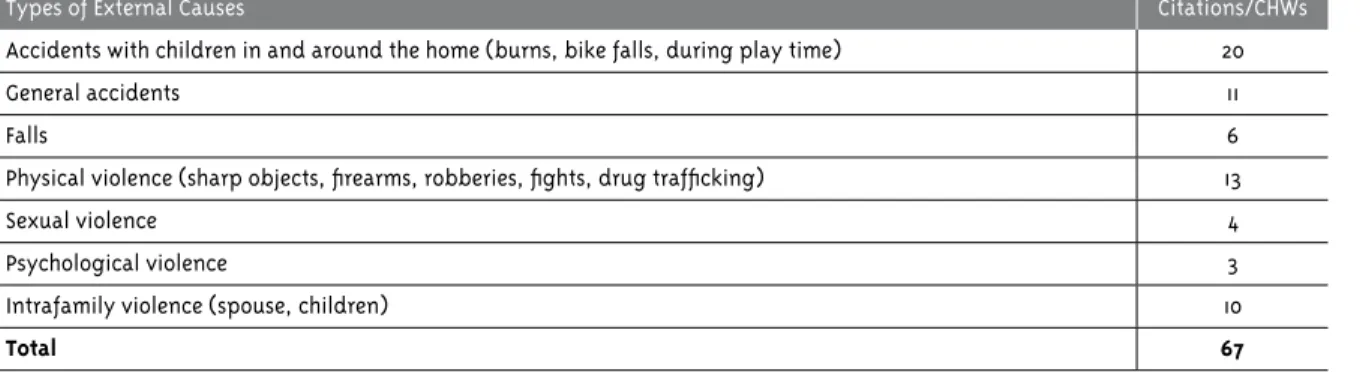
When CHWs were asked about the most common external causes they found in their work, most referred to more than one subtype. Many said they had contact with all the events as summarized in Table 2.
Overall accidents, falls, and accidents with chil-dren had 37 citations. Falls were most frequently seen among the elderly; burns, domestic accidents, and ani-mal (dog) bites were more common among children.
Studies on hospital admissions show that burns are frequently seen in children under 5. They have high risk for morbidity and death due to these causes (Brazil, 2002). Admissions due to falls are also remarkable among the elderly.
Physical violence due to gang fighting involving drugs, sharp objects, and firearms was referred thirteen (13) times in the interviews. In fact many studies show firearms as the main cause of deaths and sequelae.
Intrafamily violence was referred ten (10) times in the interviews, psychological violence three (3), and sexual violence four (4). This categorization into sub-types of violence was based on interviewees’ discourses as shown in Table 2.
While some CHWs were sensitized to this issue, others had little information or even no information at all. Ill-definitions and specific inability may make it more difficult to identify, record, manage these con-ditions.
CHW strategies for the management of morbidity due to external causes
CHWs play a central role in the management strate-gies for these conditions. Most stratestrate-gies include assis-tance at home, in groups, streets, waiting room, school, and referrals to support services, in addition to the management of care teams and services involved.
In the present study it was found that CHW management strategies most often included assistance and referrals to the health unit. Fall prevention among the elderly and common domestic accidents in children were often addressed as can be seen in the discourse below:
I ask them to remove the many rugs on the floor, an extremely smooth floor is dangerous. We try to see what is wrong at home, from the garbage outside that can be a source of rats, the elderly who are not groomed and cannot provide their own self-care, it is violence. We talk about all that, we tell children not to get close to the stove, we talk about the pet children love, some can be wild and children may te-ase them and get hurt, and dogs have flees and may cause allergies. Rugs are the most basic aspect and this is a widespread problem, it is fatal. Everything you learned you have to repeat and repeat, even a glass splinter that needs to be collected from the yard. It sounds like a stupid thing but some people don’t know it, they don’t care (Palm).
Table 2 - Relationship between type of violence and frequency of contact referred by CHWs in their microarea of work.
Types of External Causes Citations/CHWs
Accidents with children in and around the home (burns, bike falls, during play time) 20
General accidents 11
Falls 6
Physical violence (sharp objects, firearms, robberies, fights, drug trafficking) 13
Sexual violence 4
Psychological violence 3
Intrafamily violence (spouse, children) 10
Total 67
Source: Direct search, GI, Porto Alegre, 2005.
CHW reports showed that some users did not either perceive or recognize these conditions as a problem. During a home visit, CHWs have the opportunity to observe housing conditions and can identify proble-ms and provide basic assistance oriented to their reality (Ferraz and Aerts, 2005). For them, this basic assistance was not ready and required to be adjusted to people’s reality.
Health groups CHWs create in the streets can pro-vide people information about the prevailing condition in their area and its causes. According to the inter-viewees, “it is a way of preventing these conditions,” as they believe the knowledge on the most common occurrences will make people able to take actions and help prevent them.
Another strategy was basic assistance in the wai-ting room of health services. CHWs took the opportu-nity to inform users waiting to be seen. In Education in Health groups developed at the FCP, for instance, patients with high blood pressure would tell about events taking place at people’s home, or even reported them when they met CHWs on the streets.
As for referrals, CHWs reported they assisted victi-ms with information about public services that could help them manage their cases such as Women Police Station, Elderly Advocacy Services, Tutelage Council, Viva Maria Support Center (a protected shelter for women victims of violence in the city of Porto Alegre) among others.
Actions were developed aiming at prevention and intervention for conditions that seemed relevant and had an impact on the community. Most agents repor-ted positive results and that people would follow their advice. These “small rewards” seemed to have a strong encouraging effect and they continued to implement them, even thought they were isolated actions of low efficacy in general.
Family approach and action effectiveness according to CHWs: “learning how to win people’s trust”
Most CHWs (22) reported their approaches were effec-tive. Sometimes it takes long, it moves “at a snail’s pace”, but a result is achieved. CHWs seem to have a key role in the identification, prevention, and intervention of events supported by information, education, and increased awareness through home visits which are their first-choice strategy.
In regard to family approach, CHWs said they had to be “tactful,” and “learn how to win people’s trust” so they would feel confident to report what was actually happening and what factors were involved in each situation/event.
Depending on the event, we have to approach them discreetly, go step by step to get to know what actually happened. Some people don’t even want to mention it. So I get to their homes, I ask what happened, how it happened, if there was an argument. You have to be tactful to approach each family. (Violet)
Most CHWs took a direct approach to the family, they did not “beat around the bushes,” and they showed them the consequences of certain behaviors. However, when dealing events related to drug trafficking, they did not address them directly, they started by exploring “the edges” to give people time to open up and report the event.
I’m direct with the family. I seldom beat around the bush. I just don’t talk openly about drug trafficking; in these cases, we have to win them bit by bit. But I usually tell them the consequences of their beha-vior. When children are involved the family has to care about them; when dealing with parents some-times I call them names. (Tabebuia flower)
CHWs reported their approach was easier in the event of accidents while it was harder when dealing with violence or crime cases such as drug trafficking. In the event of accidents, people were given assistance and a reduction of occurrences could be seen. But while dealing with violence events, management involved not only CHW and FCP team actions but also competent authority action since, as CHWs said, “there is no use in referring people to services if competent authorities are irresponsive”.
“Better not see!”: violence management
Violence is also found within families as it includes other forms of violence rather than killing. Health providers have a key role in the management of intra-family violence (Minayo, 2004).
care at FCP and a violence case was suspected. CHWs would investigate the event by talking to the victim’s neighbors and friends to know what happened.
Most CHWs, as seen in Jasmine’s discourse below, reported they “pretended they did not see,” as they were afraid violence would be turned against them. Jasmine said CHWs should be “ethical,” they should set bounda-ries to gain access to families so they will be respected by “trafficking agents,” “the drug lords of the area”.
People are afraid, sometimes the shooting starts on Thursday and goes on over the weekend. They res-pect you, you have to set boundaries to have access. If I want to go around the neighborhood at night, they respect you. I see a lot of things and pretend not to see them, you have to be ethical and let them go by because you also live in the neighborhood, and you work at the health unit. (Jasmine)
This situation made it difficult to identify, assist, and report violence cases because CHWs and team members who had a closer contact to people also lived in the same “neighborhood”. At the same time, they were the ones more familiar with violence cases and could potentially report them. Direct contact with the victims allowed to more easily identifying them. But Tulip said that because she lived in the neighborhood they felt intimidated to take the right action, i.e., refer cases to the competent authorities:
There are many cases in my area related to external causes. As I live there, you assist people, you try to help them but you cannot go deep inside, you cannot get fully involved in the event of rape, violence. I think we cannot get too involved in our work, you have your family, and you have kids. When it is a parent with a child [sexual violence] you try to gather information, you give them advice regarding drugs but you don’t try to go deep inside.
Some CHWs did not report cases out of fear because some victim’s families were very violent. The Tutelage Council does not assure confidentiality of the repor-ting person, which prevents reporrepor-ting in many cases. A female CHW, for instance, did not regard violence as a family health issue, and reported she addressed only health-related issues but not violence cases. It evidences that, to many CHWs and service users, these events have become “naturalized,” or are just “police cases”. Violence situations can generate more
violen-ce; and negligence resulting from fear is also a form of violence. However, some CHWs did not consider this behavior negligence. One cannot criticize their attitudes because these workers often did not have any support and felt intimidated to report these cases. Besides, they also feared something could happen to their own families. These situations can be identified in the discourse below:
I work with health, I check the family’s health. In the event of a rape, it eventually bursts out but it’s not me who takes action, my approach is health-related. Yeah right, I get there and tell him he’s been abusing his daughter for seven years. I would never be able to go back to that neighborhood. Deep inside I would like to take a stand. I assist the injured people and give advice about drugs. I don’t believe in the Council, they let things get serious and do nothing. I get outraged by some things. These things make you sad because instead of protecting and helping you, they do the opposite. I don’t see much result from our work. The Council does nothing, they are funded but do nothing. You try to do your share but it doesn’t work out with the others. Everything is connected (Tulip).
One of the challenges facing health providers is to perceive and report intrafamily violence. It is estimated that only 2% of sexual child abuse within families and 6% outside the family, and about 5% to 8% of sexual abuse in adults are reported in Brazil (Brazil, 2001).
CHWs and work ability: how can they be prepared to deal with “what lies behind a door”?
With respect to CHW ability to manage these events, most (15) said they were prepared to deal with them while eleven (11) said they were not.
Among those who said they were not prepared to deal with these situations, the majority mentioned the need for improved capacity building. Bourgogne said she felt intimidated by some families, and they needed to learn how to approach them focusing on the issue of violence. Chrysanthemum mentioned the same reason for feeling intimidated, and she said they did not feel confident to take the right actions.
As for facilitating factors and difficulties of their work, most CHWs (7) said “they were welcome by people and families”. Seven (7) CHWs also mentioned they had easy approach to families in the event of accidents such as falls. But most (8) reported difficulties dealing with violence cases.
Violet said she had difficulty dealing with drug trafficking. People showed resistance to their appro-ach in these cases so “sometimes you’d better not see”. The same difficulty was reported by Jasmine and Sunflower. In the event of accidents such as falls, the approach was easier. Seven (7) CHWs also reported having problems with the response by competent authorities, their involvement and response actions supported by the team.
These CHWs reported the management of violence cases was further compromised because the support system did not work as it should. As Palm reports be-low, cases were reported but the team did not get any follow up on them or about actions taken by competent authorities.
The difficulty is to deal with violence, with the system, it doesn’t work out as it should. You visit a home, a school, come to the health unit, you report it to the Tutelage Council. You get emotionally in-volved in cases of violence involving children and elderly people. Sometimes you do not know what happened and people open up and tell you what happened, they detail the situation, you have it in your hands and do your share but you get no follow up on the case because the authorities do not give you any response, some cases even remain open. (Palm)
Petunia and her colleagues reported no difficulty approaching families. Even the most violent families would welcome her because she had a very good rela-tionship with everybody. But the difficulty lied in not getting any response, cases were passed on and they
did not give them the required attention, which was really frustrating.
A facilitating factor is that I have a very good rela-tionship with them. In my area of work most have fixed residence, I know everyone and I know how to approach them despite they being violent. Also they welcome me and I try to take their stand, to communicate with them in their own language. I try to be well-informed about the services available, and I enjoy creating groups for people to get to know each other. I have difficulty with the response, I give a lot of support to all the people I work with but when the cases are brought to the team, they don’t go there and visit them at their homes to know them, they consider it a minor issue, and this response is frustrating. (Petunia)
Lack of response from competent authorities was the most referred difficulty along with ineffective management of cases and case reportings, and inac-tion from authorities that sometimes “not even go to the place of reporting to investigate”. These were the most serious problems. These issues seem basically associated to the limits imposed to people and families resulting from difficult access to goods and services and to better quality of life.
Final considerations
CHWs directly and indirectly defined external causes as violence and accidents. Some focused their answers either on accidents or violence. These findings show that a significant number of CHWs do not perceive or understand the different dimensions of morbidity due to external causes in the community. They do not have the required resources to identify these causes and therefore are not prepared to manage them. It is believed that these situations and difficulties lead to underreporting of morbidity due to these events since CHWs provide a link to primary care and are the representatives of public authorities in direct contact with potential victims.
Most interviewees systematically developed inter-vention strategies for families as they provided assis-tance during home visits and consultations at health units on how to prevent and manage conditions. They also managed the most common external causes in their area of work through street groups, talks in waiting rooms, among others. It was found they have a key role in education, raising awareness, and involvement of people for problem management. The actions developed aiming at giving visibility, and promoting prevention and changes of morbidity causes seem to produce a major impact locally as CHWs believed their work had a positive result and their approaches were effective.
Strategies are usually employed during home visits. Approaches are gradually implemented and can produ-ce results only when CHWs are able to win a family’s trust. Their work during home visits is a first-choice instrument to tackle this issue.
The present study evidenced that external cause events or conditions call for the involvement of all health team providers and especially CHWs as they are key for approaching families and identifying risk situations. It was found that health teams were gene-rally not closely involved and provided little support for case reportings and referrals required in different situations. Isolated actions tend to be ineffective and to discourage those engaged in “hand-to-hand” work. Frequent sick leaves (as seen by the number of CHWs on sick leave at the time of the study) and sometimes absenteeism may indicate defense and protection me-chanisms to cope with suffering workers face in work situations. Another aspect is the need for community and intersectoral support to create a network of atten-tion and care services. Building capacity allied to all these components mentioned before is crucial because to identify these conditions one has to have a “sensitive eye,” which is able to denaturalize situations, provide input, and encourage people to manage them.
References
BRASIL. Ministério da Saúde. Violência
intrafamiliar: orientações para a prática em serviço.
Brasília, DF, 2001. (Cadernos de Atenção Básica, 8).
BRASIL. Conselho Nacional de Saúde (CNS). A violência nossa de cada dia. Revista da Saúde, Brasília, DF, ano III, n. 3, p. 6-11, 2002.
CHESNAIS, J. C. A violência no Brasil: causas e recomendações políticas para a sua prevenção.
Ciência e Saúde Coletiva, Rio de Janeiro, v. 4, n. 1, p.
53-69, 1999.
MINAYO, M. C. de S. Entrevista: Cecília Minayo.
Conasems, Brasília, DF, ano I, n. 4, p. 7-13, 2004. Entrevistador: G. de Paula.
FERRAZ, L.; AERTS, D. R. G. C. O cotidiano de trabalho do agente comunitário de saúde no PSF em Porto Alegre.Ciência e Saúde Coletiva, Rio de Janeiro, v. 10, n. 2, p. 347-355, 2005.
GAWRYSZEWSKI, V. P.; KOIZUMI, M. S.; MELLO-JORGE, M. H. P. de. As causas externas no Brasil no ano de 2000: comparando a mortalidade e a morbidade. Cadernos de Saúde Pública, Rio de Janeiro, v. 20, n. 4, p. 995-1003, 2004.
LEAL, S. M. C. Violência como objeto da assistência em um hospital de trauma: o ‘olhar’ da enfermagem. 2003. Dissertação [Mestrado em Enfermagem] - Universidade Federal do Rio Grande do Sul, Porto Alegre, 2003.
LOPES, M. J. M. et al. Observatório de causas externas na rede básica de saúde do município de Porto Alegre. Porto Alegre: UFRGS, EENF, 2004.
MÉDICI, A. C. As raízes econômicas da violência e seus impactos na saúde. Saúde em Debate, Pelotas, n. 34, p. 40-46, mar. 1992.
MINAYO, M. C. de S. O desafio do conhecimento: pesquisa qualitativa em saúde. São Paulo: Hucitec; Rio de Janeiro: Abrasco, 1996.
MINAYO, M. C. de S.; SOUZA, E. R. de. Violência para todos. Cadernos de Saúde Pública, Rio de Janeiro, v. 9, n. 1, p. 65-78, 1993.
ORGANIZAÇÃO MUNDIAL DA SAÚDE. Manual de classificação estatística internacional de doenças e problemas relacionados à saúde. São Paulo: Centro Colaborador da OMS para Classificação de Doenças em Português, 1996. v. 1.
PORTO ALEGRE. Secretaria Municipal de Saúde.
SANT’ANNA, A. R. Vulnerabilidade ao homicídio: sócio-história das mortes violentas dos adolescentes na cidade de Porto Alegre em 1997. 2000. Dissertação [Mestrado em Enfermagem] - Universidade Federal do Rio Grande do Sul, Porto Alegre, 2000.
SILVA, J. A. da; DALMASO, A. S. W. O agente
comunitário de saúde e suas atribuições: os desafios para os processos de formação de recursos humanos em saúde. Interface: Comunicação, Saúde, Educação, Botucatu, v. 6, n. 10, p. 75-83, 2002.