http://dx.doi.org/10.1590/0104-07072017006310015
INADEQUACIES IN THE TREATMENT OF IRON DEFICIENCY ANEMIA
AMONG CHILDREN REGISTERED IN THE NATIONAL PROGRAM OF IRON
SUPPLEMENTATION IN FLORIANOPOLIS, SANTA CATARINA, BRAZIL
Francieli Cembranel1, Arlete Catarina Tittoni Corso2, David Alejandro González-Chica3
1 Doctoral student. Post-Graduate Program in Public Health, Universidade Federal de Santa Catarina (UFSC). Florianópolis, Santa
Catarina, Brazil. E-mail: [email protected]
2 Ph.D. in Public Health. Professor, Nutrition Department and Post-Graduate Program in Nutrition, UFSC. Florianópolis, Santa
Catarina, Brazil. E-mail: [email protected]
3 Ph.D. in Epidemiology. Professor, Nutrition Department, Post-Graduate Program in Nutrition, and Post-Graduate Program in
Public Health, UFSC. Florianópolis, Santa Catarina, Brazil. E-mail: [email protected]
ABSTRACT
Objective: to identify inadequacies in the treatment of iron deiciency anemia among children enrolled in the National Program of Iron
Supplementation (PNSF) and treated at public primary health centers in Florianópolis, Santa Catarina, Brazil.
Method: a cross-sectional study was performed using secondary data obtained from the InfoSaúde system. Information was obtained on
the ferrous sulfate dose prescribed for treating iron deiciency anemia, as well as demographic and anthropometric data of all children enrolled in the program in 2010. STATA 11.0 software was used in the analysis and p-values ≤ 0.05 were considered signiicant.
Results: sixty-eight (68) of the 834 children enrolled in the program in 2010 were diagnosed as anemic; 58 of whom received an indication to use ferrous sulfate.
Conclusion: children under six months of age (65.1%), living in economically deprived areas (66.7%) and with a height/age Z-score ≥ -1.0
(52.1%) were more prone to receive inadequate supplement dosage (<3 mg/kg/day). The results are relevant to educate health professionals
about their role in effectively treating iron deiciency anemia.
DESCRIPTORS: Iron deiciency anemia. Comprehensive health care. Child. Therapeutic.
INADEQUAÇÕES NO TRATAMENTO DA ANEMIA FERROPRIVA
ENTRE CRIANÇAS CADASTRADAS NO PROGRAMA NACIONAL DE
SUPLEMENTAÇÃO DE FERRO EM FLORIANÓPOLIS, SANTA CATARINA
RESUMO
Objetivo: identiicar inadequações no tratamento da anemia ferropriva entre crianças cadastradas no Programa Nacional de Suplementação
de Ferro e atendidas em centros de saúde da rede pública de Florianópolis Santa Catarina.
Método: estudo transversal com dados secundários do sistema InfoSaúde. Foram obtidas informações sobre a dose de sulfato ferroso prescrita
para tratamento da anemia ferropriva, dados sociodemográicos e antropométricos de todas as crianças cadastradas no Programa Nacional de Suplementação de Ferro em 2010. O software STATA 11.0 foi utilizado nas análises e valoresp≤0,05 foram considerados signiicantes. Resultados: das 834 crianças cadastradas no referido programa, em 2010, 68 foram diagnosticadas como anêmicas, das quais 58 receberam
indicação para uso de sulfato ferroso.
Conclusão: crianças menores de seis meses (65,1%), residentes em áreas economicamente carentes (66,7%) e sem risco de déicit estatura/
idade (escoreZ≥ -1,0 =52,1%) tiveram maior inadequação na dosagem do suplemento recebida (<3mg/kg/dia). Os resultados são relevantes para conscientizar proissionais de saúde sobre seu papel para um efetivo tratamento da anemia ferropriva.
INADECUACIONES EN EL TRATAMIENTO DE LA ANEMIA POR
DEFICIENCIA DE HIERRO EN LOS NIÑOS INSCRITOS EN EL PROGRAMA
NACIONAL DE SUPLEMENTOS DE HIERRO EN FLORIANÓPOLIS, SANTA
CATARINA, BRAZIL
RESUMEN
Objetivo: identiicar deiciencias en el tratamiento de la anemia por deiciencia de hierro en los niños inscritos en el Programa Nacional de Suplementação de Ferro y tratados en los centros de salud pública de Florianópolis Santa Catarina, Brasil.
Método: estudio transversal con los datos secundarios del sistema InfoSaúde. Se obtuvo información sobre la dosis prescrita de sulfato de
hierro para tratar la anemia por deiciencia de hierro, datos demográicos y antropométricos de los niños inscritos en Programa Nacional de Suplementação de Ferro en 2010. El software STATA 11.0 fue usado en el análisis y los valores de p≤0,05 se consideraron signiicativos. Resultados: de los 834 niños inscritos en el programa, 68 fueron diagnosticados como anemia, de los cuales 58 recibieron indicación para
el uso de sulfato ferroso.
Conclusión: los niños menores de seis meses (65,1%), que viven en zonas económicamente desfavorecidas (66,7%) y no hay riesgo de
déicit de talla/edad (puntuaciónZ≥-1,0 =52,1%) fueron aquellos que recibieron dosiicación más inadecuada del suplemento (<3mg/kg/ día). Los resultados son relevantes para educar a profesionales de la salud acerca de su papel para el tratamiento eicaz de la anemia por deiciencia de hierro.
DESCRIPTORES: Anemia por deiciencia de hierro. Atención integral a la salud. Niño. Tratamiento.
INTRODUCTION
Among the various nutritional deiciencies, iron deiciency stands out for being one of the most important and frequent public health prob-lems in children.1 Anemia is not only present in
populations of high-income countries, but also in low- and middle-income countries. It is estimated that anemia is present in 43% of pre-school chil-dren worldwide.1 In Brazil, data from the National
Demographic Survey and Child and Women’s Health (PNDS) conducted in 2009, revealed that one in four children was anemic.2 According to a
systematic review published in the same year, the prevalence of this disease is even more worrisome in the irst two years of life, affecting up to 89.1% of children in this age group.3
Iron deiciency anemia has a considerable im-pact on children´s health, especially in the irst two years of life, as it has been associated with motor
capacity damage, learning impairments, behavioral changes, and reduced immunological capacity.4-5
Despite its severity and accumulated knowledge on its etiology, anemia prevails as a serious public health problem in Brazil.6 Efforts by various international
and national organizations to develop guidelines and policies for preventing and reducing iron deiciency anemia in children, including Iron Supplementation Programs and Food Fortiication programs, do not seem to achieve the expected effectiveness.7-11
The main focus in correcting iron deiciency is to increase hemoglobin blood levels,12 considering
that values below 11g/dL among children aged six to 59 months characterize a deiciency in this min-eral.8 Depending on the severity of iron deiciency
and type of iron supplementation chosen, treatment dosage may range from 3 to 5 mg of elemental iron per kilogram (kg) of weight per day.12-13 This
and supply daily iron requirements for appropriate growth and development, given that during this period iron obtained from food is not suficient to meet these demands.12-14 However, the low
efi-ciency of different therapeutic regimens used over the past decades for anemia treatment is striking. Several possibilities can be considered for explain-ing this occurrence; from a lack of effectiveness of the implemented treatments to problems in the bio-availability of the different iron salts and dosages, or even inadequate prescription and/or adherence to treatments, mainly due to the occurrence of side effects attributed to iron supplementation.1,15-16
Thus, given this prior knowledge, and consid-ering the magnitude of anemia as a public health issue, the present study was developed aiming to identify possible inadequacies in treating iron dei-ciency anemia among children who were attended in public primary health centers in Florianópolis, Santa Catarina, Brazil, and enrolled in the National Program of Iron Supplementation (PNSF)10 in 2010.
The study also aimed to analyze this information according to sociodemographic characteristics and nutritional status to help identify child segments that are more exposed to anemia and inadequacies in their treatment, which may be the target of public health actions for correctly treating this disease.
METHOD
The study was carried out in the city of Flori-anópolis, the state capital of Santa Catarina, Southern Brazil. According to the population census conducted by the Brazilian Institute of Geography and Statistics (IBGE) in 2010, Florianópolis had a population of ap-proximately 421,240 inhabitants, among which 18,222 were children up to four years of age.17
This is a cross-sectional study, using sec-ondary data from the InfoSaúde system (version 3.4.5.45). This system was created in 2002 by the Informatics Department of the Municipal Health Department (SMS) of Florianópolis, storing indi-vidual medical records of all patients attended at computerized health centers of the public network in the municipality. At the beginning of 2010, 35/49 health centers in the public health network in Flori-anópolis had implemented the InfoSaúde system.18
Data for this study was obtained from these 35 computerized health centers, which were distrib-uted in the ive health districts of the municipality:
Central (5/6), Mainland (9/11), East (4/9), North (6/11) and South (11/13). The population served in these 35 health centers corresponds to 80% of the total residents of the municipality. Gender and age distribution of the population was similar among those living or not living in the areas covered by InfoSaúde.19
According to the Ministry of Health, all chil-dren under two years of age who attended public health centers at the municipality should have been enrolled in the PNSF,10 and therefore registered in
the InfoSaúde system. For that reason, all children enrolled in the PNSF in Florianópolis in 2010 were considered eligible for this study. Obtaining the in-formation of interest20 took place in two stages
(Fig-ure 1 shows the study lowchart). Firstly, all PNSF records were checked between July and October 2011 to identify all children enrolled in that program in 2010. Secondly, electronic medical records of all these children were reviewed. Access to the medical records was carried out directly at the Informatics Department of the SMS and information obtained from the system was identiied.
Three different indicators were considered as dependent variables of the study. The irst indicator evaluated was the availability of laboratory blood examination for hemoglobin levels (yes/no), regard-less of the presence of the corresponding results in the electronic medical records. It is noteworthy that this laboratory blood test is not a requirement of the PNSF, although it could be considering the high prevalence of anemia in the investigated age group.1,10
A second indicator was the presence of anemia among those whose hemoglobin laboratory results was recorded. In order to establish the diagnosis of anemia, the World Health Organization (WHO)8
criterion was adopted (hemoglobin level below 11.0 g/dL for children between six months and six years of age).
Figure 1 - Study Flowchart, Florianópolis-SC, 2014
Independent variables investigated in this study were also obtained from InfoSaúde and include child’s gender (female or male); child’s age (0-6 months, 7-12 months, 13-24 months); mother’s skin color (white, black, brown, asiatic, or indigenous); mother’s education level in years of studying (0-8, 9-11, 12 or more); and geographical location of the health center (Center, Mainland, East, North and South).
In addition to sociodemographic variables, anthropometric data regarding weight (kg) and height (cm) were also obtained from the medical records and used to evaluate the child’s nutritional status at the time of the hemoglobin test. Nutritional status was evaluated through height/age indexes and body mass index (BMI)/age, expressed as mean Z-scores using the WHO Anthro 2005 software (De-partment of Nutrition, WHO, Geneva, 2006), and the following cut-off points proposed by WHO (2006):21
Z-score < -1.0 nutritional risk and Z-score ≥ -1.0 no risk of malnutrition.
Data corresponding to the dependent and independent variables were typed in a spreadsheet
using the Microsoft Ofice Excel@ 2007 program (
Mi-crosoft Corp., United States), and double checked to avoid possible typing errors. Statistical analysis was performed using the STATA 11.0 software (Stata Corp., College Station, United States). The number of health centers included in the study as well as the population covered by them were considered to estimate sample weights, and a set of STATA survey commands used in the analyzes. For descrip-tive statistics, data was presented as prevalence with their respective 95% conidence intervals (95% CI), adopting the Chi-Square statistical test with Rao-Scott correction to verify possible associations between the variables in the bivariate analyzes. Student’s t-test was also used to compare the mean Z-score of the anthropometric indices in anemic compared to non-anemic children. A p-value ≤0.05 was considered as statistically signiicant.
The project received formal authorization from the SMS Florianopolis and was approved by the Ethics Committee in Research with Hu-man Beings of the Universidade Federal de Santa Catarina (2042/2011). There are no conlicts of interest to declare.
Children with the ferrous sulfate dosage record prescribed by the doctor
(n=58)
Children without the ferrous sulfate dosage record prescribed by the doctor
(n=10) Children with anemia
Hb < 11 g/dL (n=68)
Children without anemia Hb ≥ 11 g/dL
(n=55) Children without record
of the exam results (n=172)
Children with the record of exam results
(n=123)
Children enrolled in the National Program of Iron Supplementation in Florianópolis-SC, Brazil, in 2010
(n=834)
Hemoglobin laboratory examination recorded on the child’s medical record
(n=295)
Children without hemoglobin laboratory examination record
RESULTS
Of the 834 children identiied as registered in the PNSF in 2010, 295 (35.4%) had their hemoglobin laboratory examination registered in their records.
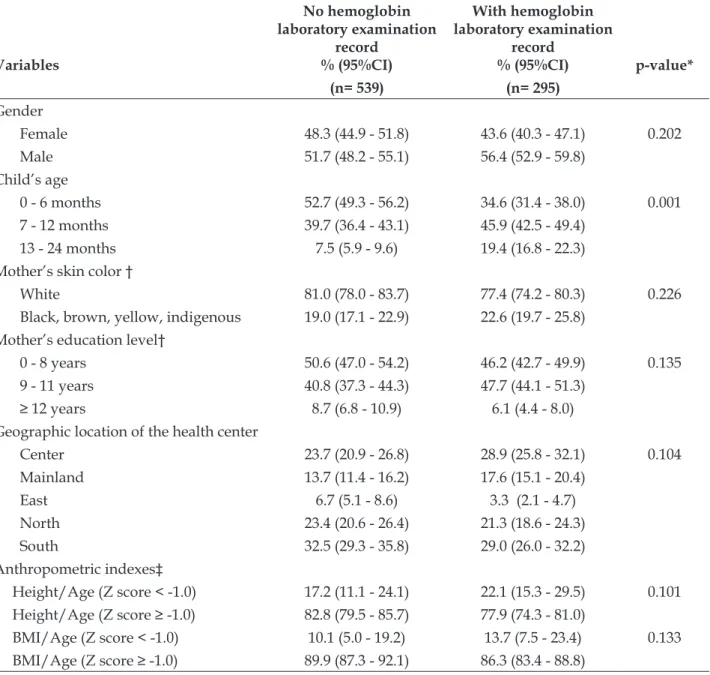
Except for child´s age (P<0.001), no differences were found according to sociodemographic variables or anthropometric indices among the 295 children who had their hemoglobin laboratory exam recorded and the 539 who did not (Table 1).
Table 1 - Distribution of children with and without hemoglobin laboratory examination record according to sociodemographic characteristics and nutritional status. Florianópolis-SC, Brazil, 2014
Variables
No hemoglobin laboratory examination
record % (95%CI)
With hemoglobin laboratory examination
record
% (95%CI) p-value*
(n= 539) (n= 295)
Gender
Female 48.3 (44.9 - 51.8) 43.6 (40.3 - 47.1) 0.202
Male 51.7 (48.2 - 55.1) 56.4 (52.9 - 59.8)
Child’s age
0 - 6 months 52.7 (49.3 - 56.2) 34.6 (31.4 - 38.0) 0.001
7 - 12 months 39.7 (36.4 - 43.1) 45.9 (42.5 - 49.4)
13 - 24 months 7.5 (5.9 - 9.6) 19.4 (16.8 - 22.3)
Mother’s skin color †
White 81.0 (78.0 - 83.7) 77.4 (74.2 - 80.3) 0.226
Black, brown, yellow, indigenous 19.0 (17.1 - 22.9) 22.6 (19.7 - 25.8) Mother’s education level†
0 - 8 years 50.6 (47.0 - 54.2) 46.2 (42.7 - 49.9) 0.135
9 - 11 years 40.8 (37.3 - 44.3) 47.7 (44.1 - 51.3)
≥ 12 years 8.7 (6.8 - 10.9) 6.1 (4.4 - 8.0)
Geographic location of the health center
Center 23.7 (20.9 - 26.8) 28.9 (25.8 - 32.1) 0.104
Mainland 13.7 (11.4 - 16.2) 17.6 (15.1 - 20.4)
East 6.7 (5.1 - 8.6) 3.3 (2.1 - 4.7)
North 23.4 (20.6 - 26.4) 21.3 (18.6 - 24.3)
South 32.5 (29.3 - 35.8) 29.0 (26.0 - 32.2)
Anthropometric indexes‡
Height/Age (Z score < -1.0) 17.2 (11.1 - 24.1) 22.1 (15.3 - 29.5) 0.101
Height/Age (Z score ≥ -1.0) 82.8 (79.5 - 85.7) 77.9 (74.3 - 81.0)
BMI/Age (Z score < -1.0) 10.1 (5.0 - 19.2) 13.7 (7.5 - 23.4) 0.133
BMI/Age (Z score ≥ -1.0) 89.9 (87.3 - 92.1) 86.3 (83.4 - 88.8)
95%CI: 95% Conidence Interval. * p-value of the chi-square test. † Maternal variables with missing data, where children without labora
-tory examination n=497 and children with labora-tory examination n=266. ‡ Child’s variable with missing data, where children without laboratory examination n=488, and children with laboratory examination n=262.
Among the 295 children whose hemoglobin laboratory tests were registered, only 123 had the result of their hemoglobin level recorded in their electronic medical record. Table 2 shows the char-acteristics of these 123 children distributed in two
of 7-12 months, with mothers having white skin color and lower educational level (≤ 8 years of study), and children with better nutritional status (Z-score ≥ -1.0) was observed in the group of anemic children.
Regarding the geographical location of the health center, a greater percentage of anemic children were identiied in the health centers of the Center, Main-land and North health districts of Florianópolis-SC.
Table 2 - Distribution of children with and without anemia according to sociodemographic characteristics and nutritional status. Florianópolis-SC, 2014
Variables
With anemia (Hb<11 g/dL)
Without anemia
(Hb≥11 g/dL) p-value* % (95%CI)
(n=68)
% (95%CI) (n=55)
Gender
Female 36.6 (28.1 - 45.7) 48.1 (38.9 - 57.2) 0.225
Male 63.4 (54.3 - 71.9) 51.9 (42.8 - 61.1)
Child’s age
0 - 6 months 34.9 (26.6 - 44.1) 23.3 (16.4 - 32.1) 0.342
7 - 12 months 40.7 (31.9 - 49.9) 52.4 (42.8 - 61.1)
13 - 24 months 24.3 (17.1 - 33.0) 24.3 (17.1 - 33.0)
Mother’s skin color†
White 74.0 (64.6 - 81.5) 81.2 (73.2 - 88.2) 0.361
Black, brown, yellow, indigenous 26.0 (18.5 - 35.4) 18.8 (11.8 - 26.8) Mother’s education level†
0 - 8 years 51.0 (41.4 - 60.4) 42.4 (32.9 - 51.7) 0.346
9 - 11 years 40.8 (32.1 - 50.8) 53.7 (43.9 - 62.9)
≥ 12 years 8.2 (3.7 - 14.5) 3.9 (1.0 - 8.7)
Geographic location of the health center
Center 38.6 (29.6 - 47.4) 28.5 (20.7 - 37.3) 0.375
Mainland 20.8 (14.3 - 29.4) 16.5 (10.2 - 24.0)
East 2.4 (0.5 - 7.0) 3.0 (0.9 - 8.1)
North 22.1 (15.0 - 30.3) 15.9 (10.2 - 24.0)
South 16.1 (10.2 - 24.0) 36.1 (27.3 - 44.9)
Anthropometric indexes‡
Height/Age (Z score < -1.0) 20.7 (11.2 - 33.4) 16.0 (7.2 - 29.1) 0.532
Height/Age (Z score ≥ -1.0) 79.3 (66.7 - 88.8) 84.0 (70.9 - 92.8)
BMI/Age (Z score < -1.0) 25.9 (15.3 - 39.0) 14.0 (5.8 - 26.7) 0.127
BMI/Age (Z score ≥ -1.0) 74.1 (61.0 - 84.7) 84.0 (73.3 - 94.2)
95%CI: 95% Conidence Interval. * p-value of the chi-square test. † Maternal variables with missing data, where Children with anemia n=62, and children without anemia n=52; ‡ Child’s variable with missing data, where children with anemia n=58, and children without anemia n=50.
Table 3 presents the mean of hemoglobin levels,
height/age and BMI/age Z-scores, and age of anemic and non-anemic children. Only the hemoglobin levels were different between the groups (p<0.001).
Table 3 – Mean hemoglobin, anthropometric indices and age of the sample and of children with and without anemia enrolled in the National Program of Iron Supplementation. Florianópolis-SC, 2014
Variables
Sample (Mean±SD)
Children with anemia (Mean±SD)
Children without
anemia (Mean±SD)
p-value*
Hemoglobin levels (g/dL) (n= 123) 10.8 ± 1.2 9.9 ± 0.8 11.8 ± 0.5 0.001
Height/age (Z score) (n= 108)† 0.10 ± 1.3 0.09 ± 1.3 0.1 ± 1.3 0.895
BMI/Age (Z score) (n= 108)† 0.04 ± 1.2 0.01 ± 1.3 0.08 ± 1.1 0.764
Age (months) (n= 123) 10.7 ± 3.7 9.8 ± 3.8 10.4 ± 3.6 0.441
SD: standard deviation; * p-value of the T-test; † Variables with missing data
Table 4 presents a comparison of the mean daily iron dosage received by anemic children for treating their condition (children with laboratory diagnosis and supplementation dose prescribed by a physician, n=58), . Generally speaking, children residing in the Central and Southern health districts, and those with adequate height for age (Z-score ≥ -1.0) were those that received lower mean iron dos-age per kg/day than the minimum amount recom-mended for treating anemia (3 mg/kg/day; p<0.05
in both cases). Moreover, female children younger than six months with mothers having white skin color and a higher educational level were those that presented the highest percentage of inadequacy. However, these differences were not statistically signiicant. A statistical signiicance was found only for the height/age variable (52.1% for those with Z-score ≥ -1.0, p=0.04), and for the residing health district (66.7% inadequacy for residents in the Cen-tral and Southern districts, p=0.026).
Table 4 - Comparison of the prescribed dosage of ferrous sulphate with the recommendations by the Brazilian Pediatrics Society (3 mg/kg/day) among children with a laboratory diagnosis of anemia and record of ferrous sulfate dose prescribed by the physician. Florianópolis-SC, 2014. (n=58)
Variables
Ferrous sulphate dosage in mg/kg/day
Inadequacy of the prescribed dose
(< 3 mg/kg/day) p-value† Median (p25-p75) p-value* % (95%CI)
Gender
Female 2.9 (0.5 - 4.3) 0.321 49.4 (36.6 - 63.4) 0.825
Male 3.3 (1.3 - 4.6) 46.5 (33.3 - 60.1)
Child’s age
0 - 6 months 2.2 (0.9 - 4.1) 0.153 65.1 (51.9 - 77.5) 0.112
7 - 12 months 3.7 (2.1 - 4.9) 33.5 (21.0 - 46.3)
13 - 24 months 3.1 (1.0 - 4.6) 42.2 (28.6 - 55.1)
Mother’s skin color†
White 2.7 (0.5 - 4.6) 0.650 53.5 (38.6 - 66.7) 0.280
Variables
Ferrous sulphate dosage in mg/kg/day
Inadequacy of the prescribed dose
(< 3 mg/kg/day) p-value† Median (p25-p75) p-value* % (95%CI)
Mother’s education level†
0 - 8 years 3.2 (0.5 - 4.6) 0.951 43.2 (29.8 - 57.7) 0.355
9 - 11 years 3.0 (1.0 - 4.2) 47.9 (33.3 - 61.4)
≥ 12 years 2.4 (1.8 - 2.5) 79.9 (65.9 - 89.2)
Geographic location of the health center
Center 1.9 (0.4 - 4.4) 0.008 66.7 (53.7 - 79.0) 0.026
Mainland 3.6 (3.2 - 4.4) 25.0 (15.3 - 39.0)
Easta - -
North 4.5 (4.0 - 4.9) 2.0 (1.1 - 3.3)
South 2.5 (1.9 - 3.1) 66.7 (53.7 - 79.0)
Anthropometric indexes‡
Height/Age (Z score < -1.0) 4.4 (3.8 - 5.2) 0.009 11.5 (4.5 - 24.3) 0.040
Height/Age (Z score ≥ -1.0) 2.7 (0.9 - 4.0) 52.1 (37.4 - 66.3)
BMI/Age (Z score < -1.0) 1.8 (0.5 - 4.9) 0.615 61.1 (47.2 - 75.4) 0.251
BMI/Age (Z score ≥ -1.0) 3.1 (1.9 - 4.3) 40.2 (26.4 - 54.8)
95%CI: 95% Conidence Interval; a - No records of anemia treatment in this geographical area. * p-value of the Kruskal-Wallis test; † p-value of the Chi-square test; ‡ Maternal variables with missing data, where children with prescribed dosage of ferrous sulfate n=53; § Maternal variables with missing data, where children with prescribed dosage of ferrous sulfate n=50.
DISCUSSION
The purpose of this study was to identify possible inadequacies in the treatment of iron de-iciency anemia among children enrolled in the PNSF in Florianópolis, SC, Brazil. Based on our results, three main conclusions can be highlighted. First, laboratory exams for blood hemoglobin levels were performed in a little more than a third of the children, but in less than half of them the examina-tion results were registered in their medical records. Second, among anemic children, 85.3% of the medi-cal records included the physicians’ prescription for using iron to treat the disease. Finally, a high percentage of inadequacy of the prescribed ferrous sulfate dosage was found, especially among females, children under the age six months, those who at-tended health centers in the Central and Southern districts of the municipality, and among those who were not at risk of height/age deicit.
Nutritional anemia due to iron deiciency be-gins early in life and is related to prematurity and low birth weight, early weaning and inadequate complementary feeding initiated after birth.22 In
Brazil, it is estimated that up to 54% of children
un-der two years of age are anemic.23 For that reason,
several national health policies were implemented, such as the corn and wheat lour iron and folic acid fortiication7,11 and the PNSF,10 which intended to
offer iron supplementation to all children in the age group of six to 18 months.
Despite all these investments to prevent and reduce the prevalence of this disease in children, anemia still remains as a neglected disease.7-9 This
is especially because those strategies are not always fully or properly implemented. For example, of the total number of children in the PNSF age group in Florianópolis in 2010 (n=13,197), only 834 were identiied as being enrolled in the program, and only 2.4% started and concluded their supplemen-tation with the recommended periodicity for their age group.20 Moreover, due to its prophylactic
guide health professional’s behavior regarding the objective of the prescription, whether prophylactic or therapeutic, as an early intervention can increase the quality of life of the child, avoiding the long-term negative repercussions of this disease.10
In the present study, blood test examinations were requested for approximately one-third of the children included in the PNSF, and among these, only 42.0% had their hemoglobin levels recorded in the medical record, and 55.3% of them had anemia. These indings are similar to the results included in a systematic review,23 which showed 60.2% of
chil-dren under the age ive years age attending public health services in Brazil were anemic. What is most striking about these results was the low number of children who had the examination results registered in their medical record, which may be indicative of health professionals failing to record the infor-mation or because the child did not return to the consultations during the irst year of life. Although adequate illing of information systems is funda-mental for planning and management of health services, a high degree of omission in completing medical records has been observed in clinical prac-tice, mainly due to the low epidemiological value given to that kind of information.24
Additionally, of the 68 children diagnosed as anemic, only 85.3% had a record of prescriptions for the use of iron salts. This result is quite serious considering that among anemic children, 10 had no record of any treatment indication, and 12 were recommended the PNSF prophylactic dose (25 mg of elemental iron once a week - data not included in the tables), a much lower dosage than that required for treatment of this disease. The recommended doses vary from 3 to 5 mg of elemental iron per kg/day for a period of two to six months, depend-ing on the intensity of anemia, tolerance to treat-ment and correction of the cause that led to iron deiciency.14-15 It is known that early treatment of
anemia is essential during early childhood.25
Com-plete adequacy to this recommendation, however, was not observed in the present study. According to the analyzed data, children up to six months of age were the ones with the highest percentage of inadequacy regarding the treatment dose received (almost twice as high as in older children).
In addition, it was still possible to verify that children at nutritional risk (height/age Z-score <-1.0) were those with the lowest percentage of inadequacy regarding the ferrous sulfate dose for treating anemia. Therefore, our results suggest that the choice of treatment dosage may be inluenced by
the physical appearance of the children and not nec-essarily by the hemoglobin laboratory results. In ad-dition, the study also identiied that anemic children presented lower height/age and BMI/age Z-scores than non-anemic, although the last difference was not statistically signiicant. This result was similar to that found by other authors who analyzed the same relationship among children enrolled in day care centers in Belo Horizonte, Minas Gerais.26 According
to these authors, one of the hypotheses explaining the relationship between anemia and nutritional risk/malnutrition is that both nutritional conditions present common risk factors, such as an inadequate diet, dificulties in accessing health care, and lower parental educational levels. Other authors have also found an association of these nutritional conditions with socioeconomic variables.27 In this study, this
relationship becomes clear when we observe that a higher prevalence of inadequacy in the supple-ment dosage received among anemic children was identiied among those served by health centers in the Central and Southern areas of the municipality, services that mostly attend to the most economically deprived population in Florianópolis.28
Finally, the use of secondary data is a limita-tion of this study. Using secondary data often re-stricts the study to the available variables, making the investigation of other determinants unfeasible. Moreover, the use of this type of data imposes the need to work with missing information on the re-cords. However, it is unlikely that such limitation affected the scientiic contribution of this investiga-tion, as the study was carried out with data from 35 health centers, and the individuals using these services are representative of the municipality’s population in this age group. It should be empha-sized, however, that the external validity of the results found by this study should be carefully analyzed, since the PNSF coverage in Florianópolis in 2010 was low.20 Still, our results can be considered
as an initial exploratory analysis with the purpose of guiding further investigations with primary data, adequate sample size and that include all children attended by the health centers.
CONCLUSION
children under two years of age, and which could guide the prescription of adequate ferrous sulfate doses when children are diagnosed with anemia. We also suggest encouraging a routine procedure for completing information systems, which can be useful for evaluating and planning health actions.
Acknowledgements
To the Municipal Health Department of Flori-anópolis, Santa Catarina, especially to the Depart-ment of Informatics, which enabled us to access the InfoSaúde System. To the Postgraduate Program in Nutrition of the Federal University of Santa Catarina and the Coordination of Improvement of Higher Education Personnel (Capes), which made the de-velopment of this research possible by granting a Master’s degree Scholarship.
REFERENCES
1. Stevens GA, Finucane MM, De-Regil LM, Paciorek
CJ, Flaxman SR, Branca F, et al. Global, regional, and national trends in haemoglobin concentration and prevalence of total and severe anaemia in children and pregnant and non-pregnant women for 1995-2011: a systematic analysis of population-representative data. Lancet Glob Health 2013; 1(1):e16-e25.
2. Brasil. Pesquisa Nacional de Demograia e Saúde da
Criança e da Mulher (PNDS) 2006: dimensões do processo reprodutivo e da saúde da criança. Brasília: 2009.
3. Jordão RE, Bernardi JL, Barros Filho A de A.
Prevalência de anemia ferropriva no Brasil: uma revisão sistemática. Rev Paul. Pediatr. 2009; 27:90-8.
4. Lopez A, Cacoub P, Macdougall IC, Peyrin-Biroulet L.
Iron deiciency anaemia. Lancet. 2016; 387(10021):907-16.
5. Parkin PC, DeGroot J, Maguire JL, Birken CS, Zlotkin
S. Severe iron-deficiency anaemia and feeding practices in young children. Public Health Nutr. 2016; 19(4):716-22.
6. World Health Organization. Worldwide prevalence
of anaemia 1993–2005: WHO global database on anaemia. Geneva, 2008.
7. Lamounier JA, Capanema FD, Rocha DS, Silva MC,
Almeida CA. Iron fortification strategies for the control of childhood anemia in Brazil. J Trop Pediatr. 2010; 56(6):448-51.
8. World Health Organization. Iron deiciency anaemia:
assessment, prevention and control, a guide for programme managers. Geneve: WHO; 2001.
9. Azeredo CM, Cotta RMM, Silva LS, Franceschini SCC,
Sant’Ana LFR, Lamounier JA. Problems of adherence to the program of prevention of iron deiciency anemia and supplementation with iron salts in the city of Viçosa, Minas Gerais, Brazil. Ciên. Saúde Coletiva, 2013; 18(3):827-36.
10. Brasil. Ministério da Saúde. Portaria nº 730 de 13 de Maio de 2005. Institui o Programa Nacional de Suplementação de Ferro, destinado a prevenir a anemia ferropriva e dá outras providências. Brasília: Ministério da Saúde; 2005.
11. Assunção MC, Santos IS, Barros AJ, Victora CG. Flour fortification with iron has no impact on anaemia in urban Brazilian children. Public Health Nutr. 2012;15(10):1796-801.
12. Braga JAP, Vitalle MSS. Deiciência de ferro na criança. Rev. Bras. Hematol. Hemoter. 2010; 32(Suppl 2):38-44. 13. Baumgartner J, Barth-Jaeggi T. Iron interventions
in children from low-income and middle-income populations: beneits and risks. Curr Opin Clin Nutr Metab Care. 2015; 18(3):289-94.
14. Bhargava S, Meurer LN, Jamieson B, Hunter-Smith D.
Clinical inquiries. What is appropriate management of iron deiciency for young children? J Fam Pract. 2006; 55(7):629-30.
15. Pasricha SR, Hayes E, Kalumba K, Biggs BA Effect of
daily iron supplementation on health in children aged 4-23 months: a systematic review and meta-analysis of randomised controlled trials. Lancet Glob Health. 2013; 1(2):e77-86.
16. Cembranel F, Dallazen C, González-Chica DA. Efetividade da suplementação de sulfato ferroso na prevenção da anemia em crianças: revisão sistemática da literatura e metanálise. Cad. Saúde Pública 2013; 29(9):1731-51.
17. Brasil. Instituto Brasileiro de Geograia e Estatística. Censo Populacional 2010. [acesso 2015 Oct 01]. Disponível em: http://cidades.ibge.gov.br/painel/ populacao.php?lang=&codmun=420540&search=s anta-catarina|lorianopolis|infograicos:-evolucao-populacional-e-piramide-etaria
18. Secretaria Municipal de Saúde de Florianópolis (BR). Departamento de Informática. Sistema INFOSAUDE: sistema de agendamento de consultas e prontuário eletrônico do paciente do município de Florianópolis. Florianópolis(SC): Prefeitura Municipal; 2011. 19. Prefeitura Municipal de Florianópolis. Secretaria
Municipal de Saúde. Indicadores de Saúde (2004-2009): Situação da base de dados nacional 2010 [acesso 2015 Oct 01]. Disponível em: http://esflop.blogspot. com.br/2011/01/centros-de-saude-por-distritos. html; e http://www.pmf.sc.gov.br/sistemas/saude/ unidades_saude/populacao/uls_2010_index.php 20. C e m b r a n e l F , C o r s o A C T , G o n z á l e z - C h i c a
DA. Coverage and adequacy of ferrous sulfate supplementation in the prevention of anemia among children treated at health centers of Florianopolis, Santa Catarina. Rev Paul Pediatr 2013; 31(3):315-23.
21. World Health Organization. WHO child growth
22. Burke RM, Leon JS, Suchdev PS. Identification, prevention and treatment of iron deiciency during the irst 1000 days. Nutrients. 2014; 6(10):4093-114.
23. Vieira RCS, Ferreira HS. Prevalência de anemia em
crianças brasileiras, segundo diferentes cenários epidemiológicos. Rev Nutr 2010; 23(3):433-44.
24. Silva LP, Moreira CMM, Amorim MHC, Castro DS,
Zandonade E. Evaluation of the quality of data in the live birth information system and the information system on mortality during the neonatal period in the state of Espírito Santo, Brazil, between 2007 and 2009. Ciênc. Saúde Coletiva 2014; 19(7):2011-20.
25. Cançado RD, Lobo C, Friedrich JR. Treatment of iron
deiciency anemia with oral iron. Rev. Bras. Hematol. Hemoter. 2010; 32(Supl. 2):114-20.
26. Rocha DS, Capanema FD, Pereira Netto M, Franceschini SC, Lamounier JA. Prevalence and risk factors of anemia in children attending daycare centers in Belo Horizonte-MG. Rev Bras Epidemiol. 2012; 15:675-84. 27. Sousa FGM, Araújo TL. Fatores de risco para carência nutricional de ferro em crianças de seis a sessenta meses na perspectiva do modelo campo de saúde. Texto Contexto Enferm 2004; 13(3):420-6.
28. Instituto de Planejamento Urbano de Florianópolis
– IPUF/SC. Peril de áreas carentes. Florianópolis, Coordenadoria de Planejamento Habitacional, 2011.
Correspondence: Francieli Cembranel
Programa de Pós-Graduação em Saúde Coletiva 1º andar do Bloco H do Centro de Ciências da Saúde
Universidade Federal de Santa Catarina 88040-900 – Trindade, Florianópolis, SC, Brasil E-mail: [email protected]