Sao Paulo Med J. 2010; 128(1):10-3
10
Original article
Risk factors for cardiovascular disease ten years
after preeclampsia
Fatores de risco para doença cardiovascular dez anos após pré-eclâmpsia
Ivete Cristina Teixeira Canti
I, Márcia Komlós
II, Sérgio Hofmeister Martins-Costa
III, José Geraldo Lopes Ramos
IV,
Edison Capp
V, Helena von Eye Corleta
VHospital de Clínicas de Porto Alegre (HCPA), Universidade Federal do Rio Grande do Sul (UFGS), Porto Alegre, Rio Grande do Sul, Brazil
IMD. Postgraduate student on Medical Sciences program, Universidade Federal do Rio Grande do Sul (UFRGS), Porto Alegre, Rio Grande do Sul, Brazil. IIMD. Pediatric radiologist and Neuroradiology fellow, Cincinnati Children’s Hospital Medical Center, Cincinnati, United States.
IIIMD. Postgraduate student on Medical Sciences program and assistant professor, Department of Gynecology and Obstetrics, School of Medicine, Hospital de Clínicas de Porto Alegre
(HCPA), Universidade Federal do Rio Grande do Sul (UFRGS), Porto Alegre, Rio Grande do Sul, Brazil.
IVMD. Associate professor of postgraduate Medical Sciences program, Department of Gynecology and Obstetrics, School of Medicine, Hospital de Clínicas de Porto Alegre (HCPA),
Universidade Federal do Rio Grande do Sul (UFRGS), Porto Alegre, Rio Grande do Sul, Brazil.
VMD. Associate professor of postgraduate Medical Sciences program, Department of Gynecology and Obstetrics, School of Medicine, and researcher, Gynecology and Molecular
Obstetrics Laboratory, Hospital de Clínicas de Porto Alegre (HCPA), Universidade Federal do Rio Grande do Sul (UFRGS), Porto Alegre, Rio Grande do Sul, Brazil.
ABSTRACT
CONTEXT AND OBJECTIVE: Preeclampsia is a gestational disease that occurs mainly among nulliparous women after the 20th week of gestation, and
frequently close to delivery. The effects of preeclampsia on women’s blood pressure over the long term are still controversial. Patients with recurrent preeclampsia or preeclampsia in the early stages of pregnancy appear to present higher risk of hypertension. The aim of this study was to determine the risk factors for cardiovascular disease among women with preeclampsia 10 years earlier.
DESIGN AND SETTING: Cross-sectional study at Hospital de Clínicas de Porto Alegre (HCPA).
METHODS: Forty women with preeclampsia and 14 normotensive pregnant women followed up 10 or more years earlier at HCPA underwent clinical and laboratory examinations. Spearman’s correlation coeficient was used to correlate body mass index (BMI) and systolic and diastolic pressures. The risk of developing hypertension was measured using the chi-square test. P < 0.05 was considered signiicant.
RESULTS: The patients with preeclampsia 10 or more years earlier had signiicantly higher diastolic blood pressure (P = 0.047), BMI (P = 0.019) and abdominal circumference (P = 0.026). They presented positive correlations between BMI and diastolic blood pressure (0.341; P = 0.031) and between BMI and systolic blood pressure (0.407; P = 0.009).
CONCLUSION: The patients with preeclampsia 10 or more years earlier had signiicantly higher diastolic blood pressure, BMI and abdominal circumference than did the control group. This emphasizes the importance of long-term follow-up assessment for cardiovascular risk factors among patients with preeclampsia.
RESUMO
CONTEXTO E OBJETIVO: Pré-eclâmpsia é uma doença gestacional que ocorre principalmente em mulheres nulíparas, após a vigésima semana de gestação e frequentemente próximo do parto. Os efeitos da pré-eclâmpsia sobre a pressão sanguínea das mulheres a longo prazo ainda são controversos. Pacientes com pré-eclâmpsia recorrente ou pré-eclâmpsia na fase inicial da gestação parecem apresentar maior risco para hipertensão. O objetivo foi determinar os fatores de risco para doença cardiovascular em mulheres com pré-eclâmpsia há 10 anos.
TIPO DE ESTUDO E LOCAL: Estudo transversal, realizado no Hospital de Clínicas de Porto Alegre (HCPA).
MÉTODO: Quarenta mulheres com pré-eclâmpsia e 14 mulheres grávidas com pressão arterial normal acompanhadas há 10 anos ou mais no HCPA foram submetidas a exames clínicos e laboratoriais. Para se encontrar a correlação entre índice de massa corporal (IMC) e as pressões sistólica e diastólica, foi calculado o coeiciente de correlação de Spearman. O risco de desenvolvimento de hipertensão foi calculado através do teste de qui-quadrado. P < 0,05 foi considerado signiicante.
RESULTADOS: Pacientes com pré-eclâmpsia há 10 anos ou mais tiveram pressão arterial diastólica (PAD) (P = 0,047), IMC (P = 0,019) e circunferência abdominal (P = 0,026) mais elevadas e apresentaram correlações positivas entre IMC e PAD (0,341, P = 0,031) e sistólica (0,407, P = 0,009).
CONCLUSÃO: As pacientes com pré-eclâmpsia há 10 anos ou mais apresentaram pressão arterial diastólica, IMC e circunferência abdominal mais elevadas que o grupo controle. Isso enfatiza a importância de acompanhamento por longo tempo para avaliar fatores de risco cardiovascular em pacientes com pré-eclâmpsia prévia.
KEY WORDS: Pre-eclampsia. Eclampsia.
Cardiovascular diseases. Hypertension. Proteinuria.
PALAVRAS-CHAVE: Pré-eclâmpsia. Eclampsia.
Doenças cardiovasculares. Hipertensão.
Risk factors for cardiovascular disease ten years after preeclampsia
Sao Paulo Med J. 2010; 128(1):10-3
11
INTRODUCTION
Preeclampsia is a gestational disease that occurs mainly among nul-liparous women, particularly after the 20th week of gestation, and most
frequently close to the time of birth. It is diagnosed when the patient presents blood pressure of 140/90 mmHg or more, in two separate mea-surements at least four to six hours apart, and proteinuria (> 0.3 g/24 h).1,2 he incidence of preeclampsia is approximately 3-5%,1,3,4 although
in some populations it may reach up to 10%.5 Its prevalence is also
vari-able: 10 to 20%.6
he efects of preeclampsia on maternal blood pressure are still con-troversial7 Women with preeclampsia appear to have higher risk of
de-veloping hypertension in subsequent pregnancies. his risk is higher among nulliparous women with preeclampsia, in whom it starts earlier in the pregnancy (risk of up to 40%).8,9 he incidence of elevated
sys-temic arterial pressure (SAP, i.e. diastolic arterial pressure ≥ 100 mmHg) was found to be 21.8% among women over 33 years of age who had had hypertension in a previous pregnancy, and only 10% (expected for the population) among women who had remained normotensive dur-ing pregnancy.10 Women who had had serious preeclampsia and those
who had had eclampsia during their irst pregnancy had signiicantly higher incidence of elevated SAP than shown by the general popula-tion, particularly when the period studied was longer than 10 years. Patients with recurrent preeclampsia and those in whom preeclampsia started during the early stages of pregnancy presented higher risk of fu-ture hypertension.9
Primiparae with preeclampsia who were evaluated 17 years after the pregnancy presented a positive association with insulin resistance and elevated blood pressure levels.11 Mild hyperinsulinemia, which
may be a cause or consequence of preeclampsia, possibly contributes towards increased risk of cardiovascular disease (CVD) in the future, with higher likelihood of developing diseases such as diabetes melli-tus (DM), high systemic arterial pressure (SAP) and ischemic coro-nary disease.11,12
Although the role of preeclampsia as another non-classi-cal risk factors for CVD among women has become increasingly recognized,13 the traditional risk factors (positive family history of
cardiovascular disease, low levels of physical activity, high BMI and central obesity) interact to compound the cardiovascular risk. he Framingham study model used age, smoking, systolic blood pres-sure and total and high-density lipoprotein cholesterol (HDL-c) to estimate the 10-year risk of CVD in women.12 Cardiovascular
dis-ease is one of the leading causes of death worldwide, and 80% of the cases occur in low-income and middle-income countries.14 he use
of prediction rules or risk scores to identify women at higher risk is an established low-cost prevention strategy for prevention of cardio-vascular disease.
OBJECTIVE
he purpose of this study was to determine the risk factors for CVD among women with preeclampsia and/or eclampsia during pregnancies that occurred 10 or more years earlier.
MATERIAL AND METHODS
Study design
his was a cross-sectional study.
Population and sample
Patients who delivered at the Gynecology and Obstetrics service of the Hospital de Clínicas de Porto Alegre (HCPA) 10 or more years be-fore the time of the present study were selected. Patients who previously presented preeclampsia and normal pregnant women (control group) were selected according to their medical records. he study excluded patients who, at delivery (10 or more years earlier), had presented signs or a diagnosis of active or previous cardiovascular disease. he control group was composed of normotensive pregnant women who delivered on the same day as the women who comprised the study sample.
Invitation letters were initially sent to the selected patients. hose who came to the hospital were instructed about the study objectives, and they signed an informed consent statement. Informed consent was obtained from the patients who were interested in participating in the study. he following clinical data were obtained: age, race, parity, smok-ing habits, current diseases, physical activity, previous gynecological and obstetric history of preeclampsia, hypertension or diabetes mellitus, other previous obstetric diseases and any family history of risk factors for CVD. A physical examination was performed, with measurements of arterial pressure (two readings), weight, height, abdominal circum-ference and hip circumcircum-ference. All of the patients underwent labora-tory tests after 12 hours of fasting, which included: total cholesterol, triglycerides, high-density lipoprotein (HDL) cholesterol and low-den-sity lipoprotein (LDL) cholesterol. Glucose levels were measured after 12 hours of fasting and two hours after consuming 75 mg of glucose. he data collection and physical examination were performed by two trained physicians. After obtaining the laboratory results, patients with abnormal indings were referred for any medical management needed.
his study was submitted to and approved by the Research Eth-ics Committee of the Research and Postgraduation Group of HCPA (GPPG 01-106).
Statistical analysis
Statistical analyses were performed using the Statistical Package for the Social Sciences (SPSS) 13.0 statistical software. Clinical and metabolic variables were shown as mean ± standard deviation. he variables studied had normal distribution. Student’s t test was used for comparisons between the control and preeclampsia groups and between smokers and nonsmok-ers. Spearman’s correlation coeicient was used to correlate body mass in-dex (BMI) and systolic and diastolic pressures. he risk of developing hy-pertension was measured by means of the chi-square test. he calculation of the risk of developing hypertension used the chi-square test. Statistical diferences with a value of P < 0.05 were considered to be signiicant.
RESULTS
Sao Paulo Med J. 2010; 128(1):10-3
Canti ICT, Komlós M, Martins-Costa SH, Ramos JGL, CappE, von Eye Corleta H
12
Control Preeclampsia
P
n = 14 Frequency of abnormal
values n = 40
Frequency of abnormal values
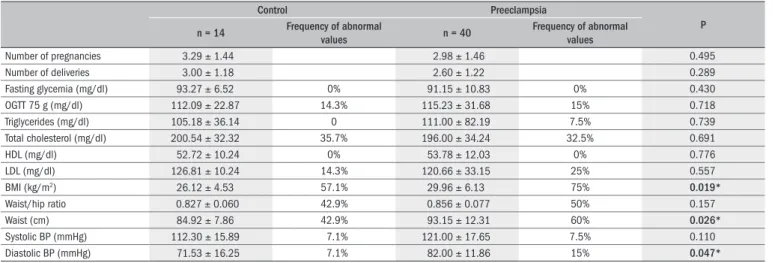
Number of pregnancies 3.29 ± 1.44 2.98 ± 1.46 0.495
Number of deliveries 3.00 ± 1.18 2.60 ± 1.22 0.289
Fasting glycemia (mg/dl) 93.27 ± 6.52 0% 91.15 ± 10.83 0% 0.430
OGTT 75 g (mg/dl) 112.09 ± 22.87 14.3% 115.23 ± 31.68 15% 0.718
Triglycerides (mg/dl) 105.18 ± 36.14 0 111.00 ± 82.19 7.5% 0.739
Total cholesterol (mg/dl) 200.54 ± 32.32 35.7% 196.00 ± 34.24 32.5% 0.691
HDL (mg/dl) 52.72 ± 10.24 0% 53.78 ± 12.03 0% 0.776
LDL (mg/dl) 126.81 ± 10.24 14.3% 120.66 ± 33.15 25% 0.557
BMI (kg/m2) 26.12 ± 4.53 57.1% 29.96 ± 6.13 75% 0.019*
Waist/hip ratio 0.827 ± 0.060 42.9% 0.856 ± 0.077 50% 0.157
Waist (cm) 84.92 ± 7.86 42.9% 93.15 ± 12.31 60% 0.026*
Systolic BP (mmHg) 112.30 ± 15.89 7.1% 121.00 ± 17.65 7.5% 0.110
Diastolic BP (mmHg) 71.53 ± 16.25 7.1% 82.00 ± 11.86 15% 0.047*
Table 1. Clinical and metabolic characteristics
OGTT = oral glucose tolerance test; HDL = high-density lipoprotein; LDL = low-density lipoprotein; BMI = body mass index; BP = blood pressure.
Normal values: fasting glycemia, < 110 mg/dl; OGTT 75 g, < 140 mg/dl; triglycerides, < 150 mg/dl; total cholesterol, < 200 mg/dl; HDL, < 40 mg/dl is low and > 60 mg/dl is high; LDL, < 160 mg/dl; waist/hip ratio, 0.85; waist circumference, > 88 cm.
*Sample powers were estimated for the following variables: BMI (96.8), waist (98.6) and diastolic blood pressure (95.8).
3.1 years in the control group and 15.9 ± 3.6 years in the preeclampsia group. he patients’ mean ages were similar at the time of drawing up this study: 37.2 ± 3.8 years in the control group and 39.2 ± 7.7 years in the preeclampsia group (P = 0.356). Other than antihypertensive drugs, just one patient in the control group was using thyroid hormone (levothyroxine).
he patients’ clinical and metabolic characteristics are shown in
Ta-ble 1 (mean ± standard deviation and frequencies). he women in the
preeclampsia group had signiicantly higher BMI, waist circumference and diastolic blood pressure than presented by the control group. All the other clinical and metabolic parameters were similar in the two groups.
Table 2 shows the correlation between BMI and systolic and diastolic
pressures (Spearman’s correlation coeicient). he patients in the preec-lampsia group presented a positive and statistically signiicant correla-tion between BMI and diastolic blood pressure (0.341; P = 0.031) and between BMI and systolic blood pressure (0.407; P = 0.009). he rela-tive risk of developing arterial hypertension among the patients who had had preeclampsia was 2.43 (0.641-9.27). In the preeclampsia group, 15.0 % of the patients presented hypertension 10 years later, while in the control group, only 7.1 % of the patients did so.
he smoking habits were similar between the groups (P = 0.793). Analysis on the metabolic and clinical variables of smokers versus non-smokers showed that difered only in relation to HDL (43.9 ± 9.8 and 56.7 ± 10.3, respectively; P < 0.001). he abdominal circumference mea-surement did not show any correlation with the metabolic parameters.
DISCUSSION
he consequences of preeclampsia/eclampsia for both the mother and the fetus are relatively well known. However, the long term con-sequences to the woman’s health are not well understood. Although some studies have not demonstrated a higher risk of elevated SAP among patients with preeclampsia/eclampsia,10,15 other authors, while
recognizing preeclampsia to be a manifestation of insulin resistance, have assumed that it involves a higher cardiovascular risk.16,17 Irgens et
al. demonstrated that mortality caused by cardiovascular disease over the long term is 1.2 times greater among patients with preeclampsia than among those without it, and found an accentuated diference (8.2 times greater) among cases of acute preeclampsia (with preterm birth).18 In another retrospective study, women who had had
preec-lampsia 15 to 19 years earlier, presented twice as much chance of hos-pital admission and death due to ischemic heart disease as did pregnant women without preeclampsia.19 More recently, a Canadian
retrospec-tive study21 on 1.03 million women identiied a risk of CVD (coronary
revascularization, stroke and peripheral arterial disease) that was twice as great among pregnant women with some type of placental syndrome (hypertensive gestational disease, placental abruption or preeclampsia) than among pregnant women without placental syndromes. Other au-thors have correlated preeclampsia with more frequent cardiovascular disease.11,16,18,20,22
Signiicantly higher diastolic pressure presented in the group of women with preeclampsia/eclampsia, compared with the control group, was also described by Wilson et al.23 and Forest et al.24 he BMI and
ab-dominal circumference measurements were signiicantly higher among women in our study who had had preeclampsia/eclampsia, and this was thought to indicate centripetal distribution of fat, since the waist/hip ratio did not difer. Abdominal fat distribution is also an early risk fac-tor for cardiovascular disease, hypertension25 and insulin resistance26 in
this group of patients.
here was a positive correlation between BMI and systolic blood pressure (0.341; P = 0.031) and between BMI and diastolic blood
pres-BMI vs. R P
Controls (n = 14)
Systolic BP 0.030 0.923
Diastolic BP 0.020 0.948
Preeclampsia (n = 40)
Systolic BP 0.341 0.031
Diastolic BP 0.407 0.009
Table 2. Correlation between body mass index (BMI) and systolic and diastolic blood pressures (Spearman’s correlation coeficient)
Risk factors for cardiovascular disease ten years after preeclampsia
Sao Paulo Med J. 2010; 128(1):10-3
13
sure (0.407; P = 0.009) in the group of patients with preeclampsia. Such indings were also described by Forest et al.24
here was no diference in the prevalence of diabetes mellitus and elevated SAP between the patients with preeclampsia and the controls, and this might be explained by the age diference between the study groups (women with preeclampsia: 39.2 ± 7.7 years old; and control group: 37.2 ± 3.8 years old).
Finally, despite our eforts, a great number of the patients had moved away and could not be contacted after 10 years. Considering the variable of diastolic blood pressure and assuming a type 1 error of P = 0.047, this sample had a statistical power (type 2 error) of 95.8 to detect the diference found. For BMI, assuming a type 1 error of P = 0.019, the statistical power (type 2 error) was 96.8; and, for waist circumference, assuming a type 1 error of P = 0.026, the statistical power (type 2 error) was 98.6. For the other variables, our sample did not have enough sta-tistical power to detect diferences.
CONCLUSIONS
Patients who had had preeclampsia 10 or more years earlier pre-sented signiicantly higher diastolic blood pressure, BMI and abdomi-nal circumference measurements than did those in the control group. hese simple and low-cost anthropometric measurements could identify which women with preeclampsia might beneit from greater rigorous-ness of clinical tracking and perhaps an early intervention in relation to cardiovascular diseases. herefore, we believe that abdominal circumfer-ence and BMI measurements should form part of the routine clinical evaluation for patients with a prior history of preeclampsia or eclamp-sia, in order to decide on the most appropriate preventive measures and management for potential cardiovascular complications.
REFERENCES
1. Report of the National High Blood Pressure Education Program Working Group on High Blood Pressure in Pregnancy. Am J Obstet Gynecol. 2000;183(1):S1-S22.
2. Sibai B, Dekker G, Kupferminc M. Pre-eclampsia. Lancet. 2005;365(9461):785-99. 3. Roberts JM, Cooper DW. Pathogenesis and genetics of pre-eclampsia. Lancet. 2001;
357(9249):53-6.
4. Gaio DS, Schmidt MI, Duncan BB, Nucci LB, Matos MC, Branchtein L. Hypertensive disorders in pregnancy: frequency and associated factors in a cohort of Brazilian women. Hypertens Pregnancy. 2001;20(3):269-81.
5. O’Brien TE, Ray JG, Chan WS. Maternal body mass index and the risk of preeclampsia: a systematic overview. Epidemiology. 2003;14(3):368-74.
6. Clausen T, Slott M, Solvoll K, Drevon CA, Vollset SE, Henriksen T. High intake of energy, sucro-se, and polyunsaturated fatty acids is associated with increased risk of preeclampsia. Am J Obstet Gynecol. 2001;185(2):451-8.
7. Haukkamaa L, Salminen M, Laivuori H, Leinonen H, Hiilesmaa V, Kaaja R. Risk for subse-quent coronary artery disease after preeclampsia. Am J Cardiol. 2004;93(6):805-8. 8. Sibai BM, Sarinoglu C, Mercer BM. Eclampsia. VII. Pregnancy outcome after eclampsia and
long-term prognosis. Am J Obstet Gynecol. 1992;166(6 Pt 1):1757-61; discussion 1761-3.
9. Sibai BM, el-Nazer A, Gonzalez-Ruiz A. Severe preeclampsia-eclampsia in young primigra-vid women: subsequent pregnancy outcome and remote prognosis. Am J Obstet Gynecol. 1986;155(5):1011-6.
10. Chesley SC, Annitto JE, Cosgrove RA. The remote prognosis of eclamptic women. Sixth perio-dic report. Am J Obstet Gynecol. 1976;124(5):446-59.
11. Laivuori H, Tikkanen MJ, Ylikorkala O. Hyperinsulinemia 17 years after preeclamptic irst pregnancy. J Clin Endocrinol Metab. 1996;81(8):2908-11.
12. Mosca L, Appel LJ, Benjamin EJ, et al. Evidence-based guidelines for cardiovascular disease prevention in women. J Am Coll Cardiol. 2004;43(5):900-21.
13. Diehl CL, Brost BC, Hogan MC, et al. Preeclampsia as a risk factor for cardiovascular di-sease later in life: validation of a preeclampsia questionnaire. Am J Obstet Gynecol. 2008;198(5):e11-3.
14. Gaziano TA, Young CR, Fitzmaurice G, Atwood S, Gaziano JM. Laboratory-based versus non-laboratory-based method for assessment of cardiovascular disease risk: the NHANES I Follow-up Study cohort. Lancet. 2008;371(9616):923-31.
15. Fisher KA, Luger A, Spargo BH, Lindheimer MD. Hypertension in pregnancy: clinical-patholo-gical correlations and remote prognosis. Medicine (Baltimore). 1981;60(4):267-76. 16. Wolf M, Hubel CA, Lam C, et al. Preeclampsia and future cardiovascular disease:
po-tential role of altered angiogenesis and insulin resistance. J Clin Endocrinol Metab. 2004;89(12):6239-43.
17. Seely EW, Solomon CG. Insulin resistance and its potential role in pregnancy-induced hyper-tension. J Clin Endocrinol Metab. 2003;88(6):2393-8.
18. Irgens HU, Reisaeter L, Irgens LM, Lie RT. Long term mortality of mothers and fathers after pre-eclampsia: population based cohort study. BMJ. 2001;323(7323):1213-7. 19. Smith GC, Pell JP, Walsh D. Pregnancy complications and maternal risk of ischaemic heart
di-sease: a retrospective cohort study of 129,290 births. Lancet. 2001;357(9273):2002-6. 20. Funai EF, Friedlander Y, Paltiel O, et al. Long-term mortality after preeclampsia. Epidemiology.
2005;16(2):206-15.
21. Ray JG, Vermeulen MJ, Schull MJ, Redelmeier DA. Cardiovascular health after maternal placental syndromes (CHAMPS): population-based retrospective cohort study. Lancet. 2005;366(9499):1797-803.
22. Rodie VA, Freeman DJ, Sattar N, Greer IA. Pre-eclampsia and cardiovascular disease: meta-bolic syndrome of pregnancy? Atherosclerosis. 2004;175(2):189-202.
23. Wilson BJ, Watson MS, Prescott GJ, et al. Hypertensive diseases of pregnancy and risk of hypertension and stroke in later life: results from cohort study. BMJ. 2003;326(7394):845. 24. Forest JC, Girouard J, Massé J, et al. Early occurrence of metabolic syndrome after
hyperten-sion in pregnancy. Obstet Gynecol. 2005;105(6):1373-80.
25. de Simone G, Devereux RB, Chinali M, et al. Risk factors for arterial hypertension in adults with initial optimal blood pressure: the Strong Heart Study. Hypertension. 2006;47(2):162-7.
26. Racette SB, Evans EM, Weiss EP, Hagberg JM, Holloszy JO. Abdominal adiposity is a stron-ger predictor of insulin resistance than itness among 50-95 year olds. Diabetes Care. 2006;29(3):673-8.
Sources of funding: This project was supported by the Fundo de Incentivo à Pesquisa of the Hospital de Clínicas de Porto Alegre (HCPA), GPPG 01-106, and the Conselho Nacio-nal de Desenvolvimento Cientíico e Tecnológico (CNPq), 305660/2006-3
Conlict of interest: None
Date of irst submission: May 9, 2008
Last received: January 18, 2010
Accepted: January 18, 2010
Address for correspondence:
Helena von Eye Corleta Rua Ramiro Barcelos, 905/910 Porto Alegre (RS) — Brasil CEP 90035-003