Original article
Frequency of subclinical thyroid dysfunction and risk factors for
cardiovascular disease among women at a workplace
Frequência das doenças subclínicas da tireóide e de fatores de risco para doença
cardiovascular em mulheres em um local de trabalho
Rodrigo Diaz-OlmosI, Antônio-Carlos NogueiraI, Daniele Queirós Fucciolo PenalvaI, Paulo Andrade LotufoII, Isabela Martins BenseñorIII
Division of Internal Medicine, Hospital Universitário, Universidade de São Paulo, São Paulo, Brazil
IMD. Attending physician, Division of Internal Medicine, Hospital Universitário (HU), Universidade de São Paulo (USP), São Paulo, Brazil.
IIMD, PhD. Full professor, Division of Internal Medicine, Hospital Universitário (HU), and Department of Internal Medicine, Faculdade de Medicina da Universidade de São Paulo (FMUSP), São Paulo, Brazil.
IIIMD, PhD. Associate professor, Division of Internal Medicine, Hospital Universitário (HU), and Department of Internal Medicine, Faculdade de Medicina da Universidade de São Paulo (FMUSP), São Paulo, Brazil.
ABSTRACT
CONTEXT AND OBJECTIVE: Subclinical thyroid dysfunction is very common in clinical practice and there is some evidence that it may be associated with cardiovascular disease. The aim here was to evaluate the frequencies of subclinical thyroid disease and risk factors for cardiovascular disease among women at a workplace, and to evaluate the association between subclinical thyroid disease and cardiovascular risk factors among them.
DEsIgN AND sETTINg: Cross-sectional study on 314 women aged 40 years or over who were working at Universidade de São Paulo (USP).
METhODs: All the women answered a questionnaire on sociodemographic characteristics and risk factors for cardiovascular disease and the Rose angina questionnaire. Anthropometric variables were measured and blood samples were analyzed for blood glucose, total cholesterol and fractions, high-sensitivity C-reactive protein, thyroid-stimulating hormone (TSH), free thyroxine (free-T4) and anti-thyroperoxidase antibodies (anti-TPO).
REsulTs: The frequencies of subclinical hypothyroidism and hyperthyroidism were, respectively, 7.3% and 5.1%. Women with subclinical thyroid disease presented higher levels of anti-TPO than did women with normal thyroid function (P = 0.01). There were no differences in sociodemographic factors and cardiovascular risk factors according to thyroid function status, except for greater sedentarism among the women with subclinical hypothyroidism. Restricting the comparison to women with subclinical hypothyroidism (TSH > 10 mIU/l) did not change the results.
CONClusION: In this sample of women, there was no association between poor proile of cardiovascular risk factors and presence of subclinical thyroid disease that would justify screening at the workplace.
RESUMO
CONTEXTO E OBJETIVO: A doença tireoidiana subclínica é muito frequente na prática clínica e há evidências que sugerem associação com doença cardiovascular. O objetivo foi estabelecer a frequência das doenças subclínicas da tireóide e de fatores de risco para doença cardiovascular em mulheres no local de trabalho, bem como avaliar a associação da doença tireoidiana subclínica com fatores de risco para doença cardiovascular nessas mulheres.
TIPO DE EsTuDO E lOCAl: Estudo transversal em 314 mulheres com 40 ou mais anos de idade que trabalham na Universidade de São Paulo.
MéTODOs: Todas as mulheres responderam a questionário sobre características sócio-demográicas, fatores de risco para doença cardiovascular, questionário de angina de Rose, e foram realizadas medidas antropométricas e colhido sangue para dosagem de glicemia, colesterol total e frações, proteína C ultra-sensível, hormônio tireotrópico (TSH), tiroxina-livre (TS-livre) e anticorpos anti-tireoperoxidase.
REsulTADOs: As frequências de hipotireoidismo subclínico e de hipertireoidismo subclínico foram respectivamente de 7,3% e 5,1%. Os níveis de anticorpos antiperoxidase foram mais elevados nas mulheres com doença subclínica da tireoide comparadas às mulheres com função tireoidiana normal (P = 0,01). Não houve nenhuma diferença estatisticamente signiicativa entre os fatores sociodemográicos e de risco para doença cardiovascular entre os grupos exceto pela maior presença de sedentarismo entre as mulheres com hipotireoidismo subclínico. Restringir a comparação somente às mulheres com hipotireoidismo subclínico (TSH > 10 mIU/l) não mudou os resultados.
CONClusãO: Nesta amostra de mulheres, não houve nenhuma associação entre um peril inadequado dos fatores de risco para doença cardiovascular e a presença de doença subclínica da tireóide que justiicasse o rastreamento no local de trabalho.
KEY WORDs: Thyroid diseases. Hypothyroidism. Hyperthyroidism. Risk factors. Cardiovascular diseases.
PAlAVRAs-ChAVE: Doenças da glândula tireóide. Hipotireoidismo.
INTRODUCTION
Subclinical thyroid dysfunction is a very common situation among middle-aged women.1-3 It is characterized by abnormal serum
thyroid-stimulating hormone (TSH) levels with normal free thyroxine (free-T4) levels. he prevalence of subclinical hypothyroidism varies from approx-imately 5-6% among women of all ages to 10-17% among women over 60 years of age1,4 and up to 21% among women over 74 years of age.2
Most patients with subclinical hypothyroidism (74-87%) present serum TSH levels of between 5 and 10 mIU/l.2,5,6
he causes of subclinical hypothyroidism are the same as the causes of overt thyroid disease. Nevertheless, some patients with TSH lev-els above the upper limit of the reference range are euthyroid outli-ers (a term applied to the 2.5% of individuals whose TSH values are above percentile 97.5 of euthyroid distribution), and thus do not rep-resent cases of disease. A signiicant proportion of such patients also have only transient thyroid axis disorders or iatrogenic subclinical hy-pothyroidism (undertreated overt hyhy-pothyroidism or overtreated overt hyperthyroidism).7 Only a small percentage of community-level
indi-viduals with subclinical hypothyroidism have real mild thyroid failure. here is controversy about the need to aggressively search for cas-es of subclinical thyroid disorders, or even the need to undertake pop-ulation-based screening.1,8-13 One possible reason for
recommend-ing such diagnostic procedures is the possibility of future complica-tions like cardiovascular disease, neuropsychiatric symptoms or overt hypothyroidism.1,14
Cardiovascular disease in cases of subclinical hypothyroidism may be a consequence of cardiac dysfunction,15-17 atherosclerotic disease18
or high cholesterol.19,20 Although some studies have shown an
associa-tion between cardiovascular disease and subclinical hypothyroidism18,21
or hyperthyroidism,22 other longitudinal studies did not show any
association.23,24 One clear bias in some studies with positive indings
was the inclusion of patients with a deinitive diagnosis of thyroid dis-ease (e.g. patients with overt hypothyroidism receiving inadequate doses of L-thyroxine, or after thyroidectomy or radioiodine therapy), and not subclinical hypothyroidism.
Regarding subclinical hyperthyroidism, the possible complications are cardiovascular disease, neuropsychiatric symptoms, reduced bone mineral density with possible fractures and overt hyperthyroidism.1,13
Cardiovascular disease in subclinical hyperthyroidism can be caused by cardiac dysfunction15-17 or atrial ibrillation.25
Even considering those evidences, a recent systematic review on subclinical thyroid dysfunction conirmed that most scientiic/medical societies do not recommend screening for thyroid disease among gen-eral populations.26
Compared with men, Brazilian women present a high burden of cardiovascular mortality, similar to that found in Eastern European countries.27,28 In addition to the most common risk factors associated with
cardiovascular disease, such as hypertension, smoking, diabetes or dyslipi-demia, other factors can also be considered to be primordial determinants of cardiovascular disease.29 It is very important to identify primordial risk
factors in the workplace,30 social inequalities,31 genetic polymorphisms32
and subclinical thyroid dysfunction, in order to be able to prevent them.
OBJECTIVE
he present study had the aim of making a cross-sectional evalu-ation on the frequencies of subclinical thyroid disease and risk factors for cardiovascular disease among women of at least 40 years of age who agreed to be screened for subclinical thyroid dysfunction at the work-place, in a country with high female cardiovascular mortality. he study had also the objetive of making an evaluation on the association be-tween subclinical thyroid disease and cardiovascular risk factors among these women.
METHODS
Subject characteristics
All 736 women aged 40 years or over who were working in three units at Universidade de São Paulo (USP) were invited to participate in screening for subclinical thyroid dysfunction. Informed consent was ob-tained from all these women. he study was also approved by the Ethics Committee of the University hospital.
Sample size
We calculated the sample size for a cross-sectional study with a di-chotomous variable (subclinical hypothyroidism: yes or no). he ingre-dients for the sample size calculation were an expected proportion of 0.10, total width of 0.10 (0.05 below and 0.05 above) and conidence level of 95%, thus giving a number of 138 women. We did the same for subclinical hyperthyroidism (yes or no) using an expected propor-tion of 0.10, total width of 0.05 (0.025 below and 0.025 above) and conidence level of 95%, thus giving a number of 291 women. Taking the expected proportion of 40% acceptance of the invitation for screen-ing (expectation based on studies with volunteers in the university), we invited 736 women working in three diferent units in the University of São Paulo.33
Data from questionnaire and anthropometric variables
All these women answered a speciic questionnaire about sociode-mographic characteristics and cardiovascular disease morbidity. Seden-tary lifestyle was deined as exercising less than once a week. High blood pressure was evaluated both as a categorical variable (presence vs. ab-sence of hypertension; preab-sence of hypertension was deined as self-re-ported based on medical information, hospital registers or current use of medication to treat hypertension) and as a continuous variable (mean systolic and diastolic blood pressure). Diabetes was deined as a cate-gorical variable (presence versus absence of diabetes; presence of diabe-tes was deined as self-reported based on medical information, hospital registers or current use of medication to treat diabetes). Hypercholester-olemia was deined as a categorical variable (presence versus absence of hypercholesterolemia; presence of hypercholesterolemia was deined as self-reported based on medical information, hospital registers or current use of medication to treat hypercholesterolemia). Angina pectoris was evaluated by means of the Rose angina questionnaire.34
subclinical thyroid disease hypothyroidism
n = 23 (100%)
hyperthyroidism n = 16 (100%)
TSH (mU/L)* 12.7 (23.0) 0.19 (0.14)
Free-T4 ng/dl* 1.0 (0.2) 1.1 (0.3)
TPO-AB (UI/ml)* 163.4 (275.8) 104.4 (170.3)
Presence of TPO-AB > 35 UI/ml 11 (47.8) 7 (43.8) Associated cause
Autoimmune
Post-thyroidectomy or iodotherapy Other causes
11 (45.8) 0 13 (52.2)
7 (43.8) 0 9 (56.3)
Table 1. Thyroid-stimulating hormone (TSH), free-T4 levels and the likely
cause of thyroid dysfunction in all women with subclinical thyroid diseases
*mean (SD); TPO-AB = thyroperoxidase-autoantibodies.
by dividing the weight in kilograms by the square of height in me-ters. Waist circumference was measured to the nearest one millime-ter at the level of midway between the lowest rib margin and the il-iac crest.
We excluded from the study all women who had had any previous diagnosis or treatment for thyroid dysfunction. Subclinical hyporoidism was deined as a TSH level > 4.0 mIU/l and a normal free thy-roxine level (0.6-1.8 ng/dl); and subclinical hyperthyroidism was de-ined as a TSH level < 0.45 mIU/l and a normal free thyroxine level. In our analysis of the association between high-sensitivity C-reactive pro-tein (hsCRP) and thyroid status, we discarded all hsCRP values higher than 10 mg/l, since these values were probably related to active infection or systemic inlammatory disease.35
Blood samples
Blood samples were taken after a minimum of 12 hours of fast-ing. Total cholesterol (TC) and triglycerides (TG) were determined by means of an enzymatic colorimetric method. High-density li-poprotein-cholesterol (HDL-C) was measured in the plasma after precipitation of the low-density lipoprotein-cholesterol (LDL-C), and fasting blood glucose was analyzed using an enzymatic meth-od. LDL-C was calculated in accordance with the Friedewald equa-tion. TSH concentration (reference range 0.3-4.0 mIU/l) was meas-ured by means of a third-generation immunometric assay (Roche TSH, Basel, Swiss). Free thyroxine was determined using an enzyme immunoassay (reference range 0.6-1.8 ng/dl) (Roche Free-thyrox-ine, Basel, Swiss) (sensitivity and speciicity close to 100%). hsCRP was measured by means of particle-enhanced immunonephelometry (Dade Behring, hsCRP, Newark, USA) (sensitivity and speciicity close to 100%).
Data analysis
For categorical variables, chi-square tests were used for comparisons when appropriate. For continuous variables, analysis of variance (ANO-VA) with the Bonferroni post hoc evaluation test was used. he age-ad-justed prevalence rate of subclinical hyperthyroidism and hypothyroid-ism was calculated using a standard population from the World Health Organization. P values less than 0.05 were considered statistically sig-niicant. he data were analyzed using the Statistical Package for the So-cial Sciences (SPSS) 14.0.
RESULTS
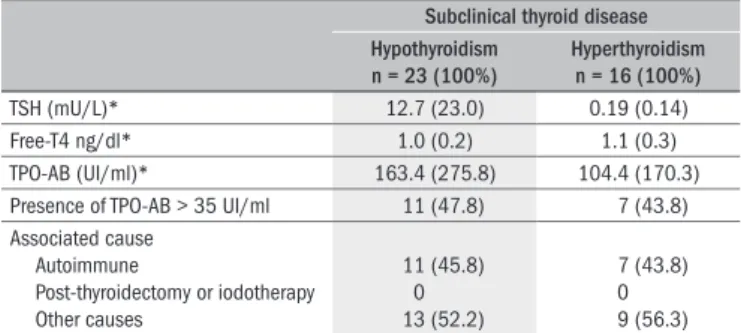
Out of the 736 women working in three units of USP who were invited to participate, 314 (42.7%) accepted the invitation and were in-cluded in the study. Of these, three were exin-cluded because of the pres-ence of overt hyperthyroidism and 11 were excluded because of the presence of overt hypothyroidism. Between the women who agreed to participate and those who did not agree, the sociodemographic and clin-ical characteristics were very similar, the frequencies of subclinclin-ical hy-pothyroidism and hyperthyroidism were, respectively, 7.3% and 5.1%. Fifty-one women were positive for antibodies against thyroperoxidase (16.2%). he mean TSH level among the women with subclinical hy-pothyroidism was 12.7 (± 23.0) mIU/l, but 78.3% of these women had TSH levels < 10 mIU/l.
Table 1 shows the mean values of TSH, free-T4 and
anti-thyroper-oxidase antibodies (anti-TPO), along with the likely causes of subclini-cal thyroid disease in the sample. Almost 45% of the cases were attrib-uted to autoimmune thyroid disease. Table 2 describes the general
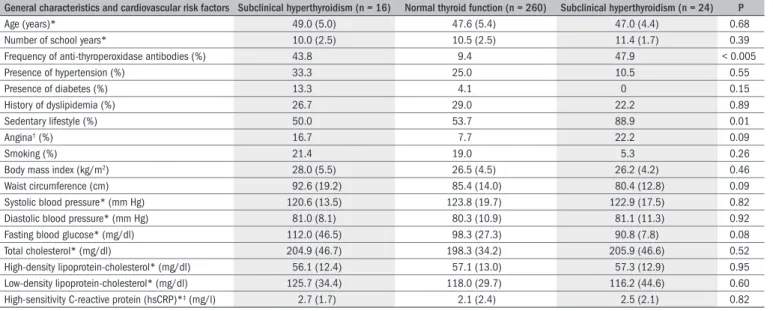
char-acteristics and the distribution of cardiovascular risk factors according to thyroid status. he mean age was 47.6 (5.3) and the median was also 47 years. Most of the women in the sample were between 40 and 50 years old (only six were older than 60 years of age). here was no difer-ence in general characteristics among these women except for sedentary lifestyle which was more common among the women with subclinical hypothyroidism.
here was no diference in the distribution of cardiovascular risk factors according to thyroid function status between the groups. Re-stricting the comparison of subclinical hypothyroidism only to women with TSH levels higher than 10 mIU/l did not change the results except for the frequency of angina and the LDL levels. he frequency of an-gina in the women with subclinical hypothyroidism was lower than in the women with subclinical hyperthyroidism and the women with nor-mal thyroid function. Although a statistically signiicant diference was found, it was in the inverse direction, since we had expected a higher frequency of angina in women with subclinical thyroid disease, com-pared with women with normal thyroid function. he same occurred for LDL-cholesterol, such that its levels were lower in individuals with subclinical hypothyroidism than in individuals with subclinical hyper-thyroidism and normal thyroid function. Again, the results were in a direction that difered from what we would have expected if subclini-cal thyroid disease were associated with a worse proile of cardiovascu-lar risk factors.
DISCUSSION
he frequencies of subclinical thyroid disease and anti-thyroperox-idase antibodies were similar to those described in other countries, al-though slightly higher for subclinical hyperthyroidism.1-3 here were no
diferences in the distribution of cardiovascular risk factors according to thyroid function status in this sample.
Surks et al. discussed the controversy regarding reference ranges for TSH and free-T4, in 2005.36 Using data from NHANES (National
popula-tion, the TSH values between percentile 2.5 and percentile 97.5 ranged from 0.45-4.17 mIU/l. Based on this data, we chose our cut-ofs as < 0.45 mIU/l and > 4.0 mIU/l.3
he Whickham survey, which was a large, good-quality popula-tion-based study with 20-year follow-up, the prevalence was 4% to 5% among women aged 18 to 44 years, and 8% to 10% among women age 45 to 74 years. For subclinical hypothyroidism, our data were very simi-lar to the data from the Whickham study, as cited in Helfand’s review in 2004.1,36,37 In another study, the prevalence of subclinical
hyperthyroid-ism ranged from 0.8% to 2.5% among women over 60 years of age.38
he diference between those results and ours can be explained partially by the lower cutofs used in the earlier study. If we had only classiied women with TSH < 0.2 mIU/l as cases of subclinical hyperthyroidism, we would have included only 9 women, thereby showing a frequency of 2.8%, which would be closer to the previous results.
Many authors have hypothesized an association between overt hy-pothyroidism and cardiovascular disease, and several mechanisms may be implicated. For example, atherosclerosis may be associated with an adverse lipid proile or there may be a direct efect on myocardial or cardiovascular function.15 he relationship between subclinical thyroid
dysfunction and cardiovascular disease could be mediated by the higher levels of serum lipids found in subclinical hypothyroidism. Some cross-sectional studies have demonstrated that the serum levels of total choles-terol and LDL-cholescholes-terol are signiicantly higher in patients with sub-clinical hypothyroidism than in euthyroid patients.39-42 However, other
studies have shown non-statistically signiicant diferences between the two groups23,40,41 or even lower total cholesterol levels18 in subclinical
hypothyroid patients, compared with thosewith normal thyroid func-tion. here have been more than 20 intervention trials assessing the ef-fects of L-thyroxine on the lipid proile of subjects with subclinical hy-pothyroidism, but most of them were uncontrolled. Many of these trials also involved iatrogenic subclinical hypothyroidism (e.g. patients taking inadequate doses of L-thyroxine) and individuals with a deinitive
diag-nosis of thyroid disease. he studies20,42 that stratiied TSH levels found
nonsigniicant efects in the patients with TSH < 10 mIU/l.
In the present cross-sectional study, there were no diferences in car-diovascular risk factor proile between the women according to their thyroid function status. he sample included women who were more obese than the general population in Brazil, which is a country with an especially high risk of cardiovascular disease among women. Even for this sample of women with high levels of cardiovascular risk factors, we were unable to show any diferences in cardiovascular risk according to thyroid function. Restricting the analysis to subclinical hypothyroidism among women with TSH > 10 mIU/l did not change the results.
Few studies have evaluated hsCRP, a non-classic cardiovascular risk factor among individuals with subclinical thyroid disease.39-44
Conlict-ing results have been obtained in relation to hsCRP: three studies showed some correlation,44-46 while another three did not show any association
at all.39,47,48 he positive studies tended to include patients with
deini-tive thyroid disease, as opposed to asymptomatic patients who had been found through screening. For example, the study by Christ-Crain et al.43
compared 63 women with subclinical hypothyroidism with 61 women with overt hypothyroidism and 40 euthyroid controls, but more than 40% of the women with subclinical hypothyroidism had been treated with radioiodine, surgery or anti-thyroid drugs for either for Graves disease or for toxic multinodular goiter. Among the remaining women with subclinical hypothyroidism, 90% had Hashimoto thyroiditis (i.e. positive for anti-thyroperoxidase antibodies). hese patients are not an appropriate comparison group for community-dwelling cases of sub-clinical hypothyroidism. In our study, we excluded from the subsub-clinical hypothyroidism group any women who, despite their biochemical di-agnosis of subclinical hypothyroidism (elevated TSH level with free-T4 within the normal range), had already been diagnosed with thyroid dis-ease or had been undergoing treatment with L-thyroxine.
he present study has several limitations. It is not a population-based sample and, out of the 736 women invited to participate, only
general characteristics and cardiovascular risk factors subclinical hyperthyroidism (n = 16) Normal thyroid function (n = 260) subclinical hyperthyroidism (n = 24) P
Age (years)* 49.0 (5.0) 47.6 (5.4) 47.0 (4.4) 0.68
Number of school years* 10.0 (2.5) 10.5 (2.5) 11.4 (1.7) 0.39
Frequency of anti-thyroperoxidase antibodies (%) 43.8 9.4 47.9 < 0.005
Presence of hypertension (%) 33.3 25.0 10.5 0.55
Presence of diabetes (%) 13.3 4.1 0 0.15
History of dyslipidemia (%) 26.7 29.0 22.2 0.89
Sedentary lifestyle (%) 50.0 53.7 88.9 0.01
Angina† (%) 16.7 7.7 22.2 0.09
Smoking (%) 21.4 19.0 5.3 0.26
Body mass index (kg/m2) 28.0 (5.5) 26.5 (4.5) 26.2 (4.2) 0.46
Waist circumference (cm) 92.6 (19.2) 85.4 (14.0) 80.4 (12.8) 0.09
Systolic blood pressure* (mm Hg) 120.6 (13.5) 123.8 (19.7) 122.9 (17.5) 0.82
Diastolic blood pressure* (mm Hg) 81.0 (8.1) 80.3 (10.9) 81.1 (11.3) 0.92
Fasting blood glucose* (mg/dl) 112.0 (46.5) 98.3 (27.3) 90.8 (7.8) 0.08
Total cholesterol* (mg/dl) 204.9 (46.7) 198.3 (34.2) 205.9 (46.6) 0.52
High-density lipoprotein-cholesterol* (mg/dl) 56.1 (12.4) 57.1 (13.0) 57.3 (12.9) 0.95
Low-density lipoprotein-cholesterol* (mg/dl) 125.7 (34.4) 118.0 (29.7) 116.2 (44.6) 0.60
High-sensitivity C-reactive protein (hsCRP)*‡ (mg/l) 2.7 (1.7) 2.1 (2.4) 2.5 (2.1) 0.82
Table 2. General characteristics and cardiovascular risk factors among women with subclinical or normal thyroid function
42.7% agreed and were included. Although there were no sociodemo-graphic diferences between the women who agreed to participate and the women who did not, some kind of bias is still possible. However, this was a sample of high-risk women, in which a possible association between subclinical thyroid disease and an inadequate proile of car-diovascular risk factors could easily be demonstrated. he results have implications for clinical practice, going against the notion of regular screening for subclinical thyroid diseases.
CONCLUSION
In this sample of women with high cardiovascular risk, subclinical thyroid disease did not show any association with an inadequate pro-ile of cardiovascular risk factors, except for sedentary lifestyle among the women with subclinical hyperthyroidism, compared with the oth-er groups. he data from this study did not favor any recommenda-tion for screening for thyroid funcrecommenda-tion, as a regular practice in the workplace.
REFERENCES
1. Helfand M; U.S. Preventive Services Task Force. Screening for subclinical thyroid dysfunction in nonpregnant adults: a summary of the evidence for the U.S. Preventive Services Task Force. Ann Intern Med. 2004;140(2):128-41.
2. Canaris GJ, Manowitz NR, Mayor G, Ridgway EC. The Colorado thyroid disease prevalence study. Arch Intern Med. 2000;160(4):526-34.
3. Hollowell JG, Staehling NW, Flanders WD, et al. Serum TSH, T(4), and thyroid antibodies in the United States population (1988-1994): National Health and Nutrition Examination Survey (NHANES III). J Clin Endocrinol Metab. 2002;87(2):489-99.
4. Díez JJ, Iglesias P. Spontaneous subclinical hypothyroidism in patients older than 55 years: an analysis of natural course and risk factors for the development of overt thyroid failure. J Clin Endocrinol Metab. 2004;89(10):4890-7.
5. Vanderpump MP, Tunbridge WM, French JM, et al. The incidence of thyroid disorders in the community: a twenty-year follow-up of the Whickham Survey. Clin Endocrinol (Oxf). 1995;43(1)55-68.
6. Vanderpump M. Subclinical hypothyroidism: the case against treatment. Trends Endocrinol Metab. 2003;14(6):262-6.
7. Chu JW, Crapo LM. The treatment of subclinical hypothyroidism is seldom necessary. J Clin Endocrinol Metab. 2001;86(10):4591-9.
8. Ladenson PW, Singer PA, Ain KB, et al. American Thyroid Association guidelines for detection of thyroid dysfunction. Arch Intern Med. 2000;160(11):1573-5.
9. Baskin HJ, Cobin RH, Duick DS, et al. American Association of Clinical Endocrinologists medical guidelines for clinical practice for the evaluation and treatment of hyperthyroidism and hypothyroidism. Endocr Pract. 2002;8(6):457-69.
10. U.S. Department of Health & Human Services. Agengy for Healthcare Research and Quality. U.S. Preventive Services Task Force. Screening for thyroid disease. Available from: http:// www.ahrq.gov/clinic/uspstf/uspsthyr.htm. Accessed in 2009 (Dec 22).
11. Cooper DS. Clinical practice. Subclinical hypothyroidism. N Engl J Med. 2001;345(4):260-5.
12. Toft AD. Clinical practice. Subclinical hyperthyroidism. N Engl J Med. 2001;345(7):512-6. 13. Surks MI, Ortiz E, Daniels GH, et al. Subclinical thyroid disease: scientiic review and
guide-lines for diagnosis and management. JAMA. 2004;291(2):228-38.
14. Cooper DS. Thyroid disease in the oldest old: the exception to the rule. JAMA. 2004;292(21):2651-4.
15. Klein I, Ojamaa K. Thyroid hormone and the cardiovascular system. N Engl J Med. 2001;344(7):501-9.
16. Bengel FM, Nekolla SG, Ibrahim T, Weniger C, Ziegler SI, Schwaiger M. Effect of thyroid hor-mones on cardiac function, geometry, and oxidative metabolism assessed noninvasively by positron emission tomography and magnetic resonance imaging. J Clin Endocrinol Metab. 2000;85(5):1822-7.
17. Biondi B, Palmieri EA, Lombardi G, Fazio S. Effects of subclinical thyroid dysfunction on the heart. Ann Intern Med. 2002;137(11):904-14.
18. Hak AE, Pols HA, Visser TJ, Drexhage HA, Hofman A, Witteman JC. Subclinical hypothyroidism is an independent risk factor for atherosclerosis and myocardial infarction in elderly women: the Rotterdam Study. Ann Intern Med. 2000;132(4):270-8.
19. Danese MD, Ladenson PW, Meinert CL, Powe NR. Clinical review 115: effect of thyroxine therapy on serum lipoproteins in patients with mild thyroid failure: a quantitative review of the literature. J Clin Endocrinol Metab. 2000;85(9):2993-3001.
20. Meier C, Staub JJ, Roth CB, et al. TSH-controlled L-thyroxine therapy reduces cholesterol levels and clinical symptoms in subclinical hypothyroidism: a double blind, placebo-con-trolled trial (Basel Thyroid Study). J Clin Endocrinol Metab. 2001;86(10):4860-6. 21. Imaizumi M, Akahoshi M, Ichimaru S, et al. Risk of ischemic heart disease and all-cause
mortality in subclinical hypothyroidism. J Clin Endocrinol Metab. 2004;89(7):3365-70. 22. Parle JV, Maisonneuve P, Sheppard MC, Boyle P, Franklyn JA. Prediction of all-cause and
cardiovascular mortality in elderly people from one low serum thyrotropin result: a 10-year cohort study. Lancet. 2001;358(9285):861-5.
23. Vanderpump MP, Tunbridge WM, French JM, et al. The development of ischemic heart disease in relation to autoimmune thyroid disease in a 20-year follow-up study of an English com-munity. Thyroid. 1996;6(3):155-60.
24. Gussekloo J, van Exel E, de Craen AJ, Meinders AE, Frölich M, Westendorp RG. Thyroid status, disability and cognitive function, and survival in old age. JAMA. 2004;292(21): 2591-9.
25. Sawin CT, Geller A, Wolf PA, et al. Low serum thyrotropin concentrations as a risk factor for atrial ibrillation in older persons. N Engl J Med. 1994;331(19):1249-52.
26. Biondi B, Cooper DS. The clinical signiicance of subclinical thyroid dysfunction. Endocr Rev. 2008;29(1):76-131.
27. Lotufo PA. Mortalidade precoce por doenças do coração no Brasil. Comparação com outros países [Premature mortality from heart diseases in Brazil. A comparison with other coun-tries]. Arq Bras Cardiol. 1998;70(5):321-5.
28. Lotufo PA. Non-communicable diseases in Brazil: mortality patterns, morbidity studies and risk factors. Arch Latinoam Nutr. 1997;47(2 Suppl 1):25-9.
29. Stamler J, Fortmann SP, Levy RI, Prineas RJ, Tell G. Primordial prevention of cardiovascular disease risk factors: panel summary. Prev Med. 1999;29(6 Pt 2):S130-5.
30. Bosma H, Peter R, Siegrist J, Marmot M. Two alternative job stress models and the risk of coronary heart disease. Am J Public Health. 1998;88(1):68-74.
31. Kaplan GA, Keil JE. Socioeconomic factors and cardiovascular disease: a review of the literature. Circulation. 1993;88(4 Pt 1):1973-98.
32. Murata M, Kawano K, Matsubara Y, Ishikawa K, Watanabe K, Ikeda Y. Genetic polymorphisms and risk of coronary artery disease. Semin Thromb Hemost. 1998;24(3):245-50. 33. Browner WS, Newman TB, Cummings SR, Hulley SB. Estimating sample size and power: the
nitty-gritty. In: Hulley SB, Cummings SR, Browner WS, Grady D, Hearst N, Newman TB, editors. Designing clinical research. 2nd edition. Philadelphia: Lippincott Williams & Wilkins; 2001.
p. 65-94.
34. Luepker RV, Evans A, McKeigue P, Reddy KS. Cardiovascular survey methods. 3rd edition.
Geneva: World Health Organization; 2004.
35. Pearson TA, Mensah GA, Alexander RW, et al. Markers of inlammation and cardiovascular disease: application to clinical and public health practice: A statement for healthcare pro-fessionals from the Centers for Disease Control and Prevention and the American Heart Association. Circulation. 2003;107(3):499-511.
36. Surks MI, Goswami G, Daniels GH. The thyrotropin reference range should remain unchan-ged. J Clin Endocrinol Metab. 2005;90(9):5489-96.
37. Tunbridge WM, Evered DC, Hall R, et al. The spectrum of thyroid disease in a community: the Whickham survey. Clin Endocrinol (Oxf). 1977;7(6):481-93.
38. Helfand M, Redfern CC. Clinical guideline, part 2. Screening for thyroid disease: an update. American College of Physicians. Ann Intern Med. 1998;129(2):144-58.
39. Efstathiadou Z, Bitsis S, Milionis HJ, et al. Lipid proile in subclinical hypothyroidism: is L-thyroxine substitution beneicial? Eur J Endocrinol. 2001;145(6):705-10.
40. Staub JJ, Althaus BU, Engler H, et al. Spectrum of subclinical and overt hypothyroidism: effect on thyrotropin, prolactin, and thyroid reserve, and metabolic impact on peripheral target tissues. Am J Med. 1992;92(6):631-42.
41. Lindeman RD, Schade DS, LaRue A, et al. Subclinical hypothyroidism in a biethnic, urban community. J Am Geriatr Soc. 1999;47(6):703-9.
42. Kong WM, Sheikh MH, Lumb PJ, et al. A 6-month randomized trial of thyroxine treatment in women with mild subclinical hypothyroidism. Am J Med. 2002;112(5):348-54. 43. Christ-Crain M, Meier C, Guglielmetti M, et al. Elevated C-reactive protein and homocysteine
44. Jublanc C, Bruckert E, Giral P, et al. Relationship of circulating C-reactive protein levels to thyroid status and cardiovascular risk in hyperlipidemic euthyroid subjects: low free thyroxi-ne is associated with elevated hsCRP. Atherosclerosis. 2004;172(1):7-11.
45. Kvetny J, Heldgaard PE, Bladbjerg EM, Gram J. Subclinical hypothyroidism is associated with a low-grade inlammation, increased triglyceride levels and predicts cardiovascular disease in males below 50 years. Clin Endocrinol (Oxf). 2004;61(2):232-8.
46. Pearce EN, Bogazzi F, Martino E, et al. The prevalence of elevated serum C-reactive pro-tein levels in inlammatory and noninlammatory thyroid disease. Thyroid. 2003;13(7): 643-8.
47. Jung CH, Sung KC, Shin HS, et al. Thyroid dysfunction and their relation to cardiovascular risk factors such as lipid proile, hsCRP, and waist hip ratio in Korea. Korean J Intern Med. 2003;18(3):146-53.
48. Hueston WJ, King DE, Geesey ME. Serum biomarkers for cardiovascular inlammation in subclinical hypothyroidism. Clin Endocrinol (Oxf). 2005;63(5):582-7.
Acknowledgement: We thank Dr Geraldo Medeiros Neto and Silvia Cardia for their help with thyroid test analyses
sources of Funding: Fundação de Amparo a Pesquisa do Estado de São Paulo (Fapesp 01/14.970-4). Dr. Lotufo and Dr. Benseñor are recipients of a fellowship from the Conse-lho Nacional de Pesquisa
Conlict of interest: Not declared
Date of irst submission: February 11, 2009
last received: January 21, 2010
Accepted: January 21, 2010
Address for correspondence:
Isabela Benseñor
Hospital Universitário (USP) — Centro de Pesquisa Clínica Av. Lineu Prestes, 2.565 — 3o andar