Fernando Ferreira CarneiroI,II Anamaria Testa TambelliniIII José Ailton da SilvaIV
João Paulo Amaral HaddadIV André Campos BúrigoV Waltency Roque de SáVI Francisco Cecílio VianaVI Valéria Andrade BertoliniVI
I Coordenação Geral de Vigilância Ambiental em Saúde. Secretaria de Vigilância em Saúde. Ministério da Saúde. Brasília, DF, Brasil
II Departamento de Saúde Coletiva. Universidade de Brasília. Brasília, DF, Brasil III Instituto de Estudos em Saúde Coletiva.
Universidade Federal do Rio de Janeiro. Rio de Janeiro, RJ, Brasil
IV Escola de Veterinária. Universidade Federal de Minas Gerais. Belo Horizonte, MG, Brasil
V Mestrado Profi ssionalizante em Educação Profi ssional em Saúde. Escola Politécnica de Saúde Joaquim Venâncio. Fundação Oswaldo Cruz. Rio de Janeiro, RJ, Brasil VI Centro Mineiro de Estudos Epidemiológicos
e Ambientais. Belo Horizonte, MG, Brasil Correspondence:
Fernando Ferreira Carneiro R. Angelim, Lote 1 Condomínio Verde 70680-608 Brasília, DF, Brasil
E-mail: [email protected] Received: 5/30/2007
Revised: 2/3/2008 Approved: 3/18/2008
Health of families from the Landless
Workers’ Movement and temporary
rural workers, Brazil, 2005
ABSTRACT
OBJECTIVE: To assess the health conditions of families from the Landless Rural Workers’ Movement and temporary rural workers.
METHODS: The research involved a comparative study of three populations: a settlement and a camp linked to the Rural Workers’ Movement, and the families of temporary rural workers in a city of Southeast Brazil, in 2005. Information relating to sociodemographic characteristics and families were collected by means of questionnaires that were put to 202 families. In addition, structured observation and group discussions were used. A discriminative factor analysis was carried out to confi rm differences between the communities.
RESULTS: The three communities scored an average of 89%, which implies that they are distinct groups and supports the hypothesis that there are real differences between them when it come to health and lifestyle conditions. There was a high rate of food insecurity (39.5%) among temporary rural workers, almost double that of families who were camping and four times greater than those living on settlements. Temporary rural workers’ salaries were low and fl uctuate, meaning that they were more exposed to pesticides than the families living on settlements or in camps. A striking characteristic of families living on the settlement was that they all practiced animal rearing, unlike the families of temporary rural workers, practically none of whom were able to do so in the city. The perceptions of most families who were living on settlements or in camps were that the Brazilian Health System had not been meeting their health needs, mainly due to access diffi culties. For this group, their needs are met only after making complaints to and putting pressure on governors.
CONCLUSIONS: The view held by families from the Landless Rural Workers’ Movement was that the fact that they belonged to the Movement and were better organized meant their health was better than that of temporary rural workers. The conservative modernization of rural Brazil has led to worse conditions for temporary rural workers, while Agrarian Reform has allowed for a better quality of life and improved health conditions among families, when compared in the areas under study.
DESCRIPTORS: Rural Workers. Rural Settlements. Social Conditions. Family Health. Rural Health. Food Security. Rural Population Health. Landless Worker Movment.
INTRODUCTION
Current Brazilian research is not yet able to provide a full explanation of the complex relationship between the health conditions of rural people and their determinants (Figueiredo7 et al 1987, Veiga & Burlandy19 2001).
(including the use of pesticides), reported morbidity and mortality and relationships with health services. The results of these studies point to increased nutri-tional defi cits as land ownership diminishes, and give evidence of a more precarious health status of the rural population when compared with urban populations. There remain signifi cant shortcomings in terms of access to and the quality of rural health services, and in terms of environmental sanitation. The process of “conservative modernization” of Brazilian agriculture has made the situation worse, since it has led to an increase in the socio-environmental vulnerabilities of this population (Brentlinger et al3 1999, Silva16 1999, Kassouf10 2005).
The use of the term “health conditions” in this current study refers to a broader defi nition, as applied by Law 8080 which governs the Sistema Único de Saúde (SUS – Brazilian Health System): “the defi ning and condi-tioning factors of health include food, housing, basic sanitation, the environment, work, income, education, transport, leisure and access to essential goods and services; the levels of health of the population are an expression of the social and economic organization of the country”.
On this basis, the objective of the present study was to compare the health conditions of a permanent settlement, a temporary encampment, both from the
Movimento dos Trabalhadores Rurais Sem Terra (MST
– Landless Rural Workers’ Movement), and a commu-nity of temporary rural workers.
METHODS
The study was carried out in the municipality of Unaí in the state of Minas Gerais. Unaí is located in the North-eastern meso-region of the state and in the micro-region, known as the Integrated Region of the Federal District and surroundings, located 130km from the capital of Brazil, Brasilia. The 2000 demographic census reported there to be 55,525 inhabitants in the urban area of the municipality and 14,508 in the rural area.
Further to a pilot and adjustments to the research tools, questionnaires were carried out by the fi eld team in each family unit in the place of residence between 15 and 28 April, 2005. The key informants were the female household member (or person who looked after the family) and male (for information relating to production). The study involved all families (26 households) from the settlement and 95 families from the encampment. Fifty families from the encampment who were not available during the research period were not included, nor were 10 squatter families who did not live on the encampment.
a Corrêa AMS, Escamilla RP, Maranha LK, Sampaio MFA, Yuyama L, Alencar FL, et al. [In] Segurança alimentar no Brasil: validação de metodologia para acompanhamento e avaliação. Campinas: Faculdade de Ciências Médicas da UNICAMP; 2003. [technical report]. [cited 2006 Dec 10]. Available from: http://bvsms.saude.gov.br/bvs/publicacoes/validacao_brasil1.pdf
In addition to this research tool, additional information was gathered through structure observation, discussions with the MST health collectives and community repre-sentatives. The health collectives are organized groups of people responsible for looking after community health matters. In addition to local collectives (found on encampments and settlements), the MST includes state- and national-level collectives that have a wider coverage and are responsible for the promotion and monitoring of public policies and cooperation with other organizations and movements. At the time of study, the organization of these collectives was still at the initial stages on both the settlement and encampment.
Issues under study included: how subjects conceived the health-illness processes; social, demographic and family characteristics; life, work and production conditions; the presence of farm animals, pets and synanthropic animals; and the identifi cation of the implementation of health policies in the different groups. The questions relating to food security were based on the works of Vasconcelos18 (2000) and Unicamp.a The defi nition of food security was taken from Law nº 11.346 of 15 September 2006 which created the National System for Food and Nutri-tional Security, namely: “food and nutriNutri-tional security consists of the realization of the rights of all to regular and permanent access to a suffi cient amount of quality food, without jeopardizing access to other essential needs, based on health promoting food practices that respect cultural diversity and that are environmentally, culturally, economically and socially sustainable”.
Selection of the temporary rural workers was based on the registry of the city’s Primary Healthcare Informa-tion System which identifi ed the neighborhood with the highest concentration of this population. A total of 98 families were registered in the local Family Health Pro-gram, of whom 81 were asked the questionnaire. Three families refused to take part and 14 were not at home.
The data obtained from the questionnaires were put together and analyzed in EpiInfo (2001), version 6.0. For the purpose of comparing differences between the communities, frequency tables were drawn up and the chi-squared, Fisher, ANOVA and T tests were used depending on the information. Subsequently, those vari-ables that showed the most acute differences between the groups were selected for a discriminant factor analy-sis using the Minitab program13 (2006), version 14.
Based on the analysis of the variables and using the theoretical grounding of the study, those variables that were most representative and that best characterized (p<0.05 in the chi-square or Fisher’s Test) the differ-ences between the communities were selected (Table 1). This was followed by a discriminant factor analysis which aimed to certify there were differences between the three communities under study. This analysis meant it was possible to check which of the variables most characterized or differentiated these groups. Values above 70% were considered satisfactory.
Prior to the work in the three areas, the research team met with representatives from the community and from the local health sector to plan the activities. Education initiatives were carried out in schools and with organized groups. After the work, meetings were held to discuss the results with the families involved in the study.
The project was approved by the Research Ethics Com-mittee of the Universidade Federal de Minas Gerais.
RESULTS
The sociodemographic and familial characteristics of the three communities under study were similar (p>0.05), in relation to: age and sex, schooling and family composition (mostly nuclear – head, spouse and children). These similarities helped the comparison between these groups.
There were differences between the three communities in terms of food security, as is shown in Table 2. The cir-cumstances in which the temporary rural workers found themselves were more critical, compared with those of families in the MST encampment and settlement.
With regard to government support, either in the form of a grant or other benefi t, only 20.1% of those from the encampment received the basic social security pack-age (cesta basica), with school grants (bolsa escola) being the most common form of welfare benefi t on the settlement (14.8%), and the family welfare grant (bolsa
família) most common in the temporary rural workers’
neighborhood (4.8%). The offer of work for the families of temporary rural workers was generally limited to just six months of the year, which meant that these families had a variable and low income.
The majority of temporary rural workers (90%) wanted to change their occupations. The alternatives to which
they aspired included “any other” (29.2%), “machine operator” (13.9%), “farm laborer” (8.3%) and other options that were considered to be “more moderate”. When asked about the worst thing in their jobs, answers included the time that they had to wake up (44.5%), travel (19.5%), food, damage to their health, tiredness and “exploitation” (14.3%). These conditions were sometimes extreme. Some reports referred to daily journey times to work of up to four hours, meaning that many people left work in the early hours of the morning. Some workers traveled more than 130km to the farms, with an average journey time of three hours. This led to problems in keeping food fresh and to complaints about tiredness and damage to one’s health.
More than half of the families living on the settle-ment (57.7%) lived from subsistence farming on their plots, growing manioc (96.2%), rice (92.3%), sugar cane (84.6%), maize (65.4%), beans (53.8%), fruits (73.1%), vegetables (69.2%) and peanuts (30.8%), which distinguished them from the families on the encampment and the temporary rural workers. All farming was basically aimed at sustaining the fam-ily, with almost no exceptions. There were very few cooperative activities on the settlements, with some examples of cooperative action between neighbors and relatives (19.2%). Some families (42.3%) also worked on farms to complement their incomes.
Even with all the diffi culties faced on the encampment, 22.1% of families managed to guarantee their subsis-tence from the land. The favored crops for growing were related to subsistence such as maize (64.2%), manioc and vegetables (62.1%), followed by rice (32.6%), fruits (28.4%), peanuts (22.1%) and sugar cane (14.7%). As with the settlement, 21.1% of families on the en-campment carried out cooperative activities with their neighbors. There were no surpluses from their farming and a signifi cant number of families also had to work as temporary rural workers (36.1%), or fi nd temporary work in the city (9%) to earn a wage.
Among the roles expected of the public health system SUS, the families from the settlement and the encamp-ment believed that it was important to guarantee access to health services and the necessary transport. The im-portance of access was most commonly mentioned by the families on the encampment (67.7%), while in the temporary rural workers’ neighborhood, where there is a local health center, access was not mentioned. For most MST families (57.7% of those from the settle-ment), the only way to ensure that the SUS met their needs was through complaints and putting pressure on the government.
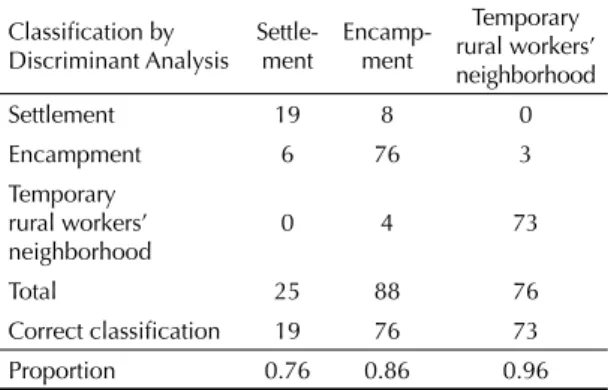
Under the discriminant factor analysis, the three commu-nities scored a general percentage of 89% correct clas-sifi cation, with only 21 families not having the typical characteristics of their own group out of a total of 189 families in the study. Of the 202 families interviewed, 13 were not included in the study as they did not provide all the information required. The families of the temporary rural workers scored the highest index of matching the classifi cation with 96%, followed by 86% on the en-campment and 76% for the settlement (Table 3).
The variables that best characterized the families from the settlement were access to credit, the rearing of farm animals, the availability of food over the previous three months, rural origins, the need for improved access to health services and the absence of piped water in their homes. At the other extreme, were the families of the temporary rural workers who were differentiated by the use of pesticides at work, the non-rearing of farm animals, the presence of piped water and the low level of participation in community organizations. The fami-lies from the encampment fell between the two, with most having urban origins, a high level of community participation and organization, low use of pesticides and access to credit (Table 4).
DISCUSSION
The drawing of conclusions relating to the relation-ship between socio-economic development, health and food security is a diffi cult and complex issue, since there are a multitude of determinants related to nutritional defi ciencies. The principal problems are related to the diffi culty in controlling all the variables that are relevant to the issue and in choosing the most
appropriate epidemiological design for the drawing up of conclusions.
The better conditions relating to food security and animal rearing, coupled with the higher levels of com-munity organization and capacities for complaints were positive attributes of the MST population. This shows the potential for this group to contribute towards a broad and participatory process of agrarian reform. However, the lack of homes with piped water and the diffi culties of access to health services point to disad-vantages associated with public health and sanitation policy limitations that have not yet been resolved, as noted by several authors (Schmidt et al15 1998, Leite et al8 2004, UnBa 2001).
The fi ndings here relating to greater food insecurity amongst the temporary rural workers compared with those from the encampment and settlement are similar to those of other researchers (Victora20,21 1983 e 1986, Lira et al9 1985, Romani & Amigo14 1986, Ferreira et al6 1997, Brentlinger et al3 1999, Veiga & Burlandy19 2001, Castro et al5 2004). These studies show that ownership of the means of production, in this case understood to mean land ownership, is associated to a better nutritional status among children. Leite et al8 (2004) also found that access to land and to the possibil-ity of growing crops for personal consumption appeared to lead to an improvement in the nutritional status of people who previously lived from temporary work or from other forms of instable employment. The analysis of income generation, taking into account both income in the form of personal consumption and monetary income showed that, even with low levels, families guaranteed their food security. In addition, Leite et al8 Table 1. Variables used for the discriminant factor analysis of the three communities under study. Unaí, Southeastern Brazil, 2005.
Thematic group Variable
Sociodemographic and family characteristics Urban or rural origin Living conditions
Food security The food supply ended in the last three months Sanitation Presence of piped water inside the home Credit Access to credit services (farming and others) Community organization Participation in an organization or community body Prouduction and working conditions
Exposure to pesticides Use of pesticides at work Animal rearing Do not rear farm animals Health services
Activities that mean that the SUS health system meets the health needs of the family or community
Demand improvements, put pressure on the government and form part of an organization
Health conditions
Factors that are missing in guaranteeing good health Access and improvements in health services SUS: Brazilian Health System
are signed, and this means they are not considered as possible benefi ciaries; but when they are unemployed and enter the pool of those waiting to receive benefi ts, they are at the bottom of the pile.
The marked involvement with animal rearing among families from the settlement was also observed in other studies of settlements (Leite et al8 2004). Although this activity generally related to personal consumption, this kind of farming leads to increased family income and improvements in food security.a
(2004) found there to be an average improvement of 90% in families’ living conditions after they had settled on the main settlement “strips” of Brazil.
The fi ndings relating to food insecurity among tempo-rary rural workers were also reported by Silva16 (1999) in up-country São Paulo. Moreira & Watanabe’s study12 (2006) of the weekly dietary intake of the families of temporary rural workers in the Canavieira Zone in Paraíba also found diets to be lacking in proteins, with food intake weighted towards cereals and their deriva-tives. Most of these families spent more than half of their family income on food.
Some of the results can help to explain the higher levels of food insecurity among temporary rural workers. An important factor is the shortage of work over the 12 months of the year. Periods without work mean that the temporary rural workers incur debts of various kinds, ranging from public payments for water and electricity, to stores that sell food and other daily staple supplies. The bolsa família welfare payments, which could serve as a temporary solution to this problem, do not provide suffi cient coverage to this population. These social programs are based on food distribution or cash transfers that are dependent on certain conditions relating to the reinforcement of basic social rights in the areas of health (children’s vaccine certifi cates must be up-to-date) and education (children must attend school) that benefi t poor families. Information from the social department of Unaí’s Municipal Mayor’s Offi ce suggest that the low levels of coverage of the bolsa família grant among temporary rural workers are related to the fact that the municipal Human development Index is higher than other regions such as the Vale do Jequitinhonha, which means that federal government transfers tends to prioritize these other areas. Another factor is that these benefi ts are passed on inconsistently: the fact that many of the temporary rural workers are considered part of the formal labor market since their employment books
Table 2. Availability of food in the last three months among families. Unaí, Southeastern Brazil, 2005.
Community
Lack of food in the last three months
Yes No Don’t Know Total N % N % N % Settlement 3 11.5 23 88.5 - 26 Encampment 21 22.1 73 76.8 1 1.1 95 Temporary
rural workers’ neighborhood
32* 39.5 49* 60.5 - 81
Total 56 27.7 145 71.8 1 0.5 202 * p <0.05 taking the settlement as the basis for comparison
Table 3. Classification of the discriminant analysis by community of residence and selected variables. Unaí, Southeastern Brazil, 2005.
Classifi cation by Discriminant Analysis
Settle-ment
Encamp-ment
Temporary rural workers’ neighborhood Settlement 19 8 0 Encampment 6 76 3 Temporary
rural workers’ neighborhood
0 4 73
Total 25 88 76
Correct classifi cation 19 76 73 Proportion 0.76 0.86 0.96
Table 4. Linear discriminant function by community of residence and selected variables for the three communities under study. Unaí, Southeastern Brazil, 2005.*
Variable Settle-ment
En-
camp-ment
Temporary rural workers’ neighborhood Constant -6.95 -3.92 -9.88 Rural or urgan origin 0.12 3.86 2.49 Presence of piped
water in the home 0.93 1.69 5.29 Access to credit 10.22 1.06 1.21 Use of pesticides 1.12 -0.06 7.46 The food supply ended
in the last three months 1.32 1.40 3.54 Demand improvements
in the SUS system, form part of an organization
2.88 1.08 -0.47
Participate in an
organization 2.89 3.02 0.98 Do not breed
farm animals 0.99 2.20 6.04 Access and
improvements in health services
2.56 1.98 1.16
* Categoriziation of variables 1= presence of factor; 0= absence
SUS: Brazilian Health System
The situation of temporary rural workers was better only in terms of access to sanitation and health services, due to the greater number of facilities supplying these kinds of services in urban areas when compared with rural areas. However, the high levels of exposure to pesticides, high rates of food insecurity and low levels of political organization also made them different to the MST population involved in the study. These negative attributes are direct consequences of large-scale pro-duction models based on monoculture, that have been analyzed in other studies (Alessi & Navarro1 1997, Silva16 1999, Castro4 2003, Miranda11 et al 2007, Soares & Porto17 2007).
Although families from the MST settlement and en-campment have lower levels of access to most public health services and policies, their political organization is much more advanced than that of the temporary rural workers. Their robust political actions aimed at claiming their rights has led to a reduction in certain
differences such as access to education and government credits, as has also been noted in other studies.a
These fi ndings contribute towards a refl ection about Brazil’s overall development aims. “Agro-business” is considered to be a major force in the Brazilian economy and is responsible for 40% of all exports, but its impact on health (workers, families and communities) and eco-systems has not been assessed. At the same time, the results that Agrarian Reform has had on living conditions and the health status of benefi ciaries may justify the need for a wide-ranging Agrarian Reform Program in Brazil.
ACKNOWLEDGEMENTS
Thanks to the families of the communities involved in the study and to the team from the Health Post in Bairro Mamoeiro for facilitating access to the families and their records.
1. Alessi NP, Navarro VL. Saúde e trabalho rural: o caso dos trabalhadores da cultura canavieira na região de Ribeirão Preto, São Paulo, Brasil. Cad Saude Publica. 1997;13(Sup 2):S111-21. doi:10.1590/S0102-311X1997000600010
2. Breilh J. Epidemiologia Crítica: ciência emancipadora e interculturalidade. Rio de Janeiro: Editora Fiocruz; 2006.
3. Brentlinger PE, Hernán MA, Hernández-Diaz S, Azaroff LS, McCall M. Childhood malnutrition and postwar reconstruction in rural El Salvador-a community-based survey. JAMA. 1999;281(2):184-90.
4. Castro J. A geografi a da fome – o dilema brasileiro: pão ou aço. 3.ed. Rio de Janeiro: Civilização Brasileira; 2003.
5. Castro TG, Campos FM, Priore SE. Saúde e nutrição de crianças de 0 a 60 meses de um assentamento de reforma agrária, Vale do Rio Doce, MG, Brasil.
Rev Nutr. 2004;17(2):167-76. doi:10.1590/S1415-52732004000200003
6. Ferreira HS, Albuquerque MFM, Ataíde TR, Morais MGC, Mendes MCR, Siqueira TCA. Estado nutricional de crianças menores de dez anos residentes em invasão do “movimento dos sem-terra”, Porto Calvo, Alagoas. Cad Saude Publica. 1997;13(1):137-9. doi:10.1590/S0102-311X1997000100024
7. Figueiredo VM, Freitas E, Pinto MGO, Barros ME. Questão Agrária e Saúde no Brasil contemporâneo.
Rev Bras Saude Ocup. 1987;15(59):7-17.
8. Leite S, Heredia B, Medeiros L, Palmeira M, Cintrão R. Impacto dos Assentamentos: um estudo sobre o meio rural brasileiro. São Paulo: Editora UNESP; 2004.
9. Lira PIC, Amigo H, Romani SAM, Torres MAA. Estado nutricional de crianças menores de seis anos, segundo posse da terra, em áreas rurais do Estado de Pernambuco, Nordeste do Brasil. Arch Latinoam Nutr.
1985;35(2):246-57.
10. Kassouf AL. Acesso aos serviços de saúde nas áreas urbana e rural do Brasil. Rev Econ Sociol Rural.
2005;43(1):29-44. Disponível em http://www.scielo.br/
scielo.php?script=sci_arttext&pid=S0103-200320050 00100002&lng=en&nrm=iso>. [Acesso em 12/out/06] doi:10.1590/S0103-20032005000100002
11. Miranda AC, Moreira JC, Carvalho R, Peres F. Neoliberalismo, uso de agrotóxicos e a crise da soberania alimentar no Brasil. Cienc Saude Coletiva. 2007;12(1):7-14. doi:10.1590/S1413-81232007000100002
12. Moreira E, Watanabe T, organizadores. Ambiente, Trabalho e Saúde. João Pessoa: Editora Universitária UFPB; 2006.
13. Minitab Statistical Software. Version 14. Pensilvânia: Minitab Inc; 2006.
14. Romani SAM, Amigo H. Perfi l alimentar e posse da terra na área rural do Estado de Pernambuco, nordeste do Brasil. Rev Saude Publica. 1986;20(5):369-76. doi:10.1590/S0034-89101986000500006
15. Schmidt BV, Marinho DNC, Couto Rosa SL,
organizadores. Os assentamentos da Reforma Agrária no Brasil. Brasília: Editora Universidade de Brasília; 1998.
16. Silva MAM. Errantes do fi m do século. São Paulo: Fundação Editora da UNESP, 1999.
17. Soares WL, Porto MF. Atividade agrícola e
externalidade ambiental: uma análise a partir do uso de agrotóxicos no cerrado brasileiro. Cienc Saude Coletiva. 2007;12(1):131-43. doi:10.1590/S1413-81232007000100016
18. Vasconcelos FAG. Avaliação Nutricional de Coletividades. 3.ed. Florianópolis: Ed UFSC; 2000.
19. Veiga GV, Burlandy L. Indicadores sócio-econômicos, demográfi cos e estado nutricional de crianças e adolescentes residentes em um assentamento rural do Rio de Janeiro. Cad Saude Publica. 2001;17(6):1465-72. doi:10.1590/S0102-311X2001000600030
20. Victora CG. Desnutrição e a propriedade da terra no campo. Cienc Hoje. 1983;1(5):80.
21. Victora CG, Vaughan JP, Kirkwood B, Martines JC, Barcelos LB. Child malnutrition and land ownership in southern Brazil. Ecol Food Nutr. 1986;18:265-75.
REFERENCES