in Comparison to Current Diagnostic Gold Standards for
BRAF
,
EGFR
and
KRAS
Mutational Analysis
Clare M. McCourt1, Darragh G. McArt1, Ken Mills2, Mark A. Catherwood2,4, Perry Maxwell1,4, David J. Waugh3, Peter Hamilton1, Joe M. O’Sullivan3,4, Manuel Salto-Tellez1,3,4,5*
1Molecular Pathology Programme, Centre for Cancer Research and Cell Biology, Queen’s University Belfast, Belfast, United Kingdom,2Haematology Programme, Centre for Cancer Research and Cell Biology, Queen’s University Belfast, Belfast, United Kingdom,3Prostate Cancer Programme, Centre for Cancer Research and Cell Biology, Queen’s University Belfast, Belfast, United Kingdom,4Belfast Trust, Belfast City Hospital, Belfast, United Kingdom,5Cancer Science Institute Singapore, National University Health System & National University, Singapore, Singapore
Abstract
Next Generation Sequencing (NGS) has the potential of becoming an important tool in clinical diagnosis and therapeutic decision-making in oncology owing to its enhanced sensitivity in DNA mutation detection, fast-turnaround of samples in comparison to current gold standard methods and the potential to sequence a large number of cancer-driving genes at the one time. We aim to test the diagnostic accuracy of current NGS technology in the analysis of mutations that represent current standard-of-care, and its reliability to generate concomitant information on other key genes in human oncogenesis. Thirteen clinical samples (8 lung adenocarcinomas, 3 colon carcinomas and 2 malignant melanomas) already genotyped for EGFR, KRASandBRAFmutations by current standard-of-care methods (Sanger Sequencing and q-PCR), were analysed for detection of mutations in the same three genes using two NGS platforms and an additional 43 genes with one of these platforms. The results were analysed using closed platform-specific proprietary bioinformatics software as well as open third party applications. Our results indicate that the existing format of the NGS technology performed well in detecting the clinically relevant mutations stated above but may not be reliable for a broader unsupervised analysis of the wider genome in its current design. Our study represents a diagnostically lead validation of the major strengths and weaknesses of this technology before consideration for diagnostic use.
Citation:McCourt CM, McArt DG, Mills K, Catherwood MA, Maxwell P, et al. (2013) Validation of Next Generation Sequencing Technologies in Comparison to Current Diagnostic Gold Standards forBRAF,EGFRandKRASMutational Analysis. PLoS ONE 8(7): e69604. doi:10.1371/journal.pone.0069604
Editor:Joseph Devaney, Children’s National Medical Center, Washington, United States of America ReceivedFebruary 6, 2013;AcceptedJune 9, 2013;PublishedJuly 26, 2013
Copyright:ß2013 McCourt et al. This is an open-access article distributed under the terms of the Creative Commons Attribution License, which permits
unrestricted use, distribution, and reproduction in any medium, provided the original author and source are credited.
Funding:This work was funded by Queen’s University Belfast lab start-up fund. The funders had no role in study design, data collection and analysis, decision to publish, or preparation of the manuscript.
Competing Interests:The authors have declared that no competing interests exist. * E-mail: [email protected]
Introduction
Molecular cancer diagnostics in clinical practice is constantly and rapidly evolving. With the need to identify standard-of-care mutations in companion diagnostics to predict therapeutic response, cancer treatment has been revolutionised.
Since the 1970s, the Sanger method [1] is the gold standard for mutation analysis in cancer diagnostics; however its low-through-put and relative low sensitivity, long turnaround time and overall cost [2] have called for new paradigms. Next Generation Sequencing (NGS) can massively parallel sequence millions of DNA segments and, in principle, offers benefits relating to possible lower costs, increased workflow speed and enhanced sensitivity in mutation detection [3]. As whole-genome-sequencing may be unaffordable for routine diagnostics, the targeted sequencing of exon coding regions or a subset of ‘genes of interest’ offered by NGS is an attractive proposition a priori [4]. When compared with single-gene analysis, the use of NGS in diagnostics would allow the analysis of more than one therapeutic avenue as well as the generation of other valuable information for research purposes. To be a plausible option, a) NGS technologies must
and it can therefore be reliably implemented as a stand-alone diagnostic test [10].
Here, we test the validity of the current technical designs for the NGS analysis ofBRAF, EGFRand KRAS(and of more than 40 other key oncogenes), exploring all the bench and bioinformatics analytical variables to confirm the possible application of these technologies for routine cancer diagnostics.
Materials and Methods
(See S1 for choice of clinical materials, DNA extraction protocols, sequencing analysis by Sanger and q-PCR platforms, general sequencing workflow for NGS analysis and ethical framework of the study). Thirteen aliquots of tumour DNA extracted from formalin-fixed-paraffin-embedded (FFPE) malig-nant melanoma, lung adenocarcinoma and colon carcinoma, and genotyped by Sanger/q-PCR sequencing for BRAF, EGFR and KRAS status, respectively, were obtained from the Northern Ireland Biobank following ethical approval (NIB12-0049). The data set has been deposited in NCBI SRA http://www.ncbi.nlm. nih.gov/sra (SRP023265).
IonTorrent sequencing
PGM sequencing was performed according to IonTorrent protocols using 10 ng DNA (Table S1), IonAmpliSeqTMCancer Panel primer pool and IonAmpliSeqTMLibrary Kit 2.0 Beta (Life Technologies) for whole-exon-sequencing of BRAF, EGFR and KRASand targeted ‘‘hot-spot’’ regions in 43 other cancer-related genes (http://tools.invitrogen.com/content/sfs/brochures/IonAmpliSeq_ CancerPanel_Flyer_CO32201_06042012.pdf). Template preparation was performed on the Ion OneTouchTMsystem for 100 bp libraries (Life Technologies). QCs were performed using the IonSphereTM Qu-ality Control Kit (according to the protocol) ensuring that 10-30% of template positive Ion spheres were targeted in the emPCR reaction. Prior to loading onto 314 chips, sequencing primer and polymerase were added to the final enriched Ion spheres.
454 GS Junior sequencing
GS Junior Titanium Fusion primers for BRAF (exon 15) and KRAS (exon 2) were designed incorporating 8 Roche multiplex identifier (MID) barcodes. BRAF and KRAS libraries were prepared adhering to the Roche Amplicon Library Preparation manual. For EGFR, libraries were prepared using the EGFR18-21MastR kit (Multiplicom), according to the accompanying protocol. Clonal amplification onto DNA capture beads was performed manually adhering to the emPCR Amplification manual-Lib A (Roche). After DNA library bead enrichment, adaptor-specific sequencing primers were annealed and libraries were sequenced according to the Sequencing Manual on the GS Junior (Roche).
Bioinformatics analysis
IonTorrent ‘closed’ bioinformatics. was performed using IonTorrent Version (V) 2.0.1 (ID.1-ID.10 and ID.12) and re-analysed by V2.2 upgrade (all samples). The HG19 reference was used for alignment. For 314 chip sequencing a threshold of
$200,000 final quality library reads was applied.
GS Junior ‘closed’ bioinformatics. was performed using Roche 454 Amplicon Variant Analyzer (AVA) V2.7 for BRAF and KRAS. HG19 BRAF and KRAS regions were used as the alignment reference, respectively. Multiplicom provided scripts for analyzing their EGFR18-21MastR Kit sequencing results. A threshold of$50,000 final quality library reads was applied for all.
Variants obtaining a frequency of detection$5% were considered in the analysis.
‘Open’ CLC Genomics Workbench. V5.5 was employed to comparatively analyse data generated by IonTorrent software (PGM) and AVA (GS Junior). HG19 was downloaded within CLC, incorporating tracks from the COSMIC database. Align-ment was carried out by 2 methods: a loose alignAlign-ment setting to identify large base changes, for example deletions, and a stringent alignment setting for quality based variant detection (QBVD) of single nucleotide variants (SNVs), both capped at 5% mutation frequency. Three QBVD thresholds were applied: (i) the lowest coverage and (ii) the second lowest coverage required to detect standard-of-care variants. A third arbitrary threshold (iii) at, 2-fold higher coverage than (ii) was also employed. Coverage equated to (i) = 71 (aa719 exon 18; EGFR), (ii) = 259 (aa858 exon 21; EGFR) and (iii) = 500, meaning any SNVs with coverage equal to or above these thresholds were included in CLC analysis and compared. For IonTorrent, four sets of data were retrieved: V2.0.1, CLC_V2.0.1 (ID.1-ID.10 and ID.12), V2.2 and CLC_V2.2 (all samples), and for GS Junior, 2 sets: AVA and CLC_AVA. Ultimately, a variant ‘passed’ if detected in 2/4 of the resultant analyses enabling a consensus list of SNVs and standard-of-care genes across different software tools and versions. Concordance (rho.c value) analysis was performed evaluating the frequency of variants detected against the reference between the following groups: CLC_IonTorrentV2.2 vs IonTorrentV2.2; Ion TorrentV2.2 vs AVA; AVA vs CLC_AVA.
Results
EGFR analysis
Lung adenocarcinoma (ID.3-ID.10). Deletion in exon 19 affecting aa745_750 was detected in 25% of patients (ID.7 and ID.10) and was concordant across Sanger, q-PCR (Cobas), IonTorrent (V2.2) and Roche GS Junior platforms (mean coverage depth .2500, Table 1). A variant in exon 20 G/A aa803 was detected in ID.10 by IonTorrent but disregarded as re-analysis by CLC and subsequent GS Junior sequencing did not confirm the base call hence not meeting our variant ‘passed’ criteria outlined in Materials and Methods. Lowering the stringency of the bioinformatic analysis allowed the detection of standard-of-care TKI-sensitising mutations [7,8] that were not detected by single gene analysis and thus, are likely to represent false-positive results. For example, in ID.9, a SNV was detected in exon 18 G/T aa719 by IonTorrent and, as a result of applying the lowest threshold, this SNV was also detected by CLC re-analysis at coverage of 89. By employing more stringent thresholds (QBVDii = 259; QBVDiii = 500), this standard-of-care mutation was not detected. Variants that ‘passed’ the 2/4 analysis criteria but not identified by the gold standard Sanger/q-PCR methods were in ID.4, ID.5 and ID.9 by IonTorrent (and CLC re-analysis) at the sensitizing mutation EGFR exon 20 G/T aa768 [8]. This finding was discordant with GS Junior and Sanger/q-PCR. Sequencing coverage averaged at 477 (for all 3 QVBD thresholds). Of note, when applying the highest threshold (QVBDiii = 500) only, this standard-of-care mutation would only have been called in ID.4. Variant ‘passed’ in 4/4 NGS analysis was the important activating mutation in ID.9 at exon 21 T/G aa858 (also identified by Sanger/q-PCR). Importantly, by applying the highest QBVDiii threshold of 500, this key SNV would only have been called in 1/4 analysis of ID.9. Variants ‘passed’ in 4/4 NGS analysis were the two standard-of-care mutations in exon 18 G/T aa719 and exon 20 G/T aa768 in ID.8, concordant with Sanger/q-PCR (Table 1). Even when applying the most stringent threshold (QBVDiii = 500),
Table 1.EGFR mutational analysis of lung adenocarcinoma, malignant melanoma and colorectal carcinoma – Sanger/q-PCR sequencing versus NGS.
Patient EGFR q-PCR Sanger IonTorrent CLC_IonTorrent 454_AVA CLC_AVA
ID Location Exon AA SNV/DEL Frequency Coverage SNV/DEL Frequency Coverage SNV/DEL Frequency Coverage SNV/DEL Frequency Coverage
3 55249063 EX20 AA787 G/A 47.4 483 G/A 49.1 568 G/A 51 2852 G/A 45.7 1959 LA
4 55249063 EX20 AA787 G/A 96.4 505 G/A 97 606 G/A 100 1474 G/A 100 1393 LA 55249005 EX20 AA768 G/T 5 540 G/T 5.1 529
5 55249005 EX20 AA768 G/T 12.6 420 G/T 12.6 412
LA 55249063 EX20 AA787 G/A 64.8 409 G/A 64.1 418 G/A 49.5 2577 G/A 50.6 2457 6 55249063 EX20 AA787 G/A 43.8 185 G/A 49.5 246 G/A 40.1 1373 G/A 49.3 2095 LA
7 55242464 EX19 745_750 Del Del Del 23.9 1404 Del 25.9 1234 Del 20.2 4197 Del 19.6 3782 LA 55249063 EX20 AA787 G/A 39.3 707 G/A 39.8 763 G/A 38.9 2298 G/A 38.7 2203 8 55241707 EX18 AA719 AA719 AA719 G/T 50.8 665 G/T 50.8 667 G/T 39.9 1969 G/T 40.6 1850 LA 55249005 EX20 AA768 AA768 AA768 G/T 26.9 750 G/T 25.4 724 G/T 43.5 550 G/T 43.4 518
55249063 EX20 AA787 G/A 99.6 770 G/A 99.8 801 G/A 100 550 G/A 100 518 9 55241707 EX18 AA719 G/T 40.9 71 G/T 32.6 89
LA 55249005 EX20 AA768 G/T 4.7 472 G/T 9.6 489
55249063 EX20 AA787 G/A 68 546 G/A 68.4 557 G/A 7 185 G/A 6.9 175 55259450 EX21 AA836 C/T 10.9 478 C/T 10.4 450 C/T 36.7 507 C/T 36.5 480 55259515 EX21 AA858 AA858 AA858 T/G 26.1 111 T/G 11.3 265 T/G 49.3 507 T/G 46.8 453 10 55242464 EX19 745_750 Del Del Del 80.3 1953 Del 82.9 3633 Del 79.3 2218 Del 79.3 2033 LA 55249063 EX20 AA787 G/A 99.5 1047 G/A 99.4 1332 G/A 100 7098 G/A 99.9 6700
55249110 EX20 AA803 G/A 4.2 2051
1 55259450 EX21 AA836 C/T 47.8 695 C/T 46.7 676 C/T 56.4 2984 C/T 43.5 2936 MM
2 55241707 EX18 AA719 G/T 27.7 170 G/T 25.7 183
MM 55249063 EX20 AA787 G/A 99 294 G/A 99.1 319 G/A 97 1275 G/A 97.2 1230 55249114 EX20 AA804 A/G 9.2 806
Application
of
NGS
for
Clinical
Cancer
Diagnost
ONE
|
www.ploson
e.org
3
July
2013
|
Volume
8
|
Issue
7
|
both therapeutic mutational targets were called. In addition, two silent germline polymorphisms [10,11] were detected in 4/4 NGS analyses: a SNV at exon 21 C/T aa836 in ID.9 and a SNV at exon 20 G/A aa787 in all lung adenocarcinoma samples. Frequencies of EGFR SNVs were concordant between IonTorrent and re-analysis by CLC (rho.c.est = 0.9957) and similarly between GS Junior’s AVA data and CLC_AVA (rho.c.est = 0.9953), verifying a strong overlap between platform-specific proprietary software and open third-party tools. There was a poor concor-dance between IonTorrent software and GS Junior’s AVA pipeline for matched EGFR SNV frequencies, rho.c est = 0.7718.
Malignant melanoma (ID.1 and ID.2). The therapeutic TKI target in EGFR exon 18 aa719 was detected in ID.2 by IonTorrent and CLC_IonTorrent analysis, albeit at the least stringent threshold of 71. No other mutations in EGFR were considered as they have previously been described as silent germline polymorphisms [10,11] or did not meet the variant ‘passed’ criteria (exon 20 aa804) (Table 1).
Colorectal carcinoma (ID.11-ID.13). In 1/3 clinical sam-ples, IonTorrent and CLC_IonTorrent analysis identified a SNV at exon 18 G/T aa719 however application of the two highest stringency thresholds excluded this base call. Again, the germline silent mutation in EGFR exon 20 aa787 was returned from the analysis in all colorectal carcinoma samples in this study and has been reported by others [12] (Table 1).
BRAF and KRAS analysis
Malignant melanoma (ID.1 and ID.2). BRAF: The stan-dard-of-care mutation, exon 15 A/T aa600 [5] was detected in both malignant melanoma clinical samples by the q-PCR method. This finding was concordant with sequence data generated from the IonTorrent NGS platform (ID.1 and ID.2) and GS Junior (ID.2 only), Table 2. Unfortunately, the clinical sample, ID.1, was exhausted and analysis with 454 GS Junior platform could not be completed.
KRAS: Although not meeting the variant ‘passed’ criteria, it is noteworthy that the clinically relevantKRAS mutation in exon 2 C/T aa12 was called (IonTorrent only) in ID.1, though at a low frequency of 5.1%. This variant was not detected by q-PCR sequencing ofKRAS, Table 2.
Lung adenocarcinoma (ID.3-ID.10). BRAF: No mutations in theBRAF gene were detected, concordant across all technol-ogies.
KRAS: The important therapeutic KRASmutation in colon cancer was detected in ID.3 and ID.6 (exon 2 aa12), two EGFR wildtype samples. Furthermore, the detection of KRAS muta-tions by NGS was concordant with the gold standard methods, Table 2. Within exon 2 of the KRAS gene, the GS Junior AVA software (and CLC_AVA) but not IonTorrent, called other variants with frequencies#7%, including a SNV at exon 2 aa14 with a COSMIC ID (http://www.sanger.ac.uk/perl/ genetics/CGP/cosmic?action = bygene&ln = KRAS&start = 4&end = 20&coords = AA%3AAA) (Table 2). Interestingly, these multiple variants were only present in ID.8 and ID.9 both of which harbour severalEGFRactivating mutations (Table 1).
Colorectal carcinoma (ID.11-ID.13). All colorectal carci-noma samples had been reported asBRAFandKRASwildtype by q-PCR sequencing. For KRAS analysis, this was concordant across all technologies, however theBRAFmutation at codon 600 was called in 1/3 colorectal carcinoma samples though at a low coverage equal to 4.38% and only by 1/4 analysis (IonTorrent, Table 2). Table 1. Cont. Patient EGFR q-PCR Sanger IonTorrent CLC_IonTorrent 454_AVA CLC_AVA ID Location Exon AA SNV/DEL Frequency Coverage SNV/DEL Frequency Coverage SNV/DEL Frequency Coverage SNV/DEL Frequency Coverage CRC 12 55241707 EX18 AA719 G/T 8 .8 239 G/T 7.9 242 CRC 55249063 EX20 AA787 G/A 34.4 270 G/A 3 2.4 3 18 13 LA 55249063 EX20 AA787 G/A 44.1 6 8 G /A 52.5 972 G /A 52.5 947 The EGFR exons 1 8–21 were sequenced and compared by four methods. NGS confirmed activating mutations in EGFR concordant with gold standard m ethods, as w ell as other mutational variants. CLC software analysis was performed to confirm or deny base calls. Del:deletion; EX:Exon; LA: lung adenocarcinoma; MM: malignant melanoma; CRC: colorectal cancer. doi:10.1371/journal.p one.0069604.t001
Table 2.BRAF and KRAS mutational analysis of lung adenocarcinoma, malignant melanoma and colorectal carcinoma by NGS LA: lung adenocarcinoma; MM: malignant melanoma; CRC: colorectal cancer.
Patient q-PCR IonTorrent CLC_IonTorrent 454_AVA CLC_AVA
ID Location Exon AA SNV/DEL Frequency Coverage SNV/DEL Frequency Coverage SNV/DEL Frequency Coverage SNV/DEL Frequency Coverage
1 140453136 BRAF Ex15 AA600 AA600 A/T 19.4 1127 A/T 19 1098 - -MM 25398284 KRAS Ex 2 AA12 C/T 5.1 9394
2 MM 140453136 BRAF Ex15 AA600 AA600 A/T 19.5 934 A/T 19 916 A/T 9.6 14911 A/T 9.6 14278 3 LA 25398284 KRAS Ex 2 AA12 AA12 C/T 15.8 1550 C/T 15.7 1551 C/T 13.6 7544 C/T 13.5 6209 4 LA
5 LA
6 LA 25398285 KRAS Ex 2 AA12 AA12 C/A 49.5 812 C/A 49.6 790 C/A 60.9 20845 C/A 39.5 17036 7 LA
8 25398234 KRAS Ex 2 AA6 C/T 6.4 7047 C/T 6.2 6549 LA 25398280 KRAS Ex 2 AA14 G/A 5.6 7044 G/A 5.7 6489 25398303 KRAS Ex 2 AA29 G/A 6.8 7045 G/A 5.7 6027 9 LA 25398279 KRAS Ex 2 AA14 C/T 6.6 10054 C/T 6.2 9253 10 LA
11 CRC 12 CRC
140453136 BRAF Ex15 AA600 A/T 4.38 1552 13
CRC
doi:10.1371/journal.pone.0069545.t002
Application
of
NGS
for
Clinical
Cancer
Diagnost
ONE
|
www.ploson
e.org
5
July
2013
|
Volume
8
|
Issue
7
|
Full analysis of IonTorrent AmpliSeq panel
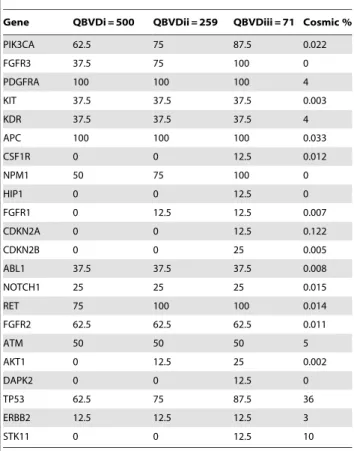
Lung adenocarcinoma (ID.3-ID.10). As defined before, variants ‘passed’ if present in 2/4 analyses: IonTorrent V2.0.1, CLC_V2.0.1, IonTorrent V2.2 and CLC_V2.2, Figure 1. Several SNVs and at different genomic positions, demonstrated by the heat map ‘distribution of variants’, were observed in TP53 in 87.5% of lung adenocarcinomas (Figure 1, Table 3). Even at the highest stringency threshold (QBVDiii = 500; Table 3), TP53 SNVs were called in 62.5% of samples. This is improbable, as when we compare this frequency with the COSMIC database for TP53 mutations in lung adenocarcinoma, the results are discordant, Table 3. Five genes were flagged as mutant in all 8 lung adenocarcinoma samples namely RET, APC, FGFR3,
NPM1 and PDGFRA when the least stringent QBVD threshold was applied (QBVDi = 71). By applying the highest threshold (QBVDiii = 500), still 100% of samples had mutations in PDGFRA and APC, while 37.5% and 75% of patient samples had FGFR3 and RET mutations, respectively. For each of the five genes, the findings are markedly discordant with COSMIC frequencies (Table 3) and were regarded as false-positives. Additionally, SNVs in NPM1 were disregarded as detection was within a homopolymer region, a documented caveat of the IonTorrent variant calling software [13]. Here, the NGS methodology needs further software and chemistry improvements. The importance of applying thresholds was addressed in relation to other genes on the panel. A low stringency level (QBVDi = 71)
Figure 1. Distribution of variants detected using the Ion AmpliSeq Cancer Panel.A heat map was generated illustrating the variants occurring in all 46 genes by both IonTorrent software versions in each of the clinical samples. COSMIC tracked variants are also described. doi:10.1371/journal.pone.0069604.g001
allowed the detection of STK11, DAPK2, CDKN2A, CDKN2B, HIP1 and CSF1R SNVs in one or two (CDKN2B only) of the patient samples. Again, these variants have not been considered in the final gene profile for lung adenocarcinomas as they are discordant with that reported by the COSMIC database (Figure 1, Table 3). Other SNVs that were detected, even by a highly stringent threshold approach, but excluded when referenced against the COSMIC database included PIK3CA (62.5% of samples vs 2.2% COSMIC frequency), KIT (37.5% vs 0.3%), KDR (37.5% vs 4%), ABL1 (37.5% vs 0.8%), NOTCH (25% vs 1.5%), FGFR2 (62.5% vs 1.1%) and ATM (50% vs 5%). Mutations that could be genuine but would require further investigation in a larger patient cohort are AKT1, FGFR1 and ERBB2, each occurring in 1/8 of the clinical samples and are reported as low frequency occurring mutations in lung adenocar-cinoma by the COSMIC database (Figure 1, Table 3).
Colorectal carcinoma (ID.11-ID.13). Analysis of ID.12 was carried out using IonTorrent V2.01 and V2.2 as this sample was sequenced prior to the software upgrade, hence included in the heat map generated in Figure 1. ID.11 and ID.13 have been analysed by V2.2 only, Table 4. Due to the limited numbers available, we adjusted our inclusion criteria for the additional genes interrogated by the Ion AmpliSeq panel. In each of the colorectal carcinoma samples, SNVs were considered if a) detected in 2/3 samples tested and b) called by both IonTorrent analysis
and CLC re-analysis. With this approach, FGFR3, PDGFRA, APC, RET, ATM and TP53 were flagged; however, experience in the larger lung adenocarcinoma cohort (Table 3) may call into question the reliability of the former 4 genes, Table 4. The results of ATM and TP53 do not allow analytical comment within this small sample number.
Malignant melanoma (ID.1 and ID.2). As above, we adjusted the inclusion criteria. SNVs were considered if detected in both malignant melanoma (BRAF mutant) samples. Genes included FGFR3, PDGFRA, APC, RET, NPM1 and PIK3CA. As before, the reliability of the former 4 genes is questionable. NPM1 was disregarded as the mutation was flagged in a homopolymer region. PIK3CA is a likely true mutation identified by the Ion AmpliSeq panel (Figure 1) and requires future validation.
Threshold filtering
The gene information obtained from interrogation of the Ion AmpliSeq panel was represented as a box plot (Figure S1) demonstrating the importance of threshold application in SNV detection in NGS. The lines represent each of the QBVD thresholds (i = 71, ii = 259, iii = 500) and the proportion of gene SNVs that are filtered according to what stringency level has been applied.
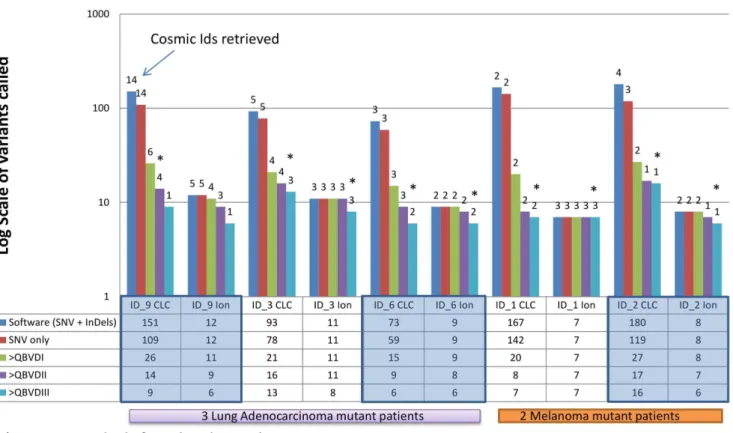
Figure 2 demonstrates the relevance of ‘filtering by threshold application’ of COSMIC SNVs in some of those patients with standard-of-care mutations inEGFR(ID.9),KRAS(ID.3 and ID.6) and BRAF (ID.1 and ID.2). For example, in ID.9 the lowest threshold level of detection for large deletions, calls variants in 151 gene regions in the Ion AmpliSeq cancer panel, 14 of which have been referenced in the COSMIC database. By applying an internal SNV only detection capability in CLC, the number of SNVs called in the full panel was reduced to 109 (14 COSMIC references still remained). As expected, application of the QBVD thresholds (i = 71, ii = 259 and iii = 500) resulted in a decrease in the number of SNVs detected from 26 to 14 to 9 and those that were COSMIC tracked, reduced from 6 to 4 to 1, respectively. An interesting observation of this threshold approach is that clinically important mutations inKRAS(ID.3 and ID.6) andBRAF(ID.1 and ID.2) were still detected when a QBVDiii (500) was applied, however, the clinically relevant mutation inEGFRwould not have been reported by applying this threshold, Figure 2.
Discussion
Generation of numerous DNA reads from significant portions of the genome in little time will transform the way we interrogate DNA in cancer diagnostics. The sooner NGS is fully fit for this purpose, the easier it will be to interrogate numerous possible drug targets per patient in a time-sensitive manner, and thus, design broader short-term and long-term therapeutic strategies.
In our opinion, the current study has 4 main points of interest. Firstly, NGS is reliable in detecting known standard-of-care mutations with good sensitivity and specificity within our small sample panel. For example, deletions inEGFRexon 19 and SNVs inEGFR exon 18 aa719, exon 20 aa768 and exon 21 aa858 in lung adenocarcinoma [8];KRASSNVs in exon 2 aa12 in 50% of wildtypeEGFRlung adenocarcinoma [14] andBRAFmutations at exon 15 aa600 in DNA from malignant melanoma [15] were all accurately identified by NGS, concordant with conventional mutation detection methods.
Secondly, NGS called other mutations in EGFR, KRAS and BRAF that represent standard-of-care but were undetected by Sanger/q-PCR methods. This may be due to a) an increased sensitivity of NGS or b) a lack of specificity of NGS. For example, Table 3.NGS gene mutation detection using the Ion
AmpliSeq Cancer Panel in lung adenocarcinoma.
Gene QBVDi = 500 QBVDii = 259 QBVDiii = 71 Cosmic %
PIK3CA 62.5 75 87.5 0.022
FGFR3 37.5 75 100 0
PDGFRA 100 100 100 4
KIT 37.5 37.5 37.5 0.003
KDR 37.5 37.5 37.5 4
APC 100 100 100 0.033
CSF1R 0 0 12.5 0.012
NPM1 50 75 100 0
HIP1 0 0 12.5 0
FGFR1 0 12.5 12.5 0.007
CDKN2A 0 0 12.5 0.122
CDKN2B 0 0 25 0.005
ABL1 37.5 37.5 37.5 0.008
NOTCH1 25 25 25 0.015
RET 75 100 100 0.014
FGFR2 62.5 62.5 62.5 0.011
ATM 50 50 50 5
AKT1 0 12.5 25 0.002
DAPK2 0 0 12.5 0
TP53 62.5 75 87.5 36
ERBB2 12.5 12.5 12.5 3
STK11 0 0 12.5 10
The proportion (%) of lung adenocarcinoma samples harbouring mutations in the other genes interrogated by the panel and the resultant application of different detection thresholds. Frequencies were compared with that observed in the COSMIC database.
our preliminary dilution sensitivity tests for NGS, prior to the validation of the technology, allowed us to indicate that the standard-of-care mutation inEGFRexon 21 aa858 was detected at 1% in a mix of wildtype/mutant DNA from a cell line (data not shown); however other mutations were also detectable at this level, suggesting that the sensitivity assays are unlikely to reflect DNA extracted from FFPE, thus making the direct correlation of NGS sensitivity with that calculated for Sanger and q-PCR approaches, 10% and 5% respectively, questionable. In any case, it is likely that many of these new mutations are not genuine and thus further refinement of the technology is necessary.
Thirdly, the need for a better NGS technology is also a consequence of the results obtained with the other 43 genes. Again, it was out of the scope of this work to Sanger sequence every mutation identified in the NGS analysis, and this is indeed one of the limitations of our study. However, the approximation to
COSMIC tells us that for many of them, the current technology may be over-calling mutations. This, which may be acceptable for discovery studies where significant downstream validations need to take place, is not appropriate in the context of routine cancer diagnostics.
Fourthly, our study is a clear example of how the application of new technologies to patient care will be dictated by bioinformatics approaches as much as wet-bench related work. The importance of the bioinformatics threshold approach in identifying credible results is a clear illustration of this and calls for the presence of molecular diagnostic bioinformaticians embedded in future reference molecular diagnostic operations.
No doubt as NGS technologies (and bioinformatics tools) evolve, accuracy will be enhanced thereby meeting our two provisos: a) NGS technologies are as efficient as the current detection methods in the diagnosis of those single genes that, for a Table 4.NGS gene mutation detection using the Ion AmpliSeq Cancer Panel in colorectal carcinoma.
ID_11 ID_13
Ion Torrent 2.2 CLC_Ion Torrent Ion Torrent 2.2 CLC_Ion Torrent
Location Gene Location Gene Location Gene Location Gene
209113123 IDH1 178927969 PIK3CA
209113125 IDH1 178927972 PIK3CA
178927969 PIK3CA 178938877 PIK3CA
178927970 PIK3CA 1807894 FGFR3 1807894 FGFR3
178927972 PIK3CA 1808323 FGFR3
1807894 FGFR3 1807894 FGFR3 55141055 PDGFRA 55141055 PDGFRA
1807904 FGFR3 55593481 KIT 55593481 KIT
55141055 PDGFRA 55141055 PDGFRA 153247311 FBXW7 (DEL)
55152040 PDGFRA 153247316 FBXW7
55972974 KDR 55972974 KDR 112175770 APC 112175770 APC
153258992 FBXW7
112175193 APC 55249063 EGFR
112175770 APC 112175770 APC 116339643 MET
112175952 APC 38282213 FGFR1
55249063 EGFR 43613843 RET 43613843 RET
38282202 FGFR1 43609181 RET
38282213 FGFR1 89717599 PTEN
43613843 RET 43613843 RET 123274818 FGFR2
123274819 FGFR2 123274819 FGFR2
108155172 ATM 108123531 ATM
108155174 ATM 108155172 ATM
108218107 ATM 108155174 ATM
108236190 ATM 108173659 ATM
108236194 ATM 108218107 ATM
1207084 STK11 48923143 RB1 (DEL)
7578263 TP53 7578263 TP53
48604689 SMAD4 (DEL)
1207065 STK11
1207084 STK11
In conjunction with Figure 1 (ID.12), the genes in bold text occurred in 2/3 samples. ID.12 was sequenced prior to the software upgrade (V2.01, V2.2). ID.11 and ID.13 by V2.2 only.
doi:10.1371/journal.pone.0069604.t004
given cancer type, represent standard-of-care; and b) the extra information that is generated in the process is of sufficient quality to consider alternative therapies or be accepted for future research endeavours. In future validations of NGS technology, one must deal with the added benefits of the discovery of new mutations versus the potential false positives that can result from altering the threshold. The importance of applying thresholds has been investigated here. In the situation where we observe lower frequency (than the QBVDiii = 500), it is likely that the mutation occurs in a small population of tumour cells or that the actual sample contained many stromal cells for example, thereby diluting the mutation frequency. The benefits of NGS are that the technology is sensitive enough to detect mutations at low frequency and in mixed tumour DNA samples; in such cases the threshold must be lowered to detect this. We believe that the sequencing of tumour samples for diagnostics must be carried on in parallel with the sequencing of an adjacent histologically normal sample; the latter acting as a baseline reference that should eliminate false positives, reveal germline mutations in both samples and finally reveal the true mutational profile of that tumour sample. Investment into sequencing precision, accuracy, reliability and bioinformatics will accelerate NGS integration into clinical cancer diagnostics either as a parallel tool with conventional sequencing methods or, in time, as a stand-alone approach to mutation detection.
Supporting Information
Figure S1 The boxplot represents the distribution of mutation variants, by coverage, obtained using the Ion AmpliSeq Cancer Panel and analyzed by IonTorrent
V2.2 and CLC_V2.2.The lines represent QBVD thresholds (i,
ii, iii) demonstrating the number of variants filtered depending on the level of detection applied.
(TIFF)
Table S1 DNA selected for NGS analysis.
(DOCX)
File S1 Ethics statement and DNA Sample Collection.
(DOC)
Acknowledgments
The authors thank Northern Ireland Biobank (NIB) for ethics approval and distribution of clinical DNA samples.
Author Contributions
Conceived and designed the experiments: CM MST. Performed the experiments: CM PM MAC. Analyzed the data: CM DM MST. Contributed reagents/materials/analysis tools: CM DM PM MAC MST KM DJW PH JO. Wrote the paper: CM MST.
Figure 2. Variant frequency between thresholds with Cosmic IDs associated.The graph illustrates the importance of filtering mutations by applying different detection thresholds in the bioinformatics analysis. ID.1, 2, 3, 6 and 9 were selected as they contained important standard-of-care SNVs.
References
1. Sanger F, Nicklen S, Coulson AR (1977) DNA sequencing with chain-terminating inhibitors. Proc Natl Acad Sci U S A 74: 5463–5467.
2. Martinez DA, Nelson MA (2010) The next generation becomes the now generation. PLoS Genet 8;6(4): e1000906.
3. Meldrum C, Doyle MA, Tothill RW (2011) Next-generation sequencing for cancer diagnostics: A practical perspective. Clin Biochem Rev 32: 177–195. 4. Choi M, Scholl UI, Ji W, Liu T, Tikhonova IR, et al. (2009) Genetic diagnosis
by whole exome capture and massively parallel DNA sequencing. Proc Natl Acad Sci U S A 106: 19096-19101. 10.1073/pnas.0910672106.
5. Chapman PB, Hauschild A, Robert C, Haanen JB, Ascierto P, et al. (2011) Improved survival with vemurafenib in melanoma with BRAF V600E mutation. N Engl J Med 364: 2507–2516. 10.1056/NEJMoa1103782.
6. Ascierto PA, Kirkwood JM, Grob JJ, Simeone E, Grimaldi AM, et al. (2012) The role of BRAF V600 mutation in melanoma. J Transl Med 10: 85. 10.1186/ 1479-5876-10-85.
7. Lynch TJ, Bell DW, Sordella R, Gurubhagavatula S, Okimoto RA, et al. (2004) Activating mutations in the epidermal growth factor receptor underlying responsiveness of non-small-cell lung cancer to gefitinib. N Engl J Med 350: 2129–2139. 10.1056/NEJMoa040938.
8. Sharma SV, Bell DW, Settleman J, Haber DA (2007) Epidermal growth factor receptor mutations in lung cancer. Nat Rev Cancer 7: 169-181. 10.1038/ nrc2088.
9. Lievre A, Bachet JB, Le Corre D, Boige V, Landi B, et al. (2006) KRAS mutation status is predictive of response to cetuximab therapy in colorectal cancer. Cancer Res 66: 3992–3995. 10.1158/0008-5472.CAN-06-0191.
10. Sikkema-Raddatz B, Johansson LF, de Boer EN, Almomani R, Boven LG, et al. Targeted Next-Generation Sequencing can Replace Sanger Sequencing in Clinical Diagnostics. Hum Mutat. 2013 Apr 8. doi: 10.1002/humu.22332. [Epub ahead of print].
11. Conde E, Angulo B, Tang M, Morente M, Torres-Lanzas J, et al. (2006) Molecular context of the EGFR mutations: Evidence for the activation of mTOR/S6K signaling. Clin Cancer Res 12: 710–717. 10.1158/1078-0432.CCR-05-1362.
12. Schmid K, Oehl N, Wrba F, Pirker R, Pirker C, et al. (2009) EGFR/KRAS/ BRAF mutations in primary lung adenocarcinomas and corresponding locoregional lymph node metastases. Clin Cancer Res 15: 4554–4560. 10.1158/1078-0432.CCR-09-0089.
13. Metzger B, Chambeau L, Begon DY, Faber C, Kayser J, et al. (2011) The human epidermal growth factor receptor (EGFR) gene in european patients with advanced colorectal cancer harbors infrequent mutations in its tyrosine kinase domain. BMC Med Genet 12: 144. 10.1186/1471-2350-12-144.
14. Loman NJ, Misra RV, Dallman TJ, Constantinidou C, Gharbia SE, et al. (2012) Performance comparison of benchtop high-throughput sequencing platforms. Nat Biotechnol 30: 434–439. 10.1038/nbt.2198.
15. Pao W, Wang TY, Riely GJ, Miller VA, Pan Q, et al. (2005) KRAS mutations and primary resistance of lung adenocarcinomas to gefitinib or erlotinib. PLoS Med 2: e17. 10.1371/journal.pmed.0020017.