Original Article
Mercury in fish and sediment of Purus River,
Acre State, Amazon
Mercúrio em peixe e em sedimento do Rio Purus,
Estado do Acre, Amazônia
Nathália Santos Serrão de Castro
1, Camila Margalho Braga
1,
Paulo Arthur de Abreu Trindade
2, Tommaso Giarrizzo
2,
Marcelo de Oliveira Lima
11 Instituto Evandro Chagas, Secretaria de Vigilância em Saúde, Ministério da Saúde - Ananindeua (PA), Brazil. 2 Laboratório de Biologia e Manejo dos Recursos Aquáticos, Universidade Federal do Pará (UFPA) - Belém (PA), Brazil. Study carried out at Instituto Evandro Chagas, Secretaria de Vigilância em Saúde, Ministério da Saúde – Ananindeua (PA), Brazil.
Correspondence: Nathália Santos Serrão de Castro – Instituto Evandro Chagas, Secção de Meio Ambiente – Rodovia BR 316, km 7, s/n – Levilândia – CEP: 67030-000 – Ananidneua (PA), Brazil – Email: [email protected]
Financial support: The research reported in this manuscript received funding from the Ministry of Health and from the National Council for Scientific and Technological Development (CNPq), Brazil, which supported the undergraduate scientific fellowship of Camila Margalho.
Conflict of interests: nothing to declare.
Abstract
Core subject: To quantify the Hg content of sediment and fish collected along the Purus River (Acre State, Amazon) in order to identify if those samples could be a potential route of Hg exposure to the population of Manoel Urbano (a riverside community). Methods: The total mercury (THg) was quantified using the Cold Vapor Atomic Absorption technique. Results: We collected 06 samples of sediment and 264 samples of fish. The Hg in sediments ranged between 0.038 and 0.065 µg.g–1.The results indicate
that sediment is in agreement with “uncontaminated” Amazonian rivers. The carnivorous species presented the highest level of Hg on muscle (mean 0.927 µg/g–1), followed by piscivorous (mean 0.873 µg.g–1), planktophagus (mean 0.566 µg.g–1), omnivorous
(mean 0.533 µg.g–1) and detritivorous (mean 0.176 µg/g–1). Fourty four percent (44%) of the total species collected presented mean
levels of THg on muscle, a percentage greater than the threshold recommended by WHO. Conclusion: Some species may be a route for Hg exposure. The sediment is within the normality. The authors suggest that other factors, such as culture and society, should be considered for future researches in order to promote the population healths.
Keywords: mercury; fish; sediment; Purus; Amazon.
Resumo
Tema central: Quantificar o teor de mercúrio (Hg) em sedimentos e em peixes coletados ao longo do rio Purus, no Estado do Acre, Região Amazônica, a fim de identificar se essas amostras conferem uma via potencial de exposição do Hg para a população de Manoel Urbano (uma comunidade ribeirinha). Métodos: O mercúrio total (HgT) foi quantificado utilizando a técnica de absorção atômica por vapor frio. Resultados: Seis amostras de sedimentos e 264 amostras de peixes foram coletadas. O Hg em sedimentos de fundo variou entre 0,038 e 0,065 µg.g–1 (média de 0,050 µg.g–1). Os resultados indicam que os sedimentos estão de acordo
com rios amazônicos “não contaminados”. As espécies carnívoras apresentaram o mais alto nível de Hg no músculo (média de 0,927 µg/g–1), seguido por piscívoros (média de 0,873 µg/g–1), planctófagos (média de 0,566 µg/g–1), onívoros (média de 0,533 µg/g–1)
e detritívoros (média de 0,176 µg/g–1). Além disso, 44% do total de espécies coletadas apresentaram níveis médios de HgT no
▄
INTRODUCTIONMercury (Hg) is a metal that accumulates along the aquatic food chain, whith carnivorous ish presenting the higher concentrations, and undergoes biomagniication in almost all food chains, which ultimately results in a very high environmental exposure to consumers1,2.
he Hg is introduced into the environment thru diferent sources, such as atmospheric transport and geochemical pools3.
Its chemical form and physicochemical properties are closed related with its distribution4,5. he Hg could be present in the
environment as inorganic (Hg0, Hg1+ and Hg2+) and organic
forms. he organometallic compounds result from the action of microorganisms that transform the inorganic form into organic forms6.
he Amazonian population diet varies according to the season and presents diversity in the consumption of regional fruits7,8. Although, this scenario have been changing slowly due
to the recent advances in the Brazilian social programs (direct cash transfer programs) which increased the inancial support capacity of some populations, diversifying the diet of these individuals and becoming less dependent of the hydrological cycles 9. In spite of this newly social context, ish continues to be
the major source of protein intake for most of the Amazonian population, especially children. Some of the ish species that are commercially available contains Hg levels that extrapolate the safe limit (≤0.50 µg.g–1) preconized by WHO10-15, leading to the
development of environmental biomonitoring programs in order to measure the concentration of this metal into diferent ish species and assess the risk of exposure for this population16–19.
In Amazon, Hg can be released in the aquatic ecosystems by anthropogenic (mainly via gold mining activity) and natural process (such as soils lixiviation)20,21. In this context,
the mercury levels of Amazonian population, even the ones located at non-canonical exposed area, usually extrapolate the maximum safe limit allowed by WHO22-25.
Brabo et al.26 conducted a study to quantify Hg in various
abiotic and biotic matrices from Acre State and Purus Rivers (both located at the west end of Western Amazonia), including ish samples from Rio Branco (the capital of Acre State), Sena Madureira, Brasiléia and Assis Brazil cities (small riverine villages located at Acre State). he results revealed that water, bottom sediments and suspended solids were in accordance with a non-impacted area and also that Hg lithogenic input is more signiicant than the external contribution. Regarding the aquatic biota, 1186 commercially samples of ish were captured. Among them, 613 were classiied as carnivorous and 513 as non-carnivorous. he Hg content followed the standard proile of bioaccumulation where the concentration was 1.287 μg.g for carnivorous and 0.115 μg.g for non-carnivorous species.
he ratio between ish ingestion and Hg exposure in the population of Acre State is encompassed by some factors, considering the consumer economical status, and, of utmost importance, a great proportion of the population (independent of its social context) shows high levels of Hg on hair27. In this
context, Martins28 identiied key aspects of feeding habits of
non-urban population of Acre that contributed signiicantly to identify possible and alternatives causes of Hg exposure, such as the cultivation of beans on the small ravines (or beaches) created during the dry season. As a result, sediment and cultivars presented low levels of Hg, but some populations presented high levels of Hg on hair: individuals from Sena Madureira (n=83/ mean =7.2 μg.g Hg) and from Manoel Urbano (n=92/ mean =14 μg.g).
he present study aims to assess if the ish species from the Purus River confer a risk of exposure to Hg for a riparian population living at Manoel Urbano (Acre State). Furthermore, the analysis of the river bottom sediment was performed in order to identify any recent anthropogenic input of Hg.
▄
METHODOLOGYArea of study
he Purus River Basin has a transfrontier position, being located at Amazonas (73%) and Acre State (21%), as well as Peru (5.5%) and Bolivia (0.5%)29. he Purus River (the main
tributary of the Basin) presents native forest, low anthropogenic impact and wetlands along the oxbow parts29. his river has an
extension of 3700 Km, emerges in the Contamana Mountain (Peru) and recedes into Solimões River30,31. he waters of the
Purus River are classiied as white, presenting a bicarbonate proile (rich in Ca2+ e HCO3-), weakly acid to neutral pH
(from 6.5 to 7) and high dissolved materials and salts that are carried from Andes32.
Manoel Urbano is located at the central part of the State of Acre along the Purus River. In 2010, the city had a population of 7,981 habitants and a demographic density of 0.75 hab/Km2 33.
Sample collection
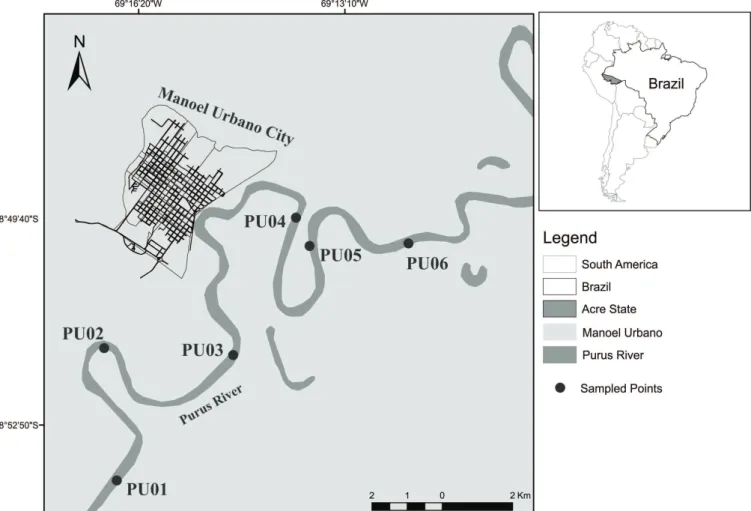
he present study collected 264 samples of 18 ish species and 06 samples of sediment along 06 points (with a distance of 5 km between each sample point) of the Purus River, in the period November 2013 (Figure 1).
Fish were collected using cast nets and gillnets with diferent mesh sizes (35, 50 and 70 mm between opposite knots). hen, the specimens were identiied using taxonomic guides34-36. Some
additional information as total weight (g), total length (cm), trophic level using the Fishbase database37, and stomach content
laboratory. he samples were stored in glass vials, homogenized and stored at –20 °C until the laboratory analysis.
he sediments were collected using Van Veen Grab sampler. hen, the samples were identiied, stored in plastic bags, dried at room temperature, fractionated until reach a granulometry of 270 mesh and stored at room temperature until the laboratory analysis.
Analysis of total mercury
he samples were analyzed according to Akagi et al.38.
Approximately, 0.5 g of homogenized muscle, 0.3 g of homogenized liver and 0.2 g of sediment were weighted and transferred to 50 mL Pirex® volumetric lasks, added 1 mL of deionized water,
2 mL of HNO3-HClO4 (1+1), and 5 mL of H2SO4. Samples were then heated on a hot plate to 200-230 °C for 30 minutes. Ater cooling, the mixture were completed to 50 mL with deionized water, then THg was analyzed by Cold Vapor Atomic Absorption Spectrometry (CVAAS) with the Mercury Analyser, model HG-201, produced by SANSIO. All analyses were performed in duplicate and were accompanied by quality control from certiied reference material (DOLT-4 and DORM-3).
Descriptive statistics and correlation calculations were evaluated (signiicance level of 95% or p<0.05) using the sotware MINITAB 17 (Minitab Inc.).
▄
RESULTSLevels of mercury in ish
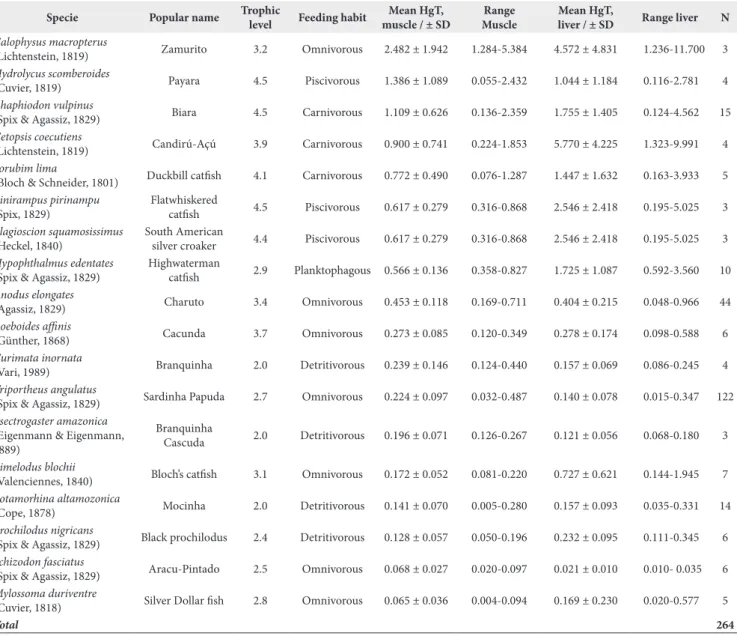
A total of 264 individuals belonging to 3 orders, 11 families and 18 species were collected. Table 1 shows the number of collected species, the popular and scientiic names, trophic levels, feeding habit and mean HgT content on muscle and liver of each specie
he THg content on muscle ranged from 0.004 to 5.384 µg.g–1.
he carnivorous species presented the highest level of Hg on muscle (mean 0.927 µg.g–1), followed by piscivorous (mean
0.873 µg.g–1), planktophagus (mean 0.566 µg.g–1), omnivorous
(mean 0.533 µg.g–1) and detritivorous (mean 0.176 µg.g–1).
ish established by WHO (0.5 µg.g–1). hose species represents
44% of the total species collected.
he Hg content on liver ranged from 0.010 to 11.700 µg.g–1.
he highest Hg content on liver was observed in carnivorous (mean 2.991 µg.g–1), followed by piscivorous (mean 2.045 µg.g–1),
planktophagos (mean 1.725 µg.g–1), omnivorous (mean 0.902 µg.g–1)
and detritivorous (mean 0.167 µg.g–1). he species that presented
more accumulation of THg into liver were C. coecutiens (mean 5.770 µg.g–1), C. macropterus (4.572 µg.g–1), P. pirinampu and P.
squamosissimus (mean 2.546 µg.g–1, both). he Pearson analysis
revealed a moderate corratio between muscle and liver (0.577). Our data indicate a good corratio between the trophic level with the THg into muscles (r=0.644; p=0.001), as well as a good corratio between THg into muscles with length (r=0.505; p=0.001) and with weight (r=0.408; p=0.001). he data is in agreement with other studies that evaluated the same parameters13,39.
Analysis of HG into sediment
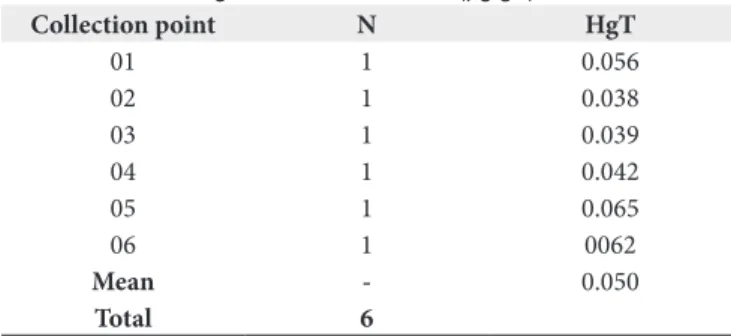
he analytical results of Hg in bottom sediments (n=6) ranged between 0.038 and 0.065 µg.g-1 and mean values observed was
0.050 µg.g–1 (Table 2).
he results are higher when the data are compared with the results obtained by Brabo et al.26 who found an mean value of
0.023 µg.g–1 for the Purus River (closer to Sena Madureira city)
and 0.026 µg.g–1 for the bottom sediment of the Iaco River (one
of the main tributary of the Purus River) while the results are similar with the ones observed by Mascarenhas et al.40 who
reported a mean Hg content of 0.054 µg.g–1 for the bottom
sediment of Acre River. he values found in this study are below the background set for “uncontaminated” Amazonian rivers <0.200 µg.g–1.
Table 1. The popular and scientific names of the collected species, the feeding habit, the number of samples and the mean HgT (µg.g–1) are shown
Specie Popular name Trophic
level Feeding habit
Mean HgT, muscle / ± SD
Range Muscle
Mean HgT,
liver / ± SD Range liver N Calophysus macropterus
(Lichtenstein, 1819) Zamurito 3.2 Omnivorous 2.482 ± 1.942 1.284-5.384 4.572 ± 4.831 1.236-11.700 3
Hydrolycus scomberoides
(Cuvier, 1819) Payara 4.5 Piscivorous 1.386 ± 1.089 0.055-2.432 1.044 ± 1.184 0.116-2.781 4
Rhaphiodon vulpinus
(Spix & Agassiz, 1829) Biara 4.5 Carnivorous 1.109 ± 0.626 0.136-2.359 1.755 ± 1.405 0.124-4.562 15
Cetopsis coecutiens
(Lichtenstein, 1819) Candirú-Açú 3.9 Carnivorous 0.900 ± 0.741 0.224-1.853 5.770 ± 4.225 1.323-9.991 4
Sorubim lima
(Bloch & Schneider, 1801) Duckbill catish 4.1 Carnivorous 0.772 ± 0.490 0.076-1.287 1.447 ± 1.632 0.163-3.933 5
Pinirampus pirinampu
(Spix, 1829)
Flatwhiskered
catish 4.5 Piscivorous 0.617 ± 0.279 0.316-0.868 2.546 ± 2.418 0.195-5.025 3
Plagioscion squamosissimus
(Heckel, 1840)
South American
silver croaker 4.4 Piscivorous 0.617 ± 0.279 0.316-0.868 2.546 ± 2.418 0.195-5.025 3
Hypophthalmus edentates
(Spix & Agassiz, 1829)
Highwaterman
catish 2.9 Planktophagous 0.566 ± 0.136 0.358-0.827 1.725 ± 1.087 0.592-3.560 10
Anodus elongates
(Agassiz, 1829) Charuto 3.4 Omnivorous 0.453 ± 0.118 0.169-0.711 0.404 ± 0.215 0.048-0.966 44
Roeboides ainis
(Günther, 1868) Cacunda 3.7 Omnivorous 0.273 ± 0.085 0.120-0.349 0.278 ± 0.174 0.098-0.588 6
Curimata inornata
(Vari, 1989) Branquinha 2.0 Detritivorous 0.239 ± 0.146 0.124-0.440 0.157 ± 0.069 0.086-0.245 4
Triportheus angulatus
(Spix & Agassiz, 1829) Sardinha Papuda 2.7 Omnivorous 0.224 ± 0.097 0.032-0.487 0.140 ± 0.078 0.015-0.347 122
Psectrogaster amazonica
(Eigenmann & Eigenmann, 1889)
Branquinha
Cascuda 2.0 Detritivorous 0.196 ± 0.071 0.126-0.267 0.121 ± 0.056 0.068-0.180 3
Pimelodus blochii
(Valenciennes, 1840) Bloch’s catish 3.1 Omnivorous 0.172 ± 0.052 0.081-0.220 0.727 ± 0.621 0.144-1.945 7
Potamorhina altamozonica
(Cope, 1878) Mocinha 2.0 Detritivorous 0.141 ± 0.070 0.005-0.280 0.157 ± 0.093 0.035-0.331 14
Prochilodus nigricans
(Spix & Agassiz, 1829) Black prochilodus 2.4 Detritivorous 0.128 ± 0.057 0.050-0.196 0.232 ± 0.095 0.111-0.345 6
Schizodon fasciatus
(Spix & Agassiz, 1829) Aracu-Pintado 2.5 Omnivorous 0.068 ± 0.027 0.020-0.097 0.021 ± 0.010 0.010- 0.035 6
Mylossoma duriventre
(Cuvier, 1818) Silver Dollar ish 2.8 Omnivorous 0.065 ± 0.036 0.004-0.094 0.169 ± 0.230 0.020-0.577 5
▄
DISCUSSIONhere is no direct evidence of gold mining activity in the Acre State. Although, its geographical location may be a determinant factor for the comprehension of Hg low in this ecosystem, given that Peru, Bolivia and Amazonia have been historically afected by gold extraction. In spite of this scenario, most of the studies identiied that the abiotic samples in this region were within the normality and were in agreement with a non impacted area26-28, and our data are in agreement with this idea.
It is premature to evaluate if C. macropterus, H. scomberoides, R. vulpinus, C. coecutiens, S. lima, P. pirinampu, P. squamosissimus and H. edentatus represents any real risk to human health. Although, according to our observations, all of them are commercialized and consumed by the population of Manoel Urbano (except for C. coecutiens).
here are few studies regarding the economic ishing potential of the Purus River. de Almeida et al.41 characterized the ishing
activity in Manoel Urbano and other small villages, unraveling the ishing sector into Manoel Urbano, revealing peculiarities about the ishing activity, such as: the preponderance of lake ishing, the use of motorized canoes rather than boats, gillnetting is the main methods used for ish capture, the absence of a central market for ish commercialization (improving the ratio between ishermen and consumers) and the decreasing of ishing activity during the dry season. his work provided a list of some species that are commercialized in the region, but used the popular their names, thus decreasing our capacity to successfully compare our results. Although, Filhote/Piraíba covers 29% of the tons landed in the main ports of the region;
Branquinha (a detritivorous ish also reported in our work) cover 11%.
Most of the species cited in this work migrate (such as
C. macropterus, H. scomberoides, R. vulpinious, S. Lima, P. pirinampu, P. amazonica, P. nigricans, S. fasciatus and M. duriventre), and some of them (H. scomberoides, P. Pirinampu and P. nigricans) had being identiied into diferent rivers in Amazonia, such as Solimões and Madeira-Tapajós interluves42,43. C. macropterus
and P. pirinampu had been identiied also in Colombia and Venezuela where it has commercial potential44,45. Other studies
also identiied the specie R. vulpinus as potential to accumulate Hg into muscle16,46. Special emphasis should be attributed to
P. squamosissimus and H. edentatus which are signiicant for the economy of the isheries activity in Amazon and presented higher values of Hg into muscle47.
he socio-economical behavior of the population of Acre (reported by Santos et al.27 and Martins28) put in evidence that
the Hg low dynamic goes beyond the geopolitical barriers, and may be dependent of anthropologic features, such as cattle activities and ancient diet heritage that corroborate with the idea that those populations have alternative origins of protein intake (rather than ish). hus, the relationship between food, culture and society should be considered in future studies in order to understand the high values of Hg observed on hair of this population.
▄
CONCLUSIONConsidering that species with higher Hg content on muscle were the ones that presented higher trophic position, the ingestion of some ish species may be a route of exposure for the population of Manoel Urbano.
Purus is an international river and merit special attention given that the route of Hg exposure may be associated with gold mining activities in other countries, such as Peru.
The population of Manoel Urbano is composed by a miscellaneous of factors, where the triad food, culture and society should be addressed for future studies in order to better design the route of Hg exposure and, consequently, promote health in this population.
Table 2. Levels of HgT in bottom sediment (µg.g–1)
Collection point N HgT
01 1 0.056
02 1 0.038
03 1 0.039
04 1 0.042
05 1 0.065
06 1 0062
Mean - 0.050
Total 6
▄
REFERENCES1. Lacerda LD, Malm O. Mercury contamination in aquatic ecosystems: an analysis of critical areas. Adv. Stud. 2008;22:173-90.
2. Mason RP, Reinfelder JR, Morel FMM. Uptake, Toxicity, and trophic transfer of mercury in a Coastal Diatom. Environ Sci Technol. 1996;30(6):1835-45. http://dx.doi.org/10.1021/es950373d.
3. Jonsson S, Skyllberg U, Nilsson MB, Lundberg E, Andersson A, Björn E. Differentiated availability of geochemical mercury pools controls methylmercury levels in estuarine sediment and biota. Nat Commun. 2014;5:4624. PMid:25140406. http://dx.doi.org/10.1038/ncomms5624.
4. White EM. Source attribution, physicochemical properties and spatial distribution of wet deposited mercury to the Ohio River Valley [dissertation]. Ann Arbor: The University of Michigan; 2009.
5. Selin NE. Global biogeochemical cycling of mercury: a review. Annu Rev Environ Resour. 2009;34(1):43-63. http://dx.doi.org/10.1146/annurev. environ.051308.084314.
7. Passos CJS, Silva DS, Lemire M, Fillion M, Guimarães JR, Lucotte M, et al. Daily mercury intake in fish-eating populations in the Brazilian Amazon. J Expo Sci Environ Epidemiol. 2008;18(1):76-87. PMid:17805232. http:// dx.doi.org/10.1038/sj.jes.7500599.
8. Boischio AA, Barbosa A. Exposure to organic mercury in riparian populations on the Upper Madeira River, Rondonia, Brazil, 1991: preliminary results. Cad Saude Publica. 1993;9(2):155-60. PMid:15448836. http://dx.doi. org/10.1590/S0102-311X1993000200006.
9. Amaral DP. Dinâmicas de desenvolvimento local e impactos na alimentação de comunidades ribeirinhas na região do médio rio Tapajós, estado do Pará, Amazônia Brasileira [dissertação]. Brasília: Universidade de Brasília; 2012 [cited 2016 may 24]. Available from: http://repositorio.unb.br/ bitstream/10482/15366/1/2012_DeusilenePereiradoAmaral.pdf
10. Dórea JG, Barbosa AC, Ferrari I, Souza JR. Fish consumption (hair mercury) and nutritional status of Amazonian Amer-Indian children. Am J Hum Biol. 2005;17(4):507-14. PMid:15981188. http://dx.doi.org/10.1002/ajhb.20410.
11. Marinho JS, Lima MO, Santos ECO, Jesus IM, Pinheiro MCN, Alves CN, et al. Mercury speciation in hair of children in three communities of the Amazon, Brazil. BioMed Res Int. 2014;2014:1-9. PMid:24734253. http://dx.doi.org/10.1155/2014/945963.
12. Dorea JG. Fish are central in the diet of Amazonian riparians: should we worry about their mercury concentrations? Environ Res. 2003;92(3):232-44. PMid:12804520. http://dx.doi.org/10.1016/S0013-9351(02)00092-0.
13. Arrifano G. P.F. Metilmercúrio e mercúrio inorgânico em peixes comercializados nos mercados municipal de Itaituba (Tapajós) e mercado do Ver-o-Peso (Belém) [dissertação]. Belém: Universidade Federal do Pará; 2011.
14. Beltran-Pedreros S, Zuanon J, Leite RG, Peleja JRP, Mendonça AB, Forsberg BR. Mercury bioaccumulation in fish of commercial importance from different trophic categories in an Amazon floodplain lake. Neotrop Ichthyol. 2011;9(4):901-8. http://dx.doi.org/10.1590/S1679-62252011000400022.
15. Faial KRF, Sá GC, Mendes RA. Mercury levels in fish of Trombetas river in low Amazon area: an area out of the influence of gold mining. Cad Saude Colet. 2005;13:237-48.
16. Kasper D, Palermo EFA, Branco CWC, Malm O. Evidence of elevated mercury levels in carnivorous and omnivorous fishes downstream from an Amazon reservoir. Hydrobiologia. 2012;694(1):87-98. http://dx.doi. org/10.1007/s10750-012-1133-x.
17. Lechler PJ, Miller JR, Lacerda LD, Vinson D, Bonzongo JC, Lyons WB, et al. Elevated mercury concentrations in soils, sediments, water, and fish of the Madeira River basin, Brazilian Amazon: a function of natural enrichments? Sci Total Environ. 2000;260(1-3):87-96. PMid:11032118. http://dx.doi. org/10.1016/S0048-9697(00)00543-X.
18. Pimentel, D. R. Avaliação dos níveis de mercúrio (Hg) total em peixes de igarpés da bacia do Rio Mamuru, Pará, Brasil. Santarém: Universidade do Oeste do Pará; 2011.
19. Amaro CSO, Rodrigues Jr D, Silva MCF, Lima AAS, Santos GFS, Pinheiro MCN. Concentration of total mercury (Hg-T) in fish marketed in different seasonal periods in the Ver-o-Peso Market, Belem, State of Para, Brazil. Pan-Amazonian J Heal. 2014;5:53-60.
20. Telmer K, Costa M, Angélica RS, Araujo ES, Maurice Y. The source and fate of sediment and mercury in the Tapajós River, Pará, Brazilian Amazon: Ground- and space-based evidence. J Environ Manage. 2006;81(2):101-13. PMid:16824670. http://dx.doi.org/10.1016/j.jenvman.2005.09.027.
21. Brabo EDS. Geochemistry of mercury in the Tapajós River basin: natural to anthropogenic [thesis]. Ananindeua: Instituto Evandro Chagas; 2010.
22. Santos ECO, Câmara VM, Jesus IM, Brabo ES, Loureiro EC, Mascarenhas AF, et al. A contribution to the establishment of reference values for total mercury levels in hair and fish in amazonia. Environ Res. 2002;90(1):6-11. PMid:12359185. http://dx.doi.org/10.1006/enrs.2002.4366.
23. Santos ECDO, Jesus IM, Brabo ES, Fayal KF, Sá Fo GC, Lima Mo et al. Exposure to mercury and arsenic in studies by the Evandro Chagas. Brazilian J. Epidemiol. 2003;6:171-85.
24. Khoury EDT, Souza GS, Silveira LCL, Araújo AA, Pinheiro MCN. Neurological manifestations in riverine populations from areas exposed to mercury in the Brazilian Amazon. Terms Public Heal. 2013;29:2307-2318.
25. Pinheiro MCN, Guimarães GA, Nakanishi J, Oikawa T, Vieira JL, Quaresma M, et al. Total mercury in hair samples of inhabitants of Tapajós river, Pará State, Brazil. J Brazilian Soc Trop Med. 2000;33(2):181-4. PMid:10881131. http://dx.doi.org/10.1590/S0037-86822000000200004.
26. Brabo ES, Angélica RS, Silva AP, Faial KRF, Mascarenhas AFS, Santos ECO, et al. Assessment of mercury levels in soils, waters, bottom sediments and fishes of acre state in Brazilian amazon. Water Air Soil Pollut. 2003;147(1/4):61-77. http://dx.doi.org/10.1023/A:1024510312250.
27. Santos ECO, Jesus IM, Brabo ES, Câmara VM, Loureiro ECB, Mascarenhas AF, et al. Exposure to mercury in the urban population of Rio Branco City, State of Acre, Brazil. Bull Environ Contam Toxicol. 2002;69(3):314-9. PMid:12177749. http://dx.doi.org/10.1007/s00128-002-0063-0.
28. Martins MMM. Encadeamento geoquímico entre sedimentos (solos) e cultivares em praias, além de cabelo humano de ribeirinhos, ao longo de rios da bacia do Purus no Estado do Acre e a sua importância ambiental [dissertação]. Belém: Universidade Federal do Pará; 2005 [cited 2016 may 24]. Available from: http://www.bc.ufpa.br/Portal/DTC/Geologia_Geoquimica/ Geologia_Geoquimica_2005/MARTINS.htm
29. Angelis CF, Waichaman AV, Silva AEP, Machado LAT. Impacts of precipitation on the water quality of the Purus River. Acta Amazon. 2008;38:733-42.
30. Santos TB, Gurgel HC, Angelis CF. Bacia do Rio Purus: potencialidades para exportação da malária. In: 3º Nacional de Geografia da Saúde - I Fórum Internacional de Geografia da Saúde; 2007 out 1-10; Curitiba, BR. Curitiba: Universidade Federal do Paraná; 2007 [cited 2016 may 24]. Available from: http://sigma.cptec.inpe.br/purus/pdf/santosetal2007.pdf
31. Silva HR. Desafiando o rio-mar: descendo o Solimões. Porto Alegre: PUCRS; 2010. 368 p.
32. Queiroz MMA, Horbe AMC, Seyler P, Moura CAV. Hidroquímica do rio Solimões na região entre Manacapuru e Alvarães: Amazonas - Brasil. Acta Amazon. 2009;39(4):943-52. http://dx.doi.org/10.1590/S0044-59672009000400022.
33. Instituto Brasileiro de Geografia e Estatística. Cidades: Acre. Rio de Janeiro: IBGE; 2014 [cited 2016 may 24]. Available from: http://www.cidades. ibge.gov.br/xtras/perfil.php?lang=&codmun=120034&search=acre|man oel-urbano
34. Santos, G., Ferreira, E. & Zuanon, J. Peixes comerciais de Manaus. Manaus: Instituto Brasileiro do Meio Ambiente e dos Recursos Naturais Renováveis; 2006.
35. Géry J. Characoids of the world. Neptune: TFH Publications; 1977.
37. FishBase. [Internet]. 2016 [cited 2016 may 24]. Available from: www. fishbase.org/
38. Akagi, H. Manual de análises de mercúrio. Ministerio do Meio Ambiente do Japão; 2004. [cited 2016 may 24]. Available from: http://www.nimd. go.jp/english/kenkyu/docs/Hg%20Manual-Portuguese.pdf
39. Baêta, A. P. Mercúrio total e metilmercúrio em tecidos de diferentes espécies de peixes da baía de Guanabara. Rio de Janeiro: Pontifícia Universidade Católica do Rio de Janeiro; 2004.
40. Mascarenhas AFS, Brabo ES, Silva AP, Fayal KF, Jesus IM, Santos ECO. Avaliação da concentração de mercúrio em sedimentos e material particulado no rio Acre, estado do Acre, Brasil. Acta Amazon. 2004;34:61-8. http:// dx.doi.org/10.1590/S0044-59672004000100008.
41. Almeida OT, Amaral L, Rivero S, Silva CN. Gfisherman and the fishing fleet of the municipalities of Manoel Urbano and Sena Madureira (AC) and Boca do Acre (AM) in Brazil. Novos Cad NAEA. 2012;15:291-309.
42. Freitas RR. Fish communities of natural channels between floodplain lakes and Solimões-Amazonas River (Amazon-Brazil). Acta Limnol Bras. 2004;16:273-80.
43. Camargo M, Giarrizzo T. Fish, Marmelos Conservation Area (BX044), Madeira River basin, states of Amazonas and Rondônia, Brazil. Check List. 2007;3(4):291-6. http://dx.doi.org/10.15560/3.4.291.
44. Pérez A, Fabré NN. Seasonal growth and life history of the catfish Calophysus macropterus (Lichtenstein, 1819) (Siluriformes: Pimelodidae) from the Amazon floodplain. J Appl Ichthyology. 2009;25(3):343-9. http://dx.doi. org/10.1111/j.1439-0426.2008.01104.x.
45. Petrere Jr M, Barthem RB, Córdoba EA, Gómez BC. Review of the large catfish fisheries in the upper Amazon and the stock depletion of piraíba (Brachyplatystoma filamentosum Lichtenstein). Rev Fish Biol Fish. 2004;14(4):403-14. http://dx.doi.org/10.1007/s11160-004-8362-7.
46. Boischio AA, Henshel D. Fish consumption, fish lore, and mercury pollution: risk communication for the Madeira River people. Environ Res. 2000;84(2):108-26. PMid:11068924. http://dx.doi.org/10.1006/enrs.2000.4035.
47. Santos GM, Santos ACM. Sustentabilidade da pesca na Amazônia. Estud Avançados. 2005;19:165-182.