AACL BIOFLUX
Aquaculture, Aquarium, Conservation & Legislation
International Journal of the Bioflux Society
Ingestion induced health risk in surface waters
near tailings ponds (North-Western Romania)
1
Mirela I. Miclean,
2Lucrina N. Ştefănescu,
1Erika A. Levei,
1Marin Şenilă,
2Sanda F. Mărginean,
1Cecilia M. Roman, and
2Emil A. Cordoş
1 INCDO-INOE 2000, Research Institute for Analytical Instrumentation, Cluj-Napoca, Romania; 2 Babeş-Bolyai University, Environmental Sciences
Department, Cluj-Napoca, Romania,
Corresponding author: Mirela Miclean, [email protected]
Abstract. Anthropogenic activities generate most elements of environmental pollution, especially with heavy metals. The paper presents some investigations of several heavy metals (Pb, Cu, Cd, Zn) concentrations, performed on water, sediments and fish samples from Lapuș and Someș Rivers located near tailings ponds, in Baia Mare area, NW Romania. Health hazard calculations related to fish consumption were computed to assess the effect of pollution on human health, based on target hazard quotient (THQ). The results showed that the heavy metals concentrations in the studied samples exceeded maximum admissible concentrations. Individual metal THQ values indicated the relative absence of health risks associated with intake of a single heavy metal through consumption of fish. Key Words: heavy metals, water, sediments, fish, risk assessment.
Résumé. Les sources anthropogènes produisent la plupart des éléments qui polluent l’environnement, particulièrement avec des métaux lourds. L’article présente des études sur les concentrations de certains métaux lourds (Pb, Cu, Cd, Zn) dans l’eau, des sédiments et pour deux espèces de poissons, recueillis sur les rivières Lăpuş et Someş dans l’année 2007. Les rivières analysées se trouvent au voisinage des étangs de décantation, à la proximité de la ville Baia Mare, une zone profondément polluée. Pour l’évaluation de l’exposition de la population à la pollution avec des métaux lourds on avait calculé le risque par l’engloutissement des poissons, en vertu des coefficients de hasard (THQ). Les résultats obtenus ont montré que les valeurs pour les concentrations moyennes des métaux lourds ont dépassé les concentrations maximales admises. Les valeurs THQ des métaux individuels ont indiqués l’absence relative des risques sur l’état de santé, par l’engloutissement d’un seul métal lourd dû à la consommation des poissons.
Mots-clés: métaux lourds, eau, sédiment, poissons, évaluation du risque.
Rezumat. Activităţile antropice generează majoritatea elementelor care poluează mediul, în special cu metale grele. Lucrarea prezintă investigaţii privind concentraţiile unor metale grele (Pb, Cu, Cd, Zn) în ape, sedimente şi două specii de peşti, recoltate din râurile Lăpuş şi Someş în anul 2007. Râurile investigate sunt situate în vecinătatea unor iazuri de decantare, în apropierea oraşului Baia Mare, o zonă intens poluată. Pentru evaluarea expunerii populaţiei la poluarea cu metale grele s-a calculat riscul prin ingerarea de peşte, pe baza unor coeficienţi de hazard ţintă (THQ). Rezultatele obţinute au arătat că valorile pentru concentraţiile medii ale metalelor grele au depăşit concentraţiile maxime admise. Valorile THQ ale metalelor individuale au indicat absenţa relativă a riscurilor asupra stării de sănătate prin ingerarea unui singur metal greu prin consumul de peşte.
Cuvinte cheie: metale grele, apă, sediment, peşti, evaluarea riscului.
Introduction. Heavy metals represent an important threat for the environment because of their toxicity, bioaccumulation, long persistence and bio-magnification in the food chain (Erdogrul & Ates 2006). Anthropogenic activities generate high amounts of metals which enter the aquatic environment through industrial effluents, domestic sewage and mining wastes. Once they have reached the aquatic systems, metal contaminants remain in soluble forms or tend to settle down to the bottom.
physico-chemical changes (Kabata-Pendias & Mukherjee 2007). Aquatic sediments can act both as a sink and a source for contaminants, whereby long-term input of contaminants can lead to high concentrations in sediments that can exceed water concentrations (Sekhar et al 2003; Pempkowiase et al 1999; Radwan et al 1990). Sediment associated metals also pose a direct risk to benthic organisms and may also represent long-term sources of contamination to higher trophic levels (Tekin-Özan 2008).
The aquatic organisms absorb and transfer heavy metals through the food chain to higher trophic levels, including fish. Concentrations of heavy metals in the organs of fish can be used as bioindicators of water pollution (Deva Prasath & Hidayathulla Khan 2008; Masoud et al 2007). Research has shown that of all water dwellers, fish is the most susceptible to toxic substances present in water (Alibabić et al 2007) and is considered as one of the most indicative factors, in freshwater systems, for the estimation of trace metals pollution potential (Erdogrul & Ates 2006).
Risk assessment through ingestion of heavy metals contaminated food was evaluated by target hazard quotient (THQ) method. THQ is a ratio of determined dose of a pollutant to the reference dose. If the ratio is less than 1, there will not be any obvious risk, and if THQ ≥ 1, the exposed population of concern will experience health risks (Wang et al 2005). The methodology for determination of THQ was provided in the USEPA Region III risk-based concentration table (USEPA 2000).
The purpose of this study was to determine the concentrations of heavy metals (Pb, Cu, Cd and Zn) in the water ecosystem from Lăpuș and Someș rivers, near sedimentation ponds, in Baia Mare area, related to mining activities. Taking into consideration the possibility of bioaccumulation of these metals in tissues of living organisms, including fish, it was necessary to find out whether the metals determined in water and sediment samples were accumulated in the fish muscle, the most edible parts. Also, the risk imposed on a local population was evaluated. The present research had been conducted in three major ways: determination of metal concentrations in waters, sediment and fish fillet samples.
Site Description and Sampling. The lower basin of Somer River that crosses the Baia Mare mining region was chosen for our investigation, because it has been exposed to intense pollution during the last century from mining industry, agriculture, chemical factories and municipal sewage discharge (Macklin et al 2003).
Mining activities in the Baia Mare area consist in non-ferrous sulfidic ores extraction, processing, flotation concentration of lead, copper, zinc and precious metals. Liquid effluents from these operations and from mine drainage are discharged, prior or after treatment, into the river system and cause the degradation of environmental quality of surface waters, mainly due to excessive levels of heavy metals. Tailings from the flotation operation are transferred to tailings ponds and represent a significant source of metals, both from the discharged effluents and from leachates derived from these sites (Bird et al 2003; Johnston et al 2002).
The Someș River flows through Romania and Hungary and has a length of 388 km, an average discharge of 120 m3 s-1 and covers an area of 15,015 km2. There are two headstreams, the Someşul Mare, rising from the Rodna Mountains and the Someşul Mic rising from the Apuseni Mountains, which is in turn composed by the confluence of another two headstreams: Someşul Cald and Someşul Rece. Before crossing the Hungarian border and join the Tisza, the Someș crosses the Baia Mare mining basin well known from ancient time for the important mining activities. The most important tributary of the Someș River is Lăpuș that carries polluted waters with high metal concentration from the Baia Mare mining region.
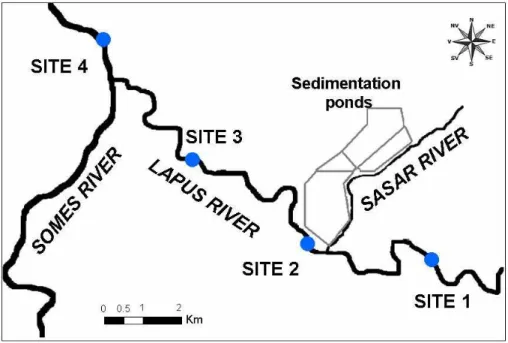
In order to establish the contamination with heavy metals, water, sediment and fish samples were collected, in September 2007, from four sites comprising Someș River and its direct tributary (Lăpuș River) affected by industrial, mining and urban metal pollution in Baia Mare mining area: North-Western Romania (Figure 1).
with Săsar River, Site 2 Lăpuș River downstream of confluence with Săsar River, near tailings ponds Bozanta, Săsar and Remin, Site 3 Lăpuș River upstream of confluence with Someș River, near Merișor village, Site 4 Someș River downstream of confluence with Lăpuș River.
Figure 1.Sampling area
The surface water samples were collected along waterways, using 1000 ml polyethylene bottles and were stored at 4oC until analysis. On site, pH was measured by a calibrated pH meter (WTW Multiline with SenTix electrode). At each site a composite sediment sample was collected at 0-30 cm depth using a stainless steel trowel and was stored in polyethylene bags for transport to laboratory. The specimens of the two studied fish species (Alburnus alburnus and Leuciscus cephalus) were collected and stored in prewashed polyethylene bags until analysis. These two species are the most frequently consumed by the inhabitants in the adjacent villages.
All glass and plastic labware was previously washed in diluted nitric acid and rinsed with ultrapure water (Millipore from a Direct Q UV 3 Millipore system) to prevent contamination and were individually sealed in polyethylene bags to avoid contamination during transportation.
Sample Preparation and Analysis. Analytical grade purity reagents (Merck, Darmstadt, Germany) and ultrapure water (18 MW cm-1, Direct Q UV 3 Millipore system) were used throughout analysis. The instruments were pre-calibrated appropriately prior to measurements. Replicate analyses (n=3) were carried out for each determination to establish reproducibility and quality assurance.
Water samples. Water samples were acidified to pH=2 with 65 % nitric acid and
stored at 4 °C until analysis. In order to determine the total metals contents, the samples were digested on a sand bath, by adding 5 ml of 65 % HNO3 at 100 ml sample. After cooling, the solution was filtered and analyzed by inductively coupled plasma atomic emission spectrometry (ICP-AES).
Sediment samples. The sediment samples were air-dried, mechanically ground
using a SPECTRO FLAME (SPECTRO, Kleve, Germany). The quantification was performed using an external calibration with multielemental Merck standard solution (Karadede & Unlu 2000).
Fish samples. For the analysis of heavy metals, fish muscle samples were
portioned using a stainless steel knife. Each sample was dried for several hours at 80C to constant weight, ground into fine particles using a clean acid-washed mortar and pestle (Altindag & Yigit 2005; Sekhar et al 2003). In order to determine the heavy metal content, tissue samples were digested using a microwave digestion system, OI Analytical, SUA. An exact weight of dry sample (0.5 g) was placed in Teflon vessels, then 8 ml HNO3 65% and 2 ml H2O2 30% were added. The vessels were sealed and allowed to predigest during the night at room temperature. The digestion block was put in the digestion oven and heated along a three steps procedure, until all the materials were dissolved. The temperature program is shown in Table 1, according to the operator’s manual of microwave digestion system, OI Analytical.
Table 1 Temperature program for fish digestion
Step 1 2 3
TC 200 200 200
Power, % 70 70 40
Time, min. 35 20 10
The samples were cooled to room temperature, filtered and diluted up to 50 ml with ultrapure water. The resulting solutions were analyzed by using the ICP-AES technique (Masoud et al 2007; Ylmaz et al 2007).
Risk Assessment. The ingestion (through consumption of fish) induced human risk was assessed based on the target hazard quotient (THQ), described by the equation (1) (Wang et al 2005):
THQ=
10
3
A AB FD
IR D F
T
W
R
C
F
E
E
(1)
where:
EF = exposure frequency (365 days year-1);
ED = exposure duration (70 years), equivalent to the average lifetime;
FIR = fish ingestion rate (g person-1 day-1);
C = metal concentration in fish (µg g-1); RFD = oral reference dose (mg kg-1 day-1);
WAB = average body weight (kg);
TA = averaging exposure time for noncarcinogens (365 days year-1 x number of exposure years, assuming 70 years in this study).
A THQ value below 1 means that the adverse effects are negligible through fish consumption by the local population (Wang et al 2005). Oral reference doses used in computing THQs were: 4, 1, 40, 300 μg kg-1 day-1 for Pb, Cd, Cu and Zn respectively (USEPA 2000). In this study we considered the average body weight for the adult local inhabitants equal to 70 kg and the fish consumption equal to 55 g person-1 day-1 (Masasoud et al 2007), the ingested dose is equal to the absorbed contaminant dose and cooking has no effect on the contaminants (Chien et al 2002).
The Student’s t test revealed no significant differences (p0.05) in metal concentrations between Alburnus alburnus and Leuciscus cephalus.
Table 2
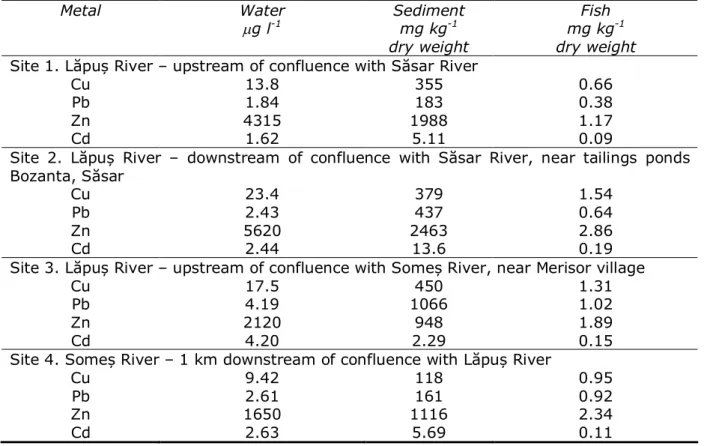
Concentrations of heavy metals in surface water, sediments and fish samples
Metal Water
g l-1 Sediment mg kg-1
dry weight
Fish mg kg-1
dry weight
Site 1. Lăpuș River – upstream of confluence with Săsar River
Cu 13.8 355 0.66
Pb 1.84 183 0.38
Zn 4315 1988 1.17
Cd 1.62 5.11 0.09
Site 2. Lăpuș River – downstream of confluence with Săsar River, near tailings ponds Bozanta, Săsar
Cu 23.4 379 1.54
Pb 2.43 437 0.64
Zn 5620 2463 2.86
Cd 2.44 13.6 0.19
Site 3. Lăpuș River – upstream of confluence with Someș River, near Merisor village
Cu 17.5 450 1.31
Pb 4.19 1066 1.02
Zn 2120 948 1.89
Cd 4.20 2.29 0.15
Site 4. Someș River – 1 km downstream of confluence with Lăpuș River
Cu 9.42 118 0.95
Pb 2.61 161 0.92
Zn 1650 1116 2.34
Cd 2.63 5.69 0.11
Fish. The obtained concentrations of Pb and Cd in all fish samples are higher than
maximum admissible values: 0.30 mg kg-1 (wet weight) and 0.05 mg kg-1 (wet weight), respectively, according to Commission Regulation (EC) No. 1881/2006 setting maximum levels for certain contaminants in foodstuffs. The highest concentration for Pb and Cd were recorded in sampling point 3, exceeding 13.6 times the admissible values for Pb and 12.0 times for Cd, taking into consideration that the average water content in fish was 75% (Agah et al 2009).
For Cu and Zn, World Health Organization proposed the maximum levels, above which consumption is not permitted: 20 mg kg-1 (wet weight) for Cu and 50 mg kg-1 (wet weight) for Zn (FAO/WHO 1989). The concentrations of these metals in studied fish muscle were in all cases lower than the maximum levels, considering the same average water content of 75%.
The relatively high concentrations of metals in fish samples could be related to mining activities in the studied area. The obtained results supplied information about metal content in Alburnus alburnus and Leuciscus cephalus fish species and indirectly indicated the environmental contamination along the Someș River. Moreover, these results can also be used to understand the chemical quality of fish and to evaluate the possible risk associated with their consumption (Tepe et al 2008).
Sediments. In Lăpuș River sediments, metal values raised downstream Săsar,
and for Cu and Pb raised continuously in the vicinity of tailings ponds. The concentrations of Pb, Cu, Cd and Zn remain high in sampling point 4 as a result of municipal and industrial waste water inputs from Cluj-Napoca and Dej towns, similar with the results obtained by Macklin et al (2003).
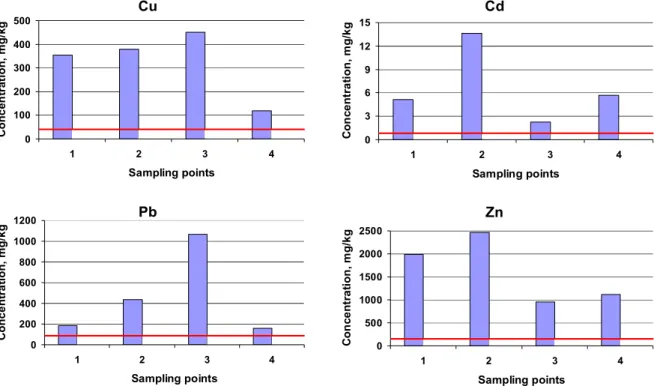
Data showed that the sediment samples were highly contaminated with heavy metals. The concentrations of Cu, Pb, Zn and Cd in river sediment samples exceeded the maximum admissible concentrations (MAC), according to 161/2006 Order of Romanian Ministry of Water, Forests and Environmental Protection: in the case of Cu and Pb the highest concentrations were found in sampling point 3, exceeding MAC for 11 and 13 times, respectively. For Zn and Cd the maximum concentrations were measured in sampling point 2, exceeding the MAC for 16 and 2 times, respectively, as shown in Figure 2.
The obtained results in the present study significantly exceeded the values obtained by Adeniyi et al (2008) for Pb, Cd and Zn concentrations in sediment samples collected from Ogun river catchments, Lagos and the contents of Pb, Cu, Cd and Zn in sediment samples from Hordodi-Holt-Tisza, in Tisza River, Hungary, recorded by Devai et al (2007) and also the Cu and Zn concentrations in sediment samples collected from Eastern Harbour and EL-Mex Bay (Abdallah & Abdallah 2008).
Cu 0 100 200 300 400 500
1 2 3 4
Sampling points C on ce nt ra tio n, m g/ kg Cd 0 3 6 9 12 15
1 2 3 4
Sampling points C on ce nt ra tio n, m g/ kg Pb 0 200 400 600 800 1000 1200
1 2 3 4
Sampling points C on ce nt ra tio n, m g/ kg Zn 0 500 1000 1500 2000 2500
1 2 3 4
Sampling points C on ce nt ra tio n, m g/ kg
Figure 2. Concentrations of Cu, Pb, Zn, Cd in sediments
Water. The obtained concentrations of studied metals in surface water samples
which may be attributed to the vicinity of tailings ponds. Heavy metals content of Zn and Cu in river water samples increased significantly after the confluence with the mining polluted tributary (Săsar river) which gathers waters from the Baia Sprie and Baia Mare mining and flotation exploitations (Macklin et al 2003).
Cadmium concentrations in the rivers may cause harmful effects upon freshwater ecosystem in relation to bioaccumulation in components of the biota (Johnston et al 2002).
The pH values in water samples are given in Table 3 and ranged from 6.15 to 7.85, with lowest value in sampling point 3, after the confluence with polluted Săsar River, near sedimentation ponds. Decreases in pH values aggravate toxicity in aquatic organisms (Adeniyi et al 2008).
According to quality classification of surface waters, most of the samples correspond to the lowest quality class.
Table 3 pH values in water samples in the four sampling points
Sampling point pH
1 7.85
2 6.15
3 7.48
4 7.60
The concentrations obtained for Pb and Cd are lower, and for Zn are higher (in sampling points 1 and 2) than those obtained by Fianko et al (2007) in the Iture Estuary, Ghana, polluted by anthropogenic activities.
Human risk assessment. According to the values shown in Table 2, the human
risk by ingestion of fish was assessed, calculating target hazard quotients (equation 1) of studied metals for the adult inhabitants living near investigated rivers. The obtained ranges and mean values for THQs are shown in Table 4.
Table 4
Ranges and mean values of target hazard quotients for individual metals, through fish ingestion
Metal Range THQ Mean THQ
Cu 0.013 – 0.030 0.022
Pb 0.075 – 0.200 0.145
Zn 0.003 – 0.007 0.005
Cd 0.071 – 0.149 0.106
The values acquired for THQs, calculated to assess human health risk by ingestion of fish are below 1, indicating no apparent risk associated with heavy metals exposure through this pathway. The obtained values of THQs for Pb and Cd are considerable higher than those obtained for Cu and Zn, this fact being important due to the high toxicity of Pb and Cd, even at low concentrations (Adeniyi et al 2008).
The obtained mean values for THQs were higher than those obtained by Wang et al (2005) for Pb and Cd, lower for Zn and similar for Cu, for fish ingestion in Tianjin, China. Also, the mean values of THQs according to Table 4 are lower than those recorded by Chien et al (2002) for Cu, Zn and Cd through oysters consumed by general population and fishermen in Taiwan.
tailing ponds effluents. The samples proved that metal concentrations found in the edible parts of the two studied fish species (Alburnus alburnus and Leuciscus cephalus) were burdened with metals. Consequently, significant hazard arises from ingestion of fish contaminated by industrial activities in this region. Fish were chosen for study because they are good biomonitors of the metals present in the environment. The Lăpuș and Someș Rivers water quality experiences a long-term environmental impact. Therefore, continuous monitoring is compulsory. In addition, treatment of aqueous effluents is an important task in overall environmental impact. Unless future mining operations use the best practice related to ore extraction, processing and waste management, there is a risk that the local river environment may be further degraded. The results of this survey reported in this paper will help to ascertain the long-term fate and environmental impact of contaminant metals released by mining activities in Maramureș County.
References
Abdallah M. A. M., Abdallah A. M. A., 2008 Biomonitoring study of heavy metals in biota and sediments in the South Eastern coast of Mediterranean Sea, Egypt. Environ Monit Assess 146:139–145.
Adeniyi A. A., Yusuf K. A., Okedeyi O. O., 2008 Assessment of the exposure of two fish species to metals pollution in the Ogun river catchments, Ketu, Lagos, Nigeria. Environ Monit Assess 137:451–458.
Agah H., Leermakers M., Elskens M., Rez Fatemi S. M., Baeyens W., 2009 Accumulation of trace metals in the muscle and liver tissues of five fish species from the Persian Gulf. Environ Monit Assess, in press.
Alibabić V., Vahčić N., Bajramović M., 2007 Bioaccumulation of metals in fish of Salmonidae family and the impact on fish meat quality. Environ Monit Assess 131:349-364.
Altindag A., Yigit S., 2005 Assessment of heavy metal concentrations in the food web of lake Beysehir, Turkey. Chemosphere 60:552–556.
Bird G., Brewer P. A., Macklin M. G., Șerban M., Bălteanu D., Driga B., 2003 The solid state partitioning of contaminant metals and As in river channel sediments of the mining affected Tisa drainage basin, Northwestern Romania and Eastern Hungary. Appl Geochem 18:1583-1595.
Chien L. C., Hung T. C., Choang K. Y., Choang K. Y., Yeh C. Y., Meng P. J., 2002 Daily intake of TBT, Cu, Zn, Cd and As for fishermen in Taiwan. Sci Total Environ 285:177–185.
Commission Regulation of amending Regulation (EC) No 1881/2006 setting maximum levels for certain contaminants in foodstuffs as regards heavy metals, Official Journal L 364 of 20/12/2006 p. 0005 – 0024. http://eur-ex.europa.eu/LexUriServ/LexUriServ.do?uri=CELEX:32006R1881:FR:HTML
Deva Prasath P. M., Hidayathulla Khan T., 2008 Impact of tsunami on the heavy metal accumulation in water, sediments and fish at Poompuhar coast, southeast coast of India. E-journal of Chemistry 5(1):16-22.
Devai I., DeLaune R. D., Devai G., Aradi C., Gori S., Sandor Nagy A., Talas Z., 2007 Characterization of mercury and other heavy metals in sediment of an ecological important backwater area of River Tisza (Hungary). J Environ Sci Health, Part A: Toxic/Hazardous Substances and Environmental Engineering 1532-4117, 42(7): 859–864.
Erdogrul O., Ates D. A., 2006 Determination of cadmium and copper in fish samples from Sir And Menzelet Dam Lake Kahramanmaras, Turkey. Environ Monit Asess 117:281-290.
FAO/WHO, 1989 Evaluation of certain food additives. Geneva: WHO.
Johnston P., Bakker N., Brigden K., Santillo D., 2002 Evaluation of trace metal contamination from the Baia Sprie mine tailings impoundment, Romania, Greenpeace Research Laboratories, Technical Note 05/2002.
Kabata-Pendias A., Mukherjee A. B., 2007 Trace elements from soil to human, Springer-Verlag Berlin Heidelberg, 2007, pp. 39.
Karadede H., Unlu E., 2000 Concentrations of some heavy metals in water, sediment and fish species from The Ataturk Dam Lake (Euphrates), Turkey, Chemosphere 41:1371-1376.
Macklin M. G., Brewer P. A., Balteanu D., Coulthard T. J., Driga B., Howard A. J., Zaharia S., 2003 The long term fate and environmental significance of contaminant metals released by the January and March 2000 mining tailings dam failures in Maramureș County, upper Tisa Basin, Romania. Appl Geochem 18:241-257.
Masoud M. S., El-Samra M I., El-Sadawy M. M., 2007 Heavy-metal distribution and risk assessment of sediment and fish from El-Mex Bay, Alexandria, Egypt. Chemistry and Ecology 23(3):201-216. http://www.e-journals.net Vol. 5, No. 1, pp. 16-22, January 2008
Pempkowiase J., Sikora A., Biernacka E., 1999 Speciation of heavy metals in marine sediments and their bioaccumulation by mussels. Chemosphere 39:313–321.
Radwan S., Kowalik W., Kornijow R., 1990 Accumulation of heavy metals in a lake ecosystem. The Science of the Total Environment 96:121–129.
Sekhar K. C., Chary N. S., Kamala C. T., Raj D. S. S., Rao A. S., 2003 Fractionation studies and bioaccumulation of sediment-bound Heavy Metals in Kolleru lake by edible fish. Environ Internat 29:1001–1008.
Tekin-Özan S., 2008 Determination of heavy metal levels in water, sediment and tissues of tench (Tinca tinca L., 1758) from Beyşehir Lake (Turkey). Environ Monit Assess 145:295-302.
Tepe Y., Türkmen M., Türkmen A., 2008 Assessment of heavy metals in two commercial fish species of four Turkish seas. Environ Monit Assess 146:277–284.
US EPA, 2000 Risk-based concentration table. Philadelphia PA: United States Environmental Protection Agency, Washington (DC).
Wang X., Sato T., Xing B., Tao S., 2005 Health risk of heavy metals to the general public in Tianjin, China via consumption of vegetables and fish. Sci Total Environ 350:28– 37.
Ylmaz F., Ozdemir N., Demirak A., Tuna A. L., 2007 Heavy metal levels in two fish species Leuciscus cephalus and Lepomis gibbosus. Food Chem 100:830-835.
Received: 30 April 2009. Accepted: 20 July 2009. Published: 21 July 2009. Authors:
Mirela Ileana Miclean, Research Institute for Analytical Instrumentation, Romania, Cluj-Napoca, 67 Donath, 400293, [email protected]
Lucrina Niculina Ştefănescu, Babeş-Bolyai University, Environmental Sciences Department, Romania, Cluj-Napoca, 30 Fantanele, 400294, [email protected]
Erika Andrea Levei, Research Institute for Analytical Instrumentation, Romania, Cluj-Napoca, 67 Donath, 400293, [email protected]
Marin Şenilă, Research Institute for Analytical Instrumentation, Romania, Cluj-Napoca, 67 Donath, 400293, [email protected]
Sanda Florina Mărginean, Babeş-Bolyai University, Environmental Sciences Department, Romania, Cluj-Napoca, 30 Fantanele, 400294, [email protected]
Cecilia Maria Roman, Research Institute for Analytical Instrumentation, Romania, Cluj-Napoca, 67 Donath, 400293, [email protected]
Emil Alexandru Cordoş, Research Institute for Analytical Instrumentation, Romania, Cluj-Napoca, 67 Donath, 400293, [email protected]
How to cite this article:
Miclean M. I., Ștefănescu L. N., Levei E. A., Șenilă M., Mărginean S. F., Roman C. M., Cordoș E. A., 2009 Ingestion induced health risk in surface waters near tailings ponds (North-Western Romania). AACL Bioflux 2(3):275-283.
Printed version: ISSN 1844-8143