http://doi.org/10.1590/2317-6431-2016-1750 ISSN 2317-6431
Analysis of the social and motivational attitudes of
students after training in hearing health
Análise das atitudes sociais e motivacionais dos estudantes após
capacitação em saúde auditiva
Wanderleia Quinhoneiro Blasca¹, Jerusa Roberta Massola de Oliveira¹, Adriana Pessutto Montilha Falsetti¹, Maria Thereza Raab Forastieri Piccino¹, Camila de Castro Corrêa²
ABSTRACT
Introduction: Providing access to information with different means of communication is fundamental and challenging, since several communication barriers are present such as the language of the issuer, the way information is presented, the material used and the difficulty of access, availability of time, motivation and, mainly the interest. Educational programs for the prevention and promotion of hearing health are essential, providing change of attitudes and improvement in the quality of life. Purpose: To verify the motivation and social attitudes of students after participating in an educational program of training in hearing health
Methods: The study featured 38 students from public schools, distributed as follows: School A (13 students), School B (five students), School C (11 students) and School D (nine students). They answered the Escala Likert de Atitudes Sociais em Relação à Inclusão (Likert Social Attitudes Scale in Relation to Inclusion) (ELASI), and the Motivational Analysis Checklist, before and after an educational hearing health training program. The study design was exploratory. Results: In the ELASI, there was a significant difference for all schools in the situations before and after the educational program. In the comparison among schools, only School B showed difference. These results indicate favorable attitudes of the students in relation to the training program, therefore revealing possible improvements in the behaviors towards inclusion in schools. In the Motivational Analysis Checklist, it was found that 100% of students positively evaluated the training program, considering it an “impressive course”. Conclusion:
The social and motivational attitudes in the educational training program, on the subject of Hearing Health, using Interactive Teleducation, were favorable, revealing trend to social inclusion.
Keywords: Hearing; Hearing aids; Speech, language and hearing sciences; Telemedicine; Health promotion
RESUMO
Introdução: Possibilitar o acesso à informação com diferentes meios de comunicação é fundamental e desafiador, pois diversas barreiras de comunicação estão presentes, como a linguagem do emissor, a forma de apresentação da informação, o material utilizado e a dificuldade de acesso, disponibilidade de tempo, motivação e, principalmente, o interesse. Programas educativos de prevenção e promoção da saúde auditiva são primordiais, proporcionando mudança de atitudes e melhora na qualidade de vida. Objetivo: Verificar a motivação e as atitudes sociais dos estudantes após participarem de um programa educacional de capacitação em saúde auditiva. Métodos: Participaram 38 estudantes da rede pública de ensino, distribuídos da seguinte forma: Escola A (13 alunos), Escola B (cinco alunos), Escola C (11 alunos) e Escola D (nove alunos). Responderam à Escala Lickert de Atitudes Sociais em Relação à Inclusão (ELASI) e à Ficha de Pesquisa Motivacional, antes e após o programa. O delineamento do estudo foi exploratório. Resultados: Na ELASI houve diferença significativa para todas as escolas, nas situações antes e após o programa educacional. Quando comparadas as escolas entre si, houve diferença apenas na escola B. Estes resultados demonstraram atitudes favoráveis dos estudantes ao programa de capacitação e, consequentemente, uma possível melhora dos comportamentos relacionados à inclusão nas escolas. Com relação ao aspecto motivacional, foi constatado que 100% dos alunos avaliaram positivamente o programa de capacitação, considerando como “curso impressionante!”. Conclusão:
As atitudes sociais e motivacionais no programa educacional de capacitação na temática da saúde auditiva, utilizando a Teleducação Interativa, foram favoráveis, revelando tendência à inclusão social.
Palavras-chave: Audição; Auxiliares de audição; Fonoaudiologia; Telemedicina; Promoção da saúde
Study conducted at the Department of Speech-Language Pathology, School of Dentistry, Universidade de São Paulo – USP – Bauru (SP), Brazil. (1) Department of Speech-Language Pathology, School of Dentistry, Universidade de São Paulo – USP – Bauru (SP), Brazil.
(2) Department of Ophthalmology, Otorhinolaryngology and Head and Neck Surgery, Botucatu Medical School, Universidade Estadual Paulista “Júlio de Mes-quita Filho” – UNESP – Botucatu (SP), Brazil.
Conflict of interests: No
Authors’ contribution: APMF, MTRF, and JRMO were responsible for the design, collection, tabulation and analysis of the data and preparation of the manuscript;
WQB and CCC supervised the data collection, participated in the study design and collaborated with the analysis of the data and general orientation of the stages of execution and preparation of the manuscript; CCC was responsible for submitting the manuscript.
Funding:Fundação de Amparo à Pesquisa do Estado de São Paulo (FAPESP), process 2011/16832-0.
Corresponding author: Wanderleia Quinhoneiro Blasca. E-mail: [email protected]
INTRODUCTION
Considering that access to information is an instrument, related to knowledge, that modifies human consciousness, and that it only takes place when it is perceived and accepted(1), it is
important to develop and implement educational programs that can provide information to a significant number of individuals, forming and/or strengthening opinions that generate substantial changes in their behavior, beliefs and concepts, that is, their way of life(2). Barriers such as inadequate language, incorrect
presentation of information, insufficient content, difficult access to information, unavailability of time, lack of motivation and lack of interest of the public should be overcome with the thorough elaboration of educational programs that are really effective and attractive(3,4,5,6).
Modern technologies allow the dissemination of information, such as the case of distance learning, which is one of the main tools adopted by the Ministry of Education, being available for all levels of education and enabling the development of educational strategies. Such endeavor has spread into the health area, which has, in turn, used new technologies to improve educational programs, with the goal of promoting health and improving care, considering the distance between the specialist and the widespread demand of patients all over the five Regions of Brazil(7).
The implementation of Telehealth programs has generated experiences and information for the support of services, which are units providing health services to the population(8,9,10). In this
context, the Young Doctor Project is an action of the university towards benefiting society, establishing a social commitment through the creation of a bond of responsibility and motivation. Using resources from Telemedicine, distance learning and the Virtual Man Project, the initiative aims to educate and promote the exercise of citizenship and encourage students. Being carried out by means of multidisciplinary activities, aimed at promoting health and improving quality of life, students apply the knowledge obtained, experiencing the understanding of the characteristics of basic health care(10,11). This represents
the chance for digital inclusion and continuous learning, the development of the social role within the community and the opportunity for learning about the dynamics of the university.
Often, in health education programs, there is concern about the promotion of health, especially in the use of strategies to prevent harm and promote hearing health. The theme studied here, related to the exposure to high levels of sound pressure (PSL) over a long period of time is worrisome, especially among young people who make use of intense sound as a measure of distraction and entertainment, as this can generate varied gradations of physical, mental, and social impairment. Damage to the auditory system, specifically due to the exposure to high sound pressure levels, leads to permanent and irreversible hearing loss(12). Thus, it is worth stressing the importance of
actions to prevent and promote hearing health in adolescents,
using technological tools to disseminate information, making activities more attractive.
In this study, we sought to investigate the applicability of a collaborative learning network as a model of hearing health education, on the theme described above, involving elementary school students and using Interactive Teleducation to motivate participants. Besides that, the investigation also covered aspects of social attitudes. Thus, the objective of the study was to verify the motivation and the social attitudes of students, after participating in an educational program of training in hearing health.
METHODS
The study was approved by the Research Ethics Committee of Bauru School of Dentistry, Universidade de São Paulo, under the number CAAE 04438612.7.0000.5417 and the authorization of the Department of Education linked to the schools.
This is an exploratory study, carried out in four schools of the public school system, which presented sufficient technology and computing infrastructure for the development of this research, besides the availability and interest in participating in a training program known as Hearing Health Education Program, using Information and Communication Technologies (ICTs). This proposal was based on the Young Doctor Project(10).
The researchers conducted a class, in 9th grade classrooms,
in all four schools, explaining in detail the project steps, requirements and expected results, offering an opportunity to those who had interest and availability to participate in the project. Thus, a total of 38 students, aged 14 to 15, enrolled in such schools, participated effectively in the present study. In this way, the sample was characterized as non-probabilistic by judgment.
First, for the Hearing Health Education Program, classroom courses were held, with an average duration of one hour, addressing aspects related to the prevention of possible hearing disorders, with the exposure to high intensity sounds and the use of individual portable sound equipment. For illustrating the content of the classes, the iconographies in third dimension (3D) of the Virtual Man Hearing Project(13) were used.
expository and theatrical activities for other students and the community.
As evaluation instruments for the students in the training program, the following were used:
- Escala Likert de Atitudes Sociais em Relação à Inclusão (Likert Social Attitudes Scale in relation to Inclusion) - ELASI, to measure the social attitudes of the students, in face of the inclusion process. The total score was calculated by adding the scores obtained in each of the 30 items of the scale, ranging from 30 to 150. The other five items correspond to the “lie” scale and the “not rated” scores(14),
applied before and after the program.
- Motivational Analysis Checklist, to subjectively evaluate the motivational aspects of the use of the Cybertutor in the domains “stimulating”, “significant”, “organized” and “easy to use”(15), applied after the program.
Regarding the analysis of the results, the data were tabulated in spreadsheets, after performing the descriptive statistics, considering the mean and the standard deviation. For the comparison between the schools, the Tukey test was applied, considering data with p≥0.05 those with normal distribution.
RESULTS
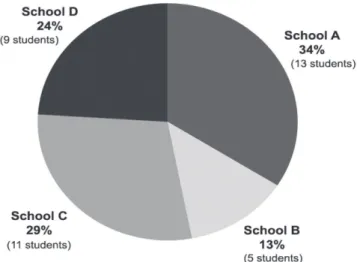
The 38 students who took part in this research were distributed according to the participating public schools, as shown in Figure 1.
Statistical analysis of ELASI for schools showed that there was a statistically significant difference between pre-training
and post-training situations in all schools. However, when the relationship between schools was analyzed, it was verified that only school B presented a statistically significant difference, that is, the results of School B indicated a possibility of more favorable attitudes towards social inclusion (Table 1).
The results of the application of ELASI demonstrated students’ favorable attitudes towards the training program and, therefore, could contribute to the inclusion process in all participating schools.
In the analysis among the schools, regarding the “stimulating”, “significant”, “organized” and “easy to use” domains, no significant difference was observed, however, the small number of participants of each school should be considered separately. The statistical analysis, by size, of the Motivational Analysis Checklist, comparing the 4 schools evaluated, is presented in Table 2.
A Cartesian projection was elaborated to evaluate the training program(15). It was verified that 100% of the students
of all schools evaluated the program positively, considering it an “impressive course” (Figure 2).
DISCUSSION
The development of an educational program in hearing health, focused on social inclusion, is in line with the reality of Brazil, which has demonstrated a high number of hearing disorders and, on the other hand, a small number of prevention and promotion actions of health. Educational programs allow information to be directly applied to a sample of individuals, encouraging them to disseminate information to their peers. Analyzing the effect of these programs for audiologists, it is worth highlighting the possibility of presenting another option of an allied tool, to prevent auditory disorders and to promote auditory health.
The literature presents an educational program in hearing health that approached the theme of hearing loss caused by high sound pressure levels, due to the indiscriminate use of portable sound equipment by adolescents(12). It is known that
besides hearing loss, undesirable symptoms, such as tinnitus, which is not commonly recognized by the affected population, may also occur(16,17).
In this sense, training programs for adolescents have been elaborated and applied(18), facing some challenges of this phase
of life, characterized by behavioral, emotional, social, cognitive and biological changes(19). Among the behavioral changes,
Table 1. Students’ performance from schools A, B, C and D in the Likert Social Attitudes Scale in Relation to Inclusion
School A School B School C School D
Pre-training total score (mean) 91.38 115.80 96.91 95.00
Standard deviation 4.8 16.1 6.6 5.7
Post-training total score (mean) 111.77 135.20 110.18 117.44
Standard deviation 185 10.2 19.9 20.1
we can see the harmful effects of listening to portable music players, in addition to the possible combination with other expositions; leisure noise, consumption of alcoholic beverages and use of tobacco(20). This way, the present study developed
an educational program featuring Interactive Teleducation, evaluating the social and motivational attitudes of the students of the four participating schools (Figure 1).
ELASI revealed a difference between the pre-training and post-training situations of the program in schools (Table 1), indicating a possible change of attitude and thus complying with the results found in previous studies, applied in different themes(14,21). As to the relationship between
schools, it was observed that only in school B the difference was significant, that is, the results showed more favorable attitudes towards social inclusion. However, when analyzing the schools separately, the limitation in the inductions is reinforced.
This increase in social attitudes expressed by the scale may be related to the increase of theoretical knowledge, because the information acquired is able to modify the human
consciousness, as far as knowledge is concerned, reflecting in a change of behavior(1).
Regarding the Motivational Analysis Checklist, it was observed that the mean values of the best performance were for the “organized” and “easy to use” domains for schools A and D. These data are important, because they showed a high “Expectation for Success” (Figure 2), which was also observed in other studies(22). For students in schools B and C,
the mean values of the best performance for the “stimulating” and “significant” domains, evidencing how much the training program was valuable (Figure 2).
All schools expressed high motivational satisfaction with the program in the “stimulating”, “meaningful”, “organized” and “easy to use” domains (Table 2), evaluating the program as “impressive” (Figure 2), results that are similar to the studies with the theme of Telegenetics(22,23), also conducted by speech
therapists, emphasizing that MAC is a highly valid instrument to measure the motivational aspect of distance learning courses.
Thus, the results found in this study indicate that the composition of the training program with synchronous,
Table 2. Mean and standard deviation by dimension in the Motivational Analysis Checklist
School
Total score
Stimulating Significant Organized Easy to use
Mean SD Mean SD Mean SD Mean SD
A 21.2 2.0 20.6 1.6 20.8 2.0 22.5 1.2
B 21.8 1.3 22.4 1.8 20.0 1.5 20.4 1.8
C 20.8 2.0 21.5 1.9 20.4 2.1 21.0 1.9
D 20.7 2.1 20.6 2.0 21.5 2.1 21.2 1.9
Subtitle: SD = Standard deviation
asynchronous and practical activities can be a positive strategy for the acquisition of knowledge in hearing health and for the modification of social and motivational aspects. The importance of new studies, in this sense, covering a greater number of individuals and considering different realities, in diverse regions of Brazil, for example, is emphasized. In addition, it is suggested that the effects of long-term training programs must be monitored, especially with regards to effective behavioral change.
CONCLUSION
Social and motivational attitudes were positive among the public school students for the educational program on hearing health, using Interactive Teleducation, revealing a trend towards social inclusion of the students involved, who presented attitudes towards the dissemination of the information acquired to the people around them.
REFERENCES
1. B a r r e t o A A . A c o n d i ç ã o d a i n f o r m a ç ã o . S ã o Pa u l o Perspec. 2002;16(3):67-74. https://doi.org/10.1590/S0102-88392002000300010
2. Jonas JA, Ronan JC, Petrie I, Fieldston ES. Description and evaluation of an educational intervention on health care costs and value. Hosp Pediatr. 2016;6(2):72-9. https://doi.org/10.1542/ hpeds.2015-0138
3. Soobrah R, Clark SK. Your patient information website: how good is it? Colorectal Dis. 2012;14(3):e90-4. https://doi.org/10.1111/j.1463-1318.2011.02792.x
4. Biondo-Simões MLP, Martynetz J, Ueda FMK, Olandoski M. Compreensão do termo de consentimento informado. Rev Col Bras Cir. 2007;34(3):183-8. https://doi.org/10.1590/S0100-69912007000300009
5. Correa CC, Ferrari DV, Berretin-Felix. Quality, range and legibility in websites related to orofacial functions. Int Arch Otorrinolaryngol. 2013;17(4):358-62. https://doi.org/10.1055/s-0033-1351372 6. Correa CC, Silva RA, Blasca WQ. Elaboration and evaluation
of contents about hearing health inserted in cybertutor. Int Arch Otorrinolaryngol. 2014;18(2):115-21. https://doi. org/10.1055/s-0033-1358578
7. Blasca WQ, Kuchar J, Pardo-Fanton CS, Ascencio ACS, Falsetti APM, Mondelli MFCG. Modelos de educação em saúde auditiva. Rev CEFAC. 2014;16(1):23-30. https://doi.org/10.1590/1982-021620141112
8. Ferrari DV, Blasca WQ, Bernardez G, Wen CL. Telessaúde: acesso à educação e assistência em audiologia. In. Bevilacqua MC, Martinez MAN, Balen S, Pupo A, Reis ACMB, Frota S. Saúde auditiva no Brasil: políticas, serviços e sistemas. São José dos Campos: Pulso; 2010. p. 189-218.
9. Blasca WQ, Maximino LP, Galdino DG, Campos K, Picolini MM. Novas tecnologias educacionais no ensino da Audiologia. Rev CEFAC. 2010;12(6):1017-24. https://doi.org/10.1590/S1516-18462010005000021
10. Macea DD, Rondon S, Chaar LJ, Wen CL. Public health education for young students aided by technology. J Telemed Telecare. 2009;15(3):159. https://doi.org/10.1258/jtt.2009.003018
11. Blasca WQ, Corrêa CC, Picolini MM, Campos K, Silva ASC, Berretin-Felix G et al. Una estrategia de teleducación sobre la salud auditiva y vocal en Brasil. Rev Logopedia, Foniatría y Audiología. 2015;35(1):2-7. https://doi.org/
12. Gonçalves CL, Dias FAM. Audiological findings in young users of headphones. Rev CEFAC. 2014;16(4):1097-108. https://doi. org/10.1016/j.rlfa.2014.05.002
13. Cruz OLM, Zanoni A. Projeto Homem Virtual: audição [CD-ROM]. São Paulo: Faculdade de Medicina da Universidade de São Paulo; 2009. Vol 1.
14. Omote SA. A construção de uma escala de attitudes sociais em relação a inclusão: notas prelimiares. Rev Bras Educ Espec. 2005;11(1):33-48.
15. Small RV, Arnone MP. Motivation mining: prospecting the web. Book Report. 1999;18:42-44.
16. Kraft SRS. Achados audiológicos e o conhecimento dos adolescentes sobre os efeitos da utilização de aparelhos portáteis de música com fones individualizados [monografia]. Universidade Tuiuti do Paraná; 2010.
17. Antonio AML. Os efeitos do uso de estéreos pessoais em jovens trabalhadores [monografia]. Universidade Tuiuti do Paraná; 2010. 18. Sant’Ana NC. Criação de uma ferramenta hipermídia para a
promoção da saúde auditiva em jovens usuários de dispositivos sonoros portáteis individuais [dissertação]. Universidade de São Paulo; 2012.
19. Ministério da Saúde (BR). A saúde de adolescentes e jovens: uma metodologia de auto-aprendizagem para equipes de atenção básica de saúde. Brasília, DF: Ministério da Saúde; 2000.
20. Corrêa CC, Silva RA, Barros GT, Pardo-Fanton CS, Blasca WQ. Promoção da saúde auditiva baseada na dinâmica do Projeto Jovem Doutor. Disturb Comunic. 2015;27(2):268-80.
21. Picolini MM, Maximino LP. Programa de capacitação em síndromes genéticas: o processo de inclusão e as atitudes sociais. Rev CEFAC. 2014;16(6):1871-7. https://doi.org/10.1590/1982-021620146313 22. Picolini MM, Maximino LP. Programa de educação em síndromes
genéticas: avaliação motivacional de um material educacional on line. Rev CEFAC. 2014;16(1):252-9. https://doi.org/10.1590/1982-021620149812