Vocal handicap and coping strategy in dysphonia after
laryngectomy
Desvantagem vocal e estratégias de enfrentamento nas disfonias
após laringectomias
Iára Bittante de Oliveira1, Daniela Regina Soares de Marialva1
ABSTRACT
Introduction: The laryngeal cancer treatment causes significant changes in the quality of life. Purpose: To assess and compare the vocal handicap and the coping strategies to deal with the vocal handicap resulting from supracricoid and total laryngectomy. Methods: Analytical, prospective observational study of groups of subjects with the same disease. Seventeen subjects were assessed and divided in two groups; the first with eight male subjects submitted to supracricoid partial laryngectomy, with cricohyoidoepiglottopexy, mean age of 67,5; and a second group with nine subjects, two women and seven men, submitted to total laryngectomy, mean age of 64,3. All subjects answered the Vocal Handicap Index-10 (VHI-10) and the Coping Strategies in Dysphonia Protocol (PEED-27). Results: The mean values of raw scores obtained with the VHI-10 by the two groups did not reveal significant differences, matching studies involving dysphonic patients. Both groups use an elevated number of coping strategies for vocal problems: the first group presented mean raw scores of 65,75 and the second group, 59,22. Conclusion: The comparison between subjects submitted to supracricoid laryngectomy and total laryngectomy does not evidence differences concerning the self-assessment of voice, vocal handicap and coping strategies to deal with vocal problems. Both groups use more than the double of coping strategies for vocal problems, with a predominant focus on emotion.
Keywords: Voice; Dysphonia; Quality of life; Laryngectomy; Self concept
RESUMO
Introdução: O tratamento para o câncer de laringe acarreta mudanças significativas na qualidade de vida. Objetivo: Avaliar e comparar a desvantagem vocal e as estratégias de enfrentamento para lidar com o comprometimento vocal resultante de laringectomias supracricoide e total. Métodos: Foram avaliados 17 sujeitos, divididos em dois grupos, sendo um com oito sujeitos, todos do gênero masculino, que se submeteram à laringectomia parcial supracricoide, com cricohioidoepiglotopexia, média de idade 67,5 anos, e um segundo grupo com nove sujeitos, sendo duas mulheres e sete homens, que se submeteram à laringectomia total, média de idade 64,3 anos. Todos responderam às questões do protocolo Índice de Desvantagem Vocal-10 (IDV-10) e do Protocolo de Estratégias de Enfrentamento na Disfonia (PEED-27). Resultados: Os valores médios dos escores brutos obtidos no IDV-10, nos dois grupos, não revelaram diferenças, sendo os índices de desvantagem compatíveis com estudos de vozes disfônicas de diferentes tipos. Ambos os grupos utilizavam um número elevado de estratégias de enfrentamento do problema de voz. O primeiro grupo apresentou 65,75 como média de escores brutos e o segundo, 59,22. Conclusão: A comparação entre sujeitos que se submeteram a laringectomia supracricoide e aqueles submetidos à laringectomia total não evidenciou diferenças, no que se refere à autoavaliação da voz, desvantagem vocal e estratégias de enfrentamento do problema de voz. Os dois grupos utilizavam mais que o dobro de estratégias de enfrentamento do problema de voz, com predomínio de foco na emoção. Palavras-chave: Voz; Disfonia; Qualidade de vida; Laringectomia; Autopercepção
The study was conducted at the Speech-Language Pathology and Audiology Course, Pontifícia Universidade Católica de Campinas – PUC – Campinas (SP), Brazil, with a research scholarship granted by Fundo de Apoio à Iniciação Científica – FAPIC – Reitoria, Pontifícia Universidade Católica de Campinas.
(1) Speech-Language Pathology and Audiology Course, Pontifícia Universidade Católica de Campinas – PUC – Campinas (SP), Brazil. Conflict of interests: No
Authors’ contribution: IBO main researcher, supervisor, study development, data collection and analysis, manuscript writing and editing, article submission and procedures; DRSM literature review, manuscript drafting, data collection and analysis.
INTRODUCTION
Supracricoid partial laryngectomy (SCPL) has been pointed out as advantageous when compared to total laryngectomy (TL), especially considering that it aims to preserve part of the organ(1,2,3,4,5,6,7). Survival rates of SCPL are similar to the
TL ones(6,8), although it may benefit the patient by not using
permanent tracheostomy. The vocal quality after SCPL is characterized as hoarse and breathy(2), however intelligible,
allowing the patient to keep an effective voice for his communication(1) and has low impact on social activities,
contributing for a better quality of life(1,3,4,5,9,10).
The TL, however, is still one of the main procedures in the treatment of laryngeal cancer and the patient needs to learn a new way of verbal communication and deal with breathing and swallowing changes, which will certainly interfere in his life(11).
Regardless the chosen surgical modality, the larynx cancer treatment results in changes in patient’s daily life activities, significantly altering its quality(12,13) and jeopardizing primordial
functions of social life(8,13,14) in which voice plays a prominent
role.
The quality of life (QoL) may be considered as the way an individual deals satisfactory or unsatisfactory with several aspects of his daily life, considering his wellbeing, beliefs, personal and spiritual satisfactions(12,15,16). The assessment
process may involve four main domains: physical and psychological functioning, social interaction and symptoms related to the disease treatment(15).
The way the patient deals with the disease significantly influences the treatment and results(17,18). He will have to deal
with the laryngectomy impairments, requiring coping. It is vital that the patient makes an effort to face the situation in order to reestablish the appropriate psychic balance(19).
This study aimed to assess and compare the vocal handicap and coping strategies in two groups of patients, after supracricoid partial laryngectomy and after total laryngectomy.
METHODS
This analytical, descriptive, prospective open study assessed 17 subjects with the same disease divided in two groups. The first group comprised eight patients submitted to SCPL with cricohyoidoepiglottopexy (CHEP), all male ranging in age from 55 to 76 years, mean age of 67,5 years. The second group comprised nine subjects submitted to TL, seven men and two women, ranging in age from 59 to 82 years, mean age of 64,3 years. Two subjects of this group used tracheoesophageal prosthesis, two used esophageal speech and two used electrolarynx.
All subjects attended the Speech Language Services of the Head and Neck Surgery Ambulatory of a private school-hospital
in Campinas city (SP). All participants were retired, literate, with an average schooling of elementary school, complete or not.
At the time of the study, subjects were in process of assisted discharged and were considered as presenting functional communication, which was an inclusion criteria for the study. The mean post-surgical time of subjects submitted to SCPL was two years and two months and the mean post-surgical time of subjects submitted to TL was three years and six months. Most of the patients had unilateral or bilateral cervical emptying (five SCPL and seven TL), however it was not the focus of the study to compare such situation.
Eligible subjects were included in the study if they met the following criteria: undergone SCPL or TL; willingness to participate in the study; general health under control at the time of the study; no cancer recurrence or other impairments or morbidities interfering with quality of life, considering only the limitations due to the surgery for laryngeal cancer; retired or not; absence of dysphagia or adapted swallowing; not in use of feeding probe.
Subjects from both groups answered the Voice Handicap Index-10 (VHI-10)(20) and the Dysphonia Coping Strategy
Protocol (PEED-27)(21). All questions of the protocols were
read by a researcher and subjects had to choose the answer according to his self-perception.
Material
The Vocal Handicap Index – 10 (VHI-10) is a shorter version of VHI, translated and adapted to Brazilian Portuguese(20).
VHI-10 was developed, maintaining the VHI-10 most clinically relevant questions. The instrument produces a total single score arrived at by a summation of scores allocated to different responses to items/ questions that range from 0 to 40 points, with 0 indicating no disadvantage and 40 indicating maximum disadvantage. A study showed that the VHI-10 is a robust tool to evidence the impacts of dysphonia in the individual’s life(22).
The Dysphonia Coping Strategy Protocol (PEED-27) was translated and into Brazilian Portuguese and validated(17). It is
Table 1. Results of Voice Handicap Index-10: averages obtained by subjects from supracricoid partial laryngectomy group and from total laryn-gectomy group
Questions Averages p-value*
SCPL TL
F1 - My voice makes it difficult for people to hear me. 1.3 1.7 0.571
F3 - People have difficulty undestanding me in noisy rooms. 2.1 2.3 0.759
F16 - My voice problem restricts my social and personal life. 0.9 1.0 0.829
F19 - I feel left out of conversations because of my voice. 0.4 0.6 0.495
F22 - My voice problem causes me finantial loss. 0.4 1.1 0.299
O10 - People ask:> “What’s wrong with your voice?” 1.1 2.2 0.024
O14 - I feel as though I have to strain to produce my voice. 1.6 0.8 0.138
O17 - I can’t predict the clarity of my voice. 0.1 0.7 0.271
E23 - My voice problem upsets me. 0.4 0.9 0.396
E25 - My voice makes me feel handicapped. 0.8 1.4 0.414
* Mann-Whitney/Wilcoxon test for the comparison of values between the groups
Subtitle: SCPL = Group of subjects submitted to supracricoid partial laryngectomy; TL = Group of subjects submitted to total laryngectomy
Ethical aspects
The study was approved by the Research Ethics Committee with Human Beings of the Pontifícia Universidade Católica de Campinas, Nº 394.430, CAAE 17671513.1.0000.5481.
All subjects were informed about the study details and, after understanding the procedures that would be performed, they signed the informed consent term and kept a copy of it.
RESULTS
Subjects from the SCPL group evaluated their voices from reasonable to good, with predominance of good, and subjects from the TL group from reasonable to very good, also with predominance of good (Figure 1). The exact test of Fischer revealed p=0.385 in the comparison of both groups.
The averages obtained by the two groups regarding VHI-10 questions with their respective p values are presented in Table 1.
The average raw scores results of VHI-10 show that the SCPL group had average value of 9,0 and the TL group, 12,7 (Figure 2). Comparing the two groups regarding the raw average values of VHI-10, the Mann-Whitney/Wilcoxon test revealed p=0.175. Highlights to answers given to question O10 of the instrument -“People ask: what’s wrong with your voice?”, where p=0.024 (Figure 3).
The average raw scores obtained by SCPL and TL groups concerning PEED-27 protocol were 65,75 and 59,22, respectively. Comparing those scores, the Mann-Whitney/ Wilcoxon test revealed p=0.359. Concerning the problem-focused domain, the value was p=0.101 and concerning the emotion-focused domain it was p=0.923 (Table 2).
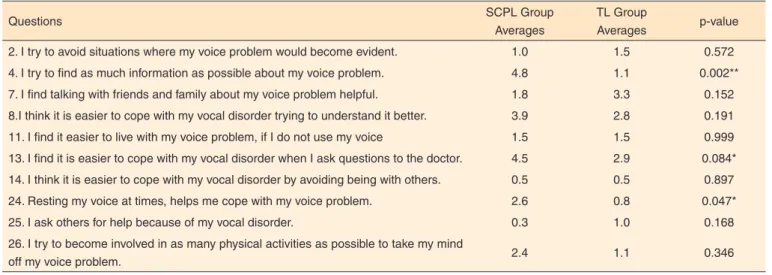
Results of the PEED-27 protocol regarding both, problem-focused and emotion-problem-focused strategies, are described in Tables 3 and 4.
DISCUSSION
Results of this study showed that the SCPL group assessed their voices from reasonable to good, while in the TL group there were concepts of reasonable to very good. Attention is drawn to the tendency of both groups to make positive self-assessments, considering the extension of supracricoid partial laryngectomy, or even the total removal of the organ, which generates the laryngeal voice alaryngeal.
Previous studies confirmed the tendency of patients with dysphonia to assess their own voice as being of good quality after a partial laryngectomy(23). One must take into account
other factors that may be influencing such self-concept since laryngectomy surgeries, partial and total, severely alter the laryngeal structure, or remove part of the organ, jeopardizing the vocal quality intensively, or leading patients to seek for substitutive phonation with esophageal speech, tracheoesophageal prosthesis, etc.
Subtitle: SCPL = Group of subjects submitted to supracricoid partial laryngectomy; TL = Group of subjects submitted to total laryngectomy
Table 2. Results of the Dysphonia Coping Strategies Protocol-27: averages obtained by groups regarding raw scores, problem-focused and emotion-focused domains
Scores
Averages of groups
p-value*
SCPL TL
Raw 65.75 59.22 0.359
Problem-focused 23.13 17.22 0.101
Emotion-focused 42.63 42.00 0.923
* Mann-Whitney/Wilcoxon test for the comparison of values between the groups
Subtitle: SCPL = Group of subjects submitted to supracricoid partial laryngectomy; TL = Group of subjects submitted to total laryngectomy
Studies show divergences of opinions concerning vocal quality, considering that communication goes beyond an impaired voice(24,25,26). Some authors defended the patients’
satisfaction with their voice in the presence of an intelligible communication(4,24,27). Others defended that the most affected
aspect was communication, which is responsible for the worst impacts upon quality of life(8). It is important to stress that, in
this study, all patients had already gone through speech therapy, which may have contributed for adaptation strategies of the new voice and for a functional communication in both groups. The HVI-10 average raw values obtained in both groups did not reveal difference, but showed compatibility with different types of voice impairment, corroborating a validation study of the HVI-10(22), in which the average values found for patients
without vocal complaint were 1,0 and raw scores varying from 8,0 to 28,0 points for patients with functional dysphonia and vocal folds palsy. However, in the mentioned study there were no cases of dysphonia by larynx carcinoma and the scores found in the present study were lower than most of the dysphonia cases studied.
Only one question from the organic domain of the HVI-10 (OHVI-10) revealed difference between the two groups. The question “People ask: what’s wrong with your voice?” revealed greater disadvantage to the TL group, which may be justified if considering the significant voice modification for the listener. In the TL group, most of the subjects used the tracheoesophageal prosthesis which seals the tracheostomy digitally when speaking, raising people’s curiosity. The same may occur with the electronic larynx which also modifies the phonation source differing it from a laryngeal voice.
Concerning the elevated number of strategies used by both groups for coping with the vocal problem, results (Table 2) agree with those found in the study mentioned previously(22). It
may be emphasized that there were no differences between the average raw scores found in both groups, which is in agreement with a study that verified, using PEED-27, that subjects with vocal complaint used more than the double of coping strategies than the general population. According to the study, the average total score of the group with vocal complaint was 51,86 and of the general population it was 23,18(17).
Coping strategies are the result of cognitive and behavioral efforts used to manage internal and external demands under stressing circumstances, and the emotions caused by them(28). In other words, they are used by an individual to
deal with a problem that causes stress, trying to overcome it somehow(17,19,29).
Coping strategies vary according to personal experiences and may be emotion-focused or problem-focused. In the first case, there is a search to decrease the internal emotional discomfort sensation, and is used predominantly when there is a permanent impairment. In the second case, there is a search for direct changes in the environment that generated the stress and it is more used in situation that are possible to be changed.
Subtitle: SCPL = Group of subjects submitted to supracricoid partial laryngectomy; TL = Group of subjects submitted to total laryngectomy
Figure 2. Results of the Vocal Handicap Index-10 raw scores aver-ages obtained by the supracricoid partial laryngectomy and the total laryngectomy groups
Subtitle: SCPL = Group of subjects submitted to supracricoid partial laryngectomy; TL = Group of subjects submitted to total laryngectomy
Table 3. Averages of both groups obtained in each question of the problem-focused domain of the Dysphonia Coping Strategies Protocol-27
Questions SCPL Group
Averages
TL Group
Averages p-value
2. I try to avoid situations where my voice problem would become evident. 1.0 1.5 0.572
4. I try to find as much information as possible about my voice problem. 4.8 1.1 0.002**
7. I find talking with friends and family about my voice problem helpful. 1.8 3.3 0.152
8.I think it is easier to cope with my vocal disorder trying to understand it better. 3.9 2.8 0.191
11. I find it easier to live with my voice problem, if I do not use my voice 1.5 1.5 0.999
13. I find it is easier to cope with my vocal disorder when I ask questions to the doctor. 4.5 2.9 0.084*
14. I think it is easier to cope with my vocal disorder by avoiding being with others. 0.5 0.5 0.897
24. Resting my voice at times, helps me cope with my voice problem. 2.6 0.8 0.047*
25. I ask others for help because of my vocal disorder. 0.3 1.0 0.168
26. I try to become involved in as many physical activities as possible to take my mind
off my voice problem. 2.4 1.1 0.346
* Significant values (p<0.05) – Mann-Whitney/Wilcoxon test for the comparison of values between the groups
Subtitle: SCPL = Group of subjects submitted to supracricoid partial laryngectomy; TL = Group of subjects submitted to total laryngectomy
Table 4. Averages of both groups obtained in each question of the emotion-focused domain of the Dysphonia Coping Strategies Protocol-27
Questions SCPL Group
Averages
TL Group
Averages p-value
1. It is easier to cope with my vocal disorder if other people are kind. 2.9 4.3 0.192
3. I find myself wishing that I never had a voice problem. 0.8 2.4 0.335
5. I find it easier to cope with my voice problem by expressing my feelings outwardly. 1.8 2.8 0.419
6. I find it easier to cope with my vocal disorder by avoiding thinking about it. 3.3 1.8 0.201
9. I keep to myself any concern about my vocal disorder. 2.6 2.1 0.460
10. I think there is not much I can do regarding my vocal disorder. 1.1 2.0 0.359
12. Having a vocal disorder helped me to understand some important facts about my life. 3.7 3.1 0.580
15. I find it easier to cope with my voice problem by wishing that it would go away somehow.
0.9 1.1 0.573
16. I find it easier to cope with my voice problem by joking about it. 0.3 2.0 0.007*
17. I try to accept my vocal disorder because there is nothing that can be done. 3.0 3.1 0.800
18. I think religion and praying help me cope with my voice problem. 4.3 3.0 0.171
19. I keep to myself the frustrations caused by my vocal disorder and a few friends know how I feel.
2.1 1.6 0.455
20. I try to convince myself that my voice problem is not really that disabling. 4.1 3.1 0.346
21. Having a voice problem has helped me to become a better person. 2.9 2.7 0.762
22. I ignore my voice problem looking only at good things in life. 3.6 3.4 0.443
23. When my voice gets bad, I find myself taking it out on others around me. 0.4 0.3 0.717
27. I find it easier to cope with my voice problem when I compare myself to others who have worse health problems than mine.
5.0 4.1 0.169
* Significant values (p<0.05) – Mann-Whitney/Wilcoxon test for the comparison of values between the groups
Subtitle: SCPL = Group of subjects submitted to supracricoid partial laryngectomy; TL = Group of subjects submitted to total laryngectomy
Both strategies occur when there is an increase in stress and mutually influence one another(28,30).
In the present study, both groups used more emotion-focused strategies and there were no statistical differences between the average scores. Essentially, one can say that subjects from both groups used the double of emotion-focused strategies (average for SCPL 42,73 and for TL 42,2) when
compared to problem-focused strategies. Literature pointed out that problem-focused strategies are, usually, used by people who go through a “temporary” problem. Considering the emotion-focused strategies, the reverse occurs(29), which may
Concerning certain questions of the problem-focused domain, some differences were observed between the groups regarding the search for knowledge about the disease. The SCPL group differed from the TL group in the following questions: “I try to find all available information about my vocal disorder”; “I find it is easier to cope with my vocal disorder trying to understand it better”; “I find it is easier to cope with my vocal disorder when I ask questions to the doctor”. Therefore, one may suppose a certain tendency of the SCPL group to search for strategies focused on efforts to manage or alter the problem(19).
Literature acknowledged that subjects use more problem-focused strategies in the presence of a “changeable” situation(28,30). Although it was a punctual tendency, the
propensity for using certain problem-focused strategies more expressively by the SCPL group than by the TL group may be justified by considering that SCPL subjects had more vocal adaptive possibilities than TL subjects, since the total larynx removal, the tracheostomy and the loss of vocal source are permanent.
Concerning questions related to emotion-focused coping strategies, the item “I find it easier to cope with my voice problem by joking about it” presented difference between the groups, being more used by the TL group. Many interpretations can be given to this fact. One may think that the unchangeable feature due to the total larynx removal, or even the communication ways (esophageal speech, electronic larynx or tracheoesophageal prosthesis), which are very different than the usual communication mode, make these individuals a constant target of social curiosity, leading them to develop this type of strategy.
According to literature, SCPL seems to be ideally suited to treat T1, T2 and T3 tumors and some selected T4 cases, when compared to TL. Its results have been satisfactory either for the preservation of the organ as for the functional benefits(1,2,3,4,5,6,7). However, despite such reports, the subjects’
vocal self-assessment and the analysis related to the vocal handicap did not reveal differences between both groups. The same happened regarding the vocal problem coping strategies.
CONCLUSION
The comparison of two groups of subjects submitted to supracricoid partial laryngectomy and total laryngectomy did not evidence difference regarding vocal self-assessment and vocal handicap aspects. Both groups used more than the double of vocal problem coping strategies when compared to the population without vocal complaint, with predominance of emotion-focused strategies. It is suggested that further studies should be developed to verify the impacts of both surgical resources.
REFERENCES
1. Gallo A, Manciocco V, Tropiano ML, Simonelli M, Marvaso V, D’Arcangelo E et al. Prognostic value of resection margins in supracricoid laryngectomy. Laryngoscope. 2004;114(4):616-21. https://doi.org/10.1097/00005537-200404000-00005.
2. Laudadio P, Presutti L, Dall’Olio D, Cunsolo E, Consalici R, Amorosa L et al. Supracricoid laryngectomies: long-term oncological and functional results. Acta Otolaryngol. 2006;126(6):640-9. https:// doi.org/10.1080/00016480500469024
3. Nakayama M, Okamoto M, Miyamoto S, Takeda M, Yokobori S, Masaki T et al. Supracricoid laryngectomy with cricohyoidoepiglotto-pexy or cricohyoido-pexy: experience on 32 patients. AurisNasus Larynx. 2008;35(1):77-82. https://doi. org/10.1016/j.anl.2007.04.018
4. Alicandri-Ciufelli M, Piccinini A, Bergamini G, Ruberto M, Ghidini A, Marchioni D et al. Atypical neoglottis after supracricoid laryngectomy: a morphological and functional analysis. Eur Arch Otorhinolaryngol. 2011;268(7):1029-34. https://doi.org/10.1007/ s00405-011-1556-4
5. Szyfter W, Leszczynska M, Wierzbicka M. Outcome after supracricoid laryngectomies in the material of ENT Department, Poznan University of Medical Sciences. Eur Arch Otorhinolaryngol. 2011;268(6):879-83. https://doi.org/10.1007/s00405-011-1513-2 6. Castro A, Sanchez-Cuadrado I, Bernaldez R, Del Palacio A,
Gavilan J. Laryngeal function preservation following supracricoid partial laryngectomy. Head Neck. 2012;34(2):162-7. https://doi. org/10.1002/hed.21703
7. Vincentiis M, De Virgilio A, Bussu F, Gallus R, Gallo A, Bastanza G et al. Oncologic results of the surgical salvage of recurrent laryngeal squamous cell carcinoma in a multicentric retrospective series: emerging role of supracricoid partial laryngectomy. Head Neck. 2015;37(1):84-91. https://doi.org/10.1002/hed.23563
8. Moyano JAM, Gutiérrez RS, Nogueras JR, Aumente PO, Villarejo PL. Calidad de vida em pacientes tratados mediante laringectomía parcial supracricoidea com cricohioidoepiglotopexia (CHEP). Acta Otorrinolaringol Esp. 2004;55(9):409-14. https://doi.org/10.1016/ S0001-6519(04)78545-3
9. Decotte A, Woisard V, Percodani J, Pessey JJ, Serrano E, Vergez S. Respiratory complications after supracricoid partial laryngectomy. Eur Arch Otorhinolaryngol. 2010;267(9):1415-21. https://doi. org/10.1007/s00405-010-1238-7
10. Kucuk H, Kurnaz SC, Kutlar G. Treatment expectations and quality of life outcomes of patients with laryngeal cancer based on different treatment methods. Eur Arch Otorhinolaryngol. 2015;272(5):1245-50. https://doi.org/10.1007/s00405-014-3066-7
11. 1. Eadie TL, Bowker BC. Coping and quality of life after total laryngectomy. Otolaryngol Head Neck Surg. 2012;146(6):959-65. https://doi.org/10.1177/0194599812437315
13. Moore KA, Ford PJ, Farah CS. ‘’I have quality of life…but…’’: exploring support need important to quality of life in head and neck cancer. Eur J OncolNurs. 2014;18(2):192-200. https://doi. org/10.1016/j.ejon.2013.10.010
14. Campos RJDS, Leite ICG. Qualidade de vida e voz pós-radioterapia: repercussões para a fonoaudiologia. Rev CEFAC. 2010;12(4):671-77. https://doi.org/10.1590/S1516-18462010005000038
15. Rogers SN. Quality of life perspectives in patients with oral cancer. Oral Oncol. 2010;46(6):445-7. https://doi.org/10.1016/j. oraloncology.2010.02.021
16. Melo Filho MR, Rocha BA, Pires MBO, Fonseca ES, Freitas EM, Martelli Jr H et al. Qualidade de vida de pacientes com carcinoma em cabeça e pescoço. Braz J Otorhinolaryngol. 2013;79(1):82-9. https://doi.org/10.5935/1808-8694.20130014
17. Oliveira G, Hirani SP, Epstein R, Yazigi L, Behlau M. Coping strategies in voice disorders of a Brazilian population. J Voice. 2012;26(2):205-13. https://doi.org/10.1016/j.jvoice.2010.10.023 18. Zambon F, Moreti F, Behlau M. Coping strategies in teachers with
vocal complaint. J Voice. 2014;28(3):341-8. https://doi.org/10.1016/j. jvoice.2013.11.008
19. Chaves EC, Cade NV, Montovani MF, O Leite RCB, Spire WC. Coping: significados, interferência no processo saúde-doença e relevância para a enfermagem. Rev Esc Enferm USP. 2000;34(4):370-5. https://doi.org/10.1590/S0080-62342000000400008
20. Costa T, Oliveira G, Behlau M. Validação do índice de Desvantagem Vocal: 10 (IDV-10) para o português brasileiro. CoDAS. 2013;25(5):482-5. https://doi.org/10.1590/S2317-17822013000500013
21. Oliveira G, Hirani SP, Epstein R, Yazigi L, Behlau M. Validation of the Brazilian version of voice disability coping questionnaire. J Voice. 2016;30(2):247. https://doi.org/10.1016/j.jvoice.2015.01.004 22. Rosen CA, Lee AS, Osborne J, Zullo T, Murry T. Development
and validation of the voice handicap index-10. Laryngoscope. 2004;114(9):1549-56. https://doi.org/10.1097/00005537-200409000-00009
23. Oliveira IB, Augusti ACV, Siqueira DM. Avaliação de voz e qualidade de vida após laringectomia supracricóide. Audiol Commun Res. 2013;18(4):353-60. https://doi.org/10.1590/S2317-64312013000400018
24. Schindler A, Favero E, Nudo S, Albera R, Schindler O, Cavalot AL. Long-term voice and swallowing modificaitons after supracricoidlaryngectomy: objective, subjective, and self-assessment data. Am J Otolaryngol. 2006;27(6):378-83. https://doi. org/10.1016/j.amjoto.2006.01.010
25. Schindler A, Mozzanica F, Ginocchio D, Invernizzi A, Peri A, Ottaviani F. Voice-related quality of life in patients after total and partial laryngectomy. Auris Nasus Larynx. 2012;39(1):77-83. https:// doi.org/10.1016/j.anl.2011.03.009
26. Saito K, Akari K, Ogawa K, Shiotani A. Laryngeal function after supracricoid laryngectomy. Otolaryngol Head Neck Surg. 2009;140(4):487-92. https://doi.org/10.1016/j.otohns.2008.12.036 27. Anchette D, Menezes MB, Nakay MY, Prandini B, Kikuchi W,
Gonçalves AJ. Avaliação da qualidade de vida dos pacientes com câncer de laringe no pós-operatório tardio. Soc Bras Psico Oncol. 2009;4(3):1-6.
28. Folkaman S, Lazarus RS. If it changes it must be a process: study of emotion and coping during three stages of a college examination. J Pers Soc Psychol. 1985;48(1):150-70. https://doi.org/10.1037/0022-3514.48.1.150
29. Antoniazzi AS, Dell’Aglio DD, Bandeira DR. O conceito de coping: uma revisão teórica. Estud Psicol. 1998;3(2):273-94. https://doi. org/10.1590/S1413-294X1998000200006