Prevalence of high blood
pressure in Brazilian adolescents
and quality of the employed
methodological procedures:
systematic review
Prevalência de pressão arterial elevada
em adolescentes brasileiros e qualidade
dos procedimentos metodológicos
empregados: revisão sistemática
Marina Gabriella Pereira de Andrada MagalhãesI
Luciano Machado Ferreira Tenório de OliveiraII
Diego Giulliano Destro ChristofaroIII
Raphael Mendes Ritti-DiasI,II
IPostgraduation Program of Adolescent Medicine, Universidade de Pernambuco
(UPE) – Recife (PE), Brazil.
IIAssociate Postgraduation Program of Physical Education, Universidade de
Pernambuco and Universidade Federal da Paraíba – Recife (PE), Brazil.
IIIPrograma de Pós-graduação em Fisioterapia, Universidade Estadual Paulista,
Presidente Prudente-SP, Brasil. Programa de Pós-graduação em Ciências da Motricidade, Rio Claro-SP, Brasil.
Corresponding author: Raphael Mendes Ritti Dias. Rua Arnóbio Marques 310, Santo Amaro, CEP: 50100-130, Recife, PE, Brasil. E-mail: [email protected]
Conlict of interests: nothing to declare.
Abstract
Objective: To review the literature on stud-ies that estimated the prevalence of high blood pressure (HBP) or systemic arterial hypertension (SAH) in Brazilian adoles-cents, considering the employed method-ological procedures. Methods: Bibliographical research of prevalence studies of HBP/SAH in adolescents from 1995 to 2010. he search was conducted in the electronic databases PubMed/Medline, Lilacs, SciELO, and Isi Adolec. he descriptors “hypertension”, “BP”, “teen”, “students”, “cross-sectional”, “preva-lence” and “Brazil” were used in Portuguese and English. Furthermore, a score ranging from 0 to 18 based on Recommendations for Blood Pressure Measurement in Humans and Experimental Animals and the VI Brazilian Guidelines of Hypertension was elaborated, in order to analyze the procedures used
to mea-sure BP in studies. Results: Twenty-one
articles were identified, mostly published in the last 10 years, and 90.5% were per-formed in school-based and regions of the Southeast, Northeast and South. he preva-lence of HBP/SAH ranged from 2.5 to 30.9%. he score of the studies ranged from 0 to 16. A signiicant negative correlation (rho = -0.504; p = 0.020) was observed between the preva-lence of HBP/SAH and the score of BP mea-surement quality. Conclusion: he great vari-ability of PAE/SAH estimates appears to be inluenced by methodological procedures used in the studies.
Introduction
Cardiovascular diseases are currently responsible for approximately 40% of the world mortality1. Systemic arterial
hyperten-sion (SAH) represents the main risk factor for cardiovascular diseases, and its early diagnosis has been pointed out as an important public health strategy.
In Brazil, studies indicate prevalence of SAH ranging from 22 to 44% in the adult
population2. Even though most of the SAH
diagnoses are established at the adult age, it is known that this disease can appear
dur-ing childhood3. herefore, measuring blood
pressure (BP) has been recommended by the VI Brazilian Guidelines of Hypertension4, as
well as by the Second Task Force on Blood Pressure Control in Children, since 19875, as
an important component of pediatric routine6,
thus enabling its early diagnosis.
Throughout the past years, several stud-ies have investigated the prevalence of SAH among children and adolescents in Brazil; however, the prevalence estimates provided by the studies present wide varia-tion. For instance, in the study conducted by Rezende et al.7, the prevalence was 2.4%,
while in the analysis by Sakamoto et al.8, the
prevalence was 30.9%. These variable results concerning the estimates can be a result of different methodological procedures, especially with regard to the procedures adopted to measure BP. Therefore, it is nec-essary to synthetize the studies in order to better understand the data that are available in literature, which can subsidize public policies of prevention and treatment of SAH among Brazilian adolescents.
hus, the objective of this study was to systematically review the studies that estimate the prevalence of high BP in Brazilian adoles-cents, according to sample characteristics and the employed methodological procedures.
Methods
A bibliographic research of descriptive epi-demiological studies analyzing the prevalence
Resumo
Objetivo: Revisar a literatura sobre estudos que estimaram a prevalência de pressão arterial elevada (PAE) ou hipertensão arterial sistê-mica (HAS) em adolescentes brasileiros, con-siderando os procedimentos metodológicos
empregados. Métodos: Pesquisa
bibliográ-ica de estudos de prevalência de PAE/HAS em adolescentes de 1995 a 2010. A busca foi realizada nas bases de dados eletrônicos PubMed/Medline, Lilacs, SciELO, Isi e Adolec. Foram utilizados os descritores: “hiperten-são”, “pressão arterial”, “adolescente”, “estu-dantes”, “estudos transversais”, “prevalência” e “Brasil”, nas línguas portuguesa e inglesa. Além disso, foi elaborado um escore,
base-ado nas Recommendations for Blood Pressure
Measurement in Humans and Experimental Animals e nas VI Diretrizes Brasileiras de Hipertensão, para a análise dos procedimen-tos utilizados para medida da PA nos estudos variando de 0 a 18. Resultados: Foram iden-tiicados 21 artigos, a maioria publicada nos últimos 10 anos, sendo 90,5% realizados em base escolar e nas regiões sudeste, nordeste e sul do país. As prevalências de PAE/HAS variaram de 2,5 a 30,9%. A pontuação dos estu-dos variou de 0 a 16. Foi observada uma cor-relação negativa signiicante (rho = -0,504; p = 0,020) entre a prevalência de PAE/HAS e o escore da qualidade da medida da PA.
Conclusão: A grande variabilidade das esti-mativas da PAE/HAS parece ser inluenciada pelos procedimentos metodológicos utiliza-dos nos estuutiliza-dos.
of high BP in adolescents until 2010 was conducted. he research was performed in the electronic data bases PubMed/Medline (National Library of Medicine), Lilacs (Literatura Latino-Americana e do Caribe em Ciências da Saúde), SciELO (Scientific Electronic Library Online), Isi Web of Knowledge and Adolec. Descriptors were selected based on consultations to MeSH (Medical Subject Headings) and DeCS (Descritores em Ciências da Saúde). he fol-lowing descriptors were considered, in English and in Portuguese: “hypertension”, “blood pressure”, “teen”, “students”, “cross-sectional”, “prevalence” and “Brazil” (in order to locate articles with national samples). Besides, the logical operators “and” and “or” were used to combine the terms. All of the search, selection and assessment processes were performed by pairs, who fully and independently analyzed al of the studies that met the inclusion criteria. he results obtained by the evaluators were compared in order to check for the concor-dance between pairs. In case of divergences, the article was revised again by a third member of the research team.
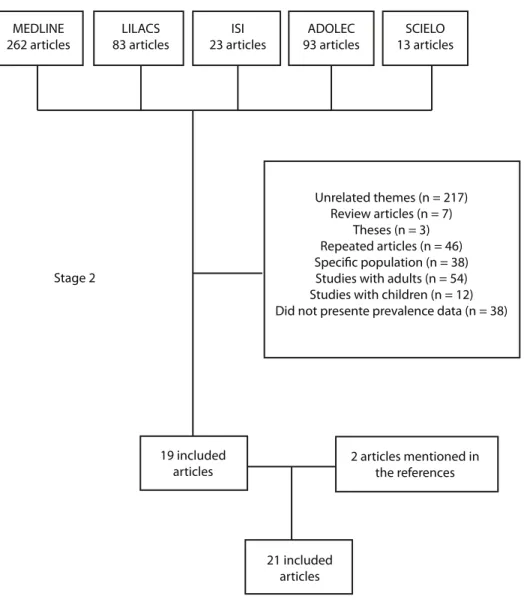
From the bibliographic research, 479 pub-lications were identified (PubMed = 262; Lilacs = 83; SciELO = 13; Isi = 28 and, Adolec = 93). Only studies investigating ado-lescents were included (10 to 19 years old)9,
even those which approached other age groups and that collected data in Brazil; review articles, theses, dissertations, and mono-graphs were not included, as well as studies with speciic population, such as people with asthma, obese participants or children of hypertensive patients.
After reading the titles of the articles, 92 remained for the analysis of abstracts. From this analysis, the articles that met the inclusion criteria were fully read by the two evaluators, who fully and independently ana-lyzed all of the studies that met the inclusion criteria. he results obtained by the evaluators were compared in order to verify concordance between pairs. In the case of divergences, the article was revised by a third researcher. It was also observed if studies had proper sample size, involving random selection, besides
the mention of ethical aspects. At the end of these procedures, 19 manuscripts were identiied. After reading the manuscripts, two other studies cited in the reference list that had not been identiied in the research were identiied10,11, therefore being included
afterwards, accounting for 21 articles, as presented in Figure 1.
For the analysis of articles, the following aspects were observed: year and region in which the study was carried out, age group, sample size, type of survey, criteria used to diagnose high BP and/or SAH, criteria employed to measure BP (placement, previ-ous rest and calibration), type of used device (aneroid, mercury column or electronic), dimension of the sphygmomanometer cuf, number of measurements, the choice of the value used to determine the prevalence of high BP and/or SAH by gender and total prevalence of high BP and/or SAH.
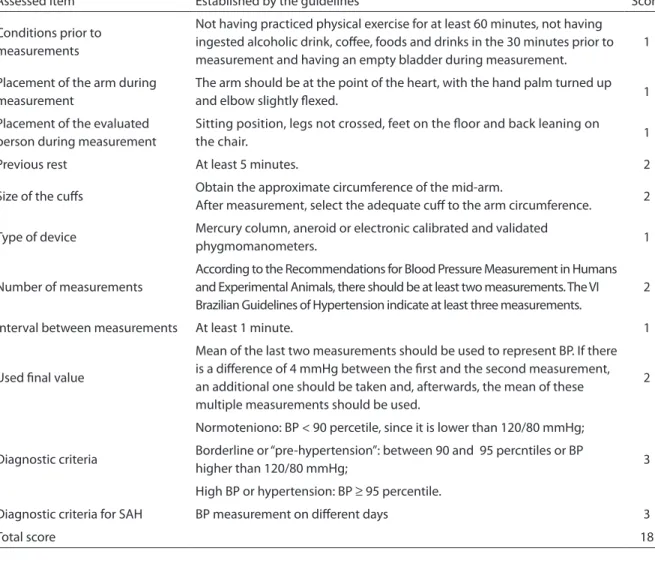
In order to assess the adopted meth-odology to verify BP in children and ado-lescents, a score was elaborated based on the Recommendations for Blood Pressure Measurement in Humans and Experimental Animals12 and in the VI Brazilian Guidelines of
Hypertension4 (Chart 1), whose scores ranged
from one to three points according to the level of importance of recommendations. Based on the established criteria, the maximum possible score was 18 points, when all of the items of the recommendations were fulilled. For statistical analysis, the software SPSS for Windows was used, version 10.0. Normality and homogeneity of data variance were ana-lyzed, and data did not show normal distribu-tion. herefore, Spearman’s correlation was employed to analyze the correlation between the prevalence found and the obtained scores, using a 5% signiicance level.
Results
articles used the descriptor SAH, 38.1%10-11,23-28
used the term HBP (high blood pressure) and 4.8%29 referred to borderline BPE. Concerning
the criteria used to classify high BP, 4.8%10 did not
provide information as to the adopted criteria, 4.8%13 used the BP criterion 140 x 90 mmHG,
23.8%8,17,24,26,28 adopted the 90 percentile, and
66.7%7,11,14-16,18-23,25,27,29 employed the 95 percentile.
All of the articles included male and female adolescents, however, only 52% presented high BP prevalence stratified by gender7,8,13-15,18,20-22,25,28. Out of these, 18.1%14,20
did not present significant differences of high
BP between men and women, 36.4%8,13,15,21
pointed out to the higher prevalence among male participants and in 45.5%7,18,22,25,28
the female gender had more prevalence of high BP.
he compiled studies were conducted in the Southeast (38%)7,13-15,19-21,29, Northeast
(28.5%)11,16,17,22-23,25, South (24%)8,10,24,26,27 and
Center-West regions (9.5%)18,28. No
stud-ies were veriied in the North region. he
sample size of the studies ranged from 558
to 3,169 individuals18. Only one analysis was
regional16, and the others were restricted
Stage 1
Stage 2 MEDLINE 262 articles
19 included articles
21 included articles
2 articles mentioned in the references LILACS
83 articles
ISI 23 articles
ADOLEC 93 articles
SCIELO 13 articles
Unrelated themes (n = 217) Review articles (n = 7)
Theses (n = 3) Repeated articles (n = 46) Specific population (n = 38) Studies with adults (n = 54) Studies with children (n = 12) Did not presente prevalence data (n = 38)
Figure 1 - Selection Flowchart of studies included in the review.
to municipal areas. Out of the 21 articles, 90% were performed by school-based sur-veys7,8,10,11,13,14,16-20,22-26,28-30 and 10% by
house-hold survey15,27. In school-based surveys, the
prevalence ranged from 2.57 to 30.9%8; as to
household surveys, prevalence ranging from 12.327 to 17.9%15 was described.
Table 2 presents a summary of the methods used in the study. he auscultatory method was used in 61.9%7,10,11,13,16,18-20,22-26 of the
stud-ies; the oscillometric method was used in 14.3%8,14,21, and 23.8% did not report the used
method15,17,27-29. he calibration of the
instru-ment used to measure BP was reported in 19% of the cases7,19,24,26. As to the number of
evaluators to measure BP, 23.8% of the stud-ies reported a single person7,8,11,22,26 and 4.8%
indicated that measurement was conducted by 4 evaluators, who were subjected to audio-metric evaluation.
Out of the 21 studies, 43% did not specify the use of cufs with diferent sizes according to the circumference of the arm of the partici-pant8,10,13-15,17,23,28,29. Rest prior to BP
measure-ment was described in 48% of the articles, and rest lasted from 218 to 30 minutes13.
With regard to the number of BP measure-ments on the same day, 9.5% of the studies did not detail the collection logistics10,17, one
study reported one single measurement23,
Chart 1 - Scores to evaluate the method used to measure blood pressure based on the VI Brazilian Guidelines on Hypertension (2010) and the Recommendations for Blood Pressure Measurement in Humans and Experimental Animals (2005).
Quadro 1 - Pontuação para avaliação do método utilizado na medida da pressão arterial baseada nas na VI Diretrizes Brasileiras de Hipertensão (2010) e nas Recommendations for Blood Pressure Measurement in Humans and Experimental Animals (2005).
Assessed item Established by the guidelines Score
Conditions prior to measurements
Not having practiced physical exercise for at least 60 minutes, not having ingested alcoholic drink, cofee, foods and drinks in the 30 minutes prior to measurement and having an empty bladder during measurement.
1
Placement of the arm during measurement
The arm should be at the point of the heart, with the hand palm turned up
and elbow slightly lexed. 1
Placement of the evaluated person during measurement
Sitting position, legs not crossed, feet on the loor and back leaning on
the chair. 1
Previous rest At least 5 minutes. 2
Size of the cufs Obtain the approximate circumference of the mid-arm.
After measurement, select the adequate cuf to the arm circumference. 2
Type of device Mercury column, aneroid or electronic calibrated and validated
phygmomanometers. 1
Number of measurements
According to the Recommendations for Blood Pressure Measurement in Humans and Experimental Animals, there should be at least two measurements. The VI Brazilian Guidelines of Hypertension indicate at least three measurements.
2
Interval between measurements At least 1 minute. 1
Used inal value
Mean of the last two measurements should be used to represent BP. If there is a diference of 4 mmHg between the irst and the second measurement, an additional one should be taken and, afterwards, the mean of these multiple measurements should be used.
2
Diagnostic criteria
Normoteniono: BP < 90 percetile, since it is lower than 120/80 mmHg;
3 Borderline or “pre-hypertension”: between 90 and 95 percntiles or BP
higher than 120/80 mmHg;
High BP or hypertension: BP ≥ 95 percentile.
Diagnostic criteria for SAH BP measurement on diferent days 3
Table 1 - Characteristics of articles, referred recommendations, diagnostic criteria and prevalence of high blood pressure in Brazilian adolescents from 1995 to 2010.
Tabela 1 - Características dos artigos, recomendações referidas, critérios para o diagnóstico e prevalências de pressão arterial elevada em adolescentes brasileiros no período de 1995 a 2010.
Article Place n Age
group Recommendations referred* Terminology (Diagnostic criteria) Prevalence of SAH or HBP by
gender
Total prevalence
Costa and Sichieri15 Rev Bras Epidemiol, 1998.
Rio de Janeiro
(RJ) 646 12 - 19 1 SAH (P ≥ 95)
M - 60.9%
F - 39.1% SAH – 17.9%
Oliveira et al.19 J Pediatr (Rio J), 1999.
Belo Horizonte
(MG) 1005 6 - 18 2#
Borderline BP (≥ 90 P < 95)
SAH (P ≥ 95) NI SAH – 3.9%
Rezende et al.7 Arq Bras Cardiol, 2003.
Barbacena
(MG) 611 7 - 14 2 SAH (P ≥ 95)
3rd measurement: M - 26.7%
F - 73.3%
SAH 1st measurement:16.6% 2nd measurement : 4.6% 3rd measurement : 2.5%
Almeida et al.13
J Bras Nefrol, 2003. Sorocaba (SP) 633 15 -25 3 SAH (≥140x90 mmHg)
M - 75.6%
F - 24 .4% SAH - 14.2%
Moura et al.25
J Pediatr (Rio J), 2004. Maceió (AL) 1253 7 - 17 4, 2
## SAH (P ≥ 95) M - 44.1%
F - 55.9% HBP - 9.4%
Silva et al.22
Arq Bras Cardiol, 2005. Maceió (AL) 1253 7 - 17 4, 2
## SAH (P ≥ 95) M - 48.5%
F - 51.5% SAH - 7.7%
Mendes et al.17 Rev Bras Saúde Mater Infant, 2006.
Recife (PE) 421 14 - 19 2## SAH (P > 90) NI SAH - 11.4%
da Silva and Rosa27 Arch Latinoam Nutr, 2006.
Porto Alegre
(RS) 706 6 - 17 5, 2##
Borderline BP (≥ 90 P < 95)
SAH (P ≥ 95) NI HBP -12.3%
Ribeiro et al.29 Arq Bras Cardiol, 2006.
Belo Horizonte
(MG) 1450 6 -18 5
Borderline BP (≥ 90 P < 95)
SAH (P ≥ 95) NI
Borderline BP- 12% SAH - ?
Monego and Jardim18
Arq Bras Cardiol, 2006. Goiânia (GO) 3.169 7- 14 NI
Borderline BP (≥ 90 P < 95) SAH (P ≥ 95)
M - 43.7%
F - 56.3% SAH - 5%
Sakamoto et al.8
Cien Cuid Saude, 2007. Maringá (PR) 55 15 - 17 6
SAH (SAH or DBP P > 90)
M - 94.0%
F - 6.0% SAH - 30.9%
Rosa et al.21
Arq Bras Cardiol, 2007. Niterói (RJ) 456 12 - 17 3 SAH (P ≥ 95)
M - 57.1%
F - 42.9% SAH - 4.6%
Romanzini et al.26
Cad Saúde Pública, 2008. Londrina (PR) 644 15 - 18 6
Pre-hypertension (P ≥ 90 ou
≥ 120/80 mmHg) NI HBP - 18.6% Leite et al.24
Fisioter Mov, 2009. Curitiba (PR) 270 10 - 16 NI
SAH (SBP and/or DBP with
P ≥ 90 or BP ≥ 120/80 mmHg) NI HBP - 10.7%
Freitas et al.11
Rev Bras Enferm, 2010. Fortaleza (CE) 307 12 - 17 NI
Borderline BP
(≥ 90 P < 95) high BP (P ≥ 95) NI HBP - 11.7%
Vieira et al.28
Acta Paul Enferm, 2009. Cuiabá (MT) 329 11-14 7 High BP (P ≥ 90)
M - 48.7%
F - 51.3% HBP -11.2%
Rodrigues et al.20
J Pediatr (Rio J), 2009. Vitória (ES) 380 10 - 14 3
Borderline BP (≥ 90 P< 95) SAH (P ≥ 95)
M - 50%
F - 50% SAH - 3.4%
Cândido et al.14 Eur J Pediatr, 2009.
Ouro Preto
(MG) 780 6 - 14 7
Pre-hypertension (≥ 90 P < 95) SAH (P ≥95)
M - 50%
F - 50% SAH - 2.7%
Gomes and Alves23
Cad Saúde Pública, 2009. Recife (PE) 1878 14 - 20 7
SAH in < 17 years old (P ≥ 95) or 18 – 20 years old
(≥ 140/90 mmHg)
NI HBP - 17.3%
Cimadon, Geremia and Pellanda10
Arq Bras Cardiol, 2010.
Bento Gonçalves
(RS)
590 9 -18 8 NI NI HBP - 11.1%
Griz et al.16 Arq Bras Endocrinol Metabol, 2010.
Região Metropolitana
de Recife (PE)
1824 14 - 20 9
SAH in < 17 years old (P > 95) or 18 – 20 years old
(≥ 140/90 mmHg)
NI SAH - 16.9%
*Recomendations referred: 1: Fifth Report of The Joint National Committee; 2: Task Force (#from 1987; ##from 1996); 3: IV Diretrizes Brasileiras de Hipertensão Arterial; 4: III Consenso Brasileiro de HAS (1998); 5: American Heart Association; 6: National High Blood Pressure Education Program; 7: V Diretrizes Brasileiras de Hipertensão Arterial; 8: I Diretriz de Prevenção da Aterosclerose na Infância e na Adolescência; 9: Seventh Report of the Joint National Committee on Prevention, Detection, Evaluation and Treatment of High Blood Pressure.
PA: Blood pressure; HAS: Hypertension; PAE: High blood pressure; NI: Not informed.
*Recomendações referidas: 1: Fifth Report of The Joint National Committee; 2: Task Force (#de 1987; ##de 1996); 3: IV Diretrizes Brasileiras de Hipertensão Arterial; 4: III Consenso Brasileiro de HAS (1998); 5: American Heart Association; 6: National High Blood Pressure Education Program; 7: V Diretrizes Brasileiras de Hipertensão Arterial; 8: I Diretriz de Prevenção da Aterosclerose na Infância e na Adolescência; 9: Seventh Report of the Joint National Committee on Prevention, Detection, Evaluation and Treatment of High Blood Pressure.
Table 2 - Methods used to diagnose high blood pressure among Brazilian adolescents from 1995 to 2010.
Tabela 2 - Métodos utilizados para o diagnóstico de pressão arterial elevada em adolescentes brasileiros no período de 1995 a 2010.
Article Size of the cufs Previous
rest Placement during measurement Type of device
N. of measurements/Interval
between measurements Used value Score
Costa and
Sichieri15 NI 15 min.
Sitting. Without smoking, eating or drinking for at least 15 min. NI *
2 measurements, and a third one in case the diference was higher than 5 mmHg/10 min. interval.
Mean of 2 meausrements. The irst measurement was ignored, in the case of
3 measurements. 10
Oliveira et al.19 25 x 12 cm and 18 x 9 cm 10 min. Sitting. Right arm at the height of the precordium
Calibrated mercury column
2 measurements/10 min. interval Mean of 2 measurements 15
Rezende et al.7 Diferent sizes 3 to 5 min.
Sitting. Right arm at the height of the precordium
Calibrated aneroid
3 measurements on 3 diferent
days/ 2 min. interval Lowest value 16
Almeida et al.13
26 x 13 cm. When arm circumference is inferior to 25 cm or superior to 32 cm, values were corrected by
the Maxwell formula.
30 min. NI Mercury
column
3 measurements/1 min. interval. When DBP or SBP difered in 6 mmHg or more, 3 new
measu-rements were taken
Mean of 3 measurements 10
Moura et al.25 25 x 12 cm and 18 x 9 cm NI NI Mercury
column 2 measurements/2 min. interval
Measurement presenting
P ≥ 95 11
Silva et al.22 Diferent sizes NI NI Mercury
column 2 measurements Mean of 2 measurements 13
Mendes et al.17 NI NI NI NI NI NI 0
da Silva and
Rosa27 Diferent sizes NI
Sitting. Right arm at the heart level. Interval of at least 30 minutes. After exercise or meal.
NI* 2 measurements/1 min. interval Mean of 2 measurements 13
Ribeiro et al.29 NI NI NI NI 2 measurements Mean of 2 measurements 7
Monego and
Jardim18 Diferent sizes 2 min. Sitting Aneroid 2 meausrements/ 2 min. interval
1st measurement ignored, 2nd measurement used 12
Sakamoto et al.8 NI 5 min. Sitting. Right arm at the
heart level. Electronic 2 measurements NI 6
Rosa et al.21 Diferent sizes NI NI Electronic 3 measurements on 2 diferent
days/1 min. interval Mean of 6 measurements 14
Romanzini et al.26 Diferent sizes 5 min. Sitting Calibrated aneroid
2 measurements/ 3 min. interval. There could be the third
measurement in case there was a 4 mmHg diference between
measurements.
Mean of 2 or 3 measurements 11
Leite et al.24 Diferent sizes 5 min. Sitting. Right arm at the heart level.
Calibrated mercury column
3 measurements/ 2 min. interval Mean of 2 last measurements 12
Freitas et al.11 12 x 10 cm and 23 x 17 cm 5 min.
Sitting, uncrossed legs, feet on the loor, back leaning on the chair, empty bladder. Arm at the heart level, hand palm turned up and elbow lexed. The non-use of drugs or
stimu-lating food was observed.
Aneroid 3 measurements /1 min. interval Mean between the 2 last measurements 16
Vieira et al.28 NI NI NI NI 2 measurements/5 min. interval NI 3
Rodrigues et al.20 Adequate size NI NI Mercury
column 3 measurements /2 min. interval Mean of 3 measurements 11
Cândido et al.14 NI NI Sitting. Left arm at the heart level Electronic
3 measurements/10 min. When pressure was above the 90 percentile, it was ratiied with
the auscultatory method
Mean of 3 measurements 11
Gomes and
Alves23 NI NI Sitting.
Auscultatory
method 1 measurement Measured value 5
Cimadon, Geremia and Pellanda10
NI NI NI Aneroid NI NI 1
Griz et al.16 Adequate size NI Sitting Mercury
column
2 measurements/1 to 2 min.
interval NI 10
*These articles report having used equipment brands Sunmark and WANROSS, respectively, but did not describe the type of equipment; BP: Blood pressure; SAH: Hypertension; HBP: High blood pressure; NI: Not informed.
35
30
25
20
15
10
5
0
0 3 6 9 12 15 18
Obtained score
SAH or HBP (%)
r = -0.504
p = 0.020
and the others mentioned two or three mea-surements. Studies that measured BP con-secutively observed that the prevalence of HBP tends to decrease with the increasing number of measurements7,19,21.
Concerning the choice of the final BP value, 48% used the mean of the obtained measurements13-15,19-22,26,27,29, 24% did not
inform the criteria used to choose the inal value8,10,16,17,28, 14% ignored the irst
measure-ment, therefore using the mean between the two others11,24 or the second measurement,
when only two were taken18, and 10% used
the mean presenting percentile ≥ 9525 in the
table of BP percentile or the lowest value
found in measurements7.
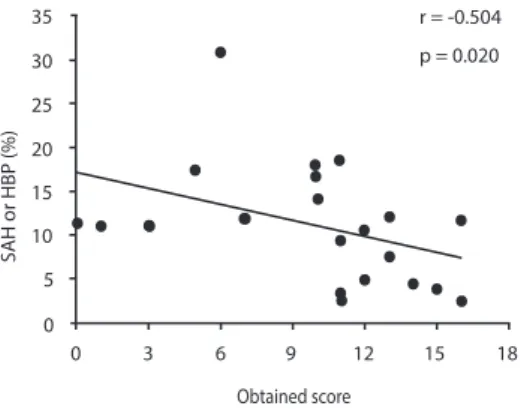
he scores of the studies ranged from 0 to 16 points. By dividing the articles in tertiles, with regard to scores, the prevalence found in the irst tertile (from 0 to 6 points) ranged from 11.110 to 30.9%8, while in the last tertile
(12 to 18 points), prevalence ranged from 2.57
and 12.3%27. Figure 2 represents the relation
between the aforementioned scores and the prevalence found in the articles used in this study. A signiicant negative correlation was observed (r = -0.504; p = 0.020) between the prevalence of HBP/SAH and the score of BP measurement quality.
Discussion
With this review, it was possible to iden-tify that prevalence studies of HBP in ado-lescents were mostly conducted in the Southeast, Northeast and South regions of the country. Only two studies were con-ducted in the Center-West region, and none was identified in the North region. Results showed that the prevalence of HBP ranged between regions. For instance, the highest prevalence of HBP identified in the Center-West region was of 11.7%, while in the Southeast and Northeast regions they were of approximately 17%, and in the South region, 30.9%. Likewise, there were differ-ences concerning the lowest prevalence identified in the regions. These results suggest that the prevalence of HBP can be influenced by the region where the teenager
lives, therefore it is important that further studies try to identify the causes of such inter-regional variability.
The mean values of HBP identified in Brazil are close to those reported in interna-tional studies. In a study conducted in China, prevalence was of approximately 20%31. A study
with adolescents in Mexico also observed prevalence of HBP in adolescents, of 20.6%32.
Kollias et al.33 studied adolescents aged 12 to
17 years old in Greece and found that 22.9% of these teenagers had HBP. However, it is worth to mention that, similarly to national studies, the comparison with international studies is also diicult due to the diferent employed methodological procedures.
The results in this study indicated that the age group of the samples in the stud-ies ranged from 6 to 20 years old. Since the prevalence of HBP tends to increase with age34, the number of individuals at
differ-ent age groups is a factor that contributes with the different prevalence described by the studies34. Out of the analyzed studies,
28.6%14,18,19,23,25,26 demonstrated prevalence
stratified by age group, and most of them showed that the percentage distribution
Figure 2 - Relationship between the preva-lence of high blood pressure in Brazilian adolescents from 1995 to 2010 and the scores obtained in relation to the used methodolo-gical processes (r = -0.504; p = 0.020).
Figura 2 - Relação entre as prevalências de pressão arterial elevada em adolescentes brasi-leiros no período de 1995 a 2010 e os escores obtidos em relação aos processos metodológicos utilizados (r = -0,504; p = 0,020).
SAH: Hypertension; HBP: High blood pressure.
of HBP as to age group increased with age14,19,23,25,26. However, in the study by
Monego et al.18, which included children
and adolescents (7 to 14 years old), such a relationship was not shown, once much of the HBP prevalence was concentrated in the age group of children (7 to 10 years old).
A study conducted by Gomes et al.23, who
worked only with the teenage population (14 to 20 years old), showed the increasing percentile with age, and found values of 14.9% in the age group of 14 to 15 years old, to 18.8% in the age group of 18 to 20 years old. Such relationship, which is similar to the one found by Romanzini et al.26, who also
worked with teenagers, is possibly caused by hormone changes and alterations in the body composition observed in this stage of life.
Most studies opted for the school-based sur-veys. This methodology has been adopted since it provides easy access to this popula-tion. he results of the study indicated that in school-based surveys, the prevalence ranged from 2.5 to 30.9%; as to household surveys, prevalence ranged from 12.3 to 17.9%, indicating more homogeneous data in household stud-ies. The wider variability in school-based studies can be caused by the inluence of fac-tors related to school on the students. In fact, factors that are known to have an impact on blood pressure levels, such as climate, access to food and spaces available for the practice of physical activities in the school inluence all of the students. Since the studies on this subject include diferent schools, such inluence ends up leading to variable results. On the other hand, in household surveys, the inluence of school is minimized, since there are students from more schools.
With this review, it was possible to identify that the criteria used to determine the high levels of blood pressure were diferent between studies. In fact, while some studies used the percentile higher than 90 as a cutof point to deine HBP8,17,24,26,28,29, others used the
percen-tile for people aged more than 18 years old15,19,
as opposed to the recommendations of the VI Brazilian Guidelines of Hypertension, which indicates that the pressure of an individual
aged from 1 to 17 years old is considered to be normal if percentile values are under 90, and also lower than 120/80 mmHg; between the 90 and 95 percentiles, it can be consid-ered as borderline or pre-hypertension; if it is equal to or higher than 95, it can be con-sidered as hypertension35, according to the
protocol used in 66.7% of the studies in this research7,11,14-16,18-23,25,27,29.
According to the VI Brazilian Guidelines
of Hypertension4, in order to diagnose SAH
several procedures must be conducted. he results in this study indicated a signiicantly negative correlation between the score of BP measurement quality and the prevalence of HBP or SAH. hese results suggest that the preva-lence of HBP or SAH observed in the studies may have been overestimated because of the non-realization of the recommended proce-dures to measure BP.
Among the factors that apparently have more influence on BP data, the number of measurements seems to be very important. In fact, while studies that used three mea-surements presented their highest preva-lence as 14.2%13, those that used two or less
measurements identified prevalence of up to 30.9%8. One of the studies in this review36
observed prevalence of HBP of 8.7% in the first measurement and 2.3% in the third BP measurement. Another variable that has major influence on the estimates of HBP is the number of days in which the
measure-ment was taken. Rezende et al.7 obtained
prevalence of 16.6; 4.6; and 2;5%for BP measurements on the first, second and third days, respectively. Therefore, it is important to be careful when analyzing studies that took only one measurement on the same day, or several measure-ments on one day, since these two factors are directly related to the overestimation of HBP or SAH prevalence.
References
1. Yusuf S, Reddy S, Ôunpuu S, Anand S. Global burden of cardiovascular diseases. Circulation 2001; 104(23): 2855-64.
2. Sociedade Brasileira de Cardiologia. IV Diretrizes Brasileiras de Hipertensão Arterial. Arq Bras Cardiol 2004; 82(Suppl IV): 1-14.
3. Shear CL, Burke GL, Freedman DS, Berenson GS. Value of childhood blood pressure measurements and family history in predicting future blood pressure status: results from 8 years of follow-up in the Bogalusa Heart Study. Pediatrics 1986; 77(6): 862-9.
4. Sociedade Brasileira de Cardiologia, Sociedade Brasileira de Hipertensão, Sociedade Brasileira de Nefrologia. VI Diretrizes Brasileiras de Hipertensão Arterial. Arq Bras Cardiol 2010. p. 1-51.
5. Horan MJ. Report of the second Task Force on Blood Pressure Control in Children―1987. Task Force on Blood Pressure Control in Children. National Heart, Lung, and Blood Institute, Bethesda, Maryland. Pediatrics 1987; 79(1): 1-25.
6. Sinaiko AR. Hypertension in children. N Engl J Med 1996; 335(26): 1968-73.
7. Rezende DF, Scarpelli RAB, Souza GF, Costa JO, Scarpelli AM, Scarpelli PA, et al. Prevalence of systemic hypertension in students aged 7 to 14 years in the municipality of Barbacena, in the State of Minas Gerais, in 1999. Arq Bras Cardiol 2003; 81(4): 381-6.
8. Sakamoto FY, Marcon SS, Oliveira AAB, Nardo Junior N. Relação da hipertensão, sobrepeso e aptidão física em estudantes do ensino médio, Maringá-PR. Ciên Cuid Saúde 2007; 6(3): 285-90.
9. World Health Organization. Young People´s Health – a Challenge for Society. Report of a WHO Study Group on Young People and Health for All. Technical Report Series 731. Geneva: WHO. 1986.
10. Cimadon HMS, Geremia R, Pellanda LC. Hábitos alimentares e fatores de risco para aterosclerose em estudantes de Bento Gonçalves (RS). Arq Bras Cardiol 2010; 95(2): 166-72.
11. Freitas RW, Silva AR, Araújo MF, Marinho NB, Damasceno MM, Oliveira MR. Prática de atividade física por adolescentes de Fortaleza, CE, Brasil. Rev Bras Enferm 2010; 63(3): 410-5.
12. Pickering TG, Hall JE, Appel LJ, Falkaner BE, Graves J, Hill MN, et al. Recommendations for blood pressure measurement in humans and experimental animals: part 1: blood pressure measurement in humans: a statement for professionals from the Subcommittee of Professional and Public Education of the American Heart Association Council on High Blood Pressure Research. Circulation 2005; 111(5): 697-716.
13. Almeida FA, Yoshizumi AM, Mota AC, Fernandes, APM, Gushi AC, Nakamoto AYK, et al. Distribuição dos valores pressóricos e prevalência de hipertensão arterial em jovens de escolas do ensino médio em Sorocaba, SP. J Bras Nefrol 2003; 25(4): 179-86.
14. Cândido A, Benedetto R, Castro AP, Carmo JS, Nicolato RL, Nascimento-Neto RM, et al. Cardiovascular risk factors in children and adolescents living in an urban area of Southeast of Brazil: Ouro Preto Study. Eur J Pediatr 2009; 168(11): 1373-82.
15. Costa RS, Sichieri R. Relação entre sobrepeso, adiposidade e distribuição de gordura com a pressão arterial de adolescentes no município do Rio de Janeiro. Rev Bras Epidemiol 1998; 1(3): 268-279.
16. Griz LHM, Viégas M, Barros M, Griz AL, Freese E, Bandeira F. Prevalence of central obesity in a large sample of adolescents from public schools in Recife, Brazil. Arq Bras Endocrinol Metabol 2010; 54(7): 607-11.
One limitation of this study was the use of a score to classify the quality of the stud-ies, and such a score was not previously vali-dated. Even though the items used to create the score were established according to the protocols to measure BP recommended in literature, it is possible that, despite being logical, the weights given to each item may have presented bias.
Conclusion
Based on this review, it was observed that the great variation related to the preva-lence of HBP can be at least partly attrib-uted to the quality of the procedures used to measure BP.
17. Mendes MJFL, Alves JGB, Alves AV, Siqueira PP, Freire EFC. Associação de fatores de risco para doenças cardiovasculares em adolescentes e seus pais. Rev Bras Saude Mater Infant 2006; 6(Suppl.1): s49-s54.
18. Monego ET, Jardim PCBV. Determinantes de risco para doenças cardiovasculares em escolares. Arq Bras Cardiol 2006; 87(1): 37-45.
19. Oliveira RG, Lamounier JA, Oliveira AD, Castro MD, Oliveira JS. Pressão arterial em escolares e adolescentes: O estudo de Belo Horizonte. J Pediatr (Rio J) 1999; 75(4): 256-66.
20. Rodrigues AN, Perez AJ, Pires JG, Carletti L, Araújo MT, Moyses MR. Fatores de risco cardiovasculares, suas associações e presença de síndrome metabólica em adolescentes. J Pediatr (Rio J) 2009; 85(1): 55-60.
21. Rosa ML, Mesquita ET, da Rocha ER, Fonseca V de M. Índice de massa corporal e circunferência da cintura como marcadores de hipertensão arterial em adolescentes. Arq Bras Cardiol 2007; 88(5): 573-8.
22. Silva MA, Rivera IR, Ferraz MR, Pinheiro AJ, Alves SW, Moura AA, et al. Prevalência de Fatores de risco cardiovascular em crianças e adolescentes da rede de ensino da cidade de Maceió. Arq Bras Cardiol 2005; 84(5): 387-92.
23. Gomes Bda M, Alves JG. Prevalência de hipertensão arterial e fatores associados em estudantes de Ensino Médio de escolas públicas da Região Metropolitana do Recife, Pernambuco, Brasil, 2006. Cad Saude Publica 2009; 25(2): 375-81.
24. Leite N, Moser DC, Góes SM, Cieslak F, Milano GE, Stefanello JMF. Medidas hipertensivas e excesso de peso em escolares da rede pública de Curitiba-PR. Fisioter Mov 2009; 22(4): 477-87.
25. Moura AA, Silva MAM, Ferraz MRMT, Rivera IR. Prevalência de pressão arterial elevada em escolares e adolescentes de Maceió. J Pediatr (Rio J) 2004; 80(1): 35-40.
26. Romanzini M, Reichert FF, Lopes Ada S, Petroski EL, de farias Júnior JC. Prevalência de fatores de risco cardiovascular em adolescentes. Cad Saude Publica 2008; 24(11): 2573-81.
27. da Silva AC, Rosa AA. Blood pressure and obesity of children and adolescents association with body mass index and waist circumference. Arch Latinoam Nutr 2006; 56(3): 244-50.
28. Vieira MA, Carmona DPD, Anjos LA, Souza T, Espinosa MM, Ribeiro RLR. Pressão arterial de crianças e adolescentes de escolas públicas de Cuiabá, Mato Grosso. Acta Paul Enferm 2009; 22(1): 473-5.
29. Ribeiro RQ, Lotufo PA, Lamounier JA, Oliveira RG, Soares JF, Botter DA. Fatores adicionais de risco cardiovascular associados ao excesso de peso em crianças e adolescentes: o estudo do coração de Belo Horizonte. Arq Bras Cardiol 2006; 86(6): 408-18.
30. Rosa MLG, Fonseca VM, Oigman G, Mesquita ET. Pré-hipertensão arterial e pressão de pulso aumentada em adolescentes: prevalência e fatores associados. Arq Bras Cardiol 2006; 87(1): 46-53.
31. Zhang YX, Zhao JS, Sun GZ, Lin M, Chu ZH. Prevalent trends in relatively high blood pressure among children and adolescents in Shandong, China. Ann Hum Biol 2012; 39(3): 259-63.
32. Urrutia-Rojas X, Egbuchunam CU, Bae S, Menchaca J, Bayona M, Rivers PA, et al. High blood pressure in school children: prevalence and risk factors. BMC Pediatr 2006; 6: 32.
33. Kollias A, Antonodimitrakis P, Grammatikos E,
Chatziantonakis N, Grammatikos EE, Stergiou GS. Trends in high blood pressure prevalence in Greek adolescents. J Hum Hypertens 2009; 23(6): 385-90.
34. Christofaro DGD, Andrade SM, Fernandes RA, Cabrera MAS, Dias RMR. Prevalência de pressão arterial elevada em crianças e adolescentes: revisão sistemática. Rev Bras Saude Matern Infant 2011; 11(4): 361-7.
35. Sociedade Brasileira de Cardiologia, Sociedade Brasileira de Hipertensão, Sociedade Brasileira de Nefrologia. V Diretrizes Brasileiras
de Hipertensão Arterial. Arq Bras Cardiol 2006; 1-48.
36. Borges LM, Peres MA, Horta BL. Prevalência de níveis pressóricos elevados em escolares de Cuiabá, Mato Grosso. Rev Saude Publica 2007; 41(4): 530-8.