Arq Bras Cardiol 2001; 76: 301-4.
Faerstein et al Reliability of history of diagnosis and treatment of hypertension
301 301
Instituto de Medicina Social – UERJ
Mailing address: Eduardo Faerstein – Rua Sacopã, 191/201 – 22471-180 – Rio de Janeiro, RJ, Brazil
English version by Stela Maris C. Gandour
Objective - To assess the intraobserver reliability of the information about the history of diagnosis and treatment of hypertension.
Methods - A multidimensional health questionnaire, which was filled out by the interviewees, was applied twice with an interval of 2 weeks, in July ’99, to 192 employees of the University of the State of Rio de Janeiro (UERJ), stratified by sex, age, and educational level. The intraobserver reliabi-lity of the answers provided was estimated by the kappa sta-tistic and by the coefficient of intraclass correlation (CICC).
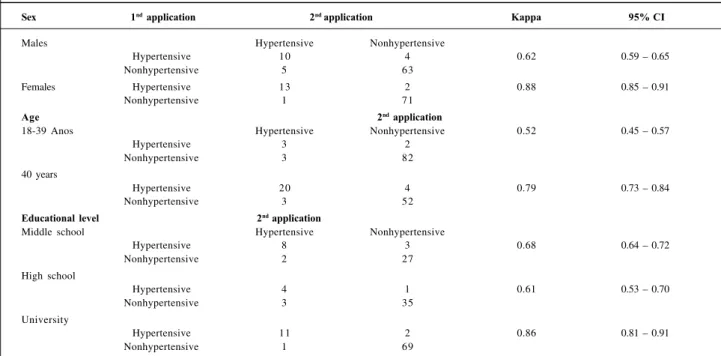
Results - The general kappa (k) statistic was 0.75 (95% CI=0.73-0.77). Reliability was higher among fema-les (k=0.88, 95% CI=0.85-0.91) than among mafema-les (k=0.62, 95% CI=0.59-0.65).The reliability was higher among individuals 40 years of age or older (k=0.79; 95% CI=0.73-0.84) than those from 18 to 39 years (k=0.52; 95% CI=0.45-0.57). Finally, the kappa statistic was hi-gher among individuals with a university educational le-vel (k=0.86; 95% CI=0.81-0.91) than among those with high school educational level (k=0.61; 95% CI=0.53-0.70) or those with middle school educational level (k=0.68; 95% CI=0.64-0.72). The coefficient of intraclass correlation estimated by the intraobserver agreement in regard to age at the time of the diagnosis of hypertension was 0.74. A perfect agreement between the 2 answers (k=1.00) was observed for 22 interviewees who reported prior prescription of antihypertensive medication.
Conclusion - In the population studied, estimates of the reliability of the history of medical diagnosis of hyper-tension and its treatment ranged from substantial to almost perfect reliability.
Key words: hypertension, reliability of results, questionnaires
Arq Bras Cardiol, volume 76 (nº 4), 301-4, 2001
Eduardo Faerstein, Dóra Chor, Claudia de S. Lopes
Rio de Janeiro, RJ - Brazil
Reliability of the Information About the History of Diagnosis and
Treatment of Hypertension. Differences in Regard to Sex, Age,
and Educational Level. The Pró-Saúde Study
Original Article
Estimates of prevalence of hypertension in some Brazi-lian regions ranged from 11% to 25% of the adult population in the ‘90s 1-4, because of an increase in the frequency of some of its risk factors, such as dietary issues 5, overweight 6, and stress of a psychosocial nature 7,8. Therefore, epidemio-logical studies on hypertension have gained an increasing relevance in our country.
Direct measurement of blood pressure is not always feasible in multidimensional studies. In such cases, infor-mation provided by the interviewee in regard to the diag-nosis of hypertension, as an approximation to the preva-lence of the disease, is usually used because, in this way, the frequency of clinical diagnosis is actually measured, in addition to its understanding and acceptance by the inter-viewee 9-12.
Assessment of the quality of the information obtained in medical-epidemiological surveys is always important either by direct measurements, or questionnaires, or any other method. Criteria such as validity and reliability are used for this assessment. Validity of a measurement is the degree to which a measurement appropriately measures what it is intended to measure, ie, how the measurements compare with the established gold standard. Reliability, on the other hand, involves stability and equivalence of repeti-tive measurements of the same concept or phenomenon; therefore, reliable estimates, in most situations, relate to the extension with which a measurement provides consistent results, when replicated at another time in the same partici-pants (intraobserver reliability), or when performed by diffe-rent observers (interobserver reliability) 13,14.
302 302
Faerstein et al
Reliability of history of diagnosis and treatment of hypertension
Arq Bras Cardiol 2001; 76: 301-4.
of the kappa statistic may be classified as a substantial relia-bility (0.60-0.79) or an almost perfect reliarelia-bility (0.80-1.00).
In our study, we report the results of the intraobserver reliability of the history of medical diagnosis of hyperten-sion and its treatment. To the extent it was possible to iden-tify, it is the first attempt in our country to investigate the quality of the information reported regarding the history of hypertension.
Methods
We carried out a study on reliability through the appli-cation of the same questionnaire twice in a time interval of 2 weeks, according to criteria established in the literature 13,14. This study relates to a cohort analysis that aims to study so-cial determinants of physical and mental morbidity, and also health practices and care, in 4,030 effective technical and administrative employees of a public university in the state of Rio de Janeiro.
Intraobserver reliability was analyzed in a pilot study carried out in 192 technical and administrative employees hired in the same university. Selection of the participants aimed to allow reliable estimates, according to age, sex, and educational level, with a reasonable statistical accuracy. Ai-ming at this, subsamples of similar sizes were randomly selec-ted in strata resulting from the crossing of these variables in the universe of approximately 1,000 eligible individuals.
Information was obtained through structured question-naires that were filled out by the interviewees, who were di-vided into groups proctored by trained personnel, during a period of 30 to 40 minutes, after written consent was given by the participants. The interviewers did not know the respon-ses provided by the interviewees in the 2 questionnaires.
The multidimensional questionnaire comprised, among other issues, the following: the history and present situation of social and economical conditions, and other aspects of the social life, such as experience with violence, social and racial discrimination, integration to social webs of support, and events of life that cause stress; dietary pat-terns, physical activity, tobacco (active and passive) and alcohol use; history of medical diagnoses and treatments; mental health; use of medication and of unconventional therapies; practice of prevention and early diagnosis; other behaviors and exposures with repercussions to health.
Questions regarding the history of diagnosis of hyper-tension are highly standardized questions, which have been used for several years in epidemiological surveys in diverse countries. The first question is: “Have you ever been told by any physician or health professional that you have hyper-tension, ie, high blood pressure?”, which has the following options for answers: 1) “Yes, I have been told only once.”; 2) “Yes, I have been told more than once, on different days.”; 3) “Yes, I have been told, but only during pregnancy.”; and 4) “No.”. In regard to the analyses presented in this study, the interviewees who answered options 1 or 2 were considered hypertensive; those choosing options 3 or 4 were not consi-dered hypertensive. The hypertensive individuals were then
asked, with the possibility of an open response, the following question: “At which age were you told, for the first time, that you had a high blood pressure?”, and subsequently: “Have you already been prescribed a medicine to control high blood pressure?” (“Yes” or “No”).
The questionnaires were manually graded by support research personnel and underwent double typing indepen-dently. The Epi-Info software was used for elaborating the data input screen, with automatic checking of invalid data; the remaining stages of the procedure and data analysis were performed with SPSS version 9.0 software.
Assessment of intraobserver reliability in the entire population studied and also in the same population stratified by sex, age, and educational level was performed through the kappa statistic and its 95% confidence intervals [95% CI (k)]. In this case, kappa values quantify the level of agree-ment between the responses given to the same questions by the interviewees on the 2 occasions, already corrected in regard to the level of agreement randomly expected. Briefly, it is the proportion of observed agreement not randomly at-tributable [proportion observed (Po) – randomly expected proportion (Pr)] in regard to the possible maximum agree-ment not randomly attributable [1.0 - randomly expected pro-portion (Pr)], ie, k= (Po – Pr)/(1 – Pr) 14. For interpreting pur-poses, we used the reliability range suggested by Landis and Koch 15, which was based on estimated values for kap-pa, as follows: almost perfect reliability (0.80 – 1.00), subs-tantial reliability (0.60 – 0.79), moderate reliability (0.41 – 0.60), reasonable reliability (0.21 – 0.40), poor reliability (0 – 0.19), and very poor reliability (<0).
In regard to age at the time of the diagnosis of hyper-tension, which was treated as a continuous variable, we cal-culated the coefficient of intraclass correlation, which esti-mates the proportion of the total variability observed attri-butable to the variability between individuals. When used as an index of agreement between 2 measurements, age is a kappa statistic, whose values range from –1 to +1 16.
Results
Out of the 192 employees participating in the pilot stu-dy, 169 (88%) answered the question used for classifying hypertension in both questionnaires (intraobserver), com-prising, therefore, the population of our study. In regard to sex, age, and educational level, the individuals who did not answer this question were similar to those who did. The proportion of males studied (52%) was similar to that of fe-males studied, and the mean age was 39 years.
Arq Bras Cardiol 2001; 76: 301-4.
Faerstein et al Reliability of history of diagnosis and treatment of hypertension
303 303
The reliability of the classification of hypertension varied in different social and demographic subgroups of the population (Table II). In regard to sex, the kappa statistic was estimated as 0.62 for males and 0.88 for females. The emplo-yee’s age also influenced agreement, which was higher among employees who were 40 years of age or older (k=0.79) then among those under 40 years of age (k=0.52). Likewise, agreement on the information among the employees with a university educational level was higher than that in the cate-gories with middle school educational level and high school educational level (k=0.86 vs k=0.68 and k=0.61, respectively). Information about the history of medical prescription of antihypertensive drugs was provided by 22 (76%) emplo-yees out of the 29 classified as hypertensive in the popula-tion studied, both in the first and second applicapopula-tions of the questionnaire. The reliability of the answer to this item was maximum (k=1.00), ie, a perfect agreement between the ans-wers provided on both occasions. Of these 22 employees, 17 reported using antihypertensive drugs, and 5 reported not using any antihypertensive medication.
Finally, 22 individuals reported the age they were told for the first time they had hypertension. The coefficient of
intraclass correlation, which measures the agreement between answers provided in the 2 questionnaires, was es-timated in 0.74. However, only 1 employee gave very diver-gent answers in the 2 applications of the questionnaire (49 and 12 years of age, respectively). In the analysis of sensiti-vity of the coefficient of intraclass correlation, we observed that, by excluding this employee from the calculation, the coefficient of intraclass correlation was estimated in 0.98.
Discussion
Whenever possible, reliability or reproducibility of measurements or diagnoses should be formally assessed in medical and epidemiological surveys. Usually, validity of the measurements is considered a property inherent in the diagnostic method (questionnaire, examination, or any other measurement tool). Reliability, however, in a certain study is influenced by characteristics of the person who answers, by the quality of the training of the observers, and by other more specific processes 13,14.
In our study, intraobserver reliability of the informa-tion about the diagnosis of hypertension varied from subs-tantial to almost perfect in different population subgroups, except for the younger employees (under 40 years of age), among whom the agreement was only moderate. This result may be partially explained by the low prevalence of hyper-tension in young individuals, and the kappa statistic ten-ded to present lower values 15.
Most of the international information comparable to ours originates from North American studies carried out according to the Behavioral Risk Factor Surveillance System, which monitores trends of prevalence of several
Table I – Agreement of the history reported about diagnosis of hypertension in 2 applications (intraobserver) of a questionnaire.
Pró-Saúde study, 1999.
2nd application Kappa 95% CI 1st application Hypertensive Nonhypertensive Total
Hypertensive 23 6 29 0.75 0.73 – 0.77
Nonhypertensive 6 134 140
Total 29 140 169
Table II - Agreement of the history reported about diagnosis of hypertension in 2 applications (intraobserver) of a questionnaire, according to sex, age, and educational level. Pró-Saúde study, 1999.
Sex 1nd application 2nd application Kappa 95% CI
Males Hypertensive Nonhypertensive
Hypertensive 10 4 0.62 0.59 – 0.65
Nonhypertensive 5 63
Females Hypertensive 13 2 0.88 0.85 – 0.91
Nonhypertensive 1 71
Age 2nd application
18-39 Anos Hypertensive Nonhypertensive 0.52 0.45 – 0.57
Hypertensive 3 2
Nonhypertensive 3 82
40 years
Hypertensive 20 4 0.79 0.73 – 0.84
Nonhypertensive 3 52
Educational level 2nd application
Middle school Hypertensive Nonhypertensive
Hypertensive 8 3 0.68 0.64 – 0.72
Nonhypertensive 2 27
High school
Hypertensive 4 1 0.61 0.53 – 0.70
Nonhypertensive 3 35
University
Hypertensive 11 2 0.86 0.81 – 0.91
304 304
Faerstein et al
Reliability of history of diagnosis and treatment of hypertension
Arq Bras Cardiol 2001; 76: 301-4.
risk factors, habits, and health behaviors through telephone interviews with population samples in each state of that co-untry. Reports of studies of intraobserver reliability identi-fied in the literature in regard to hypertension, are limited to assessing the answers to the basic question: “Have you ever been told by any physician or health professional that you have hypertension, ie, high blood pressure?”. Estima-tes of the kappa statistic for this information in 3 staEstima-tes of
the United States were 0.79 in New York 9, 0.86 in Missouri 10,
and 0.74 in Massachussets 11, which are very similar to 0.75, found in the population we studied. Stein et al 11 reported specific estimates in demographic strata, as in our study. In contrast to our study, however, they observed a higher re-liability among older individuals answering the questions, but they detected no differences in regard to sex or to edu-cational level.
It is worth noting the excellent reliability of the informa-tion about the age of the diagnosis of hypertension and about the prescription of antihypertensive drugs among the individuals providing these data. However, out of the 29 participants reporting a history of hypertension, 7 (24%) in-dividuals did not answer those questions; we may suppose that if these individuals had answered the questions, the
es-1. Rego RA, Berardo FAN, Rodrigues SR, et al. Fatores de risco para doenças crônicas não transmissíveis: inquérito domiciliar no município de São Paulo, SP (Brasil). Metodologia e resultados preliminares. Rev Saúde Publ SP 1990; 24: 277-85.
2. Lolio CA, Latorre MRDO. Prevalência de obesidade em localidades do Estado de São Paulo, Brasil, 1987. Rev Saúde Publ SP 1991; 25: 33-6.
3. Duncan BB, Schmidt, MI, Polanczyc CA, Homrich CS, Rosa RS, Achutti AC. Fatores de risco para doenças não transmissíveis em área metropolitana da região Sul do Brasil. Prevalência e simultaneidade. Rev Saúde Publ SP 1993; 27: 43-8. 4. Klein CH. Hipertensão arterial nos estratos geo-econômicos do Rio Grande do Sul. Rio de Janeiro, 1984. Tese de Mestrado - Escola Nacional de Saúde Pública/ FIOCRUZ.
5. Mondini L, Monteiro CA. Mudanças no padrão de alimentação da população urbana brasileira (1962-1988). Rev Saúde Publ SP 1994; 28: 433-9. 6. Coitinho DC, Leão MM, Recine E, Sichieri R. Condições nutricionais da
população brasileira: adultos e idosos. Pesquisa Nacional de Saúde e Nutrição, Ministério da Saúde, Brasília, 1991.
7. INCLEN Multicentre Collaborative Group. Socio-economic status and risk factors for cardiovascular disease: a multicentre collaborative study in the international clinical epidemiology network (INCLEN). J Clin Epidemiol 1994; 47: 1401-9.
References
8. Marmot, MG, Rose G, Hamilton PJ. Employment grade and coronary heart disease in British civil servants. J Epidemiol Comm Health. 1978; 32: 244-9. 9. Bowlin SJ, Morrill BD, Nafziger AN, Jenkins PL, Lewis C. Pearson TA. Validity
of cardiovascular disease risk factors assessed by telephone survey: the Behavioral Risk Factor Survey. J Clin Epidemiol 1993; 46: 561-71. 10. Brownson RC, Jackson-Thompson J, Wilkerson JC, Kiani F. Reliability of
information on chronic disease risk factors collected in the Missouri Behavioral Risk Factor Surveillance System. Epidemiology 1994; 5: 545-9.
11. Stein AD, Courval JM, Lederman RI, et al. Reproducibility of responses to telephone interview: demographic predictors of discordance in risk factor status. Am J Epidemiol 1995; 141: 1097-106.
12. Chor D. Hipertensão Arterial entre Funcionários de Banco Estatal no Rio de Janeiro: hábitos de vida e tratamento. Arq Bras Cardiol 1998; 71: 653-60. 13. Carmines EG, Zeller RA. Reliability and validity assessment. California, Sage
Publications, 1979.
14. Szklo M, Nieto FJ. Epidemiology – Beyond the Basics. Gaithersburg, MD: Aspen Pub, Inc.
15. Landis JR, Koch GG. The measurement of observer agreement for categorical data. Biometrics 1977; 33: 159-74.
16. Shrout PE, Fleiss JL. Intraclass correlations: uses in assessing raters reliability. Psychol Bull 1979; 86: 420-8.
timates of reliability would have been more conservative. We have found no data in the literature in regard to the relia-bility of this information in other populations.