
* Corresponding author. Tel: +98 21 77 50 88 9
E-mail addresses: [email protected] (H. Javanshir) © 2012 Growing Science Ltd. All rights reserved. doi: 10.5267/j.msl.2011.09.008
Contents lists available atGrowingScience
Management Science Letters
homepage: www.GrowingScience.com/msl
Investigating transportation system in container terminals and developing a yard crane scheduling model
Hassan Javanshira*, Seyed Mohammad Taghi Fatemi Ghomib, and Marjan Fatemi Ghomia
a
Department of Industrial Engineering, Islamic Azad University, South Tehran Branch, Tehran, Iran b
Department of Industrial Engineering, Amirkabir University of Technology, 424 Hafez Avenue,, Tehran, Iran
A R T I C L E I N F O A B S T R A C T
Article history: Received July 17, 2011 Received in Revised form September, 14, 2011 Accepted 14 September 2011 Available online
15 September 2011
The world trade has tremendous growth in marine transportation. This paper studies yard crane scheduling problem between different blocks in container terminal. Its purpose is to minimize total travel time of cranes between blocks and total delayed workload in blocks at different periods. In this way the problem is formulated as a mixed integer programming (MIP) model. The block pairs between which yard cranes will be transferred, during the various periods, is determined by this model. Afterwards the model is coded in LINGO software, which benefits from branch and bound algorithm to solve. Computational results determine the yard cranes movement sequence among blocks to achieve minimum total travel time for cranes and minimum total delayed workload in blocks at different planning periods. Also the results show capability and adequacy of the developed model.
© 2012 Growing Science Ltd. All rights reserved. Keywords:
Container Container terminal Container transportation Yard crane scheduling
1. Introduction
loading operation, export containers are loaded onto trucks by yard cranes and then containers are off-loaded at the yard and finally quay cranes load them to vessels (Ng, Mak, 2005).
Usually rail mounted gantry crane, rubber tyred gantry crane, straddle carrier and forklift are used for moving containers in yard blocks at container terminals. Therefore there are two types of yard cranes as follows: rail mounted gantry crane and rubber tyred gantry crane. A rail mounted gantry crane moves along a rail in a block whereas rubber tyred gantry crane moves on rubber wheel and this kind of yard crane can move among blocks. As shown in Fig. 2, a block has 6 lanes or rows that one of them is for trucks and the rests are for storing containers. Usually each lane has five containers in height called tiers. In addition, there are 20 or more containers in length in every lane. A vertical section of a block (for example, 5 tiers×6 lanes) is usually indicated as a bay (Legato et al., 2009).
Fig.2. Real and schematic illustration of a block and yard crane in a container terminal
In details, the diverse operational services of yard cranes are presented as follows (He et al., 2010):
1. Lifting inbound containers from the internal trucks and storing them at storage blocks;
2. Lifting outbound containers from the external trucks and storing them at storage blocks;
3. Retrieving inbound containers from yard and putting them to external trucks for customers;
4. Retrieving outbound containers from yard and putting them to internal trucks for exit;
5. Rearranging containers in yard.
Yard cranes are most desirable equipments for loading and unloading containers in container terminals. However, these equipments move slowly, which increase waiting time for trucks. As a
result, quay cranes become idle and their efficiency are reduced by this sort of delay.Hence logical
yard cranes scheduling plays important role in improving container terminals efficiency and decreasing operational cost (Seyedalizadeh Ganji, 2009, 2010).
H. Javanshir et al. / Management Science Letters 2 (2012)
173
Resource allocation and facilities scheduling are fundamental problems in both loading and unloading operations. When a handling job is started by quay cranes, subsequently, trucks and yard cranes are employed to finish this movement. In addition, yard cranes reshuffle and retrieve containers among the blocks (Amin & Golchubian, 2009).
Many researchers are interested in yard cranes scheduling. In this respect, Kim and Kim (1999) minimized the sum of the set up time and the travel time of cranes in a container storage block by modeling the process as a mixed integer program (MIP). In the same case, Kim and Kim (2003) also employed heuristic algorithms. Zhang et al. (2002) employed a mixed integer programming (MIP) model to find the times and routes of crane movements among blocks so that the total delayed workload in the yard is minimized. Then they solved the problem by Lagrangean relaxation. Linn et al. (2003) proposed a mixed integer programming (MIP) model to find the minimum total delay workload in blocks. Kim et al. (2003) suggested a dynamic programming model for determining the sequence of yard crane jobs. They suggested several heuristic rules to solve the model and finally a simulation study is performed to compare the performances of the suggested approaches.
Ng and Mak (2005) studied the yard crane scheduling problem with the aim of minimizing sum of jobs waiting times. They modeled the problem as an integer programming and proposed a branch and bound algorithm to solve the scheduling problem optimally. Ng (2005) investigated yard crane scheduling among adjacent blocks. He formulated the scheduling problem as an integer programming with the aim of minimizing the total completion time of jobs. Then the model was solved by a dynamic programming-based heuristic method. Jung and Kim (2006) proposed a model for loading operation scheduling that considered several yard cranes in a block.
Chen et al. (2007) investigated a problem with two yard cranes to minimize total loading time in stacks. Then they solved the problem by Tabu search method. Lee et al. (2007) discussed the scheduling problem of two-transtainer systems, which serve the loading operations of one quay crane at two different container blocks. The goal is to minimize the total loading time at stack area. A mathematical model was set to formulate the problem and a simulated annealing (SA) algorithm was developed to solve the proposed model.
Legato et al. (2009) suggested an integer programming to deal with yard crane scheduling problem between several blocks. Their purpose was to determine the block pairs between which yard cranes will be transferred during the periods in order to satisfy the crane capacity requirements and minimize the total cost for block matching and crane activation. In addition, Lee and Kim (2009) compared and evaluated various cycle-time models for yard cranes in container terminals. They calculated trucks waiting time under various sequence rules and they introduced calculation formula to determine yard cranes cycle time in every sequence rule. Huang et al. (2009) comprehensively studied various issues in the route planning for container loading and unloading in the automated container terminal. They used a multi objective mathematical model considering the factors including length, smooth degree and safety distance to determine the yard cranes optimum rout. To solve the model, an optimum route method was developed based on genetic algorithm.
Legato's model (2009). In the rest of the paper, a detailed problem description and mathematical model are given in Section 2. A numerical study is presented in Section 3. In this section, the proposed model is tested by Lingo software. Section 4 concludes the paper and recommends some suggestion for future studies.
2. Yard crane scheduling model
2.1. Problem description
A large-scale stacking yard may be divided in to a number of large parts called zones. Every zone includes several rectangular shapes named blocks. Containers are stored in these blocks temporarily side by side and one on top of the other until they are picked up by trucks or loaded onto vessels. In each zone, stacking and shuffling the containers are carried out by yard cranes. In the other words within a zone, a yard crane can move freely to carry out all movement operations generated by different vessels. The physical handling rate of a yard crane is usually about half of a quay crane. The container flow in a container terminal is bottlenecked because of the slow yard crane movement. Hence, a good yard crane scheduling can augment a terminal efficiency rate by increasing the container flow to and from vessels as a result of reducing the truck waiting time.
Decision making about how many yard cranes can work in a block and which of them is allocated to that block depends on the predicted daily workload and total required capacity. Our modeling efforts are referred to overcome the workload imbalance among the blocks while a yard crane needs to move from one to another block for the complete utilization. These movements can occur between both adjacent and non-adjacent blocks. In this case, allocation and movement of yard cranes between blocks are called yard crane scheduling. As shown in Fig. 3, if two blocks, e.g. blocks 11 and 22, are not adjacent, a yard crane needs to turn around for moving. Therefore, this sort of movement takes longer time than the straight movement that occurs among adjacent blocks, e.g. blocks 11 and 12.
Yard cranes occupy truly big road space during long operation time because of their slow movement and bulky body. In the other words, these characteristics generate some sort of obstruction among blocks and delay for other terminal operations. In addition, inefficient block-to-block movements will cause losses of crane productivity. Up to now, yard crane scheduling has been generally planned by port supervisors based on their experience. They send idle yard cranes to other blocks to release the workload when congestion occurs.
Fig.3. Illustration of yard crane scheduling
This paper studies yard crane scheduling problem among blocks and it is formulated as a mixed integer programming based on Legato's model (2009). Following issues are considered for the proposed model to be more practical:
H. Javanshir et al. / Management Science Letters 2 (2012)
175
2. Minimizing the total delayed workload is concerned to raise the container handling efficiency.
3. Multiple planning periods are assumed in this paper so that the system is studied as dynamic. This matter is useful under some uncertain conditions, because of randomly occurring events and random duration of logistic activities in such a situation. In this way more detailed and more accurate yard crane scheduling can be implemented. Therefore, we settle on a planning horizon of 1 day, divid them into six 4-h periods as follows: 00:00–4:00, 4:00–8:00, 8:00–12:00, 12:00– 16:00, 16:00–20:00, and 20:00–24:00. Every evening, the forecasted workloads in the block for the following day are assembled. Then operating plan of yard cranes is determined for each of the six planning periods.
2.2. Assumptions
We make the following assumptions to develop our yard crane scheduling model.
The capacity of a yard crane is measured in minutes and all cranes have the same capacity of 240
min in each 4-h planning period. Similarly, the workload, lack of crane capacity and additional crane capacity in blocks can be forecasted and measured in minutes.
Because of the limitation of block size and the potential events of crane interference, at most two
yard cranes are permitted to serve a block, simultaneously.
At the end of each planning period, the delayed workload is overflowed to the next period. So the
workload of a block must be calculated as a summation of the workload of the current period and the overflowed workload from the previous planning period.
The ultimate aim of this developed model is to minimize the total travel time of cranes between blocks and the total delayed workload in blocks at different periods.
2.3. Notations
i: Index of blocks with additional crane capacity;
j: Index of blocks with insufficient crane capacity;
t: Index of time periods;
M: Number of blocks with additional crane capacity;
N: Number of blocks with insufficient crane capacity;
k: Maximum number of cranes allowed simultaneously in the same block;
C: The capacity of one crane within a planning period;
ait: Amount of crane capacity available in block i during planning period t (expressed in time units);
bjt: Amount of crane capacity requested by block j during planning period t (expressed in time units);
tij: The time required for transferring yard crane from block i to block j;
2.4. Decision variables
Xijt: It is equal to 1, if crane move from block i to block j during planning period t and otherwise it is
equal to 0.
The purpose of the developed model is to minimize the total travel time of cranes between blocks and the total delayed workload in blocks during different planning periods. The developed mixed integer programming (MIP) model is as follows:
(1)
∑∑
∑∑∑
= = = = = + × N j T t jt M i N j T t ijtij X W
t
1 1 1 1 1
min Subject to: (2) T t N j b X a ijt jt
M
i
it 1,..., 1,...,
1 = = ≥ ×
∑
= (3) T t N j k X M iijt 1,..., 1,...,
1 = = ≤
∑
= (4) T t N j W X a b W jt M i ijt it jt tj 0 1,..., 1,...,
1 ) 1 ( + −
∑
× − = = = = − (5) T t N j M i X t Cait ≤ − ij× ijt =1,..., =1,..., =1,...,
(6)
{ }
0,1∈ ijt X (7) 0 ≥ jt W
Constraints set (2) specifies that the crane capacity transferred from block i to block j in planning
period t must satisfy the crane capacity requested in block j in period t. Constraints set (3) guarantees
that the number of cranes working simultaneously in block j in period t cannot exceed k. Constraints
set (4) maintains the balance between the workload that should be finished (Wi(t-1)+bjt) and the
workload that can be finished (Σait×Xijt) in each block using slack variable Wit. Constraints set (5)
ensures that the additional crane capacity in block i in the planning period t cannot exceed its total net
crane capacity. Constraints sets (6) and (7) are non-negative and integer constraints.
3. Numerical experiment
This section employs the branch and bound method to solve the MIP model using Lingo software. The capability and applicability of developed model are evaluated by conducting the following numerical experiment. In this experiment we have totally 13 blocks where 5 have additional crane
capacity(ait), and 8 do not have crane capacity (bit). They are obtained by Uniform distribution
(10,80) and (10,60), respectively. In addition, the time required to move from block i to j (tij) is
achieved by Uniform distribution (40,100) and total planning time period is set to 6. Therefore,
available total time for a yard crane would be 240 min in each period. In this example, variable k
(maximum number of cranes that can work simultaneously in a block) is equal to 2. Table 1 gives summarizes the results of the proposed model solved by Lingo.
Table 1
The general results for numerical experiment
Mixed integer programming Model class
Branch and bound Solver type
288 Number of variables
90 Number of iterations
5 second Solving time duration
4891 Best objective function value
3103 Total travel time of cranes between blocks
H. Javanshir et al. / Management Science Letters 2 (2012)
177
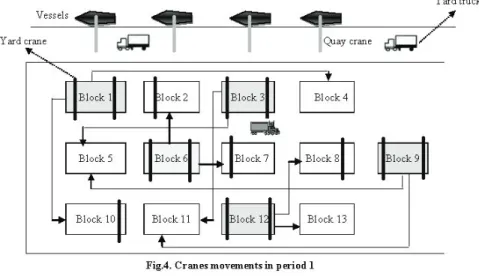
The results show that the best objective function value is equal to 4891, the total travel time of cranes between blocks is 3103 and the total delayed workload in blocks during different planning periods is 1788. The maximum portion of objective function value is associated with the movement time of cranes between blocks. This long transferring time of cranes is due to yard cranes slow motion and large scale. In addition, the results show sequence of yard cranes movement between the blocks to achieve the minimum total cranes travel time and total delayed workload. Fig. 4 depicts a typical layout of container terminal that illustrates movements of the yard cranes among blocks in period 1 (by arrows). In this figure blocks with the additional crane capacity have gray color and the blocks with no crane capacity have white color. Cranes with additional capacity move to blocks with no crane capacity while more than two cranes are not allowed to cooperate in one block, simultaneously. As an example, the additional crane capacity of block 1 moves to blocks 4 and 10, because in this period they do not have crane capacity. Similarly, the other arrows indicate crane capacity movement between the other blocks and this sort of diagram can be drawn for the rest of planning periods.
Table 2 shows delayed workload in blocks during different planning periods. In the other word, proposed model yields the solutions with optimum cranes movements to achieve minimum unfinished workload and to cover the total lack of crane capacity at the end of planning periods.
Table 2
Delayed workload in blocks with crane capacity at different planning period
Blocks with crane capacity
8 7 6 5 4 3 2 1 Planning period 70 81 116 70 44 71 76 61 1 70 60 95 70 37 60 55 35 2 45 40 60 45 16 35 35 35 3 45 30 30 45 11 20 25 30 4 35 5 20 35 5 20 25 25 5 0 0 0 0 0 0 0 0 6
As Table 2 indicates, the delayed workload at initial periods is more than that at ending planning periods. This means that with increase in the planning periods, lack of cranes capacity decreases gradually and finally it tends to zero at period 6. Fig. 5 shows this decreasing trend for different planning periods. In addition, Fig. 6 depicts the decreasing trend of total delayed workload for all
Fig. 4. Cranes movements in period 1
m
4
T p im
manner wher
. Conclusio
This paper fo aper, yard c mplemented
F
Fig.6. To
e the total un
ns and futu
ocused on inv crane sched
for a sampl
Fig. 5. Delay
otal delayed w
nfinished wo
ure study
vestigating a duling proble le problem to
yed workload
workload in
orks for all b
and planning em was form o indicate th
d in blocks wit
n blocks with
blocks tend t
g yard crane mulated as he model eff
th no crane ca
h no crane ca
to zero at per
e operations mixed integ ficiency. Obj
apacity in dif
apacity in di
riod six.
in container ger program jective funct
fferent plannin
fferent plann
r terminals. I mming and i tion was bas
ng periods
ning periods
H. Javanshir et al. / Management Science Letters 2 (2012)
179
the time and the ultimate aim was to minimize the total movement time and delayed workload. In other words, yard cranes move among the blocks in a way to reduce the total delayed workload at per block to zero. In addition, the multiple times were considered in the model. Generally, the following issues could be extracted from the current paper:
Mixed integer programming model is eligible and efficient tool to solve yard crane scheduling
problems at container terminals. In addition, Lingo software and branch and bound method are appropriate tools to solve such a model.
Proposed model determines the block pairs between which yard cranes are transferred during
different periods, in order to satisfy the crane capacity requirements and minimize the total delayed work load and total cranes travel time between blocks.
The developed model calculates the lack of capacity of the blocks with delayed work load. As it is
shown in a numerical experiment, with increase in the planning periods in each block the lack of crane capacity decreases until this value tends to zero at the last period.
The model determines sequences of the cranes movements between blocks in every planning
period.
The model could be developed by studying the efficiency of yard cranes. Investigation in this field is recommended as a topic to marine transportation researchers.
Acknowledgment
The authors would like to thank the anonymous referees for their constructive comments on earlier version of this work.
References
Amin, G.R., & Golchubian, H., (2009). The optimal number of yard cranes in container terminal.
Journal of Industrial Engineering International, 5, 71-76.
Chen, L., Bostel, N., Dejax, P., Cai, J., & Xi, L. (2007). A tabu search algorithm for the integrated
scheduling problem of container handling systems in a maritime terminal. European Journal of
Operational Research, 181, 40–58.
He, J., Chang, D., Mi, W., & Yan, W. (2010). A hybrid parallel genetic algorithm for yard crane
scheduling. Transportation Research Part E, 46, 136–155.
Huang, Y., Liang, C., & Yang, Y. (2009). The optimum route problem by genetic algorithm for
loading/unloading of yard crane. Computers & Industrial Engineering, 56, 993–1001.
Javanshir, H., & SeyedAlizadeh-Ganji, S.R. (2010). Yard crane scheduling in port container terminals
using genetic algorithm. Journal of Industrial Engineering International, 6, 39-50.
Kim, K., Lee, K., & Hwang, H. (2003). Sequencing delivery and receiving operations for yard cranes
in port container terminals. International Journal of Production Economics, 84, 283–292.
Lee, Y., & Lee, Y.J., (2010). A heuristic for retrieving containers from a yard. Computers &
Operations Research, 37, 1139–1147.
Lee, D.H., Cao, Z., & Meng, Q. (2007). Scheduling of two-transtainer systems for loading outbound
containers in port container terminals with simulated annealing algorithm. International Journal of
Production Economics, 107, 115–124.
Lee, B., & Kim, K. (2009). Comparing operation cycle times of container yard cranes under various
sequencing rules. International Journal of Management Science, 15, 23-52.
Legato, P., Canonaco, P., M., & Mazza, R. (2009). Yard crane management by simulation and
optimization. Maritime Economics & Logistics, 11, 36–57.
Linn, R., Liu, J.y., Wan, Y.W., Zhang, C., G., & Murty, K. (2003). Rubber tired gantry crane
deployment for container yard operation. Computers & Industrial Engineering, 45, 429–442.
Ng. W.C., & Mak. K.L. (2005). Yard crane scheduling in port container terminals, Applied
Journal of operational research, 164, 64–78.
Park, T., Choe, R., Ok, M., & Ryu, K. (2010). Real-time scheduling for twin RMGs in an automated
container yard. OR Spectrum, 32, 593–615.
Seyedalizadeh Ganji, S. R., Javanshir, H., & Vaseghi. F. (2009). Nonlinear mathematical
programming for optimal management of container terminals. International Journal of Modern
Physics B, 23, 5333-5342.
Seyedalizadeh Ganji, S. R., Babazadeh, A., & Arabshahi, V. (2010). Analysis of the continuous berth
allocation problem in container ports using genetic algorithm. Journal of Marine Science and
Technology, 15, 408-416.
Zhang, C., Liu, J., Wan Y., Liu, J., & Linn, RJ. (2002). Dynamic crane deployment in container
storage yards. Transportation Research Part B, 36, 537–555.
![Comment on Fun and frustration with quarkonium in a 1+1 dimension, by R. S. Bhalerao and B. Ram [Am. J. Phys. 69(7), 817-818 (2001)]](data:image/gif;base64,R0lGODlhAQABAIAAAP///wAAACH5BAEAAAAALAAAAAABAAEAAAICRAEAOw==)