Palavras chave: Sistema de suporte à decisão Tomada de decisão distribuída
Roteamento Inteligência artificial Pesquisa operacional Historic: Received 21/03/2017
Accept 02/08/2017 Keywords: Decision support systems Distributed decision making Routing Artificial intelligence Operation research
1 Federal University of Minas Gerais - Belo Horizonte, Minas Gerais, Brazil 2 Federal University of Viçosa - Viçosa, Minas Gerais, Brazil
+Correspondence:
DOI: 10.1590/01047760201723032335
Carlos Alberto Araújo Júnior1+, Helio Garcia Leite2, Carlos Pedro Boechat Soares2, Daniel Henrique Breda Binoti2, Amaury Paulo de Souza2, Antônio Ferraz Santana2, Carlos Moreira Miquelino Eleto Torre2
A MULTI-AGENT SYSTEM FOR FOREST TRANSPORT ACTIVITY PLANNING
ABSTRACT: This study aims to propose and implement a conceptual model of an intelligent system in a georeferenced environment to determine the design of forest
transport fleets. For this, we used a multi-agent systems based tool, which is the subject of studies of distributed artificial intelligence. The proposed model considers the use of
plantation mapping (stands) and forest roads, as well as information about the different
vehicle transport capacities. The system was designed to adapt itself to changes that occur during the forest transport operation process, such as the modification of demanded volume or the inclusion of route restrictions used by the vehicles. For its development,
we used the Java programming language associated with the LPSolve library for the optimization calculation, the JADE platform to develop agents, and the ArcGis Runtime
to determine the optimal transport routes. Five agents were modelled: the transporter, controller, router, loader and unloader agents. The model is able to determine the amount
of trucks among the different vehicles available that meet the demand and availability of
routes, with a focus on minimizing the total costs of timber transport. The system can also rearrange itself after the transportation routes change during the process.
SISTEMA MULTI-AGENTE PARA PLANEJAMENTO DE ATIVIDADES DE TRANSPORTE FLORESTAL
RESUMO: O presente estudo objetivou propor e implementar um modelo conceitual de sistema inteligente em um ambiente georreferenciado para dimensionar a frota de
transporte de madeira. Para isso, foi utilizada a teoria dos sistemas multiagentes, a qual é uma sub-área da Inteligência Artificial Distribuída. O modelo proposto considera a utilização do mapeamento de talhões e estradas florestais, bem como de informações sobre as capacidades de carga de diferentes tipos de caminhões. O sistema foi idealizado para se adaptar às mudanças que ocorrem durante a operação de transporte florestal, tal como modificações no volume de madeira demandado ou inclusão de restrições das rotas utilizadas pelos veículos. Para seu desenvolvimento, foi utilizada a linguagem de programação Java considerando-se a biblioteca LPSolve para os cálculos de otimização
do sistema, a plataforma JADE para desenvolvimento dos agentes e a ArcGIS Runtime
para determiner as rotas ótimas de transporte. Cinco agentes foram modelados: transportador, controlador, roteador, carregador e descarregador. O modelo foi capaz de determiner a quantidade ótima de caminhões dentre os diferentes tipos disponíveis de
forma a attender a demanda de madeira e considerando a disponibilidade de rotas, com
INTRODUCTION
Transportation of timber is an activity that constitutes a large proportion of the production costs
in forest enterprises. According to Frisk et al. (2010),
approximately thirty percent of the costs of the total raw material in the forest industry are expenses related to the transportation of logs from stands to the processing
units. The distance from the source of timber to the
destination and the fact that trucks used for transportation often travel loaded in only one direction contribute to
the high costs (MACHADO et al., 2009; RENTIZELAS et al., 2009).
Among the factors that affect the transportation costs, the travel distance is the most important one
(SILVA et al., 2007), making some projects infeasible/ impractical or greatly decreasing their profits. Because of this, some forest managers define a maximum radius
for the crop area around the mills, aiming to avoid the
high costs of wood transportation. However, sometimes
this is not possible because of land availability or increase in wood demand and it will require the coverage large
distances to maintain the mill’s supply.
In situations in which plantations are already stablished and the transportation costs need to be decreased, tools such as optimization, simulation and
GISs can be applied to accomplish such task. Examples
of works addressing this type of situation include the
studies by Lopes et al. (2003) and Rix et al. (2014). The first authors used software called SNAP III to identify
the harvest systems and the best routes to transport the
wood in each period of the planning. The second one
used mixed integer linear programming to solve a forest transportation problem considering two types of trucks,
the schedule of the freight and the route selection. Other works are presented by Berger et al. (2003) and Troncoso and Garrido (2005). However, in most cases,
the studies involved traditional planning with the use of operational research techniques, which aims at creating optimal plans that must be followed by the operational
sectors of the enterprise.
The operationalization of wood transport planning is often hard, mainly because of the presence of aspects
not considered in the mathematical models used. When
the manager tries to considerer these aspects, the model becomes too complex, resulting in a combinatorial
problem in whose resolution is difficult and incurring high computational costs, as suggested by Baskent (2001).
Aiming to avoid these drawbacks of classic operational research, computational tools have been used in forest transportation problems, such as the use
of simulated annealing (HARIDASS et al., 2014), ant colony optimization (LIN et al., 2016) and tabu search (FLISBERG et al., 2009). Simulation techniques also have been adopted, such as Petri Net (MACHADO et al., 2006) and system dynamics (JIFENG et al., 2008).
However, these tools do not make use of the features
provided by georeferenced environments. In addition,
these solution tools are not dynamic, as they do not
consider the possibility of real time monitoring. Indeed, Davidsson and Wernstedt (2002) mentioned that
static approaches are limited when applied to dynamic phenomena, as is the problem of forest transportation
operational planning. This demonstrates the importance
of searching for new tools to apply to forest planning,
especially that from the field of artificial intelligence (AI).
In this context, an area of AI that has been the
subject of many recent works is distributed artificial intelligence (DAI). Using this technique, the problem is
divided into parts (agents) capable of interacting with and searching individual solutions that provide the best
solution to the problem (KONAR, 2000). The philosophic
basis of DAI is social behaviour, meaning that the various agents act in a given environment, following rules to reach individual goals and interacting with each other to
reach the global goal. DAI has been used in various works
involving management and scheduling of production
using the paradigm called multi-agent systems (MAS) (LEITÃO et al., 2012; DOMÍNGUEZ, 2013). The use of MAS has been increasingly common since 1990 because
of the advances in computational systems and because each process in a supply chain can be modelled as an
agent with its own decision rules.
The multi-agent system has also been used
in logistic process management and vehicle routing
problems. Kohout and Erol (1999) worked with an
agent based model to solve the vehicle routing problem
involving the transportation of passengers at an airport. In that work, the multi-agent approach was able to treat the problem in a dynamic way, with real-time
solutions, allowing for parameter variations in the model
to be considered at each moment. This demonstrates that multi-agent systems also offer an answer to the
limitations of traditional approaches in operations research, representing complex and dynamics problems that are hard to express using mathematical formulas
(DONIEC et al., 2008), which, in most cases, use static variables (KOHOUT; EROL, 1999).
Many studies have already been performed using MASs for transportation planning and management
many publications about the use of MASs for modelling,
analysis and solutions of product transportation problems.
This shows that there is an opportunity to build a model
using the multi-agent system paradigm for the wood transportation problem in forest enterprises. However,
no work has been done considering this approach for
the planning and management of wood supply chains. Thus, this work proposes the development of a multi-agent system for the planning of forest transportation.
This model will consider the dimensioning of the truck
fleet and the possibility to treat interruptions during the operation to simulate real-time conditions.
MATERIAL AND METHODS
Conceptual model and correspondent agents
To model a system based on multi-agent theory, there needs to be a real-world abstraction. Therefore,
considering a forest transportation problem, the system was made to represent the elements associated to the environment (stands, roads and yard) and the elements that can be represented by agents (trucks, wood loader and unloader machines, a person or sector responsible by the truck routing and a person or sector responsible
by planning the operations).
A - Stands, roads and yard (environment)
The stands are polygons in any forest area. They
have an available wood volume to be transported and are considered to be the source of the wood to the yard or
mill. The available wood volume in each stand depends upon the characteristics of the stand. They are connected
to each other and to the yard by a road network, where each track of the road could be inactivated by events
that may interrupt the traffic at any period. These
events could cause problems in the execution of the
transportation plan. All these elements were considered
as components of the georeferenced environment in the
multi-agent model, allowing the system to estimate the
distance between the stands and yard and compute the
best route to transport the wood. B- Trucks
The forest transportation activity could be done with different types of vehicles, which vary in their load capacity and other characteristics, such as costs and speed
of traffic (RENTIZELAS et al., 2009). Therefore, each type of truck has its own size, efficiency and operational
costs, which must be analysed before choosing the best
blend of trucks in a fleet for wood transport.
In the multi-agent system, it was necessary
create a truck agent (TA) responsible for the transport
of wood. It was parametrized with information about
load capacity, type of vehicle, costs, speed when empty
and speed when loaded. When initialized, the truck
agent must evaluate the transport plan to know what
stand will be source of wood for transport activity. It
will communicate with the router agent to request the
best route between the yard and stand. When it arrives
at the stand, it needs to communicate with the loading
agent and request a volume of wood to be transported.
After being loaded, the truck agent requests a new route from the router agent and the expected time to move
from the stand to the yard. This is necessary because
problems can occur in a track during the time that the
truck is occupied with the loading operation. When the
truck agent arrives at the yard, it communicates with the unloader agent, informing the agent of the amount of wood available to be stocked, at which point the
unloader agent can start its function. C- Wood loader machine
The load machines are in the stands and have
their own operational capabilities. These machines can
move to other forest compartments when the volume is
null in the current stand.
Agents that represent the wood loaders are responsible for managing the stocks of wood in the forest and can move in the environment from one stand to
another when the first has finished its volume. The initial
behaviour of this agent is to wait for the truck agent to
request the loading operation. The truck loading activity only occurs if there is volume at the current stand. When
this communication happens, the agent reacts according
to a communication protocol. Thereby, the loader agent
(LA) must be parametrized with the time of the load per unit volume (min m-3) to estimate the time it will take to
load each truck. When the load operation finishes, the
loader agent sends a message to the truck agent, allowing
it to transport the wood from the yard. If there is more
than one truck waiting for load, the loader machine
creates a queue of waiting.
D- Wood unloader machine
Similar to the load machines, the wood unloader has its own operational capabilities that must be
considered in multi-agent modelling. In the case of the
unload machines, they must be located at the yard, without permission to move to another site, and their function is only to unload the trucks and put the wood in
an appropriate local yard.
movement from one yard to another. Its function is
only to receive wood from the trucks and store it in an
appropriate location. For this, the unloader agent (UA)
awaits the message from the truck agent requesting
the unload operation. Considering the volume of
wood available in the truck and the parametrized time
to unload per unit volume (min.m-3), the unload agent
estimates the time necessary to fi nish the operation. In
this time interval, it performs this current activity and puts other requests in a list that will be examined after
the operation. After fi nishing the unload operation, the
unloader agent sends a message to the truck, allowing it
to acquire new freight. If there is more than one truck
waiting for unload, the unloader machine creates a queue
of waiting. E- Router
The knowledge about distances and the shortest path between the stands and yard is necessary in forest transportation systems and is used to create a transport schedule that minimizes the total distance travelled
(HARIDASS et al., 2014). Therefore, route optimization
is necessary not only when the manager is planning the operation but also when there is an interruption in any part of
the track and an alternative path is needed. This consideration is especially signifi cant when strong rains occur, bridges crack, and forest fi re occur since they can cause temporary or permanent interruption to the initial route.
Thus, it is important for the model to include an agent that monitors these events and is responsible for
indicating the best route between the stands and yard. This component was called the router agent (RA). It
determines the best track using a traditional algorithm,
Dijkstra’s algorithm. Initially, this agent measures the best
distance between each stand and the yard and sends this
information to the planner agent. Next, the agent waits for messages from the truck agents requesting routes. When these messages arrive, the router agent estimates
the best route and sends a message to the truck agent updating the route, distance and time estimation of the
trip. When any event occurs in the environment, the
router agent recalculates each distance from the stands to the yard and sends this information to the planner agent, allowing it to recalculate the amount of trucks
that should be used in the forest transportation. In this
case, the exceeding trucks are inactivated after deliver
its wood at yard. This will ensure that the system can replan its operations during the processing period.
F- Planner
Every enterprise needs a person or set of persons that creates a plan for the rest of the operation
area. In forest transportation problems, it is necessary to defi ne a plan that considers the amount of wood
to be delivered at yard in a period of time, aiming to
maintain a constant fl ow of wood from the forest.
For that, information is needed about the truck types available, their characteristics and the distance between
stands and the yard. With that, the planner can create a
mathematical model to solve the problem in an optimal
way. Therefore, it is necessary for an agent to execute this process, with focus on minimizing cost. In this
multi-agent system, this multi-agent is called the planner multi-agent (PA) and is responsible for determining the amount of trucks
necessary for the wood transport. To do so, it evaluates
the environmental conditions, the routes calculated by the router agent and the characteristics of the available truck and then estimates the best composition of trucks that can deliver the amount of wood requested by the
yard. For this, the PA solves the integer linear problem
given as, where Cj is the coeffi cient that represents the average cost of transport activity for each j truck (R$ m-3 km-1); V
j is the capacity transported by the truck, j, in an
interval equal to one hour (m³ hour-1); dt is the average
distance of transport considering all of the stands (km); Xj is the decision variable, representing the amount of trucks from type j that will be used during transport
operation; and D is the amount of wood demanded from the mill in one hour (m³ hour-1); V
j is calculated from the equation; Wj is the wood capability for the vehicle type j
(m³); Njis the amount of times that the truck j can carry
timber in an hour; sjis the average speed for the vehicle type j (m³); tljis the time necessary to load truck type j and tuj is the time necessary to unload truck type j.
[1]
[2]
[3]
[4]
Another behaviour of this agent is found when
there is an interruption at any part or the road net. It
calculates the best solution to the interruption problem, evaluating the costs associated with one of two possibilities: (1) transport of the wood from the current
stand but using a sub-optimal route and (2) modifi cation
of the stand that supplies the wood to a stand that maintains the total average distance constant during the
period of interruption.
Cost (C1) in the fi rst alternative is calculated by the evaluation of amount of volume transported, considering
the time of interruption and the distance of the
sub-optimal route, given as, where cjand Vj are as defi ned before; Qj is the quantity of truck type j that there are
in the transportation fl eet; dir is the distance from stand i to the yard; vri is the volume that can be transported from stand I to the yard during the interruption time,
both considering the track restriction; diwr is the distance from stand i to the yard; vwri is the volume that can be transported from stand I to the yard during the interruption time, both considering a route without
restrictions. Lastly, n is the number of truck types and m is the number of stands.
The planner agent knows the stand that can receive the load agent will continue the operations with
the report from the solver. In this case, it is necessary to
estimate the cost involved with the change of the load location, which is composed of the costs of a vehicle to move the load machine from the current stand to the
next stand. This cost is composed of variable and fi xed costs. Thereby, the planner agent estimates the cost C2 using the following formula, where dys is the distance between the yard and the current stand, dss is the distance between the current stand to the next stand, dsy is the distance between the next stand to yard; Cv is a variable cost of operation (R$.km-1) and C
fis the fi xed cost of operation (R$). The value 2 in expression 11 is in
accordance with the fact that there are costs to move the load machine to the next stand and to move it to the
previous stand when the interruption is fi nished.
[7]
For cost (C2) calculated in the second alternative, the planner agent needs to identify the stands that will not supply their wood while the temporary restriction
is active. Thereby, it solves a binary integer linear
problem aiming to maximize the amount of wood transported without drastically changing the total
average distance of transport. The mathematical model is 8,9 and 10, where Vi is the current volume of wood available at stand i; Ti is the binary decision variable that indicates if the stand i will be transported (Ti=1) or not transported (Ti=0) during the interruption time; dir is
as defi ned before; da wr is the total average distance of transport (km) without considering the interruption
and m is the number of stands analysed.
[8]
[9]
[10]
[11]
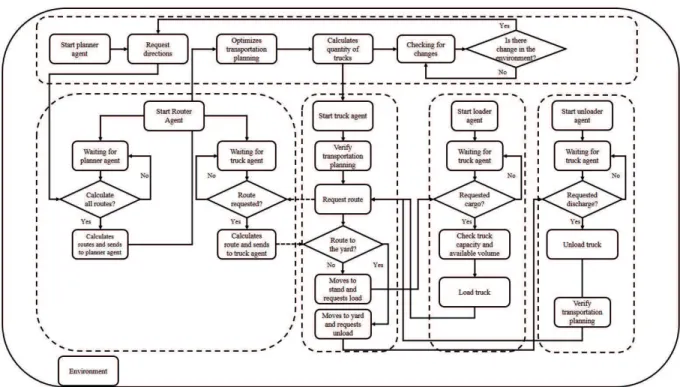
Figure 1 shows the multi-agent system
environment and how the agents interact with t with
other agents to plan and replan the wood transport.
System development
The Java programming language was chosen to
implement the proposed multi-agent system based on the conceptual model. The software was built with the Netbeans IDE (Integrated Development Environment) version 8.0.2 in Windows 10. A computer with an Intel Core i7 with 2.0 GHz and RAM memory of 8 GB was used for programming and to testing.
JADE (Java Agent Development framework)
was used for agent development and management.
It is an “open source” platform for development of
agent-based systems, and it was idealized in the 1990s (BELLIFEMINE, 2007) to consider the FIPA (Foundation
for Intelligent Physical Agents) agent communication
patterns (WOOLDRIDGE, 2002). The version used was the JADE v4.3.3 API (http://jade.tilab.com).
The LPSolve Java library was used to solve the
optimization problems. It is a mixed linear programming solver that uses the Simplex and branch-and-bound algorithms. The library’s version used was version 5.5 (http://lpsolve.sourceforge.net). We used the ArcGis
Runtime SDK (Software Development Kit) for Java to embed the forest area mapping and the spatial analysis functions into the system, such as the geographic locations
of the stands and yard, the defi nition of the best route from
the stand to the yard, the presence of barriers in part of the
For the multi-agent system to import the map of stands and roads, it was necessary to create a file with
the tpk (map tile package) extension and a geodatabase
containing a network dataset. These files were built using the ArcGis Software version 10.2.2. The map tile package is used to compress the different layers into a unique file, which is imported by the multi-agent system as the first step in the processing. The network dataset is composed of a
set of connected arc, representing the forest roads, with rules of connections and associated attributes as length,
cost, time, direction and hierarchies (NICOARA; HAIDU, 2011). It is necessary for the functions of route optimization to allow for the identification of the best alternative of wood flux during the forest transportation period.
Aiming for the data used during the processing of
the multi-agent system to be all available momentarily, we developed a database management system. For that,
we used the Java DB library, which uses the Apache Derby open code database and supports queries in
SQL (Structured Query Language) language. It is also
important because it allows the data to be recorded in
a unique address. The results of the processing of other information from the multi-agent system were inserted
in the same database, allowing the use of queries to
create graphs and analysis after the processing.
Simulations
To evaluate the behaviour of the multi-agent system, we performed three simulations. For this, we
considered the existence of 32.768 m³, distributed in
ten stands, of available wood to be transported, and the system was initiated with the aim of meeting a mill
demand, of 40 m³ per hour. The loading rate was 1.4
minutes per cubic metre, and the unloading rate was
equal to 1.2 minutes per cubic metre of wood volume.
The speed, loading rate, unloading rate and vehicle
capability were obtained from Machado et al. (2009), and
the considered cost was calculated from a mix of data
from Alves et al. (2013) and Machado et al. (2009) (Table 1). It was considered only one wood load machine and one wood unload machine.
FIGURE 1 The multi-agent system and the relationship between the agents.
TABLE 1 Parameters of the available types of vehicles.
Truck Type
Load capacity (m³)
Speed (loaded) (km.h-1)
Speed (empty) (km.h-1)
Cost (R$.m-3.km-1)
A 16 53 64 0.36
B 28 46 77 0.34
C 90 39 43 0.27
D 54 45 53 0.29
Optimization of the vehicle fleet
The system could choose different types of
vehicles from Table 1 in an optimal quantity. After
this, we considered that only trucks A, B and C were
available to execute the transport operation. The goal
was to evaluate if the system was capable of determining the optimal solution to the problem, under different
Re-planning of forest transportation considering permanent interruption of routes
Considering the same data used in Simulations section and assuming that the system works only with truck type A, a random permanent interruption was simulated in two parts of the road that are used by
the truck fleet for the wood transport. In this case, the goal was to evaluate the multi-agent system capability
in rearranging the system structure when an event
occurred in the environment.
Re-planning of forest transportation considering temporary interruption of routes
Considering the same data used in Simulations section, we simulated a random temporary interruption in two parts of the road that are used by the truck
fleet for wood transport. The first one had 20 hours of interruption, and the second one had 50 hours. In this case, the objective was to evaluate the multi-agent system
capability and rearrange the system structure considering two possibilities: (a) transport from the current stand using a more distant route or (b) changing the location of
the source of wood during the period of interruption.
RESULTS
Optimization of the vehicle fleet
The optimization of the vehicle fleet indicated the
necessity of one truck of type A and two trucks of type
D to meet the wood demand from the mill. At end of the multi-agent process, all the wood volume from the stands was transported. It was necessary to take 941
trips to distribute the work among the different trucks,
totalling 45,968 km and a total cost equal to R$ 244,984. When the system avoids choosing any quantity of truck type D, the fleet was optimized to use one truck of
type A, one truck of type B and one truck of type C. Wood
transport took 1,022 trips, covered 49,924 km and had a total cost equal to R$ 250,276. The average cost of wood transport was equal to R$7.55 per cubic metre, while the value obtained with the first evaluation was equal to R$7.35 per cubic metre. Thereby, the use of type D trucks gave transport costs that were 2.8% more expensive.
Re-planning of forest transportation considering permanent interruption of routes
At end of the planning process, it was necessary to initially use the four type A trucks to transport the
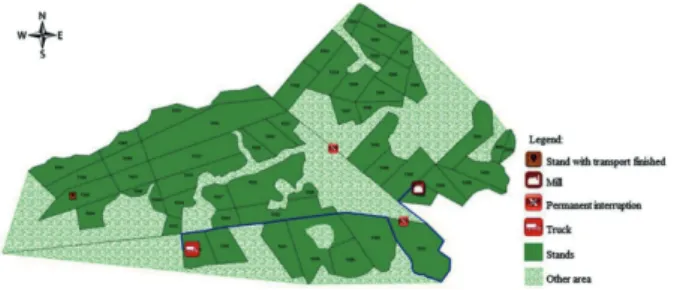
wood from stands to the yard. When the restrictions
were inserted at different points in the road network
used by the trucks (Figure 2), the multi-agent system
automatically recalculated the number of trucks it
needed, defining the necessity of one more vehicle.
FIGURE 2 Map with indications of permanent interruption of the road, the current stand that has been transported, the location of the yard (mill) and the route that has been used for the transportation (blue line).
Considering the initial condition of the routes (without interruption on track), the average distance was
equal to 24.5 km. After insertion of the route restrictions, the average distance was 27.8 km. Because of this, the average cost of transport was changed from R$8.57 per cubic metre to R$9.65 per cubic metre. The total volume of wood that was transported after 2,053 trips was distributed between the different trucks of the fleet.
The last truck inserted into the multi-agent system
transported a smaller volume of wood than others, and this observation indicates that the system was capable of correctly identifying the behaviour of each agent during
the process.
Re-planning of forest transportation considering temporary interruption of routes
The initial optimization of the fleet determined the utilization of 1 type A truck and 2 type D trucks. When the first interruption was added to the environment, the
system determined that the best decision was to change the route without changing the stand where the loading
was happening. In this case, the cost of changing the loading location was equal to R$744.00, while the cost of using a sub-optimal route was equal to R$250.00.
After the insertion of the second interruption, the most economical alternative was to change the load
machine to another stand. For this decision, the planner agent compared the moving costs (equals to R$792.00) with the cost of transporting the wood using a sub-optimal route for 50 hours (R$1,893.00). In this case,
three stands were blocked to the transport operation according to the result of the binary linear problem
For that, it was necessary to distribute 821 trips among the different trucks. This value was inferior to
the previous simulation, which can be explained by the quantity of trips taken by the trucks with the higher load
capacity that occur due to the route interruption.
The average transport distance was changed
during the interruption period that was active from 24.5 km to 25.9 km.
DISCUSSION
For the first simulation, there was a difference
between the quantity of wood transported by the last
vehicle in this simulation. This agent had a low acting time in the environment compared to others. It was
included only after the road interruption occurred, since
its first transport operation corresponded to the 108ª step registered in the system.
The planning of forest transport that considers the possibility of the inclusion a permanent restriction in the road network is important for the evaluation of different alternatives that can be adopted by the manager
when a problem occurs. One advantage of the
multi-agent system proposed is the fact that the adoption of these alternatives is supported by the early assessment of the problems, simulating different situations and their
impacts on the transport operation.
For instance, if the transport activity is performed by outsourced operations, it is desirable for the service contract to have the possibility of including new trucks without necessarily entering into a new agreement, which would make the process of operation and
planning simpler. Another example is the evaluation of
the viability in executing the maintenance of forest roads with a higher probability of deterioration and occurrence of interruptions, as well as comparing its value with
the possibility of changing the transportation route.
These considerations become more important with the increase in pressure by the reduction of costs in a period
with economic crises.
For the third case, it is possible to consider that the agents were able to transport all of the wood available at the stands to the yard, since there were two temporary
interruptions of the road. An advantage of the use of the
computational system as an auxiliary tool for decision
support is related to the reduction of the empirical factor.
In this case, the manager begins to analyse the problem with a larger quantity of technical and numerical aspects instead of considering only their experience and personal
convictions. In fact, Machado et al. (2009) highlight that
these technical and quantitative aspects are the most
important features against the decision-making and the planning of forest transportation.
Because the multi-agent system was built with
detailed considerations about the transport process, it is
possible that the manager simulates different configurations
and takes practical action in order to improve the logistical
system. An example is the evaluation of the load and unload
times of the trucks, where the time that the trucks spend waiting for loading or unloading improves the process costs
(HARIDASS et al., 2014).
With a flexible multi-agent system, these analyses are important to support strategies that increase the efficiency of the process and reduce the costs of forest transportation. In agreement with Norstebo et al. (2013), the use of
optimization models possibly provides small improvements
in efficiency that can reduce costs significantly.
Although recently developed, multi-agent system
theory has been used to solve problems in different areas,
including in the passenger and goods sector. However, MASs have not been used extensively in forest sector.
This work is, therefore, a contribution to help other
authors who want to explore this area.
CONCLUSIONS
The paradigms of multi-agent systems can be applied efficiently to the forest transportation problem, and the developed multi-agent system is flexible enough
to maintain the forest transport operation in an optimized
way over the working cycle. Thus, the use of dynamic
tools allows the forest manager to obtain a set of good conditions to evaluate different possibilities for wood
transport planning.
ACKNOWLEDGMENTS
The authors are grateful to Capes and Pró-Reitoria de Pesquisa da Universidade Federal de Minas Gerais for the financial support.
REFERENCES
ALVES, R. T.; FIEDLER, N. C.; SILVA, E. N.; LOPES, E. S.; CARMO, F. C. A. Technical analysis and transportation costs of wood with different type of vehicles. Revista Árvore, v. 37, n. 5, p. 897-904, 2013.
BASKENT, E. Z. Combinatorial optimization in forest ecosystem management modelling. Turkish Journal of Agriculture and Forestry, v. 25, n. 3, p. 187-194, 2001.
BERGER, R.; TIMOFEICZYK, J. R. R.; CARNIERI, C.; LACOWICZ, P. G.; JUNIOR J. S.; BRASIL, A. A. Forestry transportation costs minimization using linear programming. Revista Floresta, v. 33, n. 1, p. 53-62, 2003.
CHEN, B.; CHENG, H. H. A review of the applications of agent technology in traffic and transportation systems. IEEE Transactions on Intelligent Transportation Systems, v. 11, n. 2, p. 485-497, 2002.
DAVIDSSON, P.; WERNSTEDT, F. A multi-agent system architecture for coordination of just-in-time production and distribution. The Knowledge Engineering Review, v. 17, n. 4, p. 317-329, 2002.
DOMÍNGUEZ, R.; FRAMINAN, J. M. A decision management tool: modelling the order fulfilment process by multi-agent systems. International Journal of Management and Decision Making, v. 12, n. 3, p. 240-258, 2013.
DONIEC, A.; MANDIAU, R.; PIECHOWIAK, S.; ESPIE, S. A behavioral multi-agent model for road traffic simulation.
Engineering Applications of Artificial Intelligence, v. 21, n. 8, p. 1443-1454, 2008.
FLISBERG, P.; LIDEN, B.; RONNQVIST, M. A hybrid method based on linear programming and tabu search for routing of logging trucks. Computers & Operations Research, v. 36, n. 4, p. 1122-1144, 2009.
FRISK, M.; GOTHE-LUNDGREN, M.; JORNSTEN, K.; RONNQVIST, M. Cost allocation in collaborative forest transportation. European Journal of Operational Research, v. 205, n. 2, p. 448-452, 2010.
HARIDASS, K.; VALENZUELA, J.; YUCEKAYA, A. D.; MCDONALD, T. Scheduling a log transport system using simulated annealing. Information Sciences, v. 264, n. 1, p. 302-316, 2014.
JIFENG, W.; HUAPU, L.; HU, P. System Dynamics Model of Urban Transportation System and Its Application. Journal of Transportation Systems Engineering and Information Technology, v. 8, n. 3, p. 83-89, 2008.
KOHOUT, R.; EROL, K. (1999). In-time agent-based vehicle routing with a stochastic improvement heuristic. In: Eleventh Conference on Innovative Applications of Artificial Intelligence, Orlando, FL, p.1-6.
KONAR, A. Artificial intelligence and soft computing:
behavioral and cognitive modeling of the human brain. CRC Press, Boca Raton, 2000, 788p.
LEITÃO, P.; BARBOSA, J.; TRENTESAUX, D. Bio-inspired multi-agent systems for reconfigurable manufacturing systems. Engineering Applications of Artificial
Intelligence, v. 25, n. 5, p. 934-944, 2012.
LIN, P.; CONTRERAS, M. A.; DAI, R.; ZHANG, J. A multilevel ACO approach for solving forest transportation planning problems with environmental constraints. Swarm and Evolutionary Computation, v. 28, n. 1, p. 78-87, 2016.
LOPES, E. S.; MACHADO, C. C.; SOUZA, A. P.; RIBEIRO, C. A. A. S. Harvesting and wood transport planning with SNAP III program (Scheduling and Network Analysis Program) in a Pine plantation in southeast Brazil. Revista Árvore, v. 27, n. 6, p. 831-836, 2003.
MACHADO, C. C.; MACHADO, R. R.; SILVA, E. A.; & SOUZA, M. F. G. Evaluation of the wood hauling logistic performance in farm forest areas using Petri net. Revista Árvore, v. 33, n. 6, p. 1159-1167, 2009.
MACHADO, R. R.; SILVA, M. L.; MACHADO, C. C.; LEITE, H. G. Evaluation of logistic performance of wood hauling using Petri net in a forest industry of Minas Gerais. Revista Árvore, v. 30, n. 6, p. 999-1008, 2006.
NICOARA, M. E.; HAIDU, I. Creation of the roads network as a network dataset within a geodatabase. Geographia Technica, v. 6, n. 2, p. 81-86, 2011.
NORSTEBO, V. S.; JOHANSE, U. Optimal transportation of logs and location of quay facilities in coastal regions of Norway. Forest Police and Economics, v. 26, n. 1, p. 71-81, 2013.
RENTIZELAS, A. A.; TOLIS, A. J.; TATSIOPOULOS, I. P. Logistics issues of biomass: The storage problem and the multi-biomass supply chain. Renewable and Sustainable Energy Reviews, v. 13, n. 4, p. 887-894, 2009.
RIX, G.; ROUSSEAU, L. M.; PESANT, G. A column generation algorithm for tactical timber transportation planning. Journal of the Operational Research Society, v. 66, n. 2, p. 278-287, 2014.
SILVA, M. L.; OLIVEIRA, R. J.; VALVERDE, S. R.; MACHADO, C. C.; PIRES, V. A. V. Cost and distance of reforestation wood transport for different types of trucks. Revista Árvore, v. 31, n. 6, p. 1073-1079, 2007.
TRONCOSO, J. J.; GARRIDO, R. A. Forestry production and logistics planning: an analysis using mixed-integer programming. Forest Policy and Economics, v. 7, n. 4, p. 605-633, 2005.